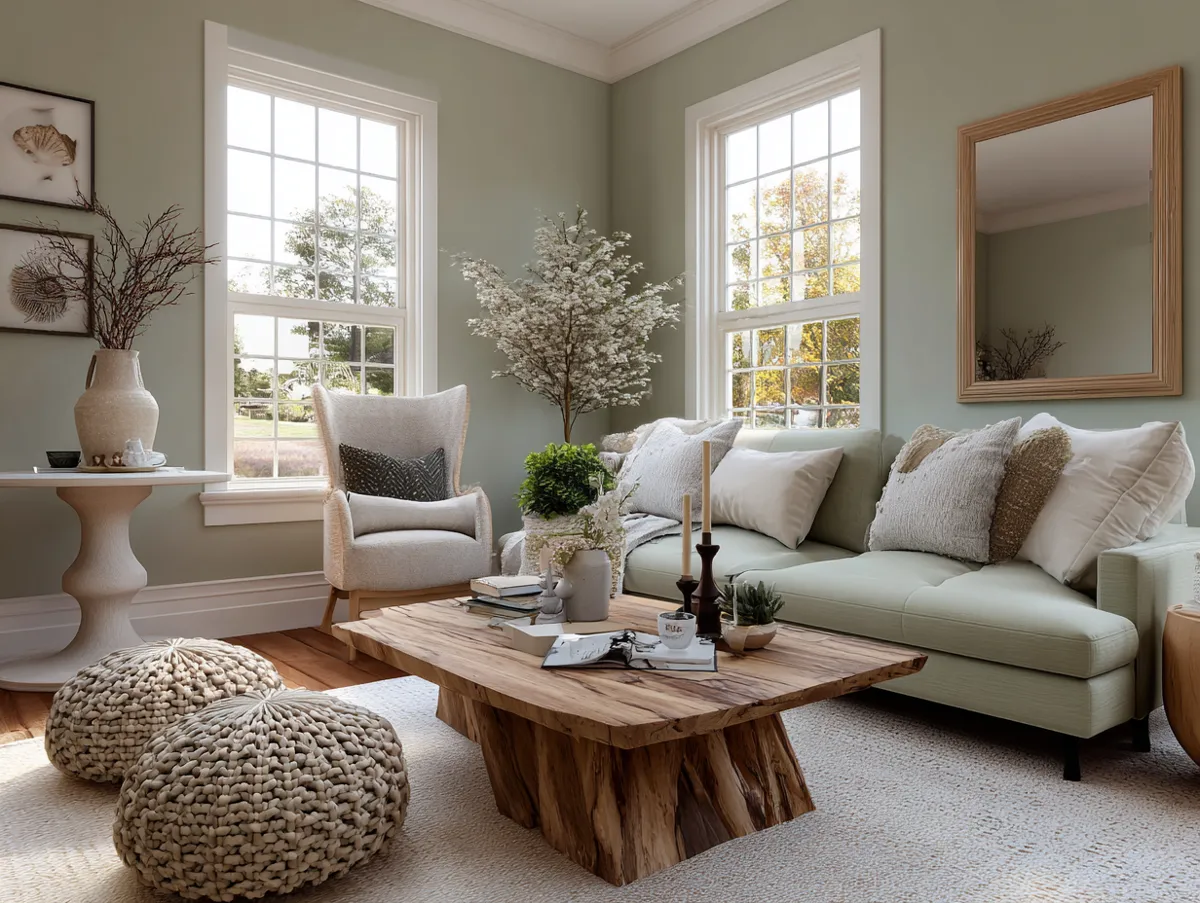
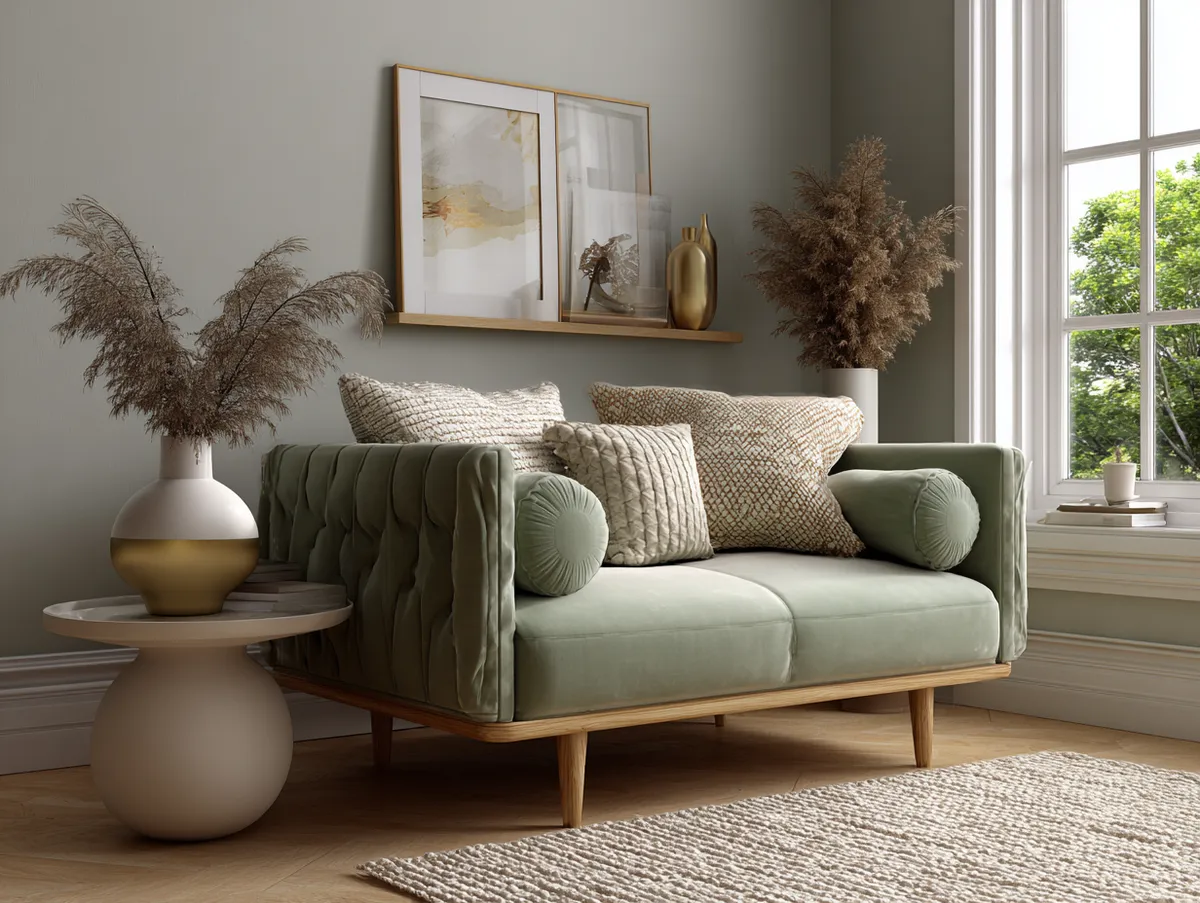
A modern dark green living room does something most color schemes refuse to do: it holds. The walls don’t just set a background — they become part of the furniture, part of the mood, part of why guests slow down instead of passing through. Deep forest tones like Sherwin-Williams Hunt Club (SW 6468) or Benjamin Moore Hunter Green (2041-10) pull a room into focus without shouting.
The trick is knowing which version of dark green you’re actually working with. Hunt Club reads blue-cool in low light and true forest in daylight — two different rooms, one paint chip. Regent Green 2136-20, named Benjamin Moore’s 2024 Color of the Year, leans warmer and works with brass without feeling overdone. Get the undertone wrong and the whole scheme fights itself.
These three design directions — modern, eclectic, and classic — show how the same color family behaves under completely different rules. Each palette works. None of them requires a decorator budget. What they require is a clear decision before the first roller hits the wall.
– Benjamin Moore Hunter Green (2041-10) and Sherwin-Williams Hunt Club (SW 6468) are the two most decorator-recommended dark greens for living rooms — cool undertones, LRV under 10.
– Dark green and gold is one of the most reliable two-color palettes in interior design; the contrast works because gold reflects what green absorbs.
– A velvet dark green sofa ranges from around $834 for a 3-seater Chesterfield to well over $3,000 for designer options — the fabric choice matters as much as the frame.
– Sherwin-Williams Emerald Interior runs about $95 per gallon at full retail (often 40% off in-store), covering roughly 350–400 sq ft per coat.
– The biggest dark green mistake: painting all four walls the same shade without first testing how the LRV reads under your specific artificial lighting at night.
What a Modern Dark Green Living Room Actually Demands
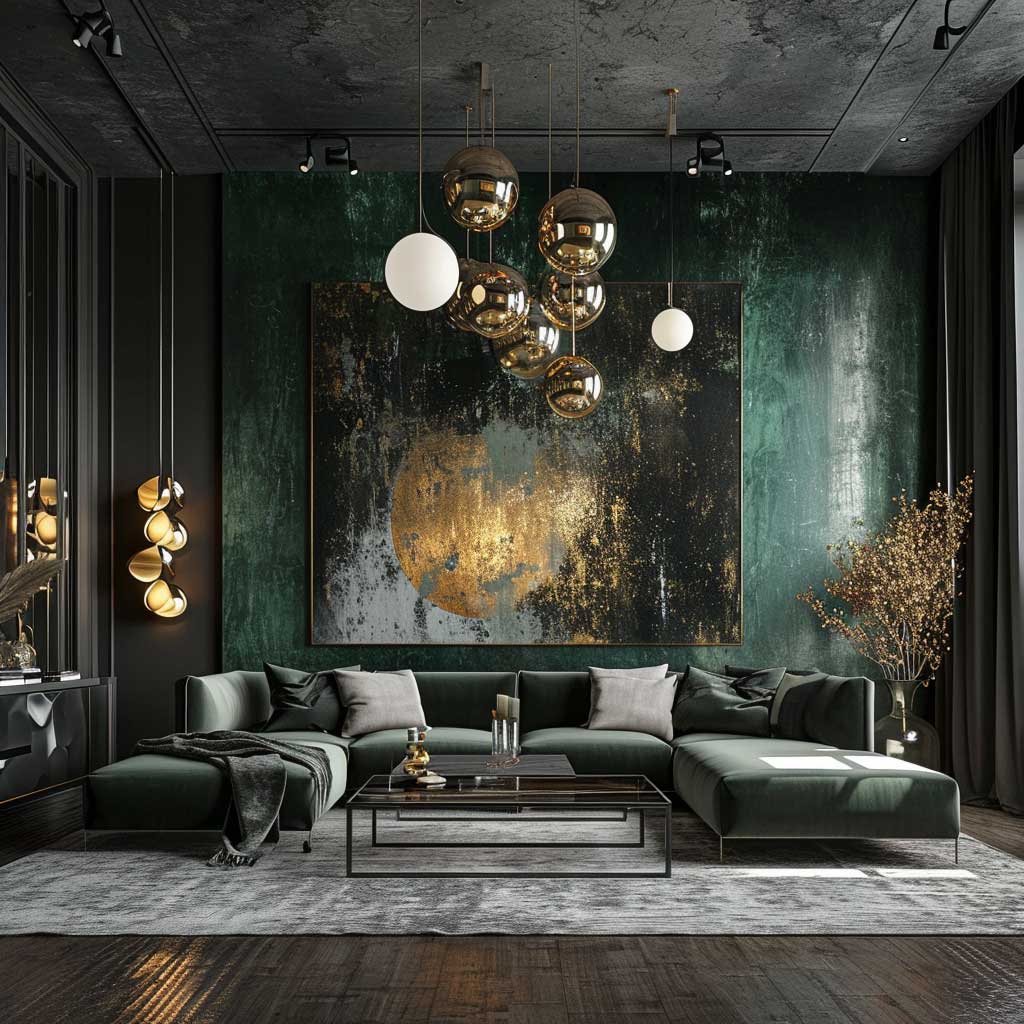


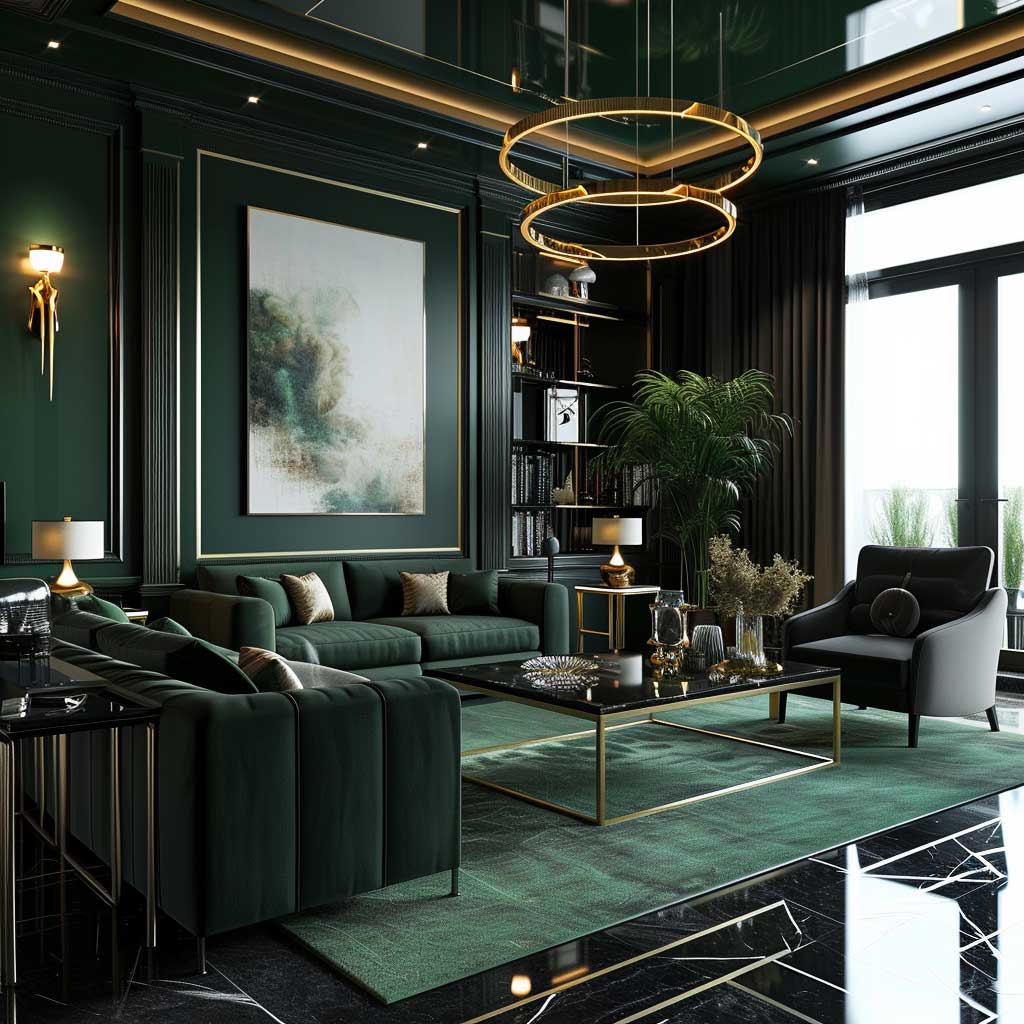
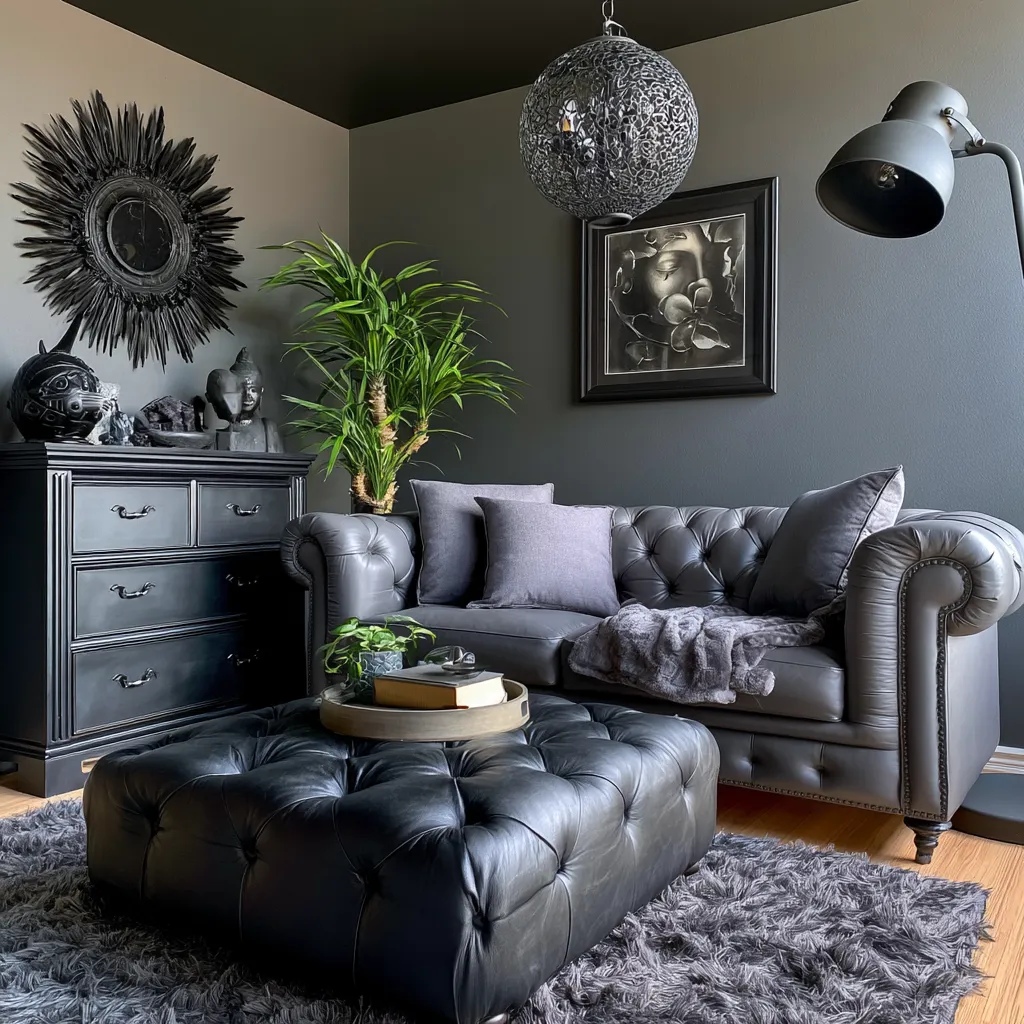
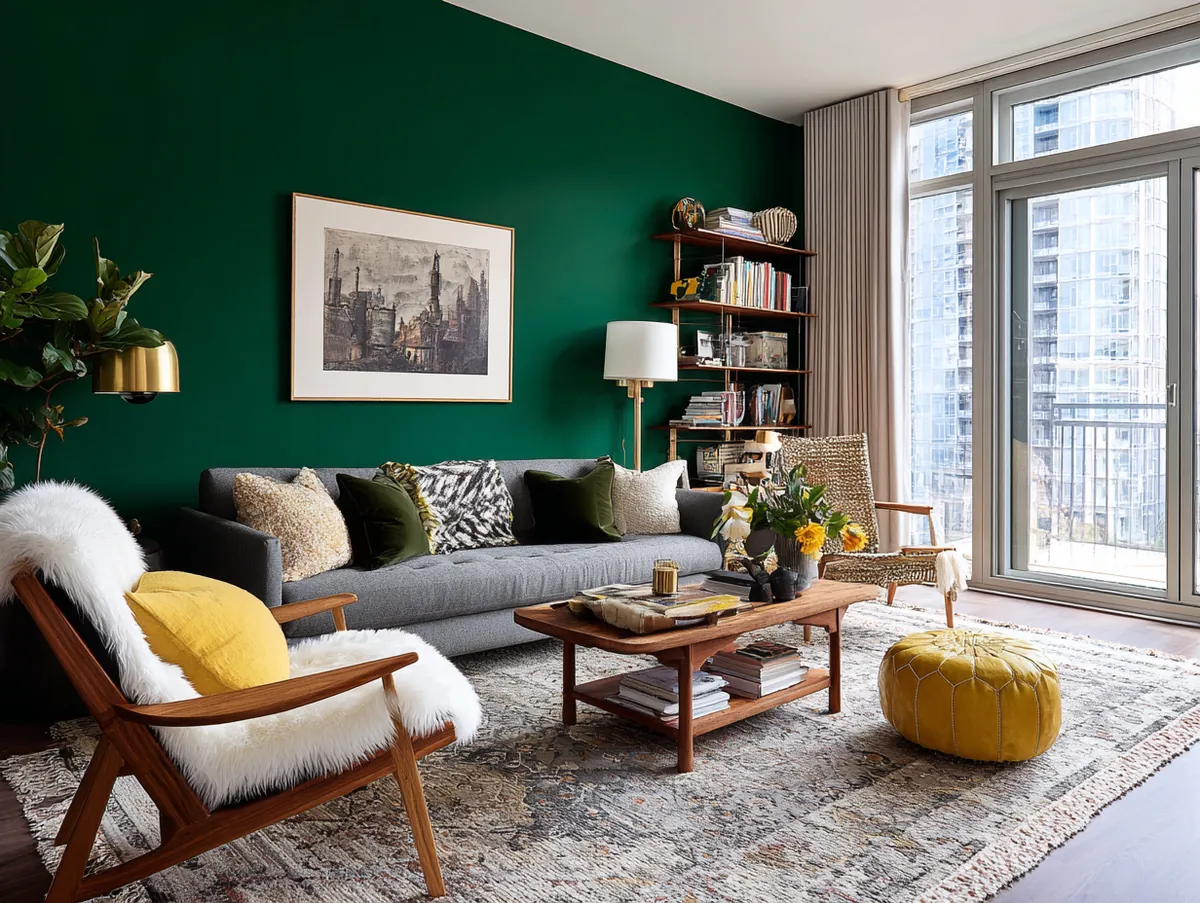
Modern dark green living room design works when the color is treated as structure, not decoration. Paint one wall in Hunt Club SW 6468 — an LRV of just 6, which means it reads genuinely dark, not muted — and let every other surface breathe: off-white plaster, light oak, concrete. The wall becomes the anchor the way a column holds a building. Everything else is just furniture.
What does a modern green room actually need in terms of light? More than you think. Stylists recommend at least two task sources in addition to ambient overhead, because dark surfaces absorb rather than scatter. A single ceiling fixture leaves the room looking flat and slightly oppressive. Place a brushed-nickel floor lamp near the sofa and a slim table lamp at the opposite end — the green starts to glow rather than loom.
Metallic accents are where the palette earns its money. Brushed gold on drawer pulls, a raw-edge copper mirror, a single brass vase: each introduces a frequency of light the green doesn’t have on its own. The combination of dark green and gold works visually because gold reflects what green absorbs — it’s not a stylistic preference, it’s basic color physics. Avoid chrome and polished nickel; they push the palette cold and lose the luxury register entirely.
Texture is the anti-mistake here. Velvet upholstery against a matte painted wall adds dimensional contrast that stops the room from reading flat in photos and in person. A 3-seater dark green channel-velvet sofa runs around $834 at Walmart — a realistic entry point for the look without committing to a five-figure piece. Pair it with a natural fiber rug and the tactile range is complete without any single item feeling overdone.

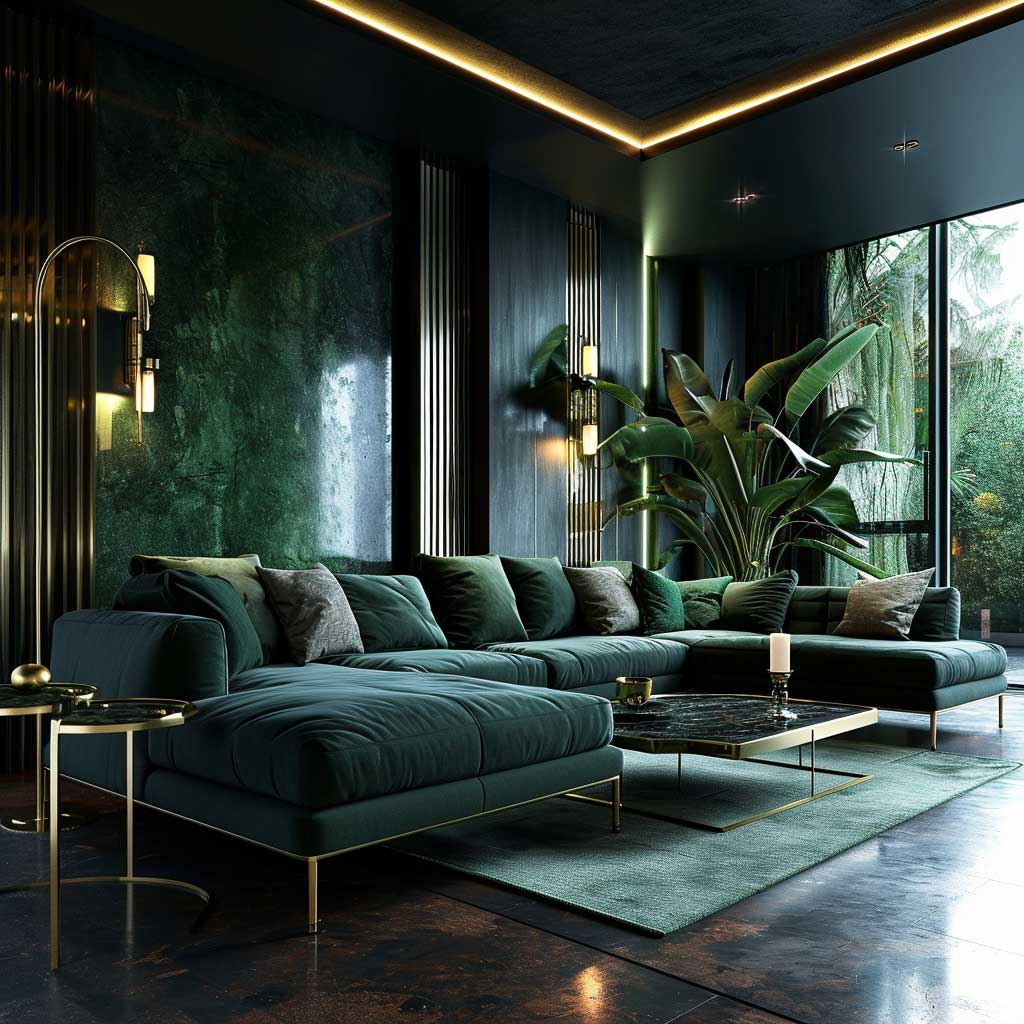
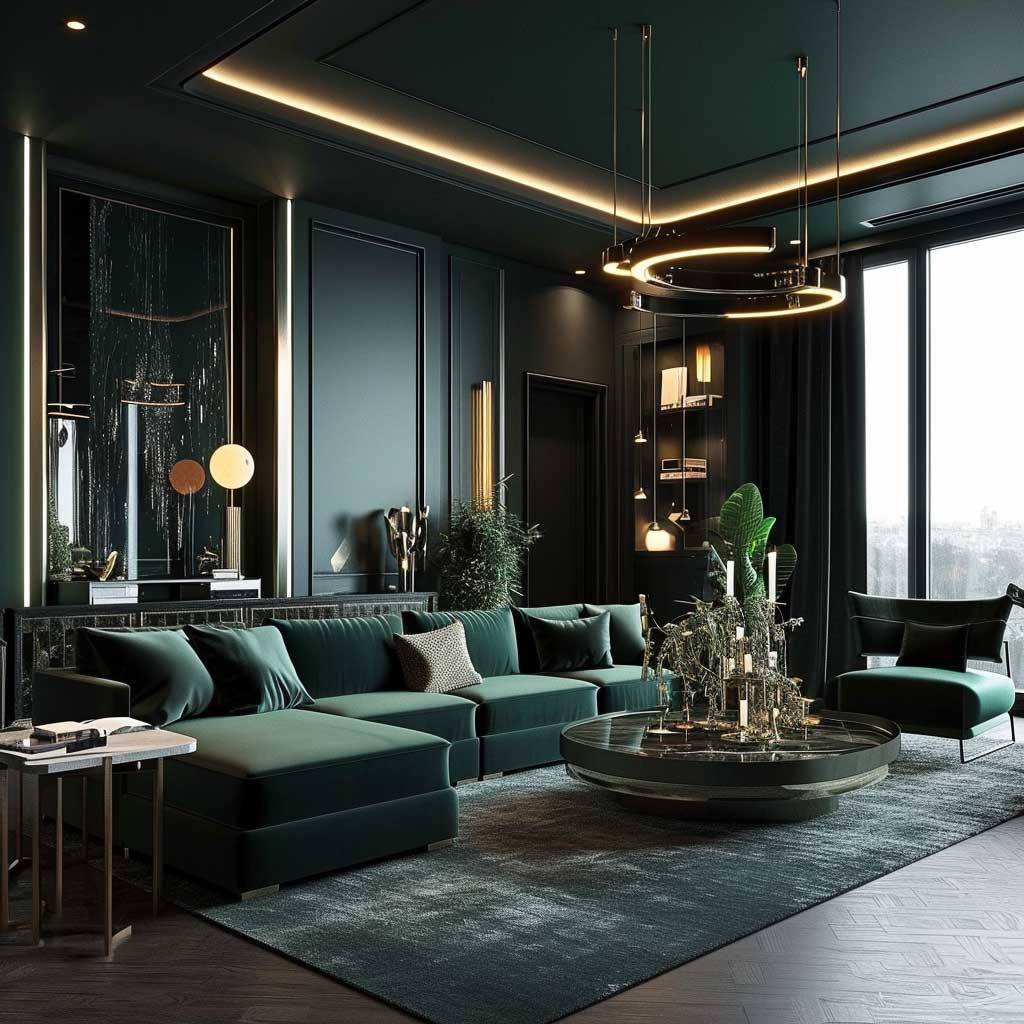

Plants deserve more credit than “decor.” A fiddle-leaf fig placed in a corner with dark green walls does something specific: it breaks the visual plane of the wall so the eye reads depth instead of flatness. The foliage color against the painted green produces a layered effect — like looking into rather than at a surface. Skip the fake stems. The difference shows immediately in natural light.
Painting all four walls in a deep green like Hunt Club (LRV 6) without a light-bounce surface somewhere in the room. Dark walls absorb up to 94% of incoming light. Without white trim, pale ceilings, or a large mirror, the room won’t feel cocooned — it’ll feel underlit and slightly suffocating. Test the color on a 12×12 board, move it around the room at noon and at 9 p.m., and make the decision at night, not in daylight.
Eclectic Rooms Where Dark Green Color Shades Do the Heavy Lifting
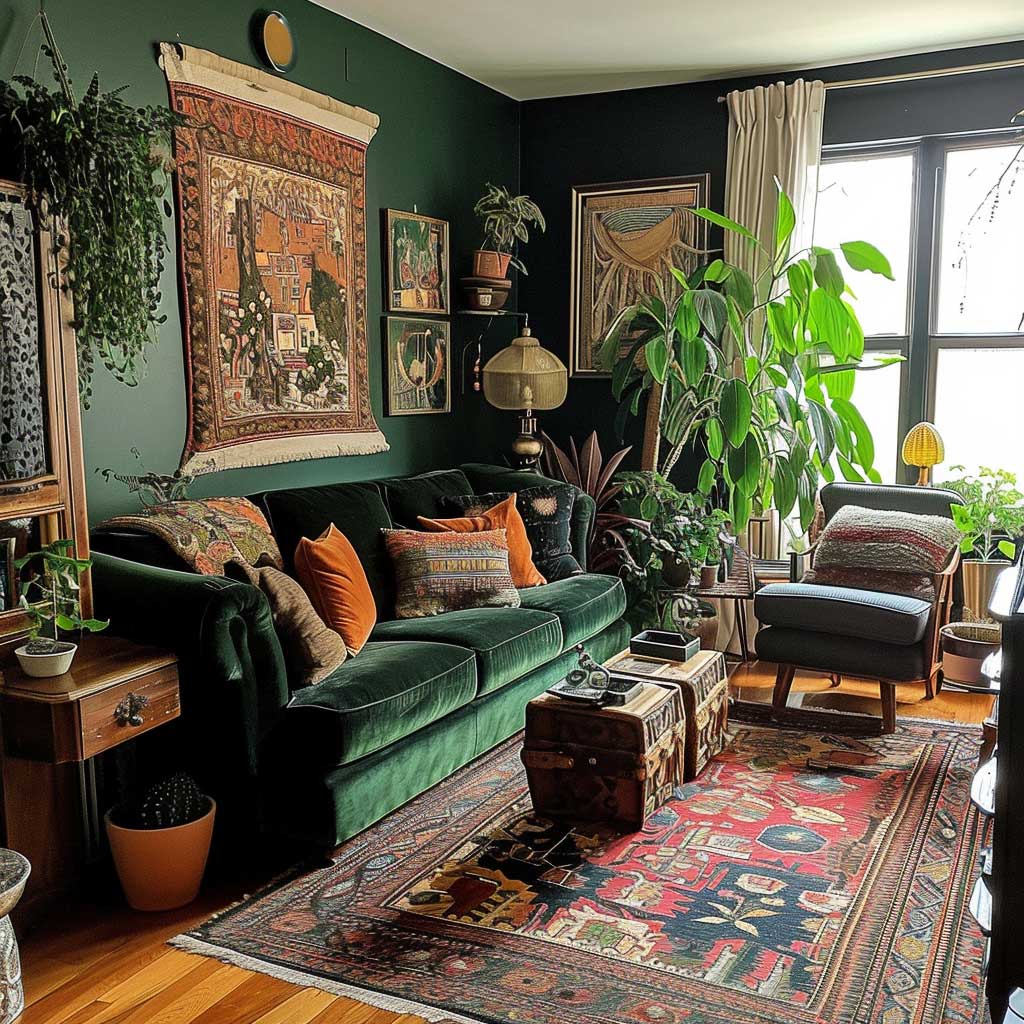
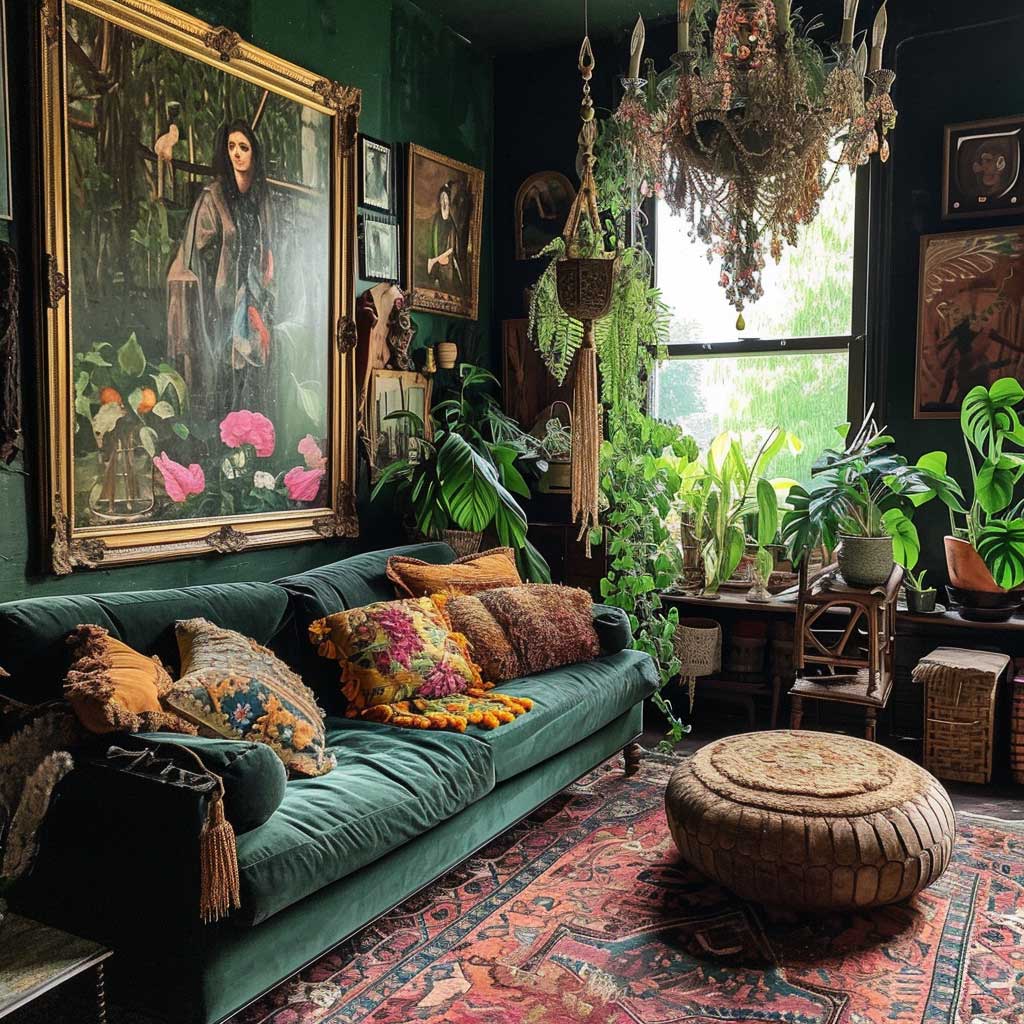

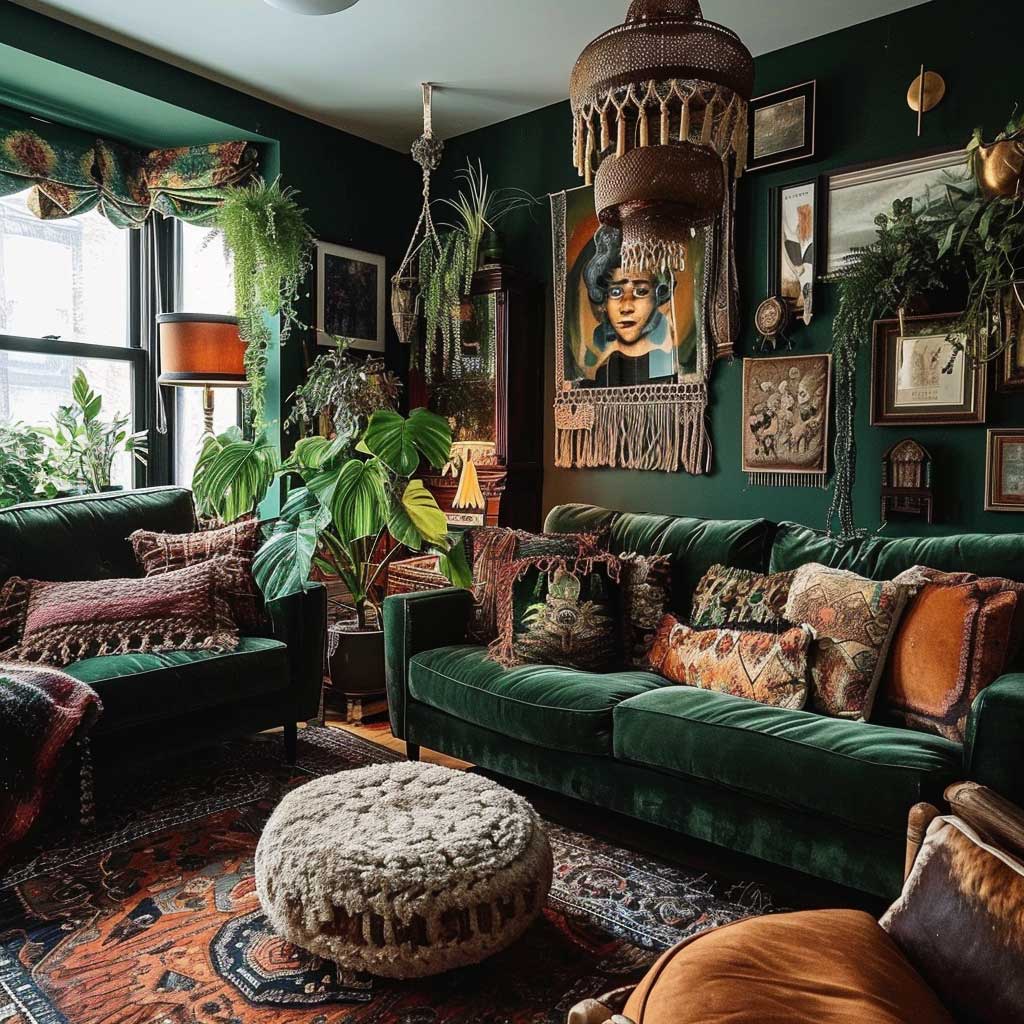

Dark green color shades give an eclectic living room something most bold colors can’t: a grounding note that keeps the mix from collapsing into visual noise. Think of it as the bass line in a track that’s otherwise all rhythm. Kilim rugs, embroidered cushions, mismatched art — none of it reads as chaotic when the walls or the main sofa sit in a consistent deep green. The color does the organizing without imposing any particular style.
How much green is too much green in an eclectic room? Designers recommend the 60-30-10 rule as a starting frame: 60% dominant neutral or green, 30% secondary texture or pattern, 10% accent color. In practice, that means a dark green feature wall behind the sofa reads as the 60%, a layered kilim rug at 30%, and a single terracotta or mustard throw at 10%. Introduce more green than the 60% share and the room stops feeling collected — it starts feeling themed.
Lighting in an eclectic green room should feel collected rather than designed. Rattan pendants, a floor lamp with a weathered bronze base, table lamps with different silhouettes — the variety reads as personality rather than indecision. Keep the bulb temperature consistent at around 2700K (warm white) across all sources, so the green reads warm-earthy rather than cool-clinical at night. Warm light deepens forest greens; cool light flattens them toward teal.
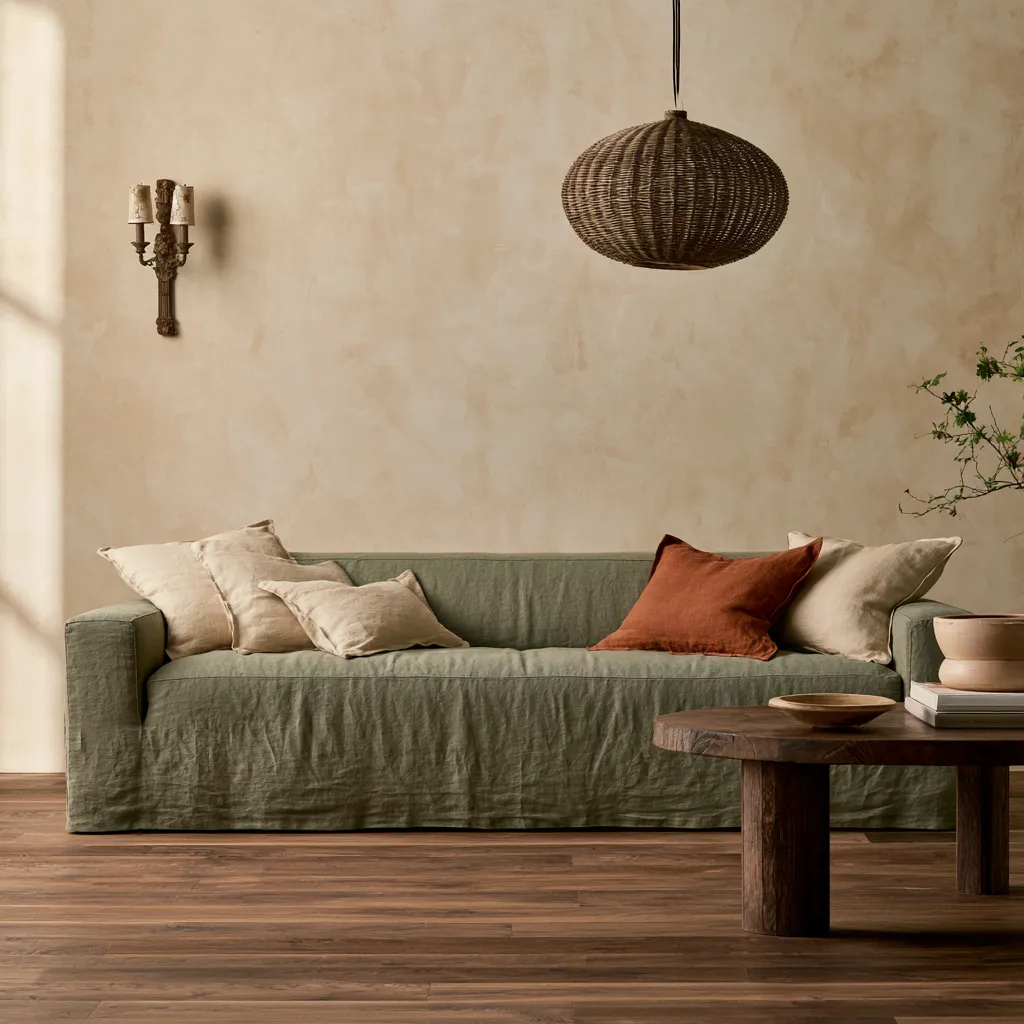
Vintage and new furniture can share the same room when dark green mediates. A worn walnut coffee table next to a clean-lined modern sofa in deep green reads as curated rather than unfinished — the color bridges the eras by having its own strong presence. The mistake is choosing furniture in green’s complement (red or terracotta) as the primary pieces. Use those colors as accents only; as dominant furniture, they compete rather than cooperate.

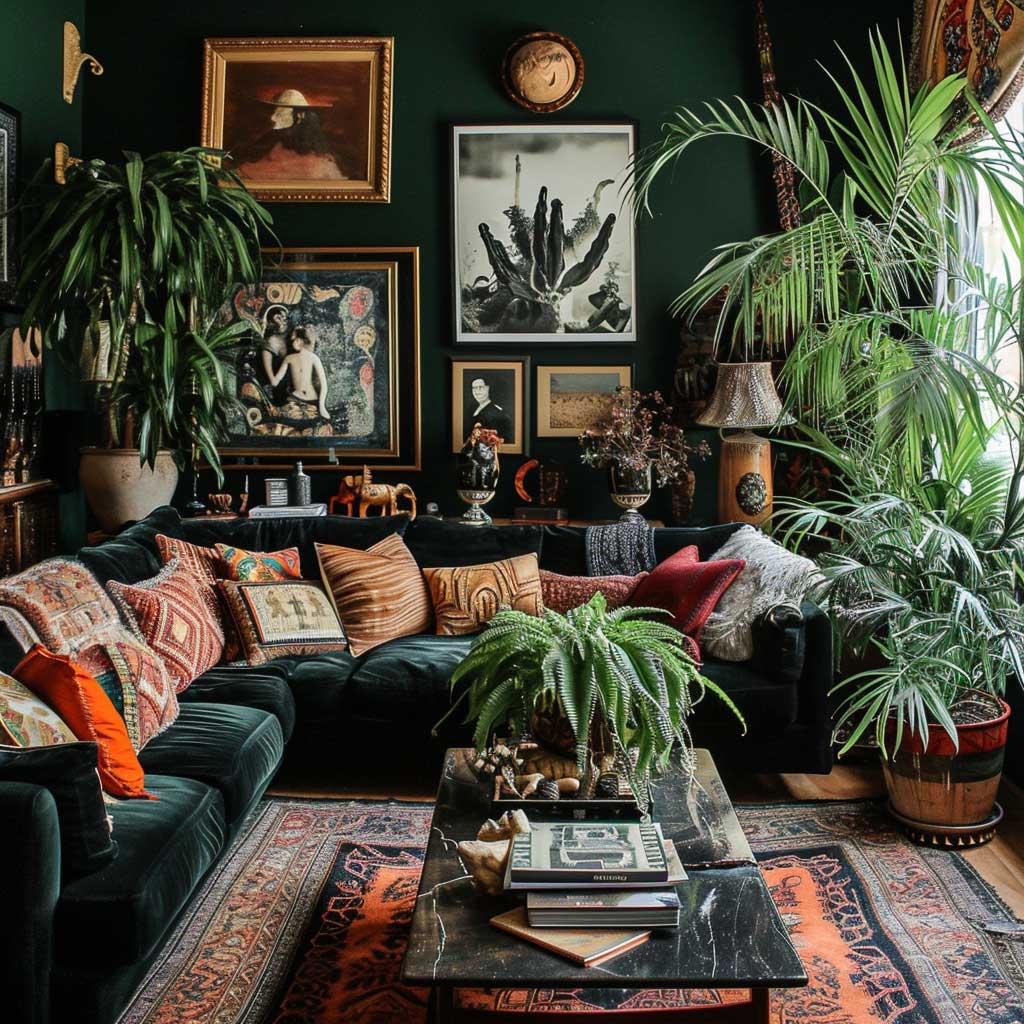
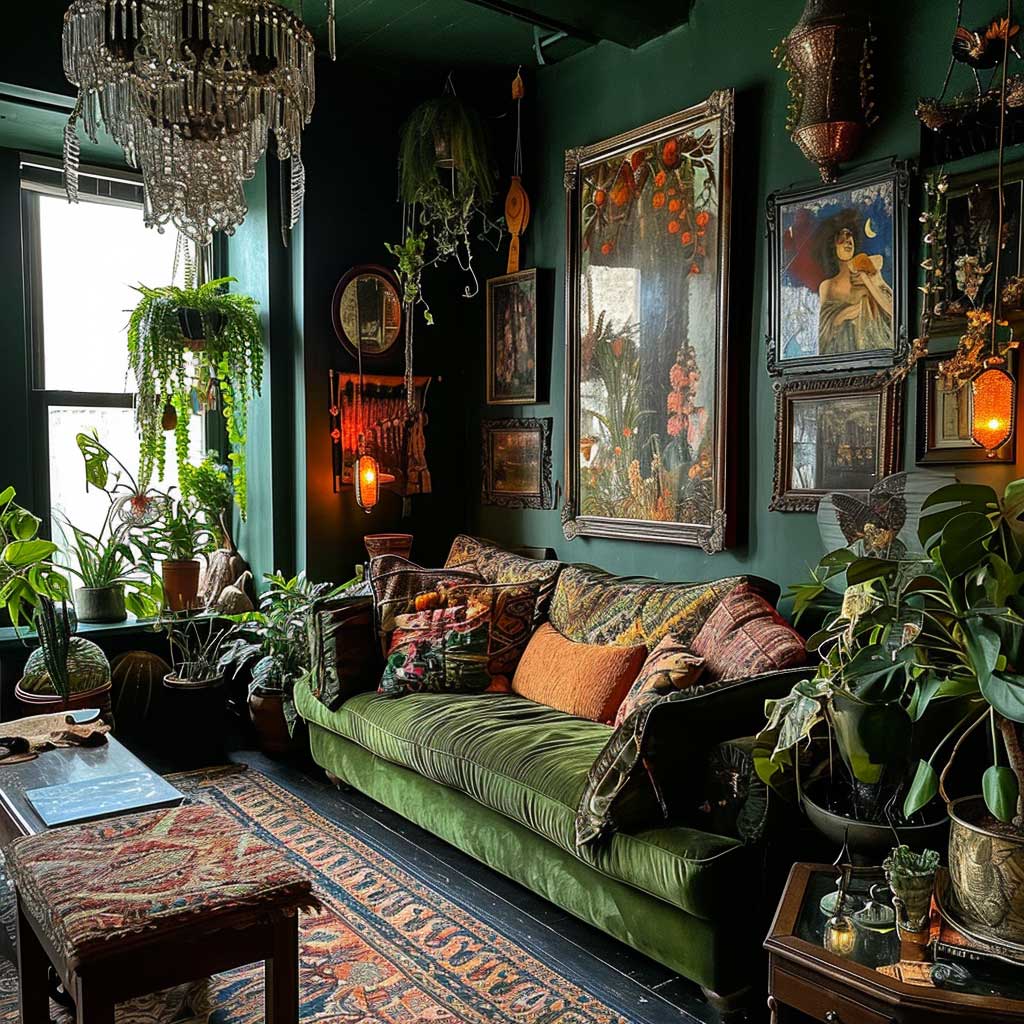
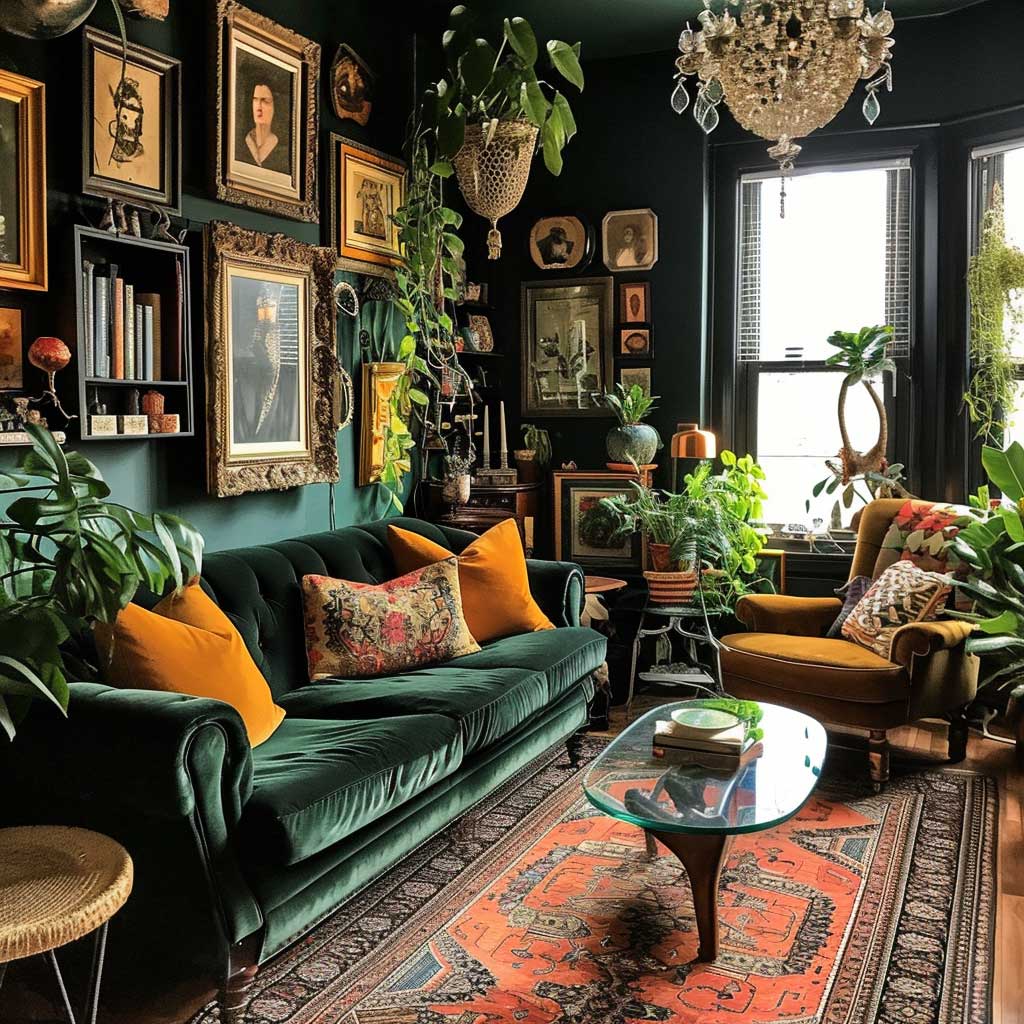
Plants in an eclectic dark green room should be large and unapologetic. A monstera with leaves wider than a dinner plate, a mature fiddle-leaf in a terracotta pot, or a trailing pothos on a high shelf all reinforce the palette without requiring explanation. Stylists note that grouping three plants of different heights creates a living focal point that competes with the sofa for attention — which is exactly the kind of productive tension that makes an eclectic room feel alive rather than arranged. For more ideas on working with dark green interior design across different rooms, the full coverage from artfasad.com is worth a read.
Classic Living Rooms That Let Dark Green and Gold Run the Room
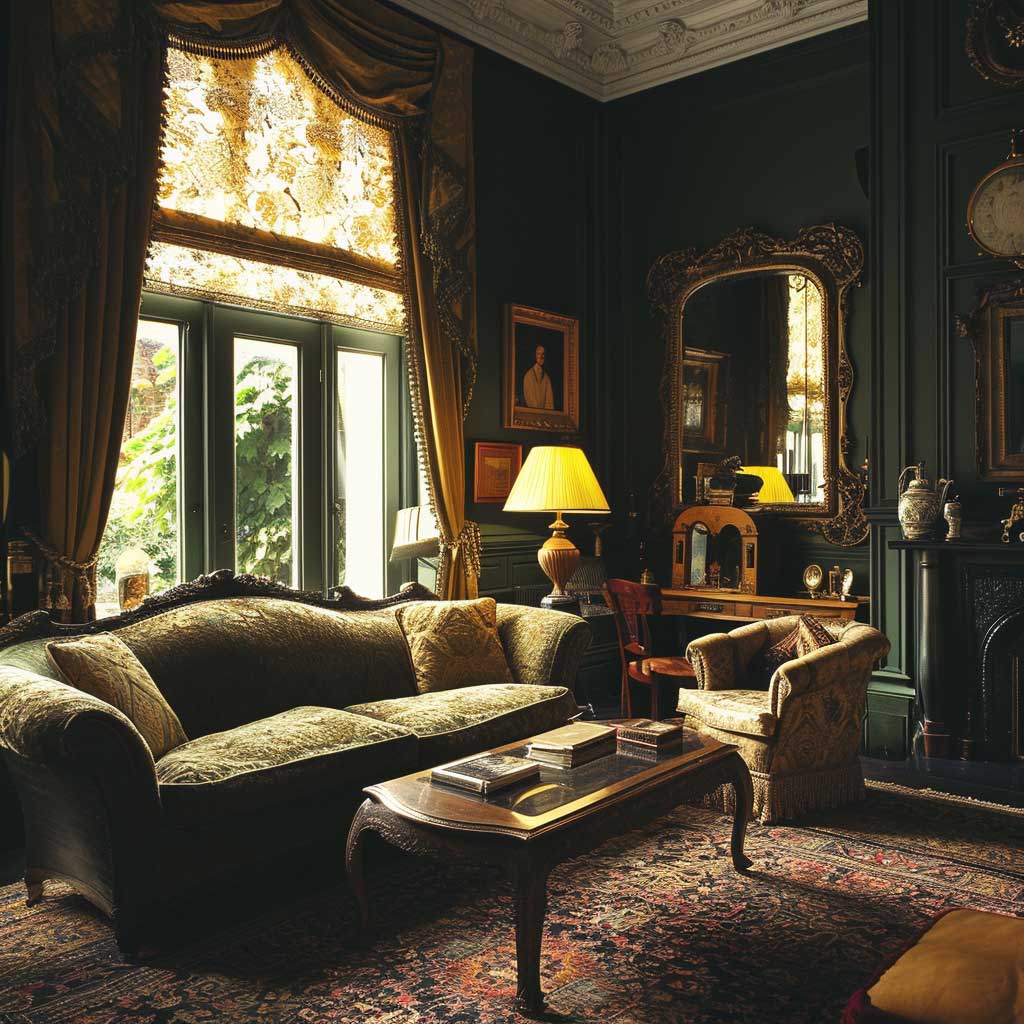
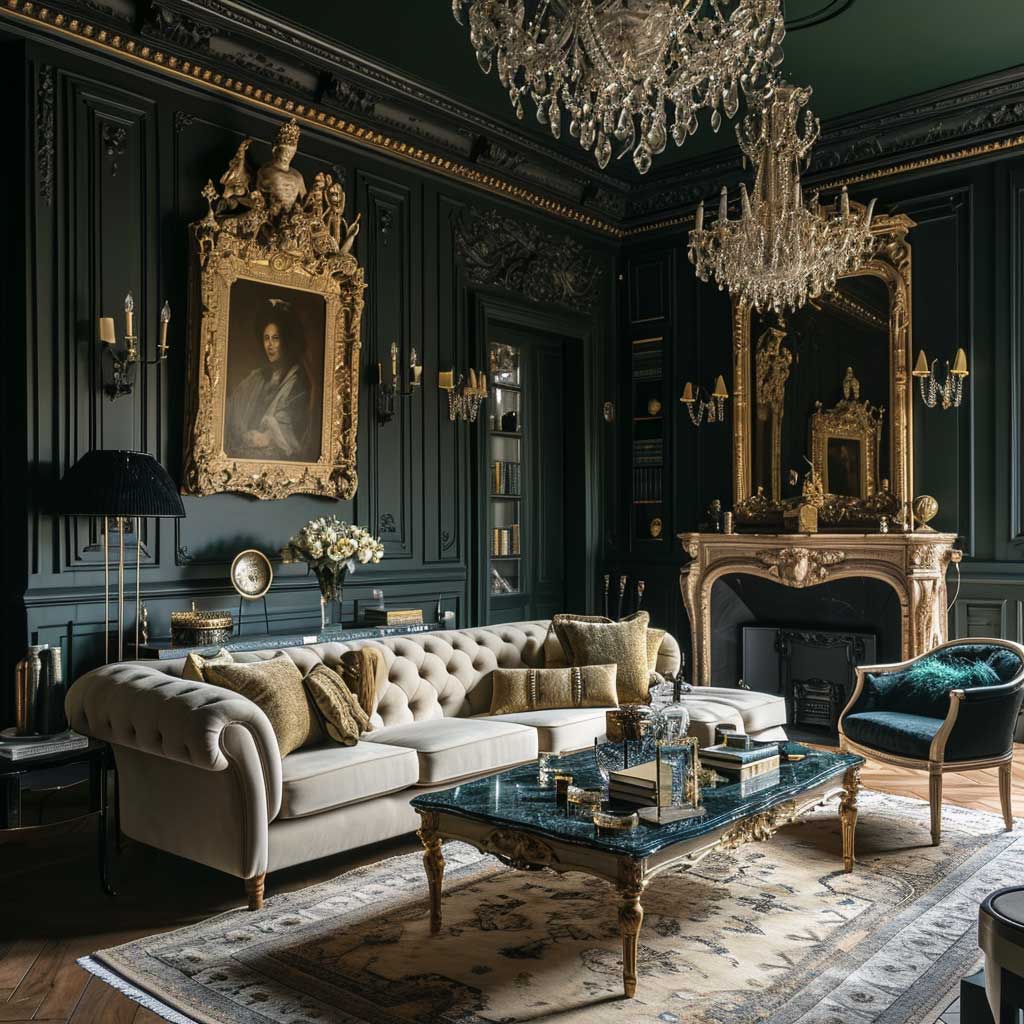

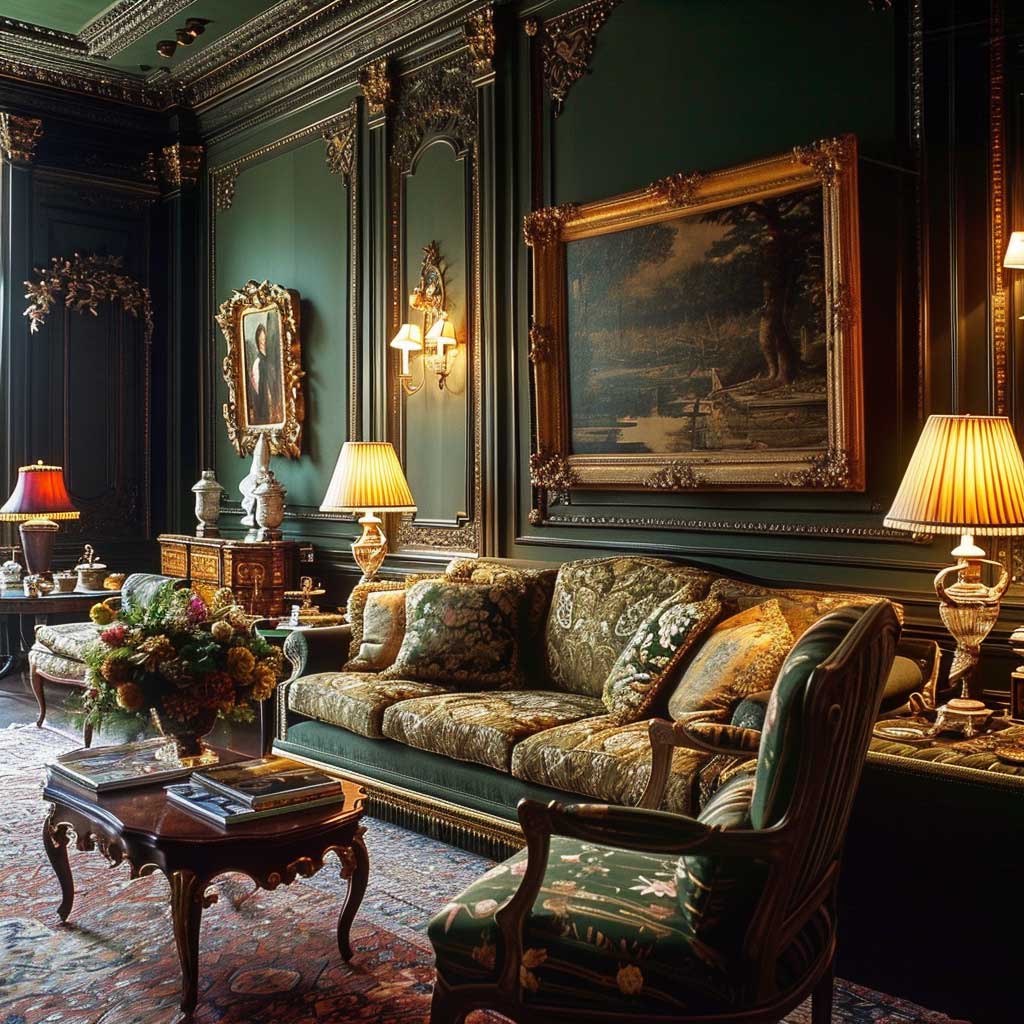
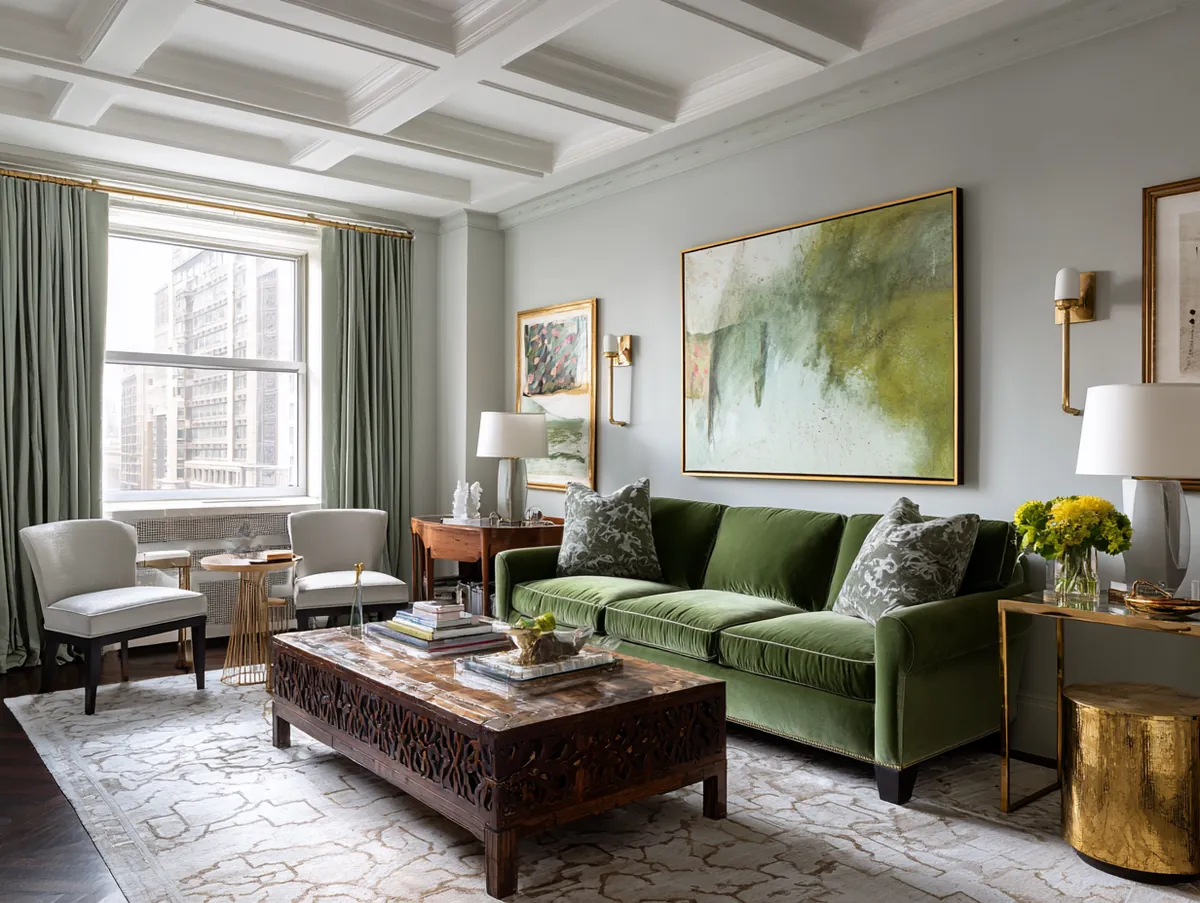
Dark green and gold is not a trend — it’s a documented pairing with origins in Victorian interiors, Art Deco jewelry, and Moroccan tilework that has survived every decade precisely because neither color needs the other to explain itself. LuxDeco’s design editors describe the combination as “subtly invigorating yet unassumingly decadent.” In a classic living room, that means deep green walls or velvet upholstery as the main surface, with burnished gold used on handles, frames, and lamp bases — never as a dominant field.
What finish of green works best in a traditional room? Matte or eggshell, not satin. A satin finish on dark green walls in a formal room reads as theatrical — the sheen catches light unevenly and makes every imperfection visible. Matte absorbs light evenly, giving the walls the depth that makes classic furniture feel at home rather than stranded. Benjamin Moore Regal Select in eggshell, around $80–90 per gallon at current retail, is the practical choice for coverage and washability without the shine.
Velvet curtains floor-to-ceiling are the single highest-impact addition in a classic dark green room. Heavy brocade or velvet in the same green family as the walls — not an exact match, but within two tones — creates a wrap-around effect that makes the room feel larger rather than smaller. Avoid sheer curtains; they contradict the weight of a formal green palette the way a paper plate contradicts a crystal chandelier. The curtain rod and rings should be in antique brass, not chrome.
Artwork selection in a classic dark green room follows one useful rule: the frame matters more than the subject. Oil paintings in dark gilded frames reinforce the palette regardless of what they depict. Botanical prints, portraits, or landscape studies all work — what doesn’t work is a contemporary graphic print in a thin black frame. The frame telegraphs the era; keep it consistent with the rest of the room’s vocabulary.


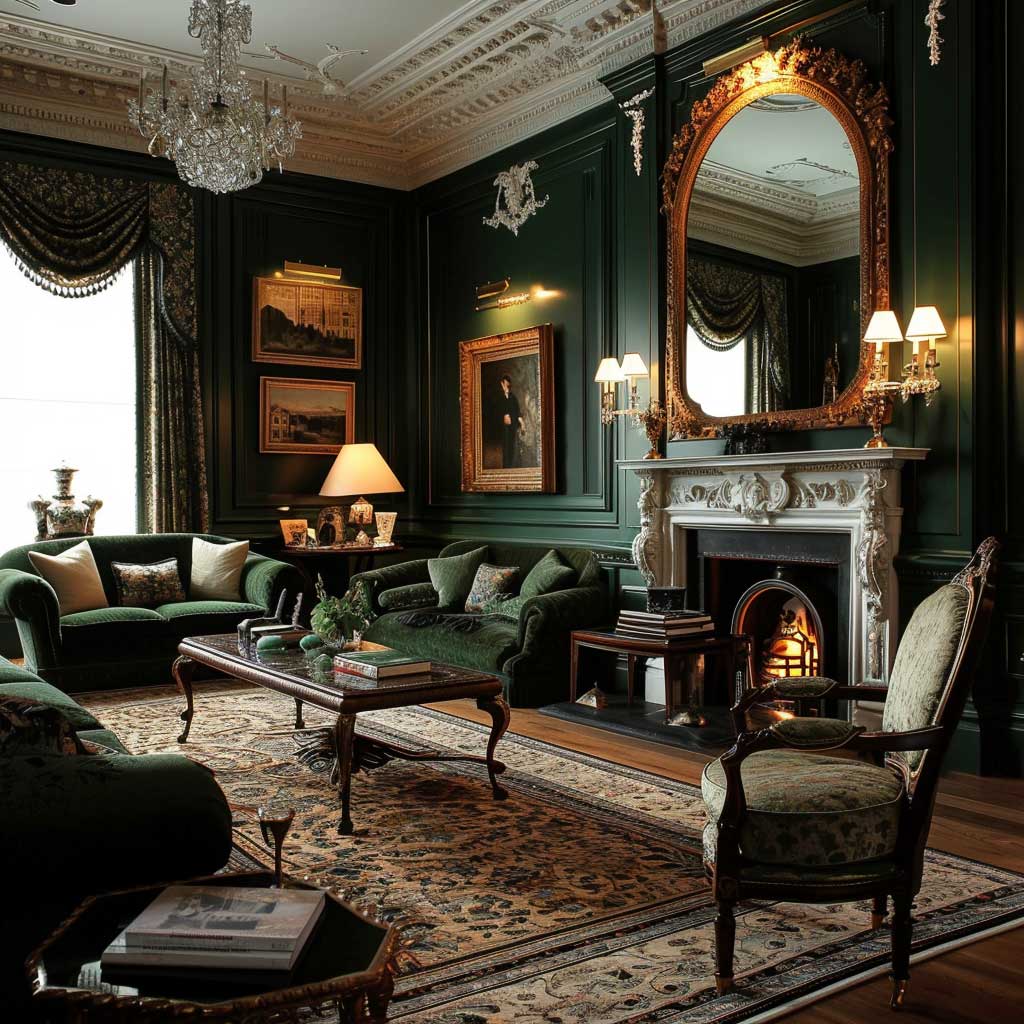
Candles and wall sconces produce a type of light that overhead fixtures never match in a classic room: shadows. Dark green walls lit only from above flatten into a single plane. A pair of antique-style wall sconces flanking a fireplace or mirror create shadow depth that makes the green recede and advance naturally — the room starts to feel like a place rather than a set. Use warm candelabra bulbs (2200–2400K), not LED daylight. The color temperature difference alone changes what the green looks like by at least two shades. For specific dark green sofa living room concepts that work within a classic frame, the velvet Chesterfield direction is especially well documented.
| Style | Key Green Shade | Dominant Metal | Avoid |
|---|---|---|---|
| Modern | Hunt Club SW 6468 (LRV 6) | Brushed gold / copper | Chrome, polished nickel |
| Eclectic / Boho | Forest Green / deep olive blend | Bronze / weathered brass | Matching all metals exactly |
| Classic / Traditional | Hunter Green BM 2041-10 or Essex Green HC-188 | Antique burnished gold | Satin finish walls, chrome frames |
Benjamin Moore’s dark green library runs to 162 colors, from Norway Spruce 452 to Deep Green 2039-10 — the breadth confirms that “dark green” is not a single decision but a spectrum of undertone choices that each produce a different room. Sampling on a large board under your actual lighting before committing to a full gallon ($57–90 depending on line) is the one step that catches most undertone mistakes before they’re painted on four walls. See the full color range at Benjamin Moore’s dark green collection.
The Real Takeaway
Dark green doesn’t ask for a style — it asks for a decision
Modern, eclectic, or classic: the palette works in all three. What breaks it is indecision — picking a shade that tries to straddle undertones, or lighting that doesn’t commit to a temperature.
Sherwin-Williams Emerald Interior at roughly $95 per gallon covers 350–400 sq ft per coat. Benjamin Moore Hunter Green 2041-10 at $80–90 (Regal Select) is slightly warmer and easier to pair with traditional wood tones. Neither choice is wrong — the wrong choice is buying a gallon without testing a sample first.
Save this post before you buy a single paint chip.