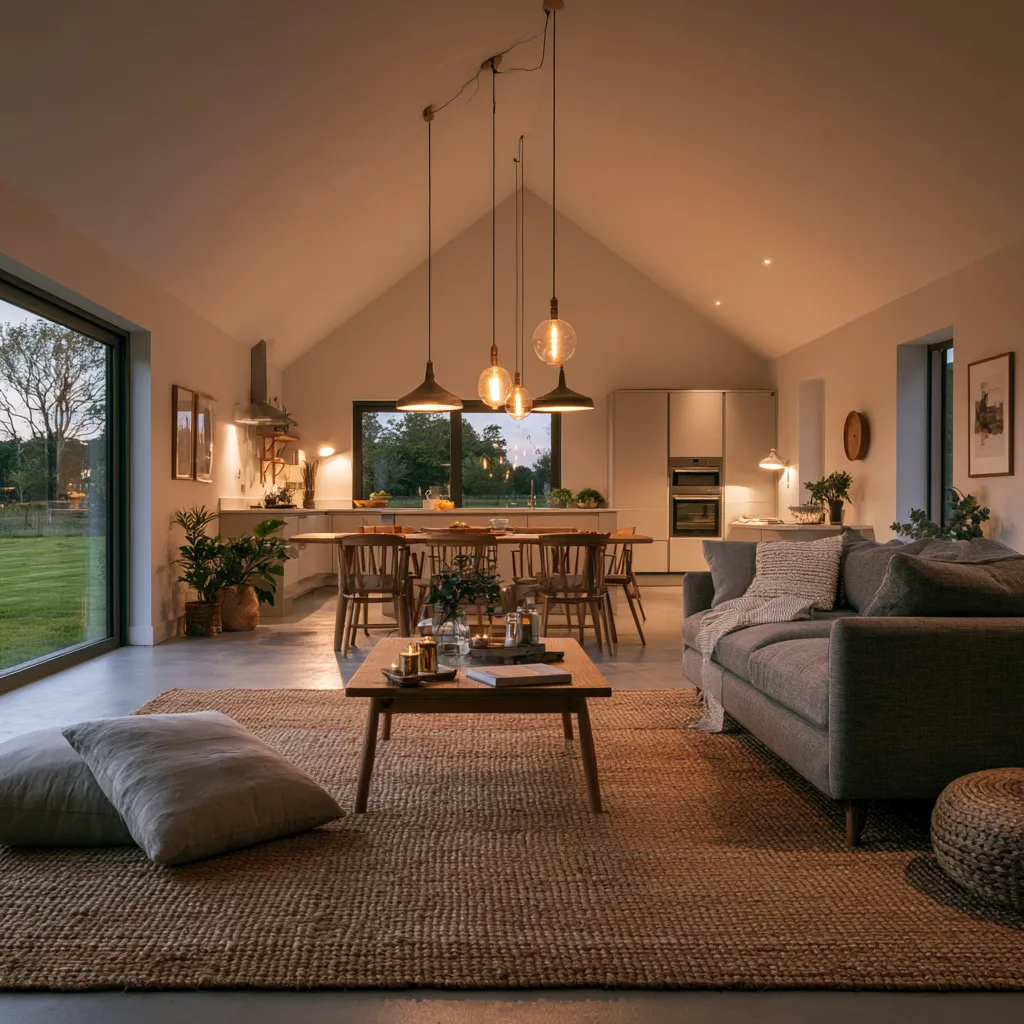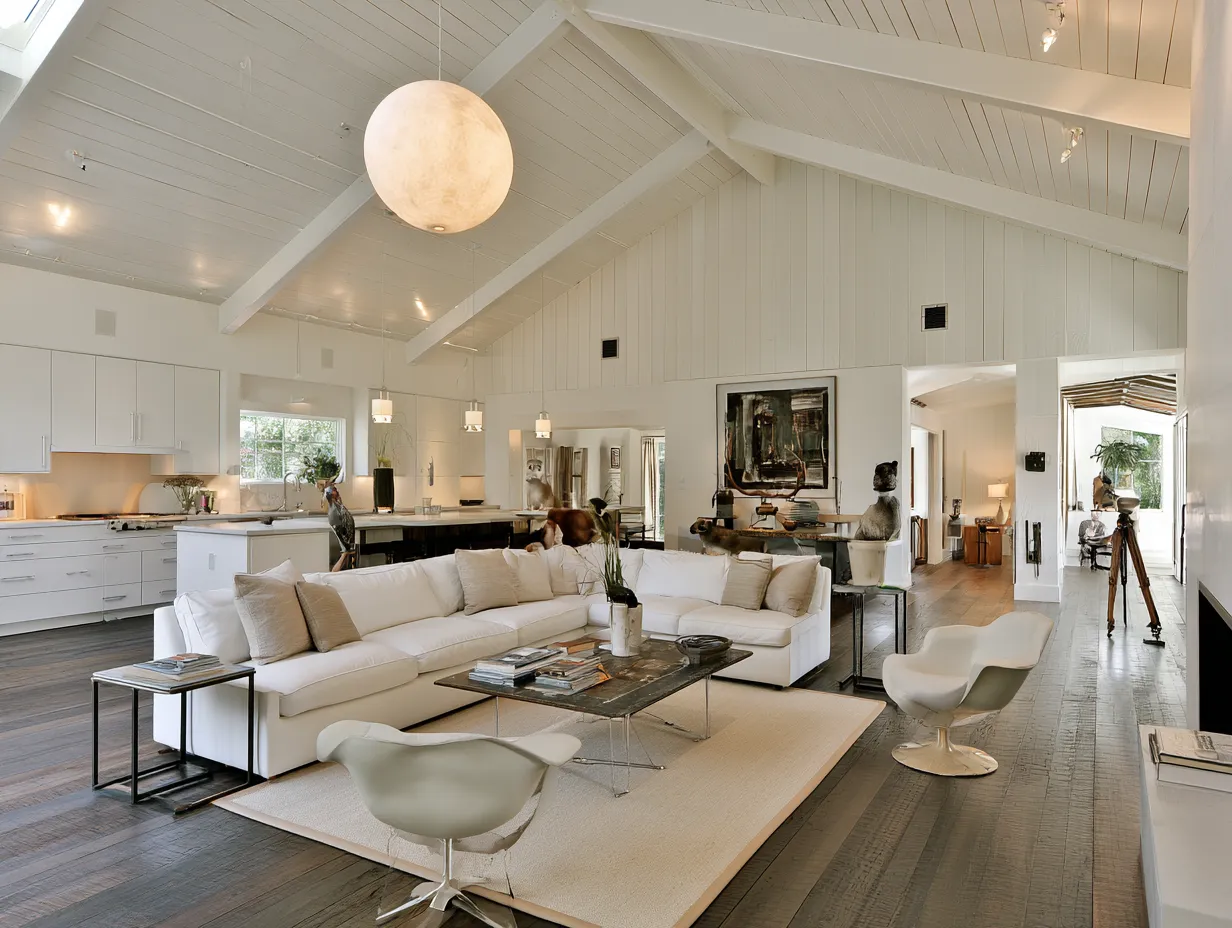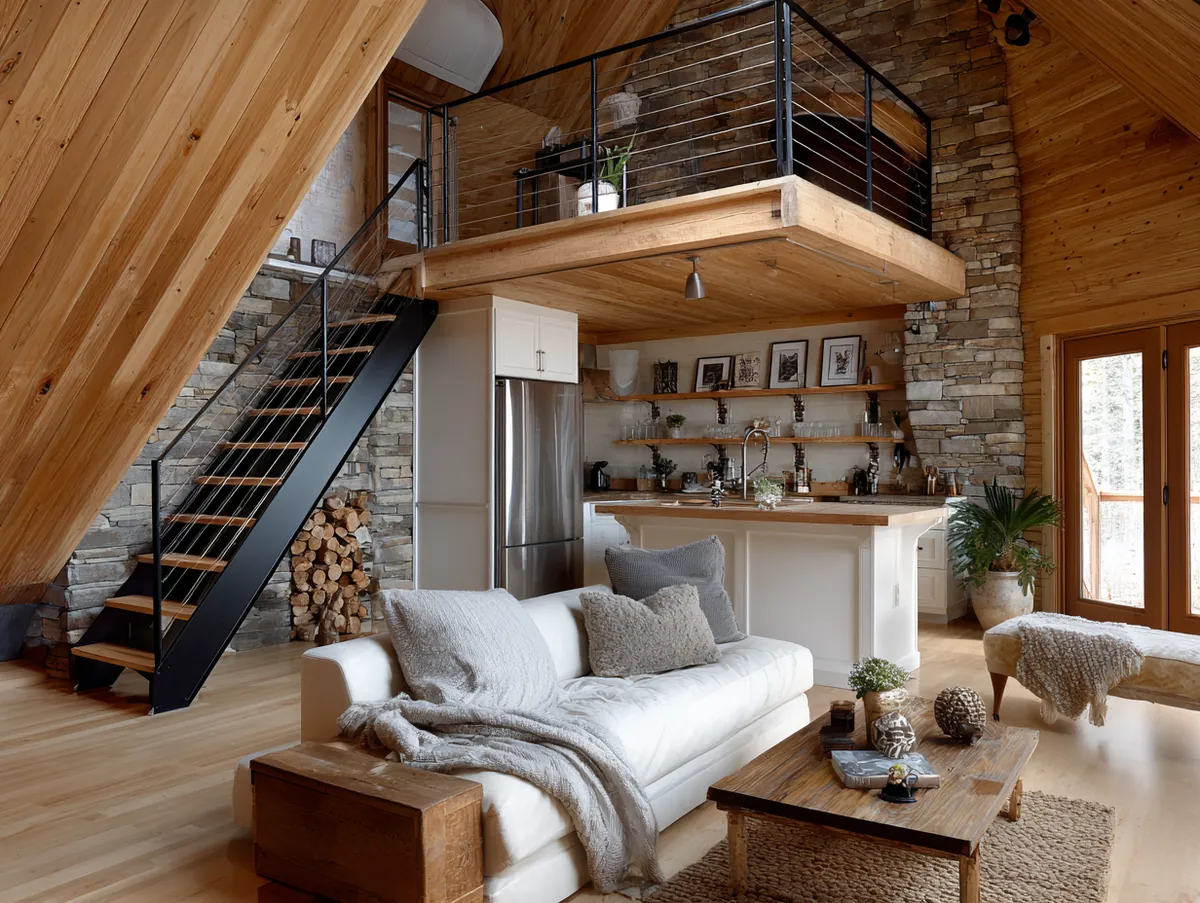
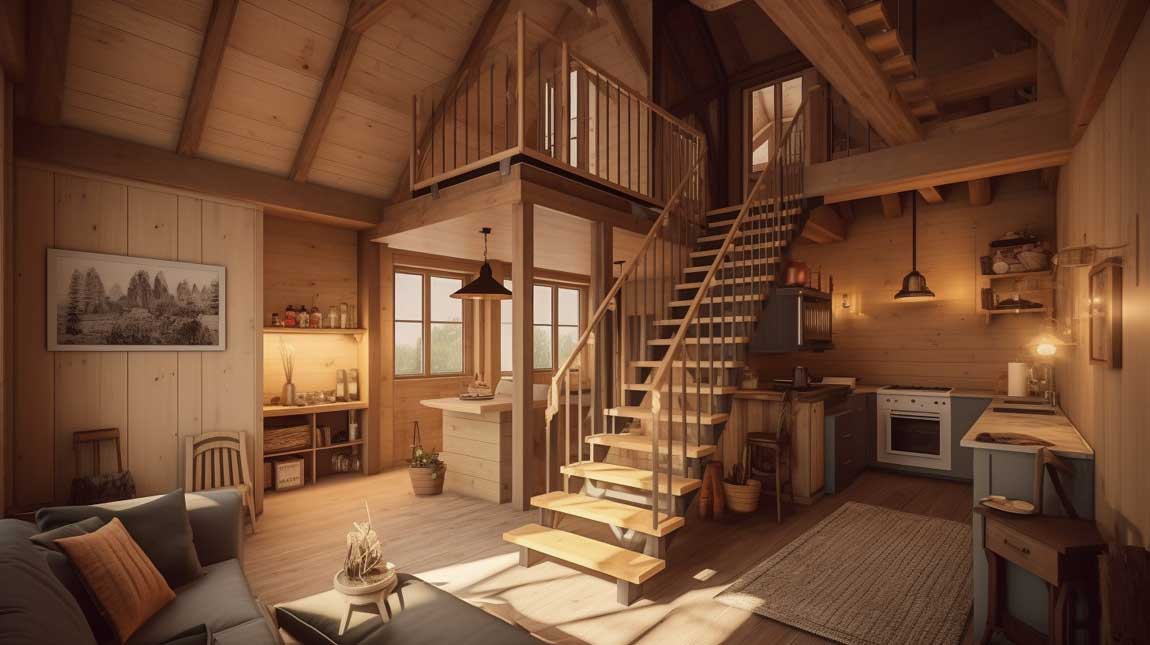
An open concept small cabin with loft turns the one thing most people ignore — the air above their heads — into the most functional part of the floor plan. I’ve toured dozens of these builds, and the ones that feel twice as big share one habit: they stopped treating the loft as a bonus and started treating it as the primary living zone. Drop the walls, push the sleeping area upstairs, and suddenly a 400-square-foot footprint lives like 700. That math is not magic. It’s vertical.
Most small cabin mistakes happen before the first nail goes in. People sketch a floorplan the way they’d furnish a studio apartment — bedroom here, couch there, kitchen squeezed into a corner — and then wonder why it feels like a closet. An open floor plan cabin with loft forces a different way of thinking. You stop dividing horizontal space and start stacking it. The result is a main floor that breathes and a loft that earns its keep every single night.
Rustic small cabin with loft builds have existed for centuries in Scandinavia and alpine Europe, but the current American version adds something those originals lacked: intentional interior design at the micro scale. We’re talking IKEA KALLAX shelving repurposed into stair risers, Murphy beds from Resource Furniture at $2,800–$4,500, and cable railings for the loft edge that keep sightlines open without the bulk of a knee wall. None of that costs a fortune. All of it changes the experience completely.




What this page covers:
- How to squeeze real function out of a cabin loft sleeping area
- Why the staircase placement kills — or saves — your open floor plan
- Storage solutions that don’t eat your square footage
- Natural light tricks that make low ceilings feel tall
- The one fireplace move that anchors an open-concept cabin instantly
- Outdoor connection strategies for decks, windows, and material flow
- Eco-friendly materials that are cheaper than their conventional alternatives
- How to personalize without making the space feel cluttered
Loft Placement Dictates Everything Else on the Floor Plan
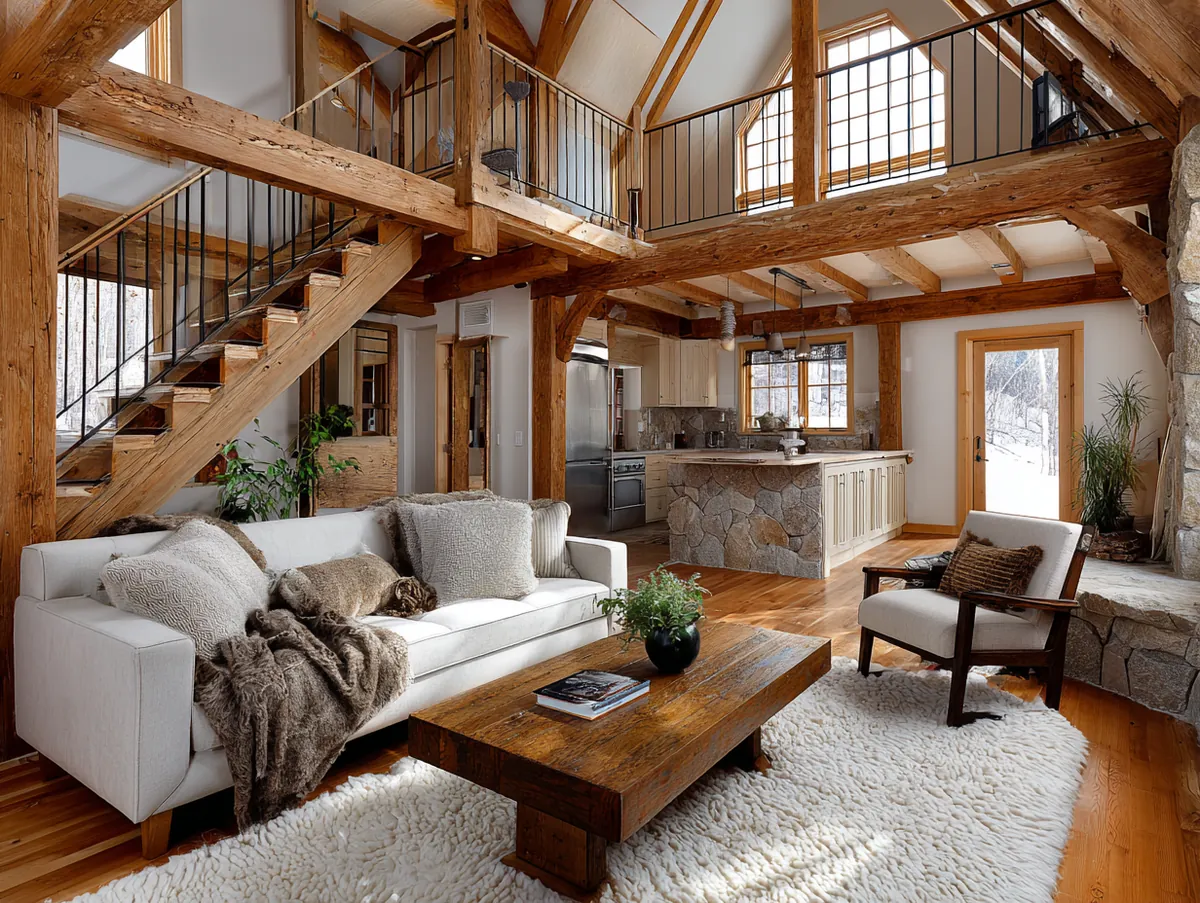
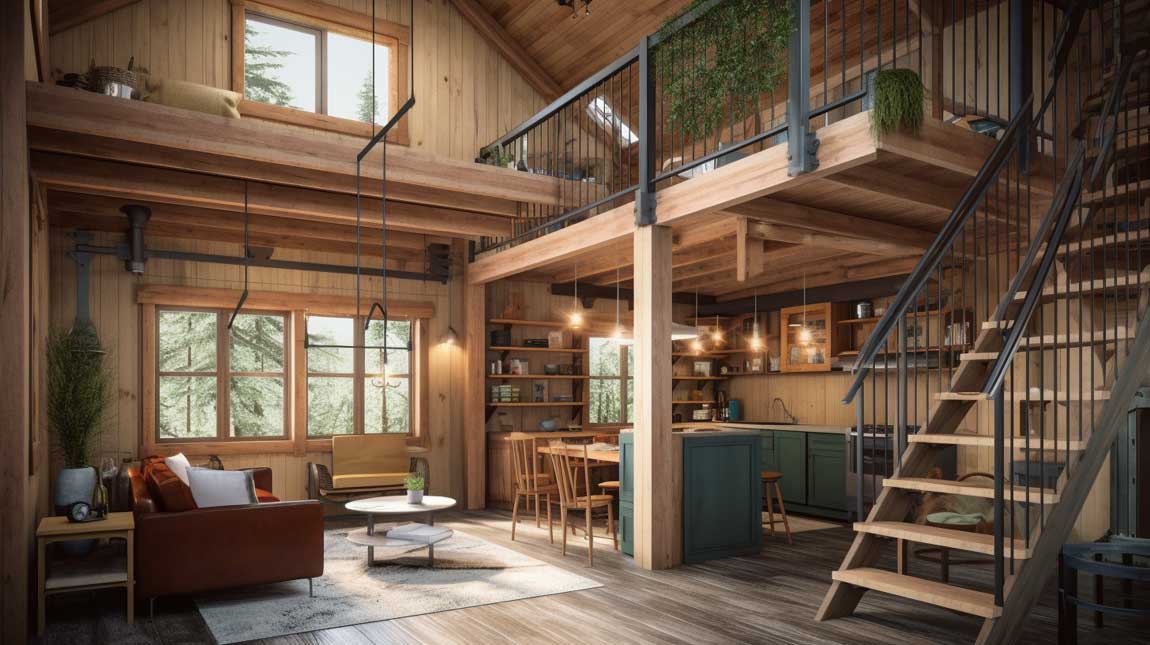
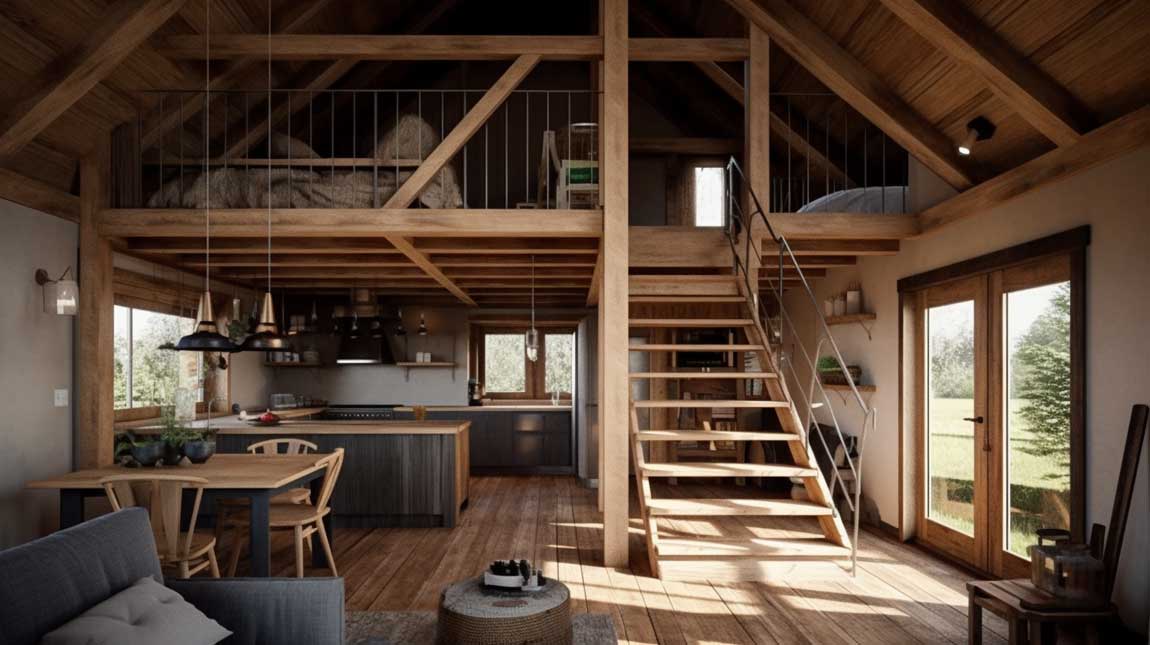
Put the loft over the kitchen and bathroom — that’s the move most small cabin loft ideas miss. Plumbing stacks stay compact, the structural load concentrates in one zone, and the main living area opens up completely. I’ve seen builds where the loft was centered over the living room, and the result was a cave underneath and wasted airspace above. Not worth it. The sleeping zone belongs above the utility zone, full stop.
Staircase placement is the second variable nobody talks about until it’s too late. A standard straight-run stair chews through 35–40 square feet of floor plan. Swap it for a ships-ladder at a 70-degree angle and you recover almost all of that. Alternating-tread stairs from companies like Salter Spiral Stair run about $1,200–$2,000 and fit in a 2-foot-wide footprint. They’re steep, but at 400 square feet you don’t have the luxury of a grand staircase.
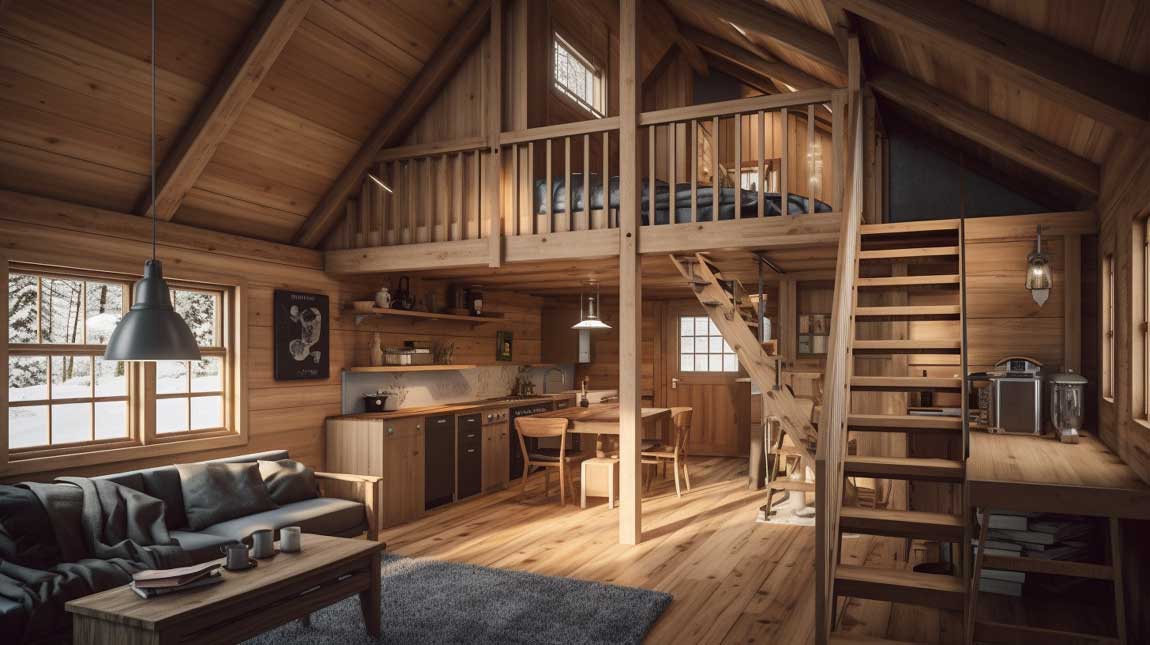
The worst small cabin loft design I encountered had the sleeping platform positioned dead-center with 5 feet of clearance on either side — unusable buffer zones on both flanks. Flush the loft to one wall. You get a full wall of built-in storage on the remaining three sides and a stair run that doubles as shelving. That’s not a compromise; it’s how Scandinavian cabin architects have been building since the 1960s.
Windows and Doors That Pull the Forest Inside
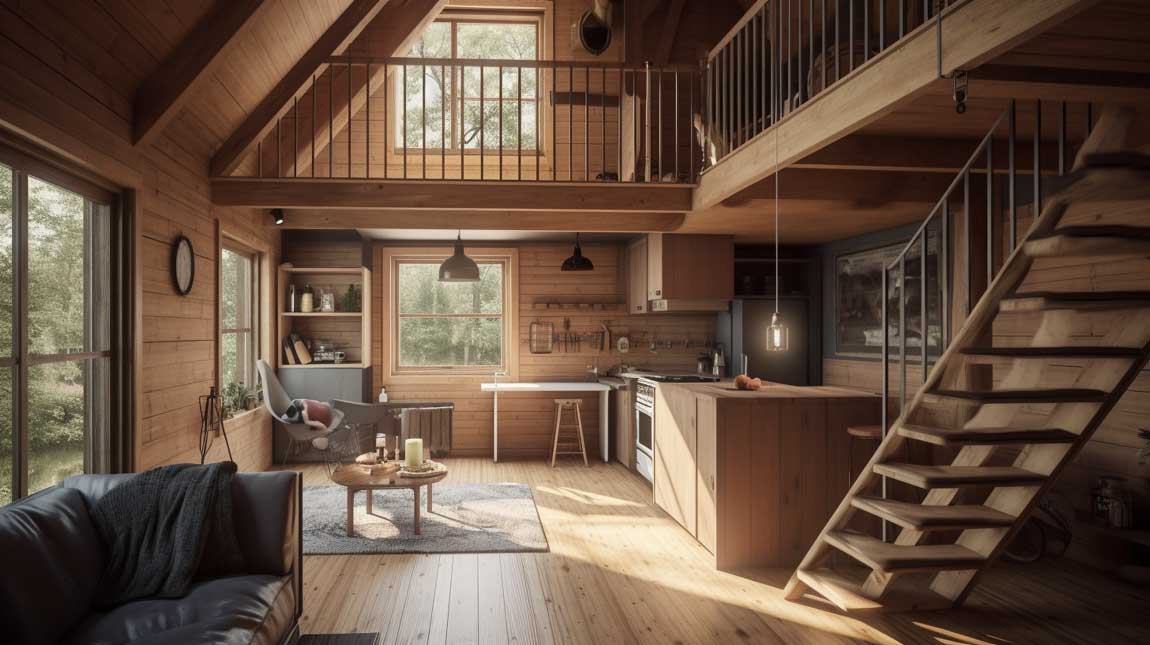
Floor-to-ceiling glazing on the gable end is the single biggest visual upgrade you can make to an open concept cabin with loft. It costs more than a standard window — Andersen 400 Series fixed units run $800–$1,400 per panel — but the return is a main floor that reads as part of the landscape rather than separate from it. You’ll notice the space stops feeling small the moment that glass meets the floor.
Sliding glass doors that open to a covered deck expand the functional footprint without adding conditioned square footage. My go-to detail is matching the interior flooring material — usually white oak or pine plank — to the deck boards, so the eye reads it as one continuous surface. It’s a trick I stole from Japanese residential design, where the engawa (transitional porch) dissolves the boundary between in and out. In a small cabin, that dissolved boundary is worth its weight in perceived space.
Don’t put a skylight directly over the loft bed unless you enjoy waking at 5am to full sunrise. Position it over the stair landing instead — you get the light, it floods both levels, and you keep sleeping until a reasonable hour. That sounds obvious. You’d be surprised how often it isn’t.

Storage That Lives Inside the Architecture, Not On Top of It
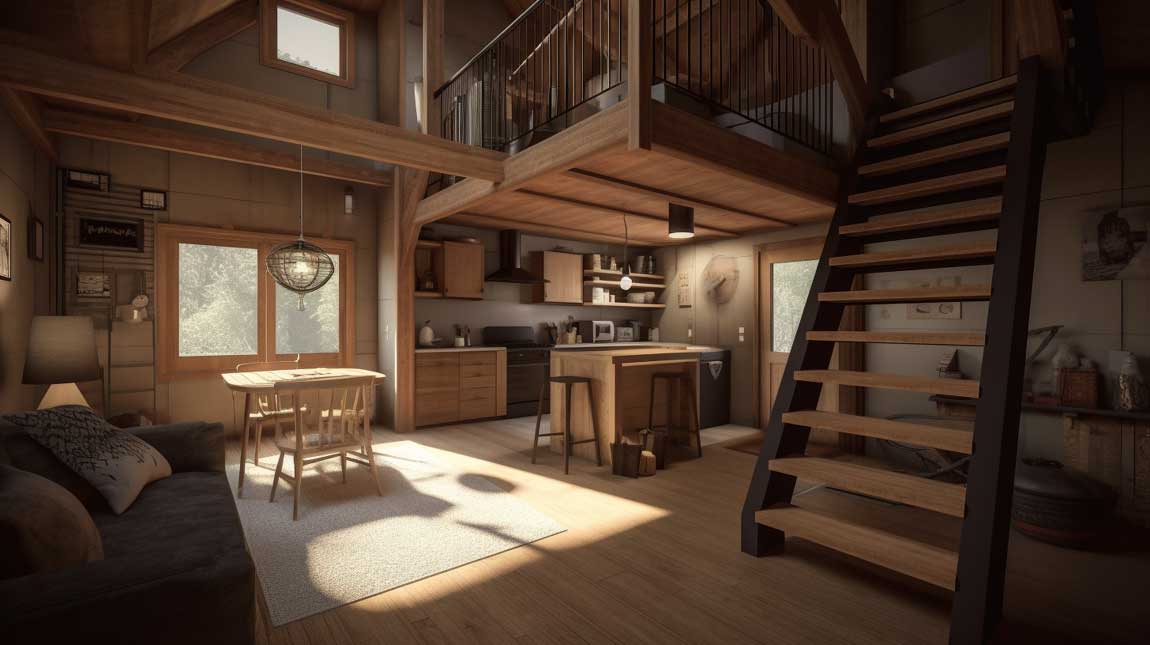
Under-stair storage is not a nice-to-have in a small cabin with loft — it’s load-bearing square footage for your life. Pull-out drawers with full-extension slides (Blum Tandem hardware, around $60 per set) built into each riser give you drawer-equivalent storage without a single piece of visible furniture on the floor. I own two of these setups and neither cabin feels cluttered, even when fully loaded for a two-week stay.
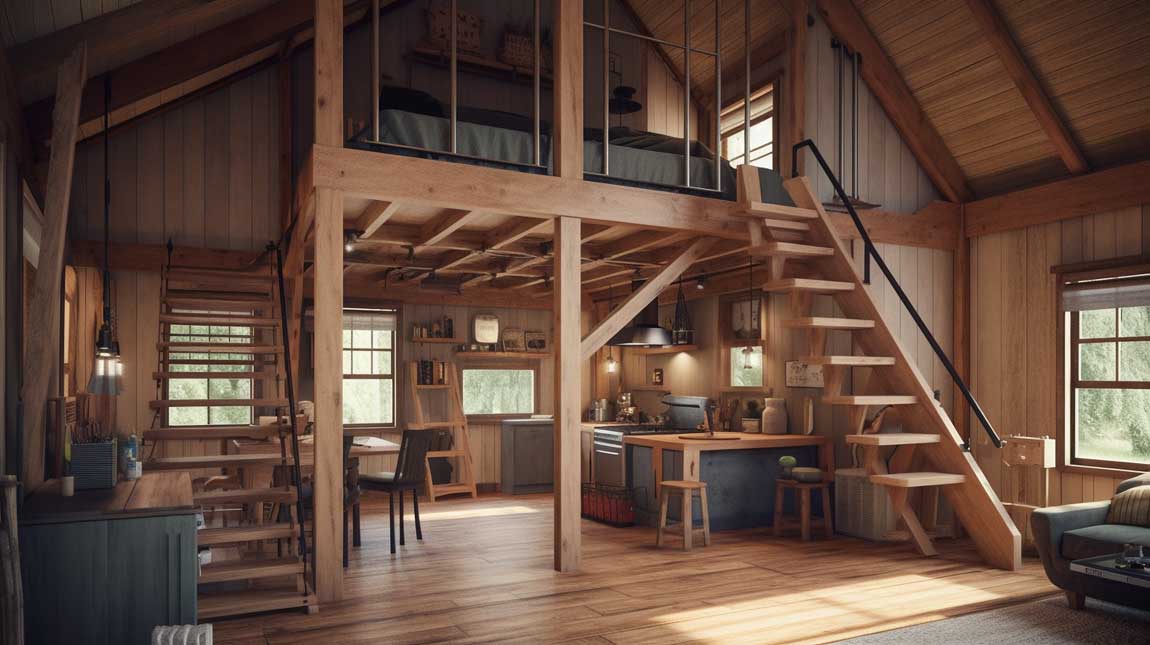
The space under the loft floor is another zone most people waste. You need 6’8″ minimum clearance to use it as primary living. If your ceiling height only allows 6’4″ under the loft deck, stop trying to make it a seating zone — it will always feel oppressive. Use that zone for a compact home office or a deep wardrobe instead, where you’ll spend minutes not hours.
Wall-mounted storage above the kitchen cabinets, extending all the way to the loft floor, is the move most open concept cabin with loft builds leave on the table. IKEA SEKTION upper cabinets at $80–$180 per unit stack cleanly to a 9-foot ceiling and look intentional rather than improvised. The mistake is stopping at the standard 7-foot height and leaving 2 feet of dead space above.
Don’t do this: Don’t use freestanding wardrobes or armoires in a small cabin loft. I’ve tried it. A single 24-inch-deep IKEA PAX unit in a 400-square-foot open plan reads like a wall that divides the space in half — visually and physically. Built-ins flush to the wall face cost more upfront but the floor you reclaim is worth $300–$500 per square foot in resale value on a cabin property. The freestanding piece that “fits” on paper will ruin the open feel you built the loft to achieve.
For more space-maximizing approaches in compact interiors, the small cabin interior ideas post covers built-in storage options that work in even the most constrained footprints.
Low Ceilings Feel Tall When You Stop Treating Them as a Liability
The loft ceiling — the underside of the roof — is where most cabin builders make their first mistake. Dark stain on low rafters makes a ceiling feel like a lid. Benjamin Moore White Dove on the same rafters makes them disappear. You keep the exposed timber detail, you lose the compression. I’ve done this in two different loft cabins and the visual height gain is legitimately startling.
Vented skylights are worth every penny for a loft that’s used in summer. A Velux FCM 2234 runs about $400 and cracks open to release heat that would otherwise turn your sleeping loft into a sauna by 9am. Proper cross-ventilation in a small cabin loft isn’t about comfort — it’s about whether you’ll actually use the space from May through September. A sealed hot box above the rafters is useless.
What doesn’t work: recessed lighting fixtures in a sloped loft ceiling. They require a box depth your rafters don’t have, they create thermal bridges, and the beam angle is always wrong. Surface-mount track lighting or simple plug-in pendants hung from a hook in the ridge beam cost $40 and take 20 minutes to install. They also look better.

A Wood Stove at 0 Does What No Sofa Can
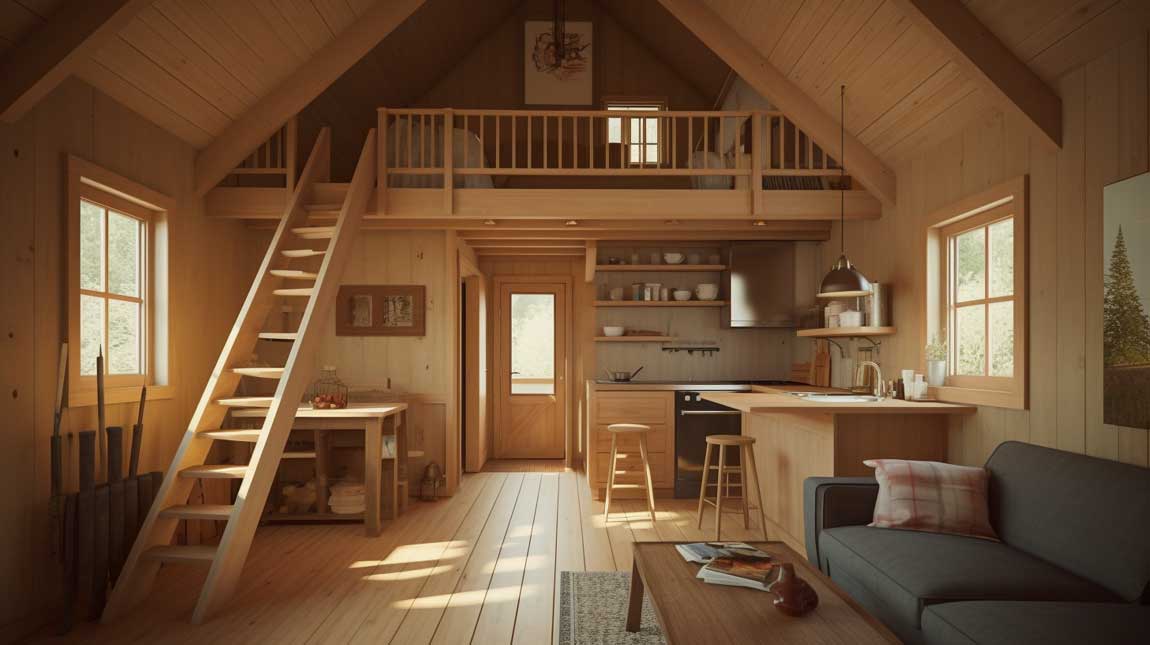
An open concept small cabin with loft lives or dies by its anchor point. Without one strong focal element on the main floor, the space feels unresolved — like furniture staged for a real estate photo rather than arranged for actual living. A cast-iron wood stove is that anchor, and it costs less than most sofas. The Drolet Escape at $950 heats 1,200 square feet, which means it absolutely demolishes a 400-square-foot cabin. That’s intentional. Radiant overperformance feels luxurious.
Placement matters more than model. Center the stove on the wall opposite the loft stair so you see it the moment you climb down in the morning. The chimney pipe becomes a vertical element that draws the eye upward, reinforcing the height of the space. Two armchairs facing the stove and a sheepskin rug in between — that’s a seating arrangement that earns its keep at 11pm in November.
Plush throw blankets and deep-cushion furniture complete the picture, but don’t skip the layered lighting. A floor lamp by the stove, a pendant over the dining table, and a wall sconce at the loft landing give you three distinct moods. Overhead fixtures only — that’s a hotel corridor, not a cabin.
Indoor-Outdoor Flow Without the Budget of a Full Addition
A covered deck doubles your usable living space for a fraction of the cost of interior square footage — typically $15–$25 per square foot versus $150–$300 for enclosed conditioned space. The trick is treating the deck as part of the interior design, not as a separate afterthought. Match the deck boards to the interior floor finish, use the same hardware on the outdoor furniture as on the interior cabinetry, and hang a simple outdoor pendant over the dining spot.
Screened-in porches extend the usable season by two months in most climates. You get the outdoor feel without the insect problem that makes sitting outside miserable in July. Native plantings along the deck perimeter — ornamental grasses, ferns, native shrubs — replace formal landscaping at a fraction of the cost and maintenance. They also look like the cabin grew there, which is the right aesthetic for a cabin.
The outdoor firepit is the most overused cliché in cabin design, but it works — because fire at night is just genuinely good. A simple ring of local fieldstone around a grate costs $0 in materials if you’re on property. If you’re spending $800 on a pre-cast concrete kit, put that money into a second Adirondack chair and a better bottle of wine instead.
Explore how cabin designs with loft handle the indoor-outdoor relationship in larger footprints — some of the material and transition details there scale down beautifully to smaller builds.

Reclaimed Wood and Recycled Metal Cost Less Than Their New Equivalents
Reclaimed barn wood planks run $3–$6 per board foot at most salvage yards versus $7–$12 for new character-grade white oak. You get a surface with a century of patina baked in, and you’re not paying the premium for someone else to manufacture that look artificially. I’ve clad an entire cabin living room wall — 180 square feet — for under $900 in salvaged material. The same treatment in new distressed oak would have cost $2,100.
Recycled corrugated metal roofing is another material that costs less used than new alternatives and performs identically. Metal Roofing Alliance-certified panels in Galvalume or weathering steel run $1.50–$3.00 per square foot used versus $4.00–$7.00 new. The weathered finish is the desired aesthetic anyway. Why pay for new and wait 10 years for it to look right?
Solar panels are the one place where new beats salvage. First-generation panels from salvage yards often have degraded output and no warranty. A current LG or REC Group 400W panel costs about $200–$280 direct from distributors and produces reliably for 25 years. For an off-grid cabin loft, two panels and a 200Ah lithium battery pack handle lighting, a laptop, and phone charging indefinitely. That’s a $1,800 system that eliminates a utility bill forever.
For a deeper look at how modern cabins integrate sustainable material choices without sacrificing visual quality, Sierra Log and Timber’s cabin loft resource covers insulation and climate control in off-grid builds with useful specifics on R-values and heating options.

Personality Without Clutter Requires One Hard Rule
Every decorative object in a small cabin loft must justify its floor or wall footprint against a functional alternative. That sounds clinical, but it’s liberating in practice. A single vintage topographic map of the local mountain range costs $30 framed and tells a story about place. Twelve throw pillows in coordinating patterns cost $200 and tell the story of a HomeGoods run. One meaningful object at scale beats a collection of small ones every single time in a compact interior.
Mix material textures rather than color palettes. Rough-sawn wood, matte stone, brushed steel, and woven wool give you visual complexity without visual noise. The palette itself can stay within four tones — I’d suggest warm white, natural pine, charcoal, and one earthy accent — and the textural variation does all the work. Color-matching every accent pillow to the throw blanket is the design equivalent of writing with too many exclamation points.
The one object worth splurging on: the bed in the loft. You spend a third of your time there, the ceiling is low and close, and the quality of what surrounds you while you sleep registers even when you’re unconscious. A Tuft & Needle Original mattress at $600 in queen or a DreamCloud Premier at $900 are both dramatically better than what most vacation cabins provide. That’s the one line item where I’d cut the outdoor firepit kit before I’d cut mattress quality.

Final Word
A small cabin loft isn’t a compromise — it’s the most honest way to build compact.
The floor plan that works isn’t the one with the most square footage. It’s the one where every cubic foot has a job. Push the sleeping platform up, open the main floor, put the stair somewhere useful, and stop apologizing for the scale.
Rustic materials and modern hardware don’t fight each other in a well-designed cabin loft. They split the work — one handles warmth, the other handles precision.
Save this post before your next cabin planning session. The details above will save you at least two rounds of costly redesign.