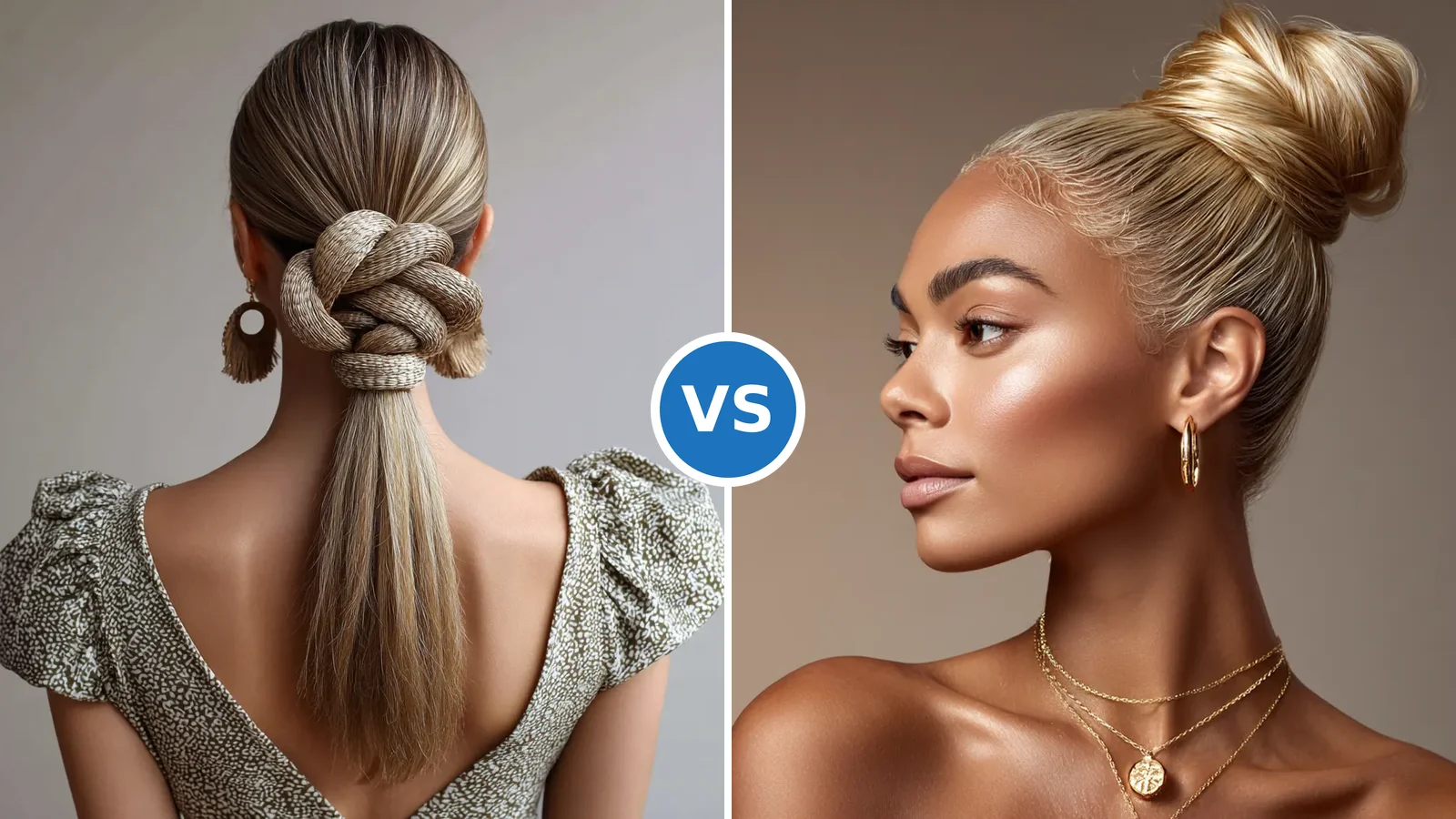
The ponytail vs bun question usually comes down to a narrower choice: a soft low ponytail at the nape or a polished slick back bun. This comparison covers exactly those two styles, so if you are weighing a high pony against a messy top knot, the reasoning still helps, but the details below are specific to these two looks.
In short, a low ponytail suits anyone who wants a relaxed, textured style that works with natural waves and needs little smoothing. A slick back bun suits anyone who wants a sharp, glossy finish that holds all day and can be placed higher to lengthen a round face.

What each style actually is
A low ponytail is gathered at the nape of the neck and either left hanging or twisted into a soft knot secured with bobby pins. Our low-knot ponytail styles range from a glossy, center-parted version to a loose knot with face-framing tendrils and a braided knot for extra texture.
Quick Verdict
- Choose a low ponytail if you have wavy or textured hair and want a softer, lived-in look with minimal smoothing.
- Choose a low ponytail if you like to add details such as a braid or loose front pieces.
- Choose a slick back bun if you want a polished shape that stays in place through a long workday or evening.
- Choose a slick back bun if you have a round face and want height that draws the eye upward.
A slick back bun starts with hair smoothed flat against the head with serum or gel, combed back, secured and wrapped into a bun that can sit low, mid-level or at the crown. The slick back bun variations we covered focus on round faces, using side parts and placement to add angles and length.

Head-to-head on the details that matter
The two styles differ less in difficulty than in finish, prep and how they shape the face. The table sums up where each one comes out ahead.
| Criteria | Low Ponytail | Slick Back Bun |
|---|---|---|
| Placement | At the nape of the neck | Low, mid-level or at the crown |
| Finish | Sleek or deliberately undone, with optional loose tendrils | Smooth, glossy and flyaway-free by design |
| Prep and products | Light: texturizing spray for the loose version, serum only for the sleek one | Heavier: smoothing serum or gel, a brush and a finishing hairspray |
| Natural texture | Shows off waves and curls in the relaxed version | Works best on blow-dried or well-smoothed hair |
| Round faces | Neutral; soft side pieces can add width | Stronger; a crown bun adds vertical length |
| All-day hold | Softer hold that may loosen over a day | Built to stay put without touch-ups |

Where the low ponytail wins
The low ponytail is the more forgiving style for natural texture. Its relaxed version is meant to look slightly undone, so waves and curls become part of the design instead of something to iron out, and a few loose pieces around the face soften the whole look.
It also takes less prep. For the loose version, a texturizing spray before you gather the hair is enough; only the sleek, minimalist knot asks for straight or straightened hair and a shine product. And it leaves room for detail work: a three-strand, fishtail or Dutch braid can be twisted into the knot for a bohemian finish that suits outdoor events and casual weddings.


Where the slick back bun wins
The slick back bun wins on polish and staying power. Because every strand is smoothed back and set with product, it keeps a clean profile through a long day without needing adjustments, which makes it the stronger pick for professional settings, formal occasions and evening events.
It is also the better tool for reshaping proportions. Placed at the crown, it pulls the eye upward and adds vertical length; with a side part, it breaks up symmetry and creates a diagonal line that makes a round face look more sculpted. A lower placement, by contrast, draws attention to the neckline.


The most common mistake when choosing
The usual error is choosing by mood alone and ignoring face shape and hair texture. A round-faced reader who picks a loose low ponytail with soft tendrils at the cheeks, hoping for a lengthening effect, gets the opposite: volume sits at the sides, exactly where the face is widest. A crown-height slick bun would have done the job.
The reverse mistake is forcing a slick back bun on curly or frizz-prone hair without enough prep. Skip the blow-dry or smoothing step and the bun looks fuzzy rather than glossy; in that case a relaxed low ponytail that embraces texture is the better call.

Ponytail vs bun for work, weekends and evenings
For the office and formal events, both can work, but the slick back bun holds its shape longer and pairs well with tailored outfits and statement earrings. The sleek version of the low ponytail is a softer alternative when a bun feels too severe.
For weekends, brunch and festivals, the relaxed or braided low ponytail is the easier fit. It looks intentional even as it loosens, which is the point of the style.

Who should choose which
Pick the low ponytail if your hair is wavy or textured, you want a style that tolerates a little mess, or you enjoy adding braids and loose front pieces. It asks for fewer products and suits relaxed days and romantic evening looks alike.
Pick the slick back bun if you want maximum polish and all-day hold, or if you have a round face and want to use height to lengthen it. Budget a few extra minutes for smoothing, and the payoff is a shape that stays sharp from morning to night.