A red and grey kitchen works when gray carries most of the room and red plays the accent, usually around 10–30% of what the eye takes in. Does the pairing hold up in daily use? Yes, because charcoal hides scuffs and splashes better than white, while red gives the room a focal point that an all-gray scheme lacks. The 60-30-10 rule that interior designers use gives a ready split: about 60% gray, 30% a supporting neutral and 10% red. Decide first which single surface will carry the red.
Budget is the second quick answer. Professional cabinet painting typically runs $2,500–$6,500, with a national average near $4,000, while DIY materials for an average kitchen come to roughly $400 for one to two gallons of paint plus supplies. Painting the walls red instead of the cabinets costs far less, with typical kitchen wall jobs averaging around $800. Choose the surface before you price the paint.
The sections below cover glossy red against matte charcoal, red uppers over gray lowers, red walls with gray cabinets, deep red with gold hardware, and the backsplash and lighting choices that tie the palette together. Each option comes with typical prices, sheen levels and the mistakes that make red look loud instead of rich. Two tables near the end compare the layouts and the cost routes side by side, so jump there if budget decides the plan.
- Keep red near 10–30% of visible surfaces and let gray cover about 60%.
- Semi-gloss red (about 50 gloss units) next to satin charcoal (about 28) creates contrast without a third color.
- Pro cabinet painting costs $2,500–$6,500 (average $4,000) vs roughly $400 in DIY materials.
- Red uppers over charcoal lowers keep scuffs on the darker half at kick height.
- Red walls with gray cabinets cost around $800 to paint vs about $4,000 for the cabinets.
- Task light at 3000K–4000K keeps red from sliding toward brown.
- Gold or brass hardware upgrades add roughly $100–$1,000 to the project.
Glossy Red Against Matte Charcoal Cabinets
Red and gray kitchen cabinets look sharpest when the two colors also differ in sheen, with glossy red facing matte or satin charcoal. A satin cabinet enamel measures around 28 gloss units, while semi-gloss climbs to roughly 50, so the red bounces back nearly twice as much light as the gray beside it. That gap works like a polished shoe next to a wool suit: one outfit, two textures, no clash. Pick the sheen pairing before the exact shade.
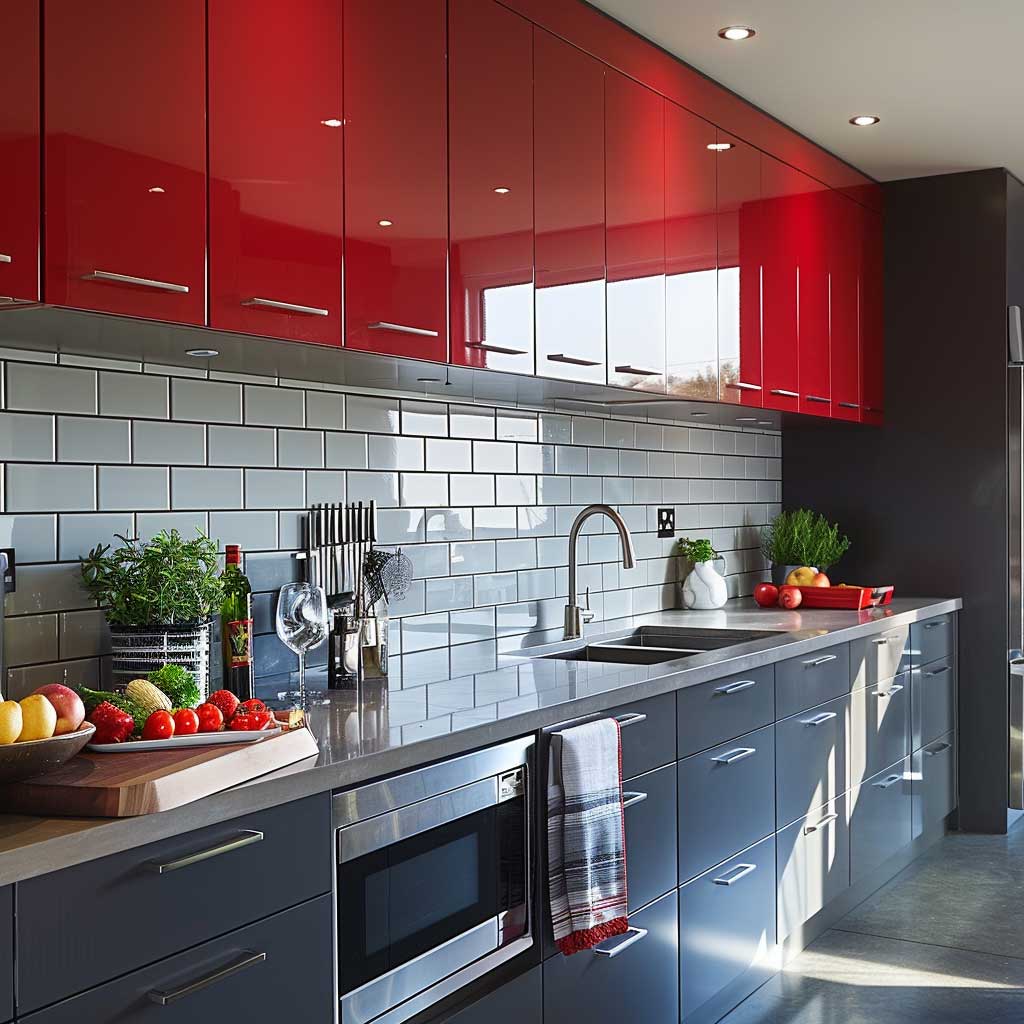
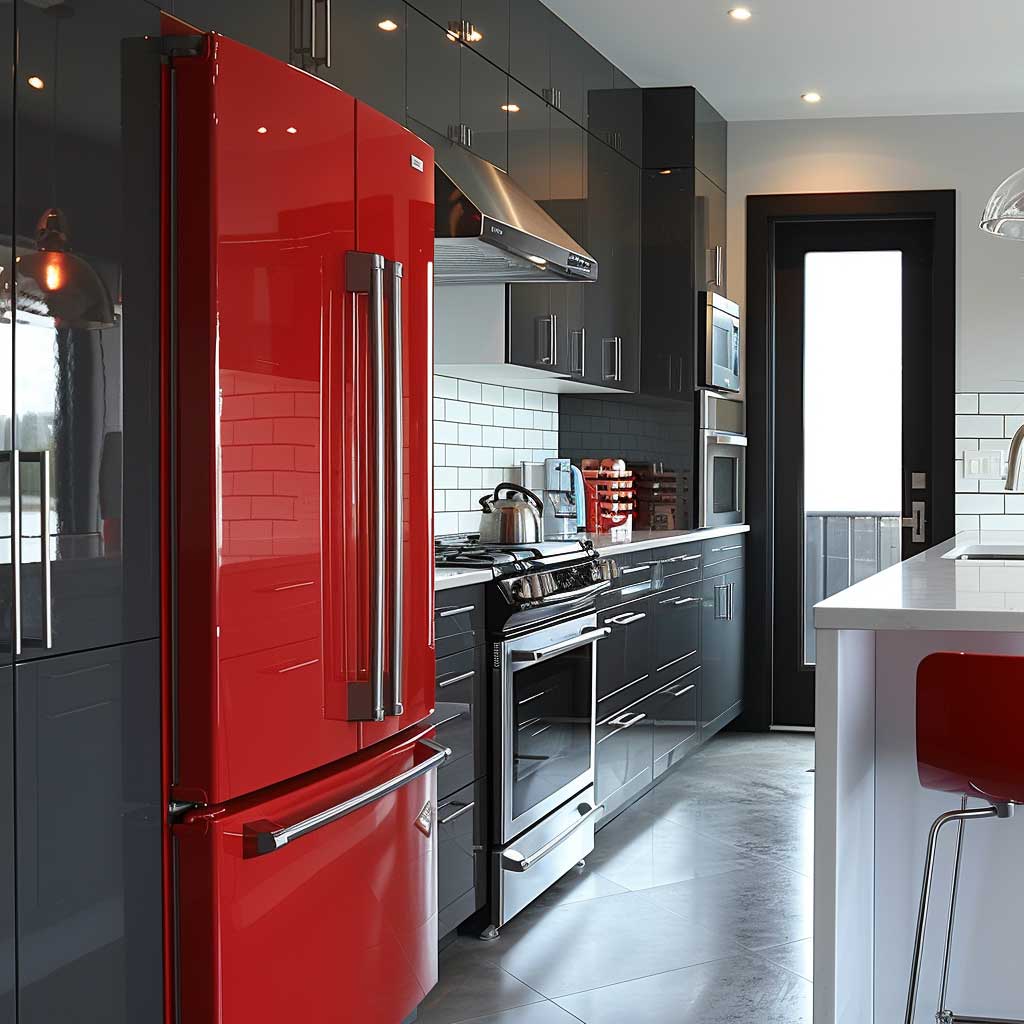
Charcoal is the steadier half of the pair, since a dark gray around LRV 10–20 absorbs most of the light that hits it and hides fingerprints, drips and toe scuffs on base doors. Is high-gloss red practical on every door? Gloss wipes clean in one pass but shows brush marks and dents far more than matte, which is why high-gloss jobs usually cost more. Don’t brush high gloss over poorly sanded doors and expect a lacquered result. Spray the red or step down to semi-gloss if the doors are already worn.
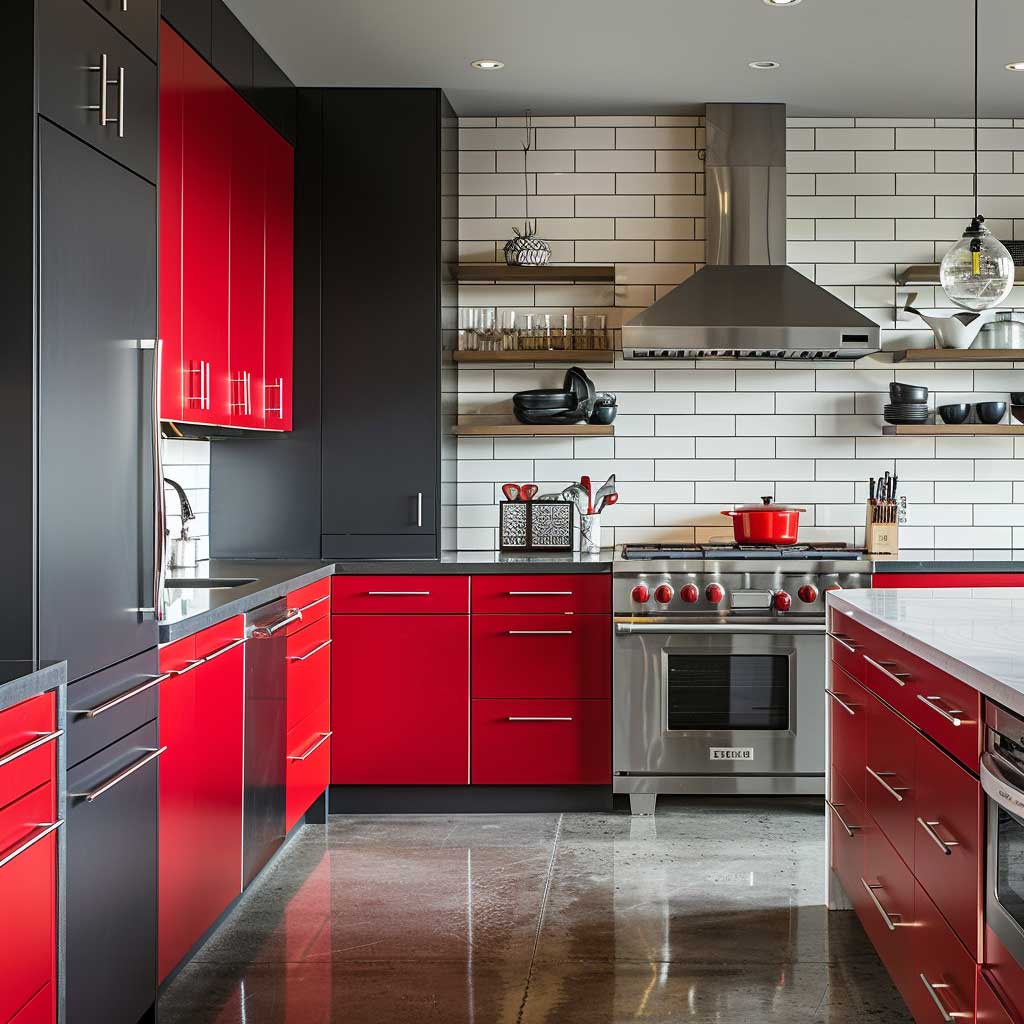
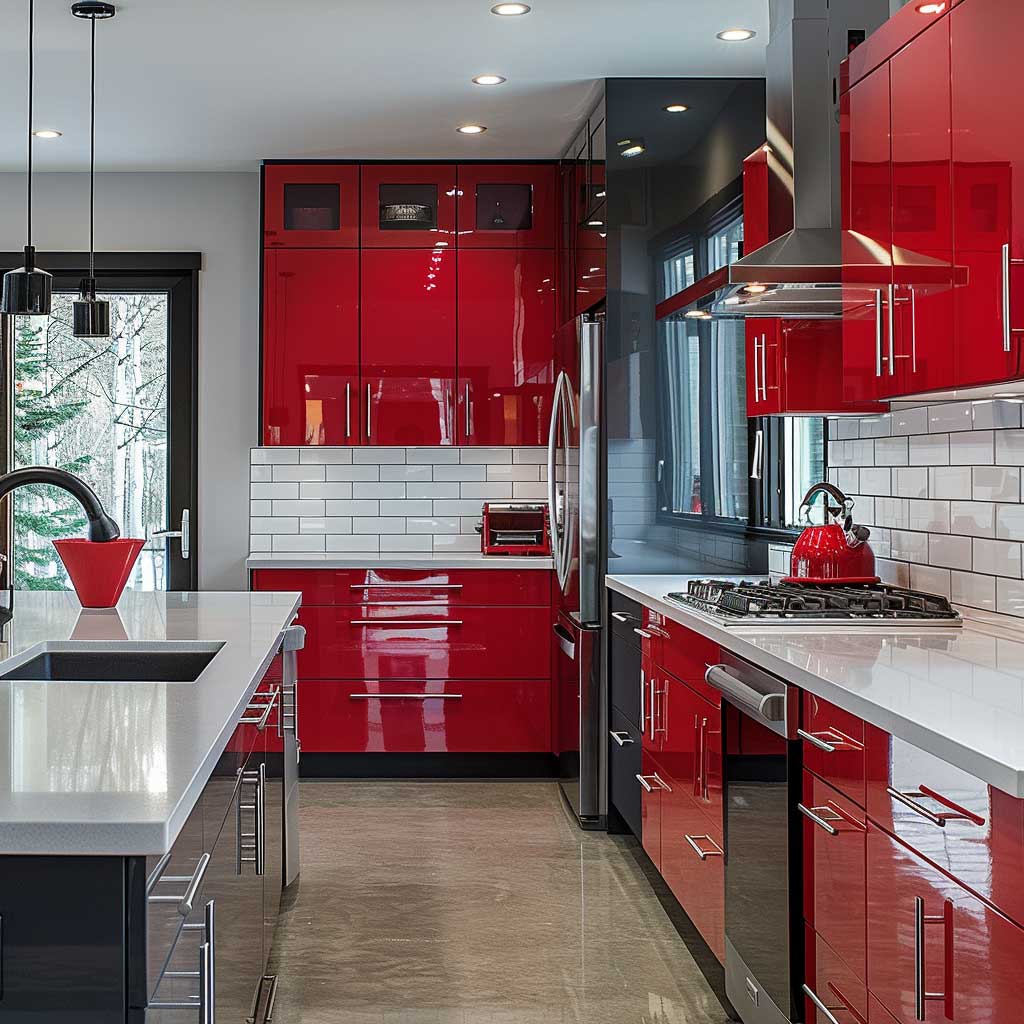
Cure time is the hidden cost of a glossy finish. Some urethane acrylic cabinet paints reach full cure in about 24 hours, while popular brush-and-roll enamels need around 30 days before they shrug off knocks. A red door rehung after two days on a slow-cure enamel can stick to the frame and tear at the edges. Keep doors off and bumper pads ready until the label’s full cure time has passed.
How Much Red a Red and Grey Kitchen Can Carry
Red and grey kitchen designs rise or fall on proportion, and the 60-30-10 split is the simplest way to set it. In a kitchen the dominant shade usually lands on cabinets and counters, the secondary one on appliances and walls, and the 10% accent on a backsplash, stools or artwork. Red can take the 30% slot or the 10% slot, never the 60%. Treat red like chili in a sauce: a spoonful lifts the dish, a cupful takes it over.
- Gray cabinets or walls cover about 60% of visible surfaces.
- A supporting neutral such as white tile, marble or stainless steel takes roughly 30%.
- Red holds about 10% as an island, a set of stools or one run of uppers.
- Red moves up to the 30% slot only in a bright room with strong daylight.
Does the same ratio work outside the kitchen? The identical split drives this guide to red office furniture balanced against calm gray, where one red hero piece sits inside 60–70% gray. Bright tomato red hits its limit fast, while burgundy and oxblood can stretch toward 15% without feeling loud. Don’t add a third saturated color once red is in the room. Match warm reds with warm grays and cool reds with blue-leaning grays.
Red Uppers and Charcoal Lowers in a Modern Red and Grey Kitchen
A modern red and gray kitchen often splits the color by height, with red wall cabinets above charcoal base cabinets. The darker half sits at kick height, where shoes, mops and pets leave marks, and the brighter half sits at eye level, where it reads as color instead of wear. A medium kitchen holds about 30–45 doors and drawers, and painters who price per piece charge roughly $70–$125 per door. Count the upper doors first, since they set the red budget.
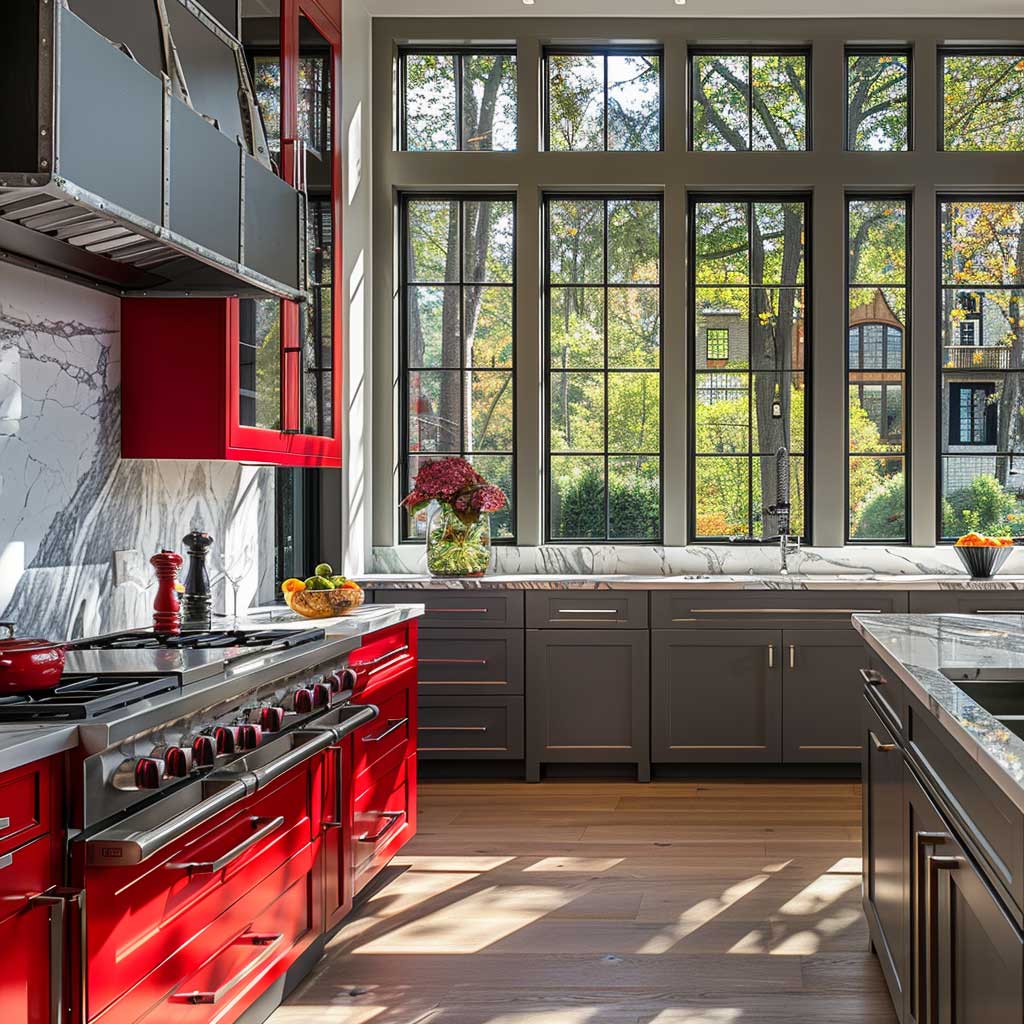
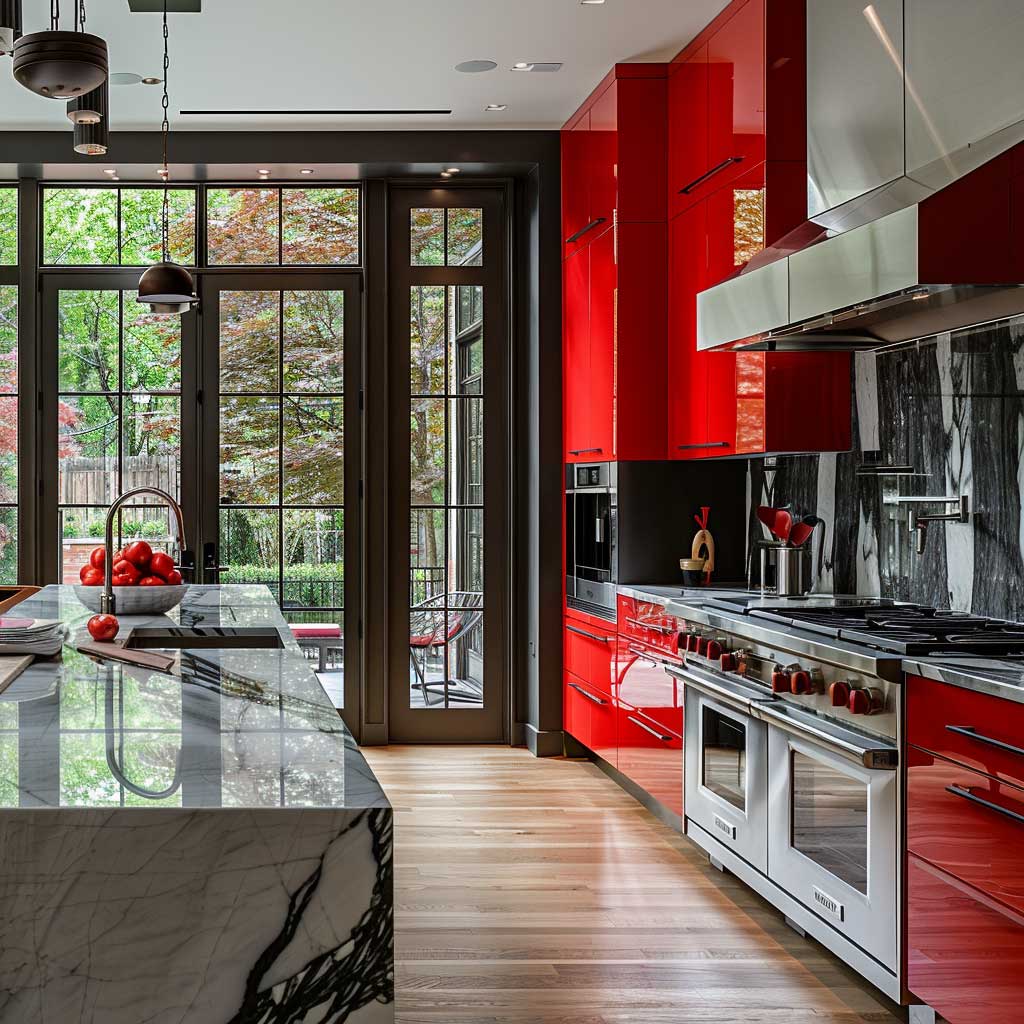
Marble is the classic surface between the two colors, and its white veining separates red and charcoal like a chalk line between two blocks of paint. Installed marble runs about $45–$180 per square foot vs $55–$150 for quartz, so a marble-look quartz gives the same contrast at a steadier price. Is real marble a risk next to the cooktop? Lemon juice and wine etch polished marble, so honed stone or quartz suits busy cooks better. Don’t pair a heavily veined slab with a patterned backsplash in the same sightline.
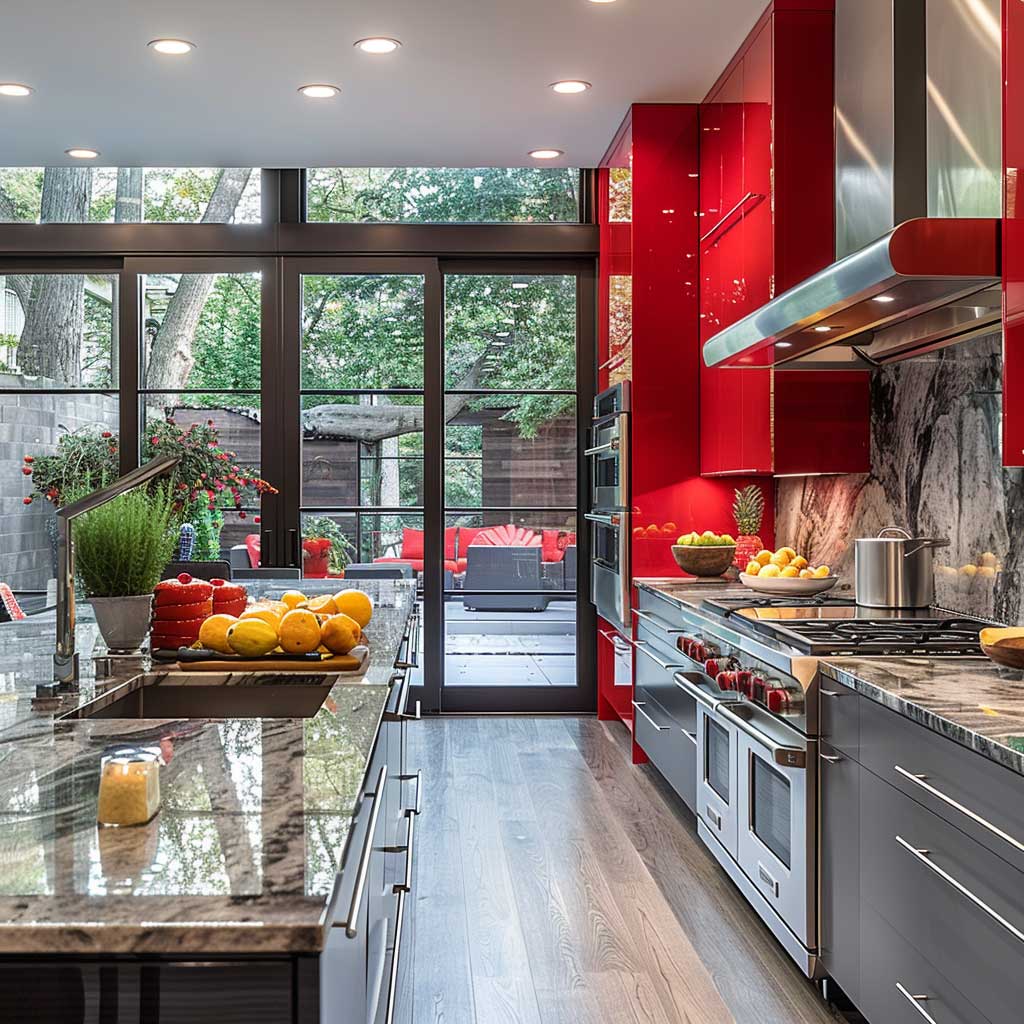
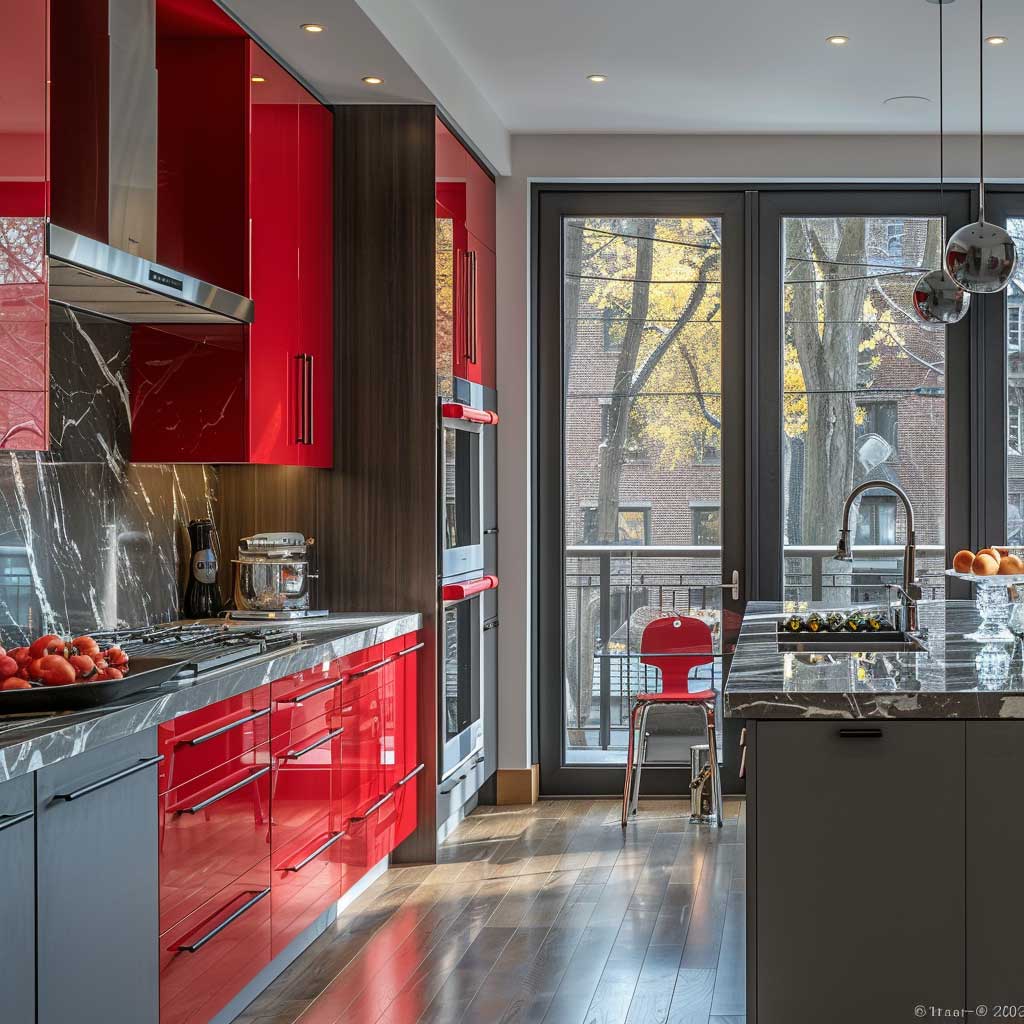
Stainless steel appliances keep a two-tone layout modern because the metal reflects both colors without adding a third hue. Window size matters just as much: red uppers look bright in a sunny kitchen, while the same paint reads close to maroon in a north-facing room with one small window. A stainless fridge vs a red retro fridge is the clearest test of restraint, and the stainless one almost always wins. Tape a painted sample board to the wall for 48 hours before ordering gallons.
Red Kitchen Walls With Grey Cabinets
Red kitchen walls with grey cabinets flip the usual scheme, giving red the backdrop role while gray keeps the furniture calm. The swap is far cheaper: a typical kitchen wall paint job averages around $800, compared with about $4,000 for professional cabinet painting. Walls also change in a weekend, which suits renters and anyone testing the color before touching doors. Paint one accent wall first and live with it for a week.
Which gray suits red walls best? Mid grays sit between bright whites at LRV 82–94 and charcoal at LRV 10–20, so they hold the red without darkening the room. Charcoal cabinets under red walls can feel like a cave in a kitchen with one window, much like a dark coat paired with a dark hat on a gray day. Don’t paint all four walls red over charcoal cabinets in a small kitchen. Keep red to one or two walls and leave the rest white or pale gray.
Deep Red, Gold Hardware and Granite for Grey and Red Kitchen Decor
Grey and red kitchen decor turns elegant when the red deepens toward wine or oxblood and the metal warms toward brass or gold. Gold pulls repeat the warm undertone of deep red and lift charcoal the way a gold watch lifts a gray suit. Replacing handles, hinges and pulls typically adds $100 to $1,000 to a cabinet project, with brass and soft-close hardware at the top of that range. Buy one sample pull and hold it against both colors before ordering a full set.
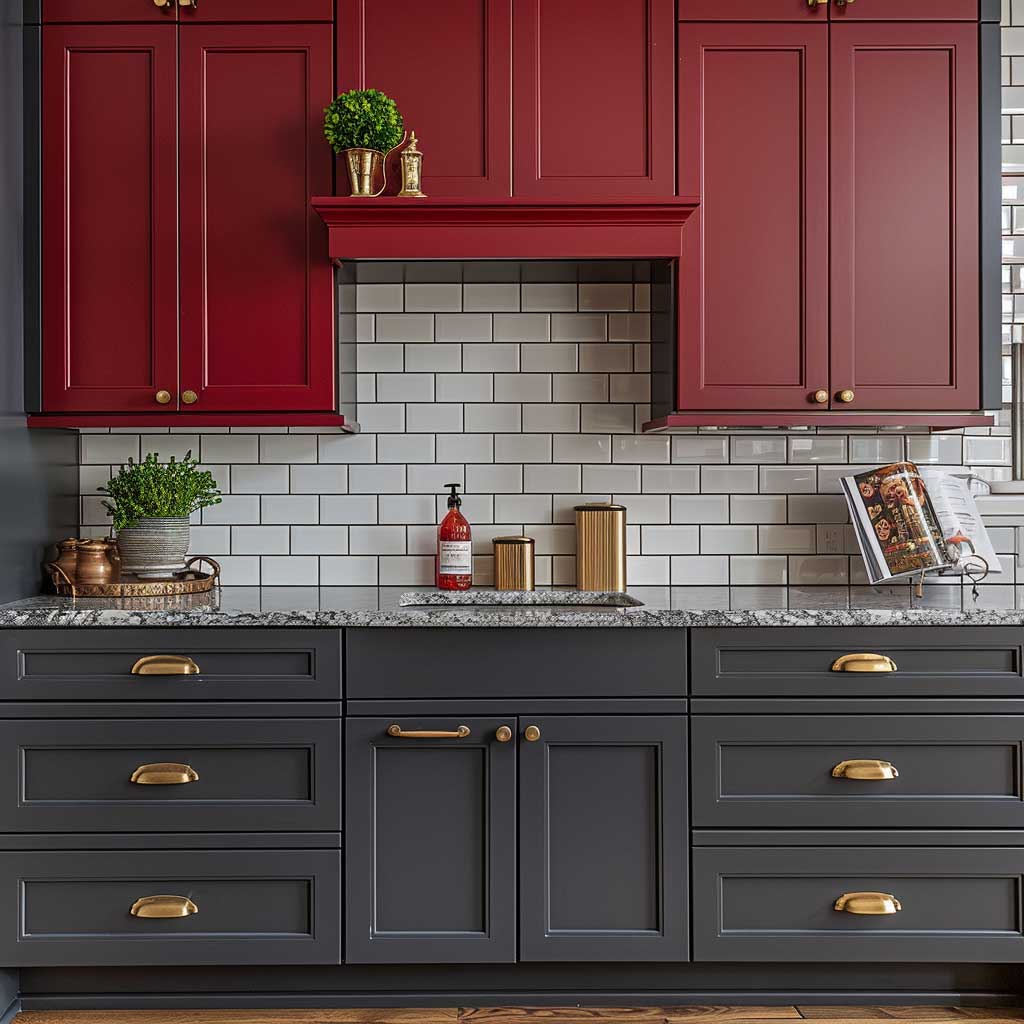
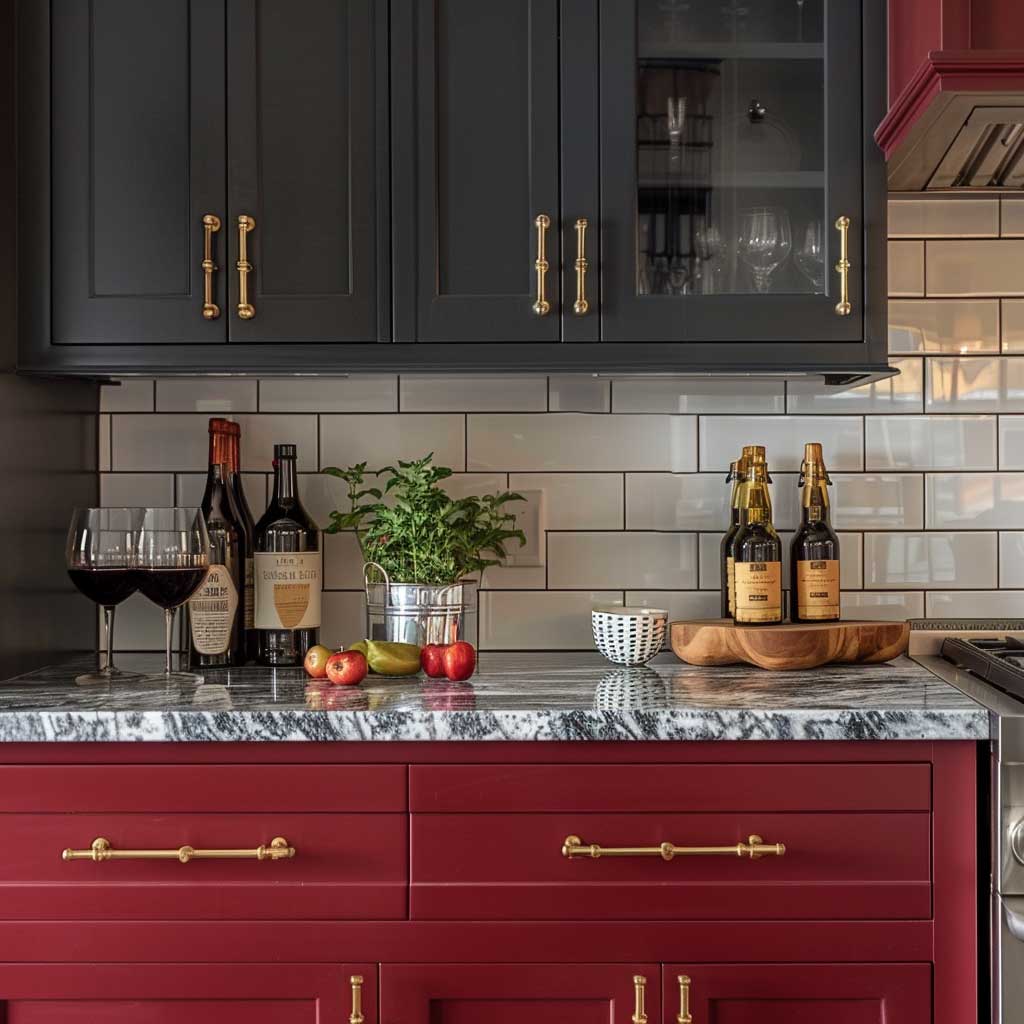
Granite suits deep red because its speckled surface often holds both warm and gray flecks that link the two cabinet colors. Installed granite runs roughly $55–$185 per square foot vs $55–$150 for quartz, and real granite needs periodic sealing that quartz skips. Does granite look dated beside gold hardware? Not when the slab is honed and the speckle is fine, while busy high-polish slabs fight the hardware for attention. Don’t choose a red-heavy granite that turns the counter into a second red surface.
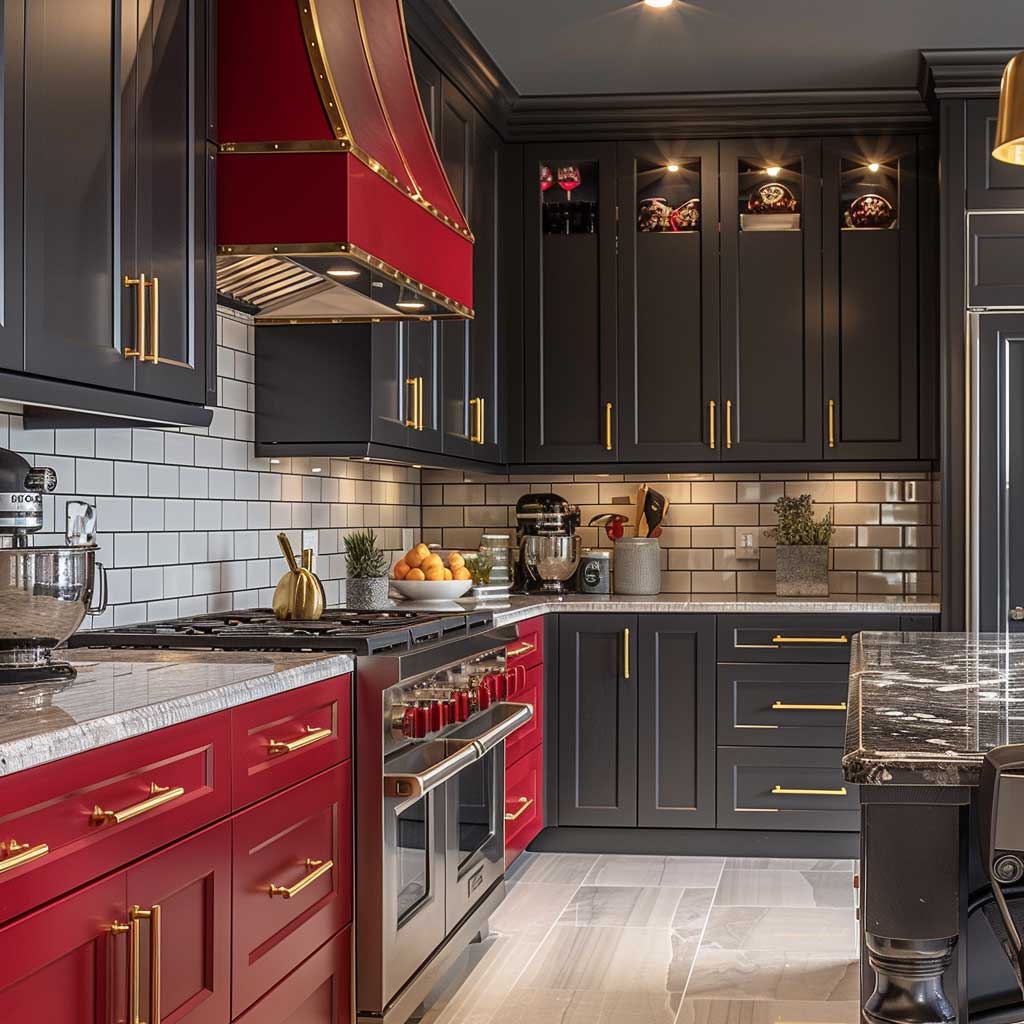
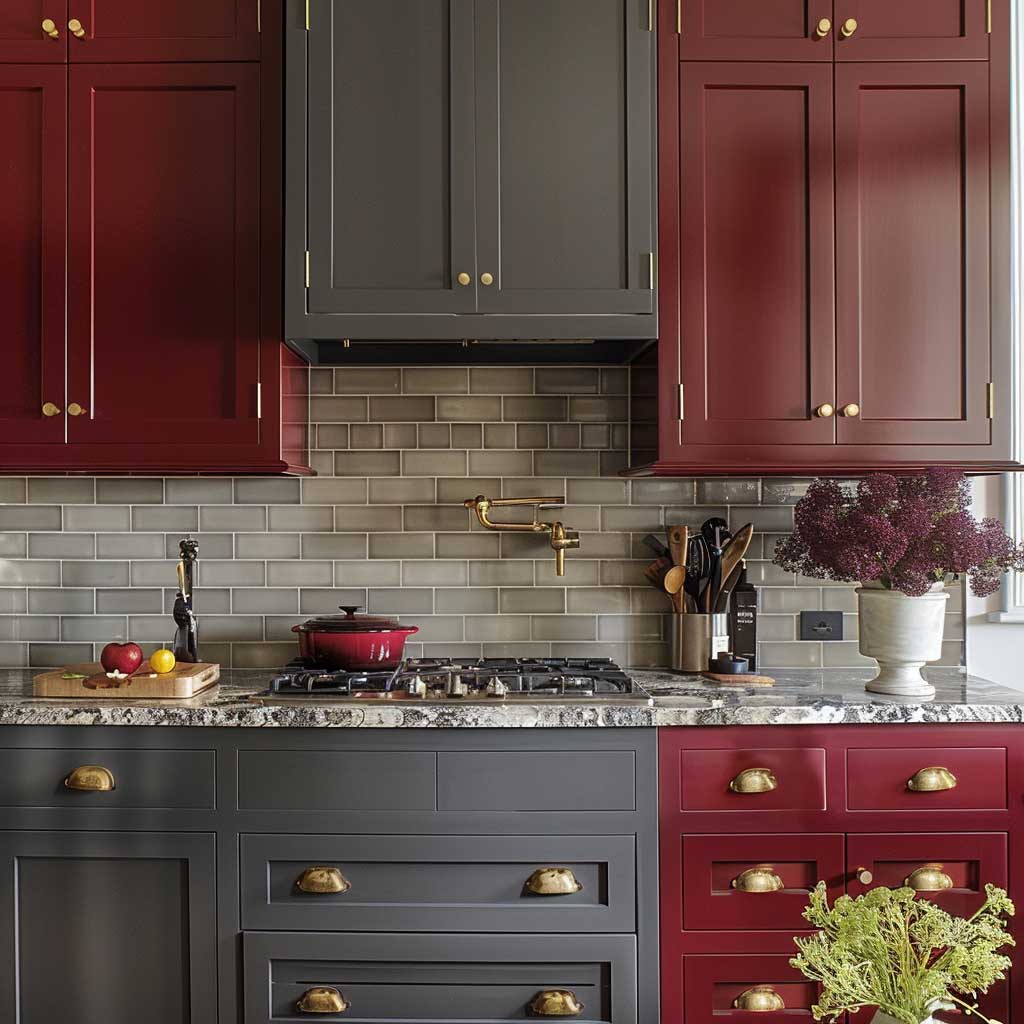
A subway tile backsplash adds a calm horizontal rhythm between deep red uppers and a speckled counter. Machine-made ceramic subway tile costs about $2 to $20 per square foot, which makes it the cheapest finish in this scheme compared with granite or brass hardware. Matching grout reads as one quiet field, while dark grout outlines every tile like a pencil sketch. Pick grout one shade darker than the tile for the easiest upkeep.
Backsplash Colours That Work With Red Tiles and Grey Cabinets
The colours that go with red tiles in a kitchen are the quiet ones, such as white, light gray, charcoal and natural wood, with gray the most reliable partner. A red tile band covers roughly 15–20 square feet between counter and wall cabinets, so on its own it already acts as a 10% accent. Most backsplash projects cost $600–$1,500 in total, with installed tile at about $30–$75 per square foot. Can red tile sit behind the stove? Yes, since glazed or porcelain tile wipes clean after grease, so use it there only when the cabinets are gray or white.
Red tile with red cabinets leaves the eye nowhere to rest, like a red shirt worn with red trousers. Gray cabinets with red tile vs red cabinets with white tile is the real choice, and both keep red near the same share of the room. Detailed prices and grout rules sit in this breakdown of modern kitchen wall tiles priced per square foot. Don’t put cement grout behind the range unless resealing every 1–2 years sounds fine, since epoxy grout needs no sealing.
Lighting That Keeps Red From Turning Brown
Lighting in a red grey kitchen decides whether the cabinets read cherry or brick, because red shifts far more than gray under different bulbs. Kitchen lighting guides set task light over counters at 3000K–4000K and warmer 2700K–3000K light over islands and seating. Very warm bulbs push red toward orange and make charcoal look muddy, while neutral-white task light keeps both colors true. Is under-cabinet lighting worth adding? Yes, since charcoal lowers swallow most ceiling light and leave the counter in shadow.
- Under-cabinet strips at 3000K–4000K over prep zones.
- Pendants at 2700K–3000K over the island or breakfast bar.
- A diffusing lens on any strip that faces glossy red doors.
Glossy red doors reflect bare LED dots as bright spots, much like a car hood under a streetlight. Matte charcoal hides those reflections, which is one more reason to keep the gloss on one color only. Don’t mix 2700K and 4000K strips along the same counter run. Choose one temperature per zone and test it on a painted sample after dark.
Red and Gray Kitchen Painting Costs Compared
Painting costs for a red and gray kitchen depend more on door count than on color, since labor makes up around 85% of a professional bill. A small kitchen with 15–20 doors and drawers usually lands at $1,000–$3,500, while a large one with 50 or more pieces can pass $10,000. Door count works like a taxi meter: each extra stop adds to the fare. Ask every painter for a per-door quote so two-tone plans compare fairly.
Painting also beats the alternatives on price, with refacing averaging about $8,250 and full replacement about $8,000 vs $4,000 for paint, according to this national cabinet painting cost breakdown. Professionally painted cabinets typically last 8–10 years with proper care. Does color change the bill? Red and charcoal often need fewer coats than white, which takes extra primer to hide grain and knots. Don’t skip a high-adhesion bonding primer, or the red will chip at the edges first.
| Scheme | Where red goes | Approx. red share | Finish pairing | Main cost driver | Best for |
|---|---|---|---|---|---|
| Glossy red + matte charcoal | Island or mixed runs | 10–30% | Semi-gloss (~50 GU) vs satin (~28 GU) | Pro paint $2,500–$6,500 | Open modern kitchens |
| Red uppers + charcoal lowers | Wall cabinets | About 30% | Gloss uppers, satin lowers | $70–$125 per door | Families and pets |
| Red walls + grey cabinets | One or two walls | 10–20% | Matte walls, satin doors | Wall paint around $800 | Renters, color testers |
| Deep red + charcoal + gold | Island or selected doors | 10–15% | Semi-gloss red, matte gray | Hardware $100–$1,000 | Classic, elegant rooms |
| Grey cabinets + red tile | Backsplash only | About 10% | Glazed tile vs satin doors | Backsplash $600–$1,500 | Small kitchens |
| Route | Typical cost | Time | What changes | Best when |
|---|---|---|---|---|
| DIY paint | About $400 in materials, 1–2 gallons | A weekend to a week | Color and sheen | Flat, sound doors |
| Professional paint | $2,500–$6,500 (avg. $4,000) | 4–5 days | Color and sheen, lasts 8–10 years | Most kitchens |
| Refacing | About $8,250 | Varies by scope | New doors and drawer fronts | Sound boxes, dated door style |
| Replacement | About $8,000 | Varies by scope | Boxes, doors and layout | Water or structural damage |
Don’t Do This
- Don’t let red pass about 30% of visible surfaces; red cabinets, red tile and red walls together read like a warning sign.
- Don’t rehang glossy red doors after 2 days if the enamel needs about 30 days to fully cure.
- Don’t mix 2700K and 4000K strips on one counter run.
- Don’t use cement grout behind the range unless you will reseal it every 1–2 years.
- Don’t pay about $8,000 for replacement when sound cabinet boxes need only $2,500–$6,500 of paint.
Where the Red Should Land
A red and grey kitchen succeeds when gray covers about 60% of the room and red stays within a 10–30% band. Where that red lives matters less than keeping it to one main surface. Uppers, an island, one wall or a tile band all work on their own.
For the biggest change per dollar, paint the uppers red and the lowers charcoal at $70–$125 per door. Keep the gloss on the red and the satin on the gray. Test both under 3000K–4000K task light before the full order.
For the lowest commitment, try red walls over gray cabinets for around $800 instead of $4,000. A single accent wall shows within a week whether the shade works in your light. Move to the cabinets only if the wall still looks right.
For a dressier finish, choose deep red, gold hardware and a honed granite or quartz counter. Budget $100–$1,000 for hardware and expect $55–$150 per square foot for quartz. Keep the backsplash plain so the metal and the red stay in charge.