A gray and yellow kitchen works because gray takes the calm, large surfaces while yellow brings warmth, so the room reads fresh instead of flat. The safest split follows the 60-30-10 rule: about 60% gray on cabinets or walls, 30% a supporting white or wood, and 10% yellow in a backsplash, an island or accessories. Does yellow make a kitchen look smaller? Only when a deep shade covers every wall, so keep the strongest yellow on one surface.
Paint numbers make the choice easier. A soft greige such as Sherwin-Williams Agreeable Gray has a light reflectance value (LRV) of 60 on a 0–100 scale, while Benjamin Moore Hawthorne Yellow sits near 71, so the yellow always reads as the brighter partner. One gallon covers roughly 350–400 sq ft per coat, which means a 12-by-12 kitchen usually needs about two gallons for two coats. Sample both colors on the same wall before buying full cans.
The proportion logic behind red and gray room schemes built on the 60-30-10 split carries straight over, with yellow taking the 10% accent slot. The sections below cover modern cabinets, Scandinavian walls, yellow paint picks, patterned walls, costs and decor, each with real figures. Start with the surface that is cheapest to change, which is almost always the wall paint.
Quick Scan
- Split the palette 60-30-10: gray leads, white or wood supports, yellow stays near 10%.
- Agreeable Gray (LRV 60) vs Hawthorne Yellow (LRV about 71): the yellow always reads brighter.
- One gallon covers 350–400 sq ft per coat; a 12×12 kitchen needs about 2 gallons for two coats.
- Professional cabinet painting runs about $2,500–6,500 vs roughly $200–600 in DIY supplies.
- A 20–40 sq ft yellow backsplash costs roughly $900–3,500 installed.
- Satin for kitchen walls, semi-gloss for cabinets and trim.
- Pale butter yellows suit north-facing kitchens; mustard suits sunny ones.
Modern Gray Cabinets Anchor a Gray and Yellow Kitchen
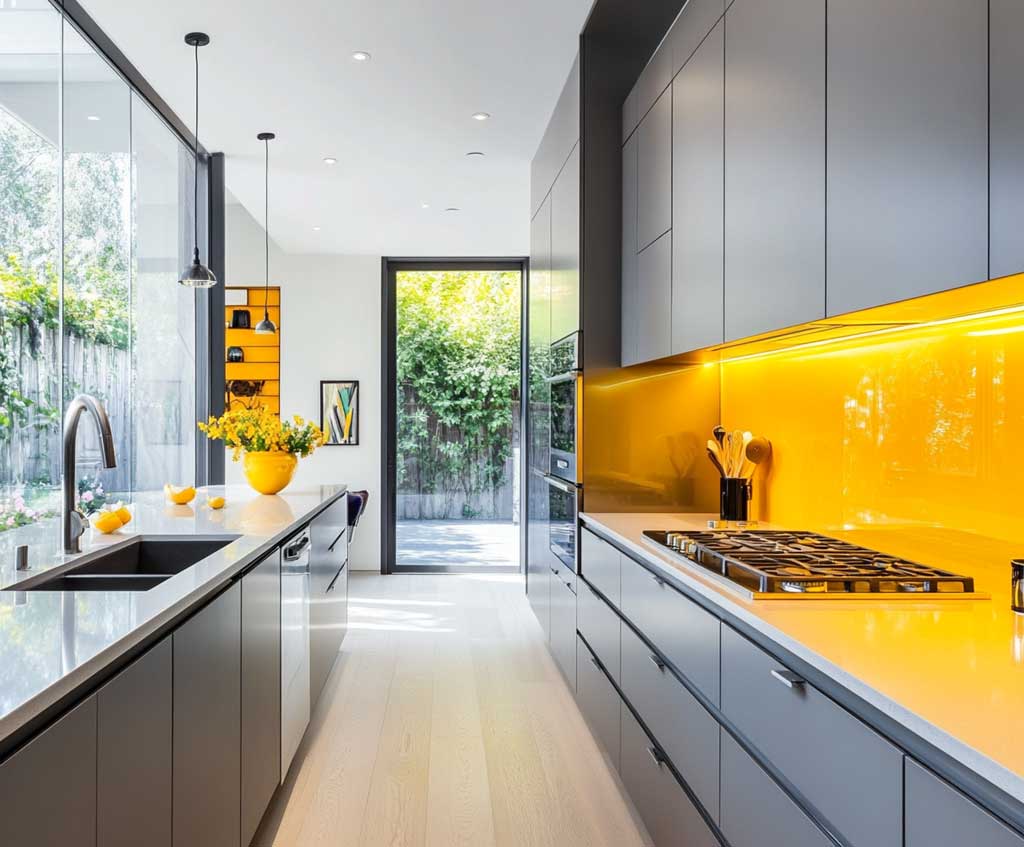
Modern gray and yellow kitchen ideas usually start with gray cabinetry and one yellow surface, most often the backsplash. Cabinets form the largest visual block, roughly the 60% share, so flat-panel gray doors with slim or hidden pulls set a clean base. A bright yellow backsplash then acts like a lit window in a stone wall, pulling the eye to the cooking zone. Keep the yellow strip between the counter and the upper cabinets so it stays a focal point rather than a flood.
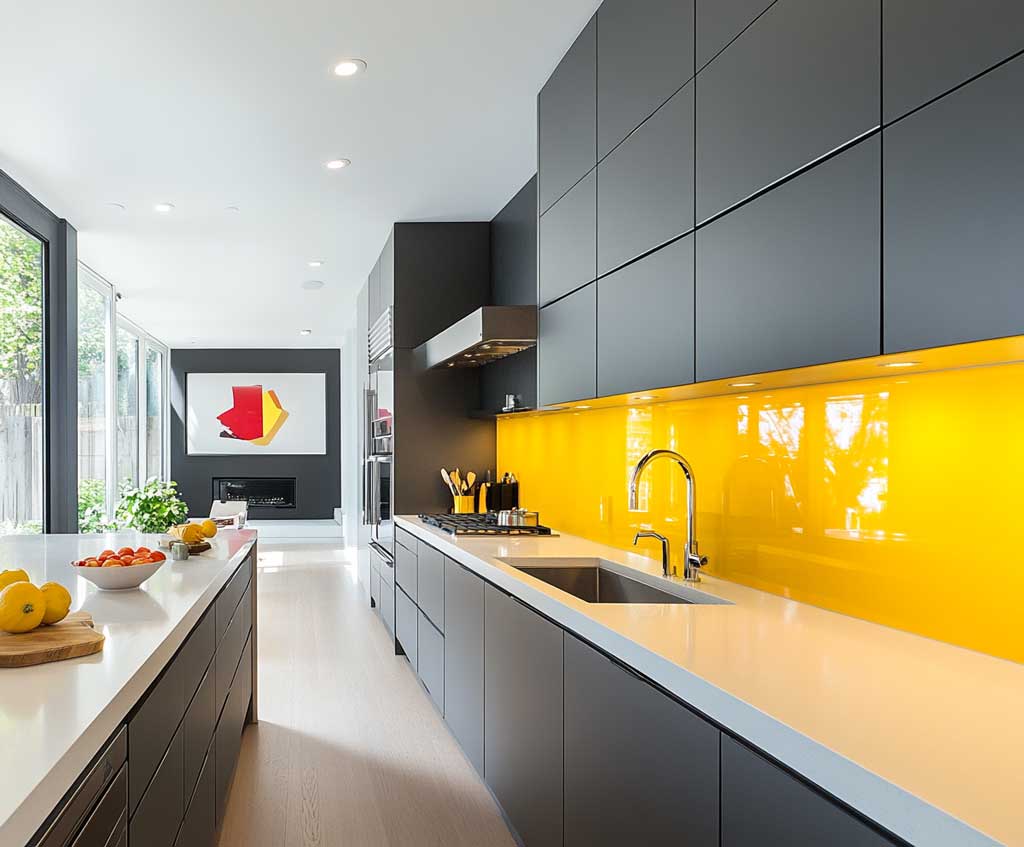
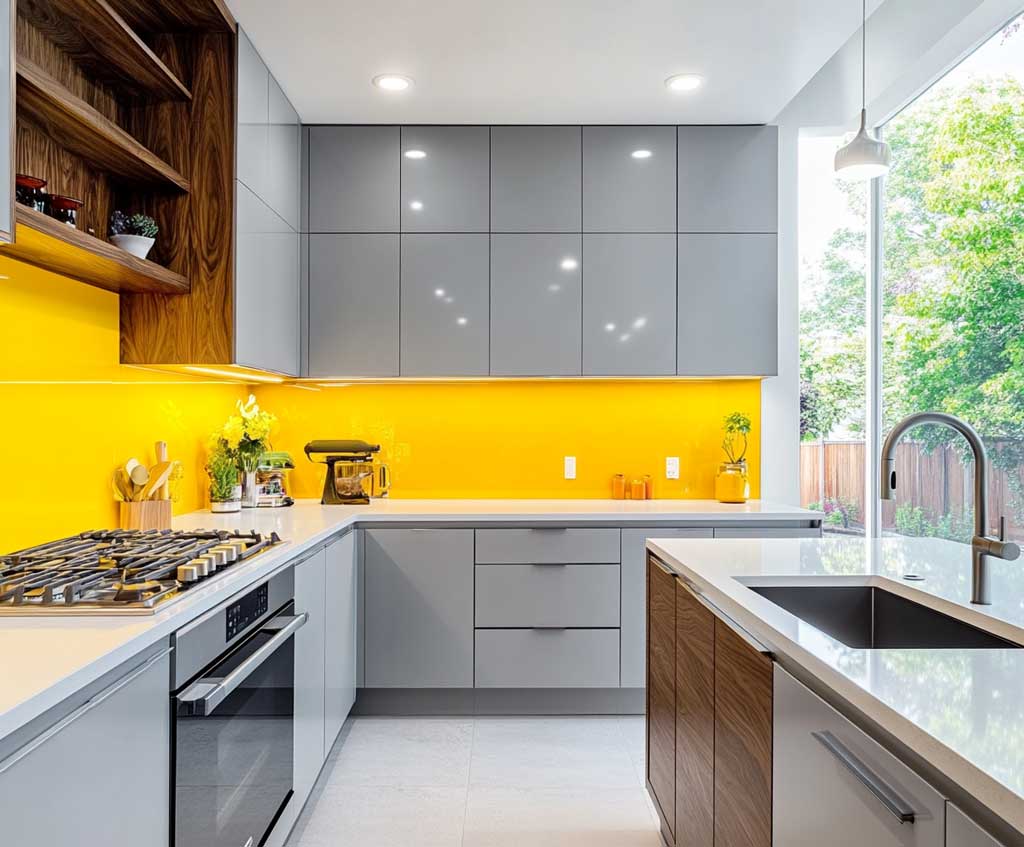
Backsplash material sets the budget. Glazed ceramic tile typically runs about $12–45 per sq ft installed against $22–75 for glass, and a standard 20–40 sq ft run lands roughly between $900 and $3,500. Glass gives the purest yellow with no grout lines, while ceramic subway tile adds texture for less money. Order 10–15% extra tile so a cracked piece never forces a color rematch.
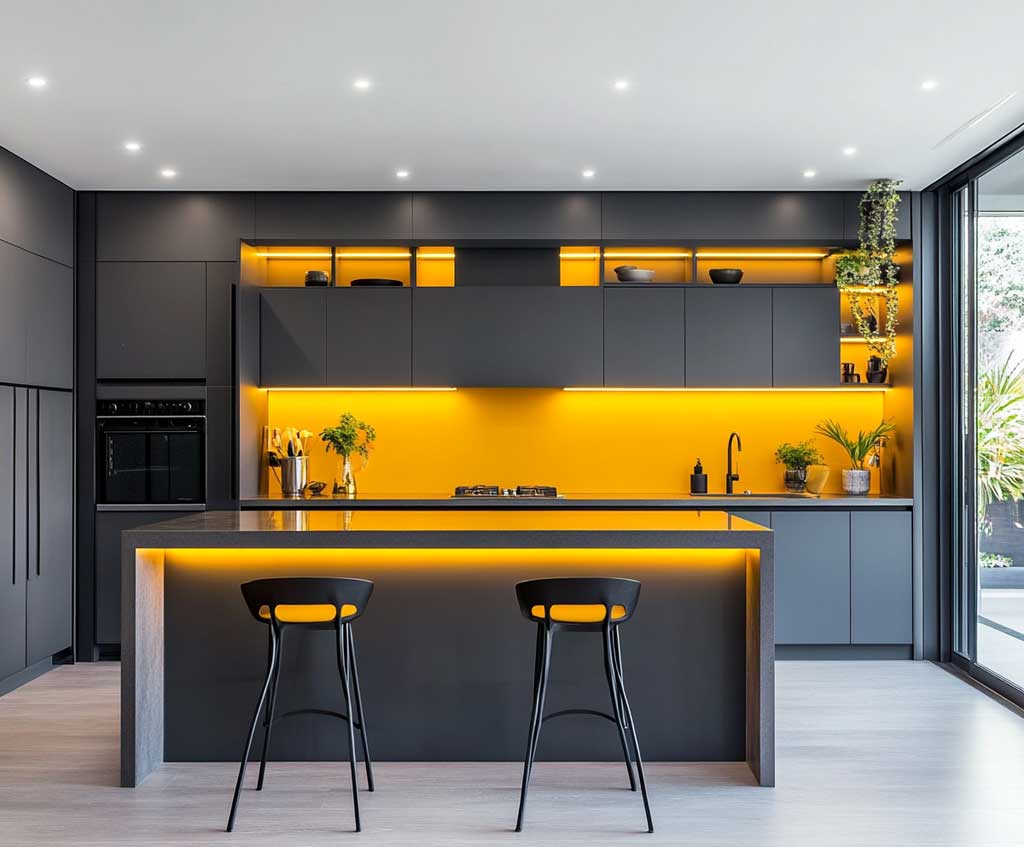
Is high gloss or matte better for gray cabinets? High gloss bounces light onto a yellow wall and makes it look brighter, whereas matte reads quieter but shows grease marks sooner. Semi-gloss is the standard sheen for cabinets and trim because it tolerates real scrubbing, while satin is the usual pick for kitchen walls. Never finish cabinet doors in flat paint, since steam and greasy fingers mark it fast.
Stainless steel appliances sit naturally between gray doors and yellow tile, like mortar between two kinds of brick. A yellow kettle, stand mixer or towel set repeats the backsplash shade for a fraction of the cost of new tile. Compare a 3000K under-cabinet LED strip with a 4000K one: the warmer light keeps yellow golden, while the cooler one pushes it toward lemon. Use one color temperature for every fixture in the room.
Soft Gray Walls Give Yellow Cabinets Room to Shine
Gray paint ideas for a kitchen in the Scandinavian mold flip the modern recipe: soft gray goes on the walls and yellow moves onto the cabinets or a coffee nook. A warm greige around LRV 60 keeps the room bright without the glare of a crisp white, which sits near 90 on the same scale. Yellow lower cabinets against gray walls feel like a sunlit meadow under an overcast sky, cheerful but grounded. Paint only the lower run yellow if the upper walls get little daylight.
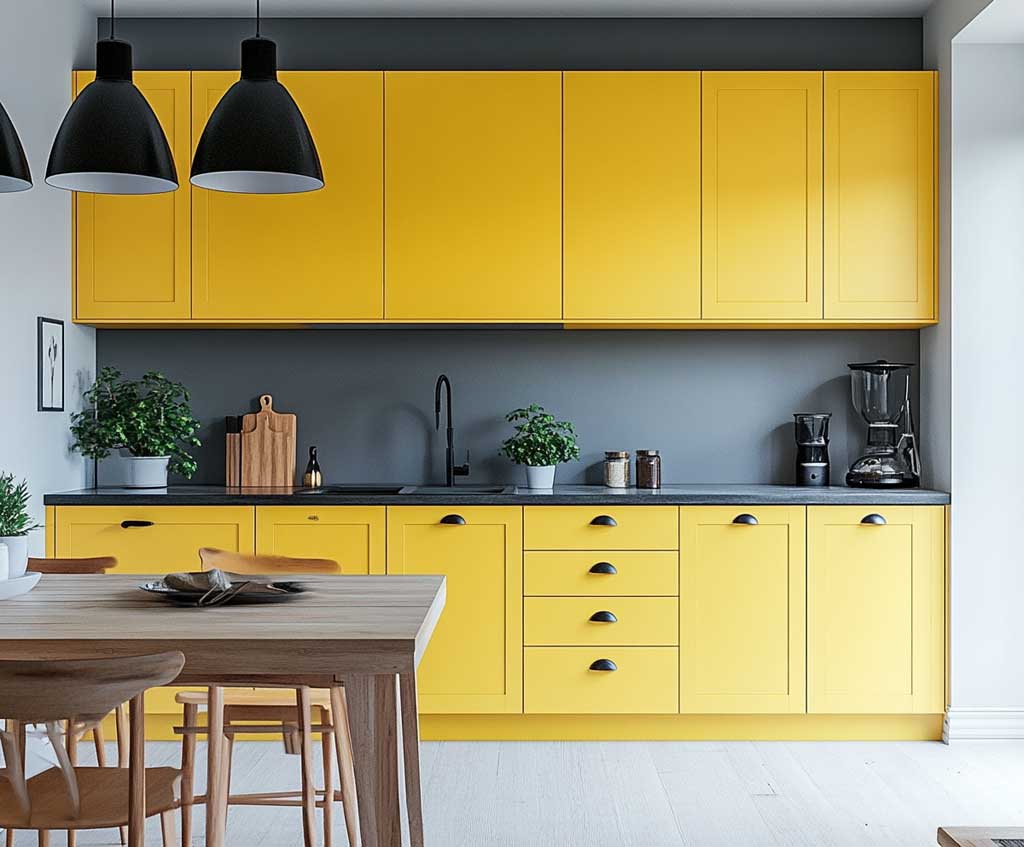
How much paint will the walls take? A gallon covers roughly 350–400 sq ft per coat, so a 12-by-12 kitchen with ordinary openings usually needs about two gallons for two coats. Mid-range paint costs around $35–60 per gallon versus $60–90 for premium paint-and-primer lines, a gap that matters far less on walls than on cabinets. Choose satin over flat for kitchen walls, because satin is the lowest sheen that wipes clean reliably.
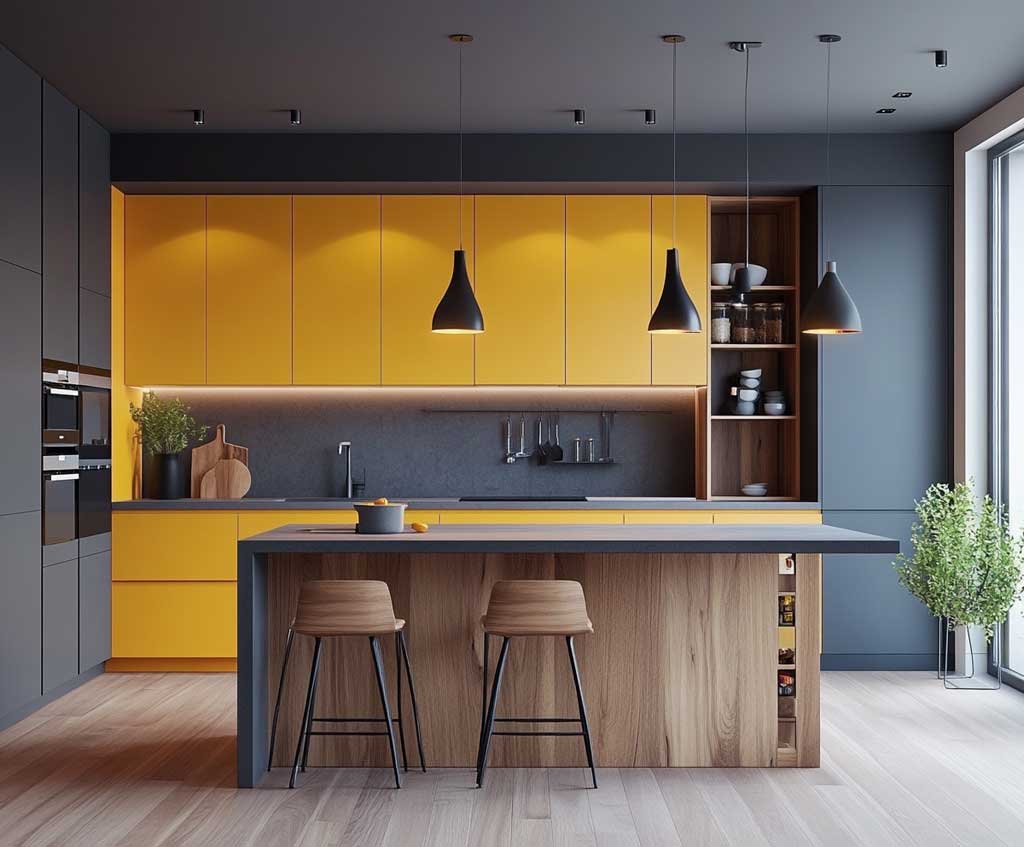
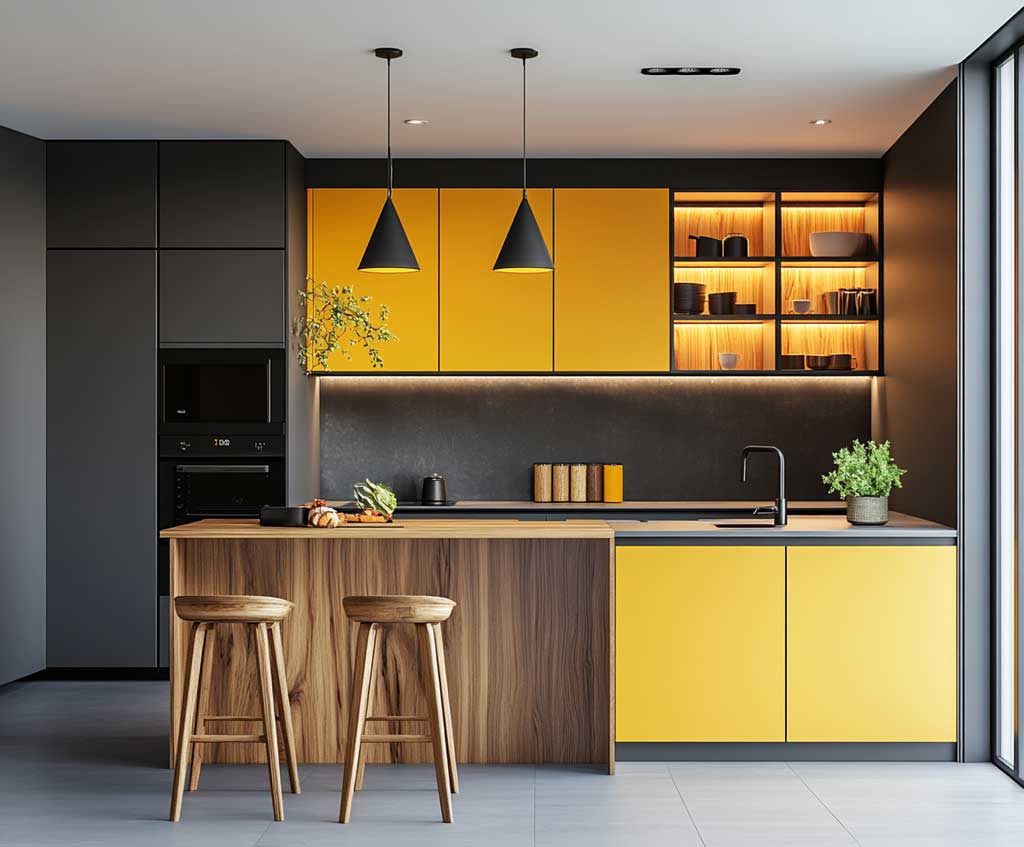
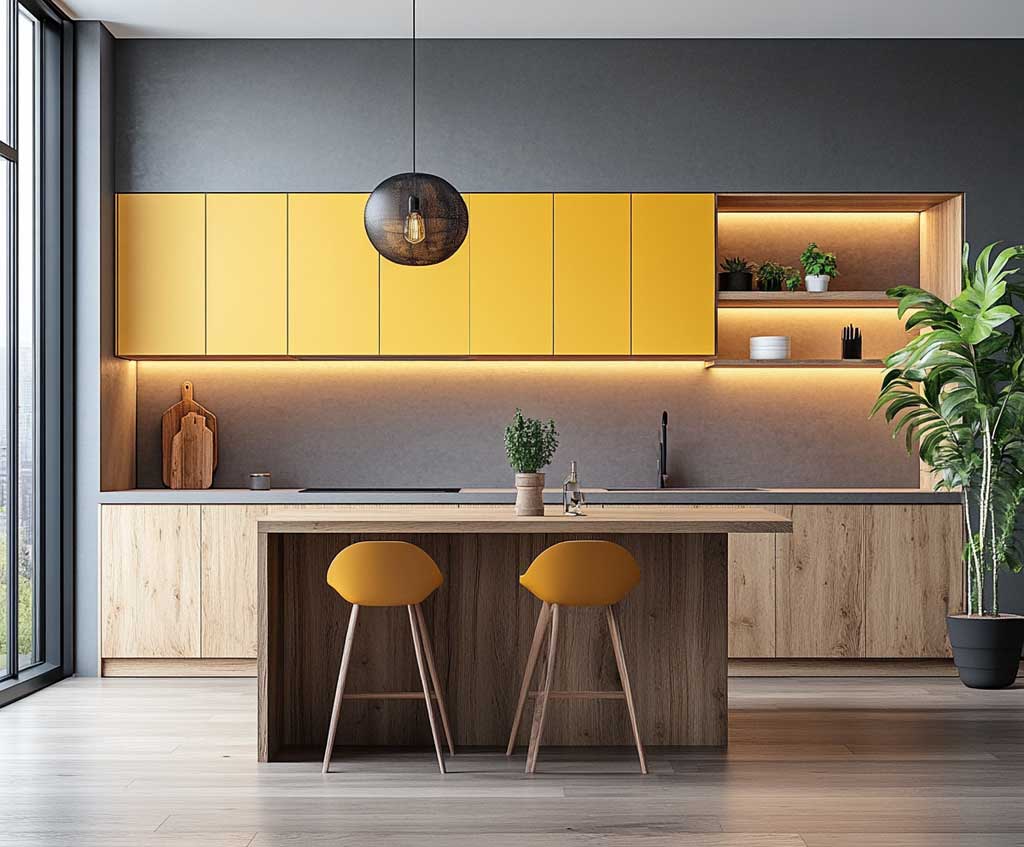
Light wood is the bridge material in this look. Oak or birch counters, a pale wood table or even a stack of cutting boards connect cool gray walls to warm yellow doors. Compare a birch counter with white quartz: the wood warms the yellow, while quartz sharpens it and tilts the room more modern. Skip dark walnut under yellow cabinets, since it can turn the pairing muddy.
Open shelving keeps the room airy, and pendants over an island give yellow fronts a spotlight after dark. Warm bulbs at 2700–3000K suit this palette best, while 4000K light can make gray walls feel clinical next to warm doors. Painted cabinets also need upkeep, and with daily wear many homeowners repaint every few years. Keep a labeled quart of each color for touch-ups.
Yellow Paint Colors for Kitchen Walls and Cabinets Compared
The best yellow paint color for a kitchen depends more on the light than on the swatch. Pale butter yellows with high LRVs, such as Benjamin Moore Weston Flax at about 69, keep north-facing kitchens bright, while deeper mustards like Dijon near 45 look rich only with strong daylight. Think of LRV as a volume dial: the higher the number, the more light the wall throws back into the room. Check which way your window faces before falling for a chip.
Which yellow is the safest first pick? Hawthorne Yellow is the classic middle ground, and the Benjamin Moore Hawthorne Yellow color page lists an LRV of 71.33 and names Wickham Gray among its coordinating colors. That pairing shows the rule worth copying: a soft mid gray next to a yellow roughly 10 points brighter. Don’t pair a lemon-bright yellow with a cool blue-gray, because the undertones fight; match warm with warm and cool with cool.
| Color | Type | LRV | Best surface | Gray partner | Light it suits |
|---|---|---|---|---|---|
| Weston Flax (Benjamin Moore) | Pale butter yellow | About 69 | Walls | Warm greige around LRV 60 | North-facing, low light |
| Hawthorne Yellow (Benjamin Moore) | Classic soft yellow | 71.33 | Walls or island | Wickham Gray | Most kitchens |
| Dijon (Benjamin Moore) | Mustard | About 45 | Island, lower cabinets | Charcoal or mid gray | South-facing, strong daylight |
| Agreeable Gray (Sherwin-Williams) | Warm greige | 60 | Walls, cabinets | Base for butter or classic yellow | Almost any room |
Sample pots save more money than any discount. Two or three test patches of about 2 by 2 feet, viewed at 9 a.m. and again at 7 p.m., show how much a yellow shifts between daylight and bulbs. Butter yellow drifts toward cream under warm light, while mustard can drift toward olive under cool light. Paint samples on two walls, not one, before choosing.
Pale Yellow and Grey Kitchen Patterns Without the Clutter
A pale yellow and grey kitchen leans on pattern instead of strong color, usually gray wallpaper on one wall and pastel yellow drawers or shelves nearby. A geometric or botanical print adds texture, and soft yellow keeps it friendly rather than fussy. Pattern behaves like spice: one feature wall seasons the room, while four walls make it inedible. Limit a busy print to a single wall behind shelving or a breakfast corner.
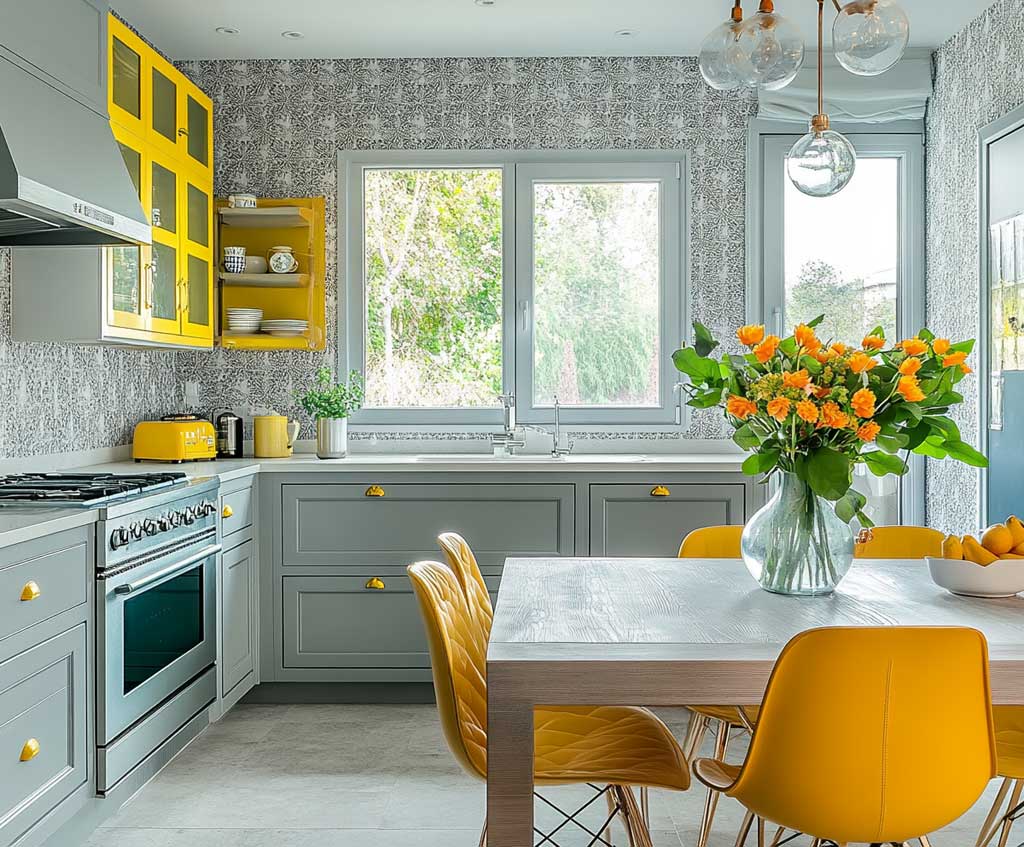
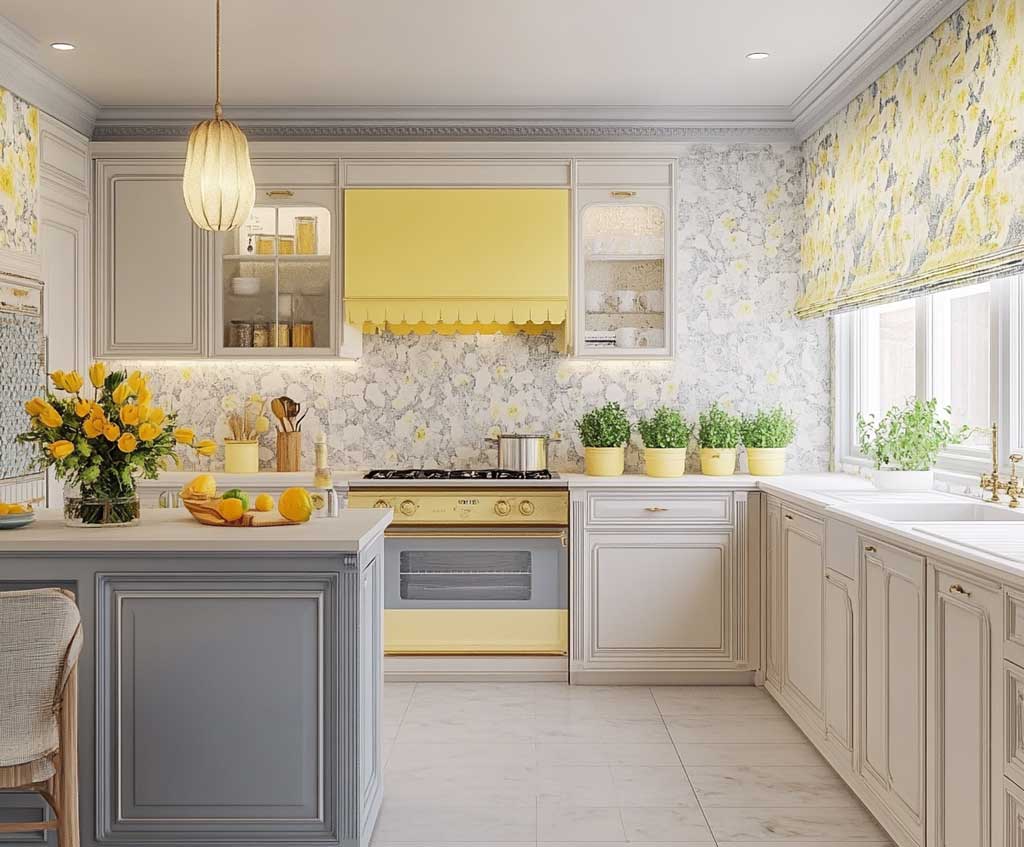
Pastel yellows in the LRV 69–71 range sit comfortably beside a patterned gray because they add light without adding contrast. Compare that with a mustard near 45, which competes with the print and makes the wall look busier than it is. Moisture matters too, so pick vinyl or other wipeable papers over uncoated paper that can lift with steam. Should wallpaper go behind the stove? No, keep it on a wall away from direct splash and tile the cooking zone.
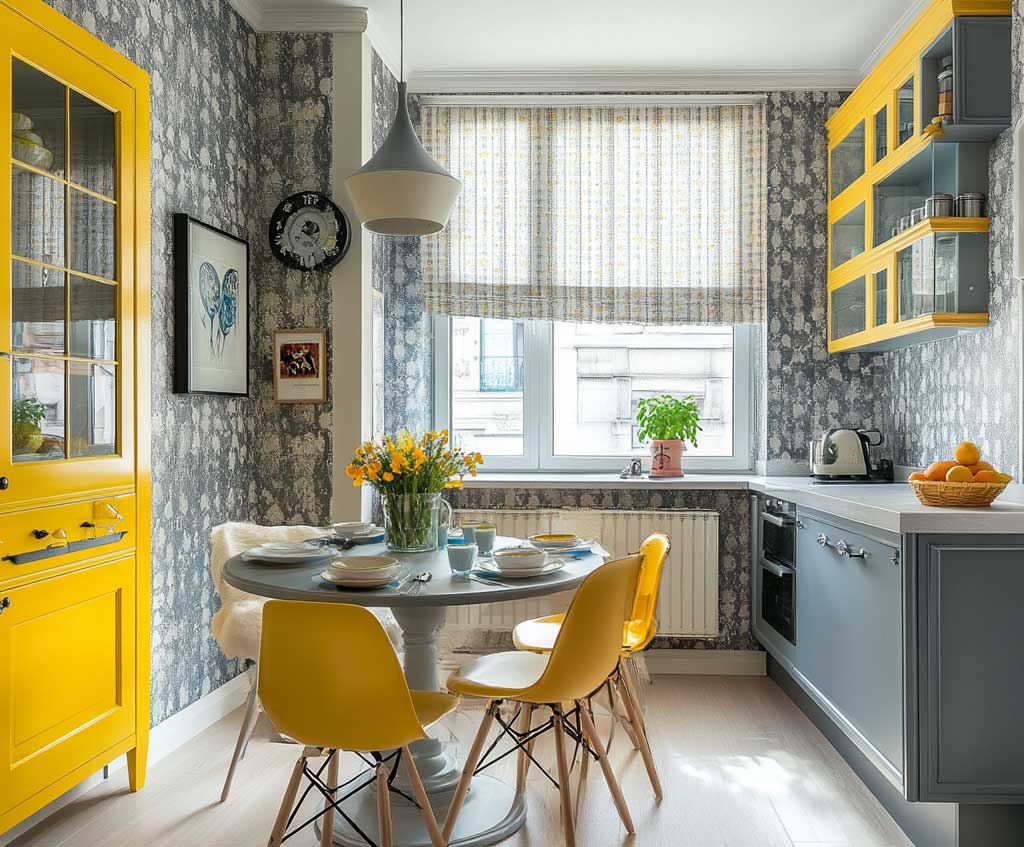
Furniture and light keep the pattern in check. Light gray or white mid-century chairs pick up the wallpaper’s base tone, while track lights or soft overhead fixtures show off the feature wall without harsh glare. Compare 2700K with 4000K bulbs: warm light softens gray motifs, cool light sharpens every line of the print. Put the pattern wall on a dimmer rather than adding brighter bulbs.
Vintage signs, old dishware and two or three herb pots add personality that suits a patterned wall. Green leaves sit well beside both gray and yellow, bringing a third color without another paint can. Keep yellow accents near 10% of what you see, because pastel yellow fighting a print turns into visual noise. Choose two or three yellow objects and repeat them instead of mixing six shades.
Yellow Kitchen Walls With Grey Cabinets and What They Cost
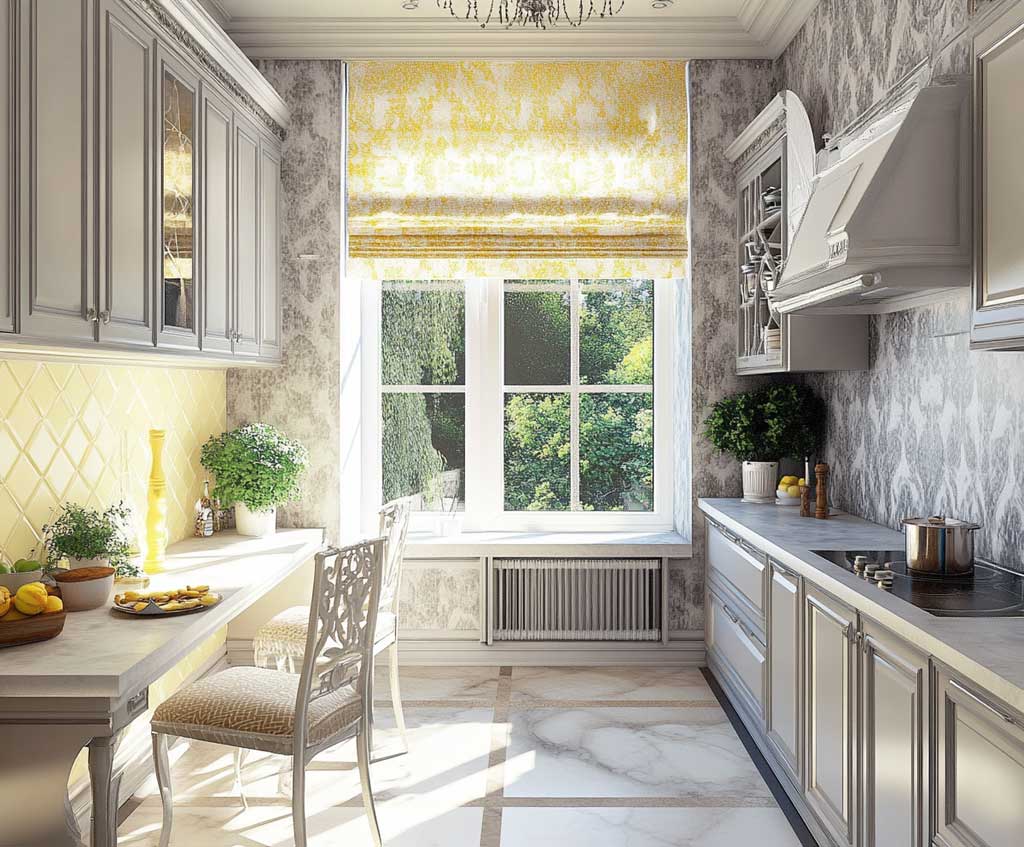
Yellow kitchen walls with grey cabinets flip the usual split, letting the walls glow while the cabinets stay neutral. The layout suits closed kitchens with one small window, because a yellow around LRV 70 returns more light than most grays near 60. Gray cabinets work like a gray suit, and yellow walls are the tie that gives the outfit its mood. Paint the walls first if the budget covers only one change, since two gallons of mid-range paint cost roughly $70–120.
Cabinets are where the money goes. Professional cabinet painting usually runs about $2,500–6,500 with an average near $4,000, while DIY supplies cost roughly $200–600 and an average kitchen needs one to two gallons of cabinet paint. A beginner can spend 50 hours or more stripping, repairing and repainting a full set of doors. Is DIY worth it? For simple slab doors and a patient schedule often yes, but inset or profiled doors usually justify a pro at about $45–55 per hour.
| Option | Where yellow goes | Typical cost | Material need | Sheen | Best for |
|---|---|---|---|---|---|
| Gray cabinets + yellow backsplash | 20–40 sq ft of tile | $900–3,500 installed | Tile plus 10–15% spare | Glazed tile | Modern kitchens |
| Gray walls + yellow cabinets | Cabinet doors and boxes | $2,500–6,500 pro or $200–600 DIY | 1–2 gallons of cabinet paint | Semi-gloss | Scandinavian looks |
| Yellow walls + gray cabinets | Walls | About $70–120 in mid-range paint | About 2 gallons for two coats in a 12×12 room | Satin | Low-light kitchens |
| Gray pattern wall + pale yellow accents | Drawers, shelves, decor | Labor about $45–55 per hour if hired | One feature wall of washable paper | Satin on painted parts | Small, character-driven kitchens |
Don’t Do This
- Don’t split gray and yellow 50/50; keep yellow near 10% for accents and no more than about 30% even when it covers the walls.
- Don’t stretch a gallon past 350–400 sq ft per coat, or yellow will dry patchy and need a third coat.
- Don’t use plain wall paint on cabinets; cabinet-grade paint or a durable topcoat prevents early chipping from heat and grease.
- Don’t mix 2700K and 4000K bulbs in one kitchen, or the same yellow will look like two different shades.
Corners are the weak spot in this layout, because a dark L- or U-shaped corner swallows yellow light. One option is borrowing ideas from white corner kitchen cabinet ideas that brighten dead space and running a white corner unit between gray runs. A crisp white near LRV 90 lifts that zone far more than a gray near 60. Test a white sample in the darkest corner before ordering doors.
Decor and Accessories That Finish a Yellow and Gray Kitchen
Yellow and gray kitchen decor is the cheapest way to test the palette before committing paint or tile. Three to five yellow pieces spread around the room give the eye a path to follow, while a single yellow object tends to look accidental. Accessories behave like highlighter on a page: a few marked lines guide the reader, a fully yellow page tells them nothing. Place yellow at three heights, such as a counter, a shelf and a window.
How much should accessories carry? In a room with gray cabinets and white counters, decor alone can supply the full 10% yellow share. Compare a yellow kettle, towels and a runner with a $900-plus tiled backsplash: accessories cost a fraction and swap out by season, while tile gives permanent impact. Never add a second bright accent such as orange or red, since yellow needs to stay the only loud voice.
- A yellow kettle or stand mixer on the main counter.
- Two or three yellow dish towels or a runner near the sink.
- One yellow print or botanical frame on a gray wall.
- Yellow ceramics on open shelves, grouped in odd numbers.
- Brass or warm-metal pulls that echo yellow without adding paint.
Textiles and metals finish the scheme. Gray linen seat cushions and a striped yellow-and-gray rug tie floor and furniture together, and brass hardware warms cool grays where chrome would chill them. Brushed brass suits warm greige near LRV 60, whereas chrome suits blue-leaning grays. Pick one metal finish and repeat it on pulls, faucet and lights.
The Verdict on a Gray and Yellow Kitchen
A gray and yellow kitchen succeeds when gray covers about 60% of what you see and yellow stays near 10%, and fails when the two split evenly.
For walls, a warm greige around LRV 60 next to a yellow around 70 gives the cleanest contrast, and about two gallons cover a 12×12 kitchen in two coats.
Cabinets are the big spend, at roughly $2,500–6,500 for a pro job versus $200–600 in DIY supplies, so paint walls or add accessories first if budget is tight.
Keep satin on walls, semi-gloss on cabinets, one bulb temperature between 2700K and 3000K, and match warm yellows with warm grays for a kitchen that still looks right ten years on.