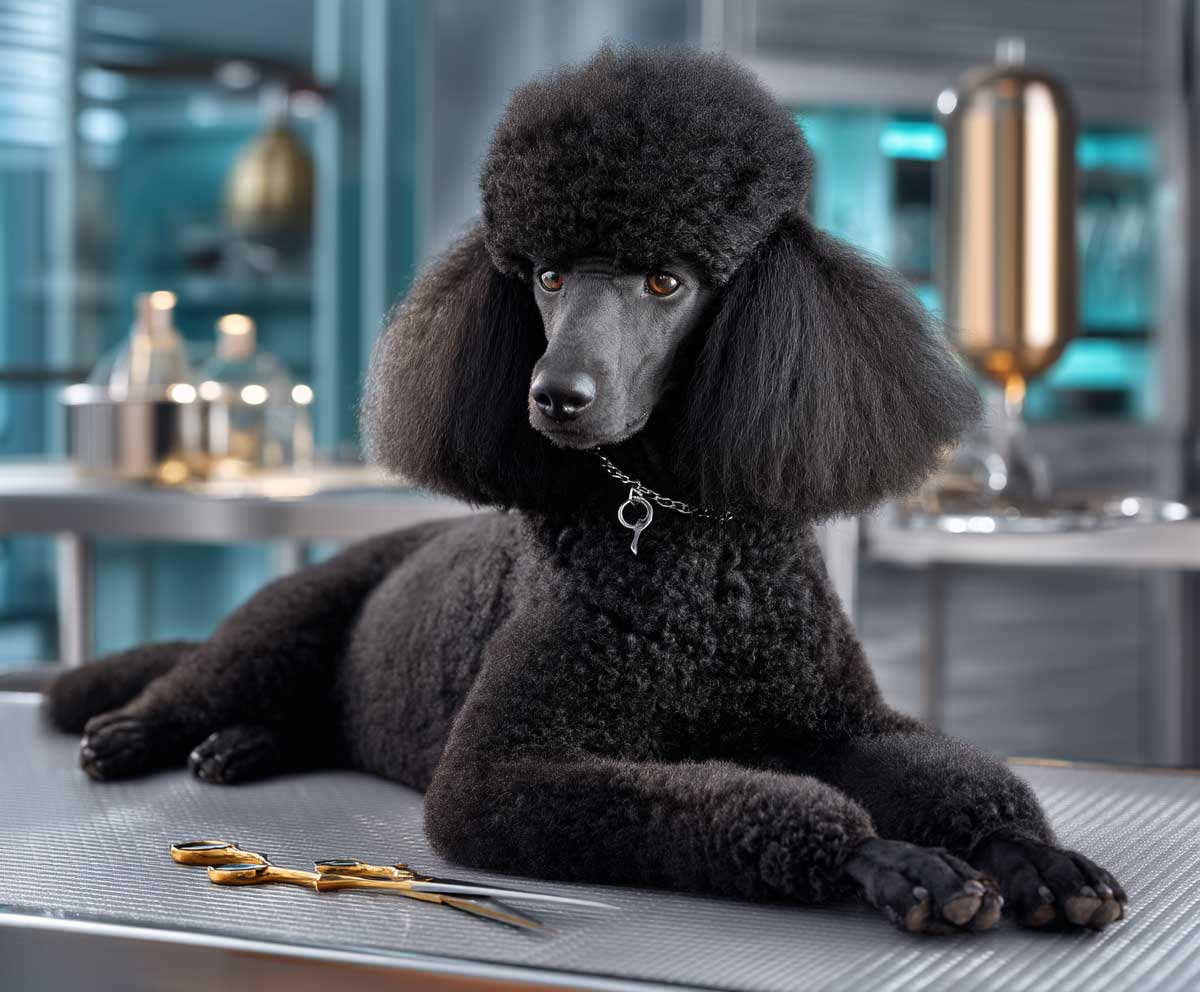
The german cut poodle isn’t a revival trend — it’s a return to function dressed up in a silhouette that happens to photograph extremely well. What looks like a deliberate aesthetic choice traces back to working-dog biomechanics: shaved areas reduced water drag when the breed was used for retrieval, while coat kept over the chest and joints insulated against cold. You’ll notice this logic written into the cut every time you see one up close.
Groomers at mid-to-high-end salons charge $110 to $200 for a standard poodle in this trim — that price reflects the scissor time required for the topknot and body shaping, which can’t be rushed without losing the cut’s proportion. The german poodle cut is one of the few pet styles where the result actually looks worse if you cut corners on the technique.
Across coat colors, the cut reads differently but the underlying geometry stays the same: shaved face, feet, and tail base; shaped body volume through the chest and loin; rounded topknot that centers over the skull. Whether the dog is a black standard or a cream miniature, that structure is what separates a german trim poodle from a generic scissor cut.
• The german cut poodle shaves face, feet, and ears — areas that trap moisture and debris — while preserving full coat on the chest and body for insulation and visual structure
• Standard poodle grooming in this trim runs $110–$200 per session at quality salons; appointments needed every 4–6 weeks to keep the lines clean
• The AKC recommends Andis or Oster clippers with a #15 or #30 blade for face and feet; a #4–7 blade handles body clipping
• Black coats reveal every scissor inconsistency; cream and apricot coats are more forgiving — advanced groomers use dark-coated dogs to test their precision
• The poodle crest (topknot) is the hardest part of this cut to maintain at home — even a minor imbalance in the head shape collapses the entire proportion
Why Dark Fur Sharpens Every Line of the German Cut Poodle
A black standard poodle in german cut standing on a stone path is not an easy groom to produce — and the coat color is why. Dark fur amplifies every edge, meaning the line where clipped feet meet full leg volume is either precise or visibly wrong. Groomers who specialize in the german cut poodle often say that a black dog is their real test case: if the scissor lines hold on black, they hold on anything. The silhouette created — square chest, tight belly tuck, rounded topknot — reads as intentional rather than incidental, which is exactly why this style dominates poodle photography.
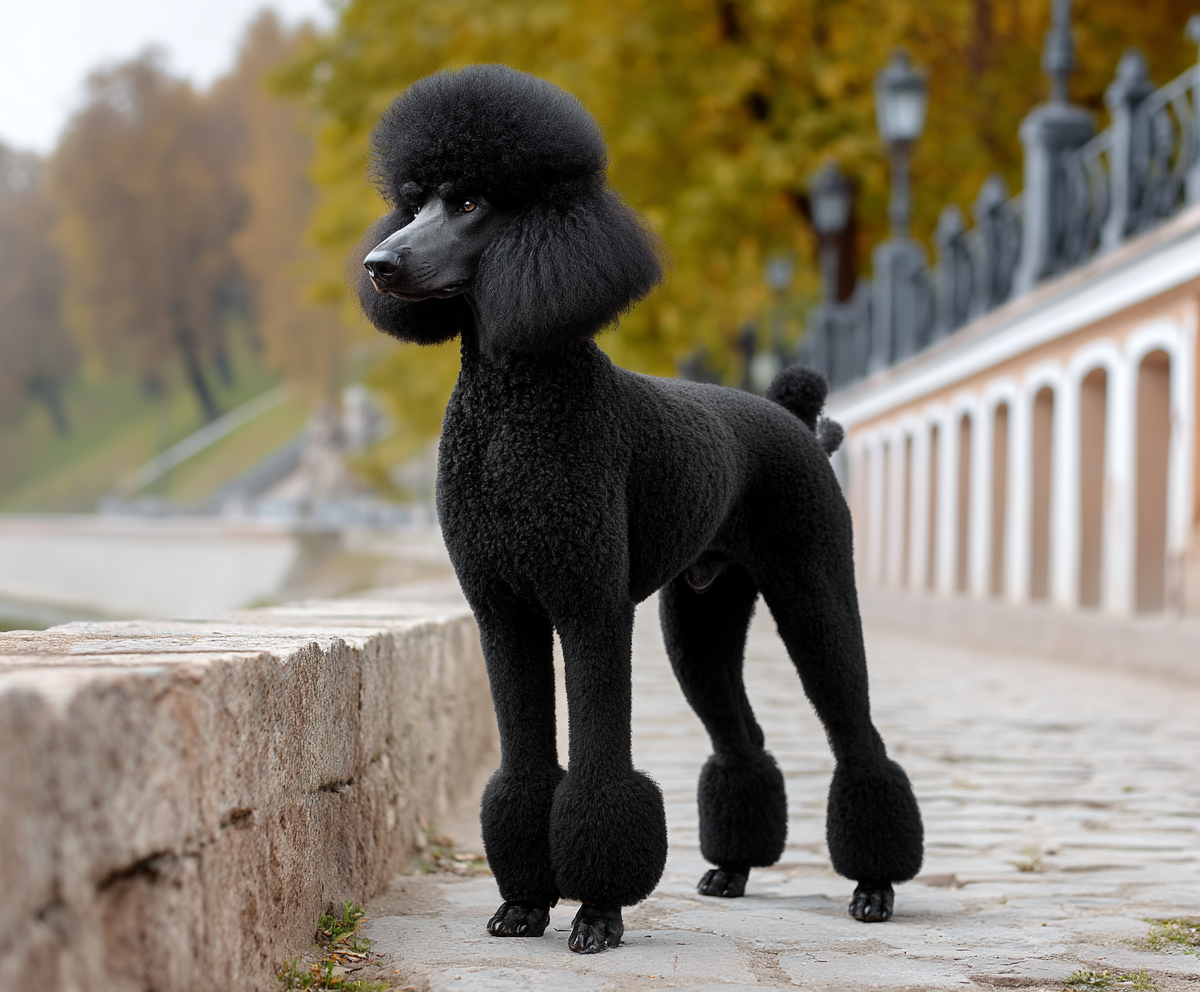
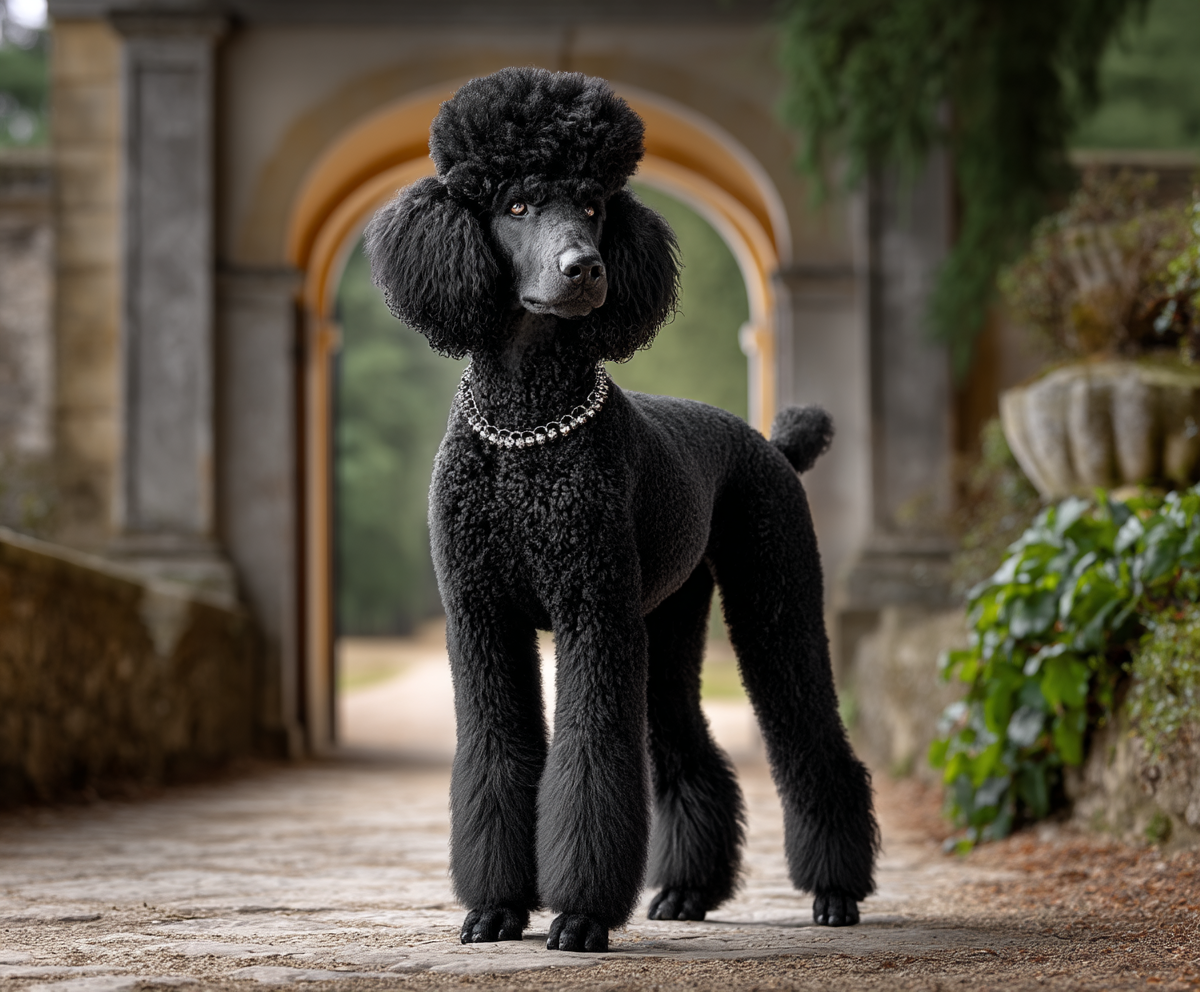

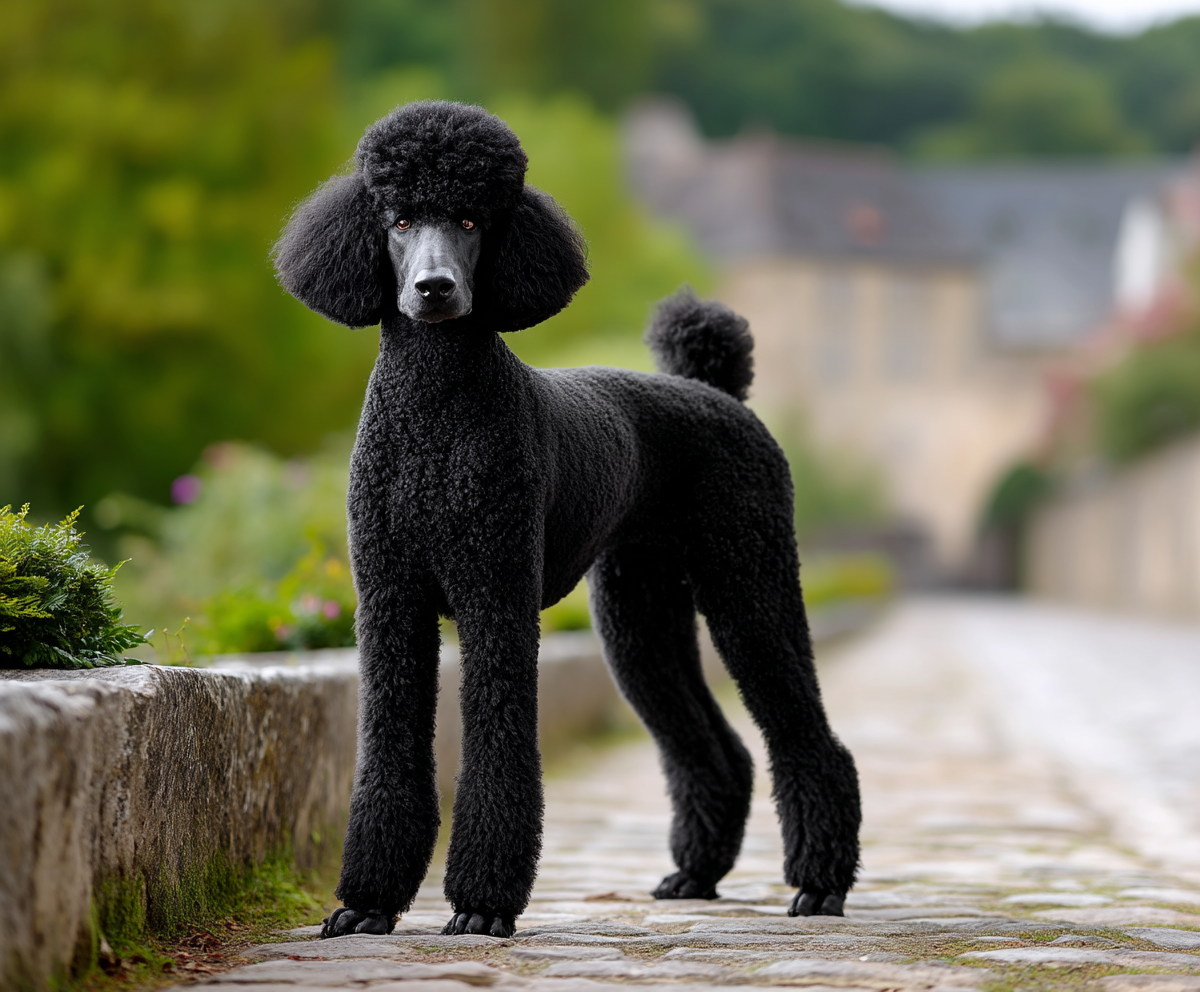
The structural logic behind the german trim poodle becomes obvious when you watch the dog move. By shaving the legs below a precise line and leaving volume only on the upper body, groomers create the visual impression of a compact, athletic frame even on dogs carrying extra coat weight. This is not decorative — it’s anatomical correction through selective volume. Owners who see their dogs in this cut for the first time often describe the effect as the dog suddenly looking “built” rather than fluffy.
What does a proper poodle crest look like in the german cut? The topknot should dome over the skull without extending forward past the eyes or ballooning beyond the ears at the sides. It reads as a crown, not a hat. The AKC’s grooming guidance recommends Andis or Oster clippers with interchangeable blades for this breed — the #15 or #30 blade handles face and feet, while a #4 to #7 blade is used for body clipping depending on desired coat length. Getting the crest right requires curved shears and the discipline to stop cutting before the shape overcorrects.
The chest panel left full in this cut acts like structured tailoring — it reads as volume the dog earned, not padding. Coat density varies by bloodline, and a groomer worth the $150 session adjusts scissor tension accordingly. Show-lineage standards carry denser curl than pet-line miniatures, and rushing through the chest without accounting for that produces a flat, stuffed look rather than the athletic rounding that defines the german cut. The dark coat makes that difference unmissable.
Using the same blade on body and feet: A #4 or #7 blade appropriate for body clipping creates rough, unfinished results on paw pads. The german cut poodle requires a #15 or #30 on feet — using a coarser blade leaves visible stubble that breaks the clean ankle line defining the trim.
Skipping the topknot blend at the ears: Cutting the head round without blending into the ear set creates a floating-ball effect that makes even a correctly executed body look unfinished. The crest must flow from the skull into the ear placement as a single, unbroken form.
Letting appointments go past 8 weeks: By week 10, the topknot and chest-to-loin transition begin losing shape. By week 12, the lines that define this cut are gone — the groomer has to start over rather than maintain, which adds time and cost to every subsequent session.
Cream Coats Reveal What the German Trim Actually Does to Posture
The german trim poodle in cream or apricot coat communicates something the black version doesn’t: warmth. Where dark coats emphasize edge and contrast, pale fur softens the geometry into something more sculptural than angular. A cream poodle mid-jump in a field isn’t trying to look polished — but the trim holds, because the structure is in the cut, not the color. The shapedness of the topknot and the clean limbs still read from a distance, which is why this version of the cut works equally well for active dogs and stationary portraits.
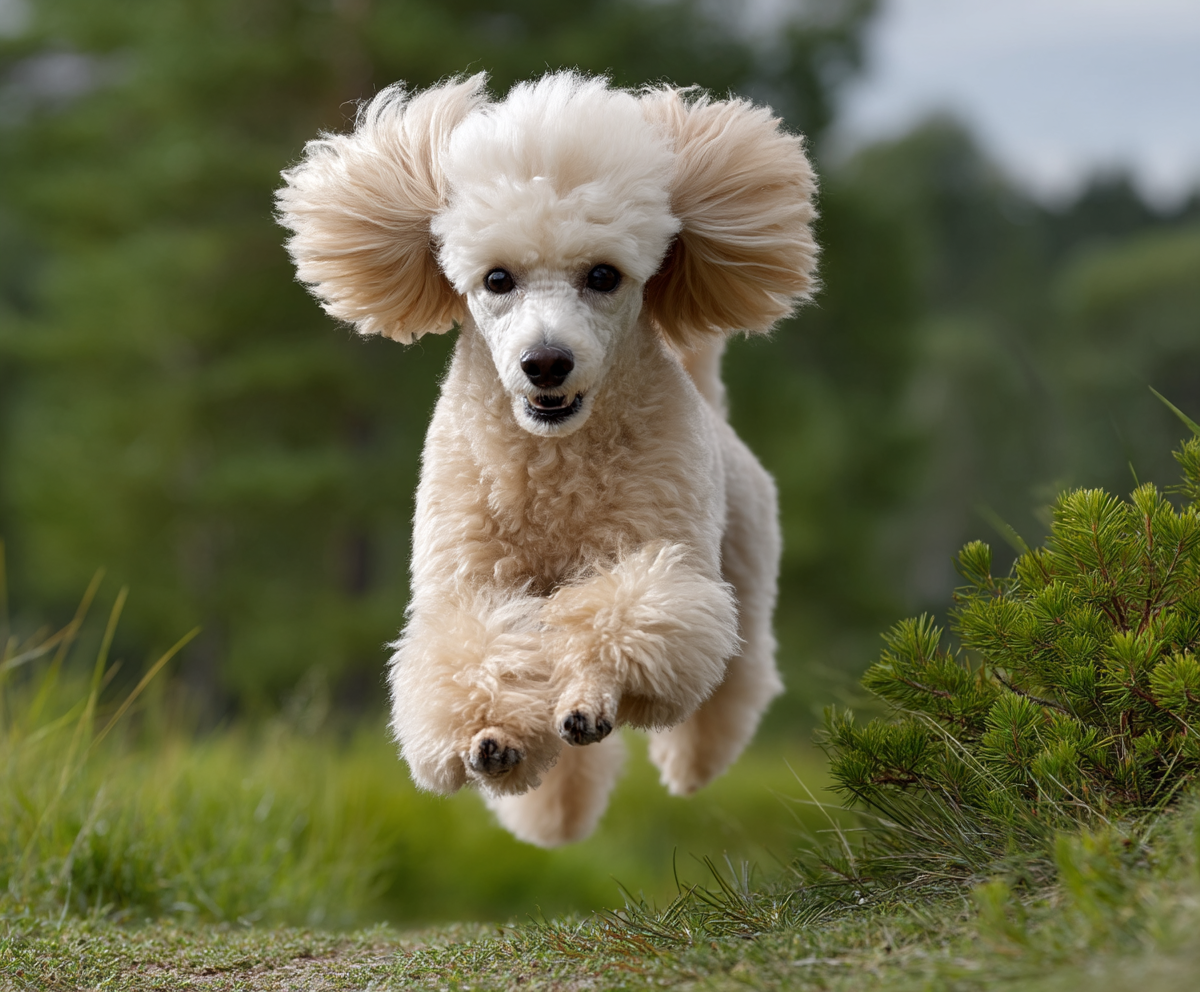
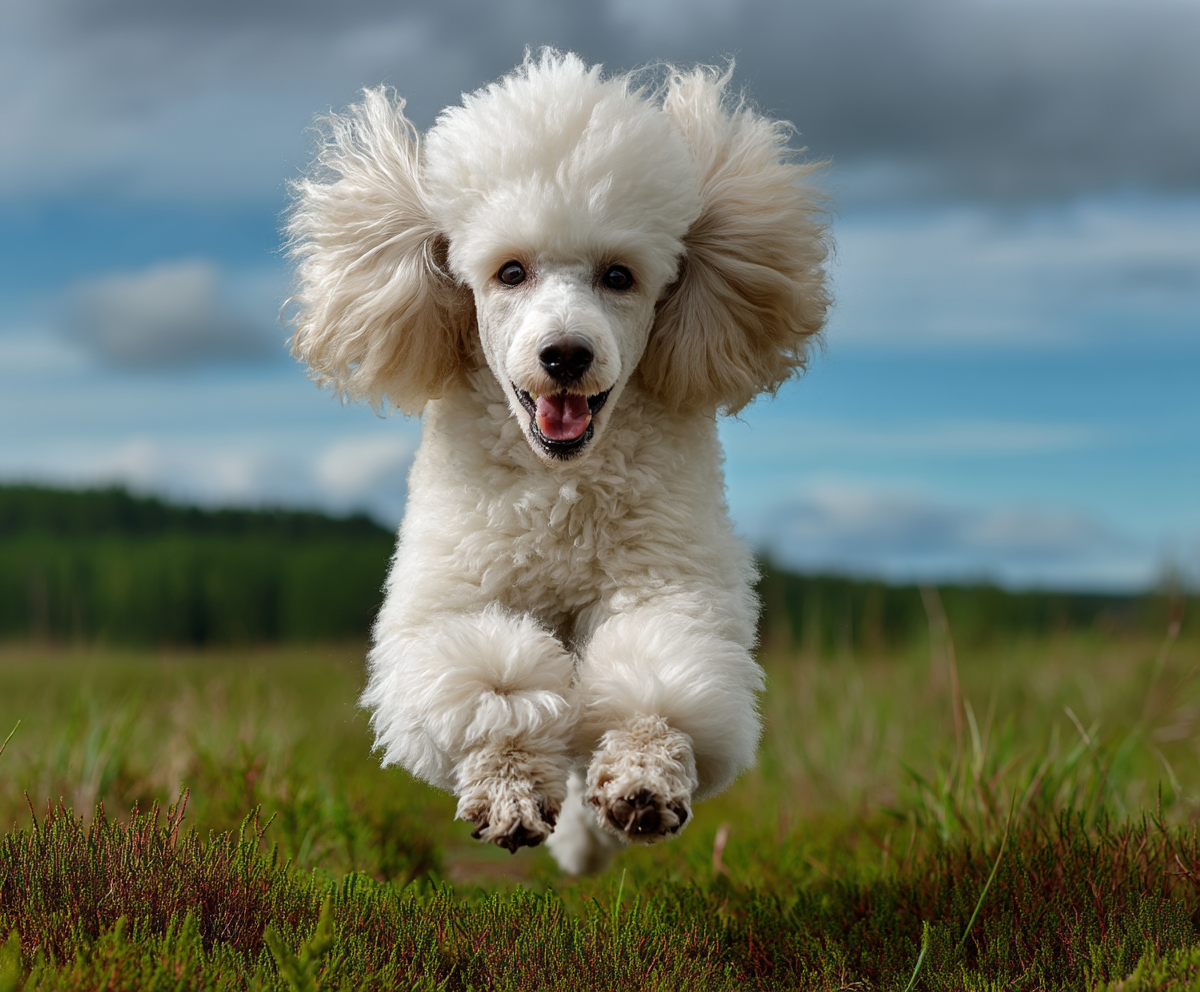
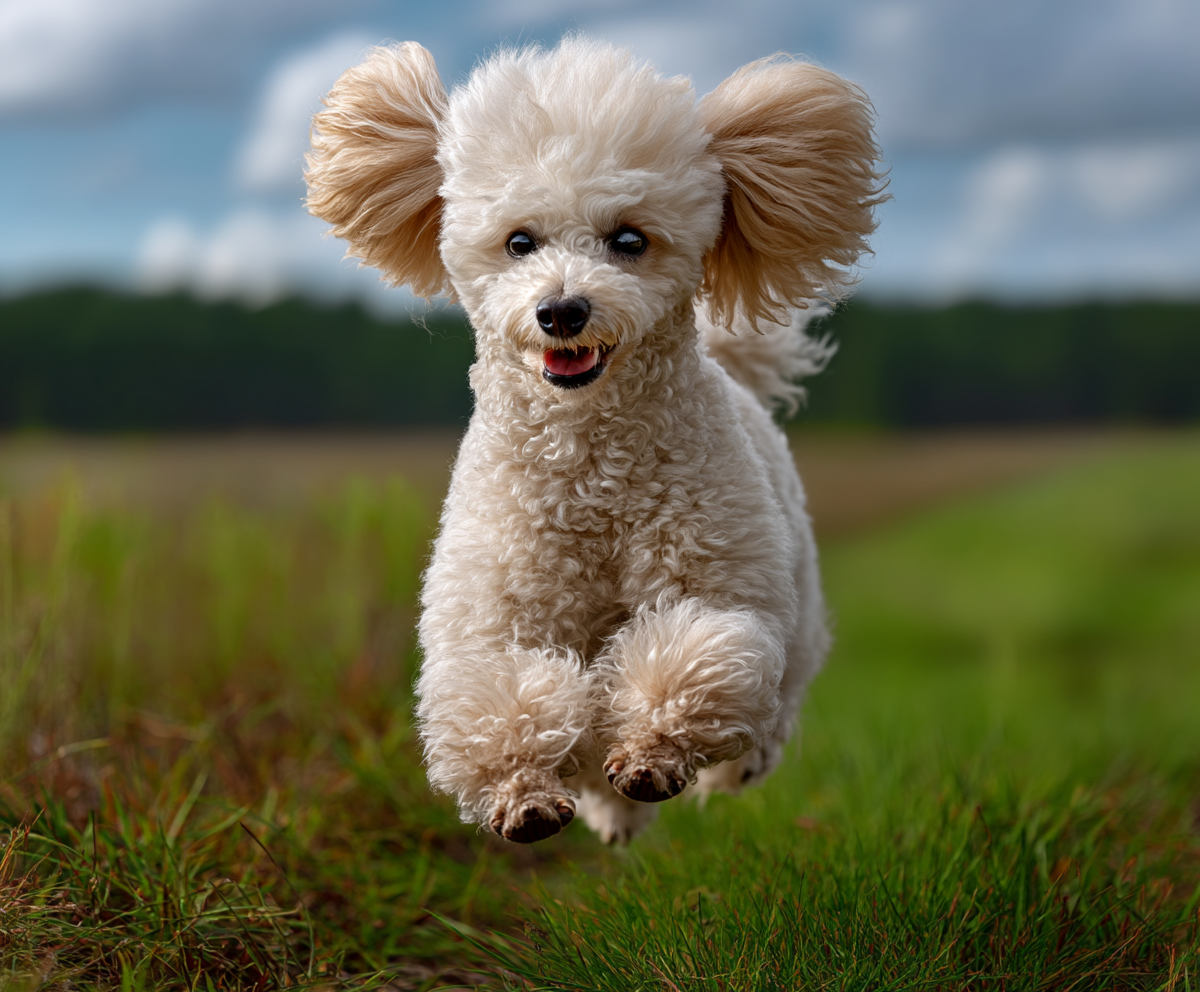
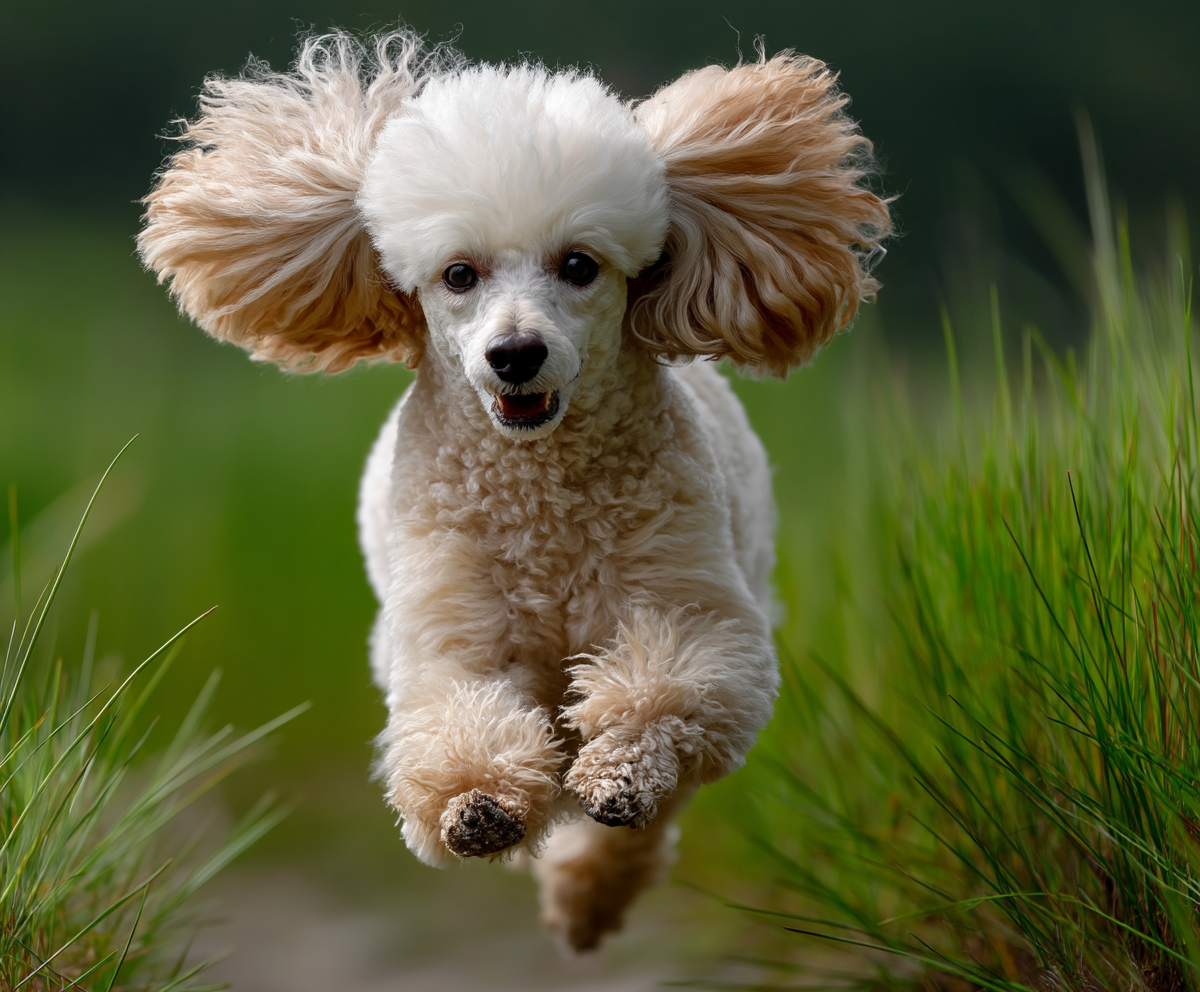
The practical case for this cut on active dogs is real. Poodles groomed on the standard 4–6 week schedule recommended by most professional groomers are far easier to maintain in a german trim than in longer, more uniform cuts — because the short areas stay short, and the shaped areas grow in a predictable pattern that groomers can follow across sessions. Lighter coats show dirt differently than dark ones, but the short leg sections clean up with a quick wipe rather than a full bath between appointments. That’s not nothing when the dog is outdoors daily.
Can you maintain a german cut poodle between professional appointments? Yes, but only the topknot and body volume really invite home intervention — and only if you have curved shears and the patience to work in small passes. The feet and face sections require clipper work with the correct blade, and attempting those at home with the wrong tool produces the choppy ankle line that immediately signals a DIY job. The cream coat actually makes this more visible, not less, because the pale fur against clean-clipped skin contrasts sharply at the wrong angle.
Cream and apricot poodles in this trim have a particular advantage on social media: they photograph against almost any background without the image reading as technically demanding. The dog looks naturally elegant rather than competitively groomed. That’s partly the color and partly the cut — the german trim poodle communicates intention without performing it. Owners of pale-coated standards who switch to this style from a longer lamb or teddy cut consistently report fewer tangles behind the ears and under the arms, the two friction zones most prone to matting in poodles with extended coat.
Salons That Know Their Poodle Anatomy Book Appointments Weeks Out
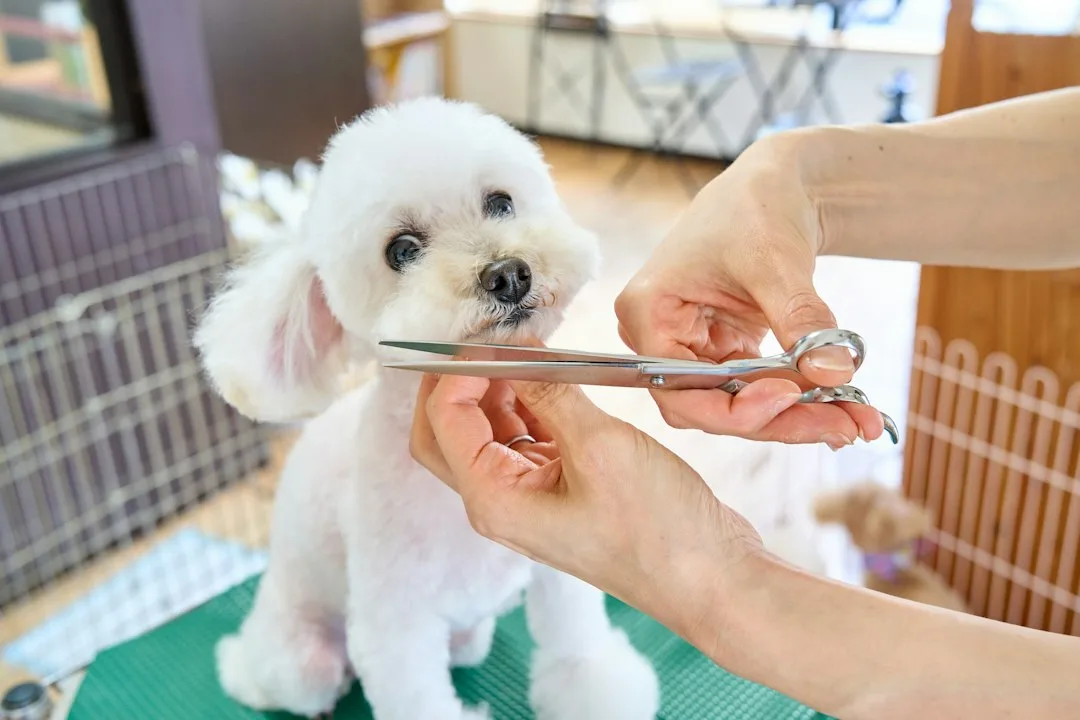
Watching a german cut poodle mid-groom in a modern salon reveals why the style commands a premium price. The process is not linear — it’s iterative. The groomer maps the cut against the actual dog’s bone structure before touching a clipper: where does the shoulder sit relative to the neck? Does this dog carry weight forward or back? Those questions determine where the shaved sections begin and where the volume should build. A standard poodle professional groom takes 2–3 hours for an experienced groomer, and the german cut adds scissor time on top of the bath, blow-dry, and brushout.
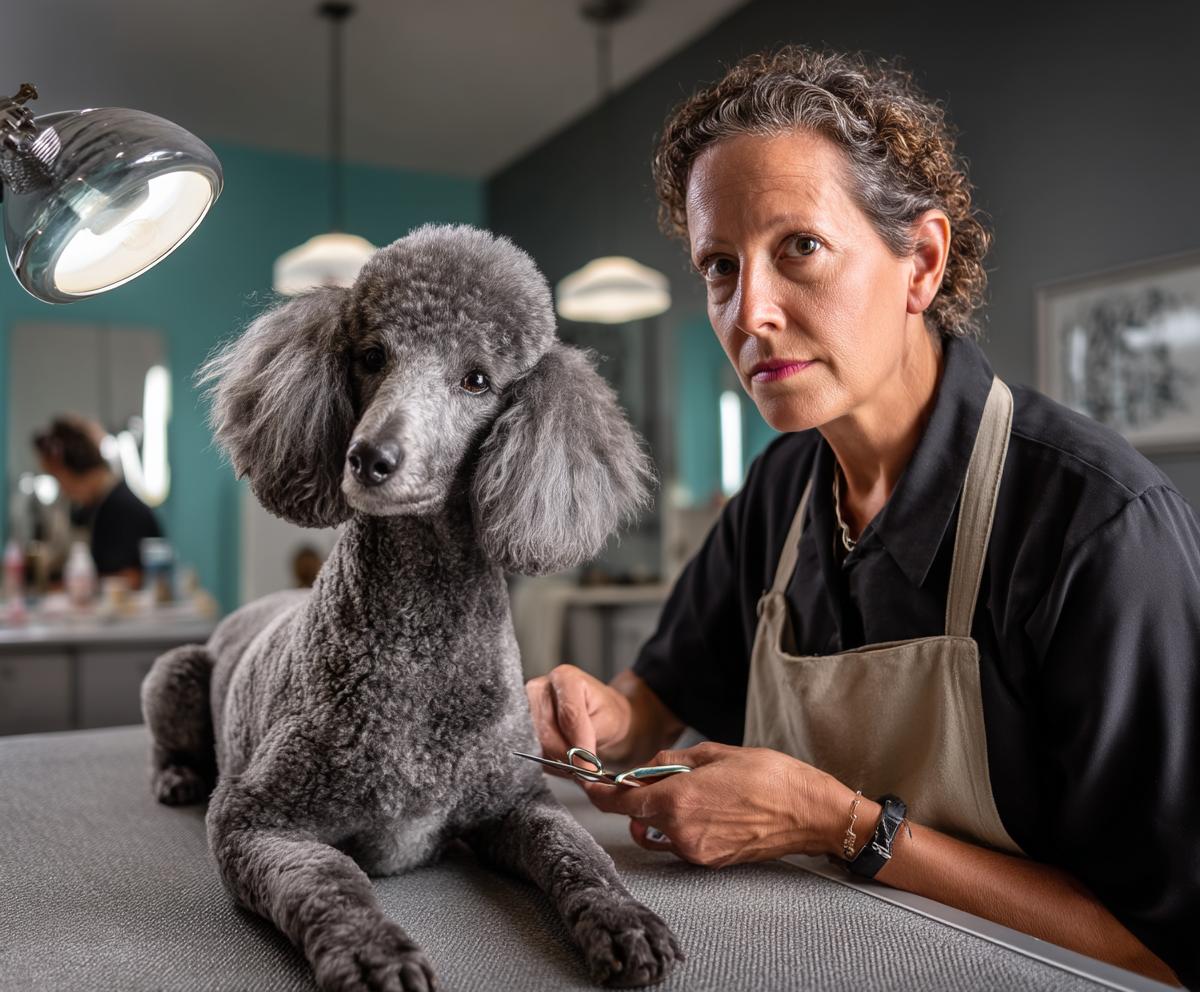
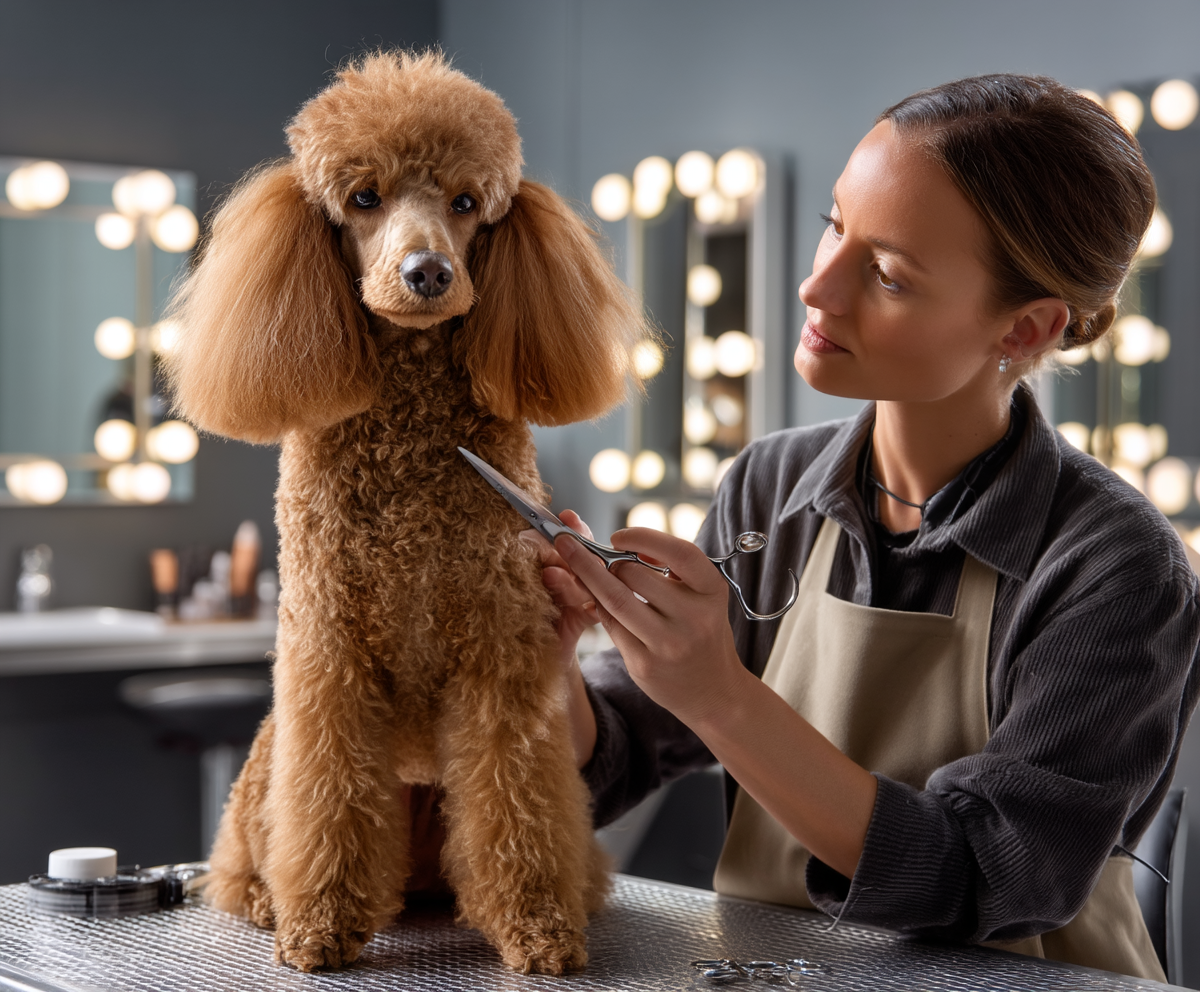
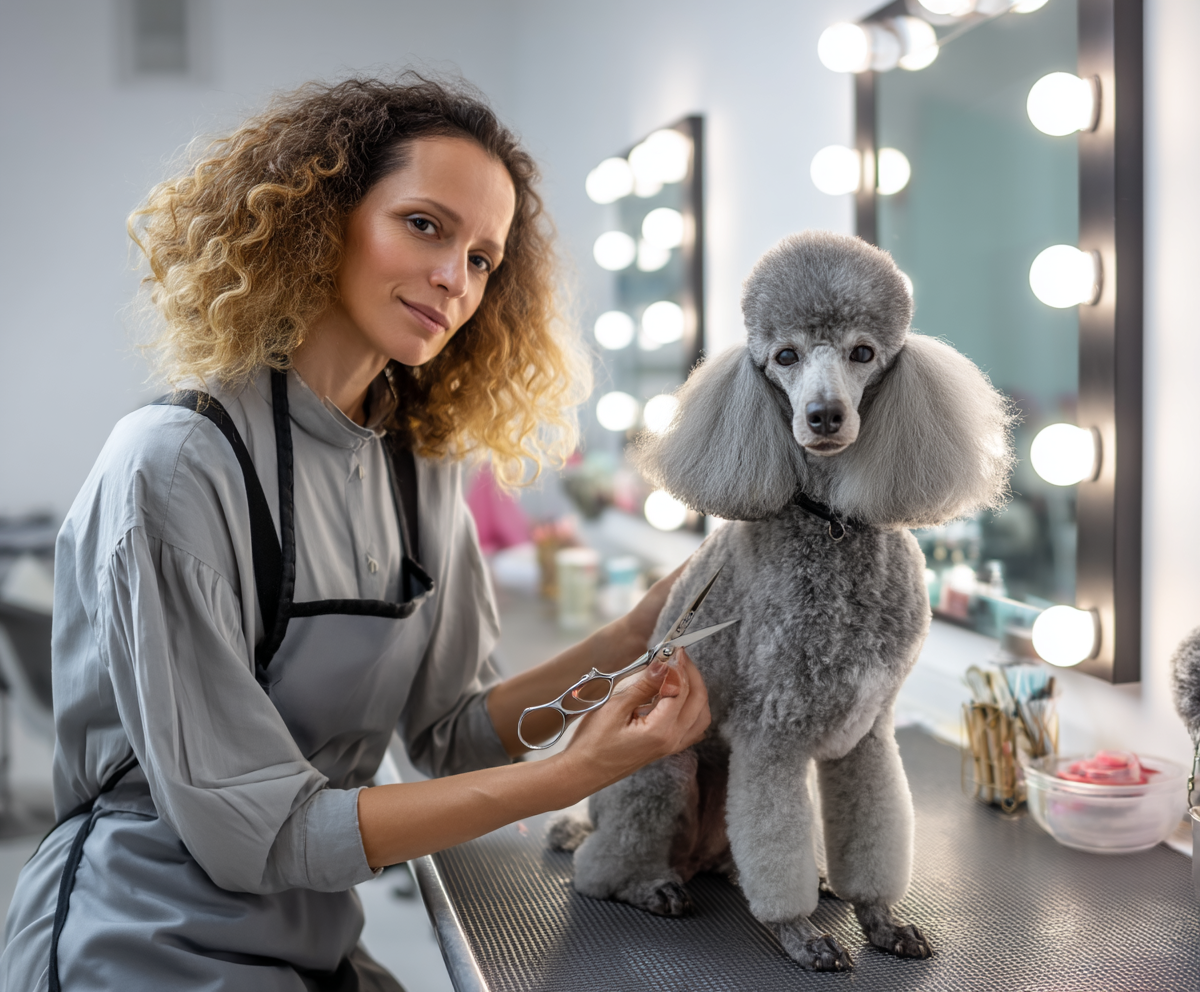
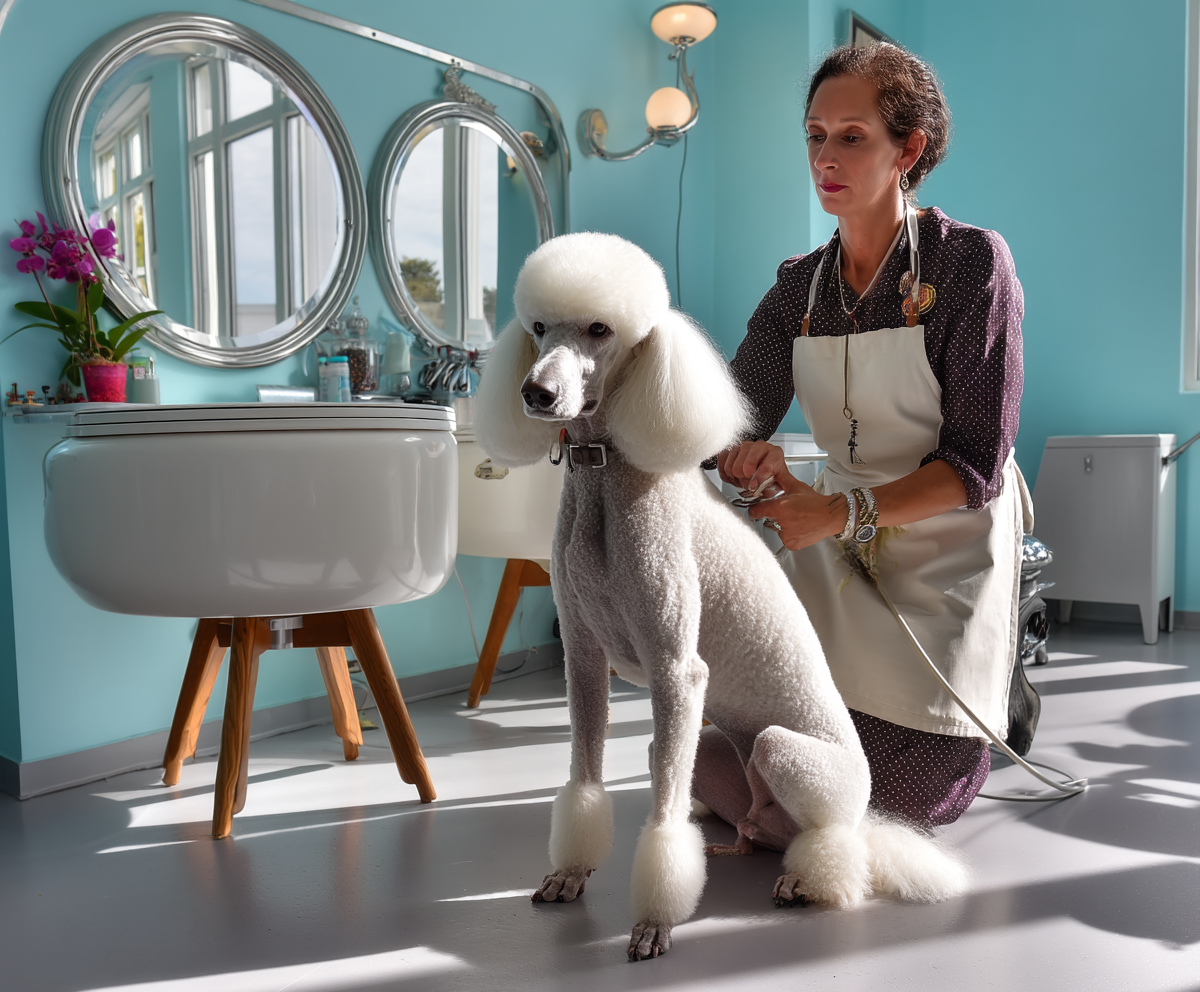
The german trim is described by Groom Haüs, a professional grooming education platform, as one of the most low-maintenance of all poodle trims — which is counterintuitive given how technical it looks. The key is in the shaved sections: ears, face, feet, and tail base are clippered clean, which removes the high-friction zones where poodle coats mat fastest. Less maintained surface area means easier coat management overall, provided the appointments stay consistent at the recommended 4–6 week interval. Why groomers favor the german cut poodle for their own clients’ dogs comes down to exactly this efficiency argument: it looks sharp and it holds between sessions.
The grooming session itself follows a fixed sequence. The brushout happens before the bath — not after — because wet poodle coat tightens curl and locks mats in place. A standard poodle coat takes 20–30 minutes of line brushing alone before water ever touches it. Then the bath, the high-velocity dry to straighten the curl enough to see true coat length, and finally the clipper and scissor work. The shaved ears are done first with a 5F blade, matching the tail blade for visual balance. The face comes next — clean from the outer eye corner to the ear, with the throat taken down to the collar line. Body and topknot work last, when the groomer can read the full silhouette without interference from unpared sections.
Table manners matter more in this cut than in simpler trims. Poodles trained from puppyhood to stand still under tension, shift weight on request, and tolerate clippers near their face allow the groomer to work in longer, cleaner passes — which is what produces the unbroken lines that define the german poodle cut at its best. A dog without those habits adds 30–45 minutes to the session and still produces a less precise result. The AKC recommends introducing poodles to the grooming table in early puppyhood specifically to build that cooperative stillness, noting it also allows groomers to catch health changes — lumps, hot spots, skin irritation — that dense coats conceal for weeks.
For a detailed breakdown of blade selection, bathing frequency, and professional technique for standard poodles, the AKC’s standard poodle grooming guide covers the full process with expert input from a professional handler and Poodle Club of America breeder.
Calling It Low-Maintenance Misses the Point — the German Poodle Cut Has Structure
The modern german cut poodle sits differently in the current grooming conversation than it did a decade ago. Where it used to be a specialty choice associated with European competition circuits, it now shows up regularly on pet-account Instagram feeds and in salon booking requests from owners who’ve never attended a dog show in their lives. The trim’s return to mainstream visibility happened through photography, not competition: the silhouette photographs cleanly at thumbnail scale, which is the only metric that matters on a Pinterest board or a mobile screen.
What distinguishes the german trim from superficially similar cuts like the modern lamb or the kennel cut is the treatment of the ears and tail. The german trim shaves the ears — at minimum a 5F blade, sometimes a #10 or #15 — and presents the tail as either a sculpted “carrot” shape or fully shaved, not a pom-pom. That distinction is not decorative. Shaved ears reduce the risk of ear infections by improving airflow in the ear canal, a real health consideration for a drop-eared breed prone to moisture buildup. Owners who switch to this style from ear-length clips often report fewer vet visits for ear issues within the first year.
Is the german cut the same thing as a german clip? Groomers use the terms interchangeably, though some distinguish a “clip” version that uses more clipper work and less hand-scissoring — the salon-friendly modification demonstrated by educators like Kat Early at Groom Haüs prioritizes speed and practicality without sacrificing the essential silhouette. The result serves clients who want the look without the competition-grade scissor time. For owners comparing the show dog-inspired haircut options available for curly-coated breeds, the german trim sits at the practical end of that spectrum.
The cut adapts across poodle sizes, but the standard poodle is where it reads most powerfully. Miniature and toy versions carry the same geometry, but the smaller frame makes the proportions harder to balance — too much topknot on a small skull looks cartoonish rather than architectural. The grooming cost scales accordingly: standard poodles run $110–$200 per session for this style, miniatures $65–$120, both requiring the same 4–6 week maintenance interval. A groomer who charges on the lower end of these ranges and still produces clean lines is worth finding and keeping.
| Variant | Coat Effect | Grooming Interval | Key Consideration |
|---|---|---|---|
| Black standard poodle german cut | High contrast, every scissor line visible | 4–6 weeks | Advanced groomer recommended; errors show clearly |
| Cream / apricot poodle german trim | Warm, sculptural, more forgiving of minor inconsistencies | 4–6 weeks | Shows dirt less; good choice for active dogs |
| Pet-length german clip (more clipper work) | Similar silhouette, faster execution | 4–6 weeks | Less scissor time; works for busy salon schedules |
| Competition german trim (fully scissored) | Maximal precision and body shaping | 3–4 weeks | Requires experienced groomer; higher session cost |
The Bottom Line
The german cut poodle earns its place by doing two jobs at once — health and aesthetics, in the same silhouette
Shaved ears reduce ear infection risk. Clean feet prevent debris matting in high-friction zones. Full chest and body coat insulates and photographs well. The four-to-six week interval isn’t arbitrary — it’s the point at which the topknot and body transitions start losing the precision that defines this cut from any other scissor job.
Expect to pay $110–$200 per session for a standard poodle in this trim at a quality salon. Andis or Oster clippers with a #15 or #30 blade on face and feet, a #4–7 blade on the body, and curved shears for the topknot are the right tools. A groomer who routinely does this cut on dark-coated dogs is the groomer who knows what they’re doing.
The cream coat version is not a softer substitute — it’s a different visual mood with the same structural demands. Save this post.