Smoky lavender hair and the A-line cut are an oddly perfect pairing — the cool, dusty tone softens the haircut’s hard angles while the geometry keeps the color from going too whimsical. The muted quality of smoky lavender is what separates it from candy-purple: it reads sophisticated rather than costume-y, and it photographs differently in every light.
Three placement techniques show up most in salon work right now — scattered streaks for a subtle entry point, balayage for a graduated fade, and a full ombre for maximum contrast. Each one sits differently on the A-line silhouette, and the right choice comes down to how much maintenance you’re willing to commit to every 6–8 weeks.
Pastel lavender fades faster than almost any other shade — Wella Professionals notes that starting slightly brighter than your target tone at the salon appointment is the single most effective way to extend how long the color looks intentional rather than washed out. That one decision buys you weeks.
- Lavender streaks — lowest commitment, easiest to maintain, most wearable at work
- Smoky lavender balayage — the middle ground; full balayage averages $150–$320 per session
- Lavender ombre — boldest contrast, steepest regrowth management
- Every version needs a purple shampoo (Joico Color Balance is a widely used option) 2–3 times per week
- A-line shapes need a trim every 6–8 weeks to keep the line sharp regardless of color choice
Layered A-Line with Lavender Streaks — Subtle but Not Boring
Lavender streaks woven through a layered A-line are what stylists recommend when someone wants color without the full commitment — the dark base carries most of the visual weight, and the smoky purple surfaces only when the hair moves. The streak placement matters more than the volume of color: sections framing the face and threading through the upper layers create light-catching movement that reads dimensional in person and vivid in photos.


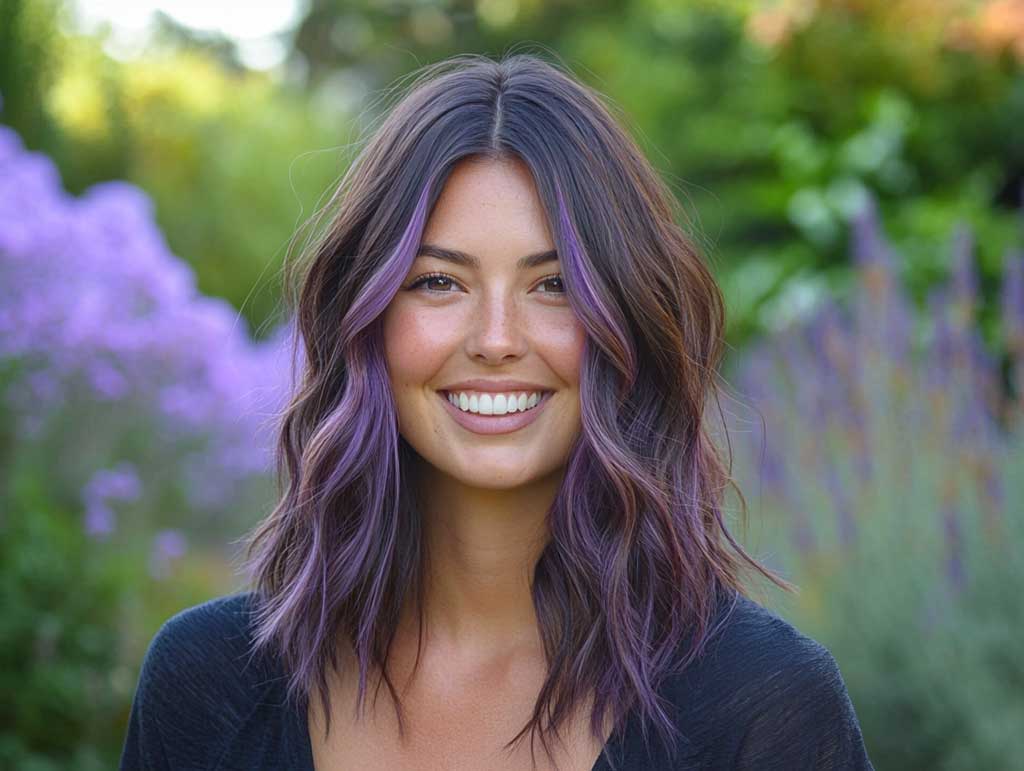
Loose waves from a 1-inch curling wand pull the streaks apart and show their contrast against the dark base — straight styling flattens that effect considerably. A shine serum applied before heat helps the color read richer. What doesn’t work is placing streaks too evenly across the whole head: uniform distribution turns dimensional color into something that looks more like a box-dye job than a deliberate placement.
Does this color require bleach? Yes, almost always — lavender tones need a level 8 or lighter blonde base to show up as purple rather than as a barely-there tint on dark hair. The upside is that partial streaks mean fewer sections to lighten, which keeps the bleach damage contained. Joico Color Balance Purple Shampoo, used 2–3 times per week as Joico recommends, is the standard go-to for preserving the cool tone between appointments. Schedule a trim every 6–8 weeks to keep the A-line’s signature angle intact — layers grow out faster than a blunt cut, and the shape defines this style. For other colored highlight approaches on the same cut, the A-line haircuts with platinum blonde highlights article shows how contrast placement changes with a lighter base color.
The trick here is restraint: four to six streaks landed at the right sections outperform fifteen streaks scattered randomly, every time. The A-line’s angled perimeter does the structural work — the color only needs to punctuate it.
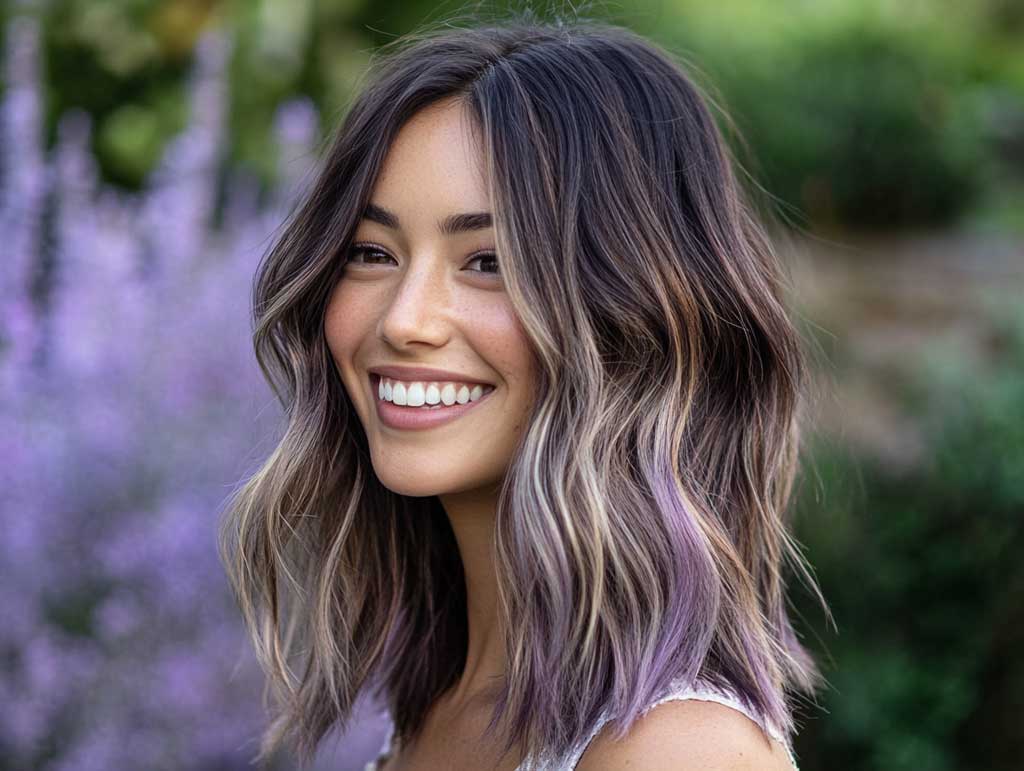
Where Smoky Lavender Balayage Changes the A-Line’s Geometry
Smoky lavender balayage on a sleek A-line produces something that plain highlights can’t — a gradient that starts at the root’s natural shadow and sweeps toward a dusty lavender end, following the haircut’s diagonal angle like it was planned that way. The hand-painted technique keeps root regrowth gradual, which is why colorists specifically recommend balayage for anyone who doesn’t want to be back in the salon chair every four weeks.



Full balayage averages $150–$320 per session nationally, with urban salons in cities like New York or Los Angeles regularly running $300 or higher — that range reflects the 2–3 hours of hands-on work the technique demands. A flat iron after the color appointment is not optional for this look: the sleek finish is what makes the lavender gradient read as intentional rather than accidental. Avoid over-washing — every rinse pulls color molecules out, and balayage ends are already the most porous and color-hungry part of the hair.
What trips people up is expecting the balayage to look the same at week six as it did at week one. It won’t, and that’s not a failure — Wella Professionals recommends asking your colorist to apply a slightly brighter starting shade specifically because pastels fade to a softer, more silver-lilac over time. If you want to keep the tone vivid, a color-depositing mask in a pale violet shade, used every second or third wash, slows that drift considerably. A lightweight styling oil — not a heavy serum — protects the ends between appointments without leaving a coating that muffles the color.
The A-line’s precise bottom line is this style’s structural anchor. Let it grow past 8 weeks without a trim and the perimeter loses the cleanness that makes the balayage gradient look deliberate rather than grown-out.
Skipping purple shampoo to “preserve” the balayage is the fastest way to end up with a yellow-tinged lavender that looks closer to dirty blonde than pastel purple. Purple shampoo doesn’t strip the color — it neutralizes the warm brassiness that always develops on lightened ends. Use it 2–3 times per week, let it sit for 3 minutes, and rinse with cool water. That routine is what keeps the smoky undertone in smoky lavender.
Graduated A-Line with Muted Lavender Ombre — Maximum Contrast, Minimum Apology
Muted lavender hair in an ombre format on a graduated A-line is the loudest version of this color story — the steep angles of the cut make the dark-to-lavender transition look almost architectural when the hair is straightened and the ends line up in a hard diagonal. The “muted” part matters: a saturated bright purple on this silhouette reads costume. A dusty, smoky lavender keeps it editorial.


The ombre’s transition line placement changes the whole dynamic of this cut — positioned at the jawline, it echoes the A-line’s angle and frames the face; positioned lower at the collarbone, it lets the dark base dominate and the lavender reads as an accent. Most colorists place the shift somewhere between those two points and soften it with a quick melt, which prevents the hard line that looks dated. Straightening with a flat iron after every wash is not a recommendation for this style — it is the requirement for displaying the color break clearly.
Can this style survive without frequent salon visits? Realistically, no. Ombre ends are fully lightened, fully exposed, and fully subject to every rinse, UV hour, and heat pass — they fade the fastest. Color-safe shampoo and avoiding wash days whenever possible (dry shampoo at the roots buys two to three days) are non-negotiable. For the lavender pixie cut styles that use the same pastel tone on a shorter silhouette, the maintenance logic is identical but the surface area is smaller, which makes color refreshes faster. The Wella Color Touch formula, used by many salon colorists for pastel tones, is specifically formulated to fade true to tone rather than going muddy — worth asking for by name at the consultation. For further guidance on maintaining any vivid color, Wella Professionals’ colored hair care guide covers heat protection, wash frequency, and color-depositing mask timing in detail.
The mistake most people make is heat-styling every day without a protectant — the color molecules in the lightened ends escape through an open cuticle, and a week of daily flat-ironing can age the ombre by a month. A spray protectant applied before every heat pass is the practical insurance policy on a $200+ color investment.
| Technique | Color Commitment | Avg. Salon Cost | Maintenance Interval |
|---|---|---|---|
| Lavender Streaks | Low — partial bleach | $110–$220 | Trim every 6–8 wks; tone every 4–6 wks |
| Smoky Lavender Balayage | Medium — freehand lift | $150–$320 | Trim every 6–8 wks; gloss every 8–10 wks |
| Muted Lavender Ombre | High — full end lightening | $200–$400+ | Trim every 6 wks; root touch every 6–8 wks |
The Bottom Line
Smoky lavender on an A-line rewards structure — and punishes neglect.
Streaks are the entry point: low bleach exposure, low maintenance, high visual payoff when placed strategically near the face and upper layers.
Balayage at $150–$320 per session is the sweet spot for most people — gradual regrowth, a soft lavender gradient, and a salon interval that doesn’t consume every paycheck.
The ombre is for those who want the full contrast hit and are genuinely prepared to protect the ends with every wash, every heat pass, and every UV-heavy afternoon. Save this post before booking your consultation — the right version of this look depends on how much time you’re willing to put in, not on which version looks best in a photo.
Related Topics