Easy hairstyles for natural hair don’t have to mean plain ones — twist outs alone unlock three completely different looks depending on how you shape them and what color you’re working with. The technique stays the same: damp twists, set overnight, unraveled carefully. What changes is everything else — the silhouette, the color, the occasion it fits.
Cantu Shea Butter Twist & Lock Gel (13 oz for $14.26 at Walmart) delivers a marketed 48-hour hold, which means the coils hold through an overnight set without going stiff or leaving residue. That single product carries all three of these styles from install through unraveling.
Below are three real twist out directions — a frohawk with burgundy color, a swept side style with golden blonde, and a layered auburn look that moves differently at every length. None require a salon visit, and all three last several days with a satin bonnet at night.
– A twist out frohawk lasts up to one week with nightly satin coverage
– Burgundy deposits color without requiring a bleach lift on medium-brown natural hair
– Golden blonde needs pre-lightening; a color wax approximates the look short-term
– A side sweep converts a standard twist out into something that reads as intentionally styled
– Auburn layers produce the most movement — best on shoulder-length or longer hair
– All three styles share the same product base: a moisture-rich cream or gel applied on damp hair
Burgundy Twist Out Frohawk Rewires What a Structural Style Can Look Like
The twist out frohawk sits in a specific lane among easy hairstyles for natural hair: it’s a shape style that builds on a texture base rather than starting from scratch. Twisting damp, well-conditioned hair with a curl cream and letting it set for at least 6–8 hours creates the coil definition the frohawk needs to hold its center strip. Without that pre-twist step, the style reads as a puff, not a hawk — a difference that’s immediately visible from across a room.


Once the twists are unraveled, the sides get either flat-twisted toward the center, smoothed with a gel, or pinned upward with bobby pins — whichever keeps them flat without product buildup. The center stays untouched. Burgundy color changes the visual register of the whole shape: each coil catches the red tone individually, so the strip running crown to nape reads dimensional rather than flat. Stylists who specialize in natural hair regularly point to the frohawk’s ability to last up to a week with proper nightly coverage as one of its strongest practical arguments — a meaningful return on a 20-minute setup.
Does burgundy require bleach? Not necessarily — Clairol Natural Instincts Vivids in Burgundy deposits color without a pre-lightening step on most medium-brown natural hair. What doesn’t work: reaching for burgundy over hair that has green or ashy undertones without correction first. The red pigment lands muddy on cool bases, and no overnight conditioning treatment fixes an undertone conflict after the fact. Stick with burgundy on warm or neutral-toned bases for the dimensional jewel effect that makes this style worth doing. For more texture-forward options that share the same structural approach, the round-up of two strand twist styles for natural hair covers the method in depth.
Morning maintenance runs under two minutes. Fluff the center, spritz the sides with a curl refresher if they’ve shifted, and re-pin anything that moved during sleep. The coil memory is what makes this sustainable — twist out texture springs back to its formed position rather than collapsing flat by day two. Re-pinning every single morning is the mistake that turns this from a low-effort style into a daily styling event; do it once and leave it alone.
Avoid removing and re-pinning the sides daily. Repeated manipulation along the hairline creates friction that leads to thinning over time — exactly the opposite of what a supposedly easy hairstyle should deliver. Pin it once on install day, cover with a satin bonnet every night, and let the shape carry through the week. Also avoid gel on the center section: gel flattens the coil definition that makes the frohawk read as a twist out rather than a slicked puff, and that coil definition is the entire reason to do the overnight set in the first place.
Golden Blonde Side Sweep Lifts Easy Hairstyles for Natural Hair Into a Different Register
A side-parted twist out in golden blonde changes how natural hair reads in photographs and in person. The light tones catch from multiple angles simultaneously, creating the appearance of movement even in a still shot. Natural hair styled this way photographs longer than the same length in a dark shade — a practical note for anyone prepping for a photo shoot or an event where the hair needs to do visible work without extra effort.


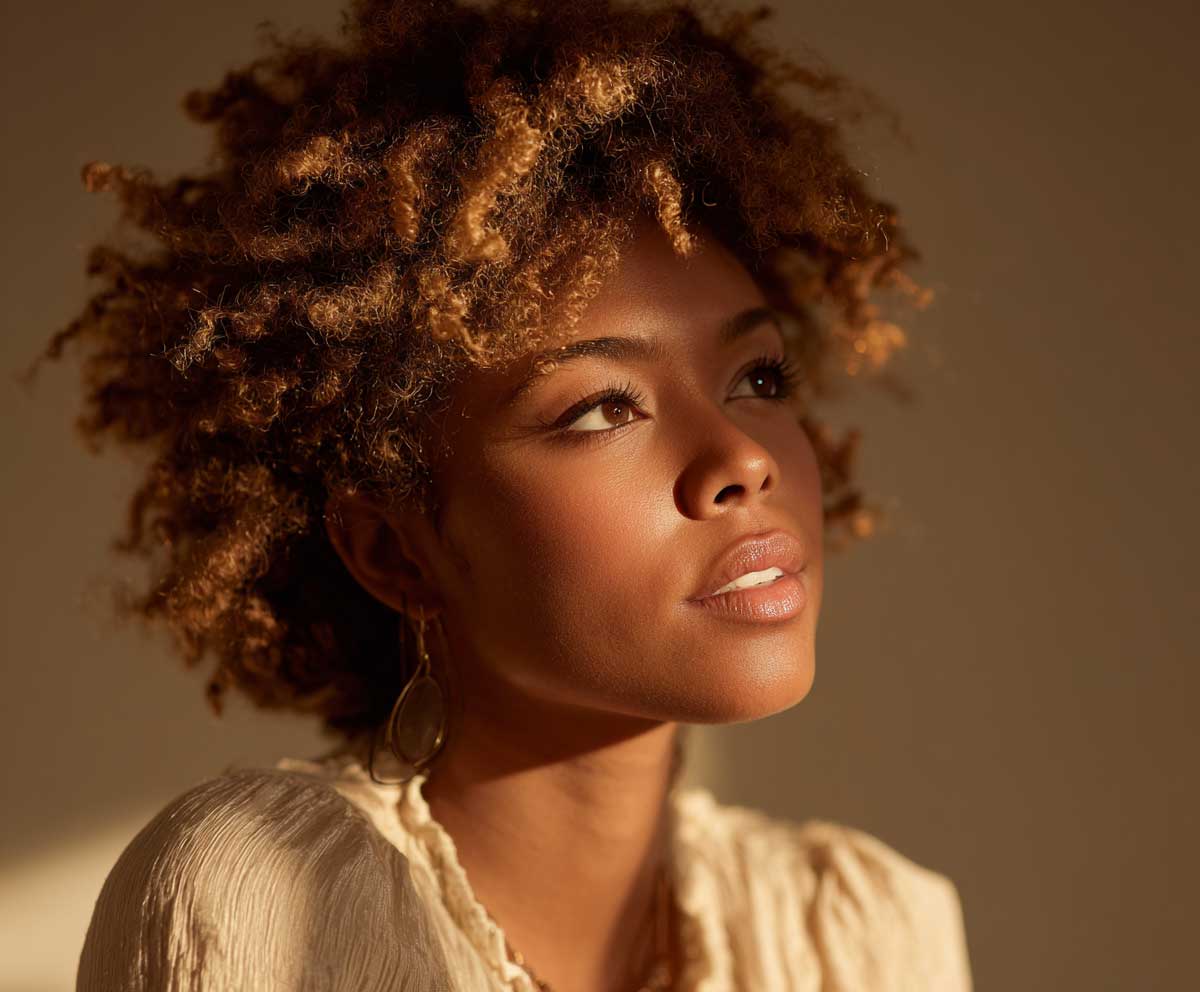
The install uses medium to large two-strand twists on damp, detangled hair. A butter-based product outperforms gel for this color — gel creates surface sheen on darker shades but flattens honey blonde’s dimensional quality by sealing the light reflection instead of letting it move. Mielle Organics Pomegranate & Honey Twisting Souffle ($12.99 at Mielle’s website) is a consistent pick because the honey undertones in the formula work with the color chemistry rather than against it. Apply on hair that’s roughly 80% dry, not soaking wet — overly wet installation causes the hair to over-expand and leads to frizz at the root by day two.
After unraveling, the side part does the heavy lifting. Sweeping the curls across the forehead and letting them fall to one shoulder gives the look structure without effort — the movement reads intentional rather than default. Think of the deep side part as the visual equivalent of a collar: one small structural choice that makes the whole look cohere. What doesn’t work here is reaching for this color on deeply pigmented hair in a single home process. Brass lands hard, and you end up copper-orange instead of honey gold. A professional lightening session plus toner — typically $80–$120 at a natural hair salon — is the only clean path to this shade. Schwarzkopf Live Color Wax (around $8) approximates the tone for short-term wear without the commitment if the price point isn’t right yet.
Maintenance is genuinely minimal: satin bonnet at night, light fluff in the morning, and a weekly argan oil seal on the ends to prevent oxidation-related dryness. The style transitions across contexts — tuck a few curls behind the ear for professional settings, let the sweep run fully for maximum visual impact at an event. Style transitions so easily because the twist out base holds its pattern even when the styling direction changes. Among easy hairstyles for natural hair, this one covers the widest range of occasions without any restyling.
Auburn Layered Twist Out Moves the Way Fabric Does
Layers change the physics of a twist out. When the cut has dimension, some curls land at cheek level and others fall toward the shoulders, creating a staggered cascade that a single-length style physically cannot replicate. The auburn layered twist out uses this layered quality as its main feature — the warm color and the movement of the lengths work together in a way that reads considered rather than assembled-quickly.


Start with clean, moisturized hair and section it using a butter or cream-based product — the layers need moisture locked into each strand before twisting, or the ends dry faster than the roots and snap during unraveling. After overnight air drying, unravel with fingers rather than a pick to preserve the curl definition the layered shape depends on. A pick separates too aggressively and collapses the staggered effect that makes this style look like it took more effort than it did. The layered shape holds well for four or more days; finger separation and a light fluff each morning are all it takes to maintain volume.
Auburn is the color variable that elevates this beyond a standard twist out. It’s warm enough to complement most natural skin tones, and when the color shifts from root to layered tip, the depth it creates makes the style read more expensive than it is. The practical upside: unlike cooler tones, auburn grows out in a way that blends with most natural hair bases rather than creating a harsh line of demarcation. Plan a protein treatment every three weeks on color-treated hair — TGIN Honey Miracle Hair Mask ($13 at Target) is protein-rich without the stiffness that conflicts with twist definition. What doesn’t work seasonally is expecting auburn to read as vividly in humid summer months; the moisture in the air softens the color’s red intensity on natural hair, making it look darker than intended.
This style functions equally well with a blazer or a sundress. The layered shape handles the visual work of looking put-together — you don’t need accessories competing with it. Avoid high-tension updos with this style: pulling layered twist out curls into a tight ponytail breaks the staggered cascade that makes the look worth doing. For anyone building a rotation of easy hairstyles for natural hair that extend across the full year, the layered twist out fits where the golden blonde side sweep feels too statement-forward. The full logic behind making twist-based styles genuinely protective is covered in the round-up of protective hairstyles for natural hair that work through every season.
| Style | Color | Best For | Key Risk |
|---|---|---|---|
| Twist Out Frohawk | Burgundy | Events, festivals, bold everyday wear | Over-manipulation along hairline daily |
| Side Sweep Twist Out | Golden Blonde | Wider social range, photos, professional settings | Brass from single-process home coloring |
| Layered Twist Out | Auburn | Everyday rotation, seasonal looks | Picks disrupting layered curl cascade |
FINAL WORD
Twist Outs Are Three Looks, Not One
The same overnight technique — damp twists, 6–8 hours of set time, careful unraveling — produces a frohawk, a swept side, or a layered fall depending on what comes next. Color determines the visual weight: burgundy reads structured and bold, blonde reads elongated and light-catching, auburn reads warm and seasonal.
Cantu Shea Butter Twist & Lock Gel at $14.26 covers all three installs. The frohawk needs a satin bonnet nightly and holds up to a week. The blonde side sweep needs argan oil on the ends weekly. The auburn layers need a protein treatment every three weeks to hold definition through the color-treated sections.
Save this post before your next wash day — pick one direction and set the twists that night.