Vintage double door design for the main door signals something about a house before anyone knocks — that the people inside care about craft, age, and the kind of entrance that takes a second look. The three styles covered here (hand-carved wood, wrought iron with wood, and distressed white) each pull from a different part of that tradition, and each works best with a specific facade type and maintenance tolerance.
Antique carved double doors on 1stDibs average around $4,320, while new custom ironwork pairs run from $1,500 to over $10,000 depending on configuration. That spread is wide enough to matter — choosing the wrong style for your budget or your facade material ends up looking forced rather than historic.
Wood doors need a paint or stain refresh every three to seven years on exterior surfaces; iron doors, properly powder-coated, can go decades without structural work. Knowing the maintenance commitment before you fall in love with an aesthetic saves a lot of regret two summers in.
– Antique carved wood doubles: average market price ~$4,320 on 1stDibs; suit rustic, traditional, eclectic facades
– Wrought iron with wood: $1,500–$10,000+ new; last 30–50+ years with minimal upkeep; best against stone or brick
– Distressed white: lowest cost option; needs repaint every 3–7 years on wood substrate; ideal for farmhouse and cottage exteriors
– All three styles require correct hardware (brass/copper patina for carved wood; forged iron for ironwork; tarnished silver/brass for distressed white)
– Avoid pairing any of these with ultra-modern facades — the contrast reads as costume, not character
Hand-Carved Wood Puts Vintage Double Door Design at Its Most Literal
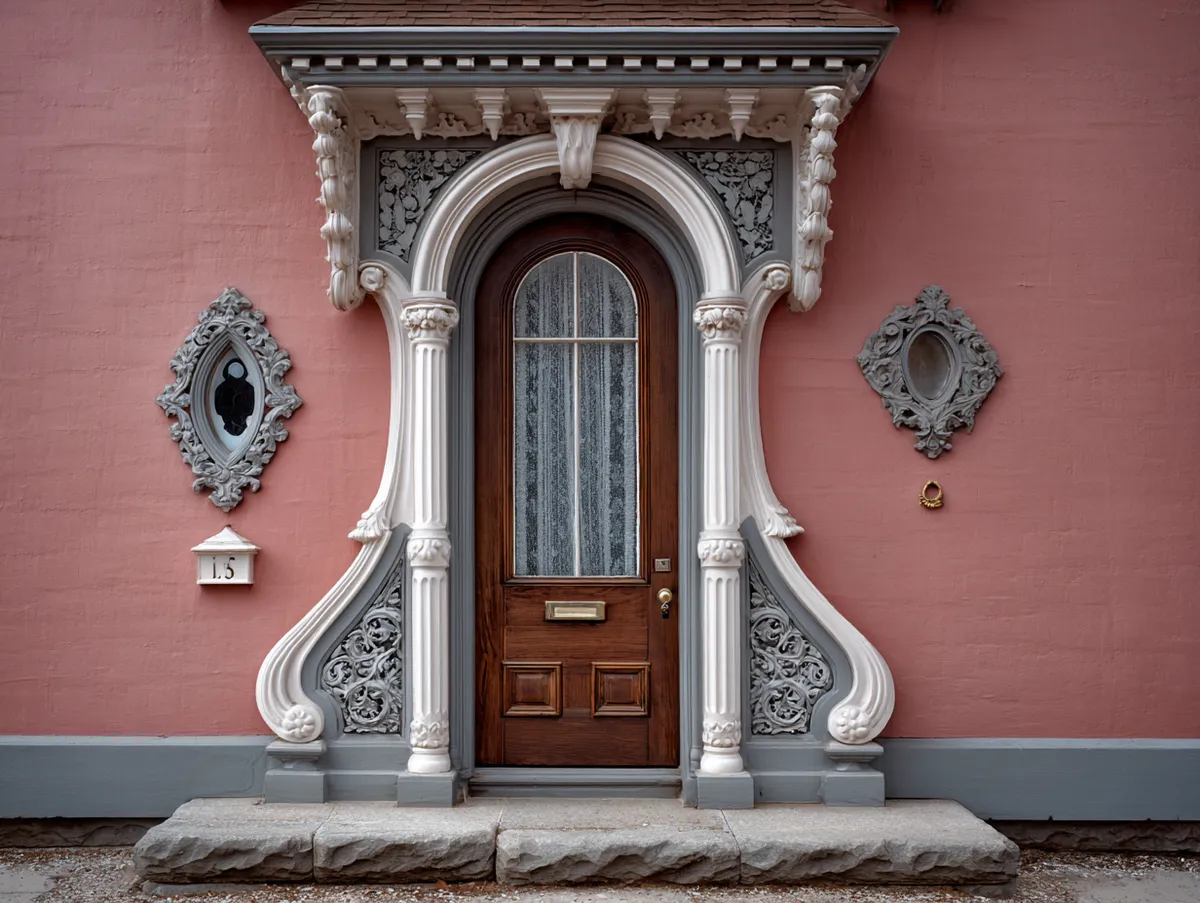
Antique double doors featuring hand-carved wood — floral scrolls, geometric panels, peacock motifs — represent vintage double door design at its most direct. Stylists who specialize in historic homes consistently recommend walnut or mahogany as the base species: both carve with enough grain variation to make relief work read from across a driveway, and both age without warping the way softer species do. On 1stDibs, wood carved double doors currently average $5,680, with pieces starting around $1,405 for salvaged panels and climbing to $48,500 for 19th-century Italian sets in pristine condition.
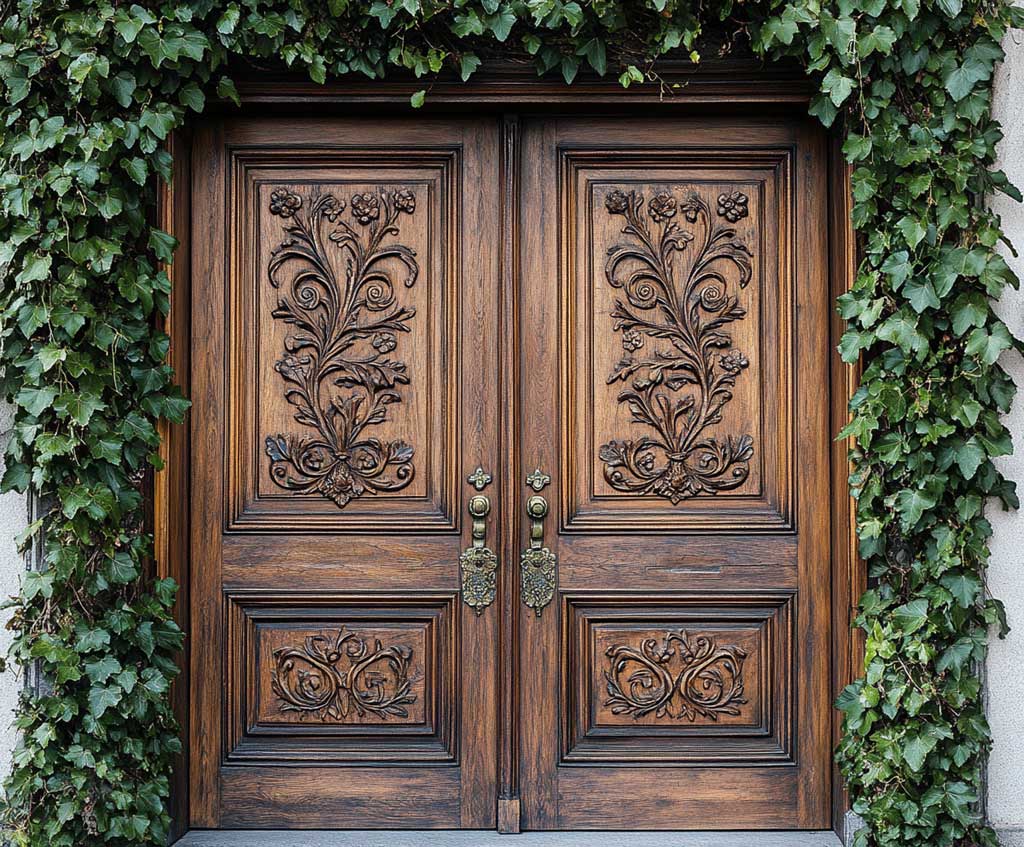


The hardware decision shapes the entire read of carved wood doors more than most people expect. Brass or copper handles with a natural patina work because they oxidize at roughly the same visual rate as the wood grain opens up with age — the two surfaces grow old together rather than fighting each other. Avoid polished chrome or matte black hardware on carved wood: it imports a modern industrial register that cancels the period feel entirely. Ask yourself what era the carvings reference, then match the metal finish to that period’s most common alloys.
Wood on the exterior needs a refinish cycle. For a carved main door in a temperate climate, the trick here is to apply a penetrating oil stain rather than a film finish — it soaks into the grain rather than forming a surface that peels when UV exposure breaks the bond. Exterior wood doors typically need attention every three to seven years; doors in direct south- or west-facing sun land toward the three-year end of that range. Ivy trained up the frame surround adds atmosphere, but keep the tendrils off the door surface itself — trapped moisture against wood is how rot starts.
Don’t buy a reclaimed carved door without checking the species first. Softwoods like pine were sometimes used in interior carved panels and won’t survive exterior moisture. Tap the door: a hollow sound near the carved sections means filler was used to build up the relief — that filler cracks and absorbs water within a few seasons. Real hand-carved solid wood has consistent density across the panel. Also avoid sealing carved doors with a thick gloss varnish — it looks plastic rather than aged, and it peels in sheets rather than fading gracefully when the UV finally gets to it.
Wrought Iron Plus Wood Pulls from Old-World Architecture Without Replicating It
Wood and wrought iron double doors trace their visual DNA to old-world European entrances — the kind of door that stood at the front of manor houses in France, Spain, and Southern Italy for three centuries. What makes this combination work structurally is that the iron framework stabilizes the wood against seasonal movement, while the wood panels moderate the cold conductance of raw metal. Standard-sized wrought iron double doors run $1,500 to $5,000 for the door alone, with custom ironwork configurations starting around $4,000 and climbing well past $10,000 for elaborate commissions — figures sourced from Black Diamond Iron Doors and Monarch Custom Doors current pricing.
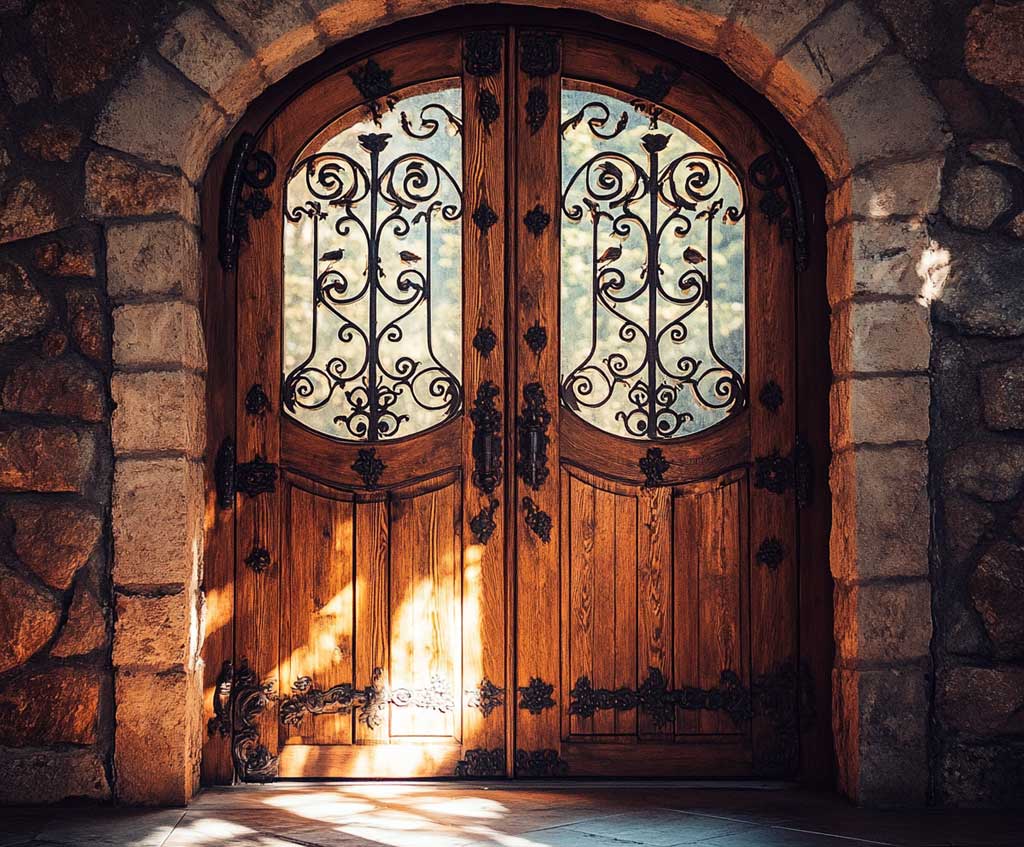


Iron doors are often lasting over 30 years with proper care, and well-maintained wrought iron can stay structurally sound for 50 years or more — a meaningful contrast to wood-only doors, which typically need refinishing or replacement at the 20-to-30-year mark under comparable exposure. What’s the catch? Iron conducts cold, so a north-facing iron door without a thermal break will bleed heat during winter months. A common approach is to specify thermally broken steel frames with iron surface detailing — you get the visual weight of solid iron without the thermal performance penalty.
Mahogany or dark oak paired with scroll ironwork reads heaviest — right for a home with a stone facade and significant architectural mass. For smaller or brick facades, specify thinner iron gauge with more open scrollwork patterns, so the door doesn’t visually overpower the surrounding masonry. The way sunlight passes through iron lattice sections and casts moving shadow patterns onto an entry floor is one of those real-world effects that never quite translates in photos — it’s worth standing in front of a reference door at midday before committing to a pattern density. See how this ironwork language scales to Victorian-style main door designs where pillar accents and stained glass complete the composition.
Distressed White Reads Farmhouse Without Trying Too Hard
Distressed white double doors work on a simple visual principle: the slightly peeled, grain-showing paint finish does the same job that age does to a structure — it signals history without requiring actual history. This is the most accessible entry point into vintage double door design, and it suits farmhouse, rustic, and cottage exteriors where a grand carved door would read as out of scale. Vertical panel layouts work best here because they let the distressed paint texture carry the visual interest rather than competing with carved relief work.


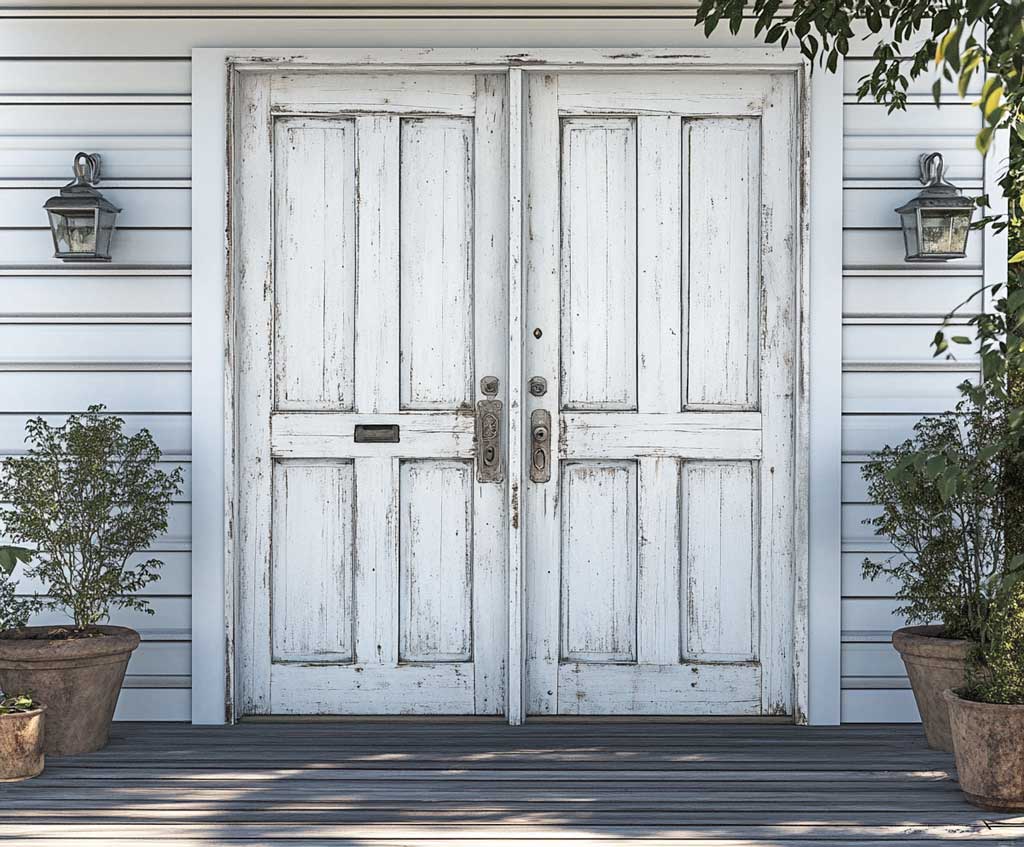
White exterior paint on wood needs attention on a real schedule. A properly maintained white wood surface typically holds for seven to ten years before visible degradation — chalking, peeling at panel edges, or yellowing around the grain — makes a repaint necessary. That clock runs faster for south-facing doors with direct sun exposure. Acrylic latex paint outperforms oil-based on exterior wood for this application: it stays flexible through temperature cycles instead of hardening and cracking, and it resists mildew better in humid climates. You’ll also notice that morning light is when distressed white really earns its keep — the raking angle catches every ridge in the wood grain and the door looks dimensional rather than flat.
The right porch surround matters as much as the door itself. A wooden porch with exposed beam ends and potted terracotta planters completes the composition; a brick porch with painted trim competes with it. Hardware choices: tarnished silver or aged brass rather than anything polished — the glint of new hardware against worn paint is the visual equivalent of wearing a brand-new belt with a vintage jacket, and it undermines the whole effect. For doors framed by flowering climbers or wisteria, leave at least 6 inches of clearance between the plant structure and the door surface. Moisture-trapping organic material against exterior wood is how rot gets started, and rot on a distressed door goes undetected longer than on a painted slab. Learn more about how artistic double door designs for the main door can extend this visual language into bolder, more expressive directions.
| Style | Starting Cost | Lifespan / Maintenance Cycle | Best Facade Match |
|---|---|---|---|
| Hand-carved wood (antique/new) | $1,405–$5,680 avg (1stDibs); new custom varies | Refinish every 3–7 years | Rustic, traditional, eclectic |
| Wrought iron + wood | $1,500–$5,000 standard; $4,000–$10,000+ custom | 30–50+ years; powder coat check every 10 yrs | Stone, brick, heavy masonry |
| Distressed white painted wood | Lowest; existing door can be refinished | Repaint every 7–10 years | Farmhouse, cottage, rural |
Wrought iron doors require professional installation on a reinforced frame — unlike standard wood doors, the weight load on hinges and threshold requires structural consideration. According to Black Diamond Iron Doors, remodel installation runs $500–$1,000+ because installers must remove the old door and casing, adjust the frame, and ensure the new heavy unit aligns correctly. Budget that installation cost separately from the door itself when comparing total project spend across the three styles.
FAQ
What is vintage double door design?
How much does a vintage double door cost?
What wood is used in antique double door designs?
How long do wrought iron double doors last?
Are vintage double doors good for security?
What hardware works with a distressed white double door?
Bottom Line
Vintage double doors reward choosing the right style for the right facade — not just the most dramatic option available.
Carved wood averages ~$5,680 on the resale market and needs a refinish every 3–7 years; choose it for rustic or traditional homes with architectural mass to match the door’s visual weight.
Wrought iron doubles start at $1,500 and last 30–50+ years with minimal upkeep — the highest long-term value of the three styles, but they require reinforced installation and a thermally broken frame on cold-facing exposures.
Distressed white is the entry-level path into vintage double door design; it needs a repaint every 7–10 years, and the effect reads best framed by a wood porch and terracotta planters, not a brick surround with polished trim. Save this post.
Complete guide
Door Design Ideas That Transform Every Entrance, Room and Style
Front doors, double doors, interior, garage, glass, wood, trim — all in one place
Complete guide
Wood in Every Room — Floors, Walls, Facades and Furniture
Paneling, ceilings, kitchens, facades, plywood, timber houses — all in one place