Industrial black and white bathroom ideas pull off something most design styles can’t: they look intentional when things are unfinished. Bare concrete, exposed steel frames, and matte black fixtures against white tile aren’t a budget compromise — they’re the whole point. The absence of polish is the aesthetic.
The style draws from urban loft conversions and converted warehouses where the bones of the building became the decor. A black-framed shower, a frameless mirror, open metal shelving — nothing is hidden, nothing is soft. That directness is why this look keeps appearing on design boards and renovation feeds alike.
The risk is in the execution. An industrial bathroom built on the right materials looks sharp for decades. Built on vague inspiration and cheap substitutes, it looks like a half-finished renovation. These three approaches break down what actually works — surfaces, fixtures, lighting — and where the style falls apart when designers cut corners.
- Exposed brick needs a penetrating silane-siloxane sealer before it survives bathroom moisture — skip polyurethane
- Matte black faucets in the $100–$300 range deliver solid brass construction without overspending
- White subway tile runs $5.58–$15/sq ft for materials; with black grout, no extra cost but far more visual impact
- Industrial pendant lights with Edison-style bulbs start at $48 at Home Depot — the warm glow offsets raw concrete surfaces
- Concrete walls pair with open metal shelving, not closed cabinetry — closed units kill the industrial logic
- Black grout on white subway tile needs epoxy grout or sealing every 12–18 months to stay dark and sharp
Brick Walls Make Industrial Black and White Bathroom Ideas Hit Different
Exposed brick is the fastest way to read “industrial” in a bathroom — but only if the brick is sealed before the first shower runs. Brick is porous. Bathrooms are wet. A penetrating silane-siloxane sealer like DRYLOK Siloxane 7, which runs around $40 a gallon, prevents moisture from migrating behind the wall and causing efflorescence — those white salt deposits that bloom through the joints and ruin the look within months. Polyurethane surface coatings trap moisture instead of repelling it; avoid them. You can find more detail on which sealers hold up long-term in our guide to exposed brick bathroom ideas.
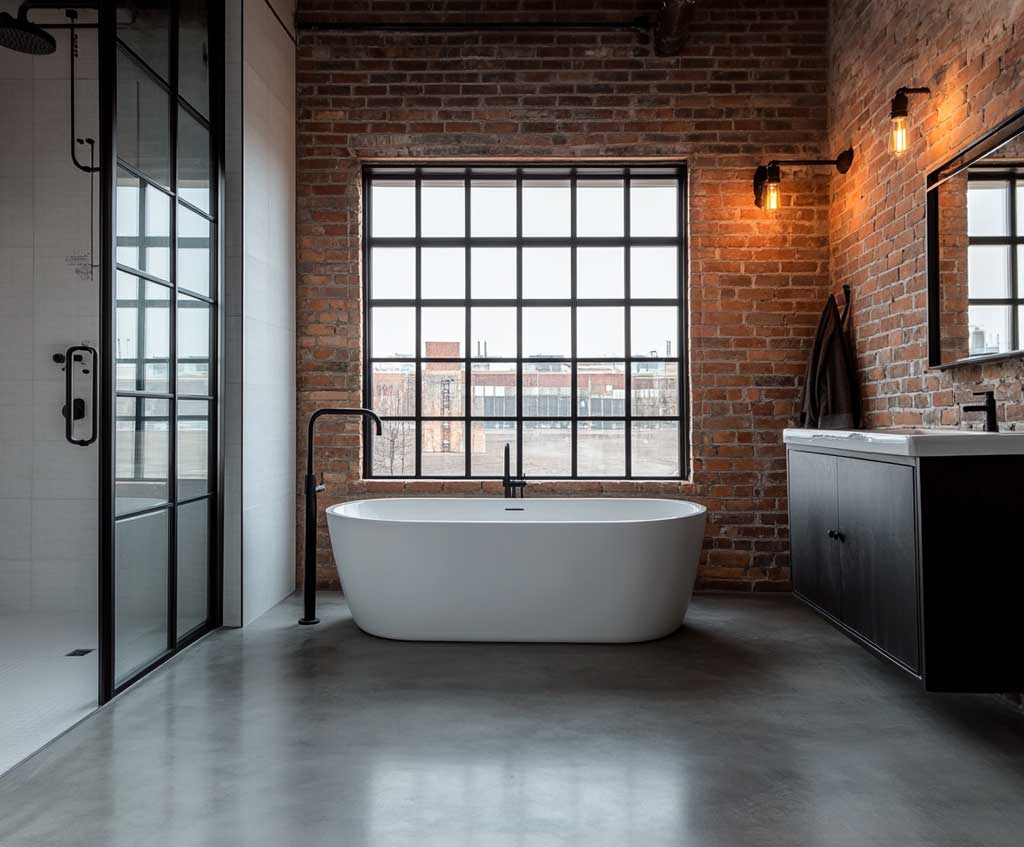


The fixture pairing matters as much as the wall. Black-framed shower enclosures with clear glass are the right call here — they hold the monochrome palette without competing with the brick texture. Stainless steel faucets reflect the industrial language without softening it. Ask yourself: does the fixture look like it belongs in a converted factory? If the answer is yes, it belongs in this bathroom. If it looks spa-like or polished-hotel, it doesn’t.
Lighting is where most industrial bathrooms lose the thread. Edison-style pendant fixtures — the kind with exposed cage frames or bare-bulb sockets — deliver around 200 lumens of warm ambient light and retail from $48 at Home Depot. That warmth is essential: it offsets the coldness of raw concrete floors and steel frames, making the space feel lived-in rather than abandoned. Avoid recessed can lighting in an exposed-brick bathroom. It reads as a remodel that couldn’t commit to the style.
Never install raw, unsealed brick inside a shower enclosure. Real brick behind a shower wall absorbs water with every use. Mortar joints dissolve, mold follows, and the fix — stripping the wall and retiling — typically runs $2,000–$3,500. Brick belongs on the dry wall across from the shower. Inside the shower zone, use glazed ceramic brick tile rated for direct water contact if you want the visual. It’s not the same tactile experience, but it’s the one that survives.
Also avoid using brick on all four walls of a bathroom under 60 square feet. Brick absorbs light. A fully bricked small bathroom feels like a cell. Use one accent wall, pair it with white tile or painted plaster on the other three, and run strong wall sconces at eye level.
Concrete and Open Metal Shelving — the Minimalist Route Through Industrial Design
Concrete walls push the black and white bathroom toward a harder, more architectural edge than brick. Where brick reads warm and textured, concrete reads precise and urban — closer to a gallery than a loft. The trick is that concrete needs company. Paired with polished concrete floors and sleek black cabinetry, raw concrete walls can feel oppressive and cold. Break that with open black metal shelving: visible towels, grouped products, a plant or two. The openness signals that the space is inhabited.


White subway tile in the shower zone is the standard pairing for a reason. At $5.58 per square foot for basic ceramic (Daltile’s Modern Dimensions matte white at Home Depot, for example) to $15 per square foot for specialty finishes, it’s genuinely affordable, and it does something concrete alone can’t: it reflects light. That reflected light is what keeps a concrete bathroom from reading as a bunker. Does white subway tile look industrial? Only with black grout. Light or gray grout turns the same tile toward Scandinavian or hotel modern. Black grout shifts it back to urban edge, with no additional material cost — just a different grout product order.
A large frameless mirror is non-negotiable in a concrete bathroom. Not a framed mirror, not a medicine cabinet — frameless, floor-to-ceiling if the budget allows. It doubles the visual depth of the space and bounces natural light across surfaces that would otherwise absorb it. Natural light from a window on the opposite wall is the best case scenario. Without it, plan for a minimum of 800 lumens of artificial light above the mirror, and supplement with wall-mounted industrial sconces on either side. One overhead fixture alone produces flat, unflattering light that makes both the concrete and the person standing in front of it look gray.
White Subway Tile and Black Fixtures — the Urban Black and White Bathroom in Practice
Urban black and white bathroom design built on subway tile and black fixtures is the most approachable entry point into this style — and the one most likely to be executed poorly. The tile itself is not the statement. White subway tile in a bathroom without black grout, black fixtures, and black-framed hardware reads as builder-grade, not industrial. Every finish decision has to run in the same direction. The moment chrome or brushed nickel appears alongside matte black — on a towel bar, a drain cover, a mirror frame — the palette fragments. Stylists working in this direction treat the fixture finish like paint color: one family, no exceptions.
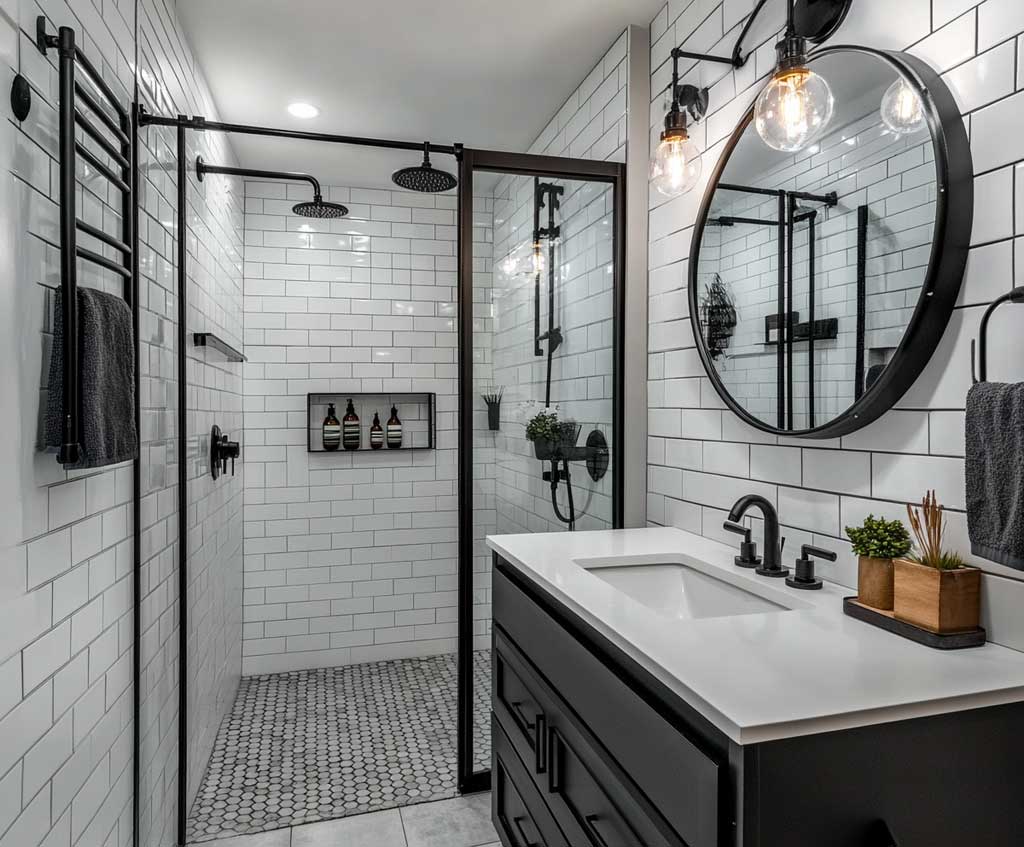

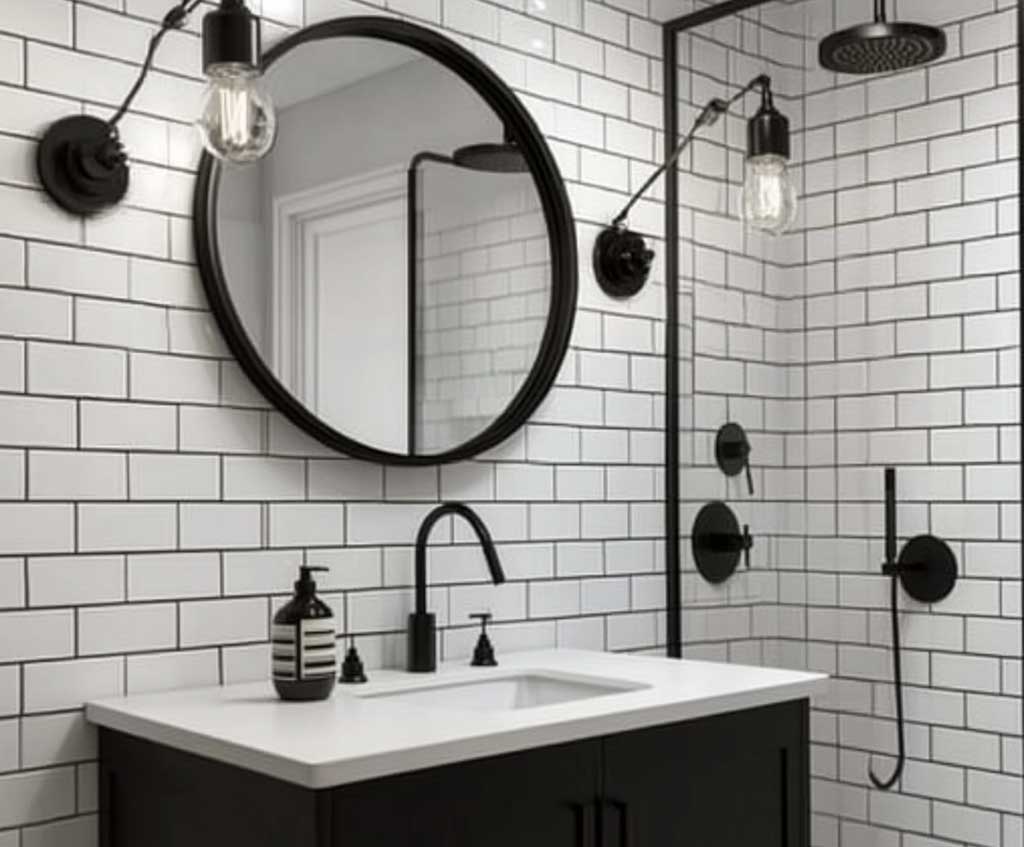

Matte black faucets in the $100–$300 range deliver the best value in this category — solid brass construction, PVD-coated finishes that resist fingerprints and water spots better than chrome, and enough visual weight to hold the monochrome scheme. The matte surface matters practically: it hides water spots that chrome turns into a daily maintenance problem. How do you choose between a single-handle and a widespread faucet here? Go single-handle. The simpler the fixture, the more industrial it reads. Widespread faucets move the style toward transitional, which fights the direction.
The lighting configuration in this setup follows a specific logic. Industrial sconces with exposed-bulb design flank the mirror at eye level — 60 inches from the floor is the standard installation height for even, shadow-free illumination at the face. The black metal frames echo the shower frame, the mirror frame, and the vanity hardware, pulling the room into visual coherence. A rain showerhead in the walk-in, also matte black, completes the material story. For current subway tile installation pricing, HomeGuide’s 2026 cost breakdown puts shower wall installation at $700–$3,200 for a typical 90-square-foot shower, depending on labor rates and tile choice.
| Approach | Key Material | Lighting Style | Primary Risk |
|---|---|---|---|
| Exposed Brick | Sealed brick + black steel | Edison pendants, warm glow | Unsealed brick = mold within 12 months |
| Concrete + Metal Shelving | Raw concrete + open shelving | Frameless mirror + sconces | No light compensation = oppressive space |
| Subway Tile + Black Fixtures | White tile + matte black hardware | Exposed-bulb sconces flanking mirror | Mixed finishes break the palette instantly |
The Takeaway
Industrial Black and White Bathrooms Reward Commitment, Not Compromise
Pick one surface direction — brick, concrete, or subway tile — and run every fixture decision through the same lens. Mixed signals (chrome next to matte black, carpet texture next to raw steel) are what make this style read as unfinished rather than intentional.
Seal the brick before you tile the shower. Budget $100–$300 for a matte black faucet that won’t show every water spot. Use black grout on white subway tile — it costs nothing extra and changes everything.
Save this post before your next renovation planning session — the material choices stack up fast when you’re standing in a tile showroom.