Green and copper kitchen combinations turn a compact space into something that reads deliberate rather than compromised. The pairing works because copper’s warm metallic tone is the complementary opposite of green on the color wheel — which means the contrast is doing structural design work, not decorating for decoration’s sake. What follows are three ways small kitchen furniture ideas built around this palette solve both the color problem and the space problem at once.
Compact kitchens magnify every decision: a hardware finish that reads flat under showroom light looks completely different against 40 square feet of green cabinetry in a real apartment. Copper sidesteps that trap because its warm reddish-brown reads rich even in artificial light — a quality that matte brass and chrome don’t reliably share. Stylists recommend testing copper alongside your specific green shade in natural morning light before committing, because sage-copper reads earthy while dark-forest-copper reads almost jewel-box.
Scale matters more in a small kitchen than in a large one. A copper range hood that would be a handsome accent in a sprawling open-plan kitchen becomes the entire focal point in a galley — which is either a strength or a disaster depending on how well the surrounding cabinetry and tile handle the visual weight. The three layouts below show how each element of the green-and-copper story can anchor a different part of the room so the composition stays balanced rather than chaotic.
- Green cabinets with copper hardware: Sherwin-Williams Evergreen Fog pairs naturally with copper pulls priced from $2 to $30 per piece; high-end copper hardware reaches $200 per handle.
- Copper range hood with green tile backsplash: copper-finished hoods run $250–$1,250 for the unit alone; green subway tile installs for $7–$35 per square foot.
- Green dining set with copper accents: compact round tables and copper-framed chairs define the dining zone without eating floor area.
- Avoid matching all metal finishes to appliance stainless — copper reads warmer and richer precisely because it contrasts, not coordinates.
- Cabinet hardware finish is the fastest swap: replacing knobs and pulls on existing green cabinets with copper pieces costs $200–$500 total for an average kitchen.
What Sage Green Cabinets with Copper Hardware Actually Cost — and Why the Hardware Finish Matters More Than the Color
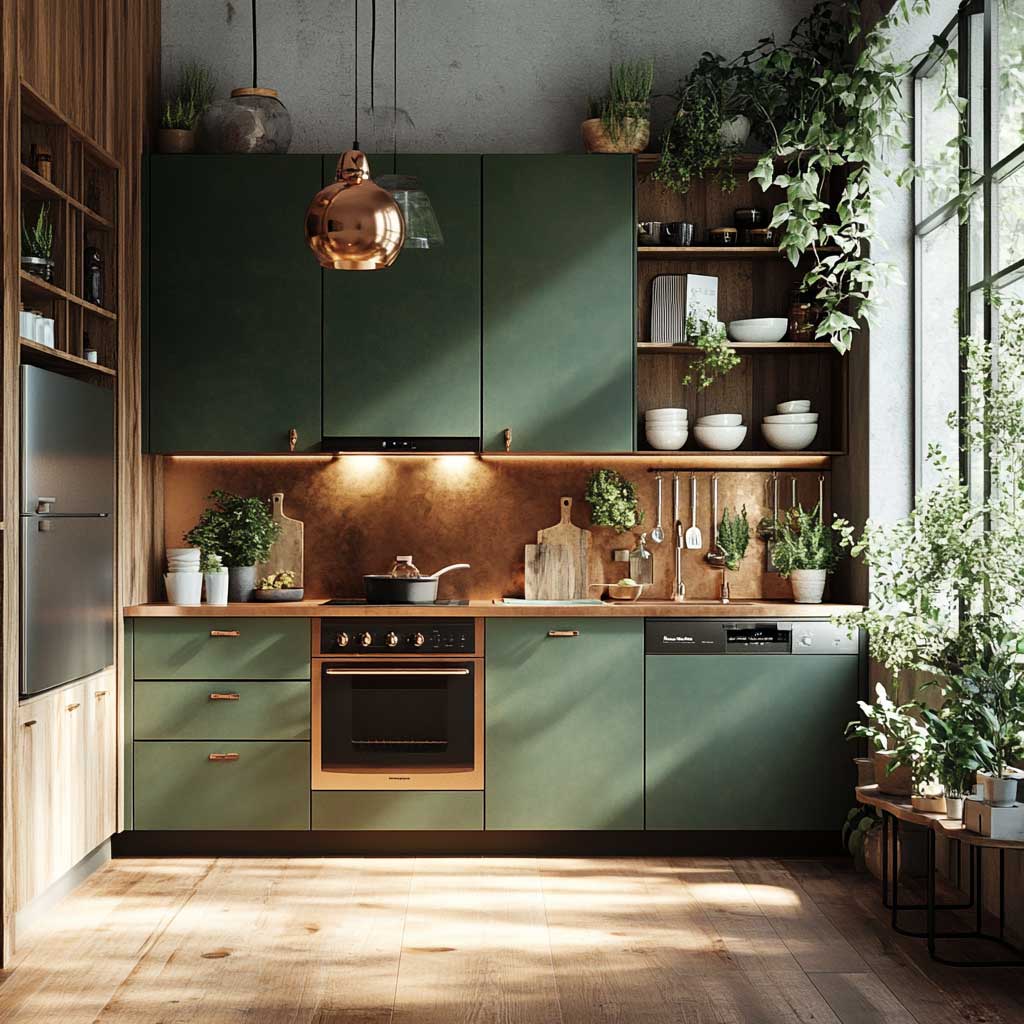
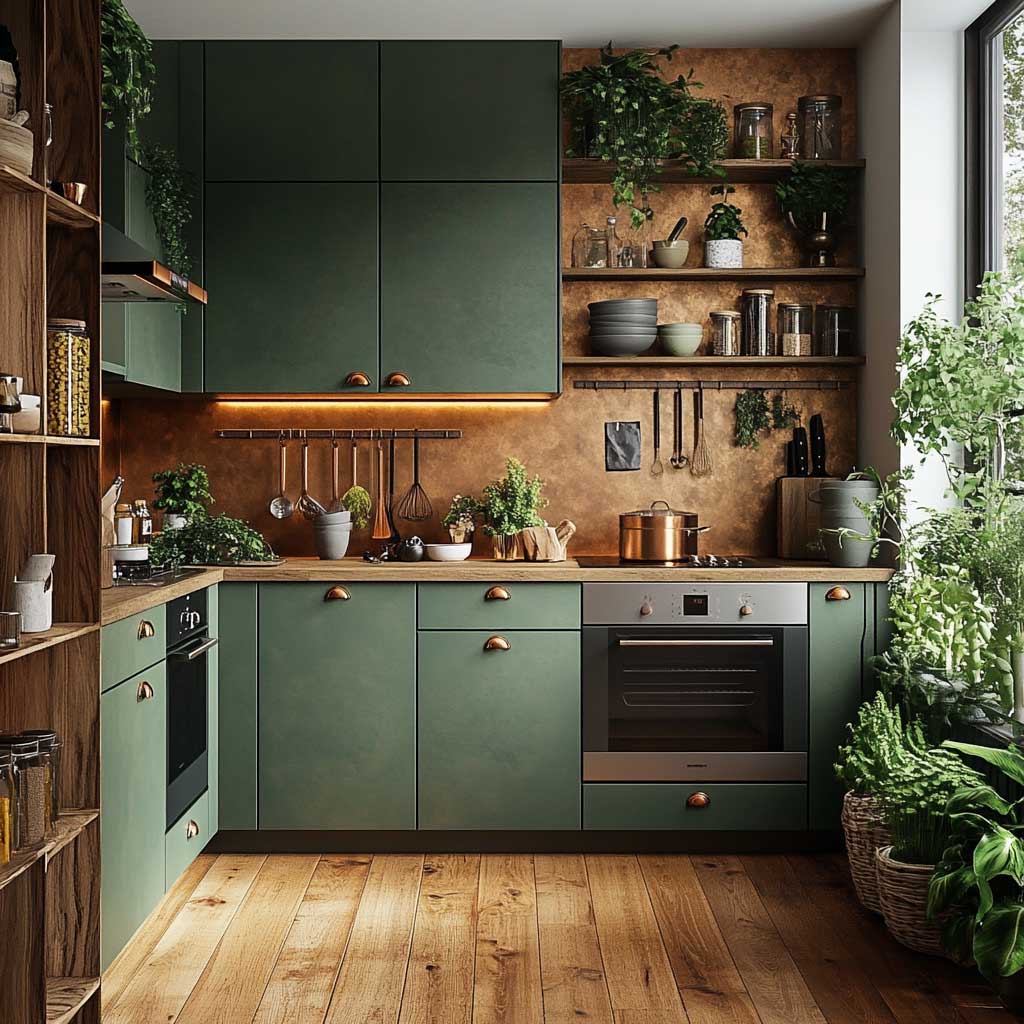
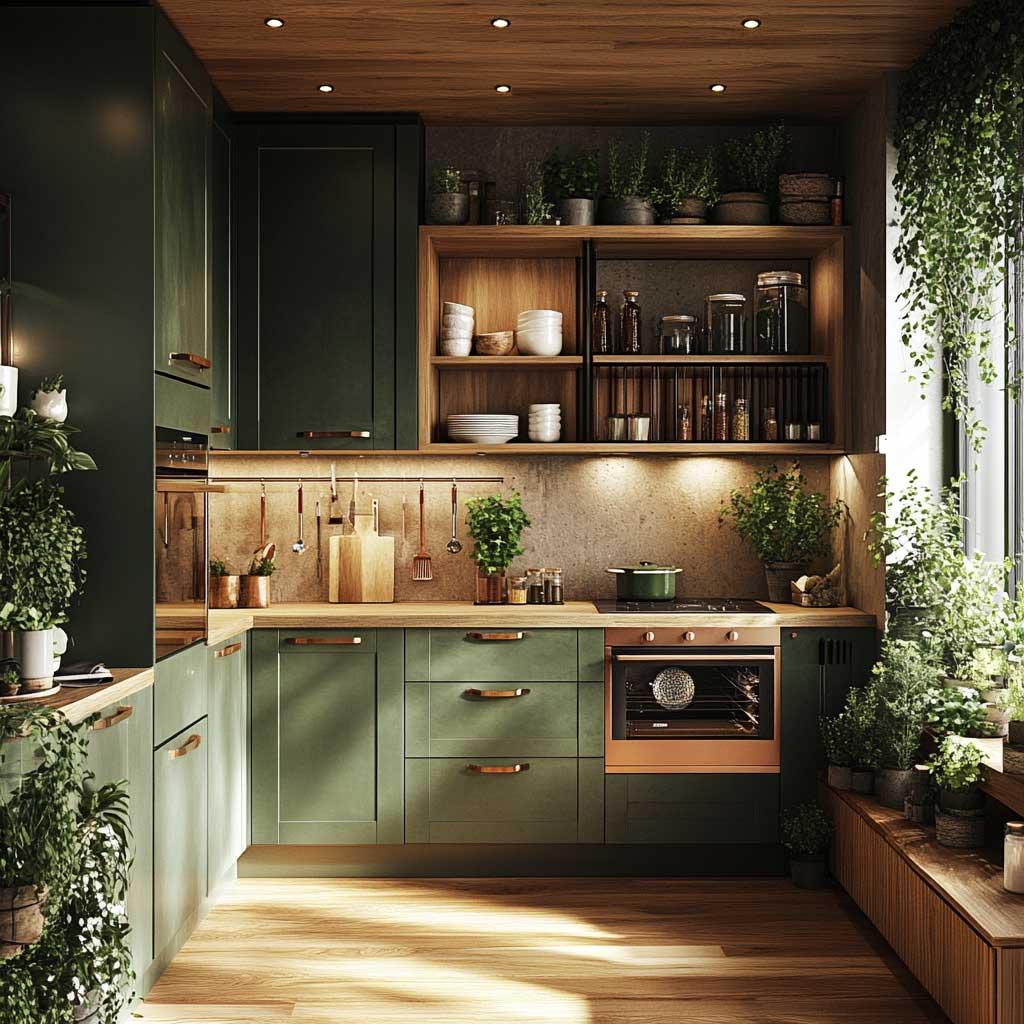

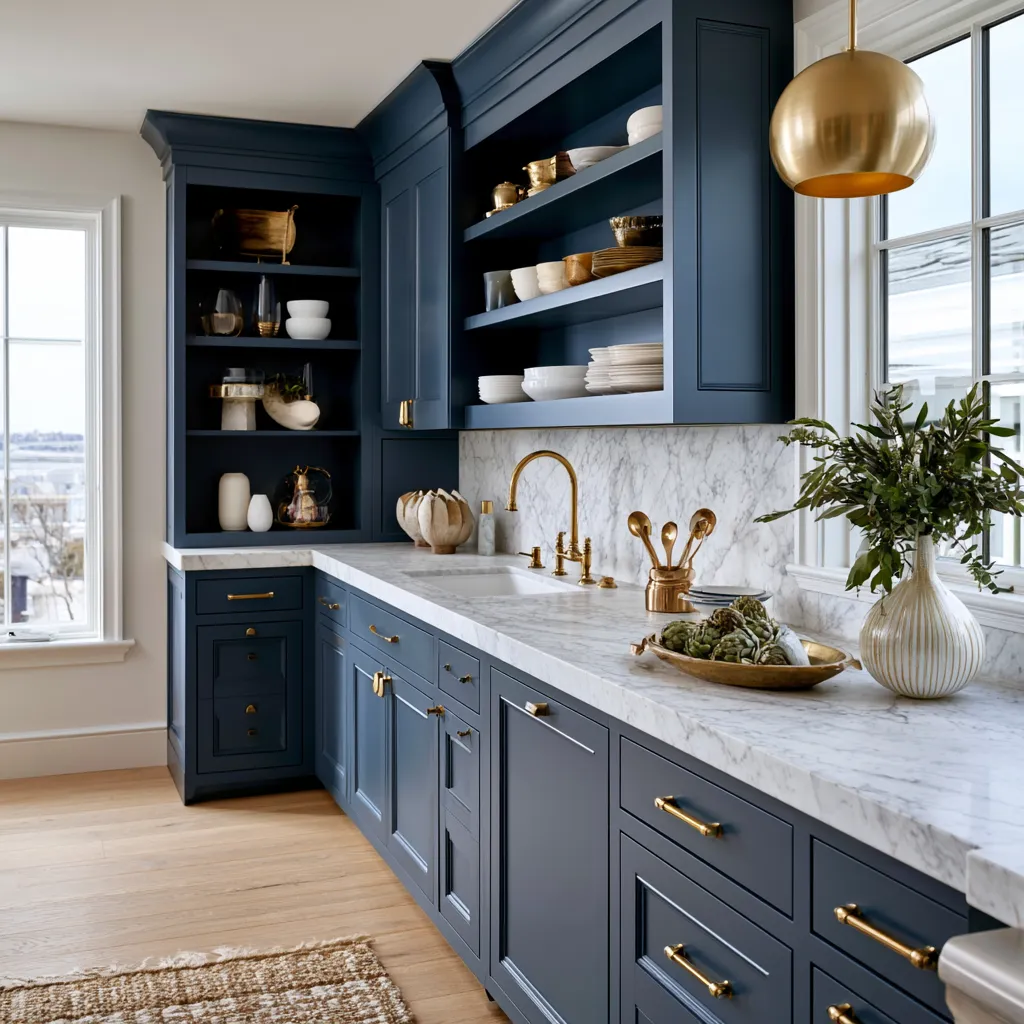
Green cabinets with copper hardware is one of the most searched small kitchen furniture ideas precisely because the entry cost is low: copper cabinet hardware runs $2 to $30 per piece for most finishes, and up to $200 each for solid high-end copper pulls. Replacing the hardware on an existing set of cabinets — without touching the paint — is a $200–$500 project for an average kitchen. The shade of green you’re working with determines which copper finish reads best. Sherwin-Williams Evergreen Fog (SW 9130), named 2022 Color of the Year, has enough grey-green to anchor unlacquered copper without the combination tipping orange-heavy. Benjamin Moore October Mist (1495) is lighter and works better with a brushed or antiqued copper finish that adds visible warmth back into the cooler tone.
Custom or semi-custom green cabinets installed with copper hardware run $150 to $500 per linear foot for stock and semi-custom options. That number can feel steep, but the payoff in a small kitchen is proportion: a compact cabinet run of 8–10 linear feet totals $1,200–$5,000 installed, which is a fraction of a full kitchen remodel. The trick here is using the copper hardware as the calibration tool — if the copper reads brassy or orange against your specific green, the green has too much yellow in its base and you need a cooler shade. If it reads brown-black, the green is so dark it’s absorbing the copper’s warmth entirely. The right match is when the copper appears to glow slightly against the green without fighting it.
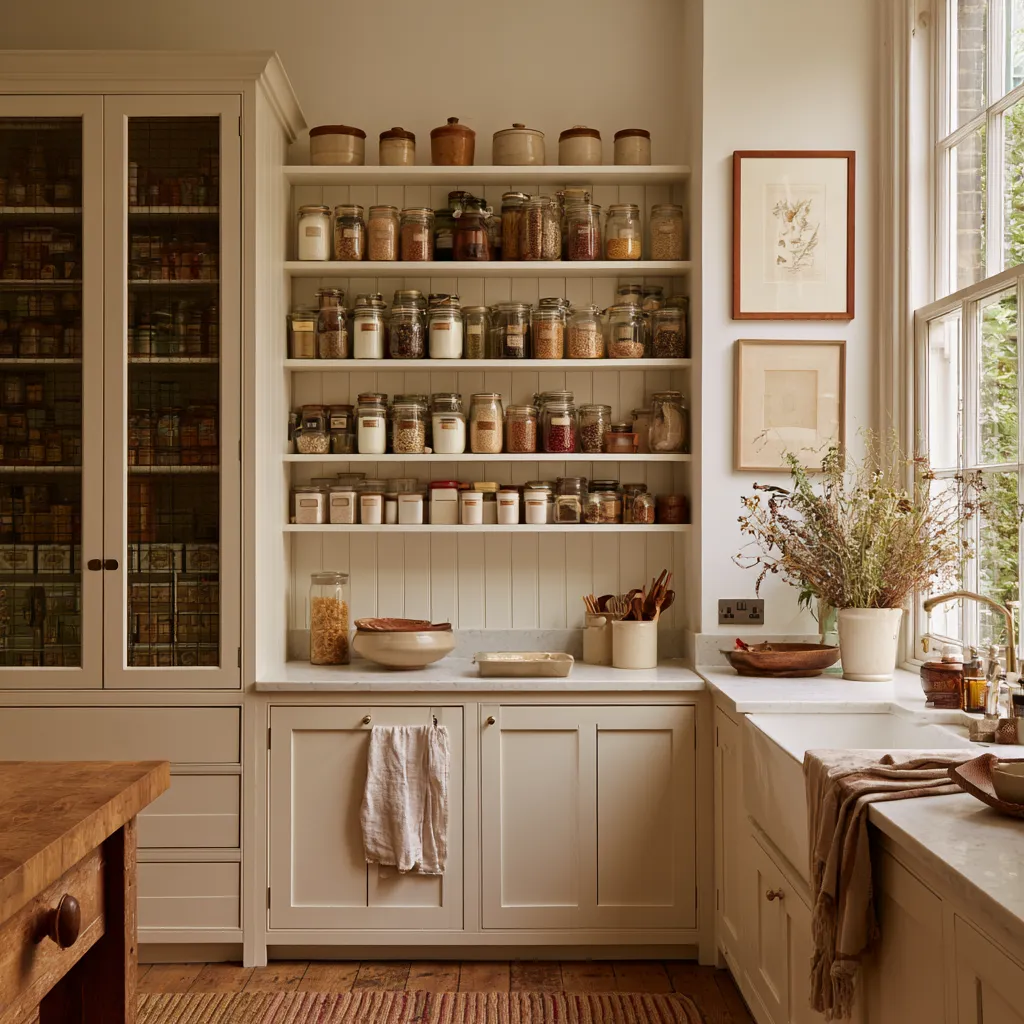
Open wooden shelving alongside green cabinetry earns its place not as decoration but as a tension-breaker — it keeps a small kitchen from feeling like a closed cabinet box. The warm wood grain picks up copper’s reddish undertone and repeats it horizontally across the room, which is how designers create cohesion without repetition. What doesn’t work: matching the shelves to a cool-toned grey or white when the rest of the palette is warm. A cold floating shelf in a copper-and-green kitchen reads like a mistake rather than a contrast. Warm oak, walnut, or stained pine hit the right register. For more on how green cabinetry handles different hardware finishes and metallic tones, the green kitchen cabinet metallic hardware pairing breakdown covers the full shade-by-shade comparison.
Pendant lighting in a small green-and-copper kitchen should use warm-white bulbs (2700K–3000K) rather than daylight bulbs. Daylight bulbs pull green toward blue-grey and make copper look pale and washed out — exactly the opposite of the earthy warmth this palette is built around. A single pendant over the sink or prep counter in a brushed copper or antique bronze finish reinforces the hardware story without adding clutter. What is the most common mistake with this combination? Matching the light fixture finish to stainless appliances instead of to the cabinet hardware. In a green-and-copper kitchen, the appliances should recede; the hardware and light fixtures should connect.
A Copper Range Hood Becomes the Focal Point a Small Green Kitchen Actually Needs

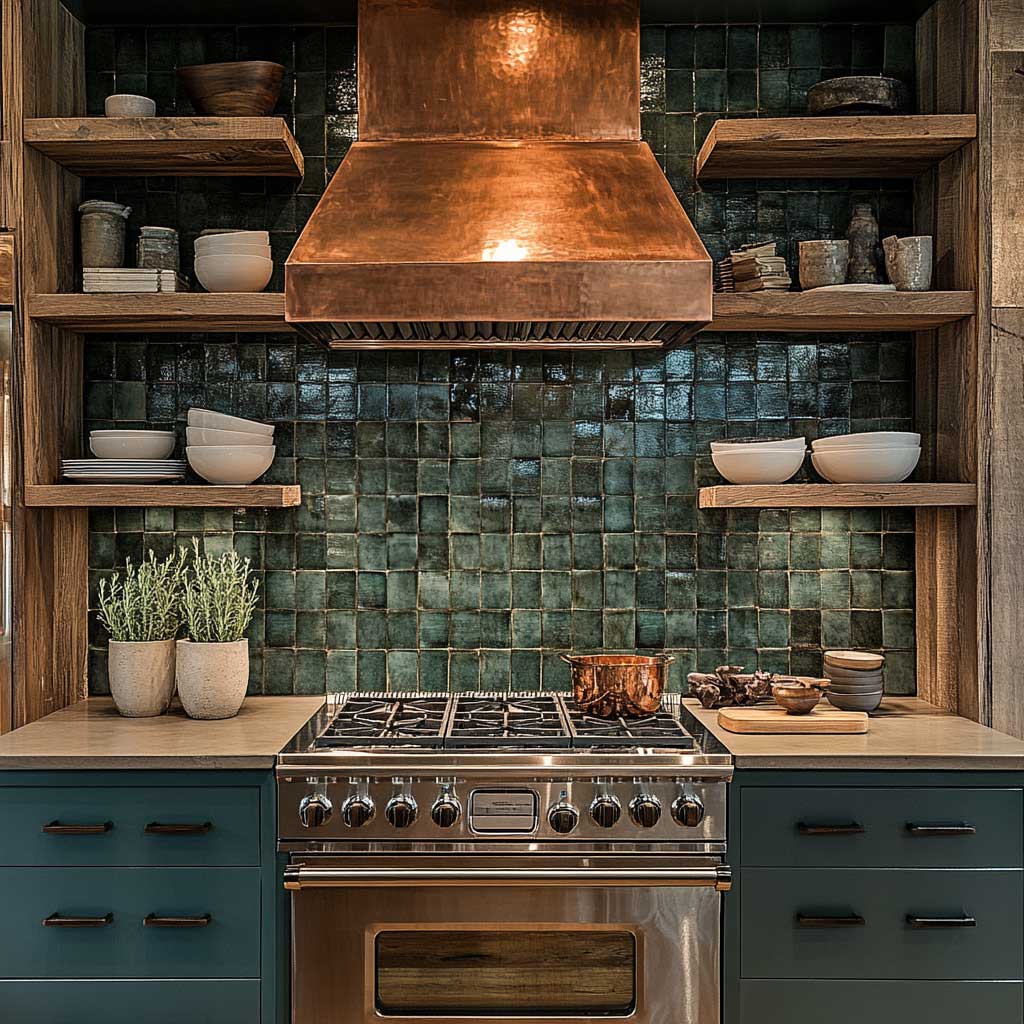
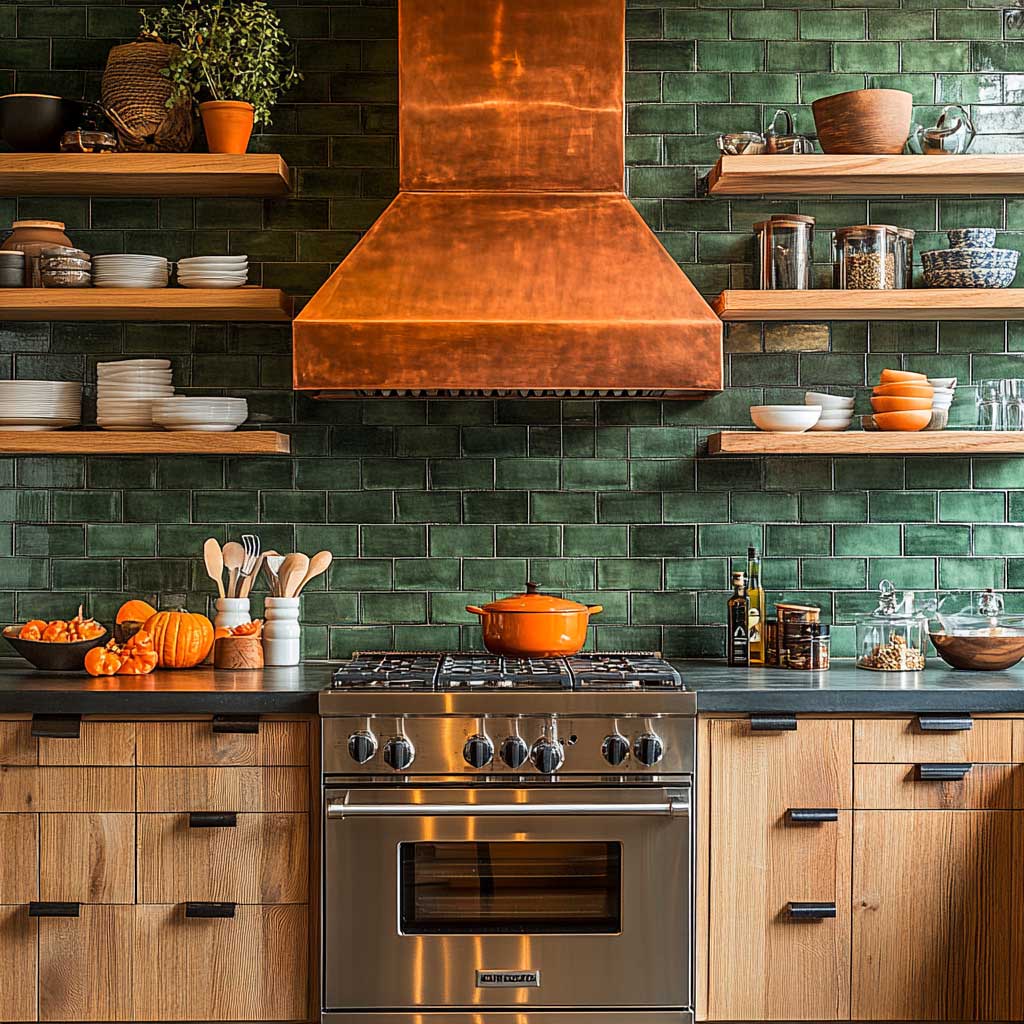
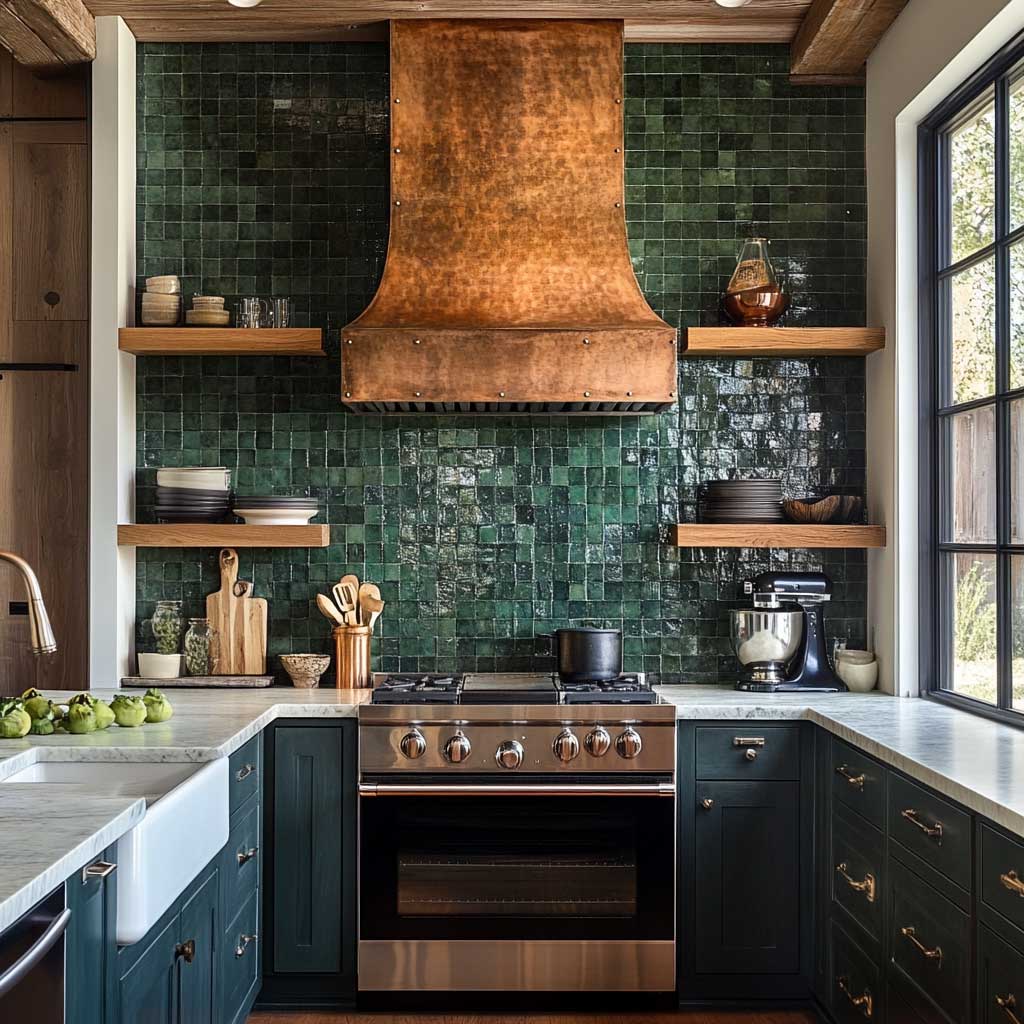
A copper range hood with a green tile backsplash solves one of the harder small kitchen furniture problems: where to put the focal point when you don’t have an island or a large window. The hood goes above the cooktop by default, which means it occupies the center of the kitchen’s most-used wall — precisely where the eye lands first. A copper-finished range hood starts at around $250 and runs up to $1,250 depending on size, according to Angi’s 2026 cost data; full professional installation adds $650–$2,500 to the total. The patina that develops on copper over 12–18 months of kitchen use deepens the metal’s color from bright reddish-orange toward amber-brown, which is when the green-and-copper combination reaches its most distinctive earthy register.
Green subway tile as a backsplash installs for $7–$35 per square foot depending on tile material and pattern complexity. For most small kitchen backsplash areas (20–35 square feet), that puts total installed cost between $140 and $1,225. Matte green ceramic is at the lower end of that range and is the right choice for a small kitchen because it absorbs light rather than bouncing it — which means it doesn’t compete with the copper hood’s reflective surface. Glossy or glass green tile on the same wall as a copper hood creates a mirror-on-mirror situation where both surfaces are trying to catch the eye at once. One should lead; stylists consistently position the copper as the lead and tile as the supporting texture. What finish works best? A 3×6 brick-lay subway in a muted sage or forest green reads grounded rather than trendy, and it won’t feel dated in three years the way a heavily patterned encaustic tile might.
Open wooden shelving alongside the hood and backsplash keeps the vertical wall composition from feeling top-heavy. A shelf at 60–66 inches above the floor — at eye level for most people — gives the copper hood a breathing zone below it rather than compressing the design. Displaying a small set of copper or terracotta cookware on that shelf repeats the warm metal story without adding another heavy element. For the full range of green tile colors and patterns that work in this layout, the green kitchen backsplash designs roundup shows how shade variations from sage to emerald perform against different hood and cabinet finishes.
The sone rating of a range hood matters more in a small kitchen than a large one because the room’s volume is lower and noise carries differently. Most hoods fall between 6 and 10 sones on a 1–20 scale — roughly equivalent to a normal conversation to a louder exchange. Quieter models run toward the higher end of the cost range, which is worth knowing before assuming a copper-finished hood is priced purely for aesthetics. Budget for under-cabinet LED lighting at the same time as the hood installation: it warms the backsplash tile from below and makes the copper hood’s finish read much richer than it will under ceiling-only lighting. That additional layer of light costs $50–$200 for a standard strip installation and changes how the whole wall reads after dark.
According to Angi’s 2026 range hood installation data, the average lifespan of a kitchen range hood is about 15 years with regular cleaning. For a copper hood, that lifespan also includes the visual evolution from bright to patinated — which means the kitchen’s character deepens over time rather than fading. That is the material argument for copper over painted or powder-coated finishes: it ages into the design rather than degrading away from it.
Green and Copper Kitchen Furniture for the Dining Zone — Fitting a Full Dining Set Into a Space That Has None

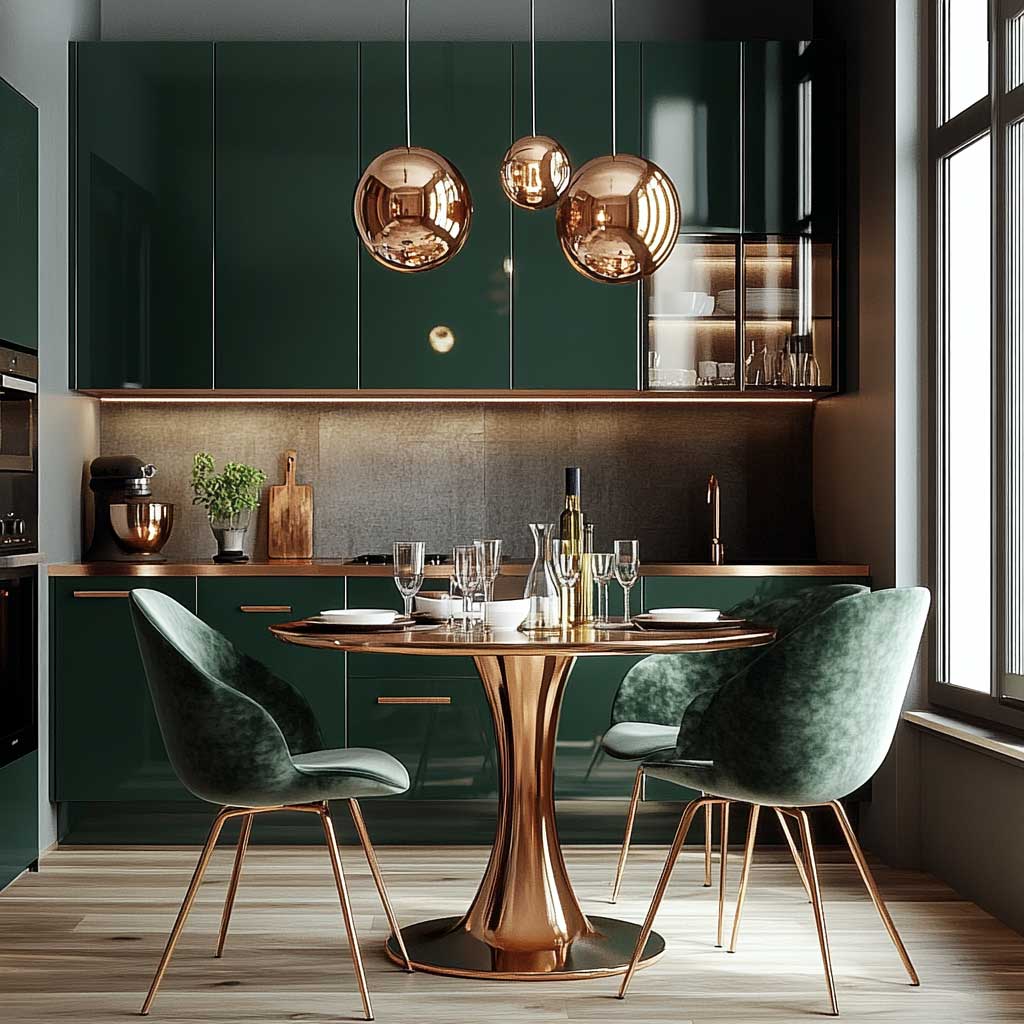
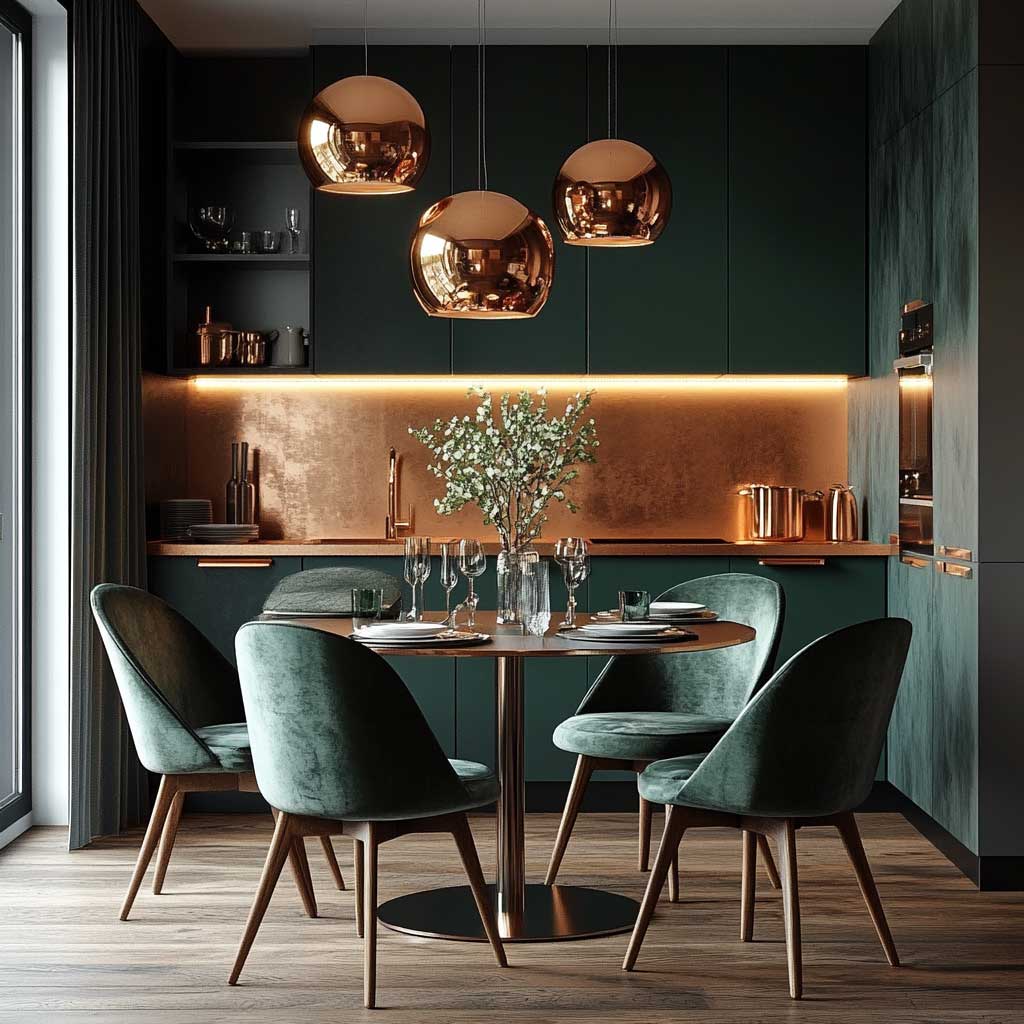
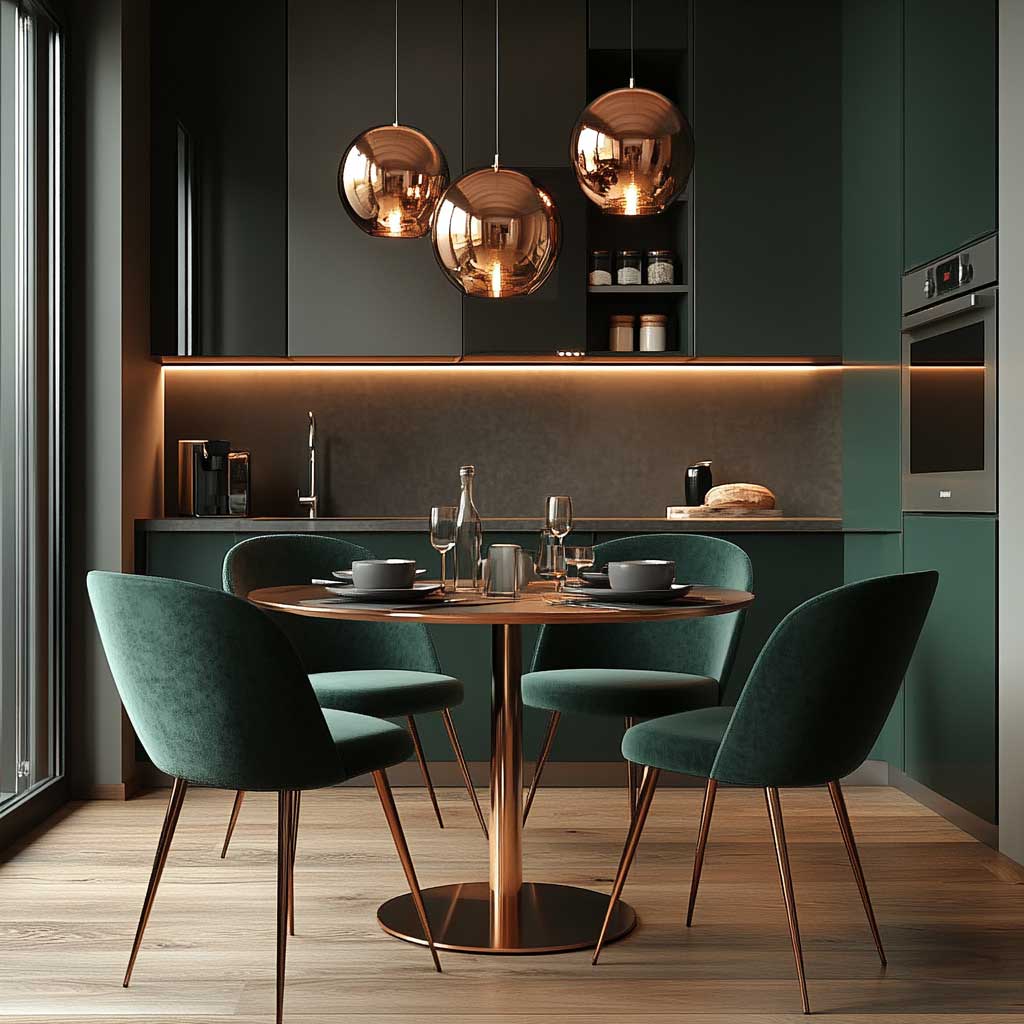
A green dining set with copper accents resolves the small kitchen furniture problem of the undefined dining zone — that awkward corner or strip of floor that’s too small for a standard table but too obvious to leave bare. Round tables earn their place in compact spaces because they have no corners to navigate around; a 36-inch round seats two comfortably and four in a pinch, and the circular footprint is roughly 40% smaller than a standard rectangular 4-person table. A green tabletop or green upholstered chair seats in sage or deep emerald anchors the dining zone to the kitchen’s color story without requiring new paint or a backsplash refresh.
Copper-framed or copper-legged chairs are where the material story connects across the room. Think of it like a relay: the copper hardware on the cabinets passes the warm metallic tone across to the copper chair frames, which carry it into the dining zone. The eye reads these as a system rather than unrelated decisions, which is what makes a small kitchen look designed rather than assembled. What pairs best with copper chair frames? Green cushioned seats in a textured fabric — boucle, cotton canvas, or linen — rather than a flat upholstery, because the texture picks up light at different angles and keeps the seat from reading as a flat colored square.
A copper pendant above the dining table — hung 30–34 inches above the tabletop rather than the standard 36 — pulls the warm metallic tone vertically and brings it down into the zone where people actually sit and eat. That lower hang point is the mechanical reason the light feels intimate in a small kitchen rather than too bright: it focuses the pool of light on the table surface and leaves the surrounding floor in relative shadow, which makes the dining zone read as its own defined space. The trick here is choosing a pendant scale appropriate to the table — a 36-inch round table needs a pendant 12–16 inches in diameter; going larger overwhelms the table and adds visual weight a small room can’t absorb.
Natural stone or wood as a tabletop material connects the dining set to the green-and-copper kitchen story at a material level rather than just a color level. A small round table in white oak or a warm-veined marble does what a painted green surface can’t: it introduces an organic, imperfect texture that looks like it grew into the space rather than being installed. Does the tabletop material need to match the kitchen’s countertops? Not exactly — but the undertones should align. A cool Calacatta quartz countertop pairs with a similarly cool-veined marble dining table; a warm butcher-block counter pairs better with a wood-topped dining surface in the same tonal family.
| Element | Shade / Finish | Best Paired With | One Risk to Know |
|---|---|---|---|
| Green Cabinets + Copper Hardware | Sage / Evergreen Fog | Warm wood shelves, warm-white lighting | Avoid chrome faucets alongside copper pulls |
| Copper Range Hood + Green Tile | Antiqued copper + matte subway | Under-cabinet LED strip, open shelf below | Glossy tile competes with hood reflectivity |
| Green Dining Set + Copper Accents | Emerald or sage upholstery + copper frames | Round table, natural wood or stone top | Oversized pendant overwhelms small tables |
The Verdict
Copper Does Not Coordinate With Green — It Contrasts, and That Is the Point
The green-and-copper combination works because the two materials sit at opposite ends of the color warmth spectrum — and in a small kitchen, that contrast does the spatial work that square footage can’t. Copper hardware costs $2–$200 per piece and is the lowest-effort entry point into this palette.
A copper range hood ($250–$1,250 for the unit) is the highest-impact single piece: it anchors the room’s focal wall and improves in appearance over 12–18 months as patina develops. Green subway tile at $7–$35 per square foot installed is the supporting texture, not the lead element — keep tile finish matte so it doesn’t compete with the hood.
Save this post before you go shopping — the comparison table above is the reference to bring to the hardware store.