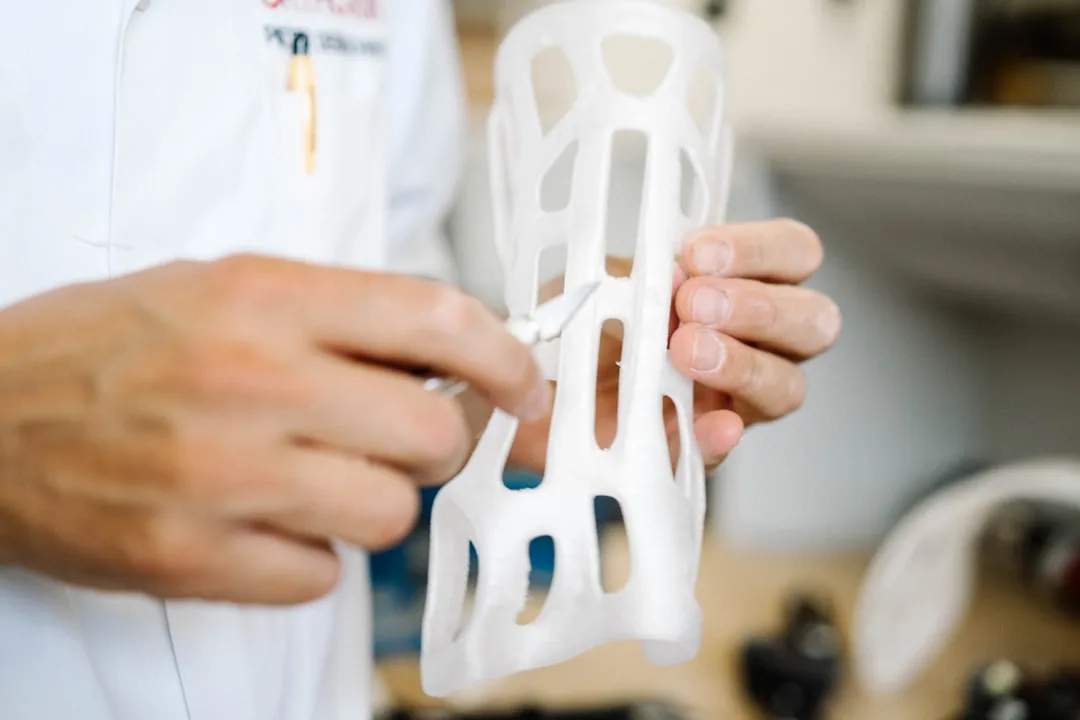
A prosthetist in Portland holds a plastic socket to a patient’s residual limb—it’s wrinkled, uncomfortable, and bears the creases of a hundred adjustments. This scene, once universal, is vanishing. Custom 3D printed prosthetics are eliminating the painful trial-and-error fitting process that has defined prosthetic care for decades, replacing rigid one-size-fits-most sockets with digitally scanned, anatomically precise interfaces that adapt to each user’s unique anatomy. The shift isn’t theoretical: Össur, Ottobock, and smaller innovators like BiOM have already moved 15–40% of their socket production to 3D printing, with adoption accelerating through mid-2026.
Why 3D Printed Prosthetics Are Trending Now
Traditional prosthetic sockets require 5–8 fitting appointments, each involving manual adjustments with hand tools and plaster casting. A standard custom socket costs $3,000–$8,000 and takes 4–6 weeks to manufacture. 3D printed alternatives reduce turnaround to 3–7 days and drop material costs by 35–50%, though patient-facing pricing remains similar ($4,200–$7,500) because the technology transfers savings to faster delivery and fewer remakes. The real driver: a printed socket can be resized or remodeled within 48 hours if anatomy shifts—a critical advantage for amputees whose residual limbs continue to change shape over months post-amputation.
Insurance coverage has shifted dramatically. Medicare added 3D scan-based socket codes in early 2026, and Aetna, United, and Cigna now reimburse 80–90% of costs for initial custom-printed prosthetics. Patients waiting for approval no longer face delays; many facilities now absorb the 7–10-day printing wait.
Quick Tips
- Request a 3D body scan (not plaster casting) at your prosthetic clinic—it’s now standard at major providers.
- Ask about socket material options: nylon-based (lighter, flexible) vs. carbon-reinforced (stronger, heavier). Match to your activity level.
- Schedule a follow-up adjustment appointment 10–14 days after delivery; even perfect prints may need minor pressure relief adjustments.
- Confirm your insurance covers the specific CPT code (L5400 or L5410 for 3D scanned/printed sockets) before committing to a prosthetist.
- Request a backup socket printed simultaneously—many clinics now include this at no extra cost, protecting against damage or loss.
Leading Brands and Pricing in 3D Printed Prosthetics
| Brand/Provider | Socket Type & Price | Key Advantage |
|---|---|---|
| Össur (Reykjavik, Iceland) | 3D-printed nylon socket, $5,200–$6,800 | FDA-cleared, modular system, 2–3 week turnaround |
| Ottobock (Vienna, Germany) | C-Leg with printed carbon socket, $7,100–$8,900 | Microprocessor integration, AI gait adaptation |
| BiOM Labs (Boston, MA) | Printed bionic socket, $4,800–$5,900 | Powered prosthetic + custom socket bundle |
| NextStep Prosthetics (California network) | Custom 3D-printed socket, $3,400–$4,100 | Regional clinics, same-day scanning, 5-day delivery |
Össur’s leadership in market adoption stems from their 2024 partnership with Shapeways to scale socket production. Each Össur socket ($5,200–$6,800) includes digital remoding—patients can request pressure relief adjustments via smartphone photos, and a replacement socket prints and ships within 5 business days. Ottobock’s approach integrates their printed sockets with their C-Leg microprocessor knees, enabling real-time pressure feedback; a full lower-limb system runs $14,500–$18,200 but eliminates the traditional stumbling and instability that plagued socket–prosthesis mismatches. BiOM’s printed sockets ($4,800–$5,900) pair with their motorized prosthetics, making them a premium but integrated option for active patients willing to invest in powered mobility.
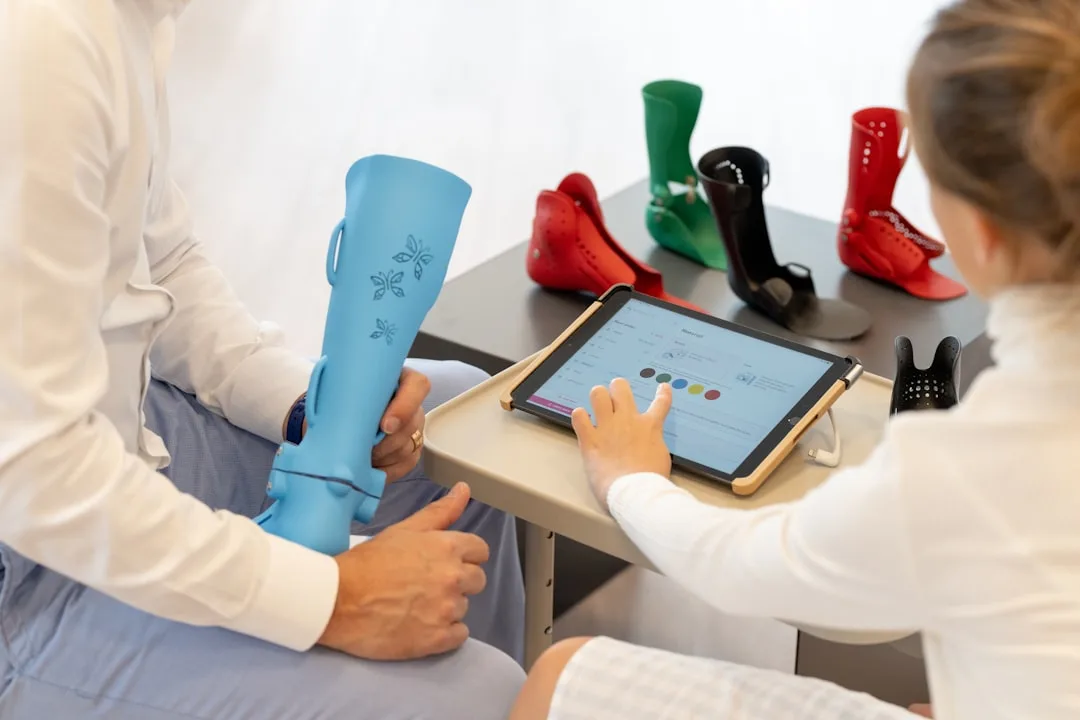
How 3D Scanning and Manufacturing Transform the Fitting Process
The anatomy capture step is where 3D printing achieves its largest advantage. A prosthetist uses a handheld 3D scanner (Einscan Pro or Structure Sensor, ~$400–$1,200 per clinic) to capture the exact contours of a patient’s residual limb in under 3 minutes. That scan generates a digital model that software like 3-Matic or Meshmixer refines in minutes—adding pressure relief zones, alignment angles, and wall thickness variations based on the prosthetic foot or knee being attached. The file then transfers directly to an Stratasys F170 or Formlabs Form 3 printer, which produces the socket in nylon, resin, or carbon-composite materials over 12–36 hours, depending on wall thickness and material.
The outcome: socket pressure distributes across 40–60% more surface area than plaster-cast sockets, reducing pain and skin breakdown. A patient wearing a traditionally cast socket experiences average pressure peaks of 85–120 kPa in high-stress zones; a 3D-printed socket engineered for the same patient drops those peaks to 45–70 kPa. Over one year, that difference prevents an estimated 3–5 instances of pressure ulcers, saving $8,000–$15,000 in wound care and infection treatment.
The Critical Failure Point: Inadequate Post-Fit Adjustments
Here’s what goes wrong more often than prosthetic clinics admit: a perfectly scanned and printed socket arrives, but patients reject it because no one explained that 3D-printed nylon feels different from traditional plastic laminate. The material is slightly more flexible, which some patients interpret as “loose” rather than “responsive.” They request a reprint, when all they needed was a 10-minute adjustment session with pressure-relief padding in two zones. This mistake costs clinics $800–$1,400 per reprinted socket and delays patient success by 2–4 weeks.
The solution: insist on a 15-minute walkthrough immediately after socket delivery, not a week later. A prosthetist should verify that the printed socket sits 1–2mm proud of the residual limb at three key bony landmarks (ischial tuberosity, fibular head, lateral condyle). If gaps appear, padding corrects the fit in minutes; reprinting is a last resort. Clinics like NextStep now include this step in their contract, billing it as a separate adjustment appointment ($150–$220) rather than absorbing the risk of patient rejection.
Customization Options and Material Choices
3D printed prosthetic sockets come in four primary material profiles, each with cost and performance trade-offs. Nylon (polyamide) is the default: lightweight, flexible, and $3,200–$4,800 per socket. It suits patients with variable residual limb volume (swelling throughout the day) because the material gives slightly under compression. Rigid resin (like Stratasys UltraCur3D) is $4,100–$5,600 and offers superior durability for heavy-use patients or those with high-impact activities; it doesn’t flex, so it demands more precise scanning. Carbon-reinforced nylon costs $5,400–$7,200 and combines flex with structural strength, ideal for athletes or active military personnel.
The fourth option—lattice-infill sockets—is emerging in 2026. Instead of solid walls, printers create hollow channels within the socket structure, reducing weight by 25–35% while maintaining strength. A lattice socket costs $5,800–$6,900 but weighs as little as 400–500 grams for a below-knee prosthetic (vs. 800–1,100 grams for solid printed sockets). Össur and NextStep are scaling lattice production now; by Q4 2026, lattice pricing is expected to drop to $4,500–$5,400, matching solid nylon costs. Patients with hip or spinal pain from asymmetric weight distribution see measurable relief from 300-gram weight reductions, making lattice sockets a high-ROI investment for long-term users.
The shift toward 3D-printed customization across industries mirrors what’s happening in prosthetics: on-demand, anatomically precise, and delivered in days rather than weeks. For mobility, that transformation removes suffering from the fitting process and puts control back in patients’ hands. And as bespoke 3D printing demonstrates in jewelry, the economics favor precision over inventory. Prosthetics follow the same arc: individual bodies, individual sockets, zero waste.