Vintage clothing ideas built around wool coats and silk scarves have outlasted every micro-trend since the 1940s — and I’ve worn enough of them to know why. My camel Max Mara coat cost me $180 secondhand at a Chicago estate sale two winters ago, and strangers still stop me on the street to ask where I bought it. The secret isn’t the coat. It’s the Hermès-style silk square knotted at the collar, which costs under $30 from any decent vintage market and changes the entire register of the outfit.
You don’t need to buy new anything to pull these looks off. Pendleton wool coats from the 1960s show up on Depop for $45–$90 and are cut better than most contemporary pieces at three times the price. Pair one with a $25 Liberty London silk scarf folded into a neat triangle, and you’ve built a look that reads as intentional and considered — which is exactly what fast fashion never manages to achieve. The wool-and-silk pairing works because the textures are opposites: one structured and matte, the other liquid and reflective.
What I keep noticing is how many people get this combination wrong by overthinking it. A floral silk scarf on a camel coat doesn’t need a matching bag, a coordinated hat, and monogrammed gloves. Pick one or two supporting pieces and let the coat and scarf do the talking. Three looks below show you exactly how — camel with florals, plaid with bold geometry, and charcoal tailoring with monochrome patterns.
– A camel wool coat under $200 secondhand (Max Mara, Pendleton, or Aquascutum) pairs naturally with floral silk — no matchy accessories needed.
– Plaid coats in deep green or navy read strongest against bold geometric silk scarves; avoid florals, which compete with the check pattern.
– Tailored charcoal or navy coats hit differently with a black-and-white monochrome silk scarf — it’s the most formal of the three looks and works in professional settings.
– Hermès silk squares cost $300+ new; identical quality silk prints from vintage markets run $15–$40.
– The biggest styling mistake: wearing a bulky knit scarf under a vintage wool coat. It distorts the shoulder line. Silk lies flat and keeps the silhouette clean.
Camel Wool Coats and Floral Silk Scarves Make the Oldest Trick Still Work
Vintage clothing ideas don’t get more foundational than camel wool over a floral silk — it’s the combination that French editors have been photographed in since 1962, and it works for a structural reason. Camel is warm-toned enough to pick up almost any floral color palette without clashing, which means you can pair a rust-and-ivory floral scarf, a rose-and-sage print, or a jewel-toned botanical and the coat reads as intentional rather than accidental. I own a late-1970s Aquascutum camel in a size 10 that cost me $65 on ThredUp — it fits like the designer cut it to last fifty years, because they did.
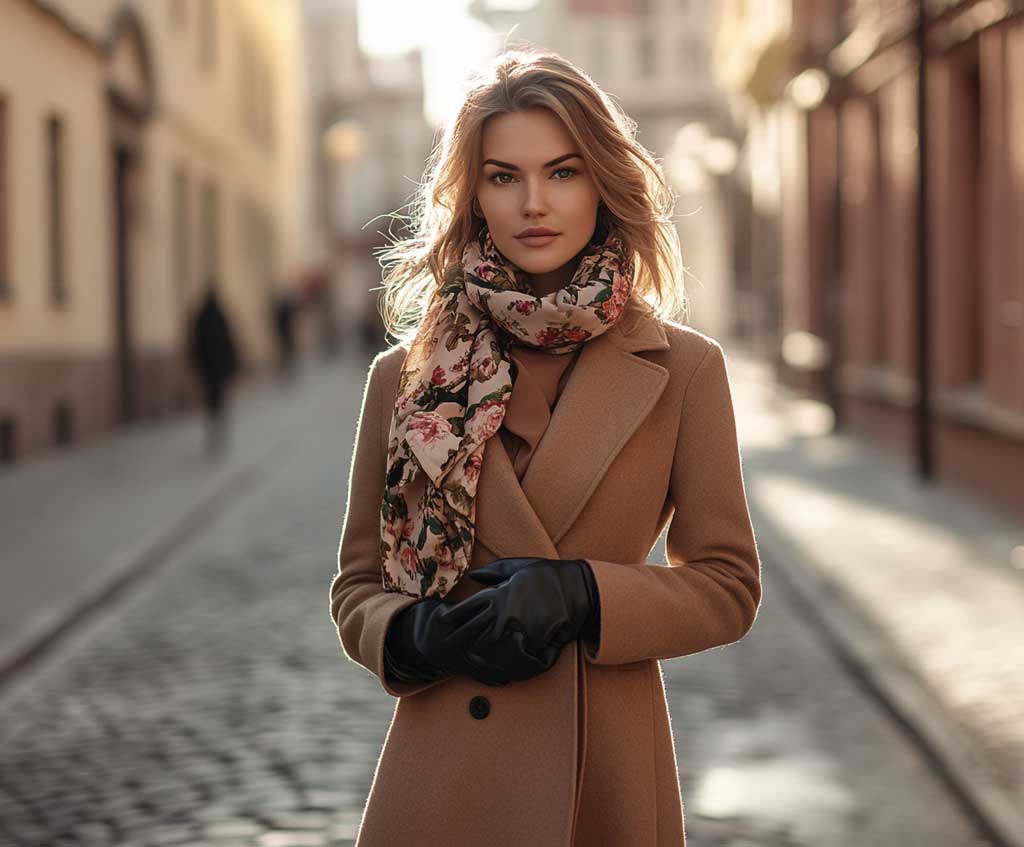
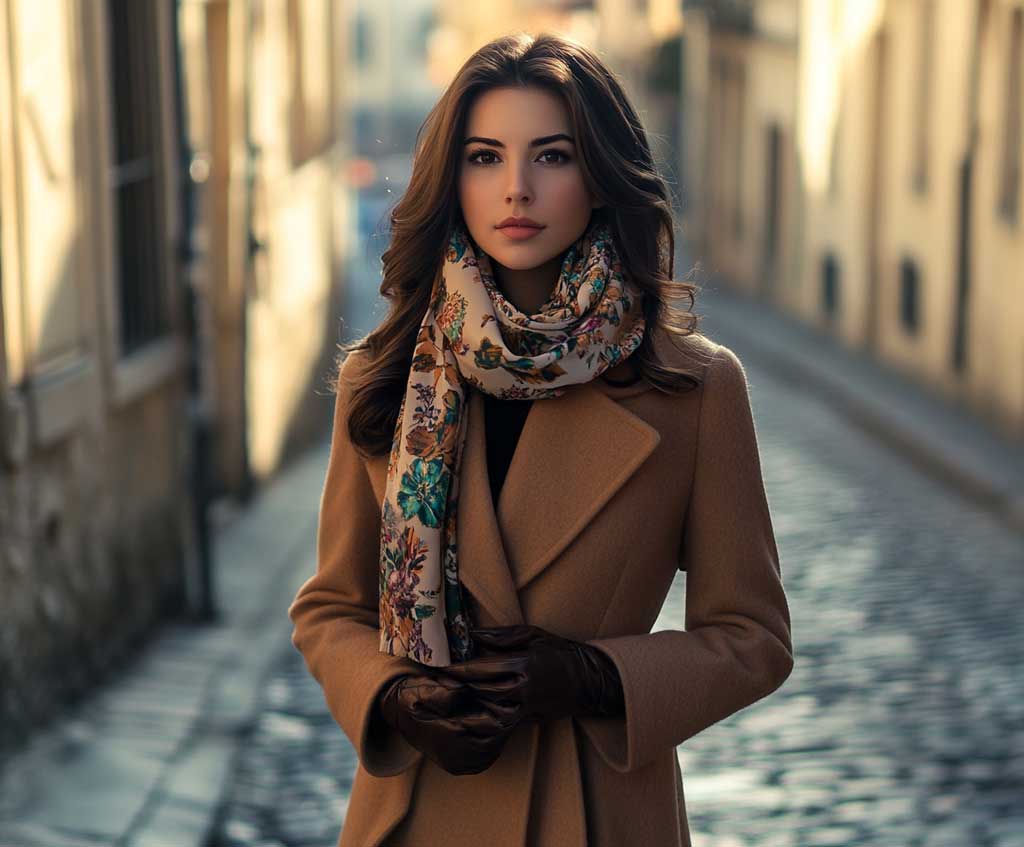
Want to know the one thing that kills this look faster than anything else? Over-accessorizing. A structured brown leather bag (Mulberry’s Bayswater or a vintage Coach, both findable for $50–$120 secondhand) and dark ankle boots are all you need below the waist. Adding a matching hat, belt, and gloves in the same session turns a quietly confident outfit into a costume. The scarf is already the statement — let it be one. Soft leather gloves in cognac or burgundy work if the temperature demands them, but they’re not required.
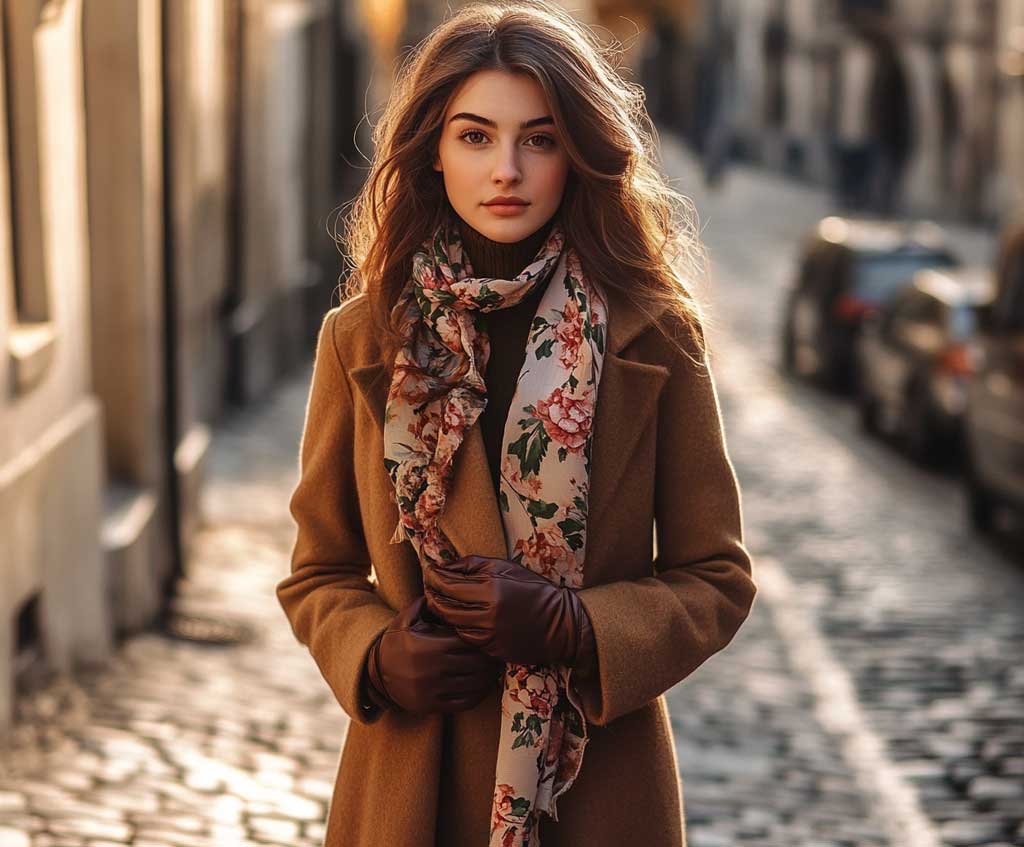
Hair is where this look either comes together or collapses. Soft waves pinned loosely at the nape feel right — they mirror the fluid quality of the silk without competing with the coat’s architecture. A tight French twist works too, especially when the scarf is bold enough to carry all the visual energy upward toward the face. Avoid leaving hair completely down with a large floral scarf: the two competing elements at the collar level create visual noise that defeats the point of the pairing. Makeup should stay warm — berry lip, soft bronze eye, clean skin. No heavy contouring. This look already has structure.
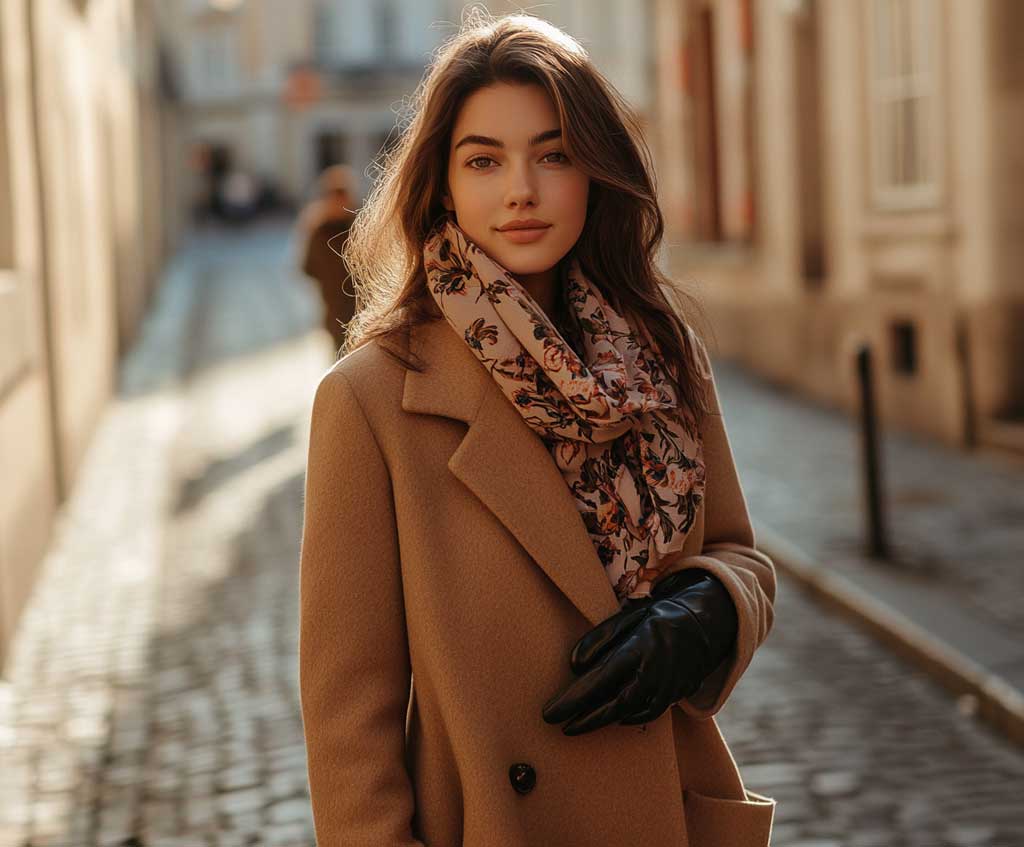
I’ve worn this combination to autumn gallery openings, Saturday farmers’ markets, and one very memorable brunch where three people at separate tables asked where the scarf came from. (Answer: a vintage market in Antwerp for €12.) The camel-and-floral pairing works across occasions because it reads as dressed up without feeling formal — it’s the sartorial equivalent of knowing exactly which song to play at a dinner party. You’ll notice that it photographs particularly well in low autumn light, which is its natural habitat. For those interested in building a broader vintage-inspired wardrobe, vintage white blazer outfit ideas offer another strong starting point for layering with scarves and silk pieces.
Plaid Wool Coats Worn With Bold Silk Scarves Demand Attention Without Trying
Plaid wool coats paired with bold silk scarves operate on the same principle as mixing two strong personalities in a room — it only works if both have enough confidence to hold their space without fighting. Deep green and navy plaid (think classic Pendleton or vintage Burberry wool check) gives you enough visual structure that a silk scarf needs to match that energy: geometric prints, abstract shapes, or bold color-block patterns. A small floral scarf on a plaid coat is like whispering in a loud room — it disappears entirely. Go bigger, go bolder, or don’t bother.
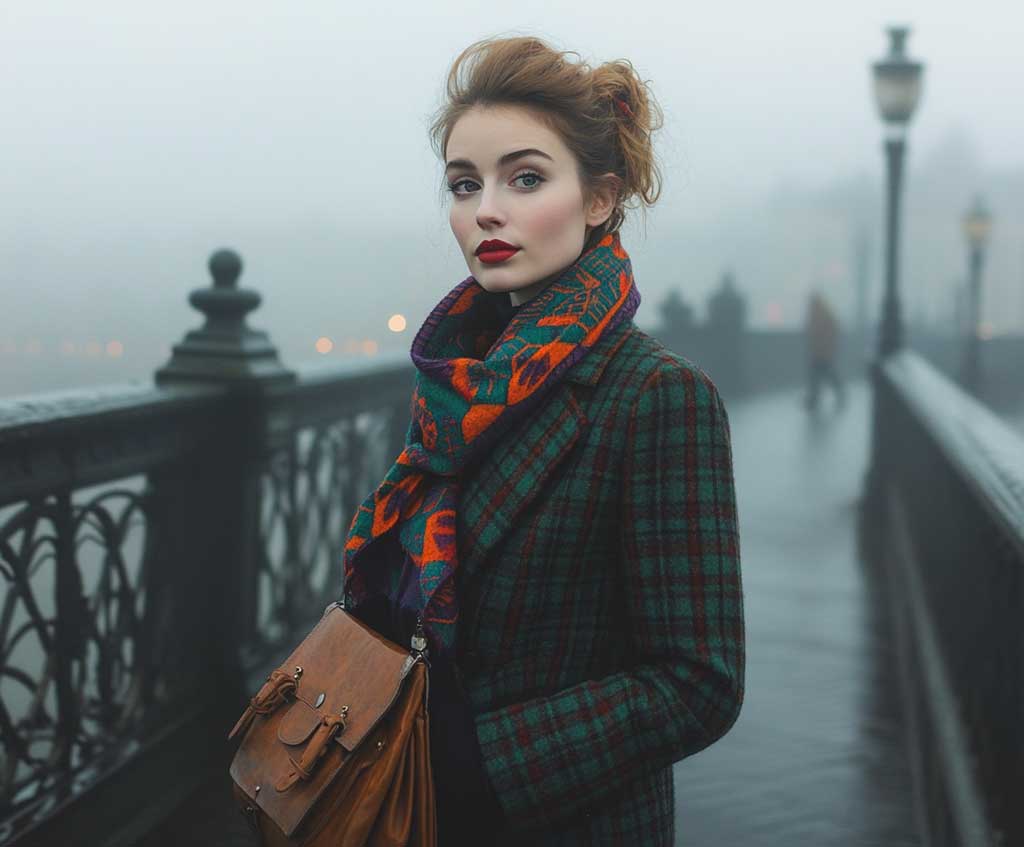

My go-to is a 1980s Pendleton board coat in burgundy and navy plaid — I found it at Goodwill for $9, which I still can’t quite believe — worn with a silk square from a French flea market featuring bold orange and black geometry. The two patterns coexist because they operate at different scales: the plaid is a medium-repeat check, the silk print is an oversized abstract shape. Pattern mixing is like music mixing — the tracks need to be in different frequency ranges to avoid muddying each other. When both patterns are the same size and weight, they compete. When one is architectural and one is graphic, they create harmony.
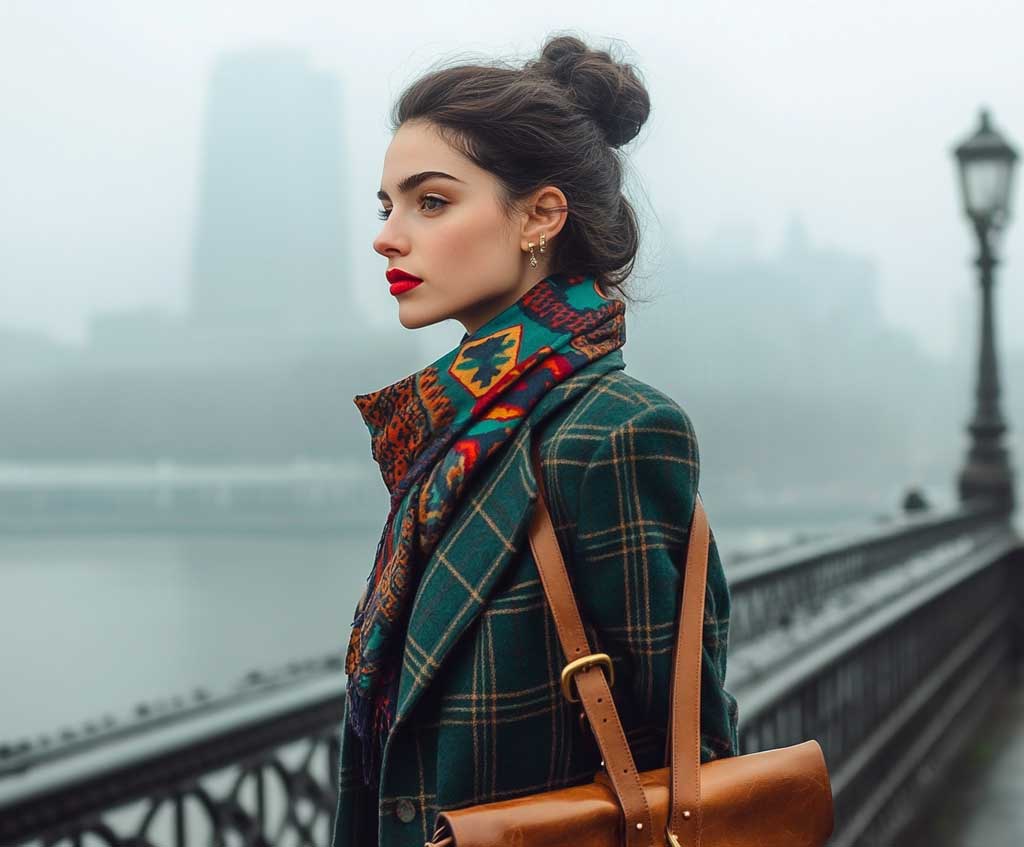
Don’t tie a chunky wool or knit scarf under a vintage wool coat collar. It creates a lumpy silhouette at the shoulders, distorts the lapel line, and defeats the structural elegance that makes these coats worth wearing. Silk lies flat. A thick wool scarf adds two inches of visible bulk at the neck and pushes the coat shoulders out of alignment. If it’s cold enough to need a chunky scarf, layer a thin silk square underneath it — you get warmth and keep the silhouette intact.
Also: don’t dry-clean a vintage wool coat after every single wear. Once per season, or when genuinely soiled. Over-cleaning degrades the wool fibers and flattens the nap. Hang it on a wide cedar hanger, brush it lightly with a clothes brush after each wear, and steam out creases rather than pressing.
Accessories for this look should lean practical and leather-heavy. A vintage satchel in warm brown — I stole this trick from a street style shot in a 1994 Italian Vogue editorial — anchors the outfit and gives the pattern-mix somewhere to land. Simple stud earrings, gold or silver, keep your face clean. Footwear choices break down by weather: sturdy lace-up boots (Dr. Martens 1460 at $140 or vintage Frye for $35–$60 secondhand) for wet city days, Oxford shoes for drier afternoons. Avoid heeled boots with plaid coats — the tailored quality of the plaid reads better with flat, structured footwear.

Hair works best pulled back with this combination — loose bun, low ponytail, or a soft chignon. Leaving hair down tends to hide the scarf against the collar, which is a waste. A deep red or berry lip is the single makeup move that pays the most dividends here: it picks up the warm tones in both the plaid and any orange or red in the scarf without adding any additional visual complexity. For more cold-weather layering ideas with warm autumn tones, cozy autumn outfit ideas with burgundy and mustard accents show how deep color combinations carry the same vintage confidence through the whole season.
Tailored Charcoal Coats Paired With Monochrome Silk Scarves Read as a Power Move
Vintage clothing ideas at their most architectural land here: a tailored charcoal or navy wool coat with sharp lapels and a belted waist, worn with a monochrome silk scarf in black-and-white stripes, checks, or abstract print. This is the combination I reach for when the occasion requires looking quietly impressive — a creative brief, a gallery opening, a job interview at somewhere interesting. The monochrome scarf functions like punctuation inside a sentence that’s already doing the work. It doesn’t add noise; it adds finality.
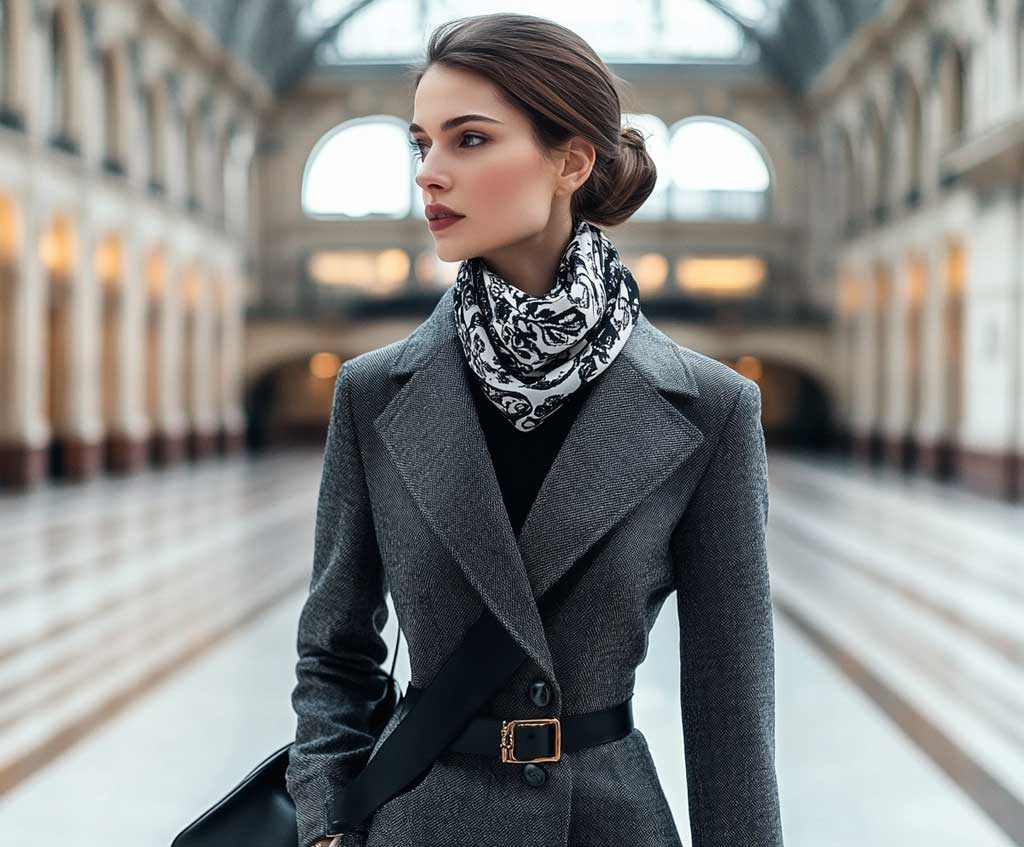
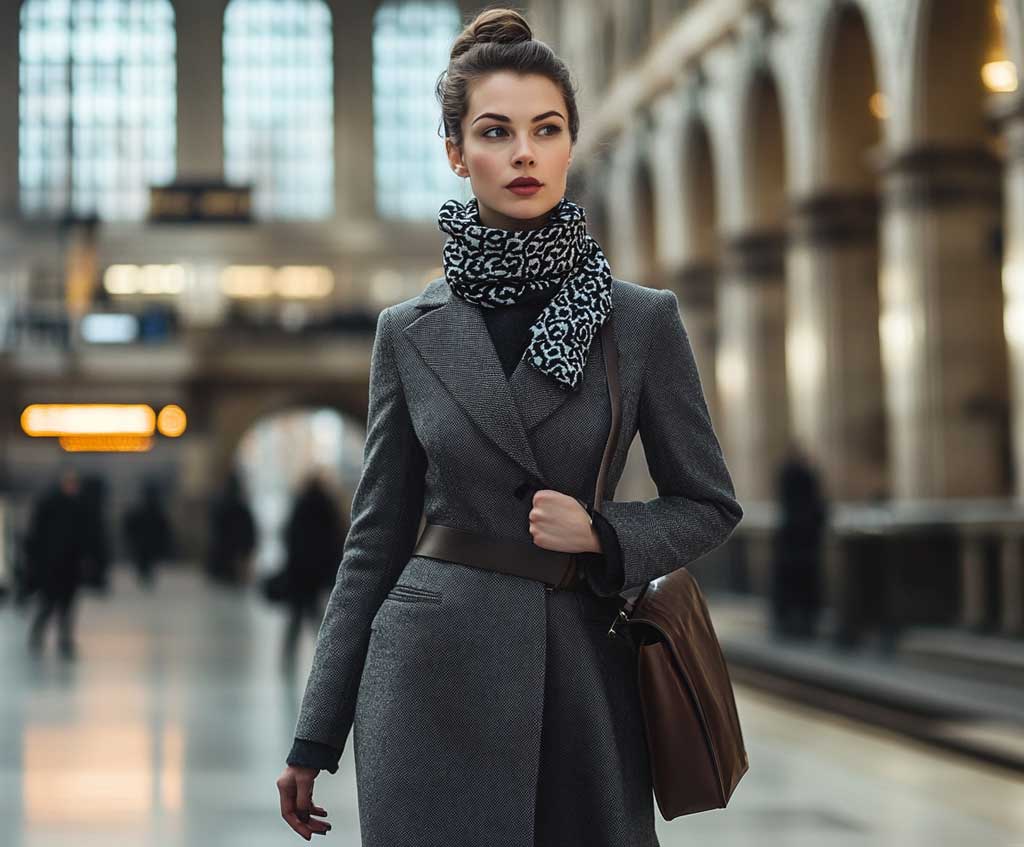
Charcoal grey and deep navy are the two coat colors that respond best to monochrome silk. Classic black coats absorb the black-and-white silk rather than bouncing it — you lose the contrast that makes the pairing work. Worth knowing if you’re shopping secondhand: look for Aquascutum, Jaeger, or early-1990s Donna Karan tailored coats in charcoal or navy. These regularly appear on eBay and ThredUp at $40–$120 and are cut with the kind of shoulder structure that modern wool coats rarely bother with anymore. The lapels lie flat. The belt actually nips at a real waistline. The difference is immediately visible.
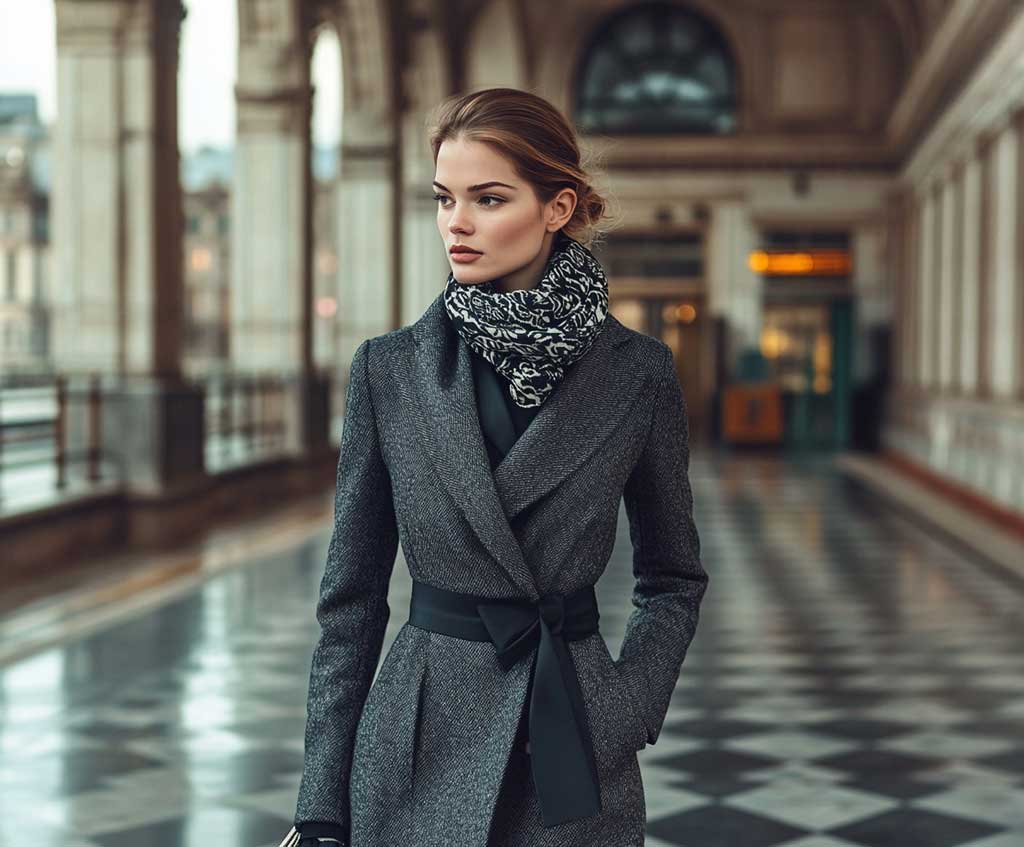
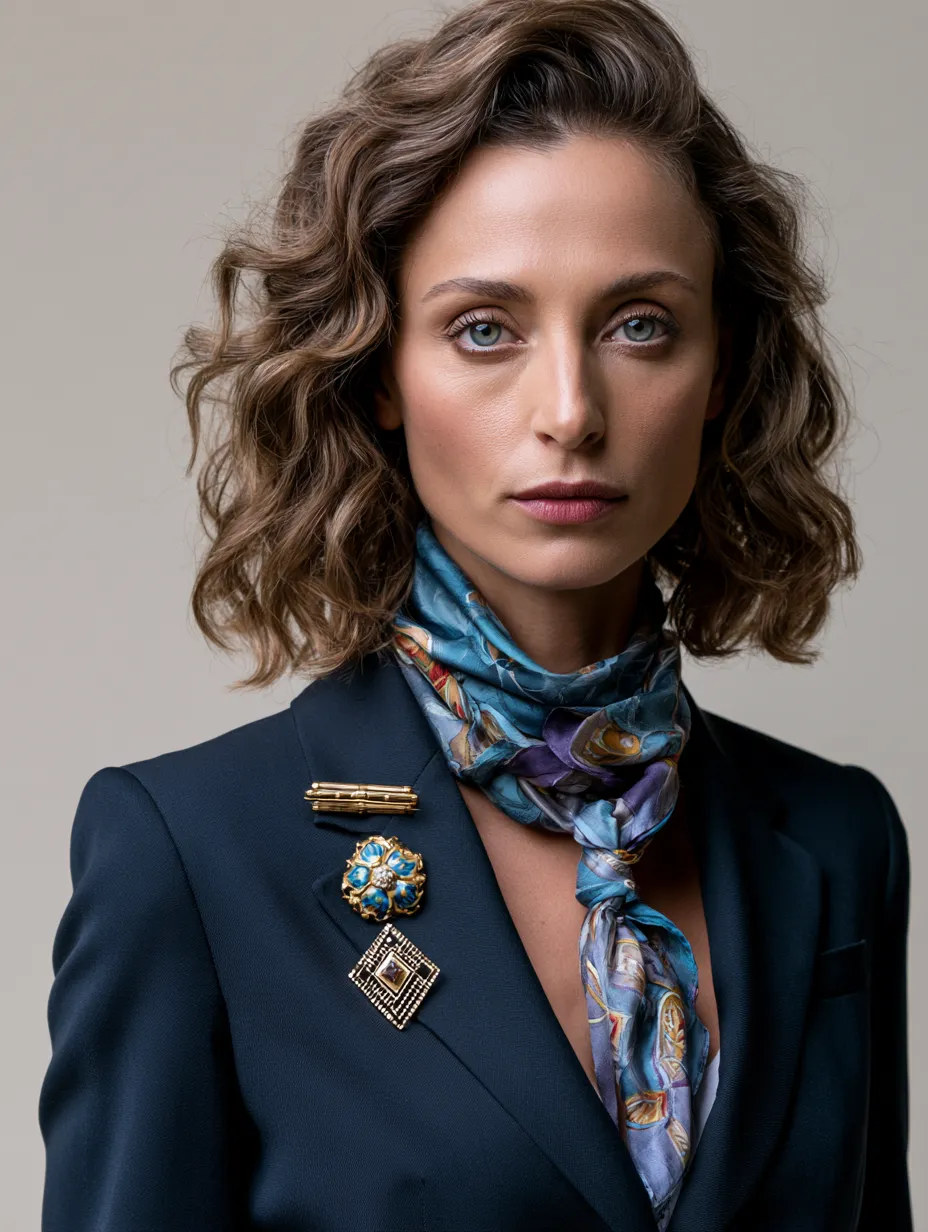
Accessories for this look reward restraint. A structured black leather bag — a vintage Chanel-style quilted flap runs $200–$400 on The RealReal, while a comparable quality vintage Ferragamo structured bag can be found at $60–$90 — keeps the aesthetic intact. Black leather gloves are optional but excellent. A small vintage brooch on the lapel below where the scarf sits is the move I’ve seen in every 1960s editorial that nailed this look: it grounds the scarf visually and stops it from looking like an afterthought. Pearl necklace or simple gold studs at the ear — never both at the same time, or it crosses into clutter.
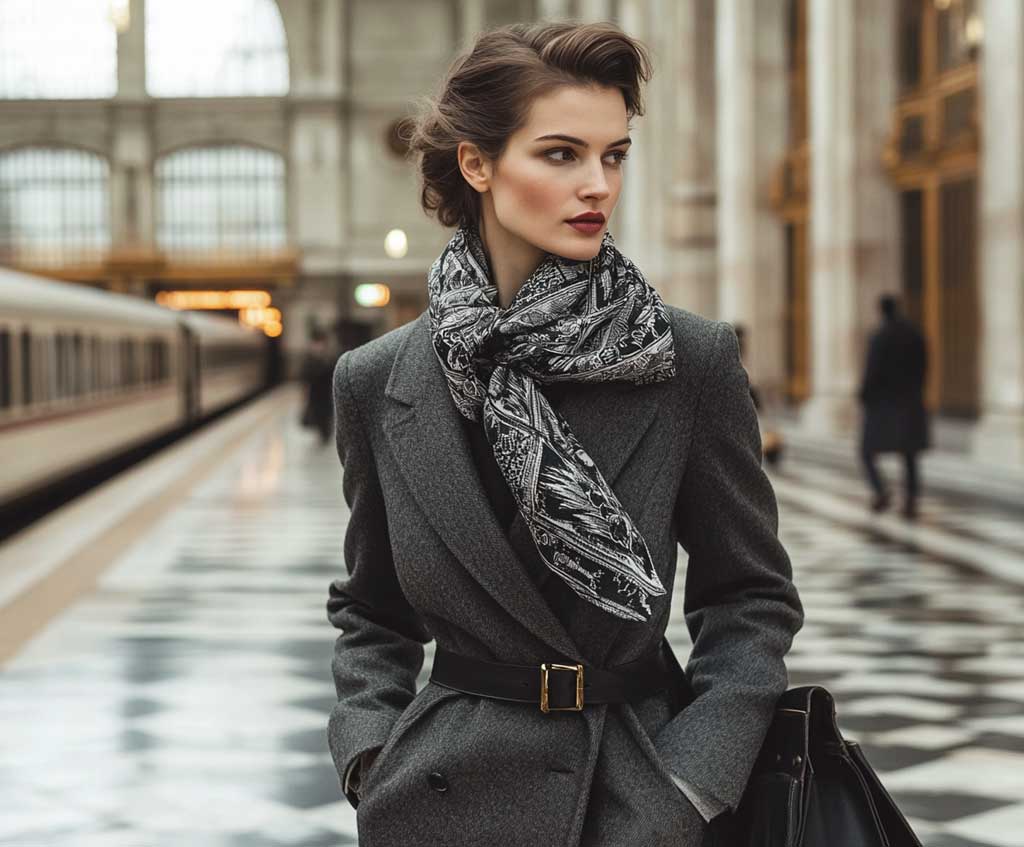
A sleek low bun is the default hair for this look, and for good reason — it clears the neck and lets the scarf sit exactly as it’s meant to. Side-swept hair works if the scarf is tied off-center as a deliberate styling choice. What doesn’t work is loose, wavy hair falling over the collar: it hides the lapel detail and muddles the scarf. Makeup stays minimal and precise — defined brows, clean skin, one or two coats of mascara, and a soft matte lipstick in dusty rose or mushroom. This isn’t the look for a statement red lip; the coat and scarf already command enough attention. For a broader external reference on tying and layering vintage scarves with outerwear, My Vintage UK’s scarf styling guide covers seven distinct methods with practical folding instructions.
The Takeaway
Vintage Wool Coats and Silk Scarves Aren’t Nostalgic — They’re the Smartest Buy You’ll Make This Year
A secondhand camel wool coat at $45–$180 and a vintage silk scarf at $15–$40 outperforms a $350 fast fashion coat and a polyester knockoff on every metric: structure, longevity, and how it actually photographs.
Pattern-mixing between plaid coats and bold geometric silk isn’t a risk — it’s a formula. Keep the two patterns at different scales and they’ll hold together every time.
Monochrome silk on a tailored charcoal coat is the quietest power move in this category. It works in boardrooms and at openings because it communicates precision, not decoration. Save this post before you go thrifting.