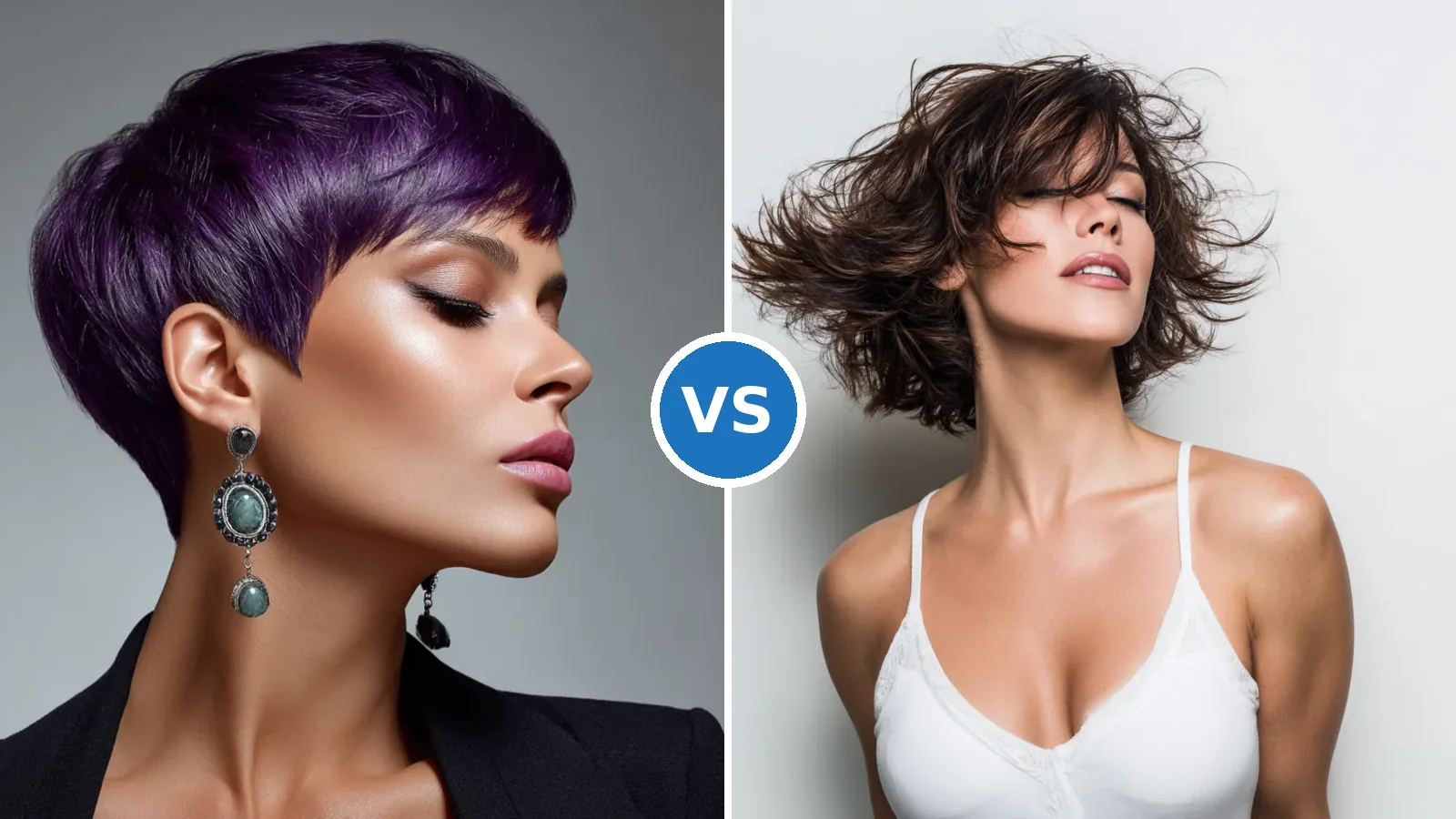
A v shape hair cut already pulls the eye downward — add highlighted tips and that movement becomes impossible to ignore. The pointed center acts like a focal point, and color at the ends frames it with contrast, warmth, or something entirely unexpected. Stylists often recommend tip highlighting specifically for V cuts because the color concentrates exactly where the geometry is sharpest, making the taper read crisper than it would in a single tone.
The three variations below cover the warm-to-cool spectrum: espresso brown with honey blonde tips, jet black with copper accents, and silver grey with mint green ends. Each pairing changes the mood of the same underlying cut — from sun-warmed to editorial to playful. A precision V cut at a mid-range salon typically runs $45–$75 for the cut alone, with tip highlights adding $60–$130 on top, depending on hair length and technique.
What kills this look fast is a rushed foiling job that places color too high up the strand. Tip highlights should stay in the bottom 2–4 inches — any higher and the color competes with the layers instead of finishing them. The trick here is asking your colorist for “tips only, concentrated at the perimeter” rather than leaving placement open to interpretation.
- Tip highlights on a v shape hair cut concentrate color exactly at the V point — the most visible part of the cut from behind.
- Honey blonde on espresso brown creates warmth and strand separation without full bleaching sessions.
- Copper on jet black delivers maximum contrast; toner touch-ups every 4–6 weeks preserve the brightness.
- Mint green on silver grey is the lowest-commitment option — semi-permanent pastel dyes refresh independently every 4–6 weeks.
- All three looks are low-maintenance compared to all-over color because only the ends are processed.
Honey Blonde Tips Turn Espresso Brown into a V Shape Hair Cut Worth Noticing
Espresso brown with honey blonde tips works because the contrast stays in the warm family — there’s no jarring color shift, just a gradual brightening that pulls the eye straight to the V point. The lightened ends create natural separation between strands, which gives the appearance of fuller, more textured hair without changing the cut’s architecture. On straight or lightly waved hair, the taper reads especially clean because the strands lie parallel and the highlighted tips catch light evenly across the V’s perimeter.


Partial tip highlights at a salon typically run $60–$130, making this one of the more affordable color pairings in this article — you’re not processing the full head, just the ends. The honey tones are painted without foil, using a freehand technique that avoids harsh demarcation lines. Want to know which hair types benefit most? Darker bases with fine-to-medium texture get the biggest payoff: the lightened tips add visual density to the perimeter right where the V narrows.
Don’t reach for a flat iron set above 200°C on freshly highlighted ends — the lighter sections are more porous than the espresso base and will fray at the tips within weeks if heat management slips. A quick round-brush blowout or a single flat iron pass on low heat is enough to bring out the shine. The color contrast stays readable even on day three, which is the real advantage of warm-toned highlights: they photograph richly and hold visual interest without needing daily restyling. For more on how color direction affects this cut’s silhouette, see v shape hair cut on straight hair.
This version of the highlighted V cut grows out gracefully. Because the honey is placed only at the ends, root regrowth stays invisible for far longer than all-over color — most people find they can push 10–12 weeks between touch-ups on the highlights themselves, trimming only when the V point softens. The separation the lightened tips create between strands actually becomes more pronounced as the color matures, not less.
Copper-Tinted Tips on Jet Black Give the V Shape Cut Its Sharpest Edge
Jet black hair gives copper tips the highest possible contrast — the dark base absorbs light while the warm metallic ends throw it back. This is the most photogenic pairing in this collection precisely because the color differential is so extreme that every angle of the V reads with absolute clarity. The silhouette stays sleek and geometric; each layer tapers with precision, directing the eye downward to where the copper concentrates at the cut’s point.


The copper hue sits only at the tips — a placement choice that preserves the integrity of the black base while letting the ends act as a design accent. Copper pigment molecules are among the smallest in the dye family, which explains why the color fades faster than most: salon colorists typically schedule a toner refresh every 4–6 weeks to keep the brightness from drifting into washed-out bronze. That cadence sounds frequent, but the benefit is that intentional fading actually looks good on this cut — as the copper softens toward the root, the gradient reads as a deliberate design choice rather than neglect.
Achieving the copper from a jet black base usually requires a pre-lightening step, which pushes the color appointment toward $160–$320 depending on hair length and salon location. Skipping the lightening and applying copper over true black results in an almost invisible result — the pigment simply doesn’t show against a base that dark. A professional colorist will lift the ends to a warm gold before depositing the copper tone, which is what produces the metallic, glowing effect visible in these images. Under artificial lighting, the copper pops dramatically; in natural light, it reads as a rich, fiery accent that shifts with the angle of the sun.
- Don’t skip pre-lightening — copper dye over unlifted black delivers no visible result and wastes a salon appointment.
- Don’t use a clarifying shampoo more than once a week — it strips copper pigment 40–60% faster than a color-safe formula.
- Don’t let the toner interval stretch past 8 weeks — at that point the copper reads brassy gold, which reads as a color mistake rather than a design choice.
- Don’t flat-iron at maximum heat immediately after a copper service — freshly lightened ends need at least 48 hours before heat styling.
Styling this version is non-negotiable: the silhouette only lands when the hair lies sleek. A single pass with a flat iron from mid-length to ends — nothing more — is enough to make each layer drop into place and the copper tips read as intentional color design rather than damage. For a broader look at how different color stories change the V haircut’s energy, iconic v haircut transformations covers five color directions on the same silhouette.
Mint Green Tips on Silver Grey Pull the V-Shaped Haircut into Unexpected Territory
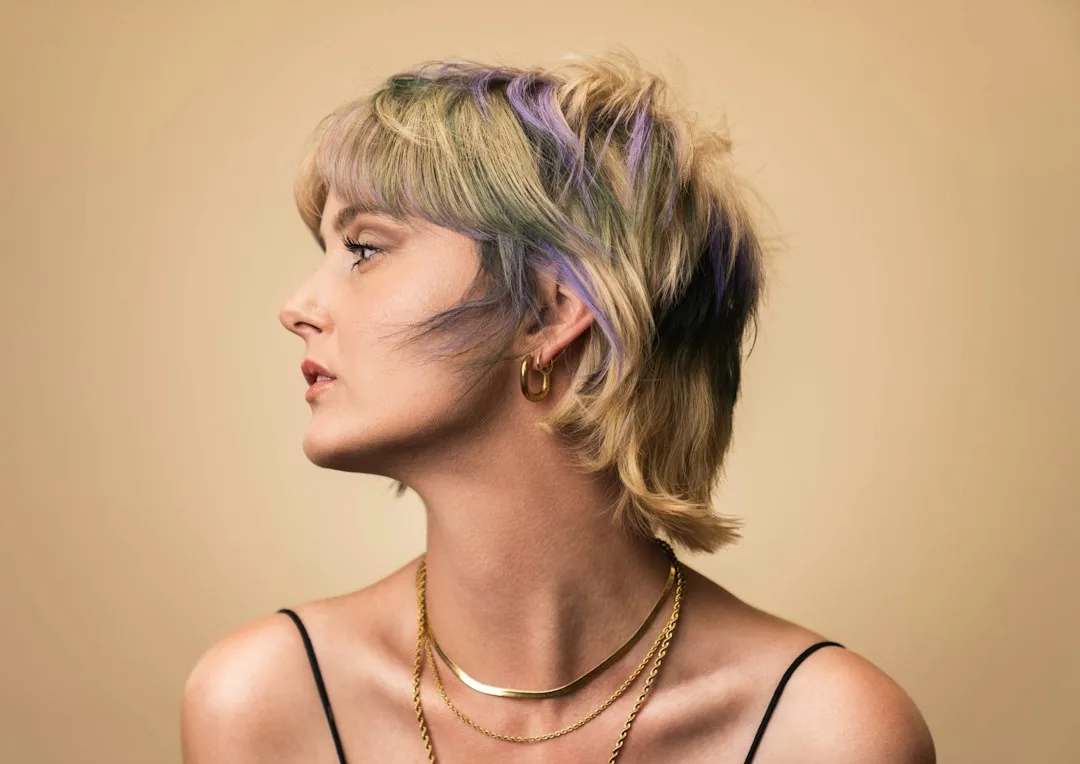
Silver grey hair provides the coolest, most neutral base possible — which makes it the ideal canvas for mint green tips. The two colors share the same temperature (both cool-toned), so the transition from grey to mint reads as a continuation of the palette rather than a contrast. What changes is saturation: the grey is muted, the mint is fresh, and the V point is where the shift becomes visible. Viewed from behind, the mint accents appear to float at the bottom of the hair, giving the look a sense of forward motion even when the hair is still.



Pastel mint greens like this one need refreshing every 4–6 weeks — the pigment molecules are small and semi-permanent, so washing and sun exposure fade them faster than permanent color. Manic Panic’s semi-permanent pastel mint formulas last 2–4 weeks per application, making at-home touch-ups genuinely practical. The advantage of tip-only placement is that you’re refreshing a small section of hair each time — not the full head — so a $12–$15 tube of semi-permanent dye handles multiple touch-ups. Silver grey itself requires pre-lightening to achieve, but once the base is established, the mint sits directly on the lightened ends without additional processing.
On straight textures, the mint tips sit neatly at the perimeter of each layer and the V taper — the geometry of the cut does the work of making the color placement look intentional. Waves or curls break the color’s edges and muddy the outline of the point. A light leave-in spray is all that’s needed to maintain the dimension; heavy creams flatten the layers and obscure the color’s placement at the ends. Does this look work for shorter v-shaped haircut variations? Yes, but the mint application needs to be more concentrated — shorter strands leave less room for a gradual transition, so a sharper tip-only approach reads better than any gradient effect.
According to L’Oréal Paris, straight hair is the most flattering styling choice for a V-shape cut because it accentuates the pointed end most clearly — a principle that applies doubly when the tips carry a distinct color. The mint-on-silver combination works because it leans into that principle: color and cut both reinforce the same geometry, rather than competing for attention.
| Variant | Best For | Touch-Up Interval | Key Risk |
|---|---|---|---|
| Honey Blonde on Espresso Brown | Natural warmth, low maintenance | 10–12 weeks | Highlights placed too high disrupt V shape |
| Copper Tips on Jet Black | Maximum contrast, editorial edge | 4–6 weeks | Skipping pre-lift makes copper invisible |
| Mint Green on Silver Grey | Cool tones, creative expression | 4–6 weeks | Waves blur the mint’s perimeter placement |
THE VERDICT
Tip Color Is the Fastest Way to Make the V Point Unmissable
Honey blonde on espresso brown delivers the warmest, most wearable result — color grows out gracefully and touch-ups are needed roughly every 10–12 weeks on the highlights alone. A solid choice if salon budget is a real constraint.
Copper on jet black is the highest-contrast option and the most technically demanding. Expect to pay $160–$320 for the initial appointment when pre-lightening is required. The toner refresh cadence of every 4–6 weeks is non-negotiable if you want the copper to read as copper rather than generic warmth.
Mint green on silver grey offers the most creative expression with the most affordable upkeep — semi-permanent pastel dyes handle touch-ups at home for $12–$15 per application. Save this post.
Related Topics