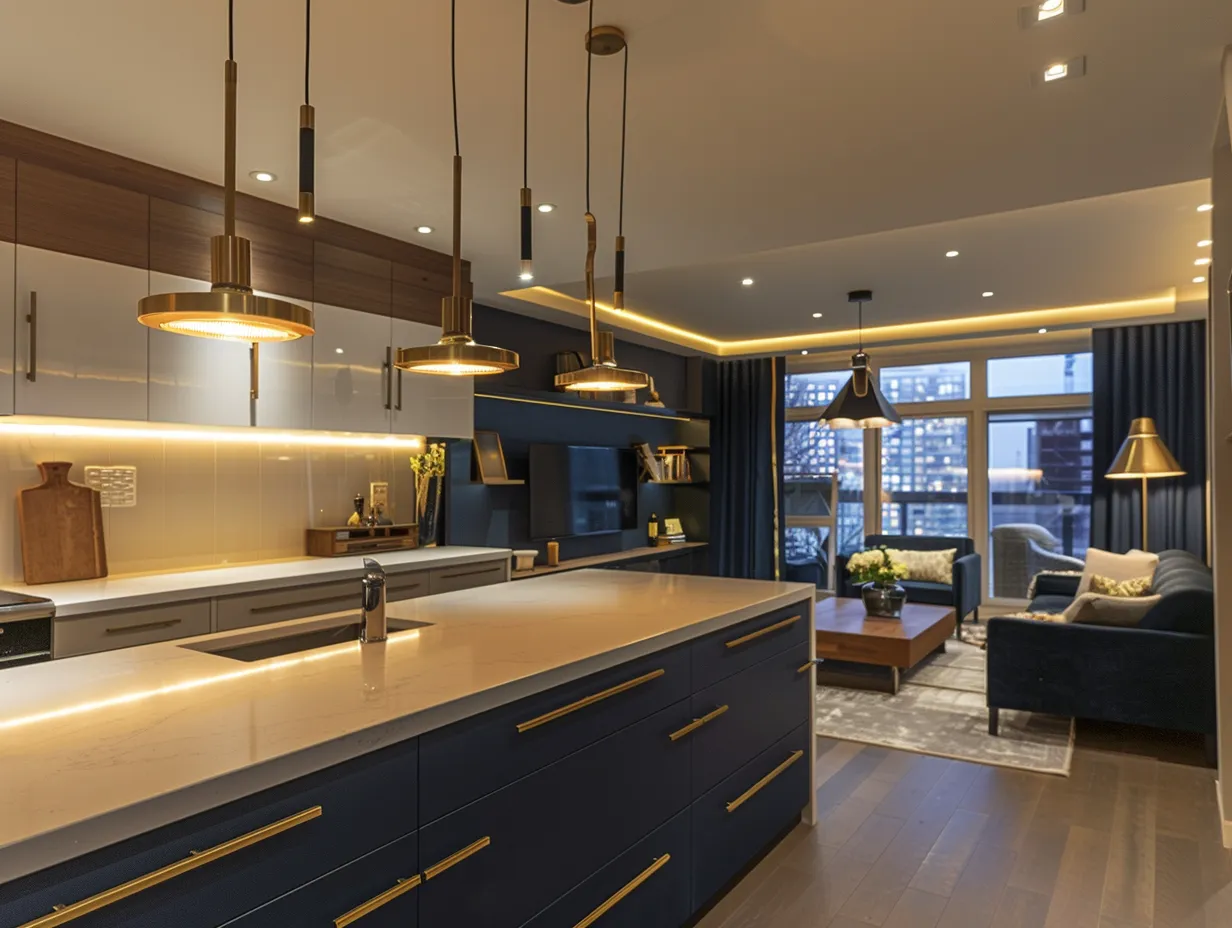
Colorful kitchen countertops shift the entire energy of the room — not just the surface. Most kitchens default to white, gray, or beige, and while those are safe bets, they rarely make anyone stop scrolling. A blue quartz slab, a slab of veined green marble, or a glossy red laminate does something entirely different: it becomes the reason the room works visually, not just functionally.
The materials covered here — engineered quartz, natural marble, and high-pressure laminate — sit at very different price points and require different levels of maintenance. What they share is the ability to anchor a kitchen around a real point of view rather than a neutral compromise.
Each section below covers one colorful countertop option, the specific design context where it performs best, and where it tends to fail. Budget figures come from current installer and manufacturer sources so you can plan realistically rather than guess.
– Blue quartz countertops run $50–$100/sq ft installed — far less than natural blue granite, which can exceed $250/sq ft.
– Green marble (Forest Green, Verde Guatemala) starts around $70 installed all-in; Italian Verde Alpi can hit $180.
– Red laminate (Formica) averages $20–$60/sq ft installed — the most budget-accessible colorful option.
– Quartz needs no sealing; marble needs annual sealing; laminate cannot be repaired if chipped.
– Colorful countertops pair best with neutral cabinetry — stacking bold color on bold color flattens the contrast that makes them work.
Blue Quartz Catches the Eye Without the Natural Stone Price Tag
Blue quartz countertops typically run $50–$100 per square foot installed, compared to genuine blue granite or quartzite, which can exceed $250 per square foot — making the engineered version the realistic path for most renovations. The color is manufactured by combining natural quartz crystals with resins and pigments, which means you can choose a specific shade — navy, teal, soft gray-blue, or saturated cobalt — rather than accepting whatever a quarry produced. That predictability is half the appeal: the slab you approve in a showroom is the slab that gets installed.
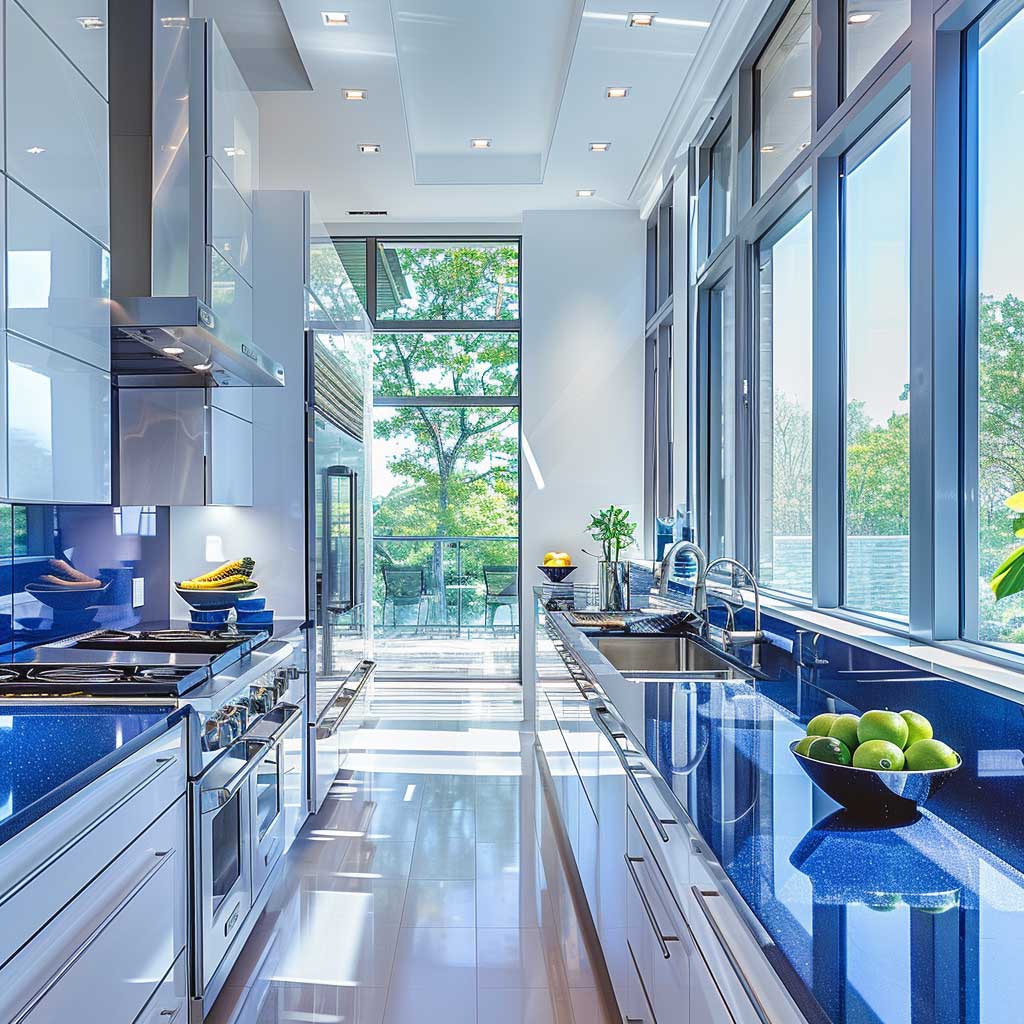
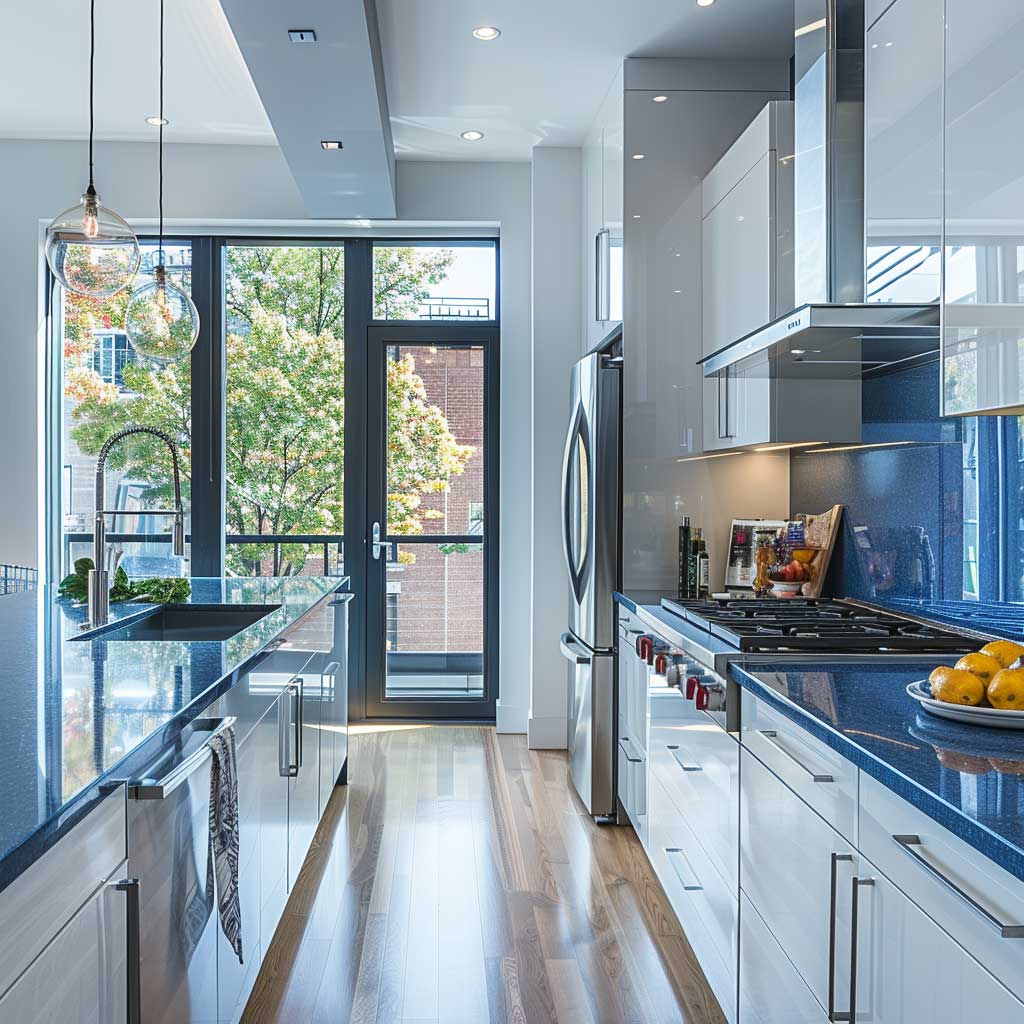
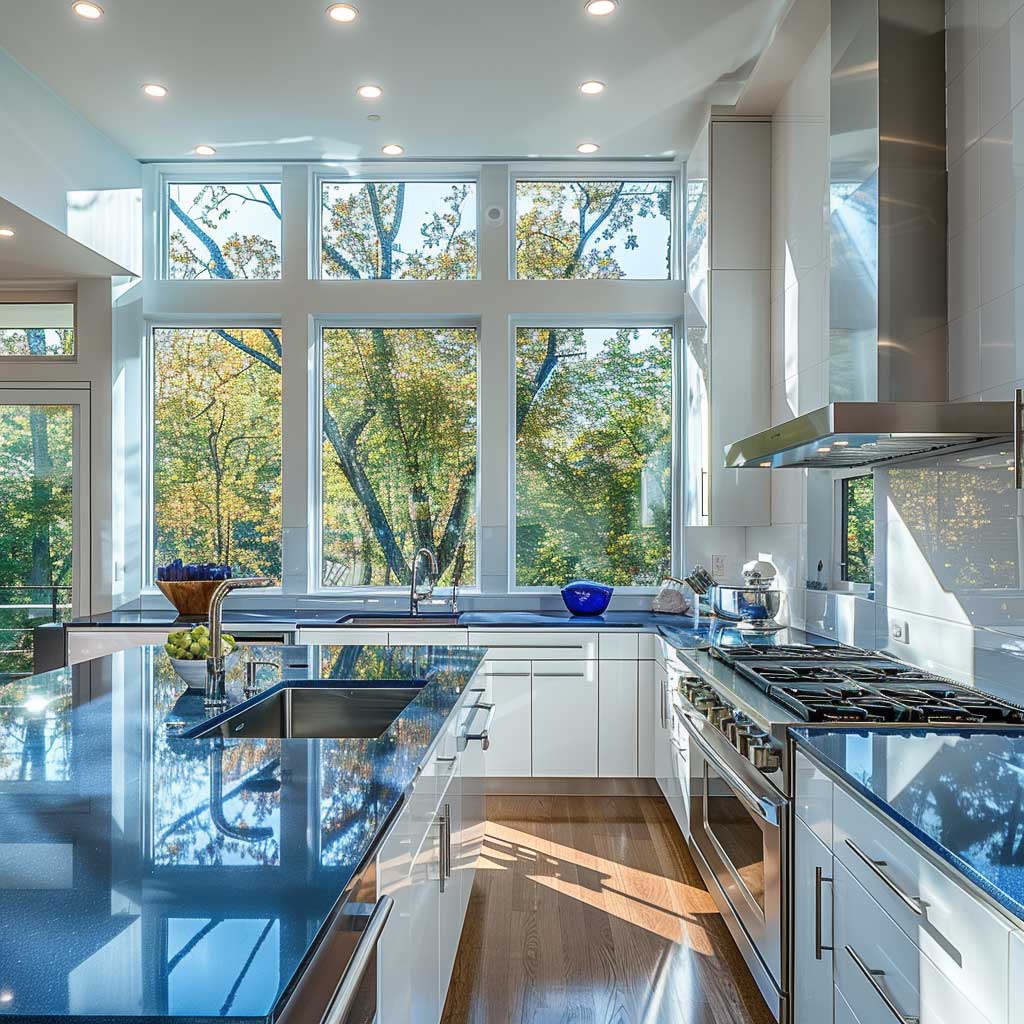
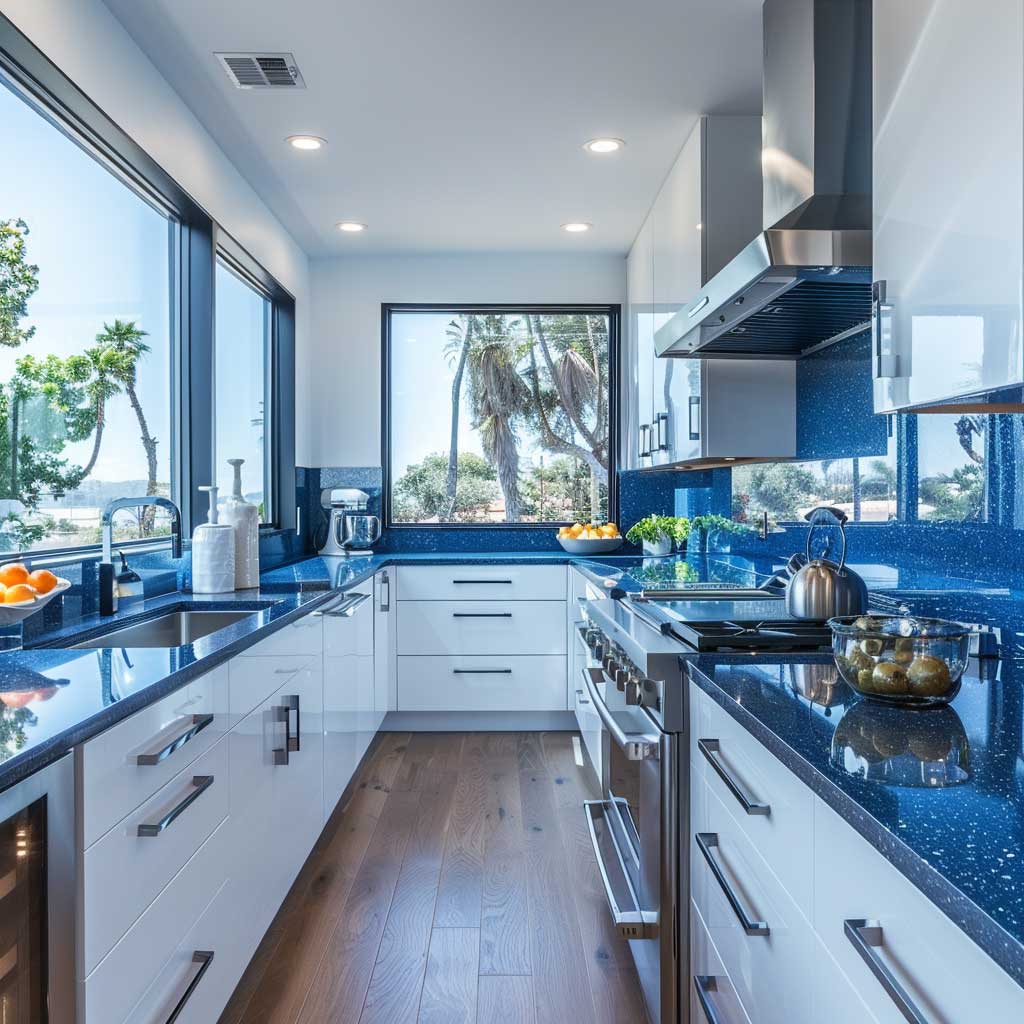
Quartz is non-porous, so it never needs sealing and resists both staining and bacterial growth on its own. Think of it as a locked surface rather than a breathing one — wine, coffee, and cooking oil wipe off cleanly without the panic that marble demands. The practical question stylists raise is pairing: white shaker cabinets with blue quartz create the clearest contrast, letting the color do its job. Dark cabinetry can work, but the countertop tends to recede rather than pop when the backdrop is already saturated.
What doesn’t work? Combining blue quartz with a colorful backsplash. The surface is bold enough on its own — a busy tile pattern behind it competes rather than complements, and the kitchen ends up reading as chaotic rather than curated. The trick is to treat everything else as a neutral frame: gray-toned wood floors, matte white walls, brushed nickel hardware. Under-cabinet LED strips bring out the depth in the surface without adding visual clutter. For a standard 40-square-foot kitchen counter, expect a total installed cost of roughly $2,000–$4,000 at mid-range pricing.
Does blue quartz suit every kitchen layout? Not quite. It performs best in kitchens with good natural light — in a north-facing room with small windows, deep cobalt can make the space feel smaller and heavier. Softer blue-gray shades handle low-light kitchens better than saturated navy. You can read a detailed breakdown of blue quartz shade selection and installation costs at Today’s Homeowner’s blue quartz countertops guide.
Green Marble Veining Earns Its Maintenance Cost in Visual Return
Green marble countertops occupy a wide price range depending on origin: Indian greens like Forest Green and Verde Guatemala start around $70 per square foot installed all-in, while Italian Verde Alpi — the deep forest-green slab with white webbing that mid-century designers favored — can reach $180 per square foot. The price difference isn’t cosmetic snobbery; Italian material tends to be denser and more structurally consistent, which matters if you’re installing a cantilevered island overhang. Vein-heavy Indian Rainforest Green slabs sometimes arrive with mesh backing and heavy resin fill, which holds fine on floors but can be risky on unsupported spans.

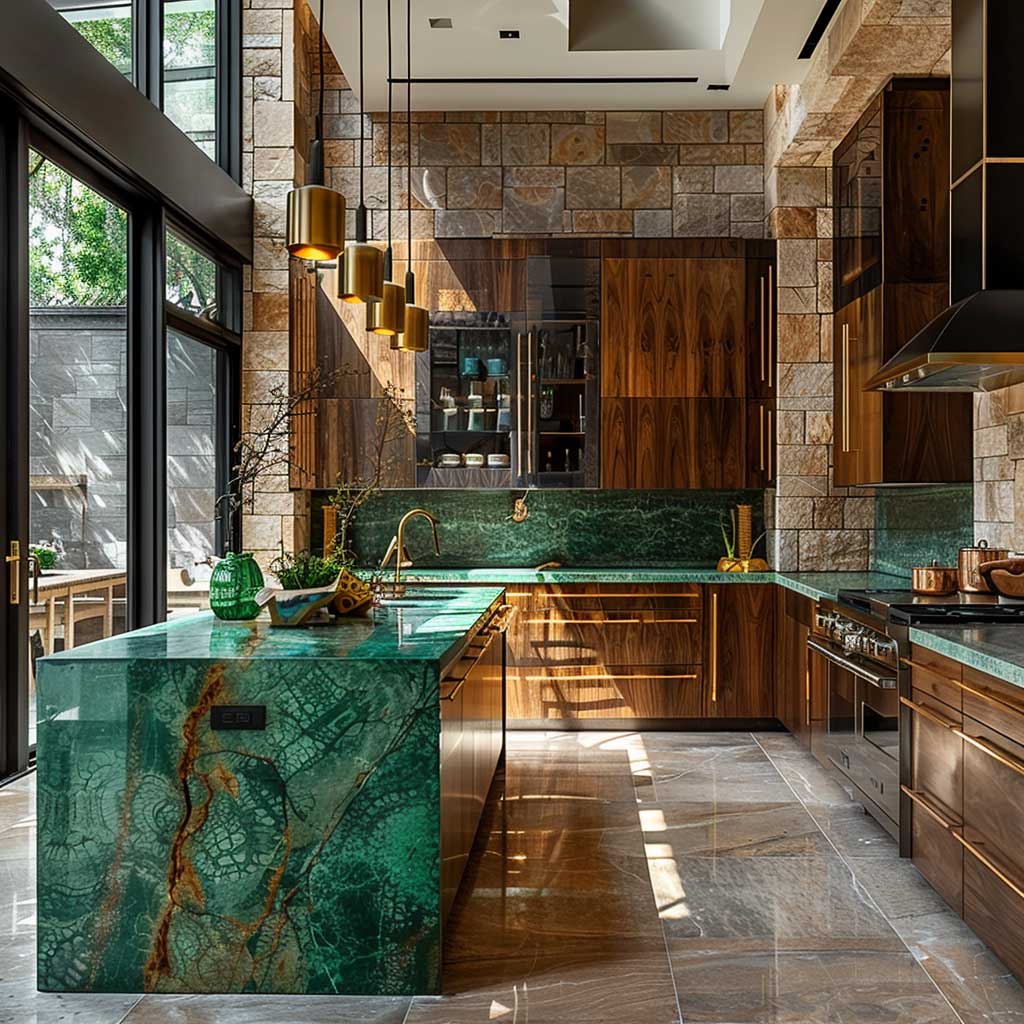

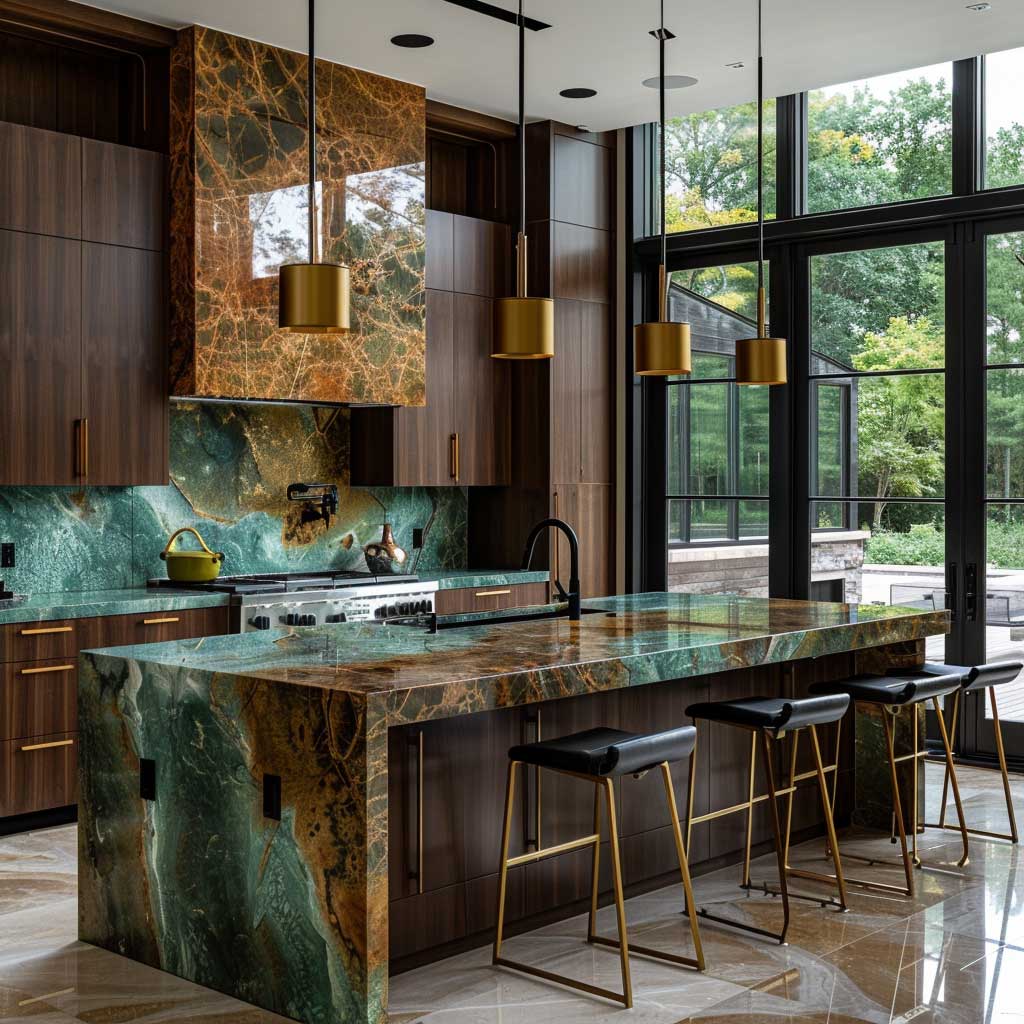
The veining is the whole point. Most dark green marbles are serpentinites rather than true calcite marbles, which makes them considerably less acid-sensitive — meaning a lemon squeezed on Verde Guatemala doesn’t etch the surface the way it would on white Carrara. That changes the maintenance calculus significantly. Annual sealing is still recommended, but day-to-day cooking anxiety is lower than the material’s reputation suggests. Dark wood cabinets — walnut, smoked oak — pair naturally with green stone because both pull from the same earthy palette, and the combination reads as intentional rather than accidental.
What fails with green marble? Overcrowded countertops. The slab is already doing a lot visually, and covering it with small appliances, cutting boards, and canisters defeats the purpose of buying it. Stylists often recommend keeping green marble kitchens as clear as possible day-to-day, treating the surface itself as the decor. Gold or unlacquered brass hardware extends the warm undertones in the stone; chrome and nickel read cold against it and flatten the visual warmth the material provides. If resale value is a concern, it’s worth noting that bold stone is a preference, not a universal sell — the buyer who loves it will love it completely, but buyers who prefer neutral spaces may see it as a renovation project.
Is green marble worth the maintenance compared to green-tinted quartz alternatives? For anyone who wants the actual movement and depth of natural stone — no engineered product replicates how light moves across veining from different angles — the answer is usually yes. For a kitchen that gets heavy daily use from children or during messy cooking projects, the quartz alternative handles abuse more forgivingly. If you’re drawn to other distinctive colorful countertops options beyond stone, warm copper kitchen countertops offer a completely different material approach with their own patina and antimicrobial properties.
Avoid pairing a colorful countertop with a colorful cabinet finish. Both surfaces compete for the same visual authority, and neither wins — the kitchen ends up looking unresolved rather than bold. A single strong color element anchored by neutrals always reads more intentionally designed than two bold elements fighting for dominance. The same logic applies to backsplash tile: if the countertop is the statement, the tile should be quiet.
Red Laminate Pulls Off Retro Without a Renovation Budget
Red laminate countertops — specifically Formica and comparable high-pressure laminate products — install for $20–$60 per square foot all-in, making them the most accessible colorful countertop option by a significant margin. Formica’s top lines, the 180fx and Premiumfx series, use multiple kraft layers bonded under intense heat, which produces a denser, more impact-resistant surface than budget laminate. The glossy red finish in particular amplifies ambient light in a way that matte stone doesn’t — smaller kitchens benefit from this reflectivity more than large open-plan spaces, where the effect dissipates across too much square footage.
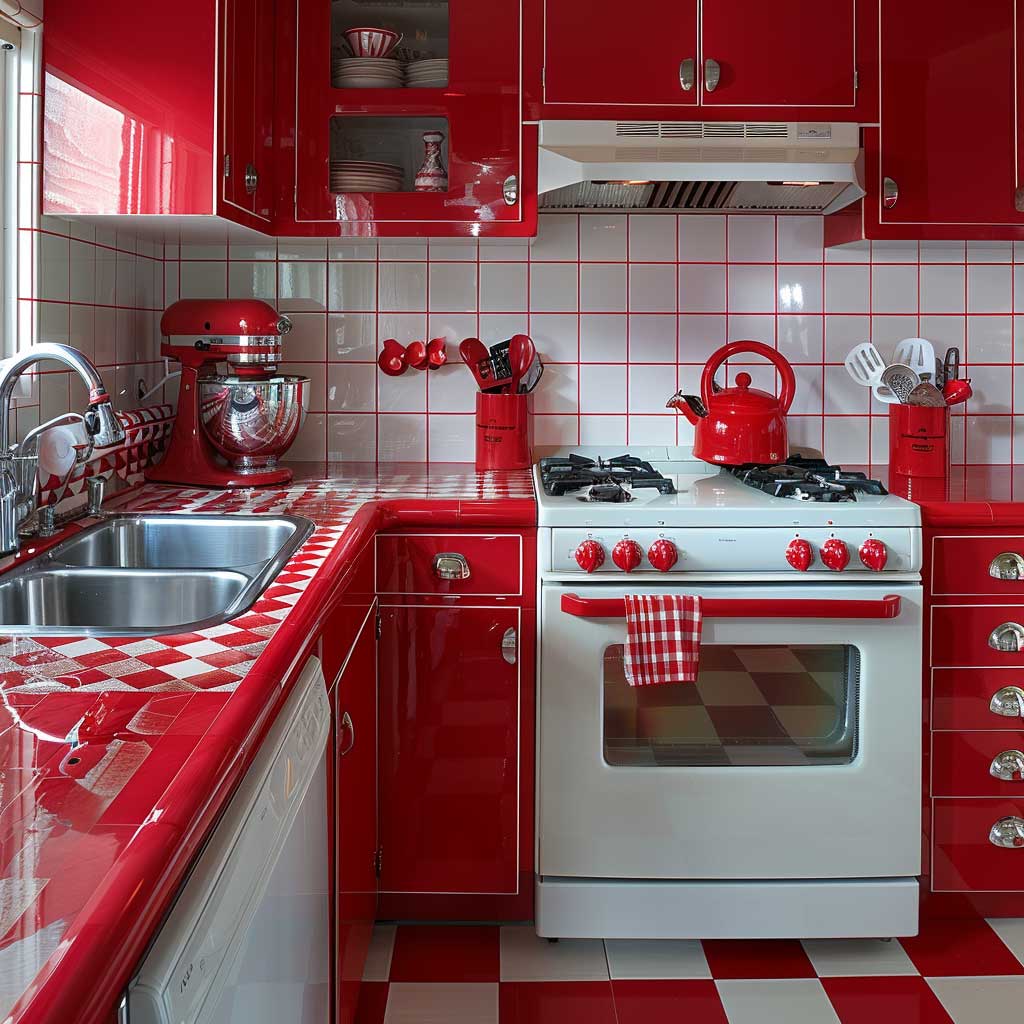

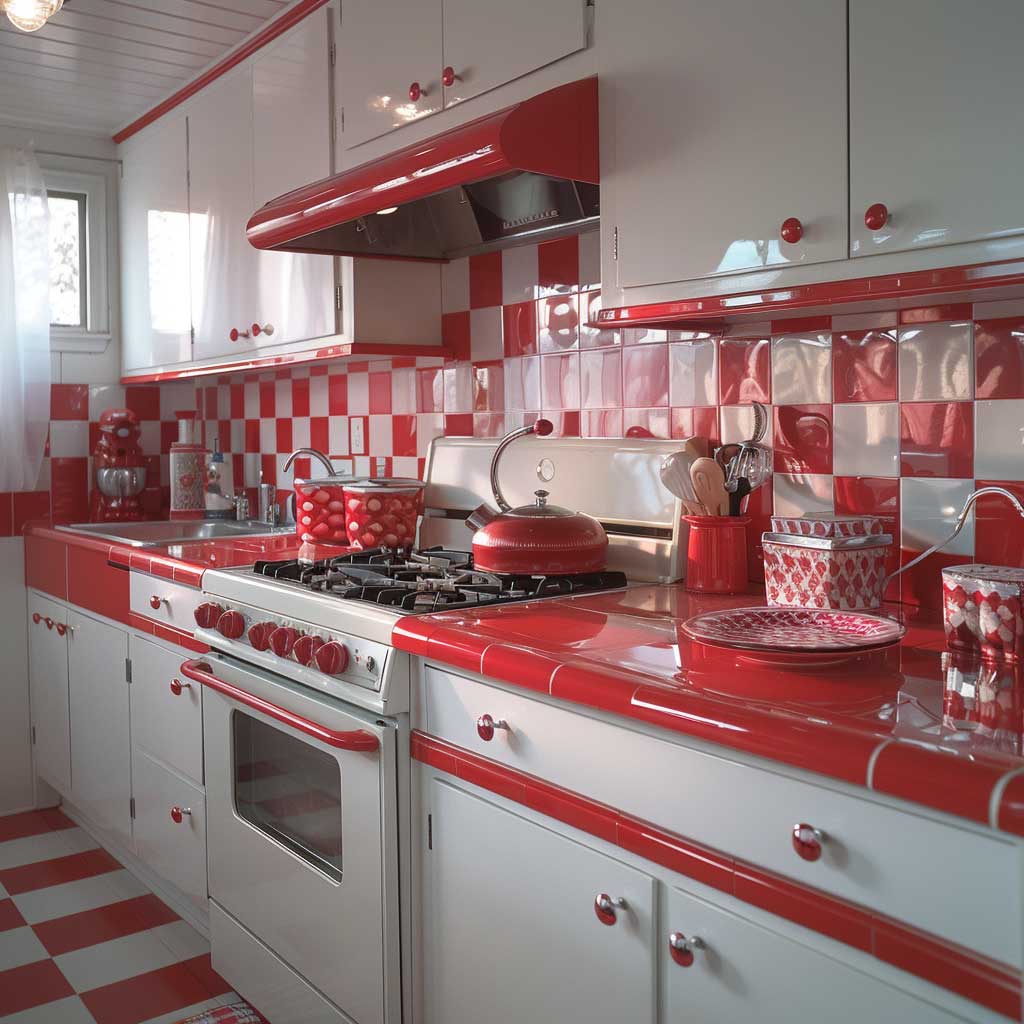
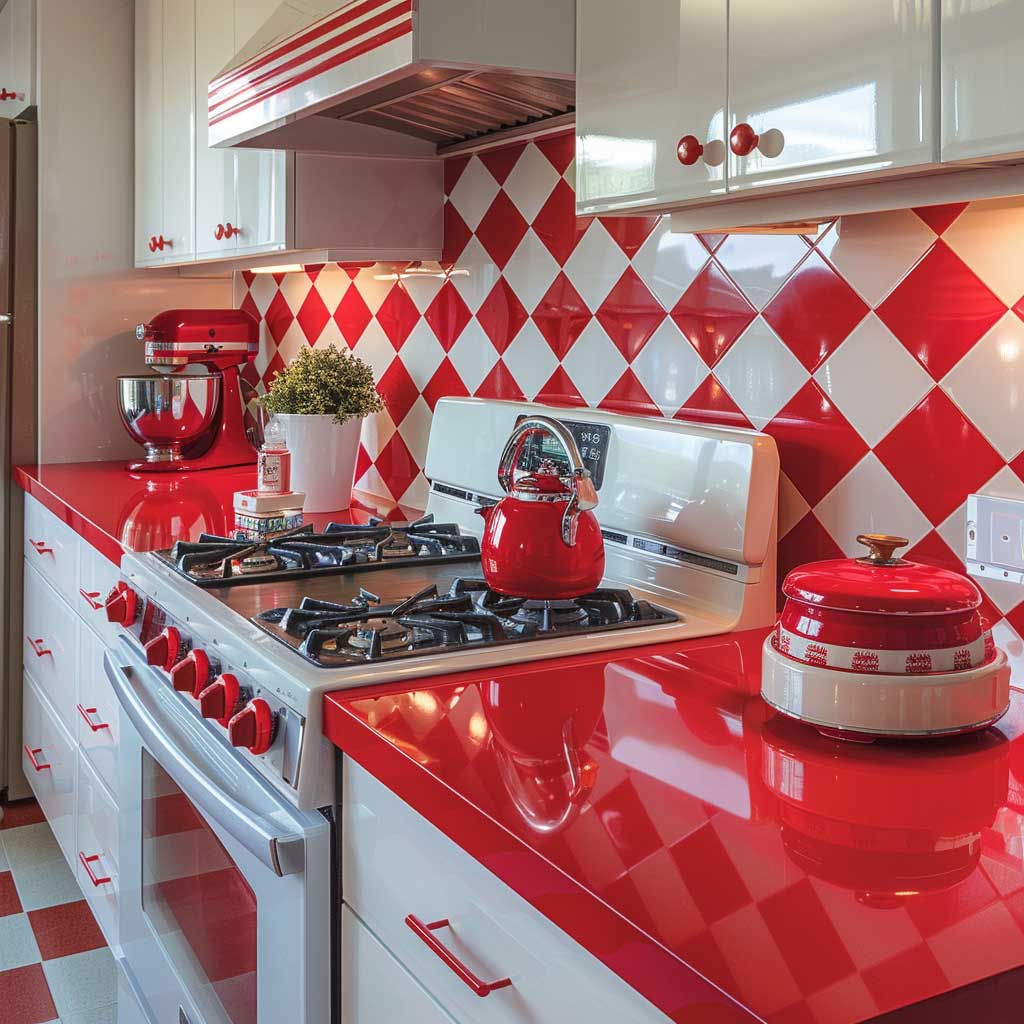
The retro-diner association is real and intentional. Red laminate counters read mid-century American — the kind of kitchen that pairs naturally with checkered vinyl flooring, a white farmhouse sink, and chrome fixtures rather than matte black hardware. That specificity is a feature if that’s the aesthetic you’re building, but it’s a limitation if the style evolves over time. Unlike stone, laminate cannot be refinished or resealed — it looks sharp when new, and the day a chip or gouge appears, repair options are limited to full-section replacement. Keep cutting boards on the counter; laminate does not forgive knife marks the way it forgives spills.
A common miscalculation is choosing a high-gloss red without testing it against the kitchen’s lighting conditions. Under warm incandescent or Edison-style bulbs, red laminate deepens and warms; under cool white LEDs, the same surface can read as harsh or flat. Request a physical sample, hold it under the actual fixtures in your kitchen at different times of day, and check it against the cabinet finish before committing. Chrome hardware is the natural pairing — it reflects the red back without absorbing it the way matte black does, and it reinforces the period-correct reference rather than muddying it. If you’re weighing colorful laminate against other non-stone countertop materials, stainless steel kitchen countertops offer a completely different take on the modern workhorse aesthetic.
| Material | Installed Cost (per sq ft) | Best Pairing | Key Limitation |
|---|---|---|---|
| Blue Quartz | $50–$100 | White cabinets, brushed nickel | Bold color limits resale neutrality |
| Green Marble | $70–$180 | Dark wood, unlacquered brass | Needs annual sealing; heavy slabs |
| Red Laminate | $20–$60 | Chrome hardware, checkered tile | Cannot refinish; chips require replacement |
The Takeaway
Color on a countertop is a commitment — pick the one that matches how the kitchen actually gets used
Blue quartz gives you the boldest visual return with the least maintenance burden and a mid-range price point that most kitchen budgets can accommodate.
Green marble delivers depth and natural movement that no engineered product replicates, but it rewards kitchens that are kept clear and maintained consistently.
Red laminate is the fastest, most affordable way to build a personality-driven kitchen — the trade-off is that it’s material-specific and difficult to repair. Save this post.
Related Topics
FAQ
What are colorful kitchen countertops made from?
How much do colorful countertops cost compared to standard white or gray?
Do colorful countertops hurt resale value?
What cabinet color goes with colorful kitchen countertops?
How do you maintain colorful quartz vs. colorful marble countertops?
Can red counter design work in a small kitchen?
Complete guide
Every Modern Kitchen Design Idea Worth Stealing Right Now
Layout, cabinets, islands, materials, color, lighting — all in one place