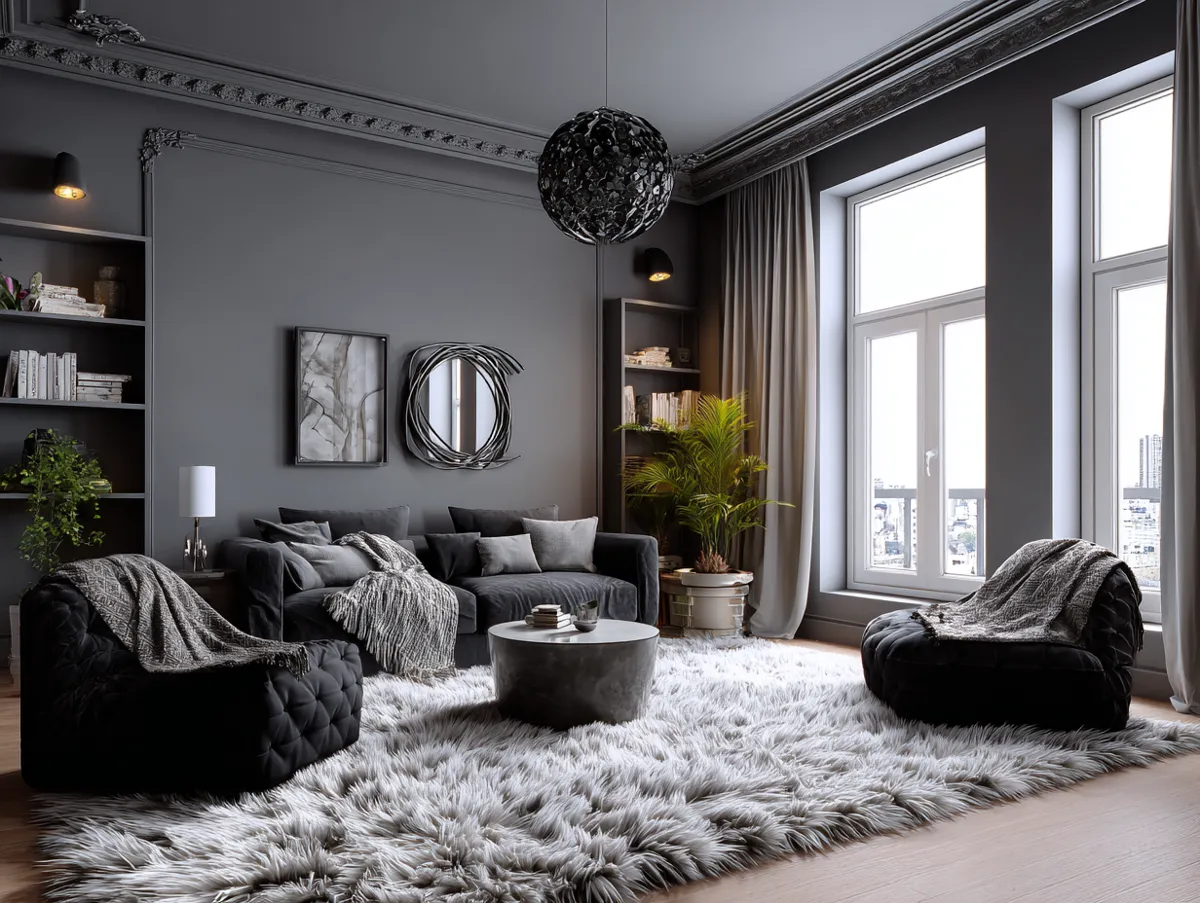
Black and white curtains for the living room work because they sidestep the single hardest decision in window dressing — color. Freed from that question, every other choice sharpens: the width of a stripe, the weight of a fabric, the distance between a sheer and a drape. The result, when those decisions land right, reads as considered rather than cautious.
Monochrome window treatments hold across light conditions in a way that colored curtains rarely do. The same black and white panel that looks graphic under afternoon sun reads as moody and architectural after dark. That reversibility is real value — you get two different room atmospheres in a single purchase, with no hardware change required.
Three approaches consistently land well in a living room context: bold graphic stripes, layered sheers with dark drapes, and abstract-printed panels. Each works differently depending on what the room needs — vertical energy, layered depth, or expressive pattern. The sections below cover all three, with specific product references, verified prices, and the mistakes that kill each look.
– Wide black and white stripes add structure and create the illusion of height — IKEA SLÅNHÖSTMAL 100% cotton pair: $49.99
– Layering sheer white panels under matte black drapes divides the window into two functional zones: day softness and evening depth
– Abstract-print panels on white fabric bring expressive pattern without color risk — Society6 options start at $109 per panel
– Avoid mixing warm-white or ivory with true black: the warmth reads as a mistake, not a transition tone
– Mount the curtain rod at ceiling height, not frame height — the difference in perceived room height is immediate
Vertical Stripe Curtains Push a Room Taller Than Any Paint Color Can
Wide black and white striped curtains work like a vertical ruler mounted in the window — the eye follows the line upward and the ceiling reads higher than it is. This optical effect is more reliable than a light paint color and more immediate than repositioning furniture. IKEA’s SLÅNHÖSTMAL pair, made from 100% cotton and priced at $49.99 for two panels measuring 57×98 inches, is the entry-level benchmark: the graphic stripe holds its structure without going limp after washing, which many polyester alternatives fail to do.
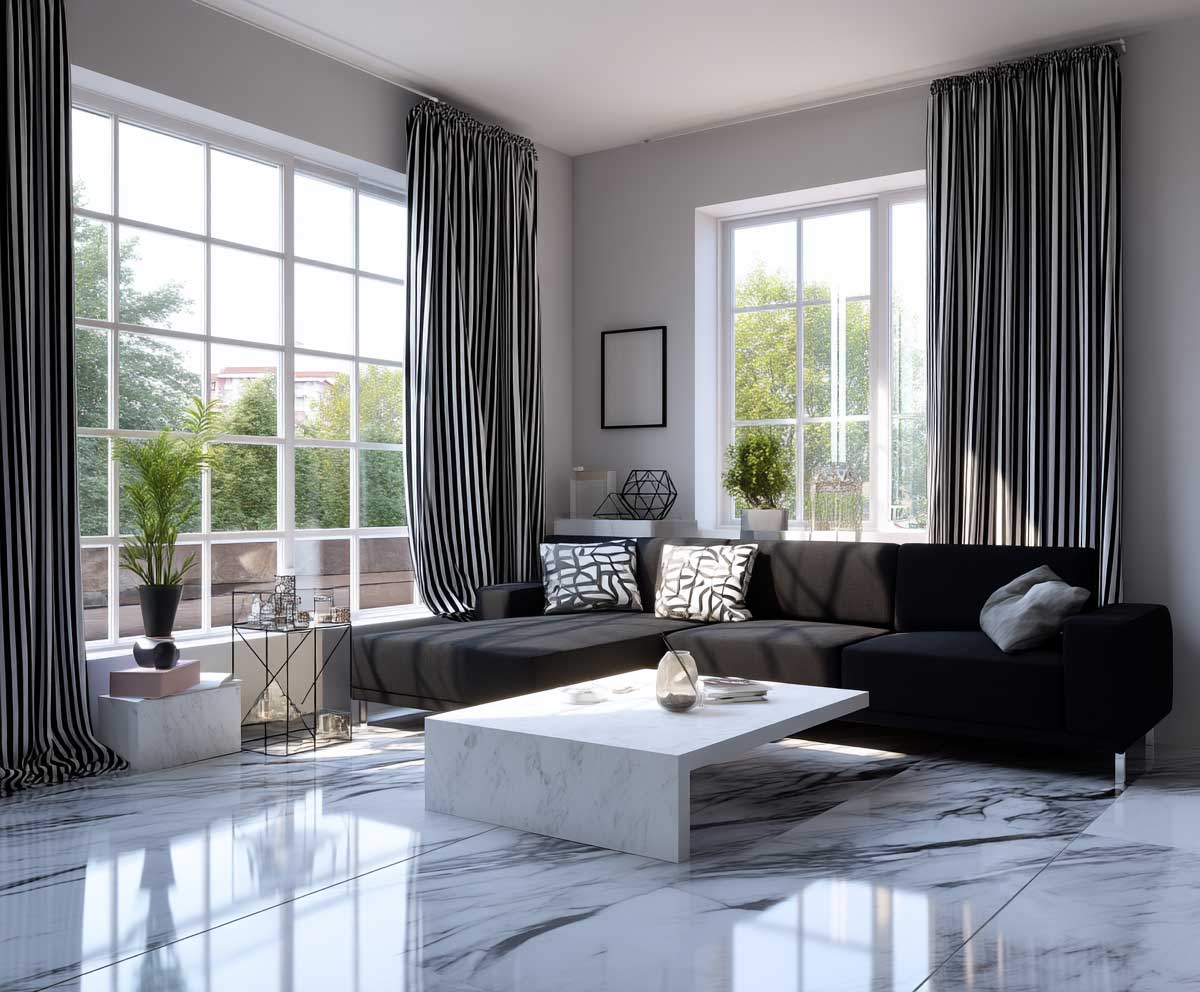


Cotton is the right fabric for this look. The weave is stiff enough to hold a stripe flat — polyester blends often buckle between stripes, which destroys the graphic clarity the look depends on. What does stripe width do to a room? Narrow stripes (under two inches) register as pattern from across the room. Wide stripes (four inches and above) register as structure. For most living rooms, wide stripes function more like architectural elements than decorative ones, anchoring the composition rather than adding busy surface detail.
The pattern pairs best when the rest of the room offers little competition. A solid white or charcoal wall, a neutral sofa, and one or two matte black accents — a lamp base, a picture frame — let the curtains anchor without fighting anything else. Add a patterned rug and the curtains start losing the room. Think of stripes the way a stylist thinks of a statement coat: every other element in the frame should be quiet enough to let it land at full strength.
Do not hang striped curtains on a rod set at window-frame height. The vertical line gets cut short and the height-gaining effect disappears entirely — the curtain reads as a panel, not a column. Mount the rod 4 to 6 inches above the frame, or as close to the ceiling as hardware allows. Also avoid pairing stripe curtains with a striped rug in a contrasting orientation — two stripe directions in the same room fight for visual dominance and neither wins.
Sheer White Panels Backed by Matte Black Drapes Split One Window into Two Moods
Layering sheer white panels behind matte black drapes solves the problem that plagues most single-curtain setups: a window that handles either privacy or light, never both at once. Interior designers consistently recommend starting any window treatment scheme with a sheer base layer — sheers diffuse daylight without overpowering the room’s design and give any heavier outer drape a quieter backdrop to play against. In a black and white living room, that pairing also builds the contrast the palette depends on without introducing a third color anywhere.

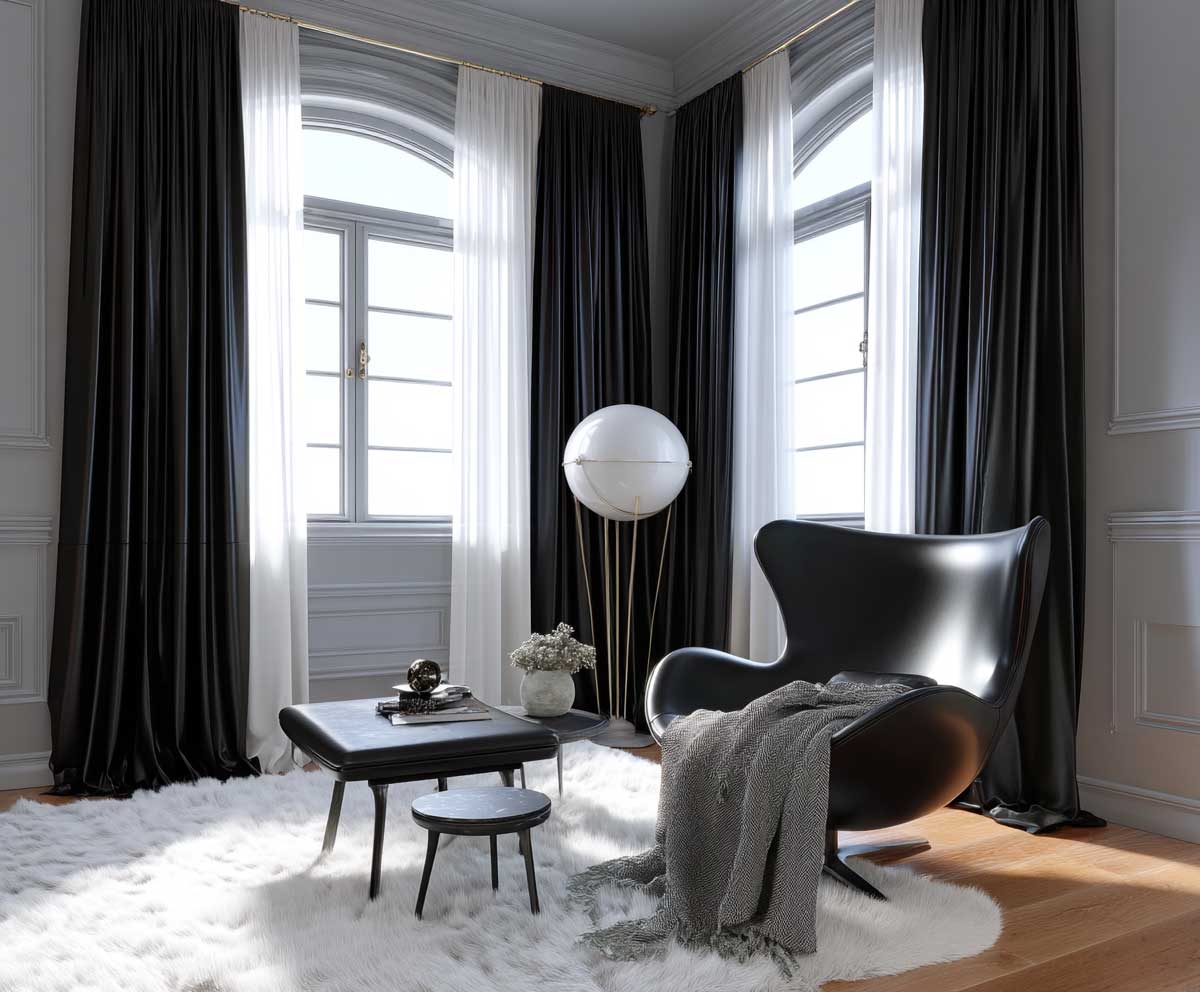


The hardware decision matters as much as the fabric. A double curtain rod places the sheer on the inner track — closer to the glass — and the matte black drape on the outer track, so both layers operate independently and neither catches the other when drawn. Why matte and not satin or velvet black? Satin and velvet surfaces create sheen that competes with the sheer’s transparency. Matte black recedes visually, which makes the sheer appear to float rather than fight against it. Brushed linen or flat-weave cotton are the right outer fabrics for this look.
Pull the black drapes to the outer edge of the window frame and hold them loosely — the sheer should account for roughly 70% of the visible glass area when both layers are open. The composition reads like a cinema setup: the sheer is the screen, the drapes are the curtains on either side, and the window itself becomes the focal point of the wall. This approach works especially well on wide windows and sliding glass doors, where a single panel leaves the outer edge visually unresolved. For how this palette performs across other rooms, the black and white room decor breakdown covers kitchens and bedrooms alongside the living room.
Close the drapes at night and the space contracts into something warmer and more enclosed — the sheer disappears behind the black and the room shifts register completely. Open them in the morning and the room fills with diffused light that lands softly on every surface. That adaptability costs less than most people expect: a sheer panel and a matte cotton drape together typically total less than a single custom-made blackout curtain, and they do more for the room’s range of moods.
Abstract Prints Turn Black and White Curtains for the Living Room into Low-Cost Wall Art
Modern black and white curtains with abstract ink prints on white fabric occupy different design territory than stripes or solids — they carry enough visual movement to function like art while keeping the base white and light-reflective. Society6 abstract black-on-white window panels start at $109 per 50″×84″ panel, printed to order in mid-weight polyester, machine washable, with a 4-inch bottom rod pocket. That price positions them above mass-market curtains but well below a commissioned artwork, which makes abstract-print panels worth considering for anyone who wants expressive pattern in the room without a separate gallery budget.


Abstract prints break what stripes cannot: the rigidity of the monochrome palette. Ink splashes, gestural brushwork, and flowing organic marks introduce randomness that prevents a black and white room from reading as stark or clinical. The base fabric color is critical here — keep it true white, not off-white or warm cream. Any warmth in the ground color will muddy the contrast with the black ink marks. Bright-white polyester holds print color better than linen in this context because linen carries a natural ivory undertone that shifts the palette off-register.
Pair abstract-print panels with furniture that stays quiet: a low-profile sofa in solid white or charcoal, shelving without competing decorative objects, and flooring that reads as neutral. The curtain does the expressive work; the room’s job is to give it space to land. Stylists recommend treating abstract curtains the way a gallery treats a painting — one strong piece per wall surface, everything else in a supporting role. You can see how the same discipline applies across black and white room design projects in living rooms, offices, and bedrooms — the distribution of the dark tone is almost always the deciding variable.
How do abstract curtains age? Better than geometric ones. A strict grid or chevron pattern dates to a specific year; an ink-wash or brushstroke abstraction is harder to pin to a moment, which means the curtains stay relevant longer. That matters more in window treatments than in almost any other soft furnishing, because re-hanging curtains involves re-drilling hardware — not just swapping a cushion cover. Hang abstract panels on a matte black rod rather than chrome; chrome adds warmth and sheen that breaks the palette’s internal logic at exactly the point where it should hold together tightest.
| Style | Best Room Match | Right Fabric | Critical Mistake |
|---|---|---|---|
| Wide vertical stripes | Low-ceilinged or narrow rooms | 100% cotton | Rod at frame height, not ceiling |
| Sheer + matte black drape | Large windows, sliding doors | Voile inner / brushed linen outer | Satin or glossy finish on outer drape |
| Abstract black-on-white print | Art-led, minimal spaces | Bright-white mid-weight polyester | Warm ivory or cream base fabric |
Layering window treatments gives a room both functional control and visual depth that no single-panel approach can replicate. Homes & Gardens covers the hardware specifics, pairing logic, and fabric weights for sheer-plus-drape setups in detail in their window treatment layering guide.
The Takeaway
Monochrome curtains succeed when fabric choice is as deliberate as color choice.
Cotton holds a stripe flat. Matte linen absorbs light without competing with a sheer. Bright-white polyester keeps an abstract print from going muddy. The palette has two colors — the material decisions are where rooms actually diverge.
IKEA SLÅNHÖSTMAL stripes cost $49.99 a pair. Society6 abstract panels start at $109 per panel. A layered sheer-plus-drape setup for a standard window typically totals under $150. All three approaches work at different budgets and all three require the same discipline: one strong decision per wall surface, quiet everything else.
Save this post before your next curtain shopping trip — the right choice is easier to make when you know what each approach actually does to a room.
FAQ
What is the best fabric for black and white striped curtains in a living room?
Are monochrome curtains hard to style around?
Can black curtains work in a white living room?
How do I match curtains to a black sofa?
What length should black and white curtains be in a living room?
Do short black and white curtains ever work?
Complete guide
The Living Room Design Ideas Vault Every Home Needs Right Now
Color, walls, furniture, layouts, styles, smart tech — 300+ ideas in one place
Complete guide
White Color in Home Design: Every Room, Every Style, Every Shade
Kitchens, bathrooms, living rooms, exteriors, palettes — all in one place
Complete guide
Black Home Color Ideas for Every Room and Every Mood
Living rooms, bedrooms, kitchens, bathrooms, exteriors — all in one place