Exterior garage lighting ideas work when three numbers line up: fixture size, mounting height and color temperature. Residential lighting suppliers point to 2700K–3000K warm white for most homes, with the center of each wall light about 66–72 inches above the ground. Does a garage need more than one fixture? A single-car door of 8–10 feet gets one or two lights, while a 16-foot double door usually takes two or three.
Style comes second, but it decides how the facade reads after dark. Warm lanterns make a garage feel like a front porch, slim cylinders make it look architectural, and barn lights add workshop grit. LED versions of all three use at least 75% less energy than incandescent bulbs, so the look you pick no longer dictates the power bill.
The sections below cover five approaches, from golden wall sconces to landscape-integrated lighting, with real lumens, sizes and running costs. Each one ends with a clear rule you can take to the hardware aisle. Measure your garage door width before you read further, because almost every recommendation scales from it.
Quick Scan
- Warm white 2700K–3000K suits most homes; 4000K and above reads commercial.
- Mount each fixture so its center sits 66–72 inches above the driveway.
- Single-car door (8–10 ft): one or two fixtures. Double door (16 ft): two or three. Triple door (24 ft): three.
- Wall lights by the door need 800–1,100 lumens; path lights only 100–200.
- Exposed walls need wet-rated fixtures (about IP65), not damp-rated (about IP44).
- LEDs last 25,000–50,000 hours versus 1,000–2,000 for halogen.
- Full-cutoff fixtures at or below 3000K keep light on the driveway, not in the neighbor’s window.
Warm Wall Sconces Turn the Garage Into a Welcome Mat
Garage wall lighting ideas start with warm sconces, because a golden glow across the door makes the driveway feel like part of the entrance rather than a service zone. Lighting retailers recommend 2700K for this look, the same warmth as an old incandescent bulb. Compare that with 5000K daylight bulbs, which flatten brick and siding into a gray parking-lot tone. Keep warm and cool bulbs off the same facade, since mixed temperatures look like two houses glued together.
Size matters as much as color. For a pair flanking a door, each fixture should be roughly one-quarter of the door height, and garage sconces scale to the garage door, not the entry door. Is bigger always better? Up to a point, yes: an undersized lantern on a 16-foot door looks like a cufflink on a winter coat. When in doubt between two sizes, pick the larger one.


Placement decides whether the light helps or blinds. Set the center of each fixture 66–72 inches above the ground, close to eye level, so faces show up clearly on a doorbell or security camera. The same rule used for front porch lighting ideas with real fixture prices carries over to the garage, which keeps both entrances at one consistent height. Avoid tucking sconces up under the soffit, where they light the gutter better than the driveway.
- Single-car garage, 8–10 ft wide: one fixture centered above the door or two smaller ones flanking it.
- Two-car garage, 16 ft wide: two to three fixtures, one at each side and an optional one at center.
- Three-car garage, 24 ft wide: three evenly spaced fixtures or one gooseneck centered over each bay.


Brightness should match the job of a door light, not a stadium. Wall fixtures beside an entry typically need 800–1,100 lumens, enough to read a key fob and house numbers. A 3,000-lumen floodlight on the same wall wins on raw output but loses on comfort, throwing glare straight into the street. Start at the low end of the range and add a second fixture before you add more lumens to one.
Slim Cylinders Give Modern Garage Lights Their Edge
Modern garage lighting ideas rely on slim cylinders and vertical bars, which wash the wall with narrow beams instead of a round halo. Many wall-mounted cylinders throw light both up and down, drawing two crisp stripes across stucco, concrete or dark cladding. Compared with a lantern, a cylinder adds almost no visual bulk, so the architecture stays the main event. Choose a matte black or graphite finish when the facade is pale, and white or brushed metal when the wall is dark.
Color temperature can push a little cooler here than on a traditional house. Lighting engineers often favor a neutral 3000K–4000K for exterior garage walls, while 5000K–6500K belongs in workshops rather than on a facade. Is cool white ever right for a home? On a charcoal box with glass and steel, 3500K looks crisp without tipping into hospital-corridor territory. Test one bulb at night before buying a full set.


Price brackets for modern cylinders sit around $150–$250 per fixture at mainstream retailers, close to what a traditional lantern costs. The real difference lies inside the housing. Fixtures with replaceable GU10 or standard bulbs outlive integrated LED boards, because a dead board usually means replacing the whole light. Skip integrated units on a garage you plan to keep for 10 years or more.


Grazing light also exposes every flaw on the wall, the way a low sun shows dust on a car hood. Smooth render and fine cladding look sharp, while patched stucco looks blotchy under a narrow beam. If you want a modern look without the stripe, full-cutoff downlights at 3000K or below aim everything at the ground and meet most dark-sky ordinances. Choose that route when neighbors sit close or local rules limit uplight.
Planting Beds Soften Outdoor Garage Lighting Ideas
Outdoor lighting ideas for garage frontages get warmer and softer when part of the light moves off the wall and into the planting. Low path lights and a few uplights in shrubs lead the eye toward the door the way stepping stones lead across a lawn. Each path light needs only 100–200 lumens with a downward beam, a fraction of a wall sconce’s output. Place them along the driveway edge, not in the middle of the planting bed.
Spacing keeps the effect from turning into a runway. Landscape lighting suppliers suggest 6–8 feet between path lights, alternating sides so each fixture fills the gap left by the last. What about a long drive? Post lights at the entrance, typically 6–8 feet tall with 800–1,200 lumens, cover the wide zone, while path lights handle the edges. Never line a short driveway with ten identical stakes, because it reads like airport approach lights.
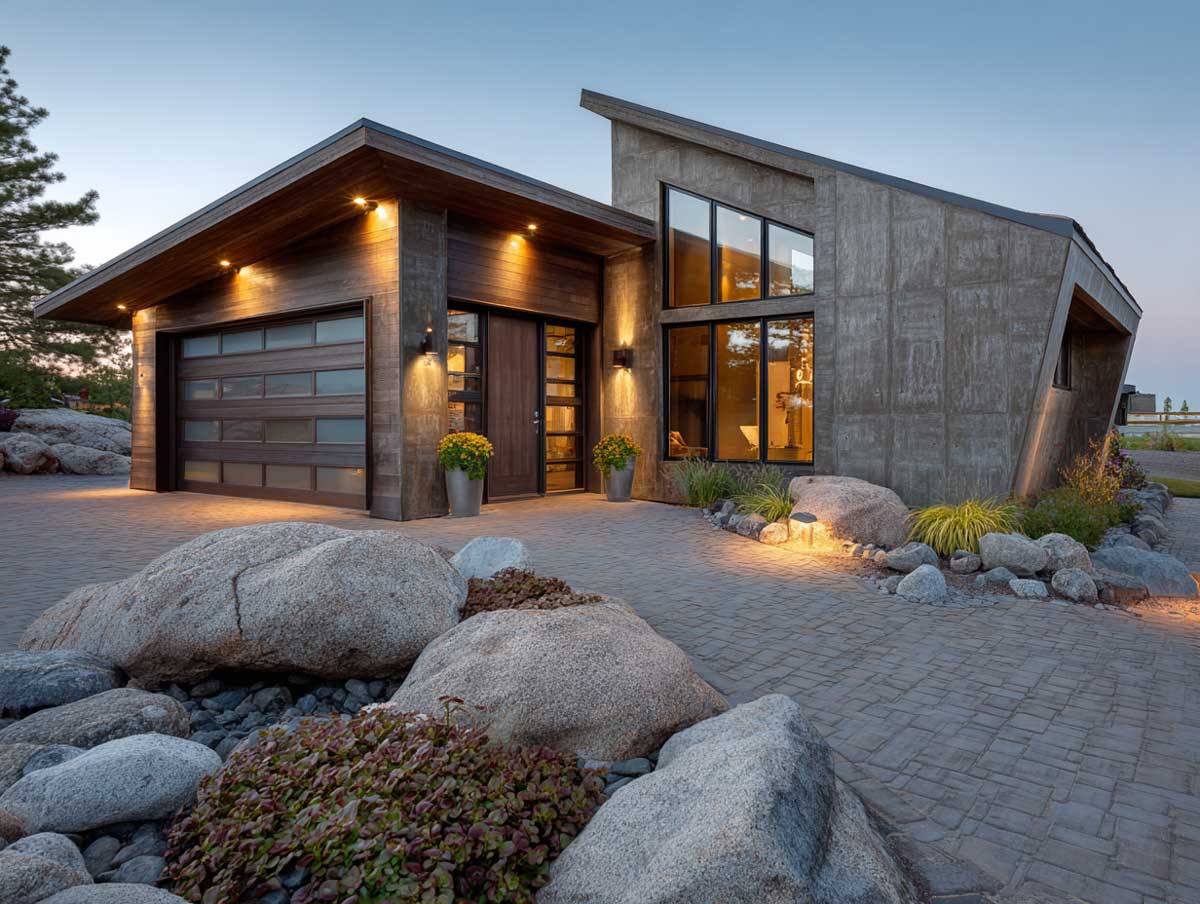


Solar stakes look tempting next to a garage because they need no trenching. They do work for accent and path lights, but only where they get 6 or more hours of direct sun, and output drops sharply in winter and cloudy climates. A hardwired low-voltage set costs more on day one and still glows in January. Pick solar for a sunny southern bed and wired lights for a shaded north-facing drive.


Layering is what makes this approach feel finished. Wall sconces handle the door, path lights handle the edges and one or two uplights add depth to a tree or hedge. Start with the wall layer for safety, add the path layer second and add accents last. Three layers at modest output always beat one bright fixture doing every job.
Barn Lights Bring Workshop Grit to the Driveway
Industrial garage outdoor lighting ideas borrow gooseneck barn lights and caged lamps from old warehouses, then shrink them to residential scale. The wide metal shade works like a hat brim, pushing light down onto the door and keeping glare out of drivers’ eyes. On a three-car garage of 24 feet, one gooseneck centered over each bay is the classic layout. Choose matte black or galvanized steel for farmhouse and modern-industrial homes alike.
Rating matters more than finish on an exposed garage wall. Damp-rated fixtures, roughly IP44, handle splashes under a roof, while wet-rated ones, roughly IP65, survive direct rain, snow and sprinkler spray. Do barn lights on an open wall need the higher rating? Yes, because a gooseneck usually sticks out past any overhang. Check the spec sheet for a UL Wet Location listing before the finish color.


Industrial does not have to mean cold. A 2700K bulb inside a black steel shade softens the factory look, while a 5000K bulb in the same shade makes the garage feel like a loading bay. Weathered metal finishes need care near the sea, where salt air can corrode standard iron and steel within months. Pick powder-coated aluminum or solid brass for coastal homes and save raw steel for inland drives.
Don’t Do This: Don’t hang an indoor-rated pendant under the garage overhang to save money. Temperature swings, wind-driven moisture and insects degrade indoor fixtures within 1–2 seasons, and the swap can void the UL listing. A wet-rated barn light costs more once and keeps working for years.


Scale the shade to the bay. A 10–12-inch shade looks right over a single 8–9-foot door, while a 16-foot double door can carry two larger shades or three small ones. Too-small goosenecks read like toy lamps on a big facade. Hold a paper template against the wall at 66–72 inches before ordering.
LEDs Slash the Running Cost of Exterior Garage Lighting Ideas
Energy-efficient exterior garage lighting comes down to LEDs, which change the math behind every idea above. According to the U.S. Department of Energy’s LED lighting guide, residential LEDs use at least 75% less energy than incandescent bulbs and last up to 25 times longer. Incandescent bulbs waste about 90% of their energy as heat, which is why an old porch bulb feels hot to the touch. Swap every exterior bulb to LED before you spend on new fixtures.
Lifespan is where LEDs pull far ahead. Outdoor LED fixtures typically last 25,000–50,000 hours versus 1,000–2,000 hours for halogen. Run 4 hours a night, a 50,000-hour LED keeps going for more than 34 years, and retailers estimate the price premium pays back within 2–3 years. Is that worth it on a single garage light? On a fixture you reach only by ladder, the saved climbs alone justify it.


Controls stretch the savings further. Dusk-to-dawn photocells switch lights on automatically, and motion sensors add a burst of brightness only when a car pulls in. LEDs also start instantly in cold weather, unlike CFLs that need a warm-up. Pair a low steady glow with a motion-triggered boost rather than running full output all night.


Lighting is only half of an energy-smart garage front. An attached garage with gaps around the door can leak warm air into the house all winter, and garage door weather sealing that cuts heating losses pairs naturally with an LED upgrade. Both jobs fit into one weekend and one ladder trip. Tackle the seals first, then mount new fixtures on a door frame you won’t have to touch again.
Sizing and Style Choices for Exterior Garage Lighting Ideas
Comparing the five approaches side by side shows that most differences come down to color temperature, lumens and exposure rating rather than looks alone. Warm sconces and barn lights share the same 2700K sweet spot, while modern cylinders can stretch to 3500K–4000K. Landscape lights run at a tenth of a wall fixture’s output. Use the table to set your shopping list before choosing a finish.
| Approach | Color temperature | Lumens per fixture | Typical price | Best fit |
|---|---|---|---|---|
| Warm wall sconces | 2700K–3000K | 800–1,100 | $150–$400 | Traditional, brick and stone facades |
| Modern cylinders | 3000K–4000K | 800–1,100 | $150–$250 | Flat-roof and dark-clad garages |
| Path and post lights | 2700K–3000K | 100–200 path, 800–1,200 post | Varies by system | Long driveways and planted borders |
| Industrial barn lights | 2700K–3000K | 800–1,100 | $150–$400 | Farmhouse and workshop-style garages |
| LED retrofit only | Match existing | Same as replaced bulb | Bulb cost only | Any fixture still in good shape |
| Garage door width | Typical bays | Fixture count | Mounting height (center) | Layout |
|---|---|---|---|---|
| 8–10 ft | 1 | 1–2 | 66–72 in | One centered or two flanking |
| 16 ft | 2 | 2–3 | 66–72 in | Both sides plus optional center |
| 24 ft | 3 | 3 | 66–72 in | Evenly spaced or one per bay |
The Short Version for Your Driveway
Two or three warm 2700K–3000K fixtures, centered 66–72 inches up and sized to the garage door, beat one oversized floodlight on every count: comfort, curb appeal and glare.
Pick the style from the house, not the catalog. Lanterns suit brick and stone, slim cylinders suit flat roofs and dark cladding, and barn lights suit farmhouse and workshop garages.
Buy wet-rated fixtures for any exposed wall and keep wall lights at 800–1,100 lumens. Add 100–200-lumen path lights every 6–8 feet if the driveway runs long.
Finish with LEDs and a dusk-to-dawn sensor. At 75% less energy and 25,000–50,000 hours of life, the upgrade usually pays for itself within 2–3 years.