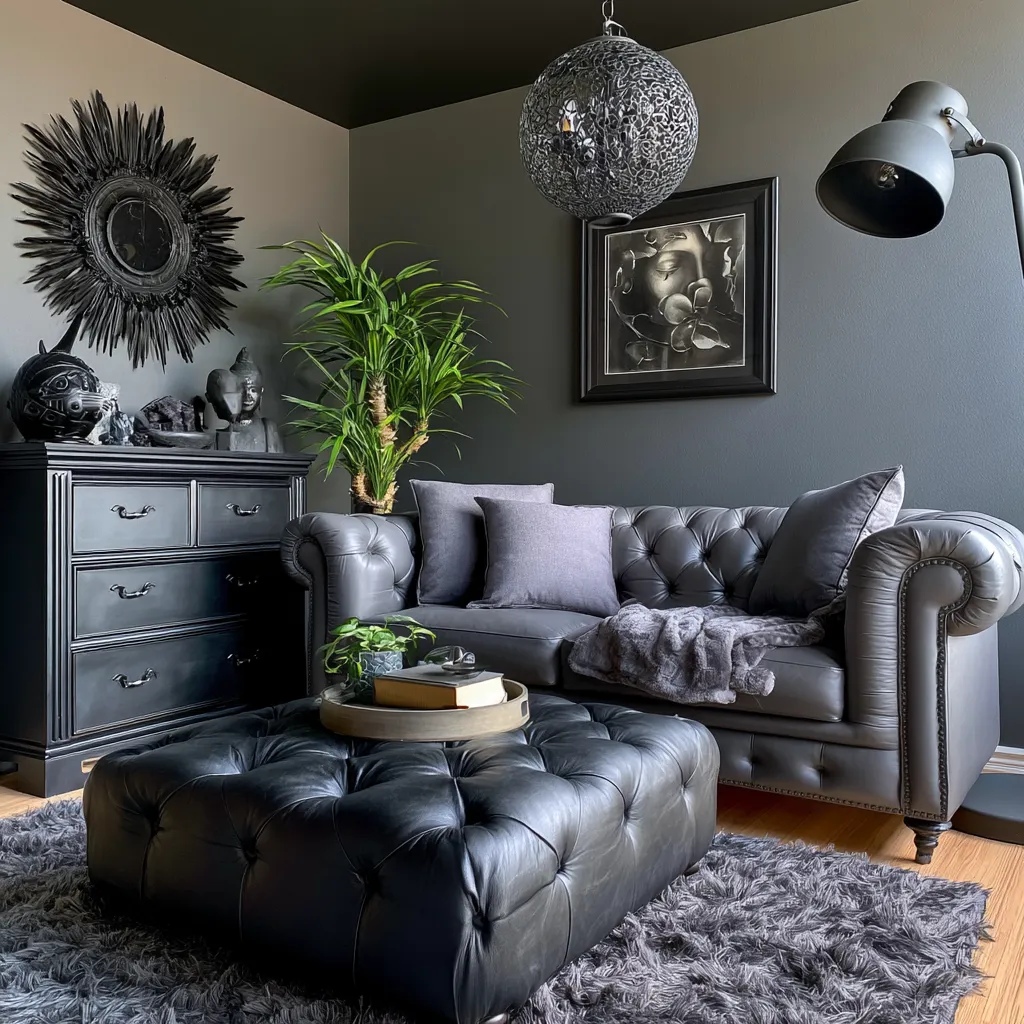
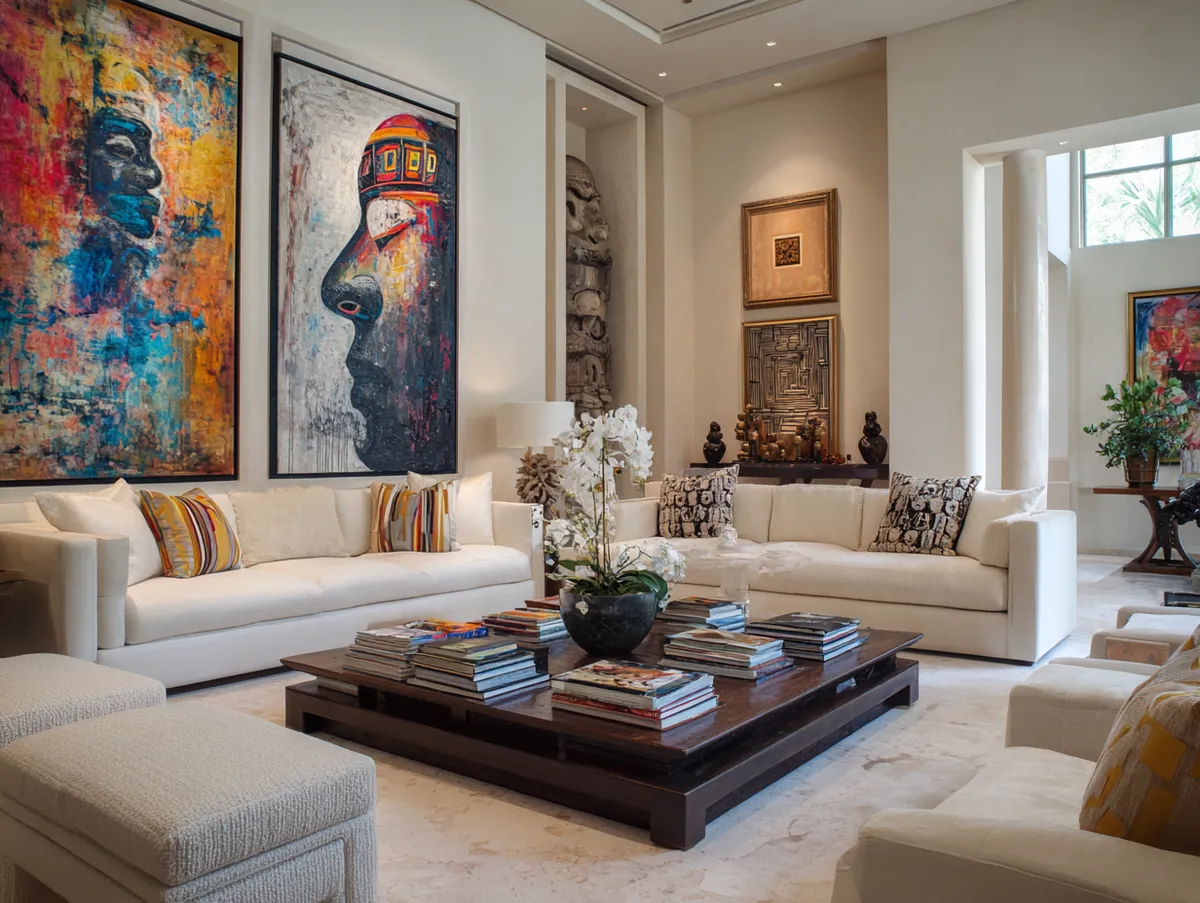
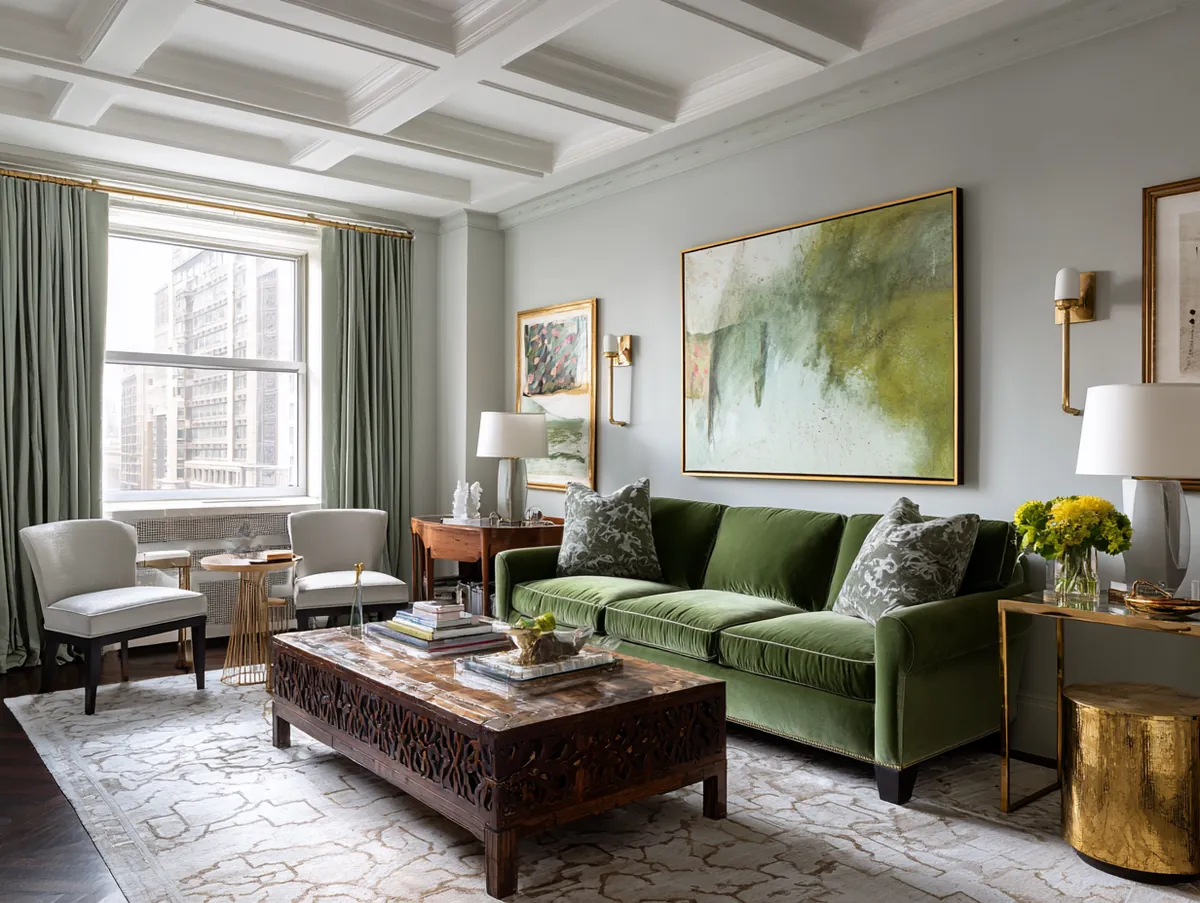
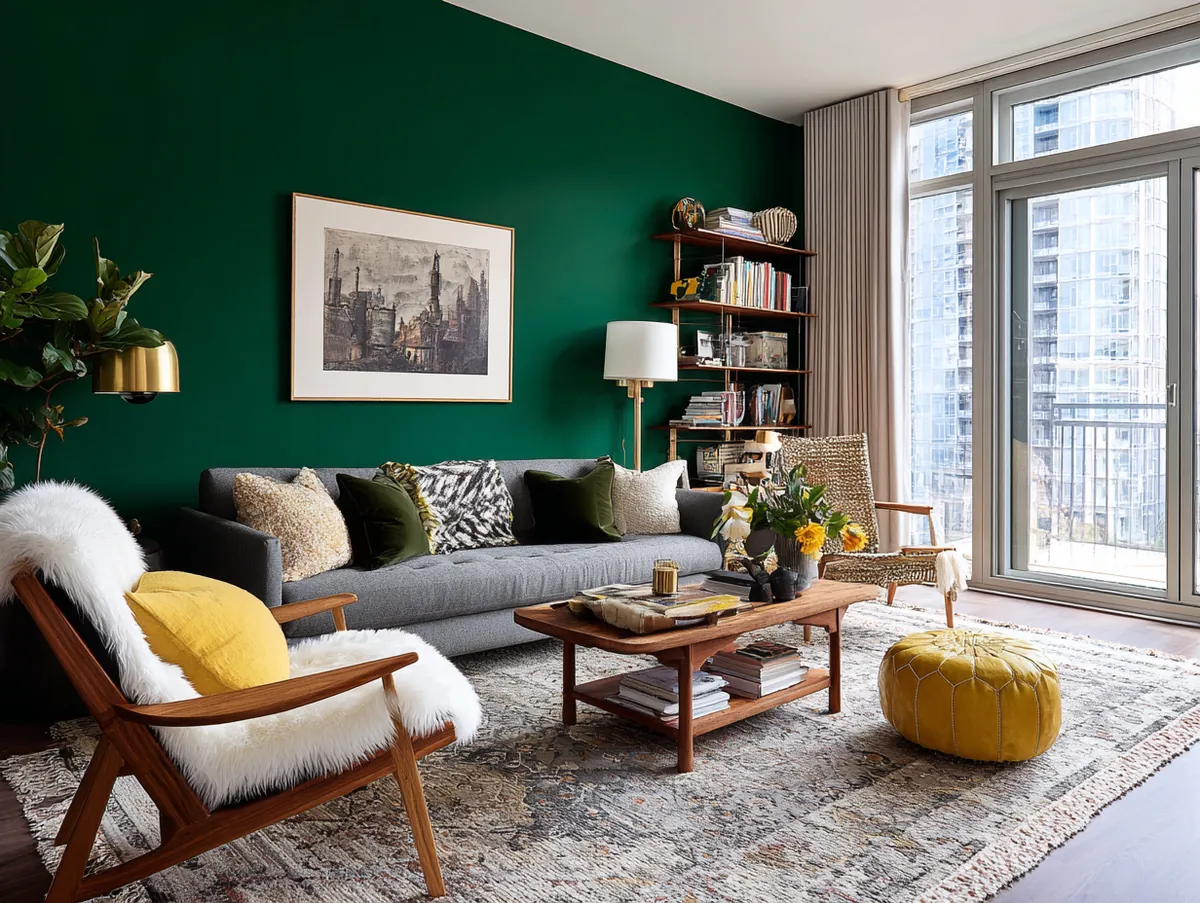
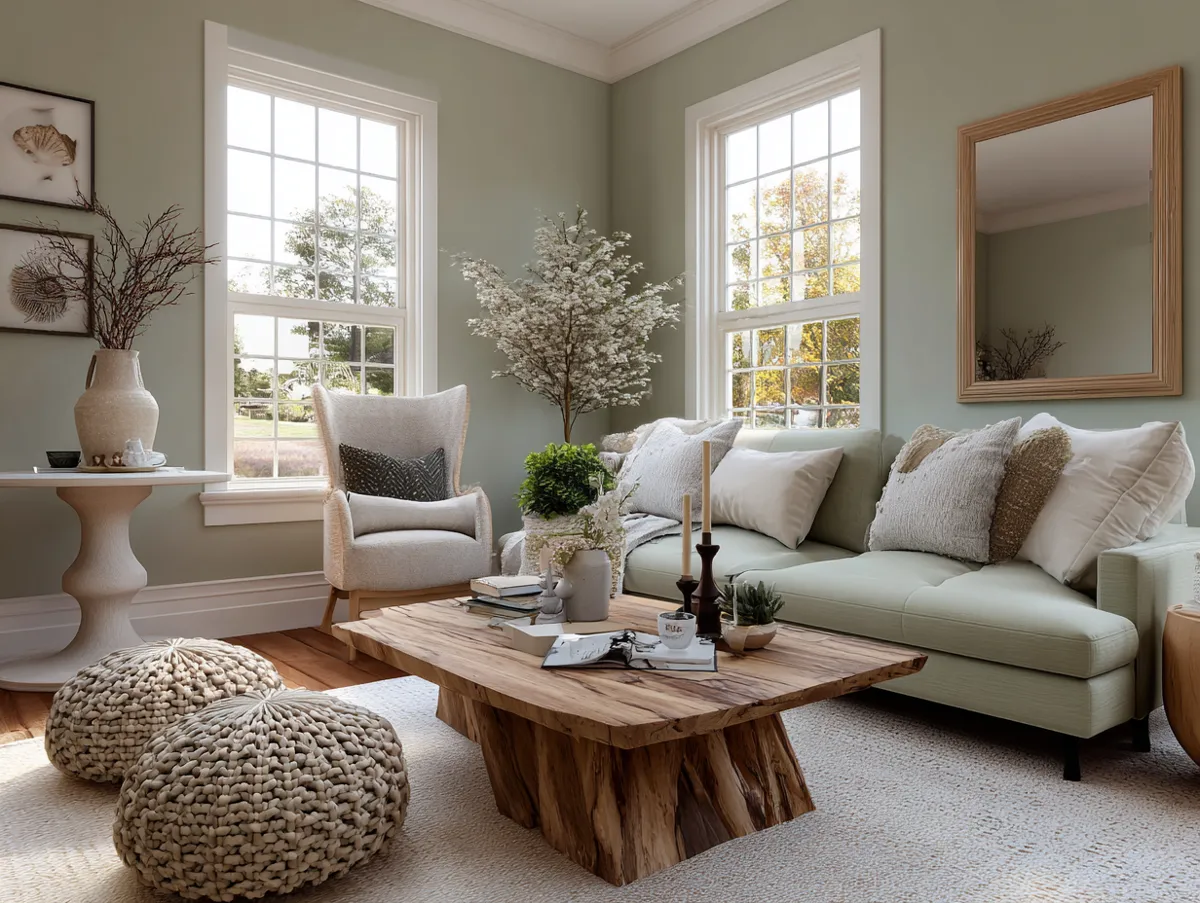
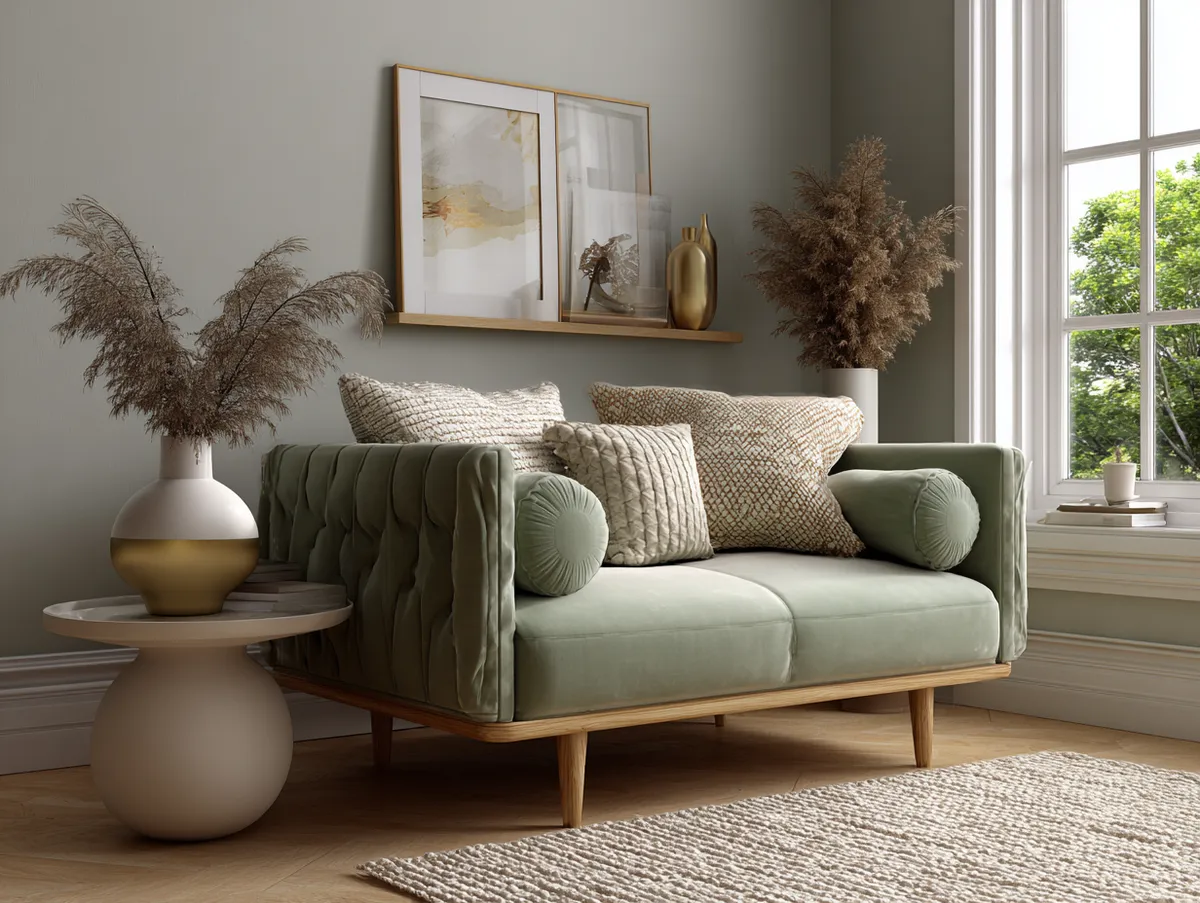
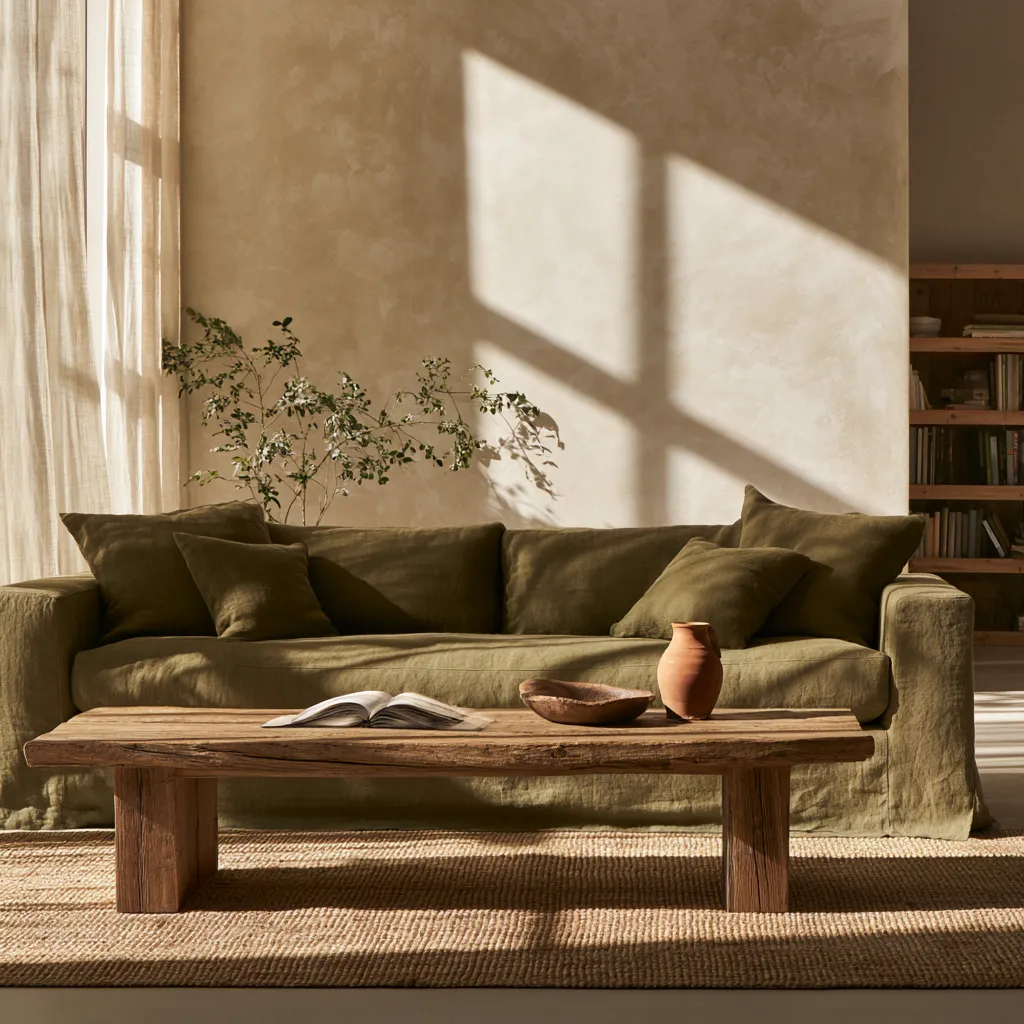
There is a reason this palette keeps appearing on interior design boards, in editorial shoots, and in the living rooms of people who have stopped chasing trends. Warm beige and sage green sit together the way earth and moss do in nature — one grounding, one alive. Together they create a room that feels quiet without feeling empty, and layered without feeling busy. This guide covers every decision you will face: paint selection, furniture placement, lighting, textiles, and the details that separate a pulled-together room from one that merely looks inspired by one.
Why Warm Beige and Sage Green Work So Well Together
Color theory explains the harmony mathematically: sage green sits in the yellow-green range of the spectrum, and warm beige carries undertones of yellow and orange. This means the two share a hidden yellow base that makes them feel cohesive even when they contrast in value. Warm beige reads as the light source; sage green reads as depth. The eye moves between them naturally, which is why rooms built on this palette feel restful rather than flat.
Beyond theory, there is data behind the preference. A 2023 Dulux color trend survey of over 4,000 European homeowners found that 67% described “nature-inspired greens paired with warm neutrals” as their preferred direction for living spaces. Sherwin-Williams reported a 41% year-over-year increase in searches for sage green paint between 2022 and 2024. This is not a micro-trend — it is a sustained shift toward palettes that feel grounded and restorative.
The palette also has unusual flexibility. It works in a north-facing room with limited natural light because warm beige compensates for cool tones that grey walls would amplify. In a south-facing room flooded with sun, sage green prevents the space from reading as washed out. That balance makes it one of the most forgiving combinations you can choose.
Choosing the Right Shades of Beige and Sage for Your Living Room
Not all beiges are warm, and not all sage greens read the same under different light conditions. The most common mistake designers see is pairing a cool greige — a beige with pink or grey undertones — with a muted sage that leans blue. The room ends up feeling hospital-adjacent rather than earthy.
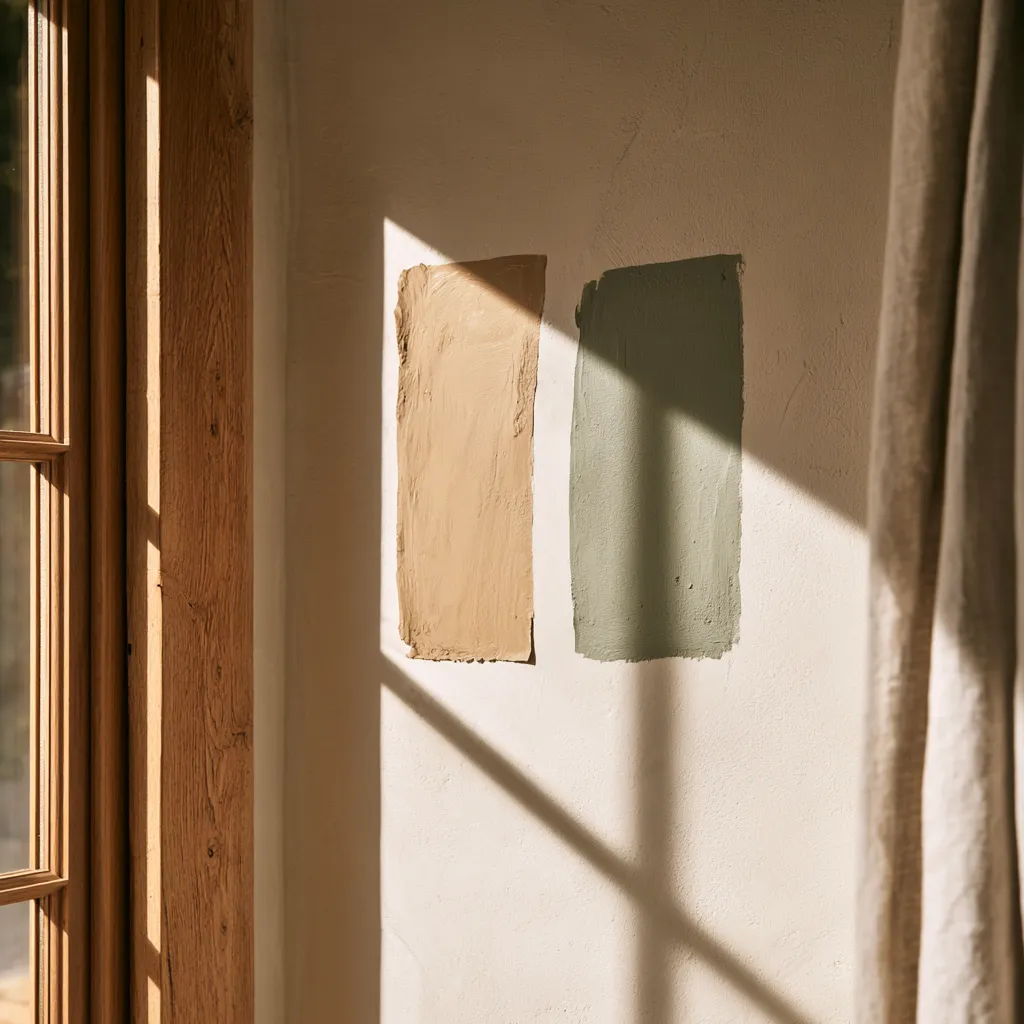
For warm beige, look for paints with LRV (Light Reflectance Value) between 55 and 70. Paints in this range hold warmth without overwhelming the room. Strong candidates include Farrow and Ball’s Elephant’s Breath (though it reads warm greige, its yellow undertone pairs beautifully with sage), Benjamin Moore’s White Dove OC-17 used with warm-toned accessories, and Sherwin-Williams’ Accessible Beige SW 7036 — one of the most-searched neutral paint colors in North America for the past five consecutive years.
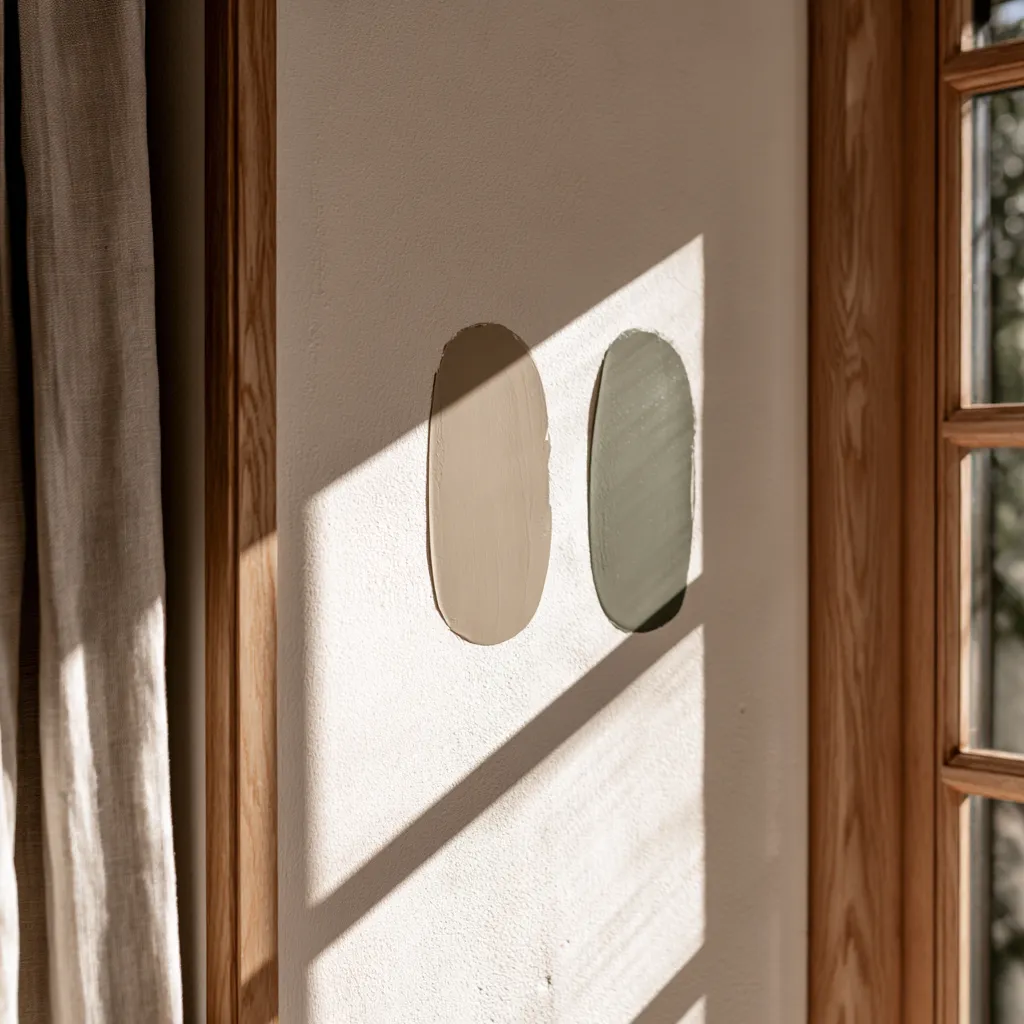
For sage green, the yellow-grey greens outperform the blue-grey ones in this pairing. Farrow and Ball’s Mizzle No.266, Sherwin-Williams’ Retreat SW 6207, and Benjamin Moore’s Rosemary AF-50 all deliver a grounded, dusty sage that holds warmth. Avoid anything marketed as “cool sage” or “grey-green” — these pull towards mint and read cold against warm beige walls.
Always test swatches in the actual room at three times of day: morning, midday, and evening under artificial light. A paint that looks sage at noon can look khaki at 7 PM under incandescent bulbs. This is particularly important with green tones, which shift more dramatically under warm artificial light than most other hues.

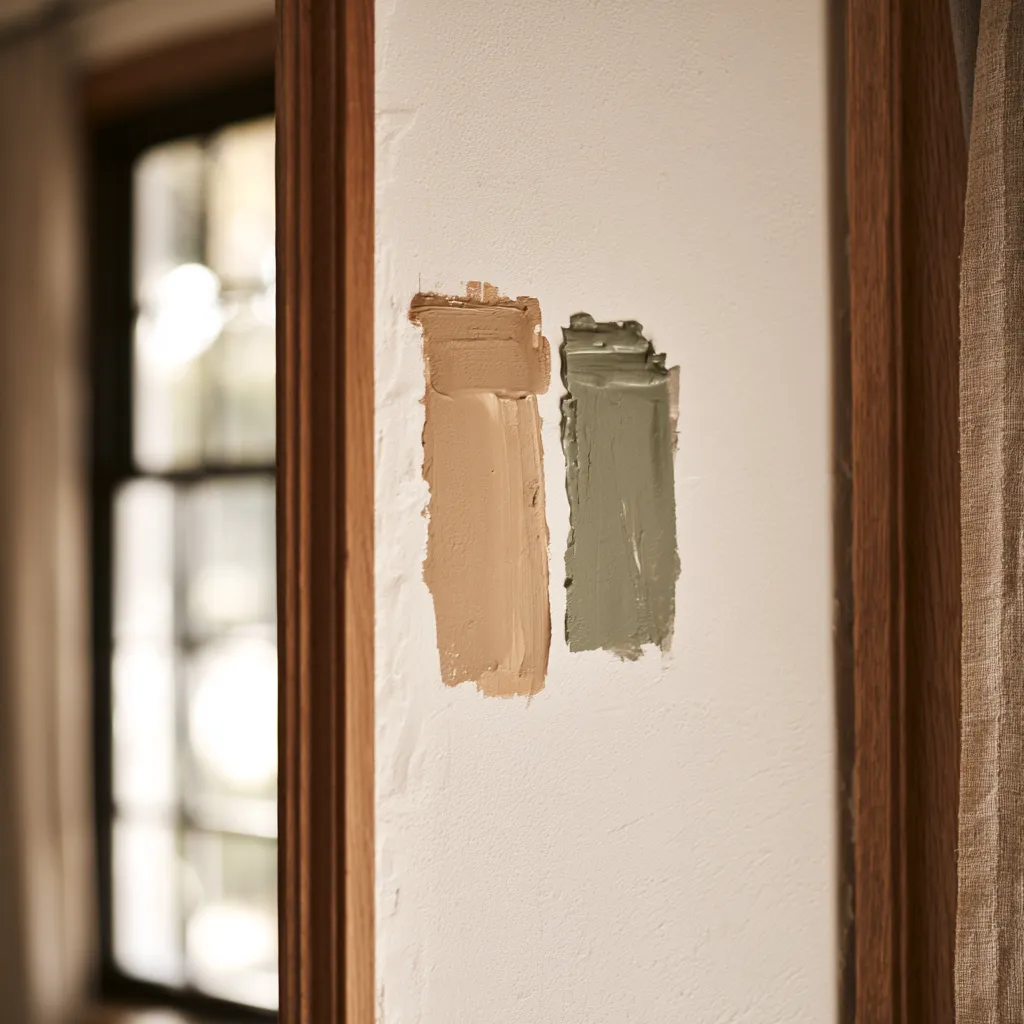
The 60-30-10 Rule Applied to a Beige and Sage Green Living Room
The 60-30-10 rule is the most reliable framework for distributing color in any room: 60% dominant color, 30% secondary color, 10% accent. In a warm beige and sage green living room, the breakdown typically works as follows.
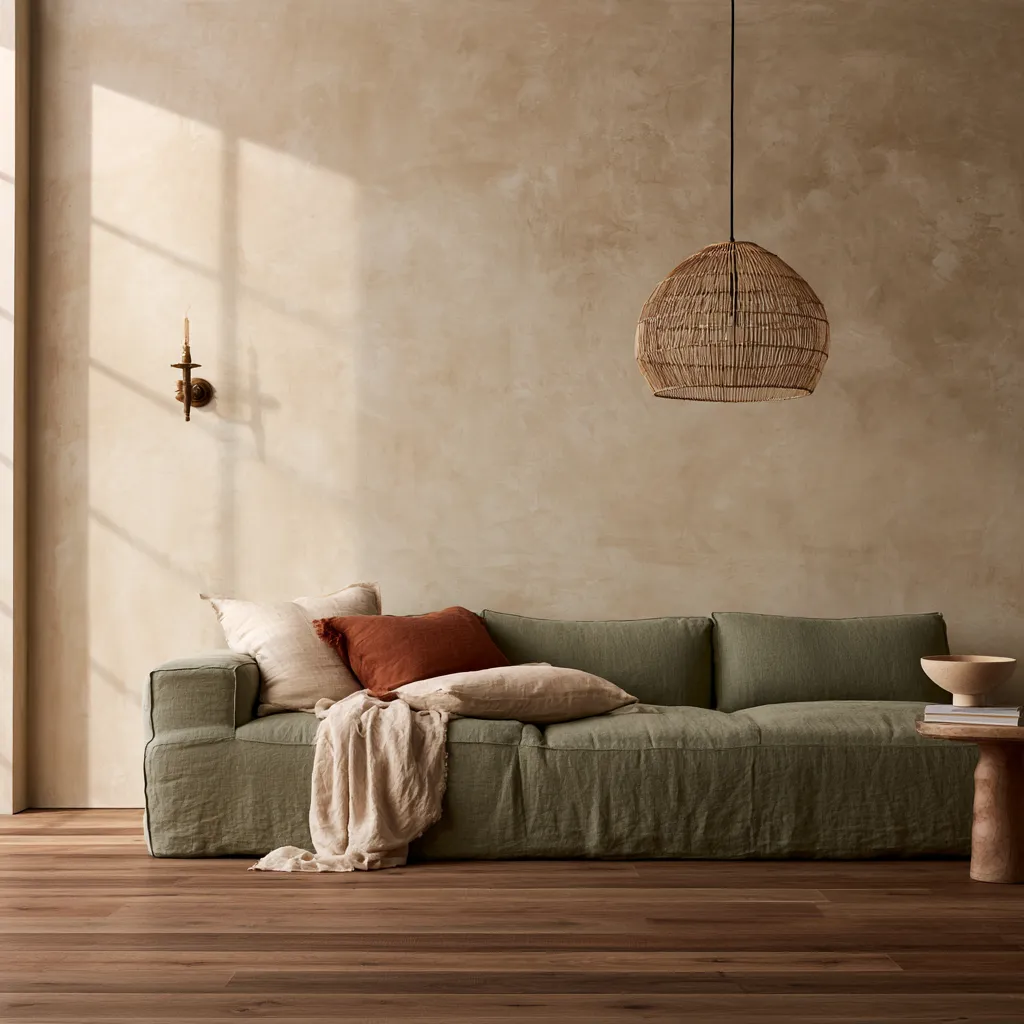
Sixty percent warm beige covers the walls, ceiling (in a slightly lighter tint of the wall color), and large-scale furniture like a sectional or primary sofa. This is the room’s visual anchor — the tone the eye returns to. Thirty percent sage green appears in a key upholstered piece, in drapery, in a painted bookcase or media cabinet, or across multiple soft furnishings like cushions and throws that total enough visual weight to hold the percentage. The remaining ten percent belongs to accent colors that add warmth and contrast — terracotta, rust, aged brass, deep tobacco brown, or off-white linen.
Where designers typically stumble is in splitting the sage and beige evenly, producing a 50-50 split that feels unresolved. Commit to one as dominant. In most living rooms, warm beige wins the dominant position because it reads lighter and allows sage to act as the statement — the color that gives the room its personality.
Sage Green and Warm Beige Living Room Furniture Ideas
The furniture strategy for this palette follows a single governing rule: natural materials first, upholstery color second. Rooms that lean on stone, raw oak, rattan, linen, and aged leather read as intentional because the materials themselves carry the warmth that synthetic alternatives cannot replicate.
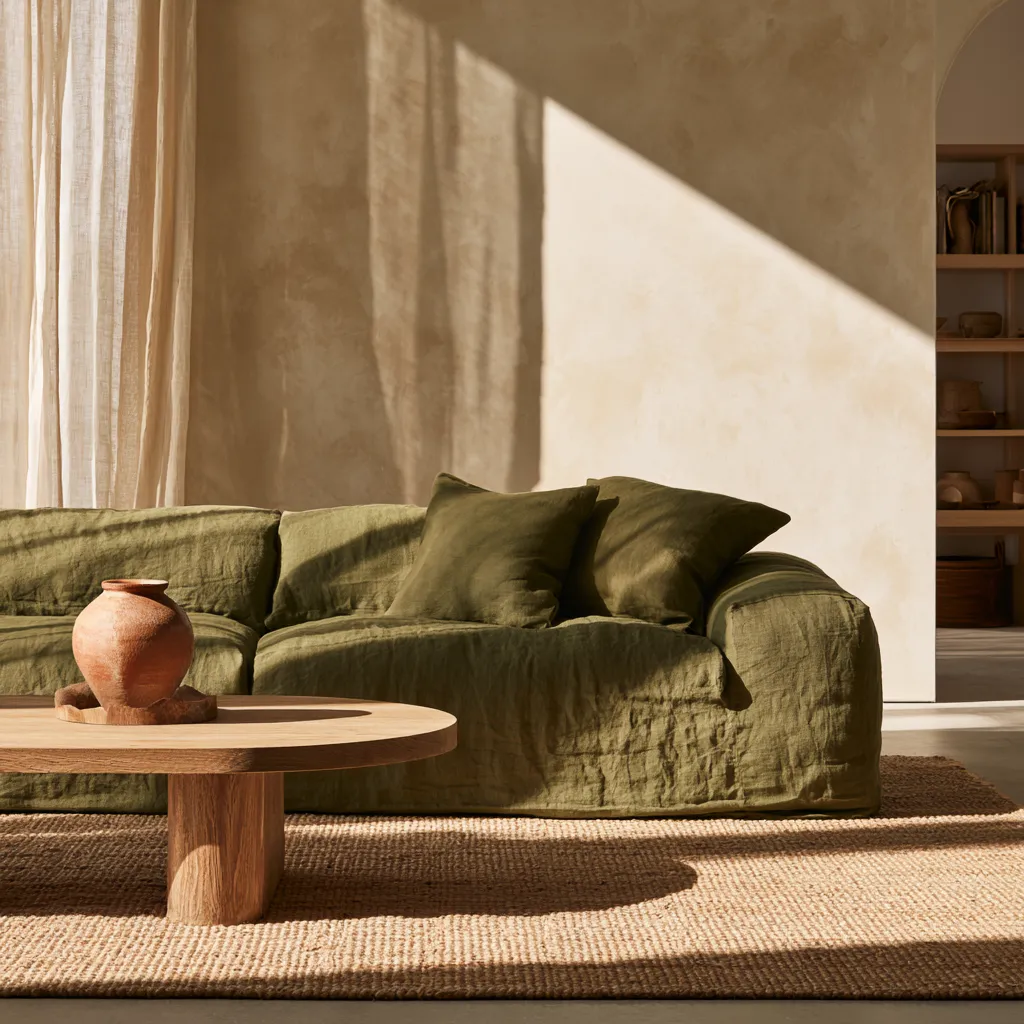
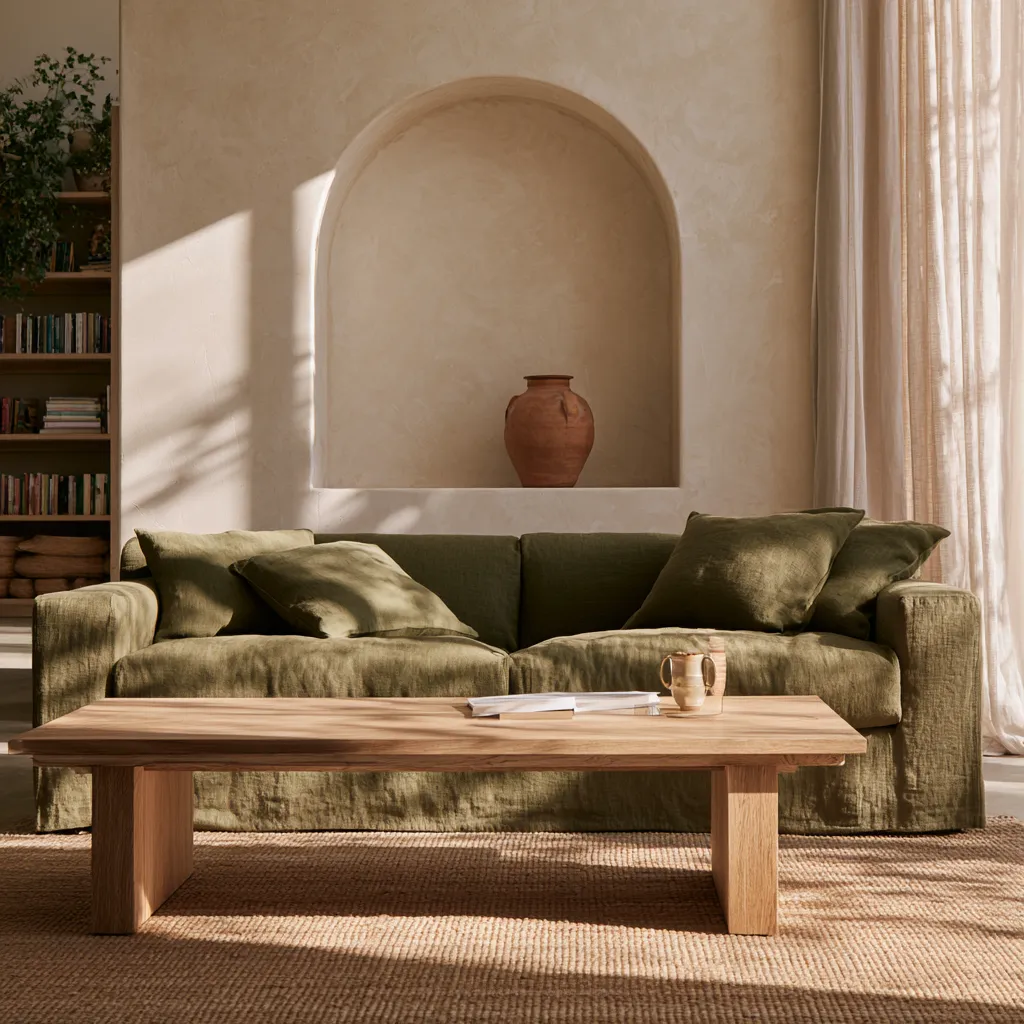
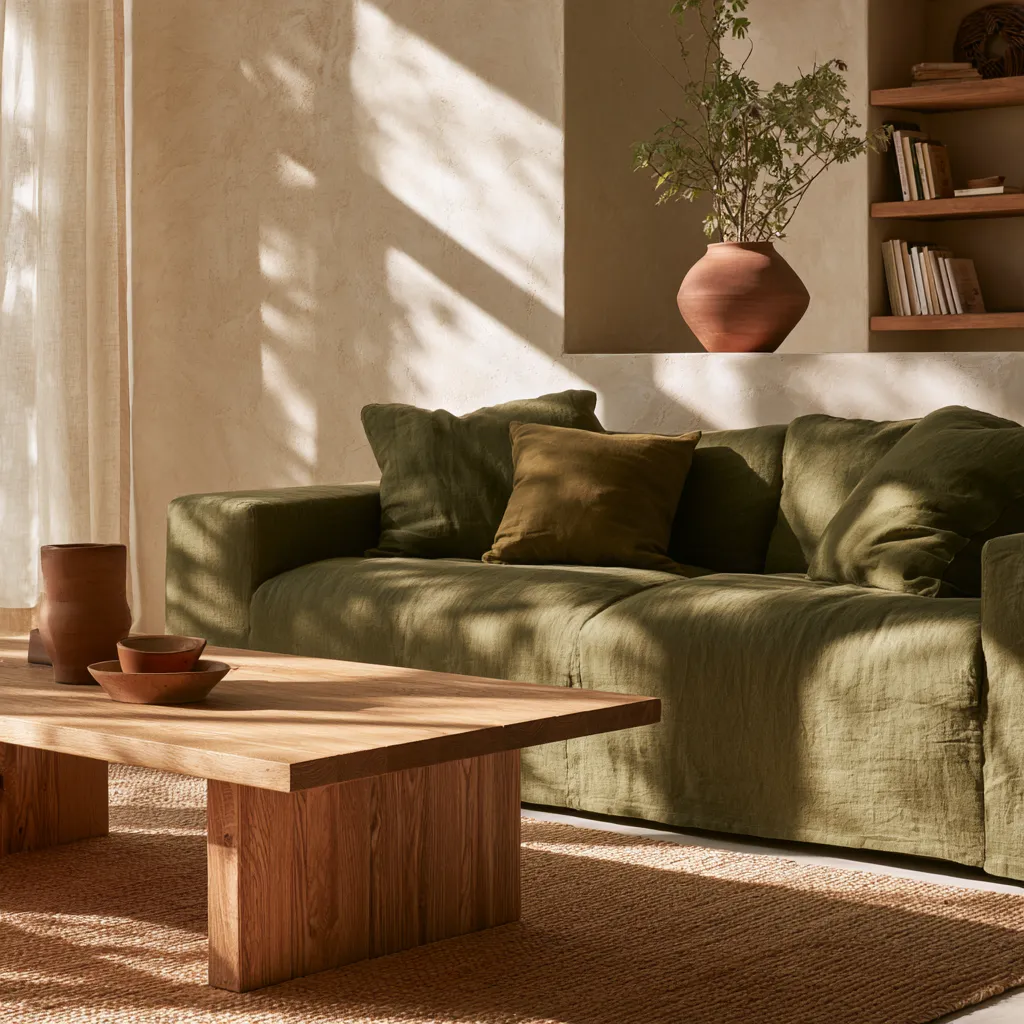
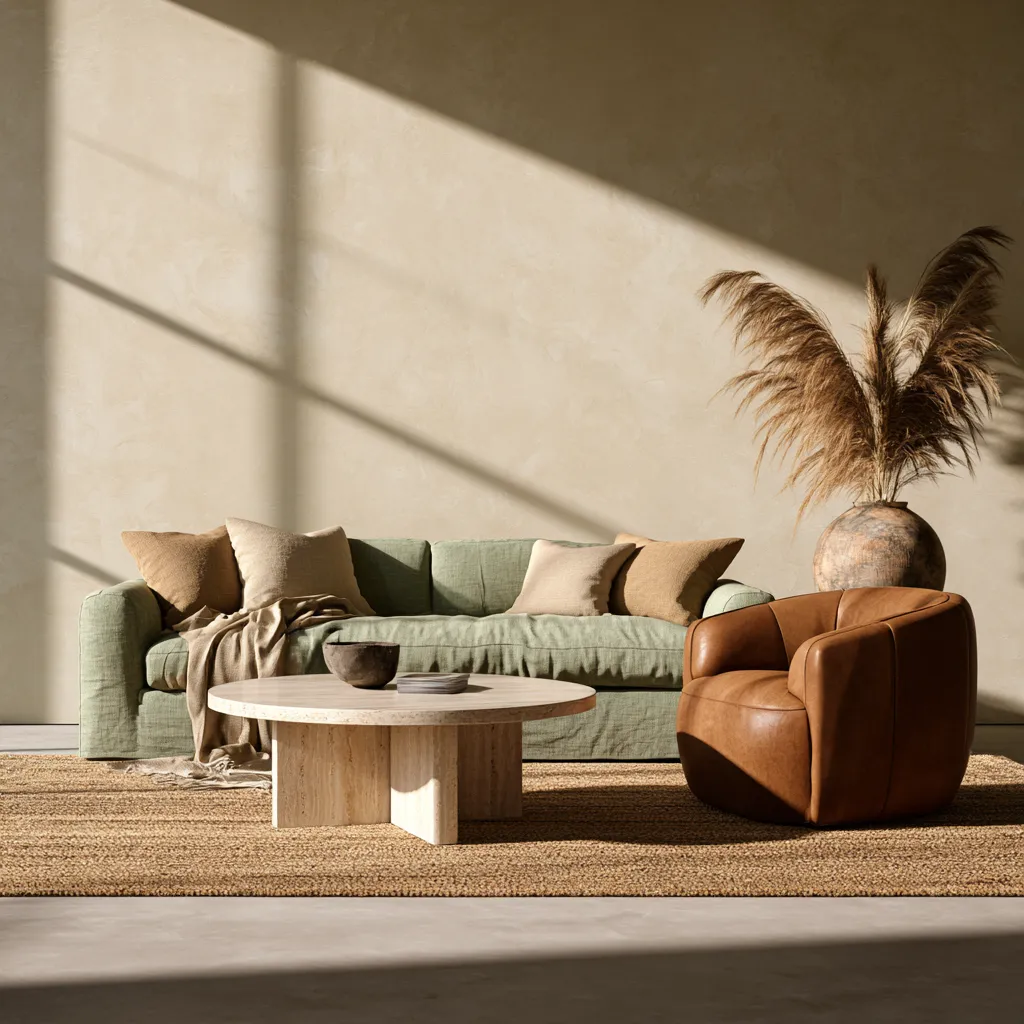
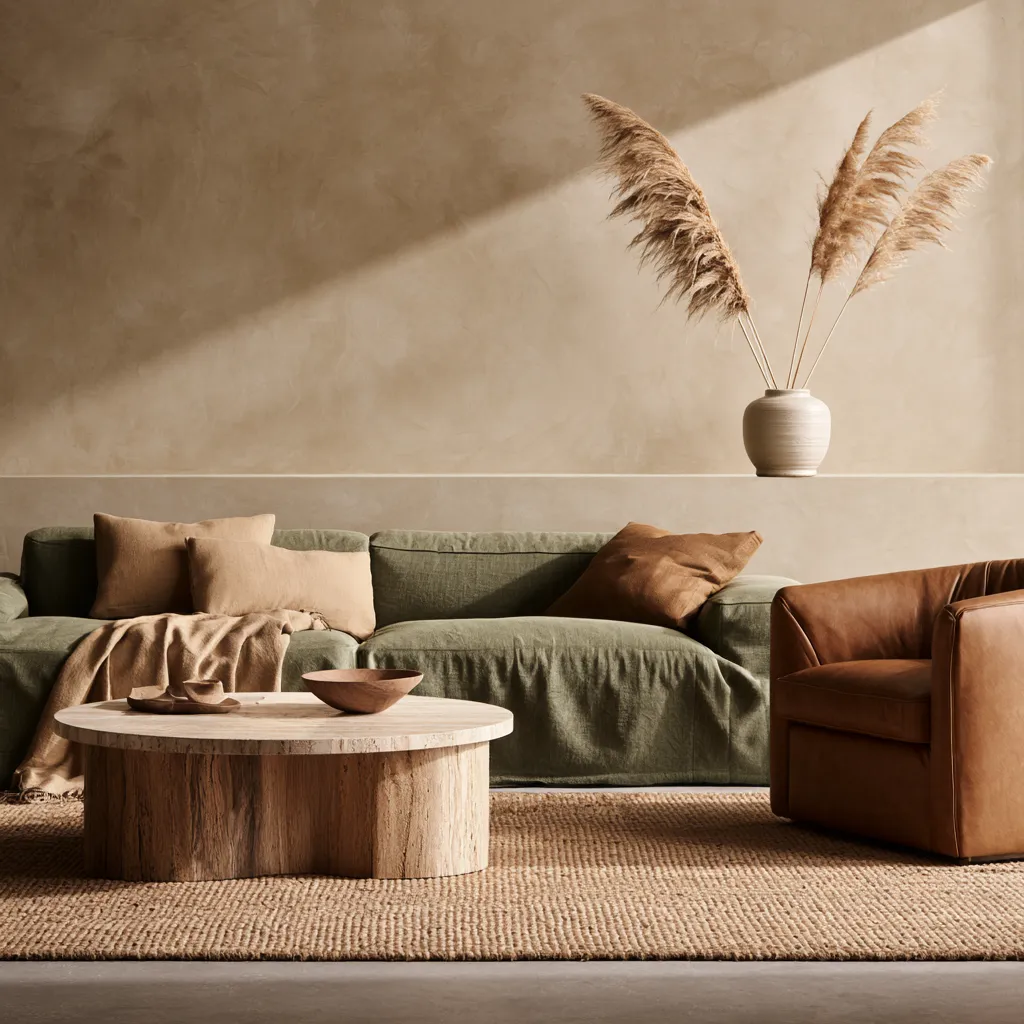
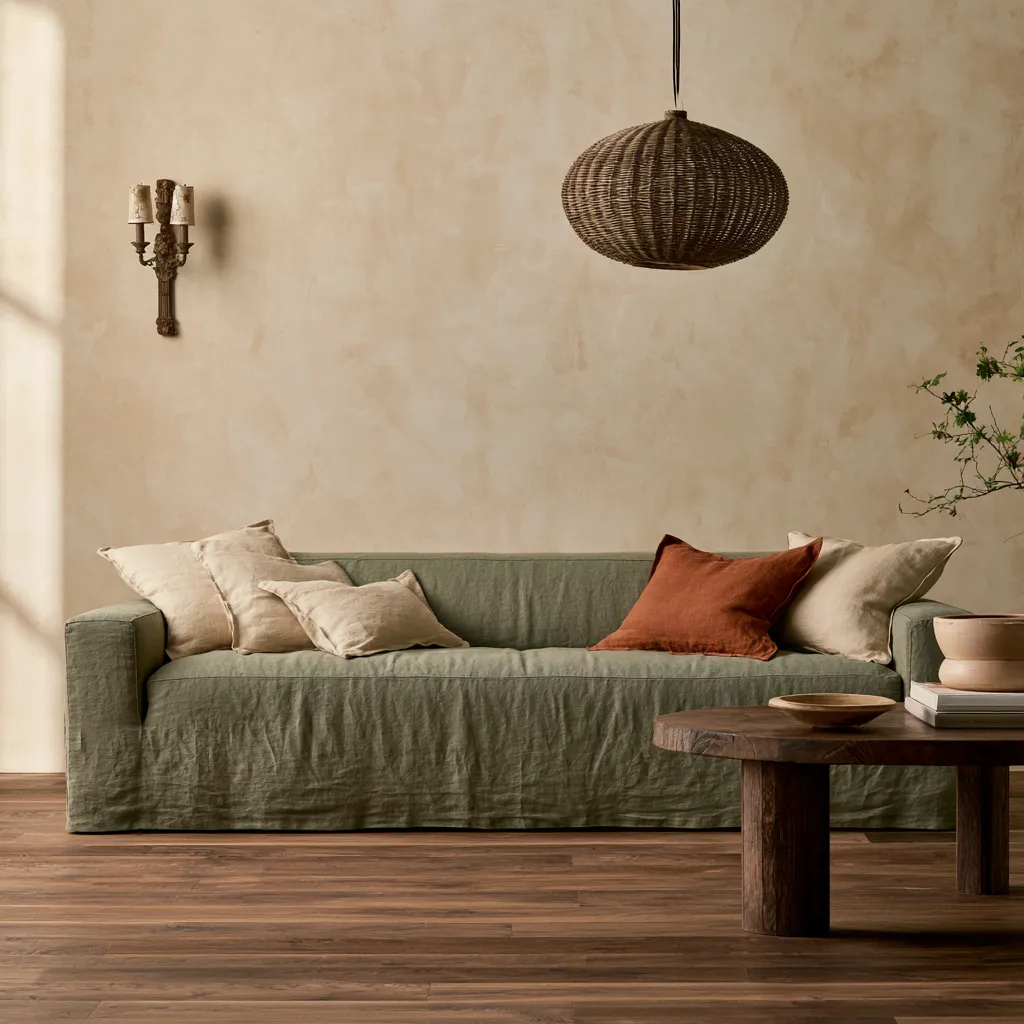
A sage green sofa is the most powerful single statement in this palette. Choose linen, cotton-linen blend, or bouclé in a dusty sage or moss green. Avoid velvet in sage — the sheen reads as jewel-toned under light rather than muted, which shifts the room away from the earthy grounded feel this palette is built on. A sage green linen sofa from a brand like Article, Maiden Home, or Floyd will typically land between $1,200 and $3,800 depending on configuration.
Coffee tables in natural oak, travertine, or raw concrete bring the right contrast without introducing a competing color. A travertine round coffee table — one of the most searched furniture pieces in 2024 and 2025 according to Pinterest Predicts data — reads as warm beige itself and doubles the cohesion of the palette.
For seating beyond the sofa, consider an armchair in warm camel leather or oatmeal boucle. These tones bridge the beige and green without pulling toward either too hard, creating a transition point the eye uses to move comfortably around the room. If you want to explore how green upholstery works as a standalone hero piece in a living room, this guide on making a green sofa the star of your living room covers placement, pairing, and proportion in detail.


Rugs, Textiles, and Layering in a Warm Beige and Sage Green Space
Textiles are where this palette either deepens into something rich or stays flat and predictable. The goal is to build three to four layers of texture in the same color family while varying the surface quality — rough against smooth, matte against slightly shiny, tight weave against loose weave.
Start with a jute or sisal rug as the foundation. Natural fiber rugs in their undyed state read as a warm mid-beige that grounds both the furniture and the walls. Size matters more than most homeowners expect: in a typical living room of 12 by 16 feet, a rug should be no smaller than 8 by 10 feet, with furniture legs resting on it. An under-scaled rug is one of the most common reasons a room feels disconnected.
Layer a second flat-weave rug in sage green or olive over the jute if you want to add pattern without wallpaper. Moroccan-inspired flat-weave rugs with geometric stripe patterns in sage, cream, and tan offer entry-level layering at accessible price points — brands like Beni Rugs, Rugs USA, and Wayfair carry relevant options between $150 and $600.
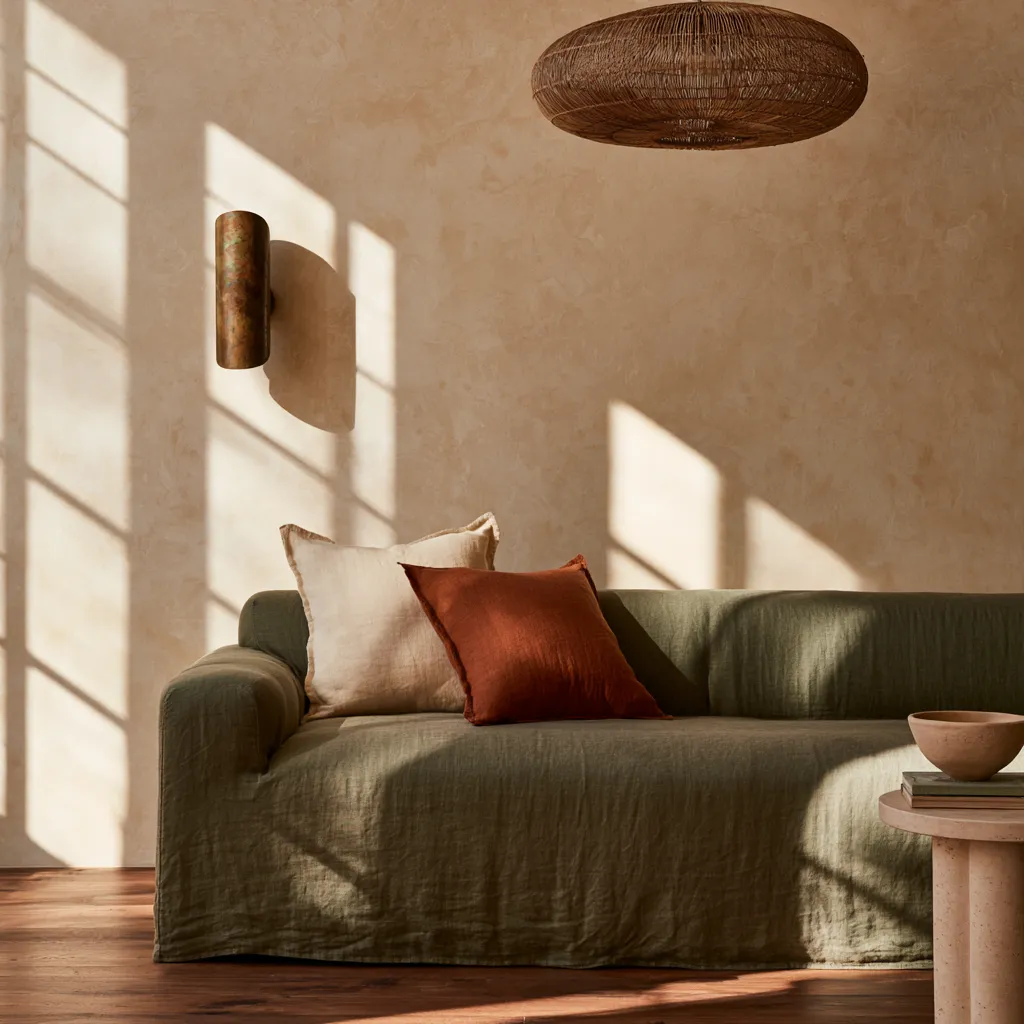
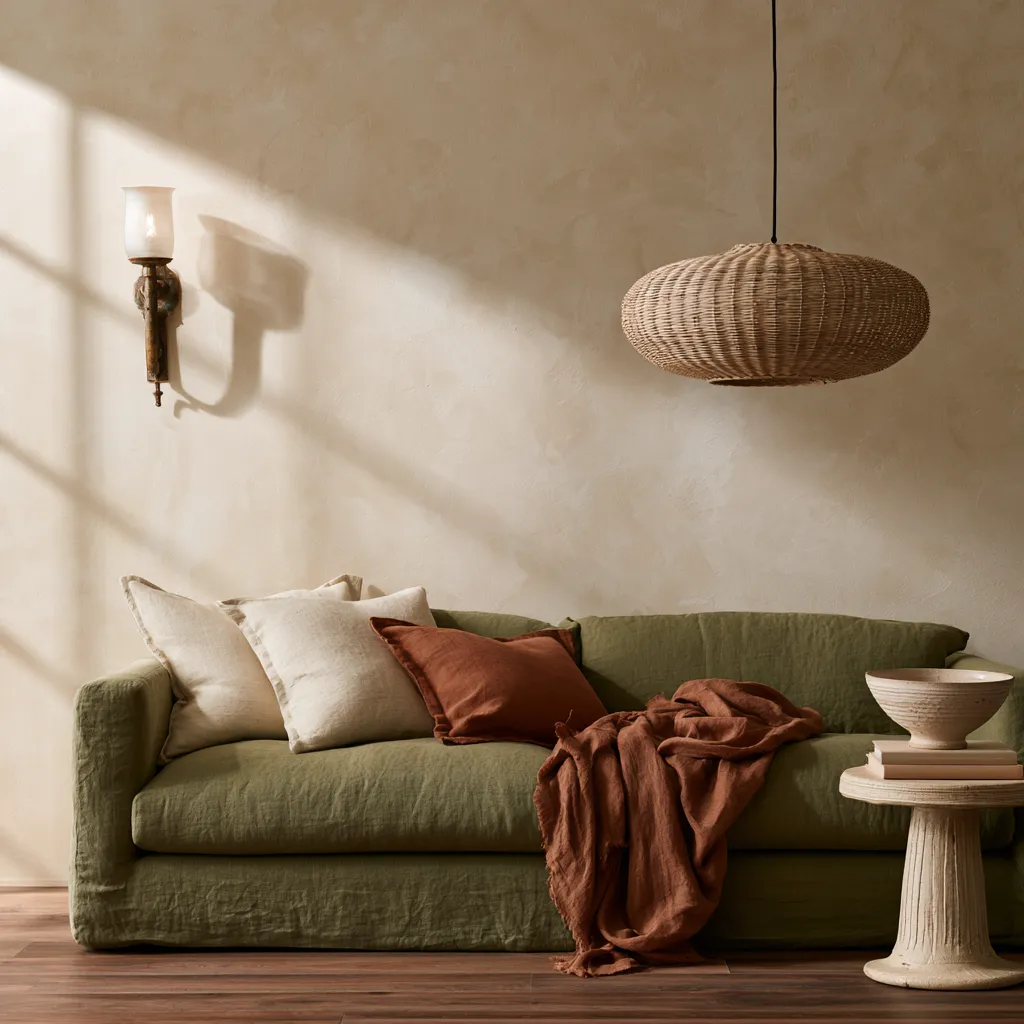
Cushions should run in odd numbers — three or five per seating area — mixing textures rather than matching patterns. A linen cushion in sage, a boucle cushion in cream, and a small woven cushion in terracotta or rust gives the sofa enough visual interest without introducing more than four colors to the room. Throws in waffle-weave cotton or loose-knit wool in warm oatmeal or moss green drape naturally over armrests and add the casual lived-in quality that stops a room from feeling staged.
Linen curtains deserve special attention. Floor-length panels in undyed or warm white linen allow light to filter into a warm amber tone at golden hour, which deepens both the beige on the walls and the sage on the sofa in the most flattering way. If you are curious about why natural linen has become the go-to textile choice in grounded interiors, this article on why linen belongs in every modern interior covers the material science and the design logic.
Lighting a Sage and Beige Living Room Correctly
Lighting is the variable that most disrupts this palette and the one most homeowners underestimate. Cool LED bulbs — anything above 4,000K — strip the warmth from beige walls and push sage green toward grey-green. The target bulb temperature for a warm beige and sage green living room is 2,700K to 3,000K. This is the range that keeps beige golden, holds sage at its softest dusty green, and makes skin look healthy in the space — all of which are properties that signal comfort before anyone consciously registers them.
Layered lighting beats overhead-only lighting in every scenario. A combination of a central pendant or semi-flush fixture, two table lamps at eye height when seated, and one or two floor lamps in corners creates the kind of even warmth that a single overhead fixture never achieves. Pendant lights in aged brass, unlacquered brass, or warm burnished bronze align perfectly with this palette. Rattan pendant shades cast a dappled warm light that references the natural texture of the jute rug below — a subtle coherence the room registers as calm.
Avoid cool-toned recessed lighting as the primary source. If you have recessed cans already installed, swap the bulbs to warm white at 2,700K and add supplemental lamps to compensate. A room that looks beige-and-sage during the day and grey-and-khaki at night has a lighting problem, not a paint problem.
Accent Colors That Complement Warm Beige and Sage Green
The 10% accent layer is where the room shifts from harmonious to memorable. The wrong accent color — anything cool, saturated, or high-contrast — collapses the grounded quality of the palette. The right accent colors deepen it.
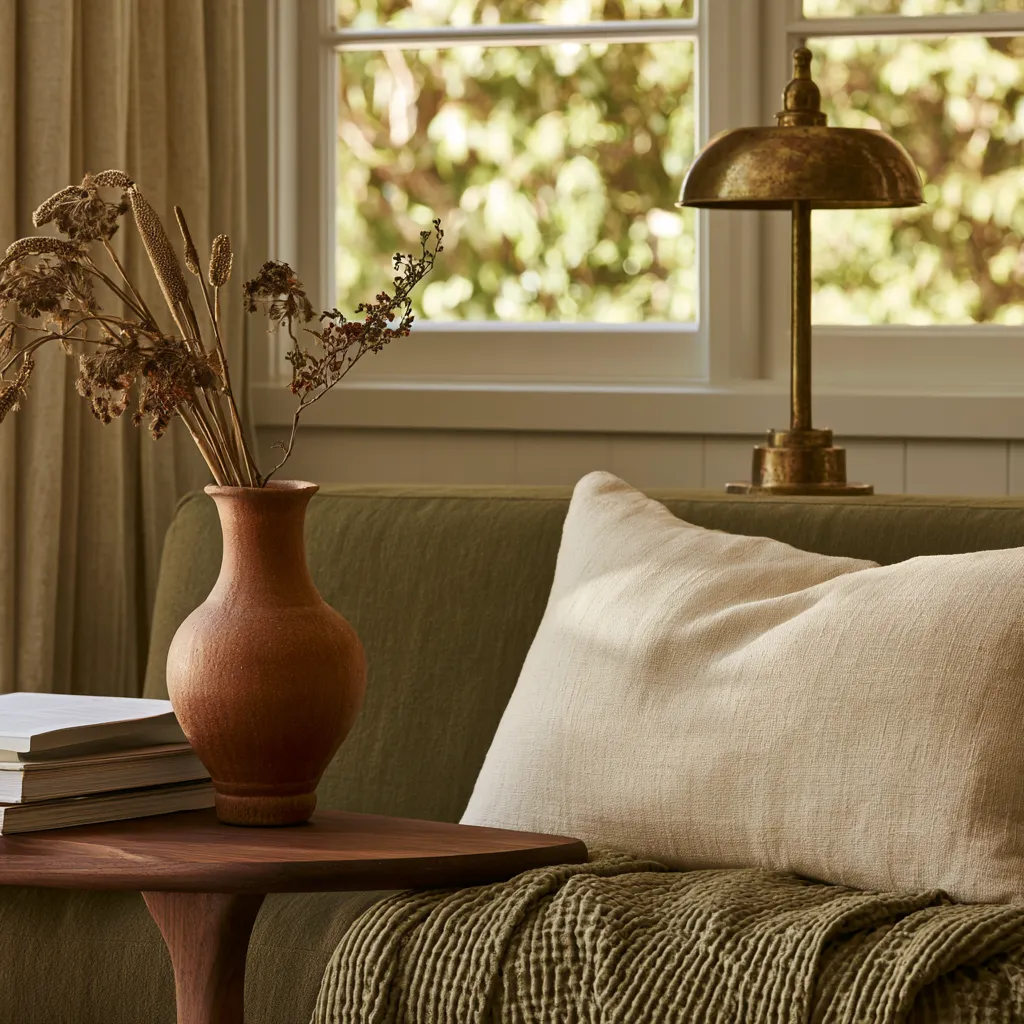
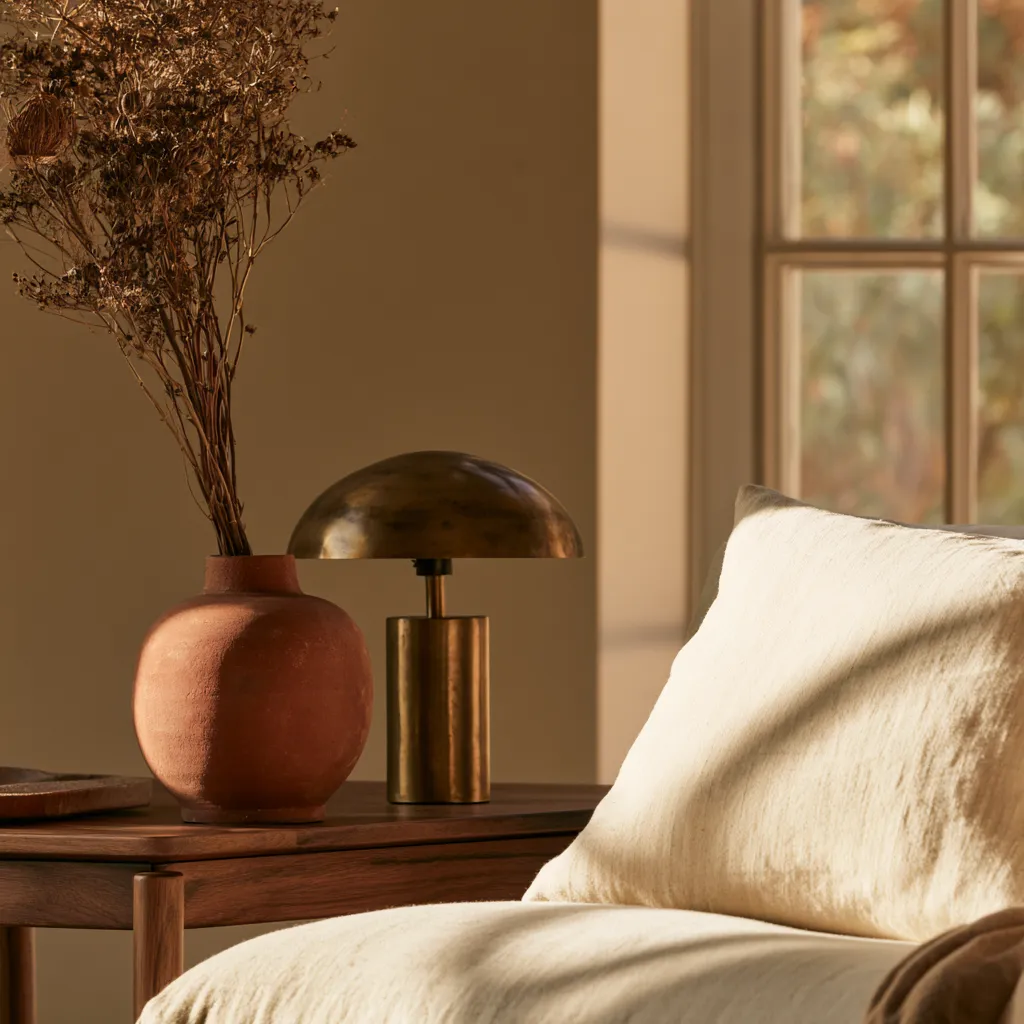
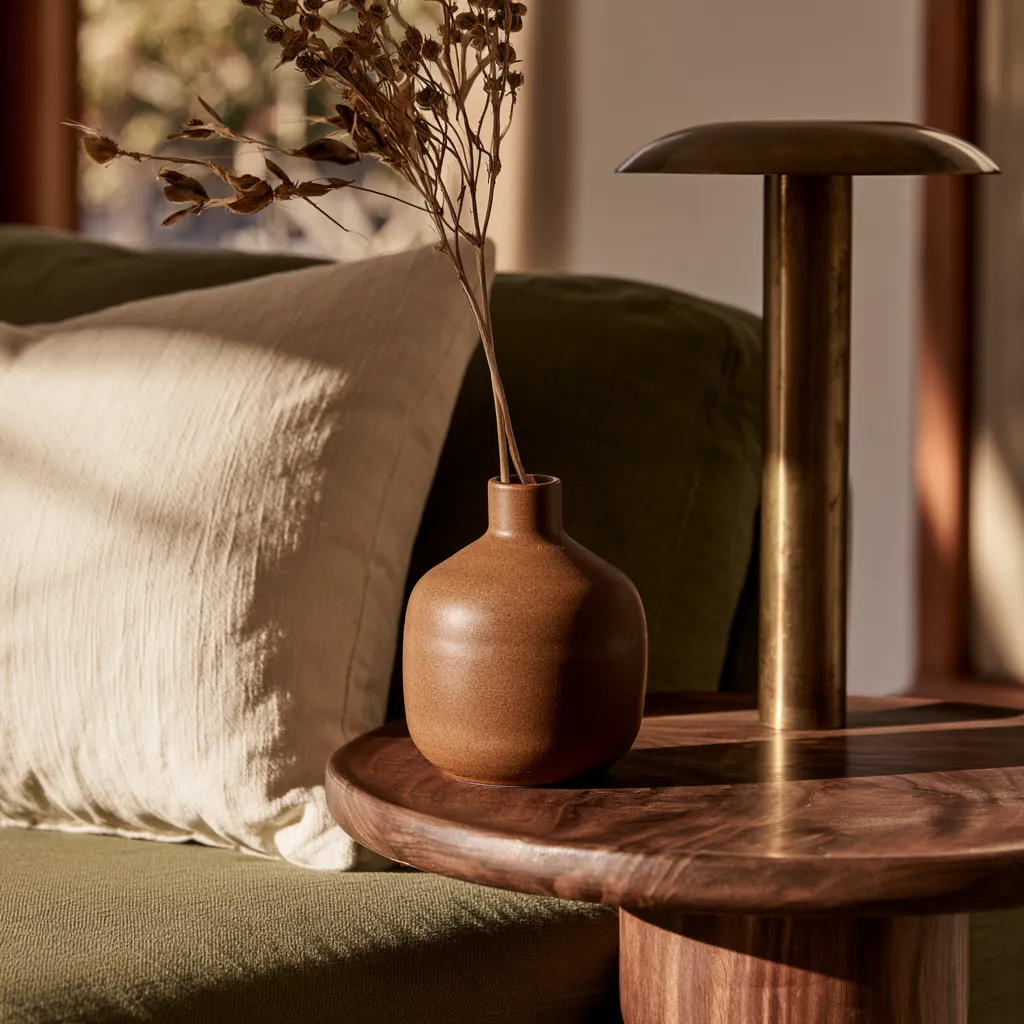
Terracotta and rust are the most common accent choices and for good reason: they sit in the warm orange-red zone that provides the color wheel contrast sage green needs without introducing a competing cool tone. A single terracotta vessel, three to four rust-toned book spines on a shelf, or one rust-colored ceramic lamp base is enough. More than that tips the room toward bohemian, which may or may not be the direction you want.
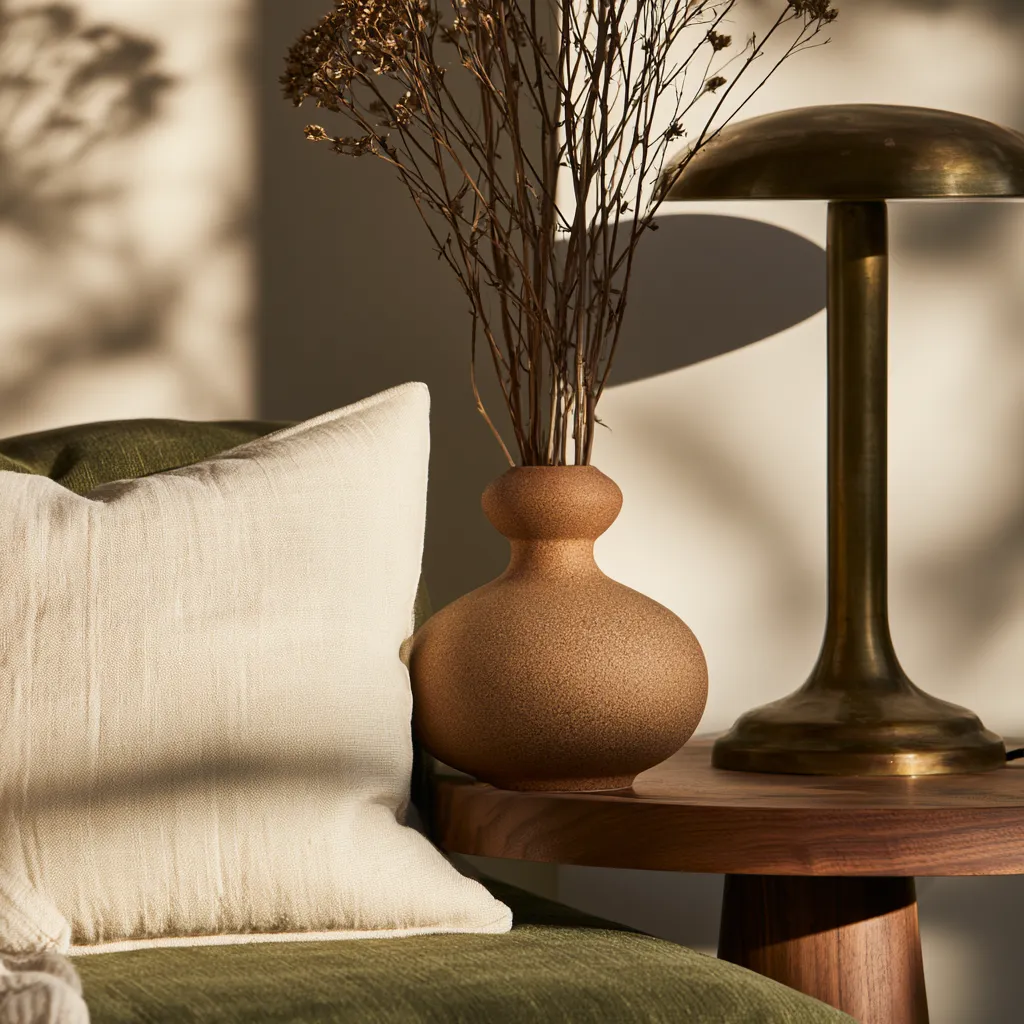
Aged brass adds warmth through hardware and lighting without introducing a new color — it reads as a very warm gold that belongs to the beige family. Use it consistently in cabinet pulls, lamp bases, curtain rod finials, and mirror frames. Consistency in metal finish is one of the most reliable marks of a room that looks professionally designed.
Deep tobacco brown or walnut — in furniture legs, a wooden tray, a side table — grounds the palette without weight. This is particularly useful in rental situations where you cannot paint walls and need the warm beige to come from furniture and accessories rather than architectural surfaces. For rooms built around warm neutral foundations, this article on organic modern style with warm neutrals and muted olive illustrates how muted greens and warm base tones build on each other across different room types.
Comparing Sage Green Variations for a Warm Beige Living Room
Not all sage greens perform equally in this palette. The table below compares five popular paint and textile shades by undertone, LRV, and suitability for pairing with warm beige.
| Shade Name | Brand | Undertone | LRV | Best Use | Beige Pairing Score |
|---|---|---|---|---|---|
| Mizzle No.266 | Farrow & Ball | Yellow-grey | 37 | Walls, cabinetry | ★★★★★ |
| Retreat SW 6207 | Sherwin-Williams | Yellow-green | 42 | Walls, furniture upholstery reference | ★★★★★ |
| Rosemary AF-50 | Benjamin Moore | Grey-green | 31 | Accent wall, cabinetry | ★★★★☆ |
| Lichen No.19 | Farrow & Ball | Yellow-grey | 35 | Feature wall, furniture | ★★★★☆ |
| Agave SW 6438 | Sherwin-Williams | Blue-green | 45 | Textiles only, not walls | ★★★☆☆ |
The yellow-green undertones consistently outperform blue-green undertones when paired with warm beige. Blue-green sages pull cooler under evening light, which makes beige appear more grey in comparison. If your room has limited natural light, prioritise LRV values above 35 to prevent the sage from reading dark and heavy.
Small Living Rooms in Beige and Sage Green
Small rooms benefit from this palette more than most color combinations. Warm beige on walls reflects light and visually recedes, which makes the perimeter of the room feel further away. Sage green on one key piece — the sofa, or a single painted bookcase — draws the eye to a focal point rather than to the room’s boundaries.
In rooms under 150 square feet, use the lighter version of the beige on ceilings — a step lighter than the wall color, never pure white — to lift the ceiling visually without disconnecting it from the room. Keep sage contained to one or two elements rather than spreading it across multiple walls, which would reduce the sense of space. A sage green bookcase against a warm beige wall reads as a feature, not a closure.
Mirrors in aged brass frames on the wall opposite the main window return light across the room and create depth. A round mirror between 24 and 36 inches diameter is typically the right proportion for a living room wall. Avoid oversized mirrors in small rooms — they read as an uncovered wall rather than a design choice.
Warm Beige and Sage Green Living Room Ideas by Style
The palette adapts naturally to several interior styles without requiring major changes — only the material choices and furniture silhouettes shift.
Organic modern: Curved furniture silhouettes, limewash walls in warm beige, sage green boucle sofa, travertine coffee table, ceramic vessels in earth tones, zero printed textiles. This is the most-searched application of the palette and the one most frequently published in architectural interiors press.
Cottagecore: Floral or botanical print textiles in sage and cream, exposed wooden beams painted in warm white or left natural, aged linen curtains pooling slightly on the floor, vintage or antique wooden furniture with original patina. The sage here can run slightly warmer — more moss than muted — without breaking cohesion.
Japandi: Streamlined low-profile furniture in light oak or ash, minimal decorative objects, neutral paper pendant lighting, tatami-reference woven flooring, sage used very sparingly on one wall or a single upholstered piece. The palette’s restraint makes it an ideal fit for Japandi’s philosophy of considered emptiness.
Transitional: Traditional furniture silhouettes in updated fabrics — a roll-arm sofa in sage linen, a camelback chair in camel leather, crown moulding painted in the beige wall color, Persian-adjacent rug with green and rust tones. This version of the palette tends to read most comfortably for homeowners who want something current without a complete style departure.
If you are drawn to how muted green palettes behave differently across style categories, this article on perfecting an emerald green living room design shows how deeper green tones navigate the same style spectrum — useful context for understanding where sage sits in relation to its more saturated cousins.
Wall Treatments That Elevate a Sage and Beige Living Room
Standard matte paint works, but it is the least interesting surface option available for this palette. Limewash paint — a traditional technique using calcium carbonate that creates subtle variation across a wall surface — adds depth that makes warm beige walls look three-dimensional. Brands like Portola Paints, The Real Milk Paint Co., and Romabio offer accessible limewash products that apply over standard drywall without specialist labour, at costs typically between $45 and $85 per gallon.
Venetian plaster is the premium option, typically applied by a specialist at $5 to $15 per square foot depending on region and complexity. In a living room, a single accent wall in Venetian plaster behind the sofa provides a surface quality that no textile or artwork can replicate — it catches light differently at every hour of the day.
Wall panelling in warm beige with sage green upholstered panels as inserts, or classic board-and-batten painted entirely in warm beige with contrasting sage trim, adds architectural interest to rooms that lack original detail. Panel heights of 36 to 42 inches work best in standard 8-foot ceiling rooms; anything taller risks making the walls feel lower rather than taller.
For those weighing limewash against modern plaster finishes and the texture options in between, this article on natural plaster wall finishes replacing drywall in high-end interiors covers the technical and aesthetic case for each finish in detail.
Plants and Botanicals in a Beige and Sage Green Living Room
Plants are not simply decorative in this palette — they are structural. A living room built on sage green and warm beige is already referencing the natural world; plants complete the reference and give it believability. The key is in variety rather than volume: three to four plants of varying heights, leaf shapes, and planter materials do more than a dozen plants in matching pots.
A large fiddle leaf fig or olive tree in a terracotta pot in a corner provides vertical emphasis. A trailing pothos or heartleaf philodendron on a high shelf creates movement. A low, spreading rubber plant or ZZ plant on the floor beside the sofa adds a horizontal layer. Each plant introduces a slightly different tone of green — olive, deep forest, bright lime — that makes the sage green upholstery and any sage paint in the room read as part of a continuous spectrum rather than a single flat note.
Dried botanicals — pampas grass, dried eucalyptus, dried honesty stems — extend the palette into the tabletop layer. Their muted tones of straw, silver-green, and brown read as warm neutrals in the beige family and add textural contrast to the smoother surfaces around them.
A Room-by-Room Starting Point for This Palette
If you are starting from a blank room with no existing furniture, the most efficient sequence is: walls first, rug second, sofa third, lighting fourth, accessories last. This order means every subsequent decision responds to something already installed, which prevents the common mistake of building around a fabric sample or mood board that never quite translates to scale in a real room.
If you are working with existing furniture, identify the dominant color of your largest piece first. If it is already in the beige family — cream sofa, ivory linen sectional, natural wood — introduce sage through new cushions, a throw, and either a repainted bookcase or a new upholstered chair. If your existing sofa is grey or charcoal, sage green cushions and a warm beige rug can shift the room significantly without replacing the sofa. The walls do the rest.
Budget benchmarks for a full living room in this palette, based on mid-range pricing: paint and supplies for a 200 square foot room, $80 to $150; jute rug 8×10, $180 to $400; sage linen sofa, $1,200 to $3,500; camel or oatmeal accent chair, $500 to $1,400; travertine or oak coffee table, $300 to $900; linen curtains per panel, $60 to $200; lighting, $150 to $600; accessories and plants, $100 to $350. Total range for a complete room: approximately $2,570 to $7,500, with significant savings available if existing furniture remains in use.
Common Mistakes to Avoid in a Sage Green and Warm Beige Living Room
- Matching instead of layering: Choosing a sofa, curtains, and cushions in the exact same sage green produces a flat, monochromatic result. Vary the intensity and texture of the green — dusty sage on the sofa, deeper olive on a cushion, a lighter sage-adjacent hue in the curtain fabric.
- White instead of warm beige on trim: Bright white trim against warm beige walls creates a contrast that reads as unfinished. Opt for warm white or the same beige in a slightly lighter tone for skirting boards, door frames, and cornicing.
- Too many accent colors: Adding yellow, purple, navy, or blush alongside terracotta and brass fragments the palette. Limit accents to two: typically rust/terracotta and aged brass.
- Under-scaled rug: In a living room, a rug that does not extend under at least the front legs of all seating makes the furniture float and the room feel disconnected. When in doubt, size up.
- Cool-tone artwork: Blue-heavy or grey-heavy prints on the walls will fight the warm undertone of the beige and pull the sage towards grey. Choose artwork with warm, muted tones — earthy abstracts, botanical prints with yellow-green tones, warm sepia or ochre photography.
The Long View on Warm Beige and Sage Green
Trends cycle. Greige replaced grey, sage replaced greige, and something will eventually displace sage as the dominant neutral-adjacent choice in living rooms. But the underlying logic of warm beige paired with a muted earth-derived green is older than interior design as a category. It is the palette of old European farmhouses, Japanese wabi-sabi interiors, and English country houses that have been photographed for a century without going out of fashion. What changes is the specific shades and the furniture silhouettes — not the fundamental harmony.
Rooms built on this palette tend to age better than rooms built on trend-specific color moments precisely because the palette is not trying to be surprising. It is trying to be restful. And restful rooms, as any homeowner who has lived in one will tell you, are the rooms you never want to leave.