Sofa design for small living rooms is the one decision that either opens up your space or kills it entirely — and most people get it wrong on the first try. I’ve seen 200-square-foot rooms feel genuinely generous, and I’ve seen 400-square-foot layouts feel like you’re navigating a furniture warehouse. The difference was always the sofa: its depth, its leg height, its footprint relative to the walls. Not the color, not the throw pillows. The sofa itself.
You don’t need a bigger room. You need the right couch for small living room spaces — and a ruthless eye for what’s actually stealing your floor. This post walks through three sofa categories that reliably work, what to avoid in each, and the placement logic that makes the whole thing land.
Convertible sectionals — best for flexible layouts; look for models under 90″ wide with reversible chaise (from ~$400 at IKEA VALLENTUNA to $1,800+ at Article)
Loveseats & settees — best for rooms under 120 sq ft; exposed legs are non-negotiable; WEST ELM Andes loveseat around $900
Sofa beds — best for studio and guest-room combos; avoid pull-out bar mechanisms under $600; BURROW Nomad sleeper starts at $1,595
Sofa arrangement tip — floating the sofa 6 inches off the wall reads larger than pushing it flush, even in tight rooms
Skip — any sofa over 36″ deep in a room under 150 sq ft; cloud couches entirely
Convertible Sectional Sofas Earn Their Keep When the Chaise Reverses


The reason a convertible sectional works in a small living room isn’t that it seats more people — it’s that you can move the chaise to whichever wall actually has room for it this week. I own the IKEA VALLENTUNA in an 11-by-13 room, and having a reversible chaise means the layout can change when the light changes, which it does seasonally here. Most 3-seat sectionals run 90 to 104 inches wide; stay under 92 if your shortest wall is under 11 feet. Anything wider reads like a sofa fighting a room.
Convertible sectional sofas with under-seat storage are worth the price premium — usually $200 to $400 more than a fixed equivalent. You’ll use the storage constantly. Blankets, extra cushions, kids’ stuff — all of it disappears. The dual function makes a sectional act like two pieces of furniture without taking two footprints.
What actually hurts in this category? Overstuffed cushion backs. Anything with a cushion depth over 6 inches on the backrest pushes the seat forward and cuts into your floor by 3 to 4 inches you didn’t account for on the floor plan. You’ll notice it the first time you try to walk between the sofa and the coffee table — suddenly there’s no room. Track-arm models with tight-back upholstery always buy you those inches back.
For material, microfiber at the $500 to $800 range handles daily use without showing every crease. Velvet reads beautifully in photos and on Pinterest, but it marks from sitting and shows pet hair relentlessly — I’d save velvet for a loveseat you use less. Gray and warm oat hold small rooms better than charcoal, which compresses visual space the same way dark walls do.


Placement logic matters more than most people expect. Sofa arrangement in a small living room works best when you float the sofa about 6 inches off the back wall instead of pressing it flat. It sounds counterintuitive — surely the sofa against the wall leaves more room in front? — but the visual gap reads as intentional, like an art frame, and the room feels arranged rather than crammed. Pull the sofa out, put a slim console behind it if there’s room, and watch the space transform into something that looks styled instead of stuffed.
A convertible sectional can also define zones in an open-plan space without any walls doing the work. The back of the sofa becomes a divider between the living and kitchen zones. It’s the same trick architects use in loft conversions — the sofa is the partition. Point the chaise toward the TV wall, leave the sofa back facing the kitchen, and you’ve created two distinct rooms out of one.
Loveseats with Exposed Legs Make the Floor Feel Twice as Long


Loveseats are the most underused sofa format in small living rooms — people default to a 3-seat sofa out of habit and then wonder why the room feels overpowered. A loveseat runs 52 to 72 inches wide. That’s often 24 to 30 inches narrower than the sofa most people buy. In a room under 130 square feet, those 24 inches are the difference between breathing room and an obstacle course. My go-to is the WEST ELM Andes Loveseat at 62 inches — it seats two comfortably, has 7-inch tapered legs, and the exposed-leg silhouette keeps the floor visible from across the room.
Sleek loveseats with mid-century tapered legs work like an optical trick: you see the floor underneath, so the room reads as having more floor than it actually does. Skirted loveseats — where fabric falls to the ground — do the opposite. They block the floor visually and make the piece feel heavier than it is. Avoid them in any room under 150 square feet, even if the style appeals to you on a larger sofa in a bigger space. The rule doesn’t transfer.
Settees — slightly longer than loveseats, traditionally more structured — work beautifully in formal small living rooms or in spaces that double as home offices. The firmer back support means you actually sit up rather than sink, which reads professionally in a room that gets Zoom calls. I stole this trick from a designer I interviewed who furnishes NYC studio apartments: she puts a linen settee at the far end of every studio and it makes the room look like it has a defined sitting area even at 300 square feet.
Don’t buy a loveseat in a fabric you can’t spot-clean. Loveseats in small rooms get used hard — every seat, every day. Performance fabrics like Crypton or Sunbrella-grade weaves are worth the premium ($150 to $300 more) because a loveseat that looks grubby after six months destroys the whole room. I bought a cream linen loveseat once. It lasted one dinner party. Buy the washable cover version or choose a mid-tone woven; never white or ivory in a living room that actually gets lived in.
Don’t pair a loveseat with a massive coffee table. A 48-inch round coffee table in front of a 62-inch loveseat looks like the furniture is arguing. Scale the table to the sofa: a 30-by-20-inch rectangular tray table or a pair of 18-inch nesting tables keeps the proportion right and frees up floor circulation.
Don’t skip the rug anchor. A loveseat floating on bare floor in a small room looks abandoned. A rug that gets at least the front legs of the sofa grounds the whole arrangement and makes the seating zone feel intentional.

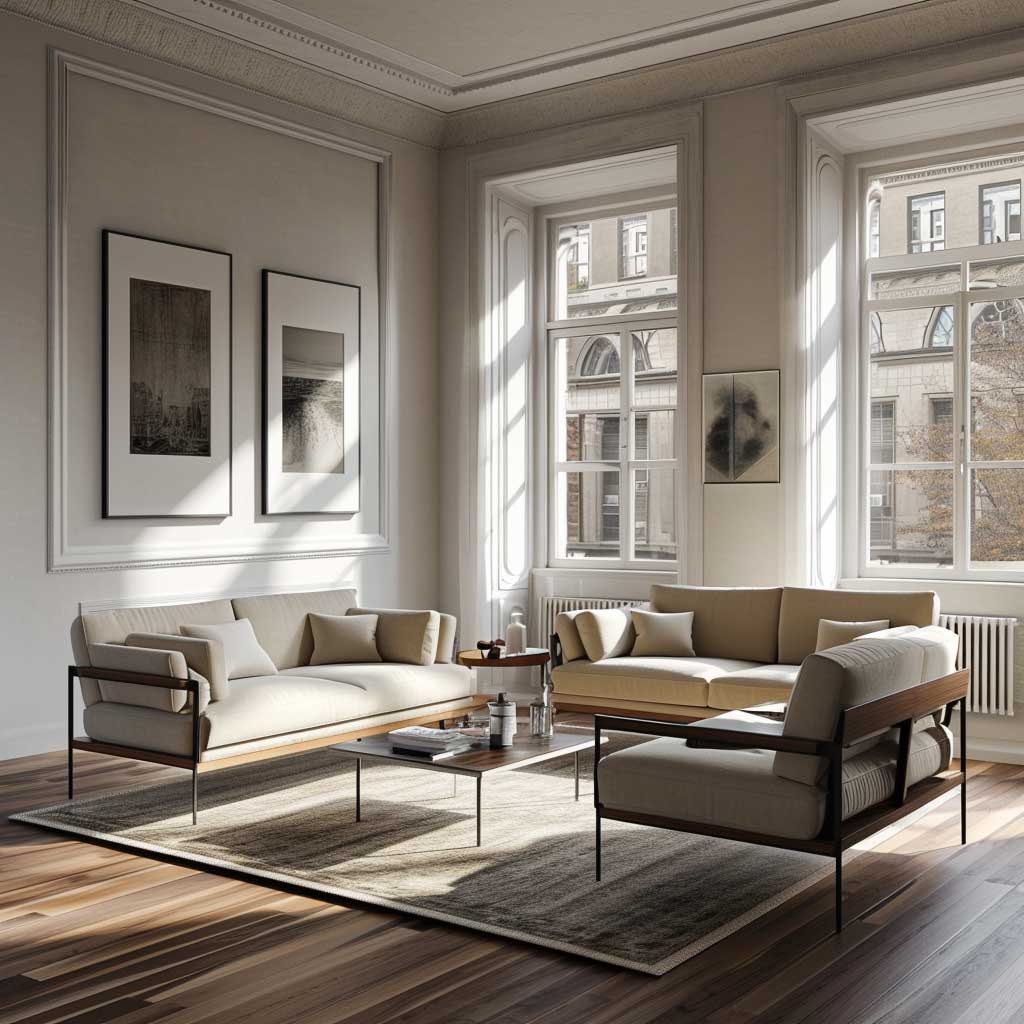


Color strategy matters here. Neutral oat, warm sand, and sage linen all work because they don’t compete with the wall — the sofa becomes part of the room rather than a statement against it. Bold-color loveseats can work, but you need walls that actively recede: soft white, warm greige, or something lighter than the sofa fabric. A cobalt loveseat against a medium-gray wall in a small room is a standoff neither wins. You’ll notice this immediately in real life even when it looked fine on a mood board.
Lighting completes the loveseat moment. A floor lamp positioned to the side and slightly behind the sofa creates ambient warmth that makes a compact seating area feel deliberately cozy rather than accidentally small. Avoid ceiling fixtures directly over the sofa — they flatten the space. Side and rear light sources give the zone depth that overhead light entirely removes. For more small living room layout ideas, this breakdown of small living room layouts on ArtFasad covers how sofa position interacts with traffic flow.
Sofa Beds in Small Rooms Work Only If the Mechanism Clears the Wall


A sofa bed in a small living room functions like a Swiss Army knife: you hope you never actually need the blade, but when you do, you’re grateful it’s there. The problem is the conversion mechanism — most budget pull-out bars below $600 require you to pull the sofa completely away from the wall to open, which means the room needs to be essentially clear. In a small space, that’s not always realistic. The better investment is a click-clack or fold-flat mechanism, where the back drops down without the sofa moving. IKEA FRIHETEN at $799 uses this logic and works in rooms as tight as 10 feet wide.
Sofa beds have evolved past the bar-in-your-back era. BURROW’s Nomad Sleeper ($1,595) ships in modular pieces that fit through narrow doors — a real problem in older buildings and apartments — and assembles without tools. The memory foam layer actually sleeps like a real bed, not like camping. For guest use two or three times a year, that investment makes sense. For nightly use, buy a proper bed and a loveseat instead.
What’s the one thing nobody mentions about sofa beds in small rooms? Clear floor depth. When fully extended, most queen-size sofa beds need 80 inches of clear floor space from the wall they’re against. Measure that before you buy. I have watched people order beautiful sofa beds, assemble them, open them once, realize the bed hits the TV console, and never open them again. The sofa becomes very expensive seating with a secret it’s too cramped to reveal.


Upholstery durability doubles in importance on a sofa bed because it’s being sat on, slept on, and converted repeatedly. Microfiber and performance linen handle mechanical stress better than velvet or bouclé, which wear unevenly at the fold line within two years of regular use. Stick to flat-weave fabrics in mid-tones: warm gray, oat, or sage. They hide the creasing that happens at the hinge point and clean up without drama.
Styling a sofa bed to read as a sofa takes about four decisions: choose a sofa-height back rather than a daybed profile, use firm square cushions rather than soft round ones, add a throw draped casually over one arm rather than folded, and keep the coffee table at normal sofa distance. Do those four things and nobody walks in and immediately reads “sofa bed.” The room reads as a living room. The sleeping function becomes architectural, not apologetic. For more on making compact rooms feel complete, see small living room furniture optimization ideas on ArtFasad.
Sofa Comparison
| Type | Ideal Room Size | Price Range | Best Feature | Main Risk |
|---|---|---|---|---|
| Convertible Sectional | 130–200 sq ft | $400–$1,800 | Reversible chaise, storage | Overstuffed backs eat floor depth |
| Loveseat / Settee | 80–130 sq ft | $300–$1,200 | Exposed legs, visual openness | Skirted styles block visual floor |
| Sofa Bed | 120–180 sq ft | $599–$1,800+ | Dual-use for guests | Needs 80″ clear depth when open |
Final Word
The Right Couch for Small Living Room Spaces Gives You Floor, Not Just Seating
The sofa you choose sets the ceiling for how good your small living room can ever look. Pick a silhouette with exposed legs, a width that leaves at least 30 inches of clearance on both sides, and a mechanism (if it converts) you can actually use without rearranging the whole room first.
Neutral fabrics age better in compact rooms than bold ones. Floating the sofa slightly off the wall always reads better than flush. And a rug that anchors at least the front legs of the sofa turns a furniture arrangement into a room.
Save this post — come back to it when you’re measuring before you buy.
Related Topics
FAQ
What size sofa is best for a small living room?
How do you arrange a couch in a small living room?
Are sectional sofas good for small spaces?
What sofa style works best in a small drawing room?
How much should I spend on a sofa for a small living room?
Can a sofa bed work as the only sofa in a studio apartment?
Complete guide
Furniture Decor Ideas for Every Room in Your Home
Living room, bedroom, dining, kitchen, outdoor — all in one place
Complete guide
The Living Room Design Ideas Vault Every Home Needs Right Now
Color, walls, furniture, layouts, styles, smart tech — 300+ ideas in one place
Complete guide
Small House Design Ideas That Make Every Square Foot Feel Intentional
Exteriors, layouts, kitchens, bedrooms, bathrooms, outdoor — all in one place