Red and white kitchen design pulls off something most bold color schemes never manage: it ages well. The combination reads as energetic without tilting into trendy, and it works across layouts from compact galley kitchens to wide open island plans. Three design directions — minimal and graphic, refined with a statement island, and high-energy with maximum contrast — cover the full range of what this palette can do.
The difference between a red and white kitchen that photographs beautifully and one that feels overwhelming in person is almost always about proportion. Too much red and the space feels hot. Too much white with red accents dropped in randomly and it looks like a decoration decision rather than a design one. The setups shown here resolve that tension in three different ways — each with its own logic, its own material choices, and its own set of trade-offs worth knowing before you commit.
Cabinet costs run $100–$300 per linear foot for stock units up to $500–$1,200 for full custom, so understanding exactly what kind of red and white kitchen you’re building before you start shopping changes the budget conversation entirely.
- Red and white kitchen design works in three distinct modes: minimal-graphic, refined-elegant, and high-contrast vibrant
- Sherwin-Williams Real Red (SW 6868) is a clean, primary red with no obvious undertones — reliable for cabinetry across all three looks
- Quartz countertops cost $115–$200/sq ft installed and need zero maintenance; marble costs similarly but requires resealing every 6 months
- Red lower cabinets with white uppers is the most space-preserving layout — the lighter tone at eye level makes the room read taller
- Backsplash tile in ceramic or porcelain runs $2–$10/sq ft for materials; the backsplash is where you control how loud or quiet the palette feels
- Under-cabinet lighting is not optional in a red and white kitchen — without it, the red cabinets absorb light and the space feels darker than it is
Flat Panels and Clean Lines Carry a Red and White Kitchen Past the Obvious
Flat-panel slab doors on red base cabinets work like a graphic poster — the color gets full attention because nothing interrupts it. Shaker or raised-panel profiles add shadow lines that compete with the red, softening it in a way that reads as indecisive rather than considered. For a modern red and white kitchen design with a clear point of view, slab doors on the lower run paired with white uppers is the layout designers return to most often. Sherwin-Williams Real Red (SW 6868) — a clean, true primary red with no orange or brown undertones — holds its tone under warm and cool lighting conditions without shifting the way more complex reds do.


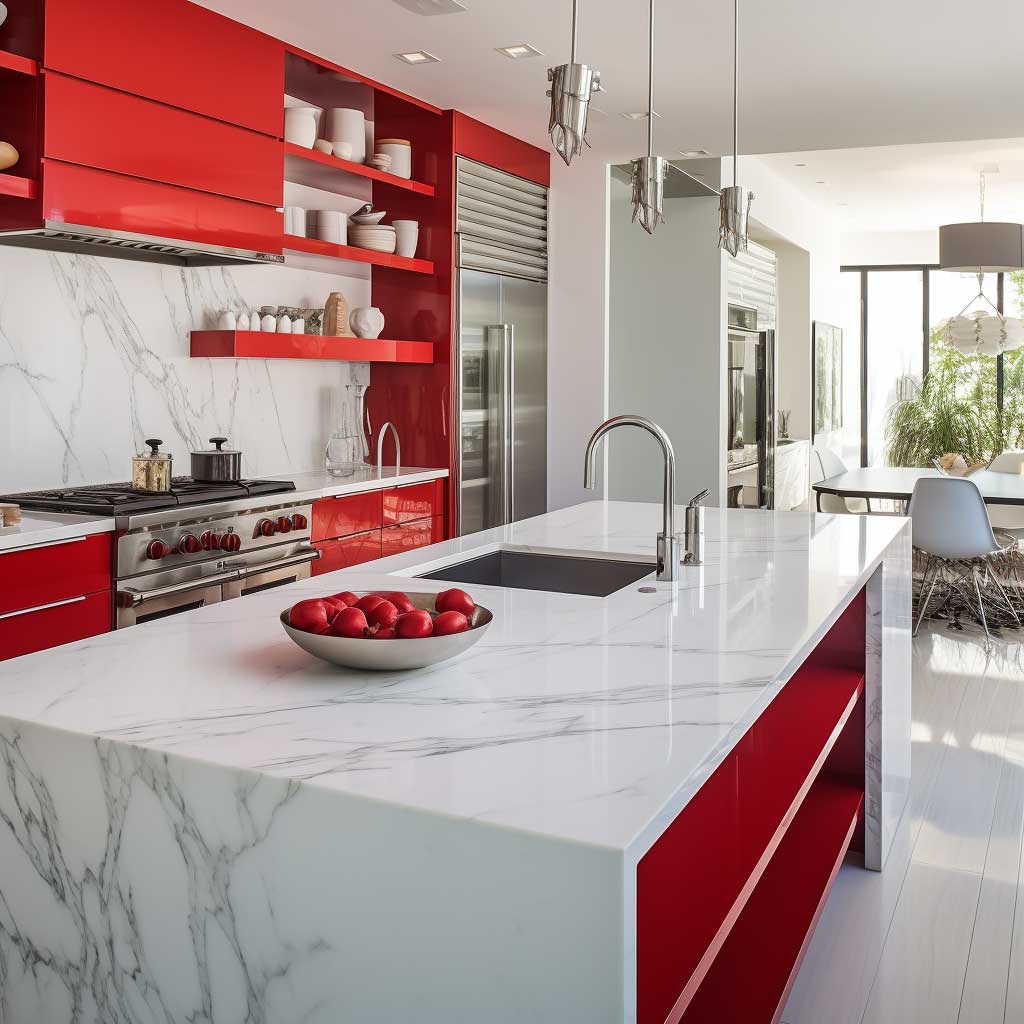

The white marble countertop here handles two jobs at once: it bounces light back into the space (critical when the base cabinets are absorbing it), and it introduces the kind of surface variation that keeps the palette from feeling like two paint swatches. Quartz in a Carrara or Calacatta pattern runs $115–$200 per square foot installed and behaves far more predictably than natural marble — no annual sealing, no etching from lemon juice or vinegar. The trade-off is that the veining is repeated rather than unique. For a kitchen this graphic, the consistency of engineered stone is usually the right call. What most people regret in this setup is skipping under-cabinet lighting: red cabinets absorb light, and without strips under the uppers, the countertop goes flat in the afternoon.
Proportion is what makes or breaks this look. Why does a red and white kitchen feel energizing in some spaces and aggressive in others? The answer is almost always the ratio of red to white, and specifically whether the ceiling and walls are holding their own as neutral territory. Here, white walls and light flooring function like a reset — they give the eye somewhere to rest between the red and white cabinet runs. Adding a second strong element (a patterned backsplash, colored flooring, bold hardware) tips the balance. Keep the backsplash in white or very light neutral tile and the contrast stays organized.
Matching red cabinet hardware to the cabinet color — bar pulls or knobs in the same red family — collapses the contrast that makes the design work. Hardware should anchor, not disappear. Brushed nickel, polished chrome, or matte black all read clearly against red cabinetry. Brass adds warmth and works well with deeper reds that have a burgundy lean. The moment the pulls vanish into the door, the cabinetry looks unfinished regardless of how good the color is.
A White Island Shifts the Weight in a Red and White Kitchen Design
Red and white kitchen cabinets with a white island between them set up an interesting spatial trick: the island pulls focus without adding more red, so the eye lands on the center of the room before registering the perimeter. This is the opposite of the standard approach — most kitchen designs treat the island as accent and the perimeter as backdrop. Here the island becomes the visual anchor, and the red cabinetry encircling it gives the room its energy. For a kitchen that needs to work as a social space as well as a cooking one, the island-forward layout solves both problems at once. Painting kitchen cabinets in red versus having them factory-finished changes the long-term cost picture: factory finishes at cabinet manufacturers typically carry a 5-year warranty against chipping, while field-applied paint on site requires recoating every 3–5 years depending on use.


The countertop material decision matters more in a setup like this than it might seem. Marble is rated 3 on the Mohs hardness scale compared to quartz at 7, which means it scratches and etches from acidic liquids — citrus, vinegar, tomato sauce. A white marble island in a working kitchen that sees daily cooking needs sealing every six months to maintain any stain resistance. Polished quartz in a Calacatta pattern gives the same visual result with none of that maintenance cycle, and at $115–$200 per square foot installed, the price difference from natural marble is often less than people expect. The island shown here uses white marble styling; the practical substitute is Caesarstone Calacatta Nuvo or Silestone Eternal Calacatta, both of which pass for natural stone in photographs.
Pendant lights above the island in a red and white kitchen are doing more than illuminating the surface — they’re establishing a vertical hierarchy. Think of them as punctuation: they tell the eye where the composition ends at the top. Without pendant fixtures here, the island reads as furniture rather than architecture. The fixture finish should coordinate with hardware. Does the pendant need to be statement-level or quiet? In a kitchen where the red cabinetry is already making the statement, quiet pendant fixtures in brushed nickel or matte black let the color carry the room.
Maximum Contrast in Modern Red and White Kitchen Ideas, Handled Without Going Loud
Red and white kitchen ideas that push the contrast further — red cabinets plus red backsplash, with white countertops as the only break — work the same way a red dress against a white wall does. The red isn’t divided; it runs as a continuous surface from floor to backsplash height, which makes the countertop line feel sharper and more deliberate. Ceramic or porcelain tile in red for the backsplash runs $2–$10 per square foot for materials, making it a relatively low-cost place to commit to the palette. The risk is that a red backsplash behind a red cabinet run reads as more red than either element alone — the surfaces add rather than stack. This works if the countertop is bright white and the flooring is light neutral; it overpowers if either of those two elements has any color in it.


Modern appliances in stainless steel function as a neutral third element in this palette — not quite white, not quite red, but reflective enough to hold their own between the two. The reflective surface of a stainless refrigerator adjacent to red cabinetry actually takes on some of the red’s warmth, which softens the contrast slightly. That’s useful in a kitchen where the goal is vibrant but not aggressive. A fully paneled refrigerator disappears into the cabinetry and makes the red more continuous; whether that’s the right choice depends on how much visual movement the kitchen can handle. Modern minimalist kitchen design principles — flush appliances, no visible hardware, cleared counters — can be applied selectively here to calm the palette without losing the contrast.
Bar stools at the island in white or light wood keep the seating from adding more visual weight to a palette that’s already carrying a lot. What most people overlook is lighting scale: pendant fixtures in a high-contrast kitchen like this need to be proportionate to the island length. A single small pendant over a 48-inch island looks like a afterthought; a double or triple pendant run at consistent spacing reads as intentional. The trick here is matching fixture diameter to island width — roughly one fixture diameter per 18–24 inches of island is the professional standard. Overlighting the island washes out the red; underlighting it makes the countertop look dark.
| Design Direction | Cabinet Layout | Countertop Pick | Key Watch-Out |
|---|---|---|---|
| Minimal & Graphic | Red base, white uppers, slab doors | White quartz, $115–$200/sq ft installed | Skip under-cabinet lighting and the red absorbs all the room’s light |
| Refined with Island | Red perimeter, white island | Calacatta quartz or marble-look quartz | Marble needs resealing every 6 months — quartz is the lower-maintenance match |
| High Contrast | Red cabinets + red backsplash, white countertop | Bright white quartz or solid surface | Flooring must be light neutral — any color in the floor tips the room into overload |
Kitchen and bath design authorities at Savona Design note that red and white kitchen cabinets succeed specifically because the two colors address different psychological needs simultaneously — red stimulates appetite and conversation, white signals cleanliness and order — which is why the combination appears consistently in hospitality design as well as residential kitchens.
Final Word
Red and white kitchens earn their boldness when the ratio is right and the materials do the work
The three designs above share exactly one trait: the red doesn’t fight the white. In each case, one color leads and the other holds — and the countertop, flooring, and hardware are chosen to reinforce that hierarchy rather than complicate it.
Semi-custom cabinets run $150–$650 per linear foot installed. If you’re pricing this kitchen, the biggest swing in cost is the countertop material — engineered quartz at $115–$200 per square foot installed versus natural marble at similar price points but with ongoing maintenance costs.
Save this post before your kitchen planning session — the design decisions that seem small (backsplash color, pendant scale, hardware finish) are the ones that determine whether the result looks intentional or assembled.
Related Topics
FAQ
What makes a small kitchen design in red and white work without feeling claustrophobic?
Is red and white kitchen decor sustainable long-term or does it date quickly?
What does a modular red and white kitchen cost compared to a custom build?
Can you add red accents to a white kitchen without repainting cabinets?
How does a red, black, and white kitchen work compared to straight red and white?
Which countertop material holds up best against a red cabinet run?
Complete guide
Every Modern Kitchen Design Idea Worth Stealing Right Now
Layout, cabinets, islands, materials, color, lighting — all in one place
Complete guide
White Color in Home Design: Every Room, Every Style, Every Shade
Kitchens, bathrooms, living rooms, exteriors, palettes — all in one place