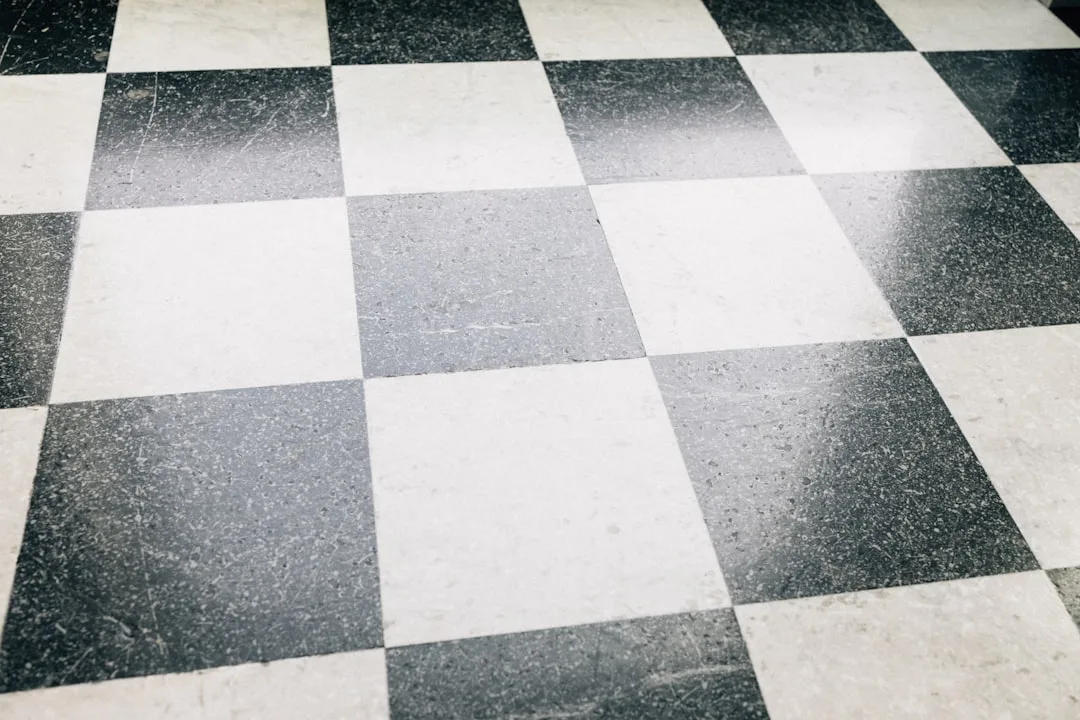
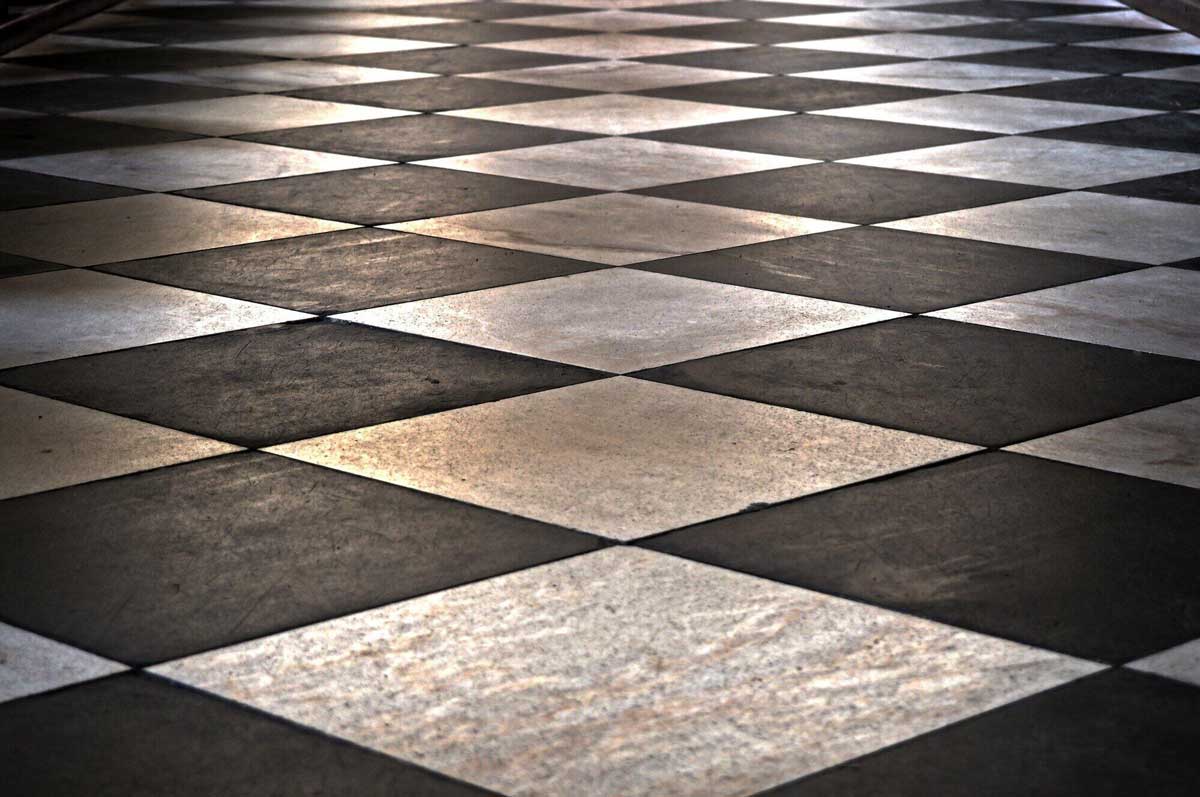
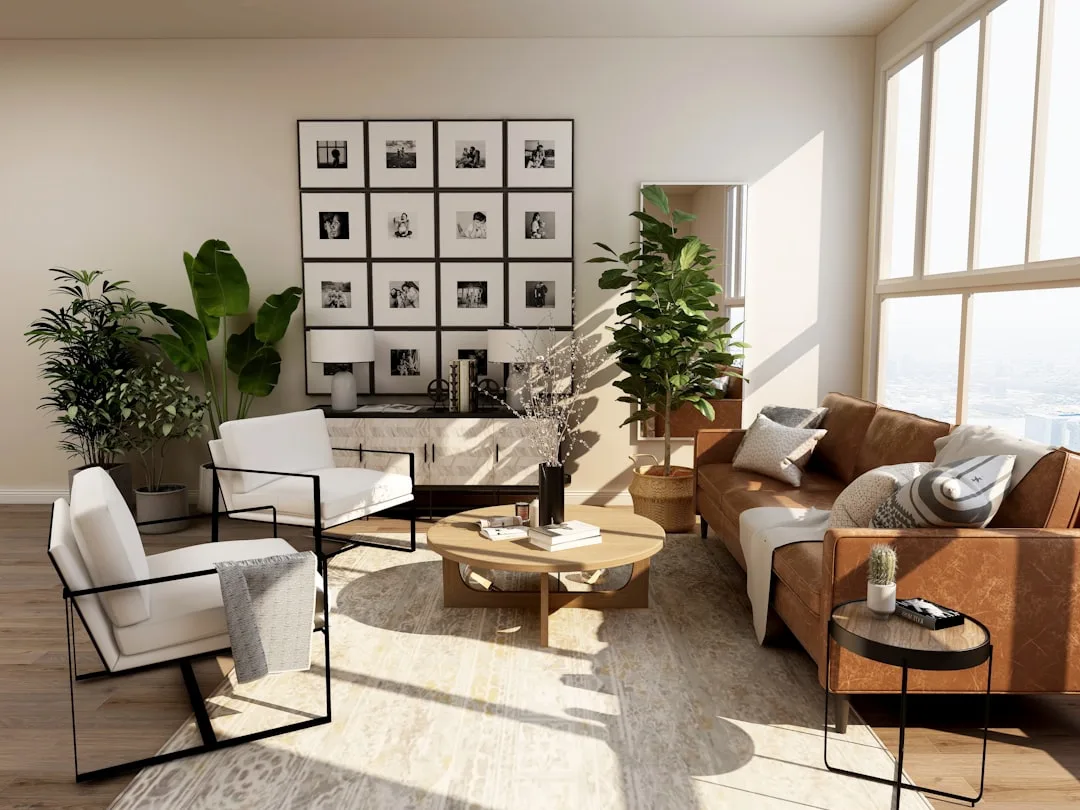
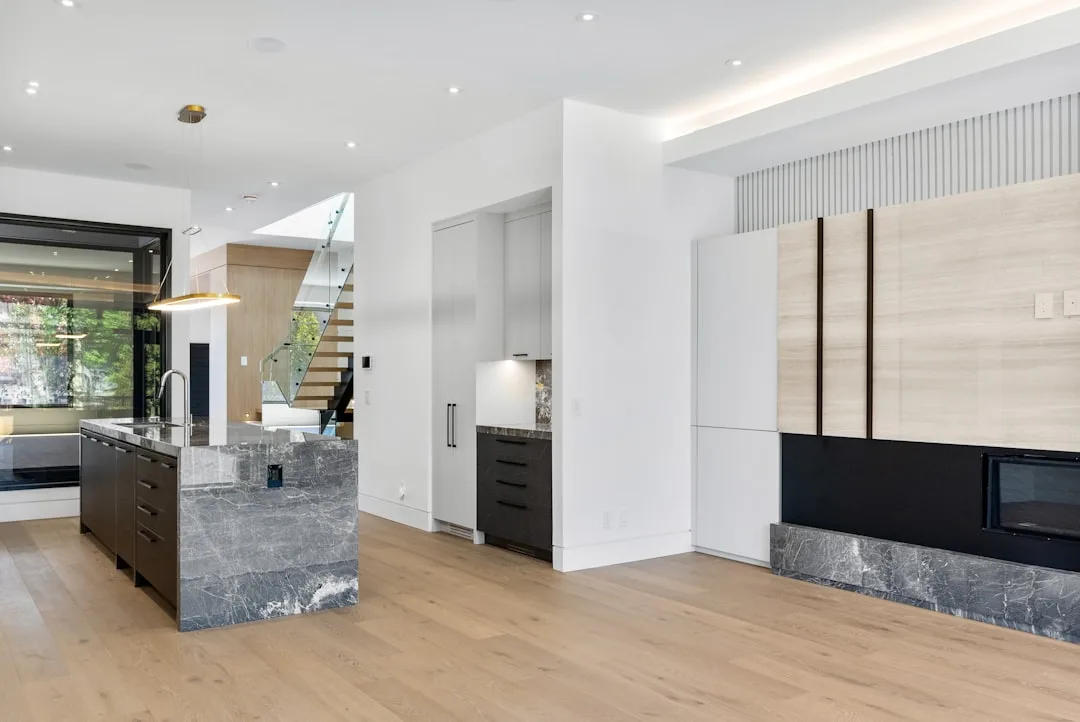
Decorative concrete basement floors have moved well past the gray slab default — and the GSC data is right: most homeowners still don’t know what a finished concrete floor can look like until they see it. At $3 to $12 per square foot for a basic polished or stained finish, the option competes directly with carpet and laminate on upfront cost while outlasting both by decades below grade. The floor you’re working with is already there; the question is what finish to put on it.
Polished concrete basement floors are the starting point most designers reach for first, and for good reason. The mechanical polishing process works on the existing slab without adding height or adhesive — the concrete is ground, densified, and refined until it holds a reflective surface that shifts character with the light. What you choose to do with that surface defines whether the room reads industrial, minimal, or warm.
The four directions below — industrial, minimalist, lounge, and dining — aren’t just aesthetic categories. Each involves different finish decisions, different lighting strategies, and different trade-offs that are worth understanding before you call a contractor.
- Polished concrete basement floors run $3–$12/sq ft for basic finishes; decorative multi-step work reaches $8–$20+
- Properly maintained polished concrete lasts 20+ years — longer than carpet, laminate, or most tile installations
- Reseal residential polished floors every 2–5 years depending on traffic; commercial spaces typically need resealing annually
- Industrial: pairs exposed brick with high-gloss polish and metal furniture — keep the color palette tight or the room fights itself
- Minimalist: satin or matte finish, white walls, natural light; dark stains kill this look immediately
- Lounge: layered lighting does more work than any rug; a warm-temperature pendant over seating transforms the concrete’s color
- Dining: chandelier height matters — hang it too high and the floor’s reflectivity is wasted
Raw Brick Meets Polished Concrete in the Industrial Basement
The industrial basement works because two raw materials — polished concrete and exposed brick — do something unusual together: the concrete’s reflectivity makes the brick look more saturated, and the brick’s texture gives the concrete something to contrast against. Neither looks as strong alone. A basic polished and sealed finish at $3–$5 per square foot is enough to get that reflective quality; a higher-gloss option at $6–$12 runs the surface closer to a mirror and makes the lighting decisions matter more.
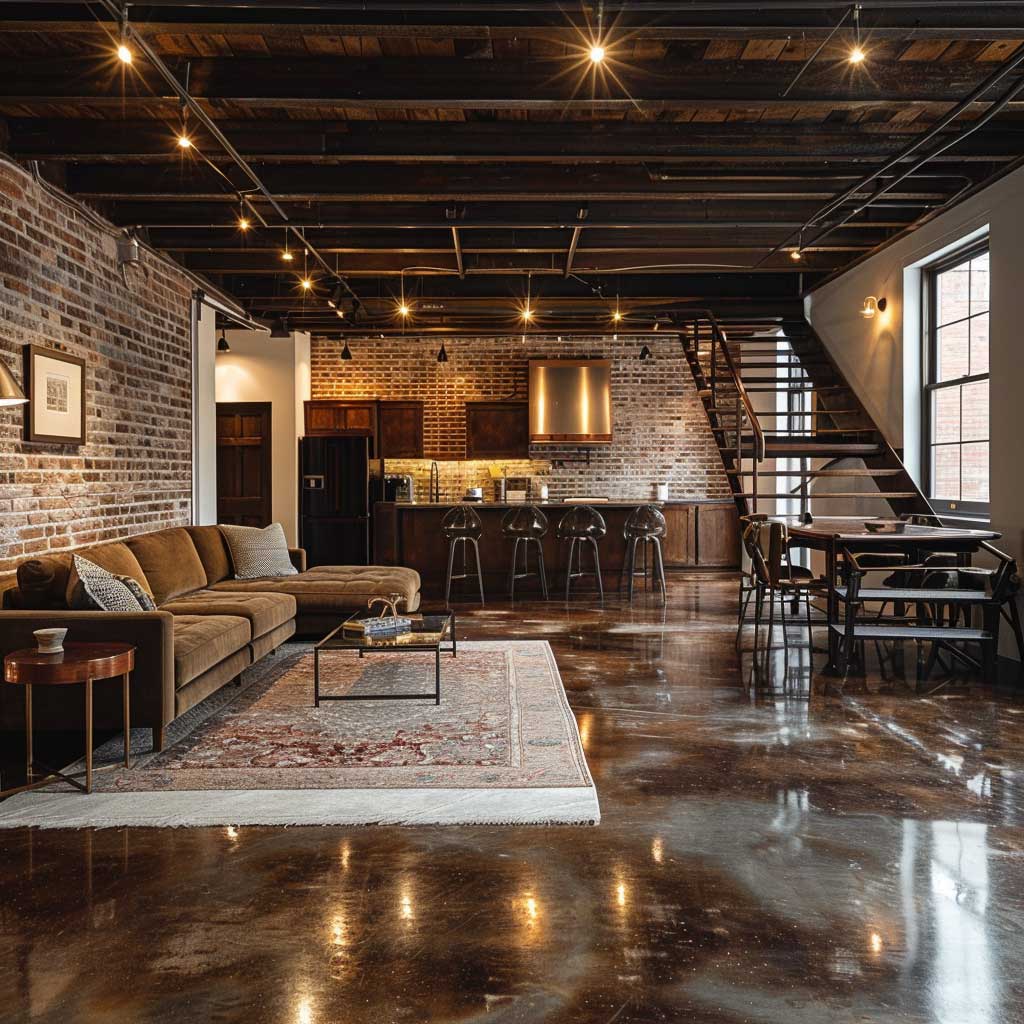
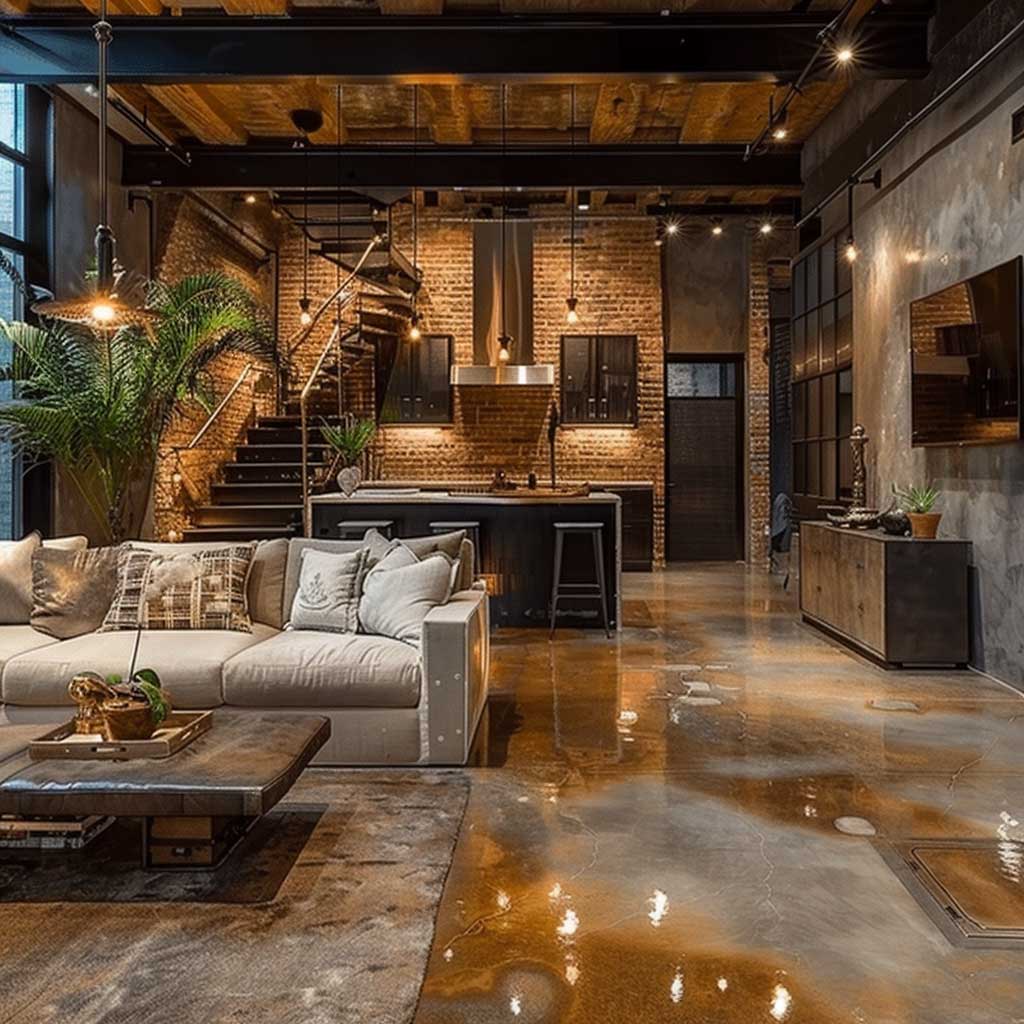
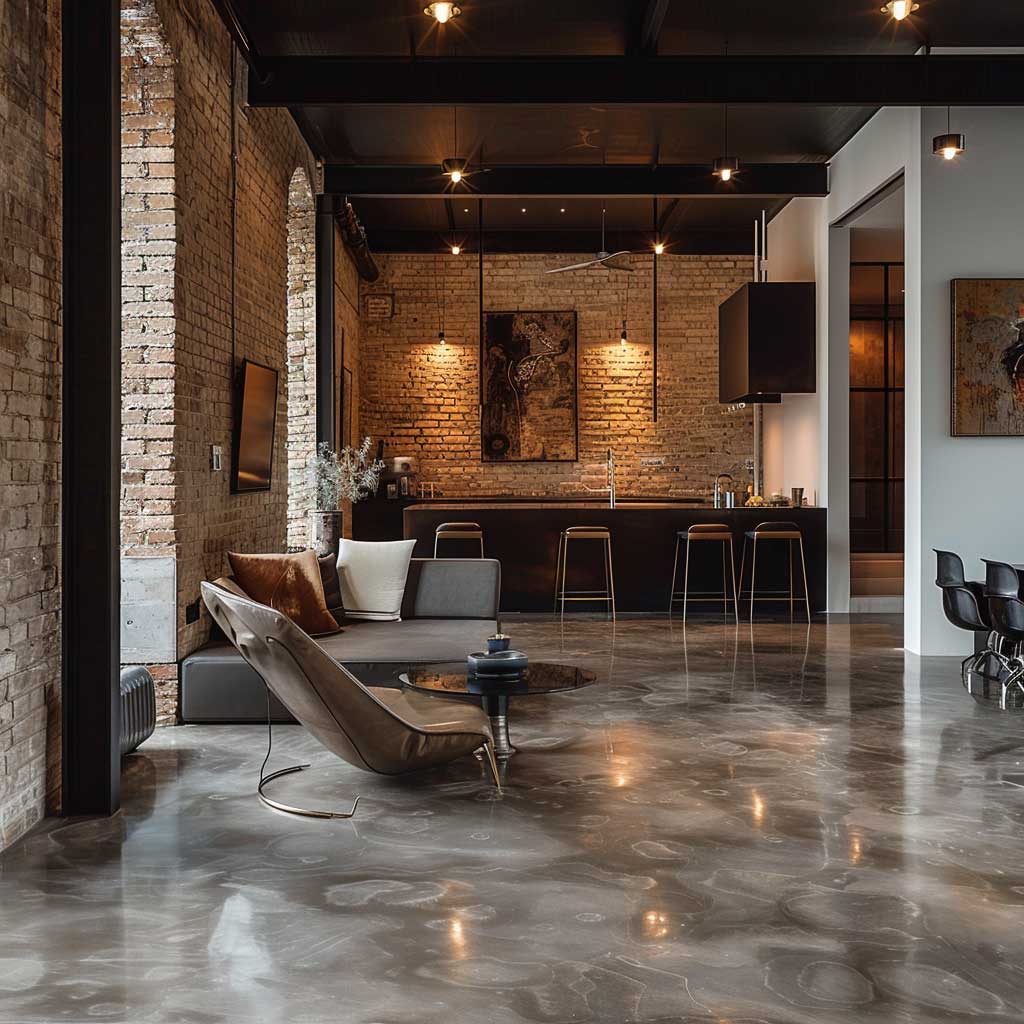
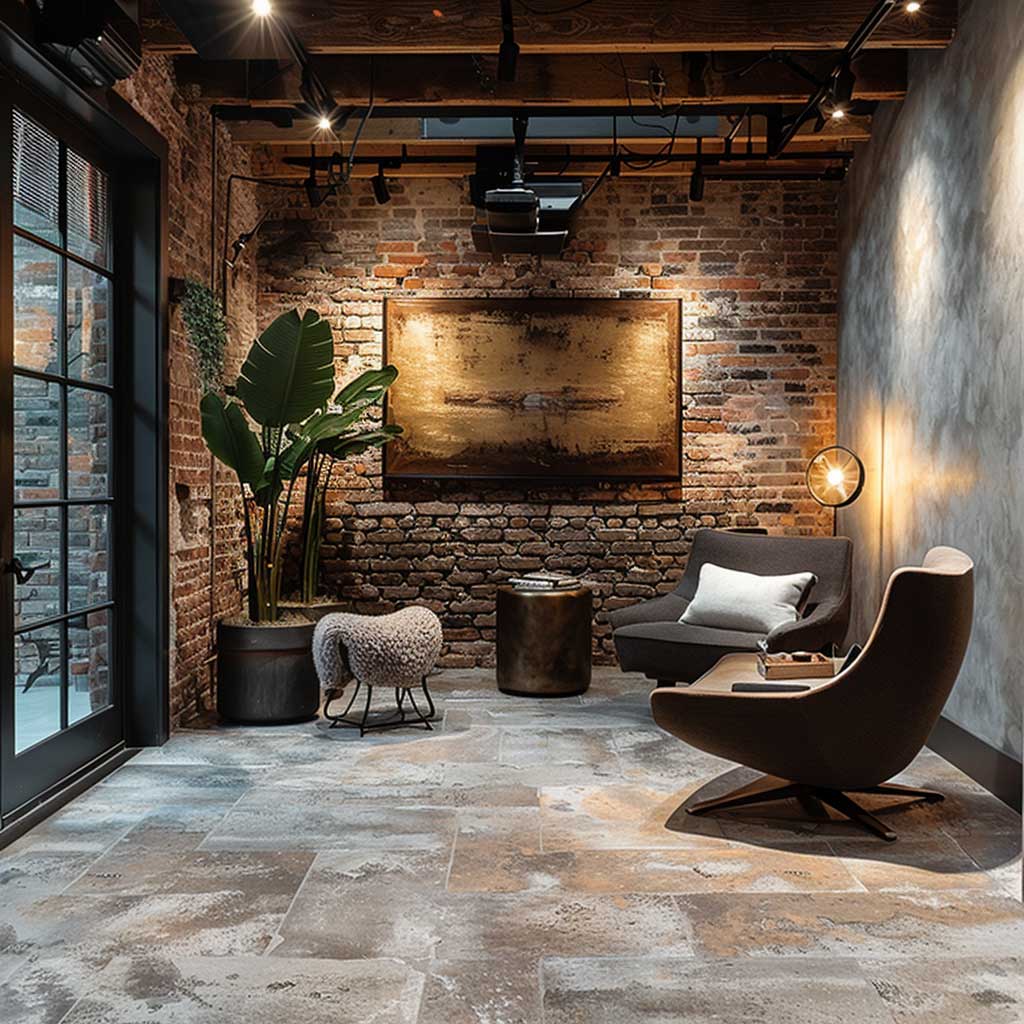
Metal furniture is the right call here — steel-framed chairs, iron-leg coffee tables, and open industrial shelving in blackened steel all read as extensions of the floor’s material logic. What doesn’t work is soft upholstery in a saturated color. A deep red sectional in an industrial basement doesn’t read as contrast; it reads as an error. The palette should stay in neutrals, aged leather, or charcoal, with the brick and the floor doing the color work. Does lighting type matter more than intensity? In an industrial basement, yes — a single flat overhead grid flattens the texture of both materials, while pendant fixtures hung at 60–72 inches off the floor pull the concrete’s grain out of the surface the same way side-light does for stone.
Area rugs have a real function here beyond warmth — concrete is hard underfoot and picks up sound. A low-pile or jute rug under the seating zone absorbs some of the acoustic bounce that an open basement with no soft surfaces creates, without softening the material story of the floor. The trick is size: too small and it reads like a doormat under a sofa; the rug should extend at least 18 inches past the furniture footprint on each side. For wall treatment ideas that work alongside polished concrete in this kind of space, the basement wall ideas covered on ArtFasad go through material combinations in more depth.
Polished Concrete Basement Floors in a Minimalist Layout
Minimalist basement design depends on a matte or satin-finish polished concrete floor more than any other element — the smooth surface reflects diffused light rather than concentrated glare, which is what keeps the space from reading as a showroom. A satin finish at the 400–800 grit level is the right target: enough reflectivity to bounce light upward in a below-grade room, not so much that every footprint shows at a distance. A high-gloss mirror finish in a minimalist room is like turning up the volume on a quiet record — it defeats the point.
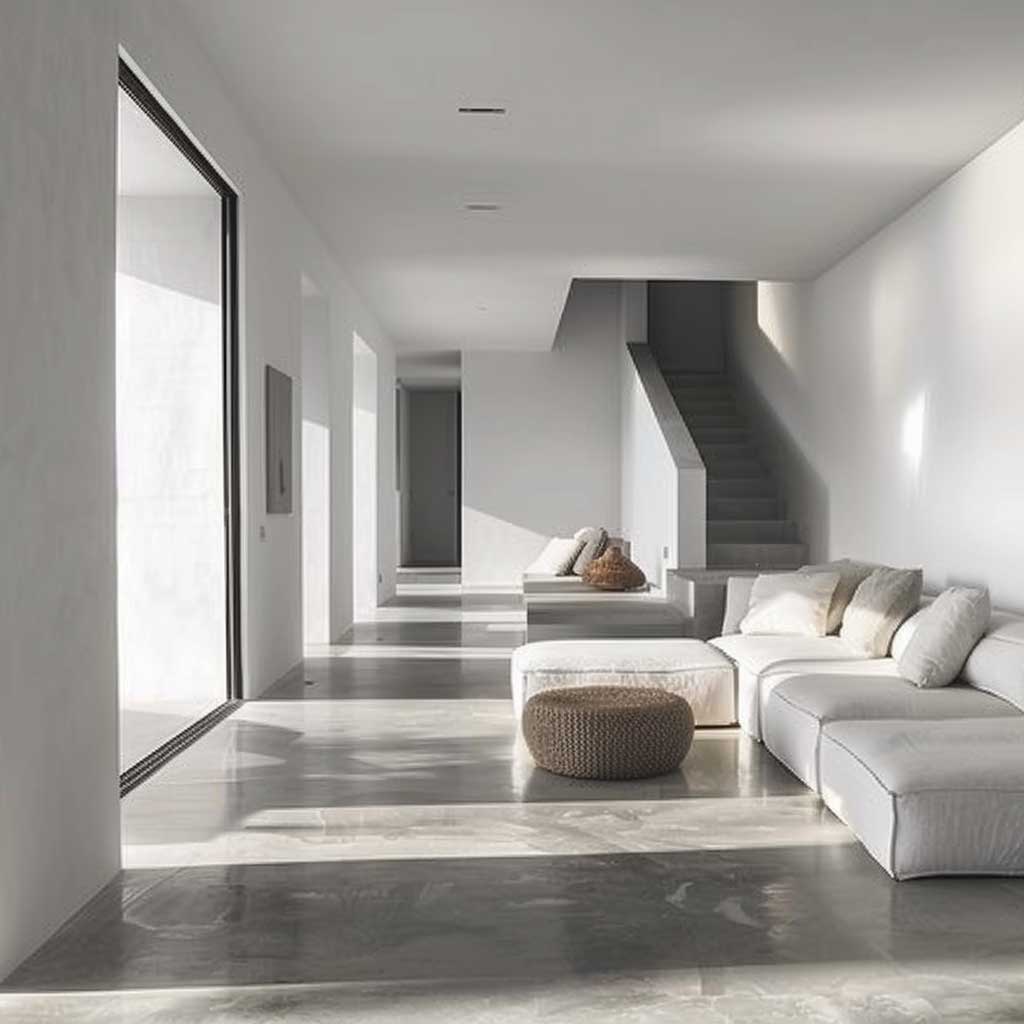
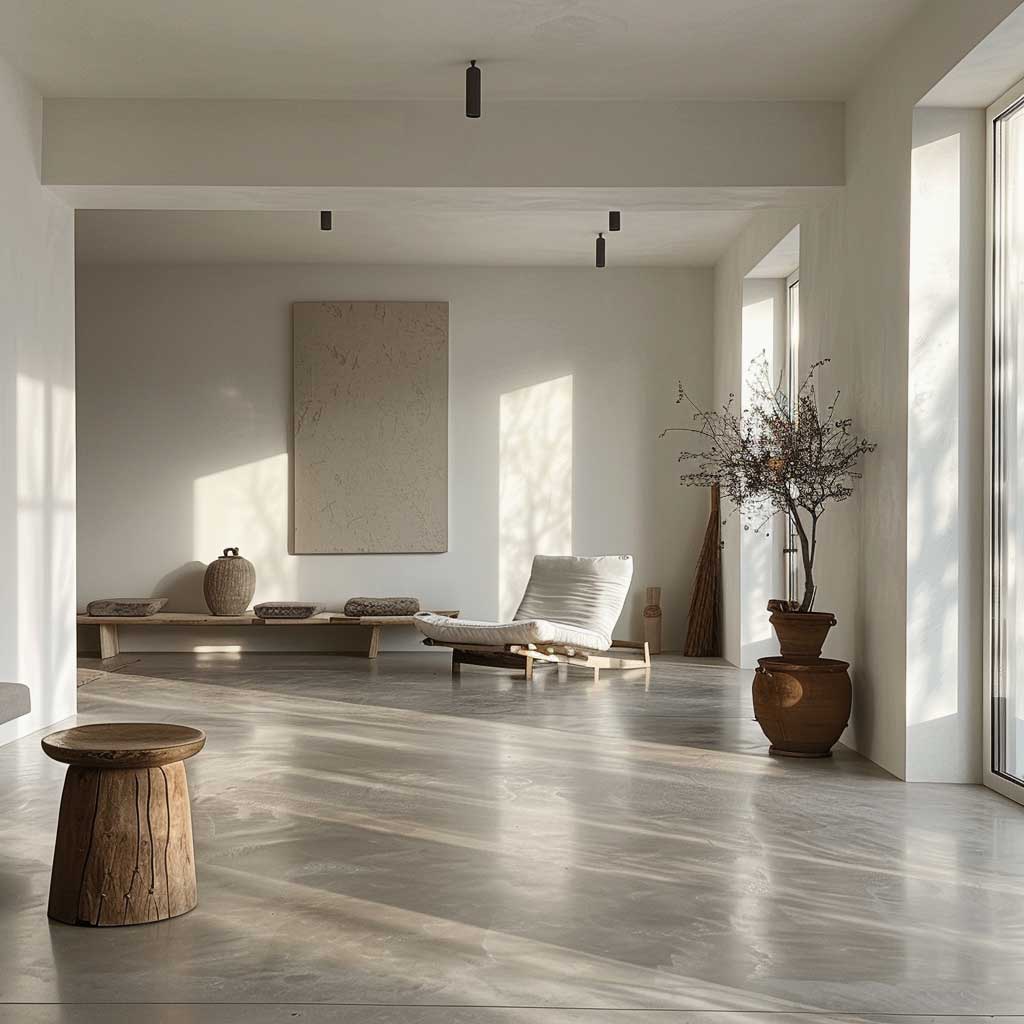

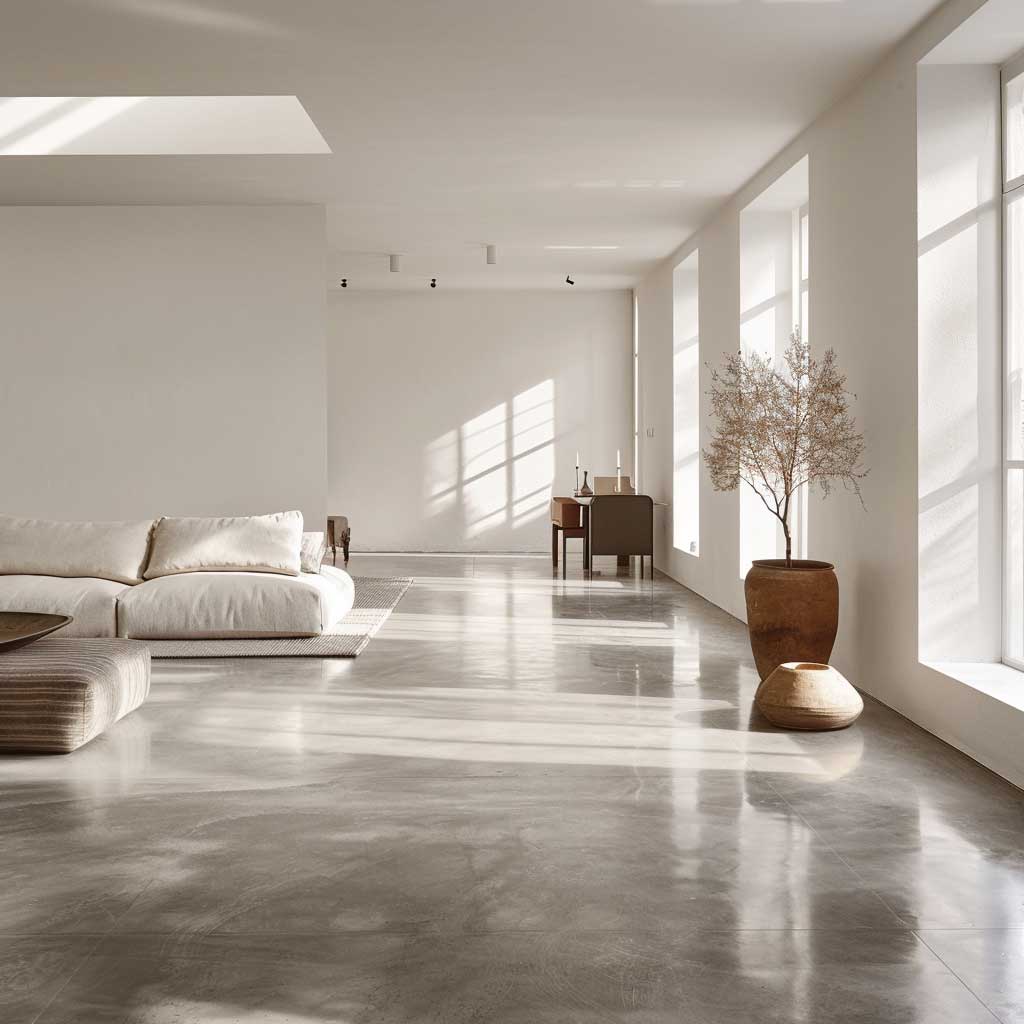
White walls against a neutral concrete floor create a ratio that makes both materials look more intentional. The wall reads as the backdrop; the floor reads as the subject. Interrupt that with wallpaper, a gallery wall, or patterned tile and the concrete loses its visual authority — suddenly it’s just the thing you chose to avoid paying for tile. Furniture selection follows the same logic: one sofa, one table, one storage unit. The question designers ask here is whether every piece earns its floor space, and in a basement with a finished concrete floor, the answer should nearly always be no to the fourth item.
Natural light is the variable most minimalist basement designs underestimate. Concrete reflects what’s available, so a below-grade room with two small egress windows will still feel dim even with a polished floor — the light just bounces more efficiently. The real fix is supplemental lighting placed at low angles: floor lamps beside seating, LED strips along the base of cabinetry, and recessed perimeter cans rather than a center fixture. A single centered overhead light in a minimalist basement turns the concrete into a spotlight stage rather than a room. One or two organic material accents — a wood shelf, a linen throw — prevent the space from reading as a showroom mock-up.
- Dark stain in a low-light basement — a walnut or charcoal stain on a basement floor with limited windows makes the room feel compressed. Stain colors in basements should stay in the mid-tone or warm-neutral range.
- Covering existing concrete with carpet before testing for moisture — carpet over a slab with any moisture migration becomes a mold surface. Tape a plastic sheet to the concrete for 24 hours; if condensation accumulates under it, address the moisture before any floor treatment.
- High-gloss polish in a minimalist room — this choice demands perfect furniture placement, perfect cleanliness, and no texture anywhere, or the gloss creates visual chaos. Satin finishes are more forgiving in lived-in spaces.
- Mixing more than one decorative technique on the same floor — staining plus stamping plus saw cuts is three competing visual statements. Choose one direction.
Concrete Floor Basement Lounge with Layered Lighting
A basement lounge built around concrete flooring succeeds or fails on lighting decisions, not furniture quality. The floor material picks up color temperature and reflects it — a 2700K warm-white bulb over polished concrete makes the surface look almost amber, which reads as inviting. The same floor under a 4000K cool-white fixture looks like a parking garage. For a lounge, that temperature dial matters more than fixture style. Pendant lights hung 60–66 inches off the floor over a seating area set the right scale; anything higher shifts from intimate to overhead.
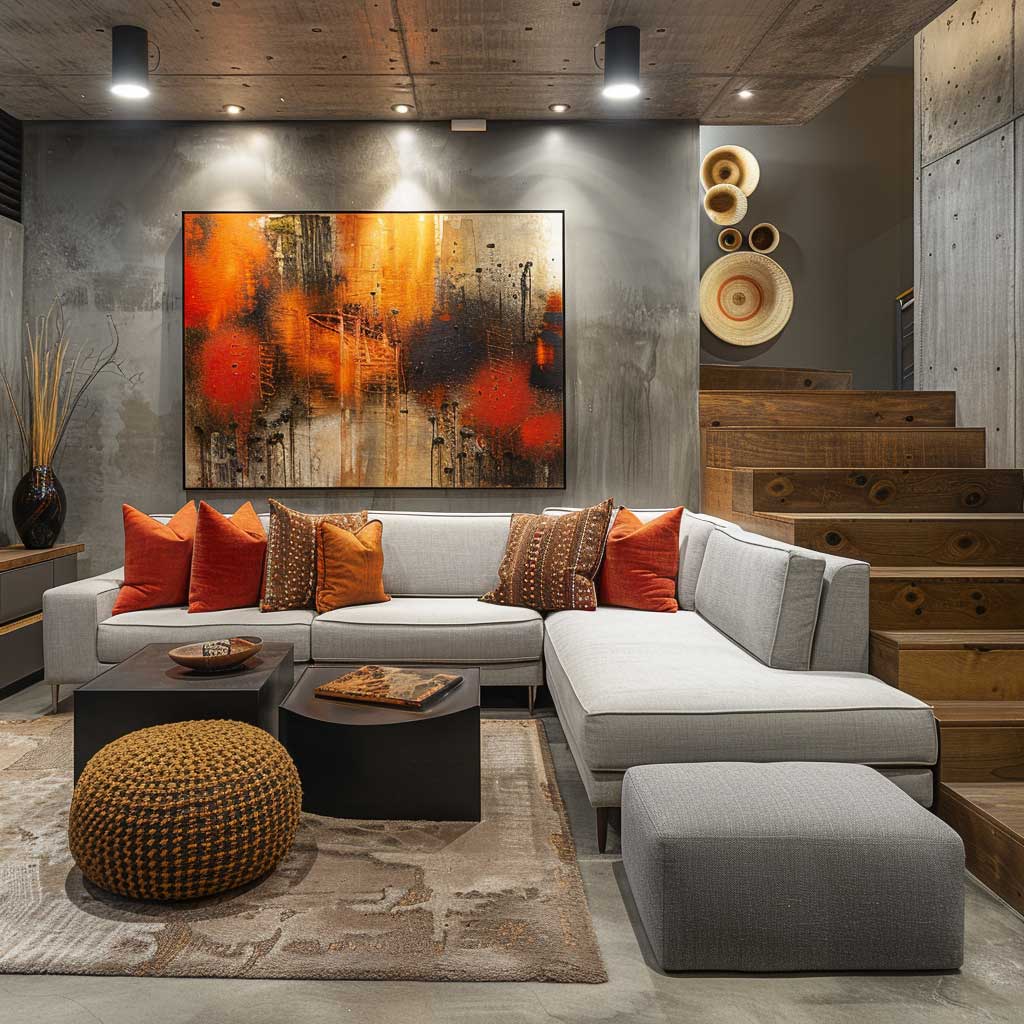
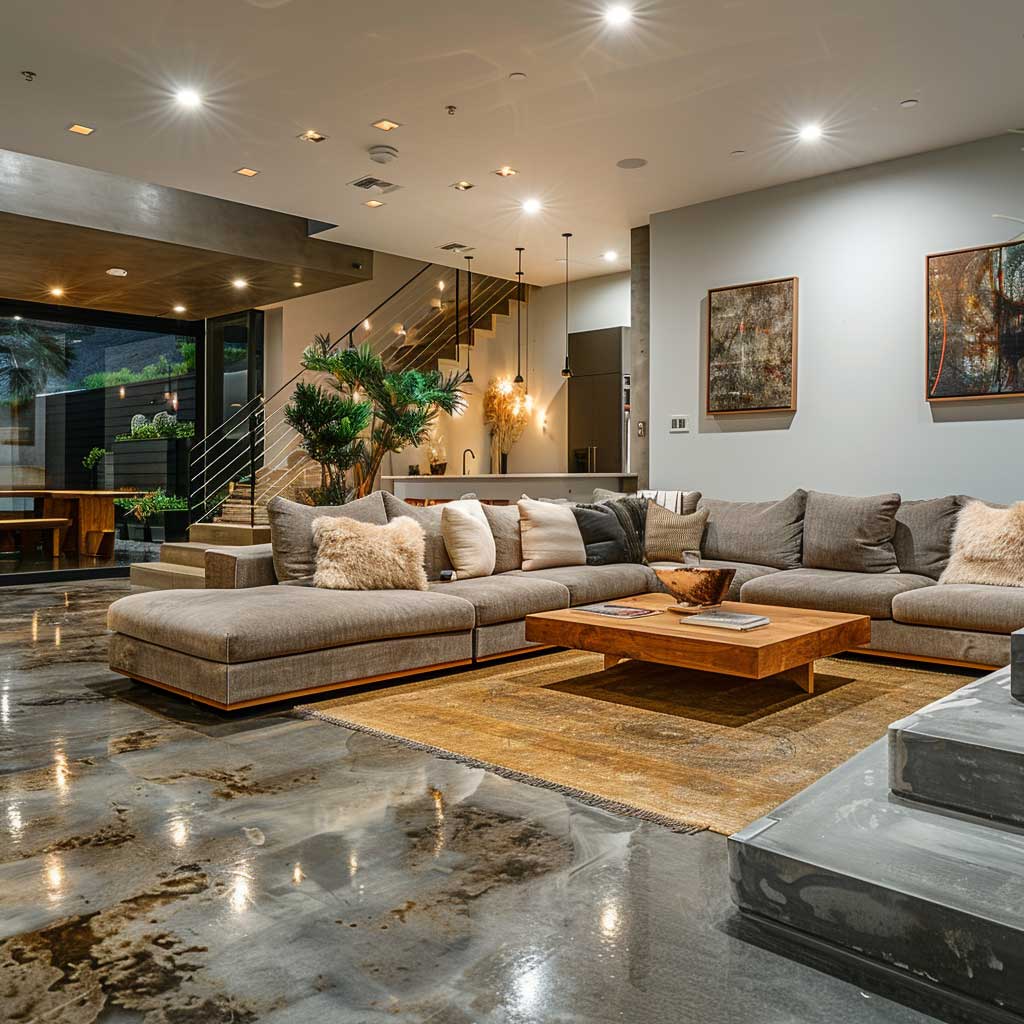
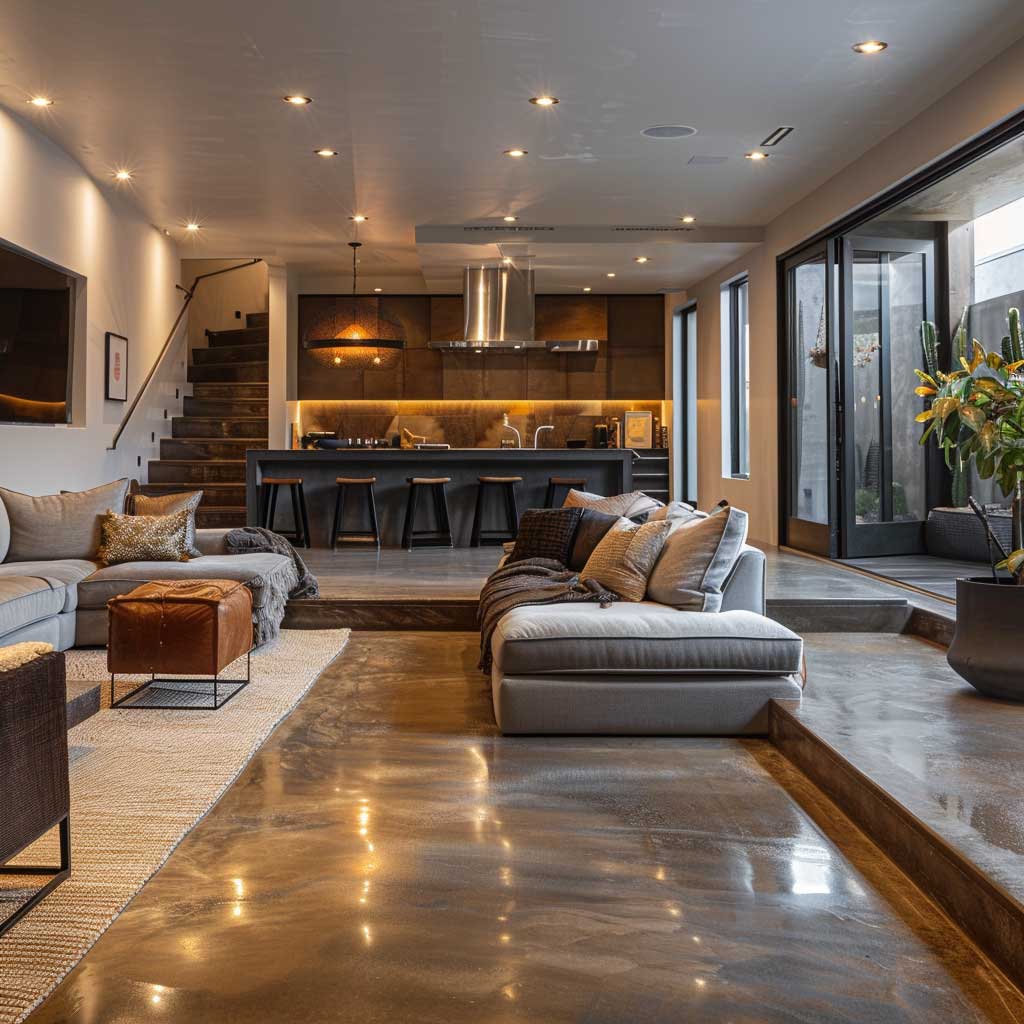
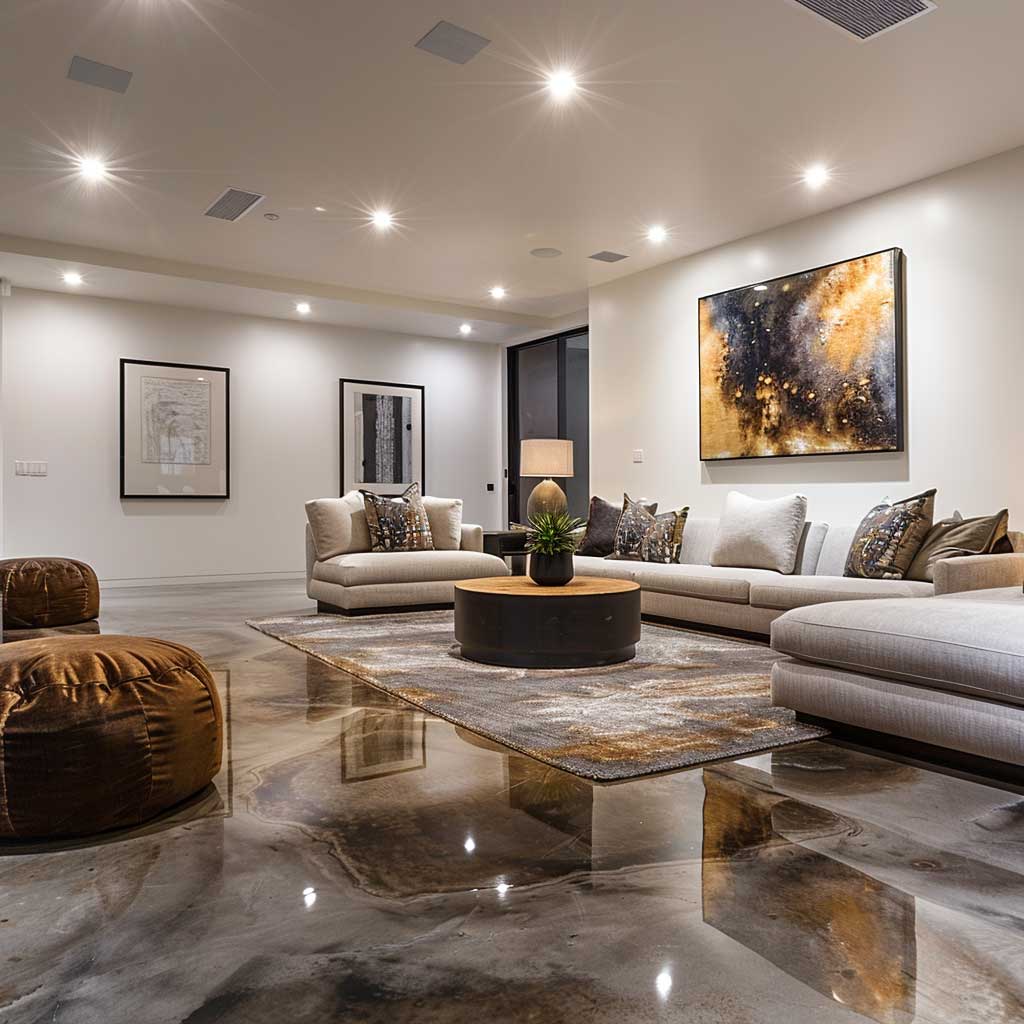
Comfortable, scaled seating is a non-negotiable — this isn’t the room for a sleek two-seater from a design catalog. A sectional or three-piece arrangement that faces a media wall or fireplace anchors the lounge function, and the concrete floor’s durability means it doesn’t need to be handled gently. Concrete polishing creates a surface that resists most everyday staining without coating that can delaminate; a basic grind-and-seal finish at $3–$5 per square foot handles the casual use a lounge sees. What is the right rug size for a concrete-floored basement lounge? Stylists generally recommend going larger than feels comfortable on paper — an 8×10 under a medium sectional reads as undersized; a 9×12 or 10×14 grounds the furniture as an actual room zone.
Decorative concrete techniques open the lounge section up further than a plain polish does. Acid staining at $3–$6 per square foot per the Concrete Network’s cost breakdown produces variegated, translucent color that looks different from every angle — closer to aged leather or stone than painted concrete. Dye at $1–$3 per square foot added before the final polishing pass is faster and delivers more consistent, vibrant color for a space where personality is the point. Both options pair with an engineered hardwood alternative on the approach stair for rooms that combine flooring zones — more on engineered hardwood basement floors when the lounge section transitions to a second material.
A Dining Room Below Grade Anchored by Decorative Concrete Basement Floors
A basement dining room is the application where polished concrete flooring benefits most from a decorative layer — not because plain concrete looks wrong, but because a dining room calls for material intention that a flat gray slab doesn’t provide. Acid staining using three or four color layers produces a translucent, dimensional effect that resembles aged stone without requiring stone’s installation complexity or cost. A multi-color stain job at the intermediate level runs $5–$15 per square foot according to Concrete Network’s current pricing breakdown, which puts it in ceramic tile territory without the grout lines.
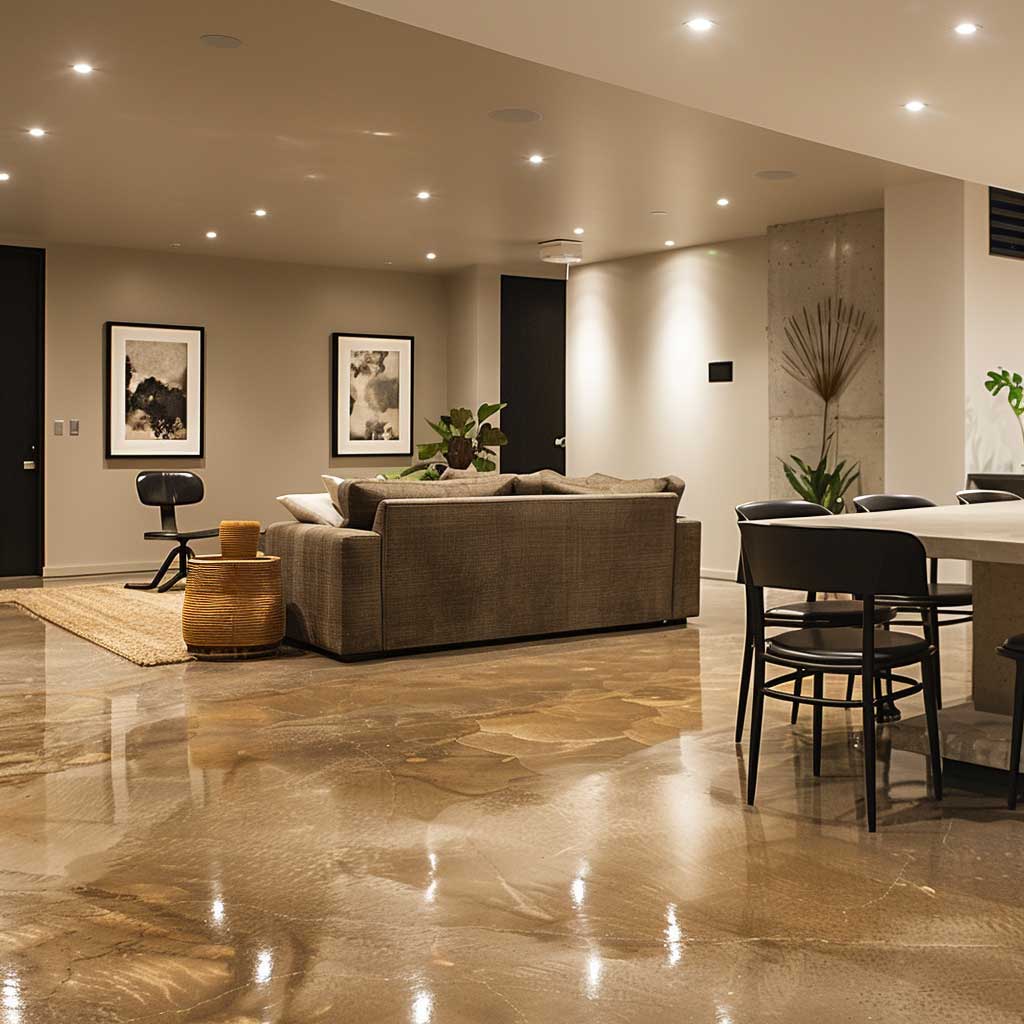
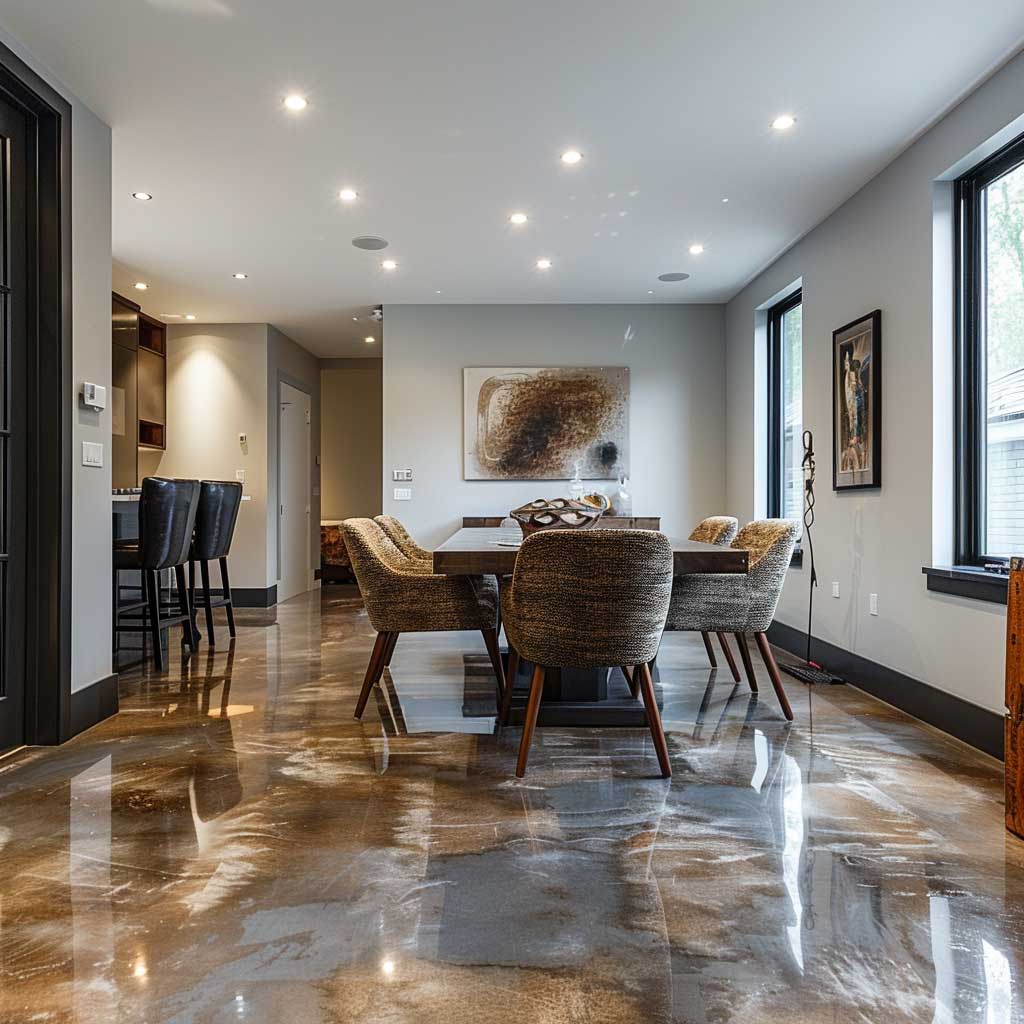
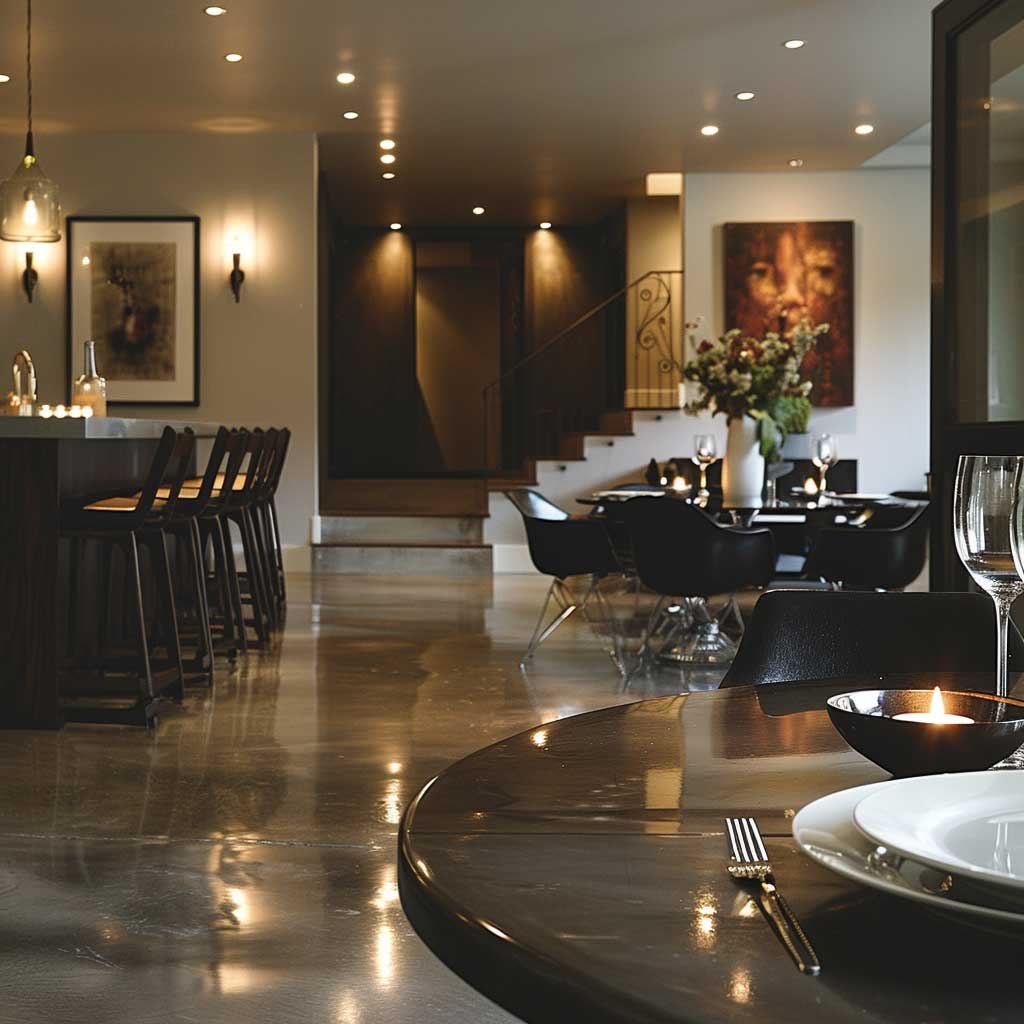
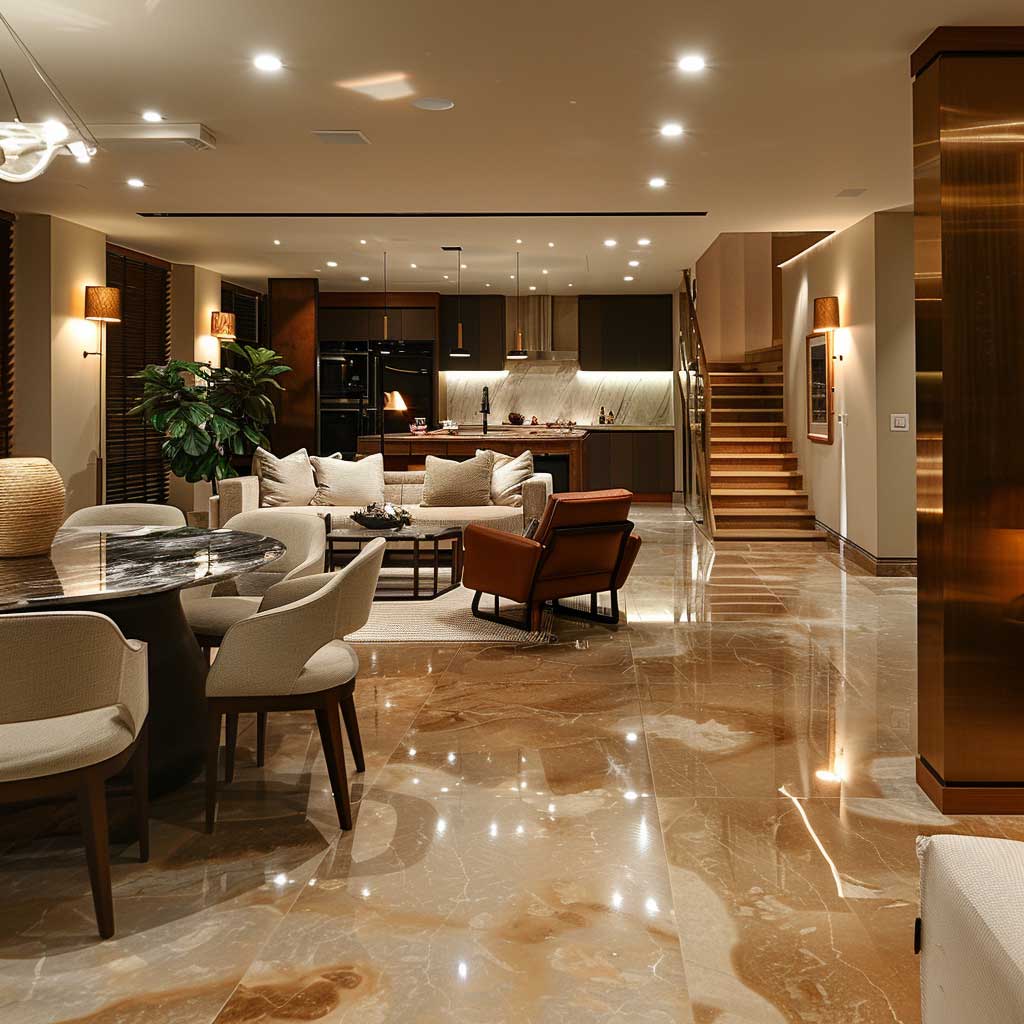
Furniture for a concrete-floored basement dining room should lean upholstered rather than hard-seated — the floor is already the hardest material in the room, and upholstered dining chairs provide the acoustic softness the space needs. Dining chairs dragged on a polished concrete surface leave fine scratches over time; felt pads under all chair legs are a maintenance requirement, not a suggestion. A sideboard along one wall with a mirror above it doubles the light the floor reflects, which is the closest thing to a window a below-grade dining room gets. What makes the chandelier height critical here? A pendant or chandelier hung 30–34 inches above the tabletop bounces light off the concrete rather than projecting it straight down — that reflected component is what makes the floor feel like a design choice rather than leftover construction.
Textiles close the material gap between the hard floor and the formal register of the room. A dining area rug in a wool or flatweave material that extends 24 inches beyond the chairs on all sides provides chair-roll comfort and absorbs enough sound to prevent the room from echoing during conversation. Avoid synthetic pile rugs — they create static, trap food debris, and look visually cheap against a finished concrete surface. The concrete itself, maintained with occasional damp mopping and resealed every 2–3 years per standard residential guidance, will outlast any rug placed over it by decades. According to the Concrete Network, basic stained or polished concrete in a basement holds up through moisture events that destroy carpet or laminate — the practical case for concrete in a dining room below grade is actually stronger than it is upstairs.
| Finish Style | Cost Range (per sq ft) | Best For | Key Risk |
|---|---|---|---|
| Basic grind-and-seal | $3–$5 | Industrial, lounge with rugs | Low durability without resealing; needs touch-up every 2–3 yrs |
| Single-color stain + seal | $3–$6 | Dining rooms, warm minimalist | Acrylic stains peel; use acid stain only for permanent color |
| Multi-color decorative stain | $5–$15 | Dining areas, formal lounge | Requires sealed subfloor; multi-color errors are hard to reverse |
| High-gloss mirror polish | $6–$12 | Industrial, high-contrast spaces | Shows every footprint and furniture scratch in daily use |
For a deeper breakdown of finish options across all basement flooring types — including how polished concrete compares to epoxy and stained overlays in real basement conditions — the Concrete Network’s basement floor resource covers moisture concerns, finish costs, and common contractor decisions in technical detail.
The Bottom Line
Decorative Concrete Turns a Basement Slab Into the Room’s Best Feature
At $3–$12 per square foot for a polished or stained finish, the concrete already in your basement is the cheapest starting point for a floor that outlasts carpet and laminate by 15–20 years — and survives the moisture events that destroy them.
The finish level determines the room’s register: a basic satin polish reads industrial or minimalist; a multi-color acid stain reads warm and formal. Lighting temperature determines how any of them actually look at night, and that decision costs nothing to change.
Reseal every 2–3 years, use felt pads under all furniture, and damp-mop with a pH-neutral cleaner. That’s the full maintenance plan for a floor that can hold its surface for 20+ years. Save this post.