A blue shaker kitchen u-shape layout gives you three full walls of cabinetry, counter space that wraps around you like a workbench, and a color that lowers cortisol faster than almost any other hue in a home. Designers recommend this combination specifically for kitchens where cooking happens daily — not just for aesthetics, but because the enclosed three-wall footprint shortens the distance between sink, stove, and refrigerator to a work triangle measured in steps, not meters. Experts note that an ideal u-shaped layout needs roughly 107 square feet, with at least 9 feet of width between facing cabinet runs.
The shaker door profile is the key decision here. Its flat recessed panel absorbs paint evenly, which means color accuracy stays consistent across every cabinet face — a detail that matters when blue is your dominant surface. Stock blue shaker cabinets typically run $100–$300 per linear foot, while semi-custom versions land between $150 and $650 per linear foot. That range gives you genuine flexibility to hit almost any budget without sacrificing the clean geometry that makes the style work.
What follows are four proven approaches to a blue shaker u-shaped kitchen — from classic white-and-blue contrast to coastal shiplap and quartz-topped transitional builds. Each section includes a countertop pairing, a lighting angle, and at least one thing worth avoiding.
- A u-shaped layout needs at least 107 sq ft and 9 ft of clearance between facing counters — narrower than that and the layout fights you.
- Blue shaker cabinets run $100–$650 per linear foot depending on stock vs. semi-custom; color accuracy is best in a recessed-panel door profile.
- White quartz ($50–$150 per sq ft installed) and white marble are the two countertops that widen blue visually without competing with it.
- Coastal decor with blue works best when nautical accents stay minimal — rope lighting, natural baskets, one anchor motif maximum.
- Transitional kitchens mix shaker doors with a mosaic backsplash: the trick is keeping grout color closer to the cabinet color than the counter color.
White Marble Sharpens What Blue Shaker Cabinets Already Do Well
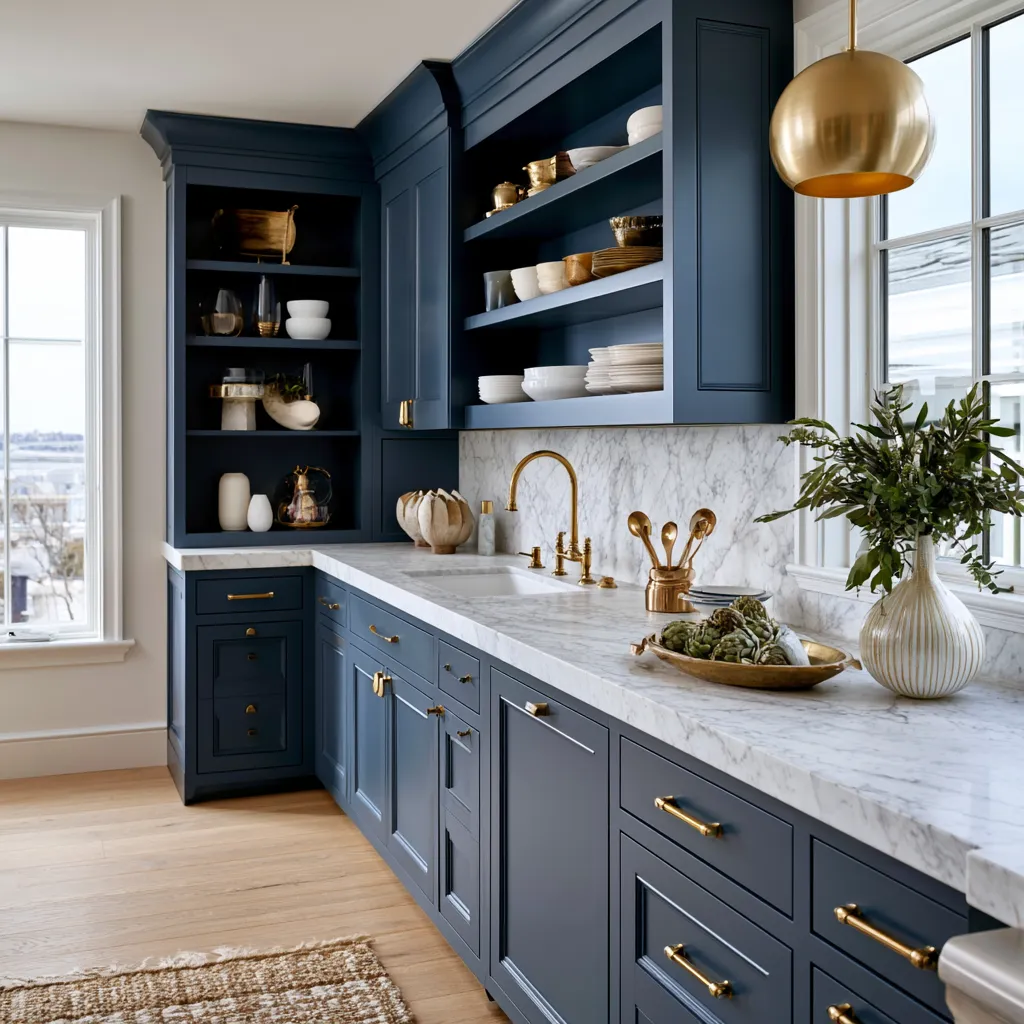
Classic blue and white in a u-shaped kitchen works because the contrast operates like a visual anchor — the blue recedes on vertical surfaces while white marble pulls light across horizontal ones. Stylists recommend pairing a mid-tone blue (think Benjamin Moore’s Newburyport Blue or a similar slate-adjacent shade) with Carrara-style marble rather than a stark Calacatta, because the gray veining in Carrara echoes the cool undertone in most shaker blues without creating a cold overall feeling. The u-shape delivers roughly 20–25 linear feet of cabinet storage in a standard 10×10 footprint, which means the color shows up on a lot of surface area — getting the shade right before committing is not optional.


White subway tile on the backsplash is the most common choice in this configuration, and it works, but avoid stacking it in a standard horizontal brick pattern if the cabinets already have strong horizontal framing rails. A vertical stack bond or a herringbone keeps the eye moving rather than reinforcing the same line twice. What doesn’t work: glossy white tile paired with glossy blue paint — the double shine flattens the room and makes both surfaces look slightly cheap. Matte or satin finish on the cabinets, a honed or tumbled finish on the tile.
Does natural light change how the blue reads? Dramatically — north-facing kitchens should skew slightly warmer in their blue choice (dusty slate rather than clean cerulean) because cool north light will push an already-cool blue into something that feels clinical. South-facing kitchens have more latitude. The trick here is to test paint chips in the actual space at 10am and again at 4pm before ordering cabinets, not to trust a swatch under showroom lighting. Stainless steel appliances integrate cleanly without requiring color-matching, which is one practical reason this combination remains popular even after decades of trend cycles.
For small personal accents — potted herbs on open shelving, a ceramic fruit bowl on the counter — choose warm terracotta or ochre rather than more blue or white. A third color in a small quantity is what gives a two-tone kitchen its lived-in quality rather than its showroom quality.
Wood Countertops Pull the Blue Away from Cold
Wood countertops in a blue shaker u-shaped kitchen work like a thermostat — they turn the temperature of the room up by several degrees without touching the paint color. Butcher block runs around $40–$100 per square foot depending on species, which puts it below quartz in most scenarios, and its natural variation means no two kitchens look identical even with the same blue cabinet choice. You’ll notice the most visual movement happens where the end grain meets the blue cabinet face: the grain pattern draws the eye horizontally, which reinforces the wrapping quality of the u-shape rather than breaking it.
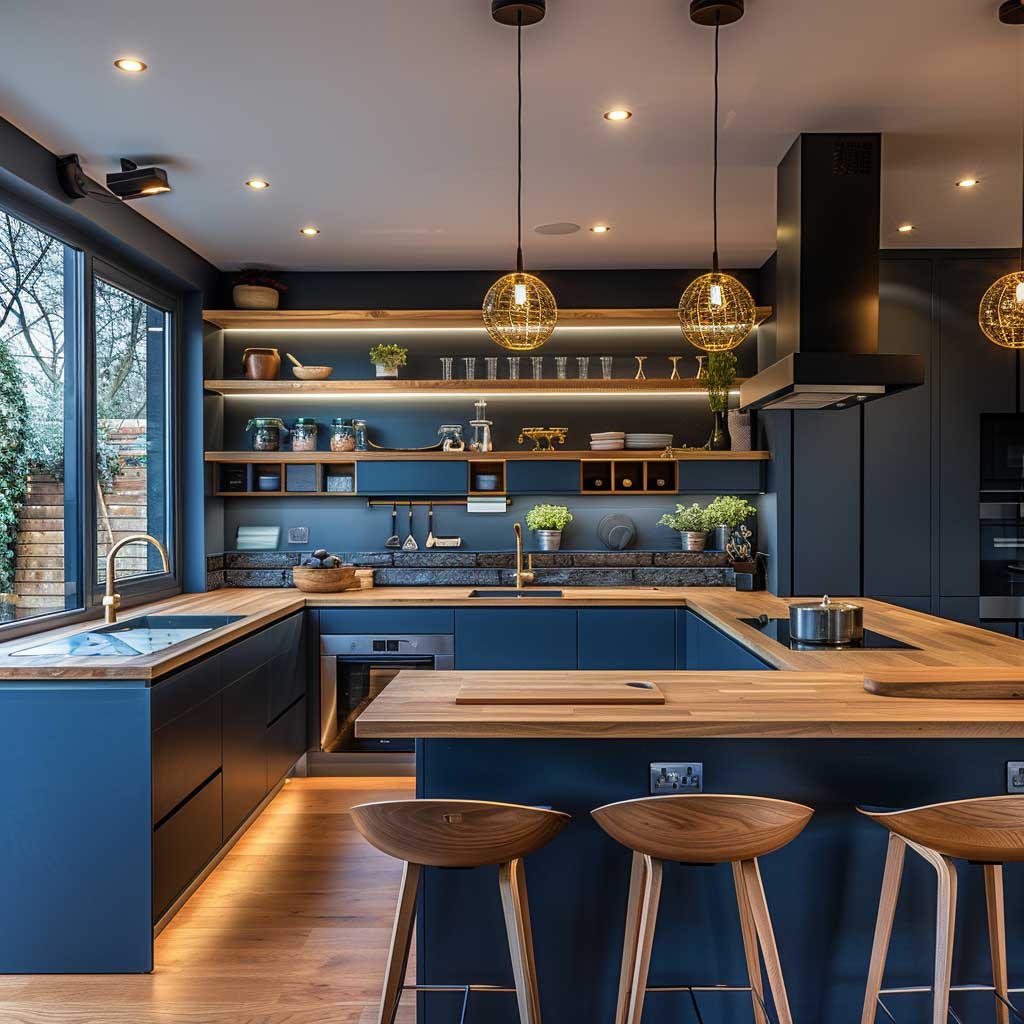


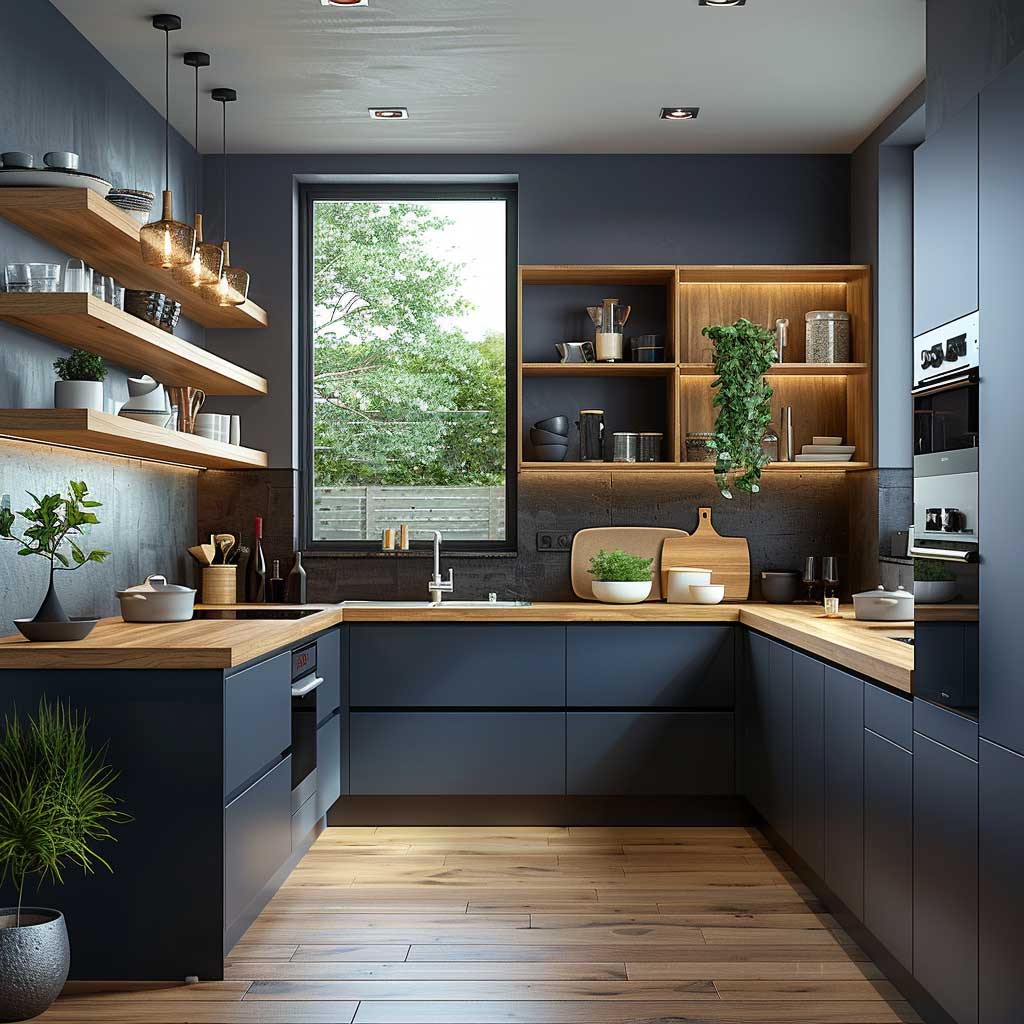
Open shelving with wood brackets is a natural extension of this approach. A common pairing: two or three floating shelves in the same wood species as the countertop, positioned on one leg of the U to break up the all-cabinet expanse. This works well when the shelved wall faces a window — displayed items get light, and the shelving itself doesn’t trap shadows the way upper cabinets would. What doesn’t work: mixing two different wood tones in the same sightline. Dark walnut countertop plus light oak shelves creates a visual friction that undercuts both materials. Choose one and repeat it.
For hardware, brass or unlacquered brushed gold is the recommendation that most kitchen designers land on for blue-and-wood combinations. It costs roughly $8–$25 per pull for mid-range cabinet hardware, which adds up across a full u-shape, but the warmth it adds is structural — not decorative. Polished chrome is technically cleaner but reads colder next to both blue paint and natural wood grain, and the effect is a kitchen that looks assembled rather than considered.
If the space connects to a dining or living area, the u-shape’s enclosed back works as a natural visual boundary without requiring a wall. Keep the countertop material on the open-facing side consistent with the rest of the u — this is what makes the space feel like one room, not two. You can find small u-shaped kitchen design approaches that show how this boundary plays in more compact footprints.
- Don’t mix warm wood with a cool-toned blue and cold hardware simultaneously. Each element pulls the palette in a different direction. Pick warm throughout (wood + brass) or cool throughout (quartz + chrome) — crossing the streams produces a kitchen that feels unresolved rather than eclectic.
- Don’t use open shelving on every wall of the u-shape. The u-shape’s storage value comes from its enclosed cabinets. Open shelving on one wall adds visual relief; open shelving everywhere erases the functional advantage of the layout.
- Don’t choose a matte finish for wood countertops in a high-traffic kitchen. Matte butcher block requires oiling every 1–3 months; a food-safe oil-varnish blend gives you a surface with slightly more sheen but far better water resistance between maintenance cycles.
Nautical Blue Shaker Kitchen U-Shape Without the Clichés
A coastal take on the blue shaker kitchen u-shape gets tiresome fast when it leans too hard into anchors and rope — the goal is the feeling of proximity to water, not a ship’s galley. White shiplap on one accent wall behind open shelving is the right level of coastal reference: it adds texture and breaks the flatness of painted drywall without introducing a themed element. Shiplap installation typically runs $2.50–$7 per square foot for materials alone, which makes it one of the more accessible ways to add architectural interest to a rental-grade box kitchen.


Rope pendant lights are genuinely good in this context — not because they’re nautical, but because a woven texture over an Edison bulb produces a warmer, more diffused light than a metal shade, which suits the relaxed quality that blue coastal kitchens aim for. The trap is buying lights that look like literal rope coils around a bulb; opt for tightly wrapped natural fiber pendants with a clean silhouette instead. A pair hung 30–36 inches above the counter on the center wall of the u-shape provides task lighting where prep work actually happens.
Does the view from the kitchen affect the palette choice? Yes — if the kitchen overlooks a garden or exterior greenery, a slightly more saturated navy works better than a washed coastal blue, because the green exterior light coming through the window will desaturate lighter blues visually. Coastal pale blue reads correctly when the view itself is neutral or sky-lit. For a deeper dive into navy options that pair with coastal references, the modern navy blue kitchen cabinets roundup covers shade selection and coordinating materials in detail.
Natural materials close the loop in the coastal approach without tipping into costume territory: woven seagrass baskets on lower open shelves, a driftwood-toned cutting board left out on the counter, a small terracotta pot with a succulent. The u-shape’s three-wall span gives you enough surface area to introduce these objects without clustering. Clustering is what makes a kitchen look decorated rather than inhabited.
Quartz Countertops Make the Transitional Argument for Blue Shaker
Quartz countertops are the practical choice for a transitional blue shaker u-shaped kitchen because they close the gap between traditional cabinetry and modern use patterns. Standard quartz runs $50–$150 per square foot installed — Caesarstone’s white and light-gray lines, for example, sit on the lower end of the premium range and work with blue shaker doors without requiring an exact shade match. Quartz is non-porous, which matters in a u-shaped layout where counter surface runs along three walls and inevitably accumulates splatter near both the stove and sink zones.


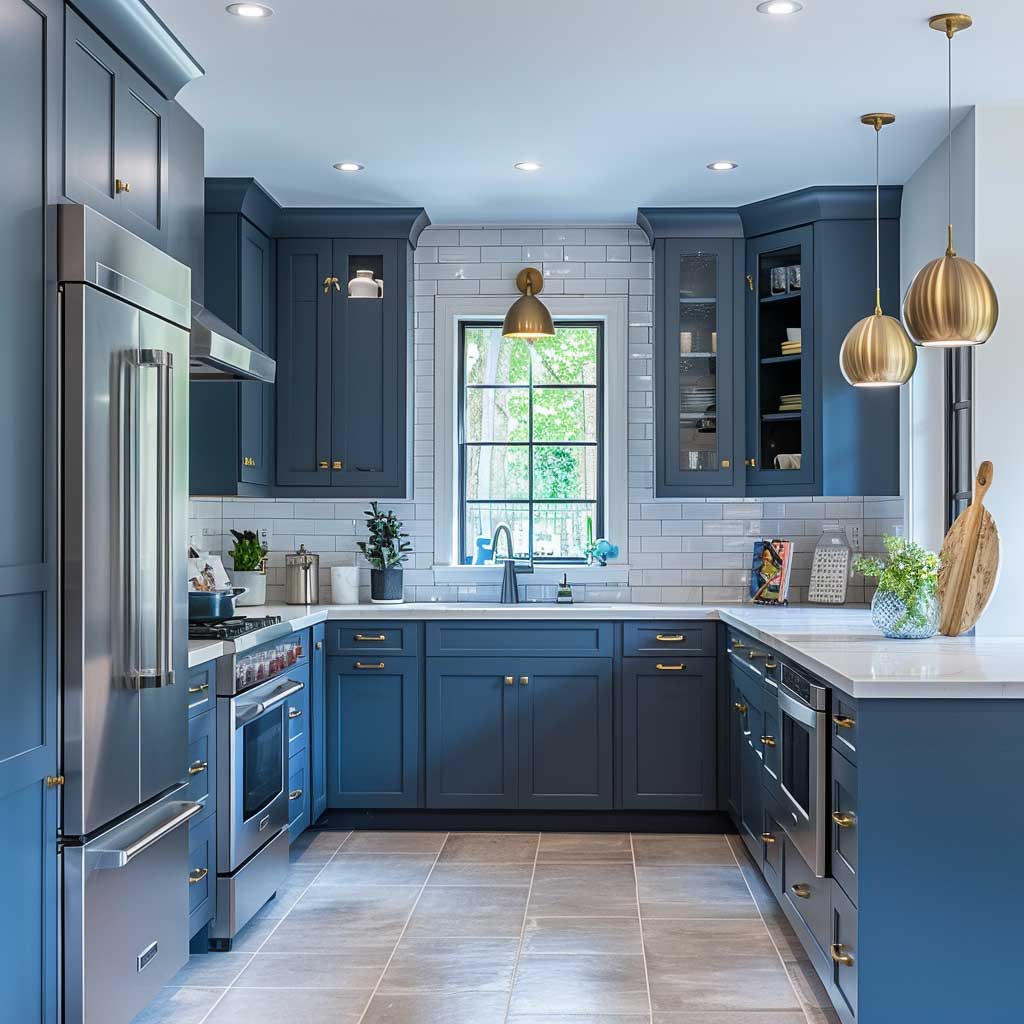
The mosaic tile backsplash is where transitional kitchens earn or lose their cohesion. A small-format mosaic — 1×1 inch or 2×2 inch tiles in a mix of gray, white, and the same blue as the cabinets — ties the surface colors together more effectively than a contrasting color choice would. What you want to avoid: a backsplash in a warm beige or terracotta when the rest of the palette runs cool. The transition between the warm backsplash and the cool cabinetry creates a visible fault line that no amount of accessorizing fixes.
Transitional design handles mixed finishes better than either traditional or modern styles, so this is the place to pair a matte cabinet finish with a polished quartz surface. That finish contrast — flat against glassy — is what gives the kitchen its layered quality. A useful reference when ordering: Caesarstone’s quartz surfaces are available in over 50 colors with both polished and honed finishes, and a full surface catalog is available on their site for pairing directly against cabinet swatches before committing.
Modern integrated appliances — concealed refrigerator panels, flush-mounted induction hobs, under-counter dishwasher drawers — work particularly well in a transitional u-shape because the shaker door profile bridges the gap between the old-fashioned appliance bank and the contemporary concealed approach. The u-shape’s three-wall span gives you room to spread out appliances so they don’t cluster on a single wall, which is the most common layout error in transitional kitchens that feel cramped despite having adequate square footage.
| Style | Countertop Pairing | Key Material | Main Risk |
|---|---|---|---|
| Classic Blue + White | Carrara marble or marble-look quartz | White subway tile backsplash | Double gloss (tile + cabinet) flattens the room |
| Blue + Wood Accents | Butcher block ($40–$100/sq ft) | Brass or brushed gold hardware | Mixing two wood tones in one sightline |
| Coastal Nautical Blue | White quartz or honed marble | Natural fiber pendant lights | Over-theming with anchor and rope motifs |
| Transitional with Quartz | White or light-gray quartz ($50–$150/sq ft) | Small-format mosaic backsplash | Warm backsplash clashing with cool cabinetry |
Bottom Line
A blue shaker kitchen u-shape rewards specificity — the shade of blue, the finish of the countertop, and the clearance between cabinet runs all determine whether the layout works or fights you.
A 107 sq ft minimum footprint gives you the wrap-around counter space that makes the u-shape worth building. Below that, the enclosed three-wall feeling tips from efficient to cramped.
Quartz and butcher block are the two countertop materials that pair most reliably with blue shaker doors — quartz for durability and cool contrast, butcher block for warmth. Marble works but requires maintenance planning.
Hardware finish is the fastest way to correct a palette that’s running too cold: brass pulls on blue shaker doors add approximately $200–$500 to a full kitchen’s hardware budget and shift the room’s temperature more than any paint tweak will. Save this post.
Complete guide
Every Modern Kitchen Design Idea Worth Stealing Right Now
Layout, cabinets, islands, materials, color, lighting — all in one place
Complete guide
Blue Home Color Ideas for Every Room and Style
Navy, sky blue, slate, teal — interiors, exteriors, kitchens, bedrooms — all in one place
You Might Also Like
Related Topics