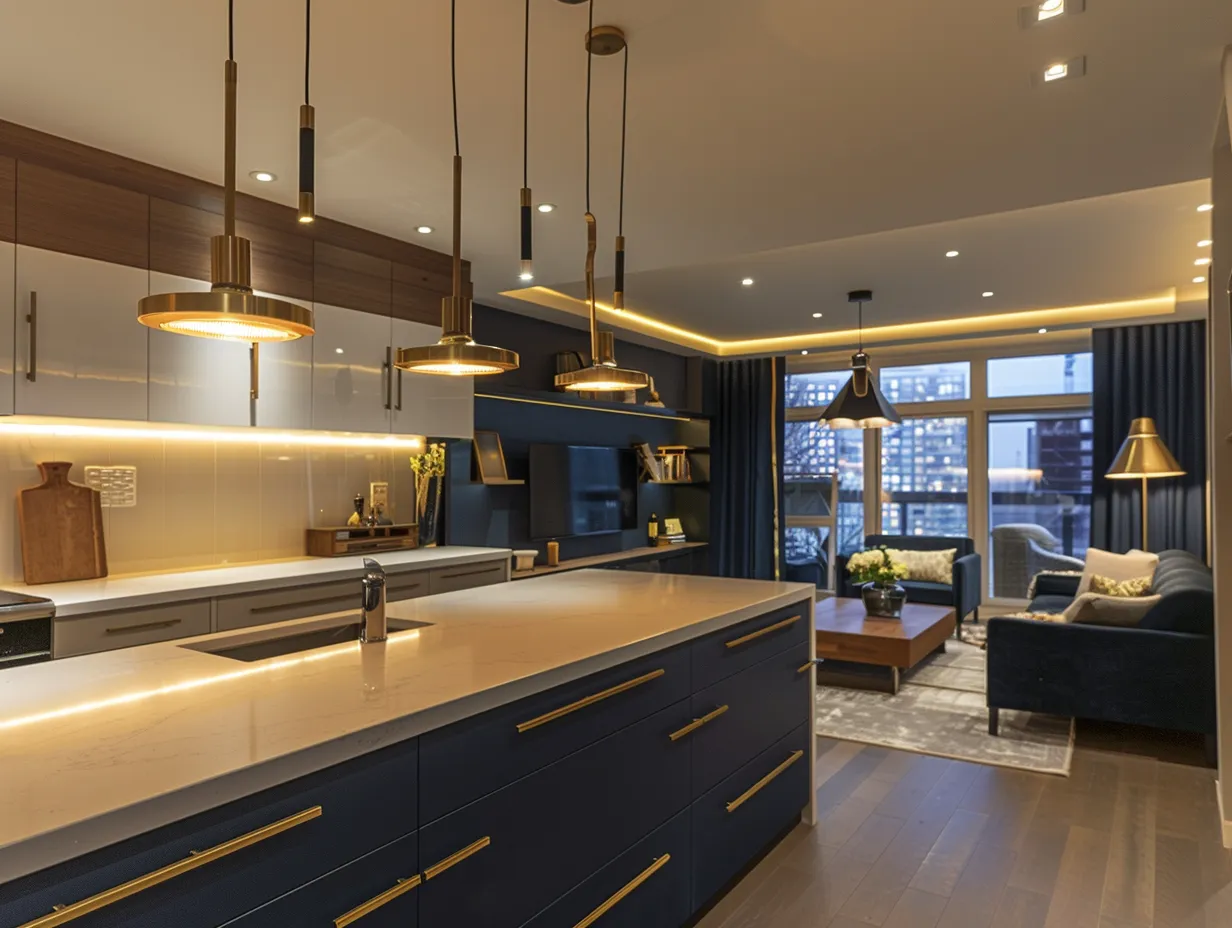
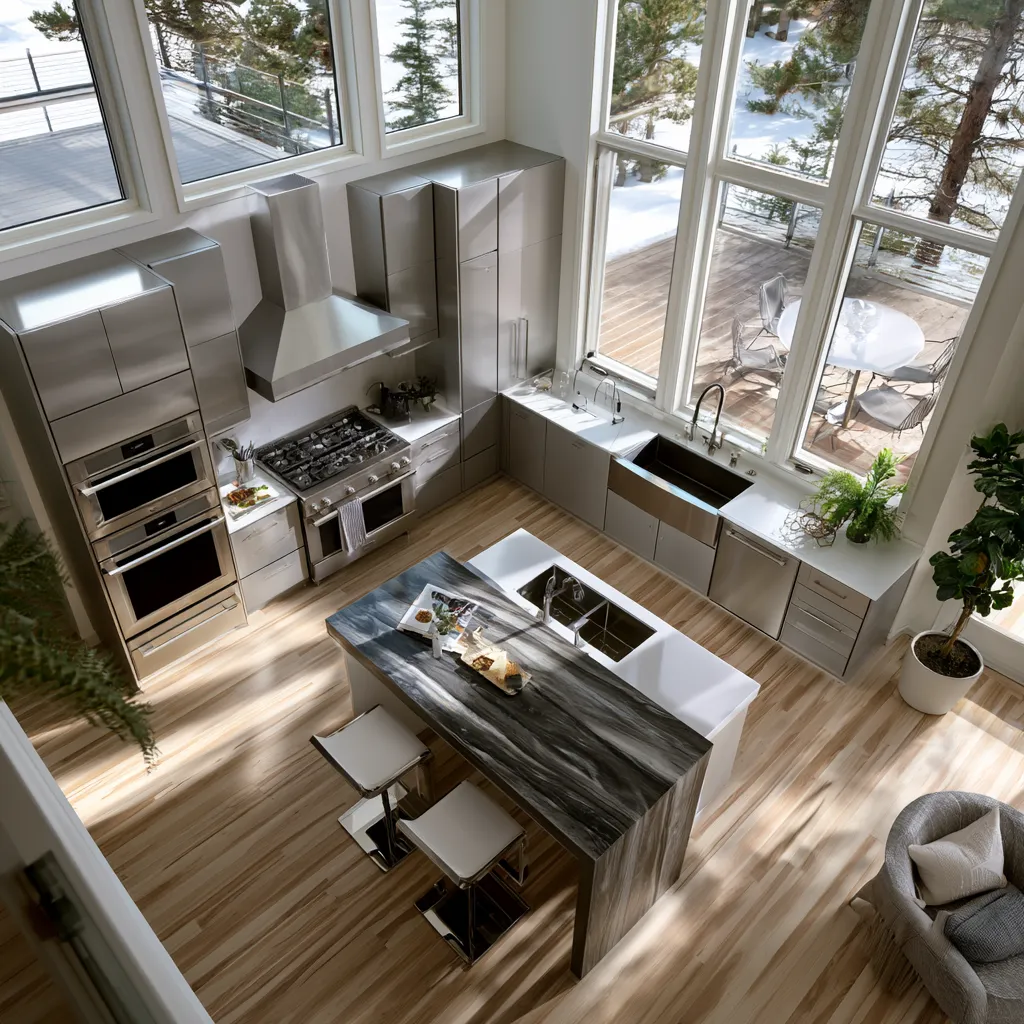
A silver kitchen with neon lights works when the metal does the reflecting and the neon does the coloring, so each layer has one clear job. Matte or brushed silver cabinets bounce the glow without turning into a mirror, while blue and purple LED strips paint the surfaces after dark. Does the look survive daily cooking? Yes, as long as the neon stays accent light and plain white task light covers the counters. Plan the work light first and the color second.
The numbers are friendlier than the look suggests. Contractor cost data puts LED strip lighting at $20–$50 per linear foot installed, and a stainless steel backsplash at roughly $20–$60 per square foot. An average backsplash covers about 30 square feet, so the reflective wall behind the stove usually lands well under the price of a single premium appliance. Budget the backsplash and the lighting together, since one depends on the other.
The three kitchens below move from cabinets and neon strips to a steel backsplash with holographic art, then to silver appliances softened by dark wood. A cost table and a short list of mistakes follow. Read the lighting section first, because every later choice reacts to the glow.
- LED strips cost about $20–$50 per linear foot, while a full under-cabinet job averages around $400.
- Counters need roughly 50 foot-candles of task light, about five times the 10 fc used for ambient glow.
- Stainless backsplash panels run $20–$60 per sq ft installed vs $12–$45 for ceramic tile.
- Simple LED neon flex costs $50–$150 per foot; glass neon runs 2–4 times higher.
- Fingerprint-resistant stainless adds about $100–$150 to a refrigerator but cuts daily wiping.
- Brushed or matte silver beats mirror polish on cabinet doors.
- Keep neon as accent light; white light at 3000–3500K handles prep.
Silver Kitchen Cabinets Under Blue and Purple Neon Lights
Silver kitchen cabinets under blue and purple neon lights look best in a matte or brushed finish, because a flat sheen spreads color instead of throwing hot spots back at you. Think of it like a movie screen: a matte surface shows the whole picture, while a mirror only shows the projector. A high-gloss door reflects every LED dot along the strip. Choose matte silver for any door above waist height.
Neon kitchen lighting needs a white partner to stay practical. Lighting guidelines call for about 50 foot-candles on the counter for food prep, compared with roughly 10 foot-candles for general ambient light. Can colored LEDs reach that level alone? Rarely, since blue and purple light make raw chicken and fresh herbs look the same gray. Run a white under-cabinet strip alongside the colored one and switch them separately.


Cost stays manageable because most kitchens only need a short run. Typical cabinet runs measure 10–25 linear feet, and professional under-cabinet installation usually falls between $200 and $800, with plug-in kits starting near $50. LED strips also last up to 25,000 hours, which is more than eight years at eight hours a day. Measure the run before shopping so the controller and power supply match the length.
The island is where polished silver earns its place, since it sits below eye level and reflects the ceiling glow rather than the strips. A polished top against matte doors works like a chrome bumper on a satin car body, one bright line that defines the shape. Silver works the same way next to pale walls, and the logic behind gray and white palettes that make rooms look larger applies here too. Don’t polish every surface in the room, because three mirror finishes turn neon into glare. Limit high polish to the island top and hardware.
A Mirror-Bright Backsplash Behind Holographic Cyberpunk Art
A metallic silver backsplash behind holographic cyberpunk art turns the wall into a light amplifier, pushing ambient glow back across the counters. Installed stainless panels cost roughly $20–$60 per square foot, compared with $12–$45 for ceramic tile and $22–$75 for glass tile. For a typical 30-square-foot backsplash, steel panels land somewhere between $600 and $1,800. Get quotes on panels and tiles side by side before committing.
Black countertops keep that reflective wall from feeling like a commercial kitchen. The dark slab absorbs light the way asphalt absorbs sun, so the silver above it reads brighter by contrast. Is pure black too heavy for a small room? Not when it stays at counter height and the upper half of the room is light. Keep black horizontal and silver vertical for the cleanest split.


Holographic art needs dim surroundings to read as moving light rather than a flat print. Ambient lighting around 10 foot-candles lets the shifting cityscape stand out, while full 50-foot-candle task light washes it out. Put the art and the work zones on separate circuits. A dimmer on the ambient layer usually costs far less than rewiring later.
Touchscreen appliances finish the futuristic theme, but they bring a price jump. Smart appliances typically cost 20–50% more than basic versions of the same model. Does every appliance need a screen? No, and one connected oven reads as more deliberate than five glowing panels. Pick the single appliance you touch most and upgrade only that one.
Dark Wood Warms a Silver Kitchen With Neon Wall Art
Metallic silver appliances with cyberpunk wall art need a warm counterweight, and dark wood cabinetry is the most reliable one. Steel alone feels like a server room after sunset, while walnut or smoked oak adds the warmth of a leather car seat inside a metal body. Stainless refrigerators generally cost $100–$200 more than white or black versions. Spend that premium on the appliances people see first, not the ones hidden behind panels.
Fingerprints are the real cost of a shiny metal kitchen. Fingerprint-resistant stainless typically adds about $100–$150 to a refrigerator, compared with daily wiping for an uncoated finish. Is the coating worth it in a busy family kitchen? Usually yes, though harsh cleaners and abrasive pads can damage it. Wipe coated fronts with mild soap and a soft cloth only.


Neon wall art carries the cyberpunk mood, and LED neon flex keeps it affordable. Simple LED neon runs about $50–$150 per linear foot, while traditional glass neon generally costs two to four times more. A home-sized sign usually lands near $200–$600. Choose LED flex for a kitchen, since it runs cooler near cabinets and food.
Industrial layouts handle this mix of steel, wood and glow especially well, and L-shaped industrial kitchens with stainless accents and exposed brick show how the same materials sit in a longer run. Don’t scatter neon across every wall, because four glowing pieces read like a bar, not a kitchen. One art piece plus one strip under the island is usually enough. Repeat one neon color from the art in the island strip to tie the room together.
Price and Lifespan of Every Neon Kitchen Layer
Neon lights and metallic surfaces compare most clearly when cost, lifespan and upkeep sit in one place. The table below uses typical installed ranges from contractor cost data and manufacturer ratings. LED options win on running cost, since LED under-cabinet lighting costs roughly $1–$5 a year to operate in standard kitchen use. Compare the upkeep column as closely as the price column.
| Layer | Typical cost | Lifespan or durability | Upkeep | Best role |
|---|---|---|---|---|
| White LED strip | $20–$50 per linear ft installed | Up to 25,000 hours | Low, wipe off grease | Task light on counters |
| RGB LED strip | $20–$50 per linear ft plus controller | Up to 25,000 hours | Low, controller may need replacing | Neon glow under island and toe-kick |
| LED neon flex sign | $50–$150 per linear ft | Long rated life, cool running | Low | Wall art and signage |
| Glass neon sign | 2–4 times LED flex price | Fragile glass tubing | Higher, transformer service | Statement piece away from cooking |
| Stainless backsplash | $20–$60 per sq ft installed | Very durable | Shows smudges, wipe often | Reflective wall behind range |
| Glass tile backsplash | $22–$75 per sq ft installed | Durable, grout lines age | Moderate, grout cleaning | Colored shimmer under neon |
Under-cabinet labor often makes up 40–60% of the total bill, so a plug-in strip can halve the cost of a hardwired one. Detailed ranges by cabinet length and fixture type appear in this under-cabinet lighting cost breakdown. Is hardwiring ever worth the extra spend? It is when switches need to sit on the wall instead of on a dangling cord. Hire an electrician for anything that runs inside the cabinet box.
Don’t Do This
- Don’t rely on colored neon for prep; counters need about 50 foot-candles of white light, not 10.
- Don’t choose mirror-polished cabinet doors; brushed silver hides fingerprints and LED dots far better.
- Don’t hang glass neon above the range; LED flex costs 2–4 times less and runs cooler.
- Don’t put touchscreens on every appliance; smart models cost 20–50% more each.
- Don’t use glass cleaner or scouring pads on fingerprint-resistant stainless.
Where the Glow Pays Off
A neon silver kitchen pays off when about 20 feet of LED strips and 30 square feet of reflective backsplash do most of the visual work. That combination often costs less than one premium appliance and changes the room more.
Split the light into two layers from day one. White strips at 3000–3500K cover the counters, while blue or purple strips handle mood on a separate switch.
Keep surfaces mostly matte. Brushed silver doors with one polished island top give contrast without glare, and dark wood or black stone adds the warmth steel lacks.
Treat neon art as one statement piece. LED flex at $50–$150 per foot gives the cyberpunk glow without glass tubing near the stove.