A red and white house exterior announces itself from the end of the street in a way that beige never will. The contrast between saturated red and crisp white is one of the few color pairings that reads as intentional at every scale — on a front door, across a full roof, or wrapped around a garage fascia. That clarity is also what makes it unforgiving when you get it wrong.
Color proportion is the variable most homeowners underestimate. Red reads as aggressive when it covers too much surface and disappears as a decorative quirk when it covers too little. White needs to be the right white — a warm or yellowed white muddies the contrast; a stark blue-white turns the whole facade cold. The sections below work through four distinct configurations of the pairing, with specific numbers and material notes so you can actually price and plan the change.
Landscaping does more work than most people expect in this palette. A continuous band of deep green — hedges, ornamental grass, boxwood — acts as the visual buffer that stops red from looking aggressive against white. Without that third element, the two-color scheme can read as a graphic rather than a home.
- A red front door with white trim is the lowest-commitment entry point — one quart of paint, one afternoon, measurable curb appeal change
- White walls with red accent shutters and door keep red under 20% of visible wall area, which is the sweet spot before the palette tips into overwhelming
- Red tile roofs with white siding last 50+ years when properly installed — the longest-lasting version of this combination
- White garage with red trim is the most underused configuration; it frames the largest flat surface on most facades without competing with the front door
- Benjamin Moore Caliente AF-290 and Heritage Red HC-181 are the two reds most consistently recommended by colorists for white-siding exteriors
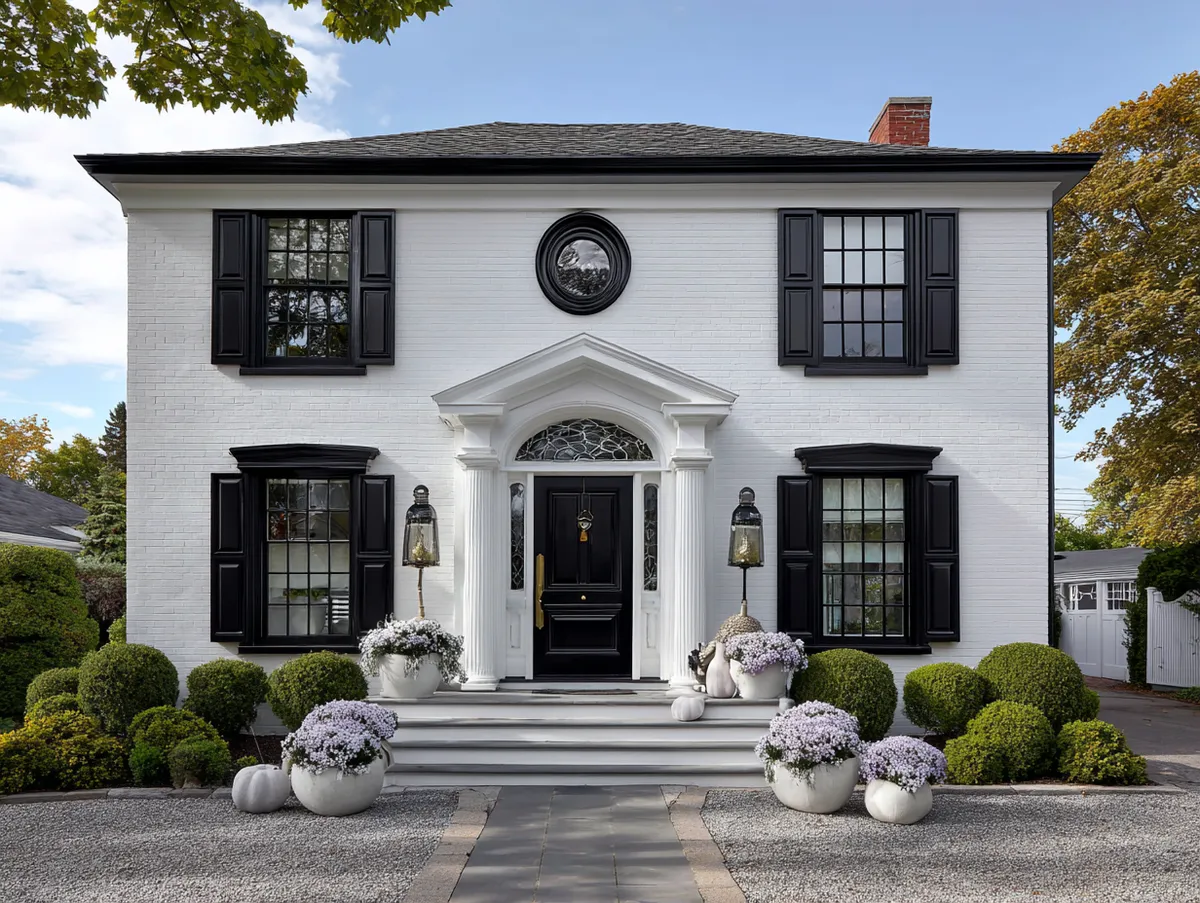
A Red Front Door Changes the Read of the Whole White Trim Facade
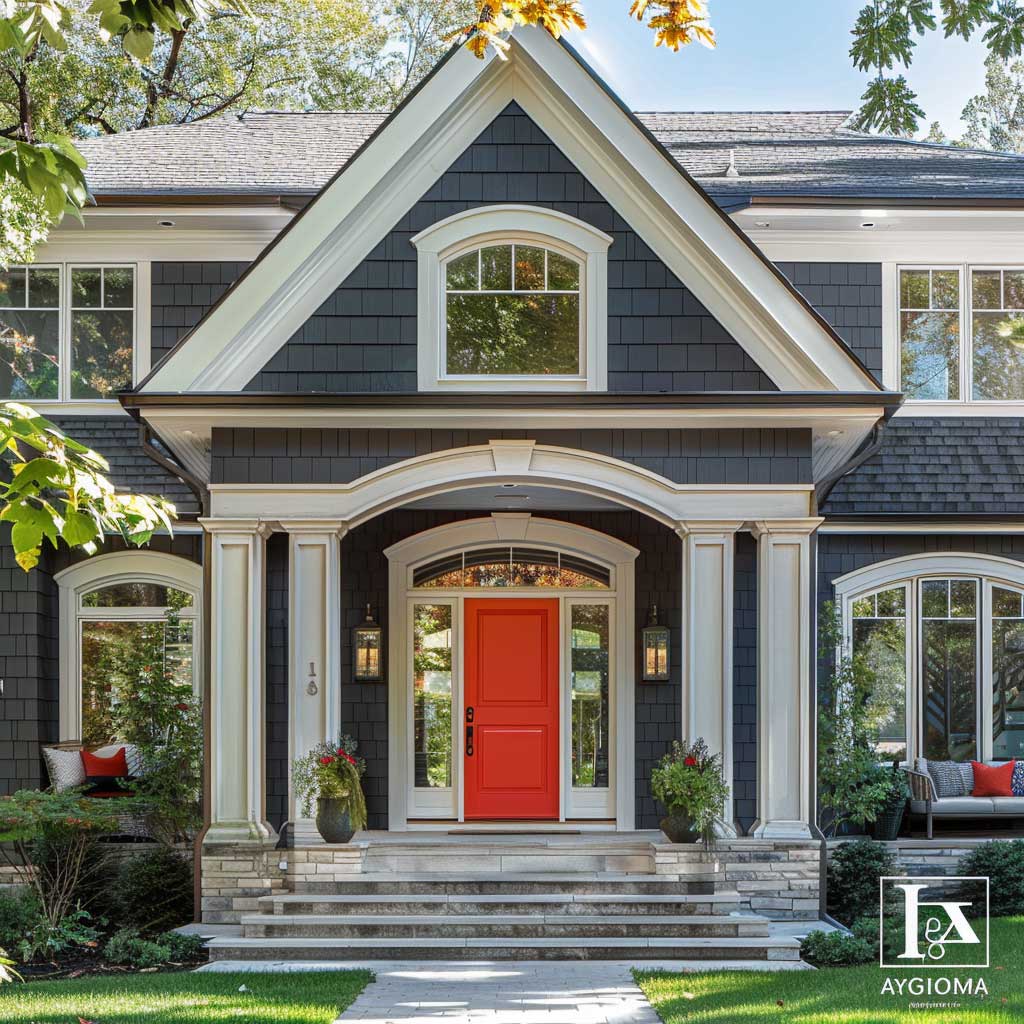
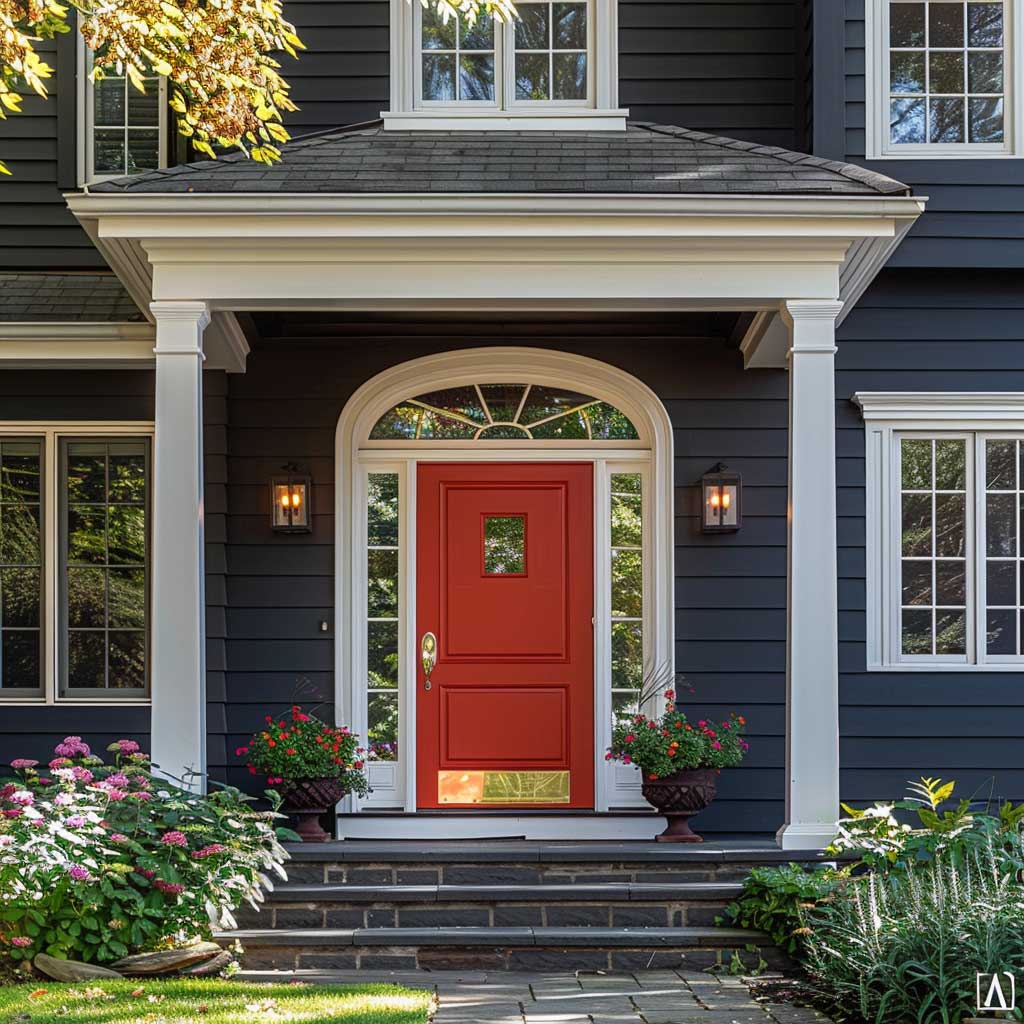
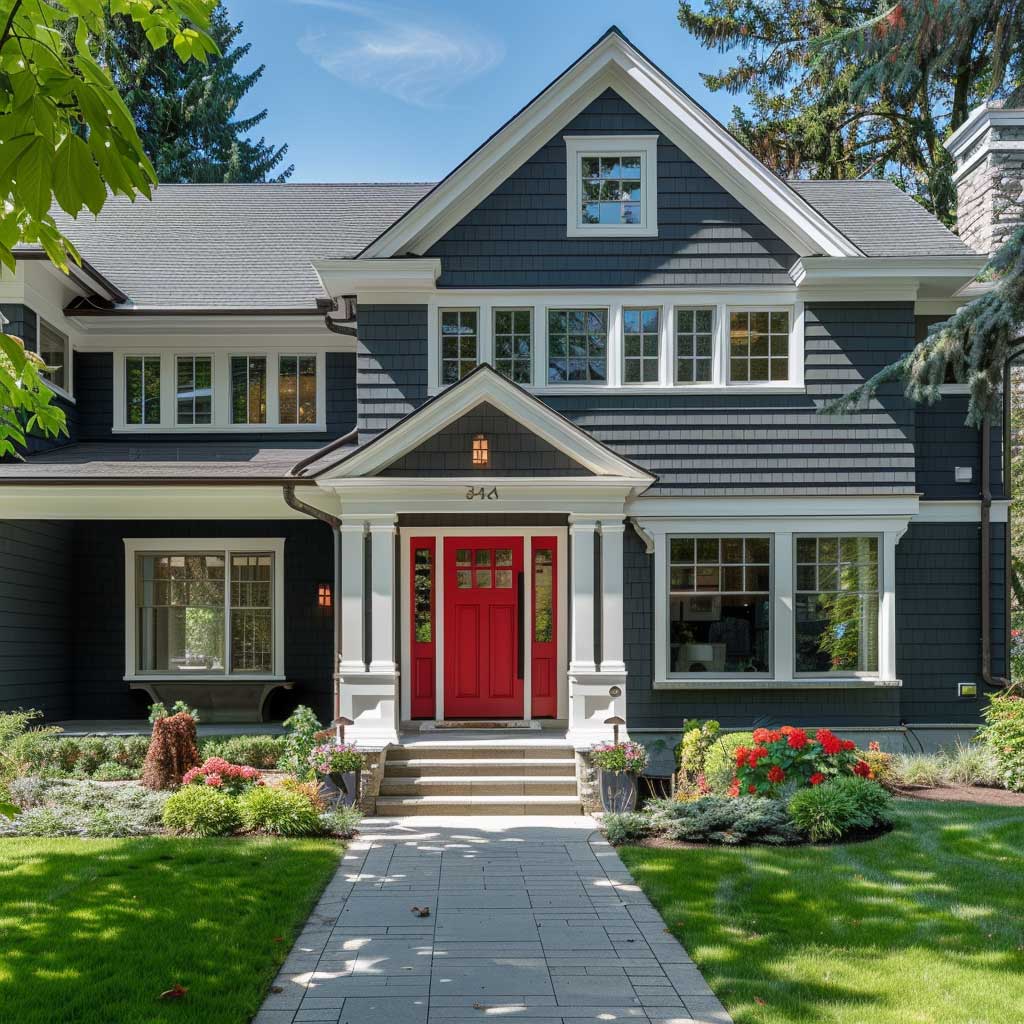
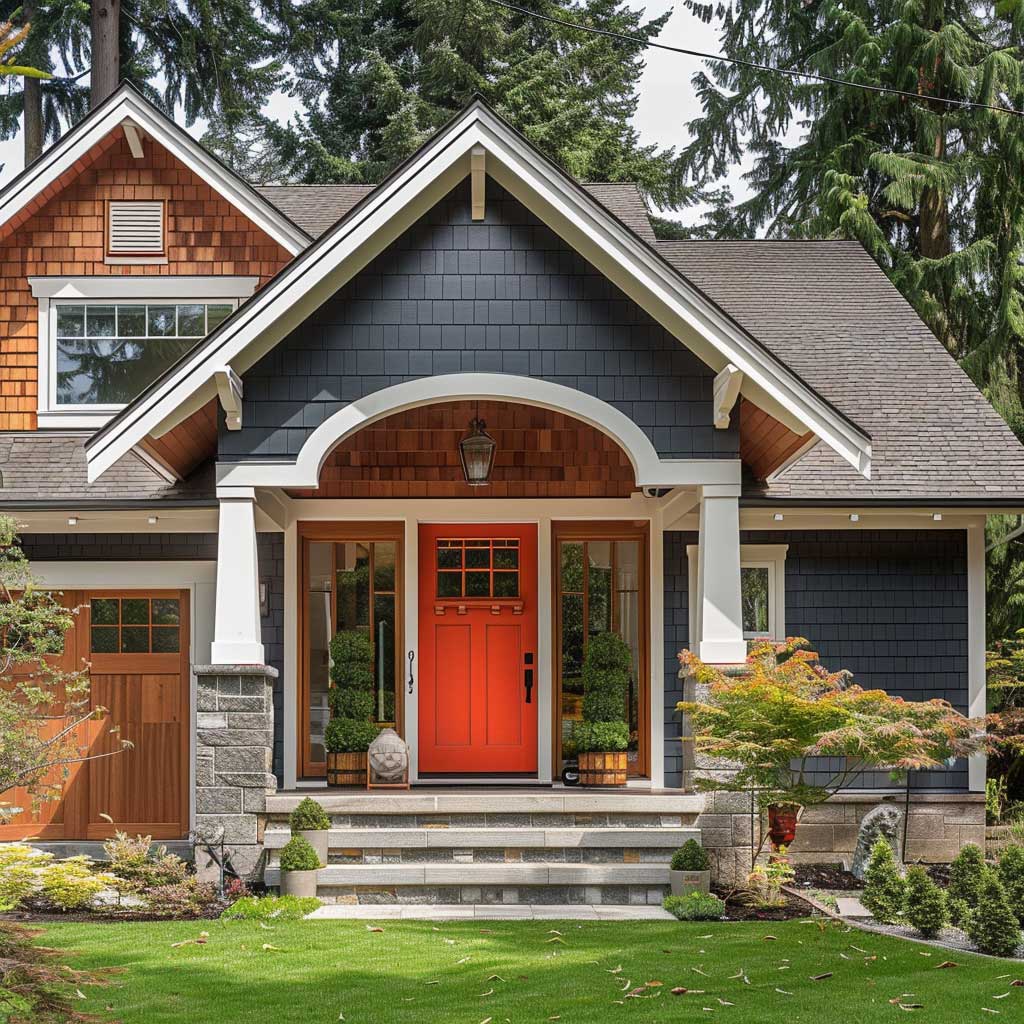
On a red and white house exterior, the front door is doing disproportionate work for its size. A door covers roughly 20 square feet of the facade — less than 2% of a typical two-story elevation — but it’s where the eye lands on every approach. Painting a front door red costs between $80 and $500 for professional application depending on door size and paint quality, according to Angi. Benjamin Moore’s Caliente AF-290 and Heritage Red HC-181 are the two reds colorists reach for most consistently on white-sided homes — the former for brighter, more energetic facades, the latter for homes with traditional detailing where a slightly aged, dusty red reads more naturally.
White trim functions as a frame that controls how much visual weight the red carries. Think of it the way a mat board works in framing — the wider and crisper the white surround, the more contained and deliberate the red reads. A door with 4-inch trim reads more casual than the same door with 8-inch pilasters and a pediment. What doesn’t work: cream or off-yellow “white” trim against a high-saturation red. The two warm tones compete, and neither reads clearly. Designers recommend a true white — Benjamin Moore Super White OC-152 or Decorator’s White OC-149 — when pairing with reds in the Caliente or Vermilion range.
Does the finish matter as much as the color? Yes, and it’s the detail most homeowners overlook. Benjamin Moore’s Element Guard exterior paint is specifically formulated for front doors, designed to resist wind-driven rain and humidity without the color chalking out within two seasons. Satin or semi-gloss finishes protect better than flat and give the red its characteristic depth under direct sunlight. Flat red on a door looks cheap within two years — the finish wears unevenly and the color appears chalky rather than saturated. A quality exterior semi-gloss in red runs roughly $50–$100 per gallon for premium paint.
Surrounding the door with established greenery — even two symmetrical planters with clipped boxwood — shifts the combination from graphic to architectural. The green absorbs some of the red’s intensity and grounds the entrance in a way that potted annuals alone don’t achieve. Sleek hardware in matte black or unlacquered brass extends the color story without adding a third paint color, which is where most DIY door makeovers go sideways.
White Walls Work as a Canvas Only When the Red Accents Hold the Right Proportion
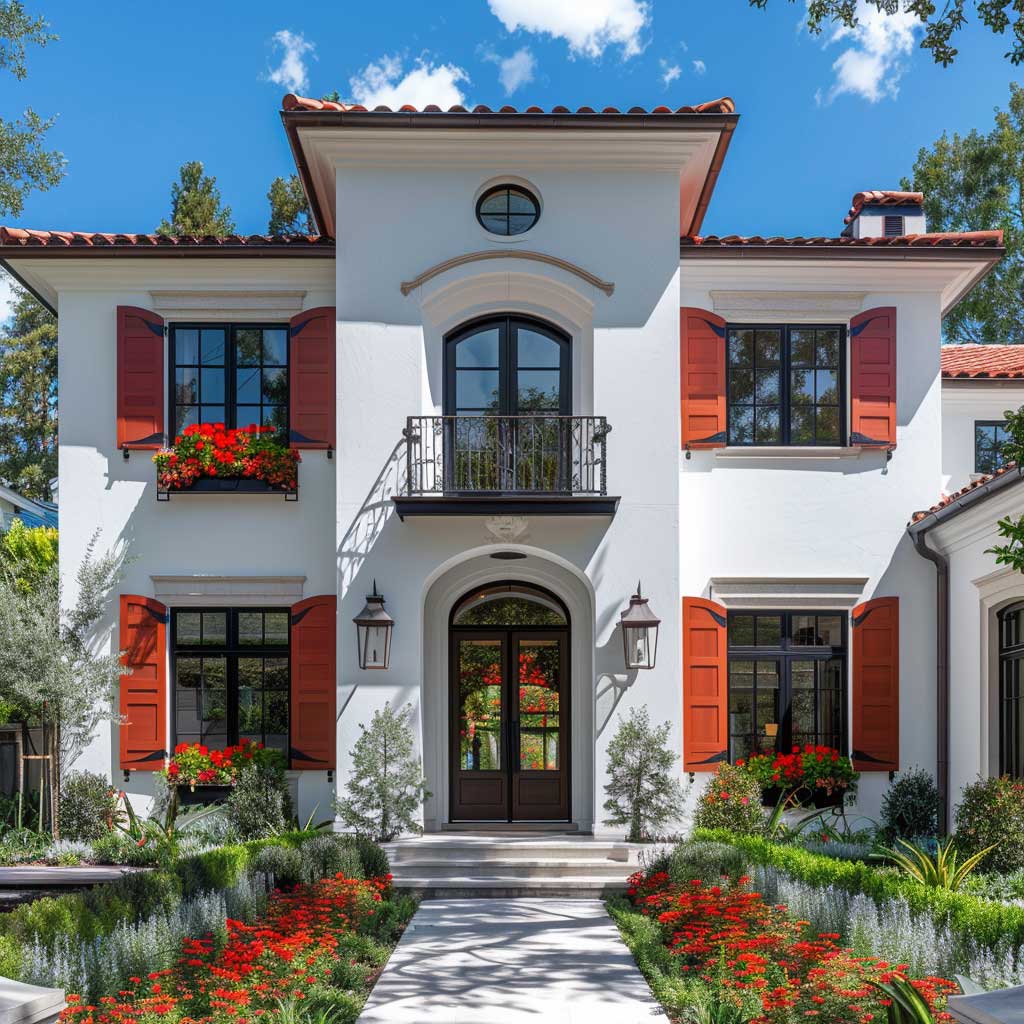
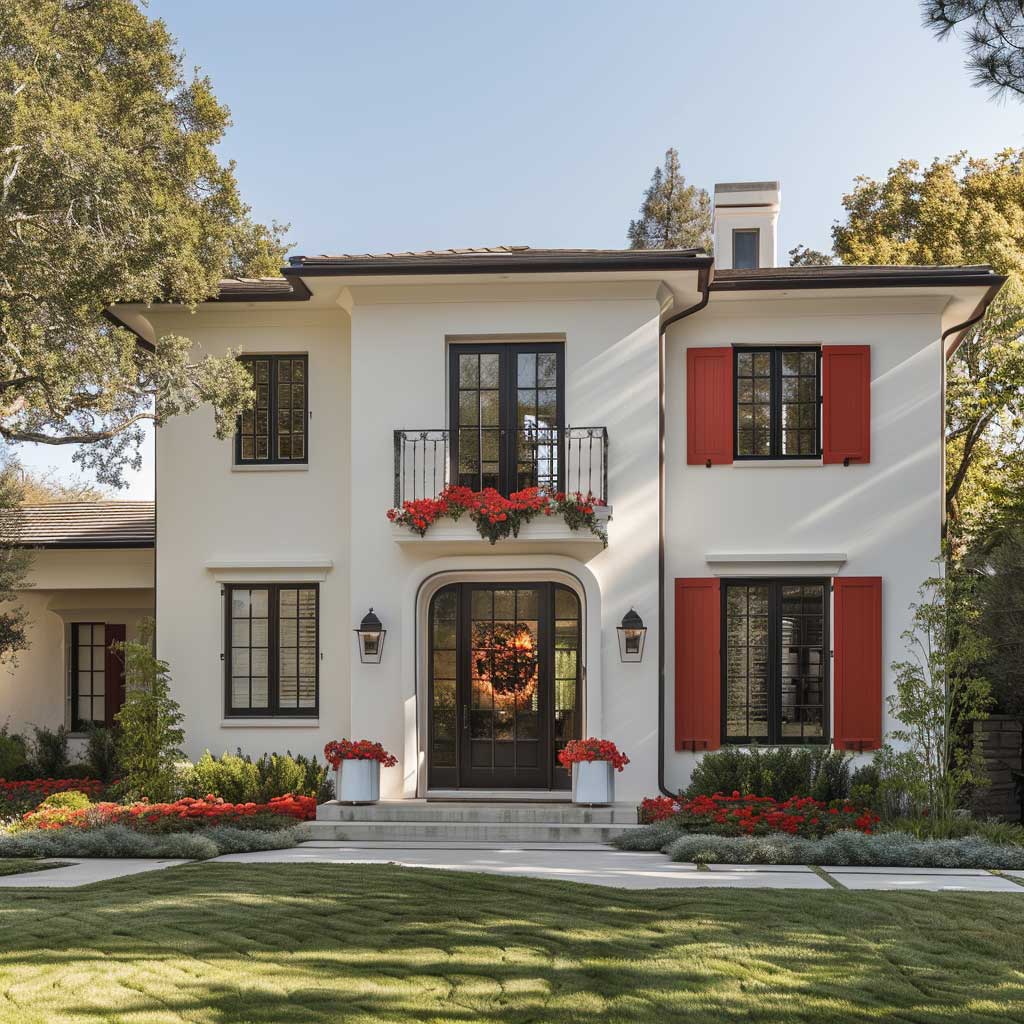
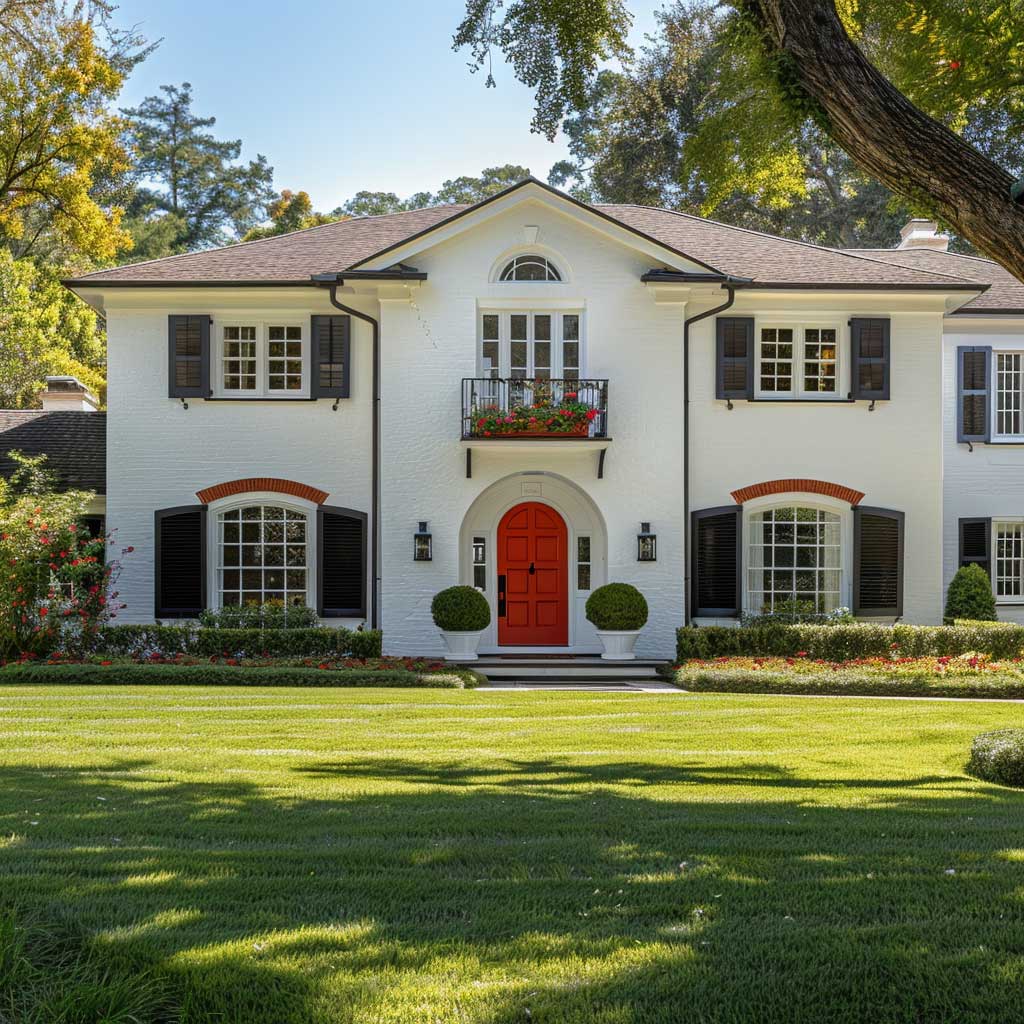
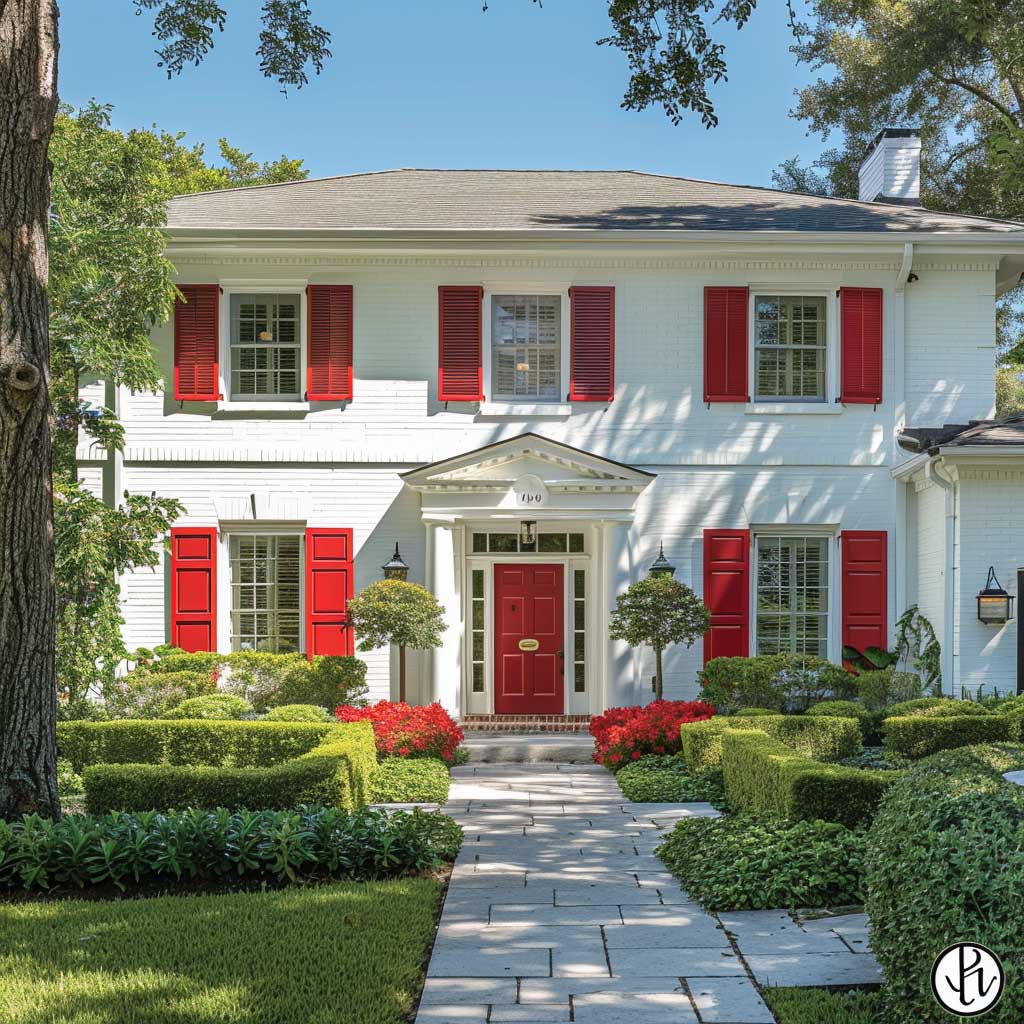
White walls with red accents on the shutters, door, and window surrounds keep the red and white house exterior scheme legible without saturating the facade. The working rule is that red should cover no more than 15–20% of the total visible wall area from any single vantage point. Beyond that, the white stops reading as a field color and starts looking like a background the red is trying to escape. Vinyl siding installation on an average home runs $4–$12 per square foot installed, according to multiple contractor sources — choosing a clean, bright white in that range gives you the neutral field that makes every red accent count.
Shutters are a more forgiving place to introduce red than the door, because they appear in pairs and create visual rhythm rather than a single focal point. The trick here is scale: shutters that are correctly sized to the window (wide enough that they would actually cover the glass if closed) read as architectural. Undersized shutters — the common builder default — look decorative in the pejorative sense, like stickers applied to the facade rather than functioning elements. On a home with six windows, two oversized red shutters flanking the two central windows will read better than six pairs of undersized ones.
This configuration works across more architectural styles than the front-door-only version because it distributes the color across the facade rather than concentrating it at one point. Colonial, Cape Cod, and farmhouse styles with symmetrically placed windows look naturally suited to this treatment. Contemporary homes with asymmetric window layouts require more planning — what reads as rhythm on a traditional facade can look scattered on a modern one. Stylists recommend mocking the shutter placement with kraft paper cutouts before committing to paint or new hardware. A garden with established hedges or ornamental grasses in front of the white base ties the palette to the ground plane in a way that foundation planting lists in most landscaping catalogs don’t actually achieve.
- Don’t use warm-toned white for the siding base — cream, ivory, and antique white all push the red accents toward orange when seen together in outdoor light. Use a true white with a neutral or slightly cool undertone.
- Don’t paint shutters red on a house where the door is a different accent color — three separate accent colors on one facade turns the exterior into a color sampler. Red shutters demand a red door, or no shutters at all.
- Don’t skip primer on shutters before red paint — red pigments have low hiding power and will show bleed-through in as little as two seasons if applied without a quality exterior primer first.
- Don’t mix shutter styles and materials — louvered red shutters next to board-and-batten red shutters on the same facade undermine the coherence that makes this scheme work.
Red Roof White Siding Puts the Boldest Version of This Exterior Palette Overhead
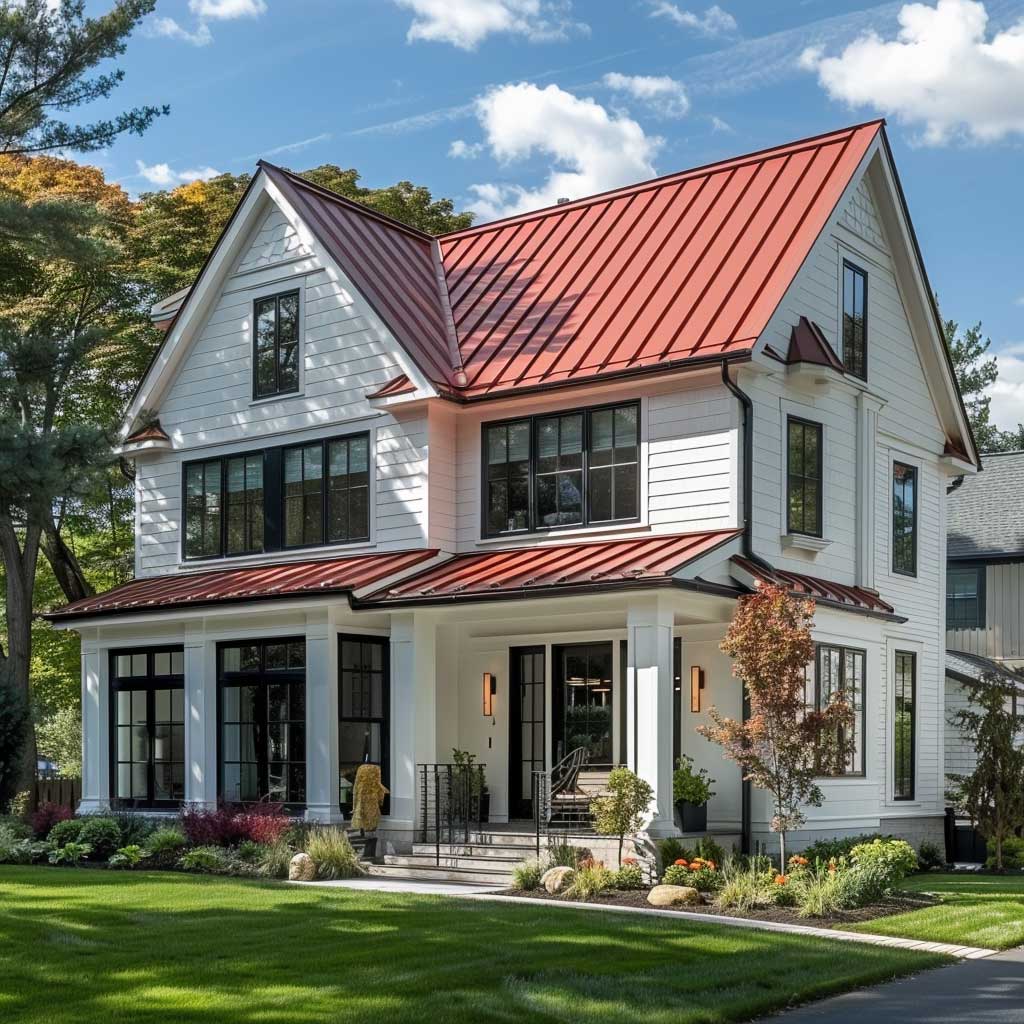
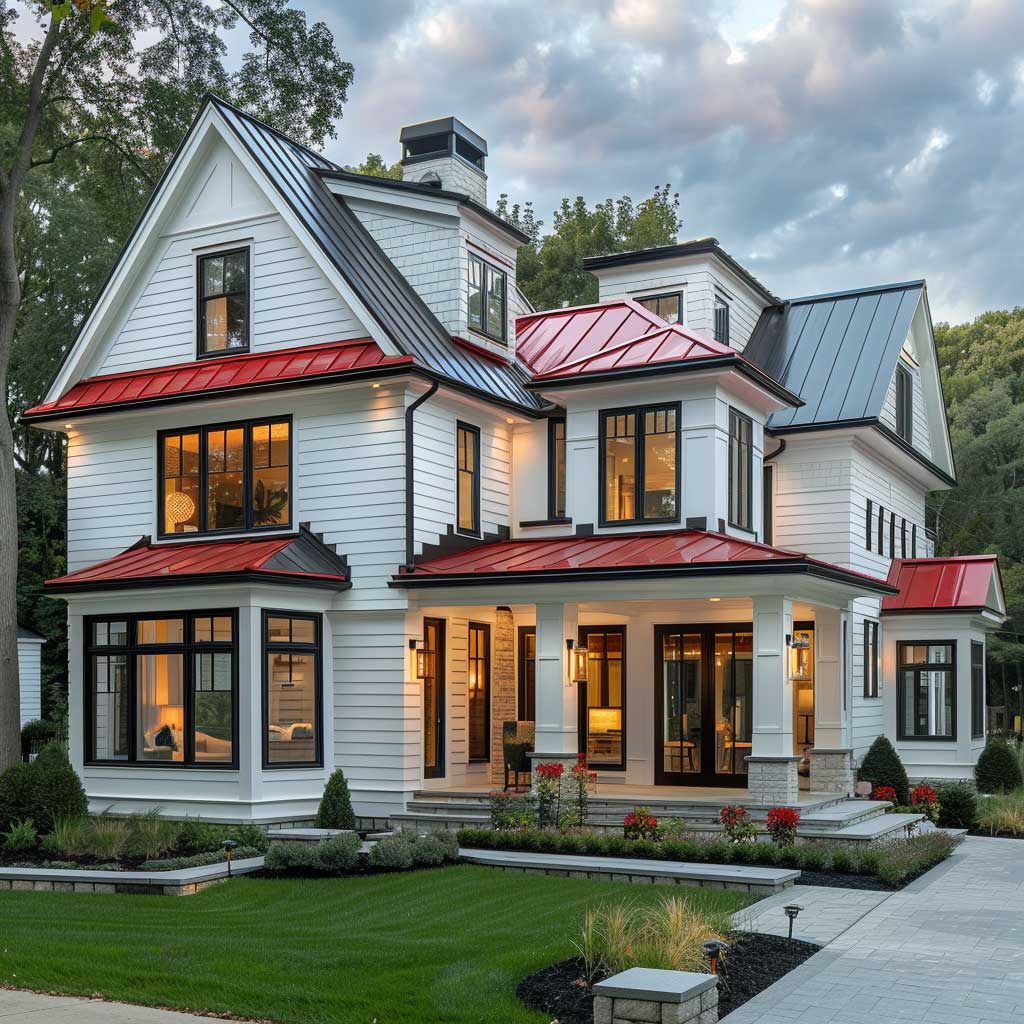
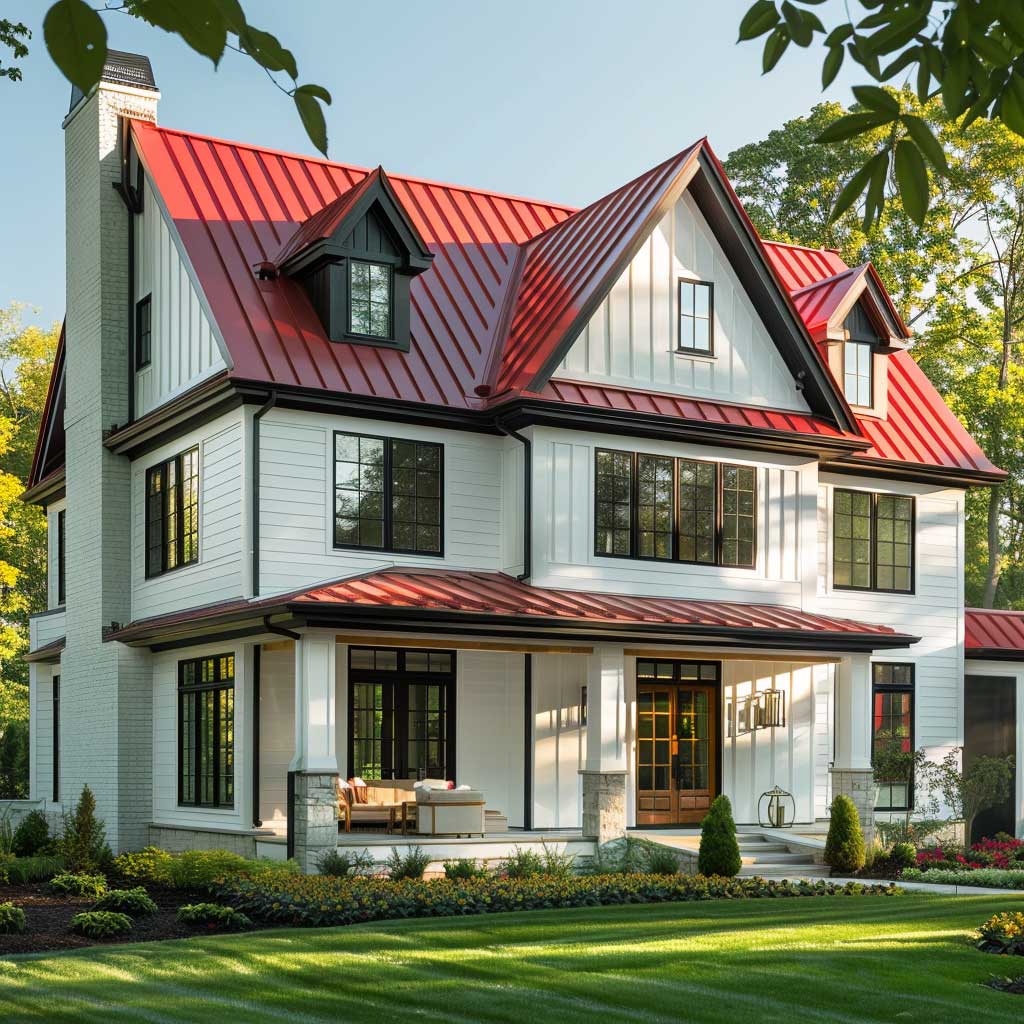
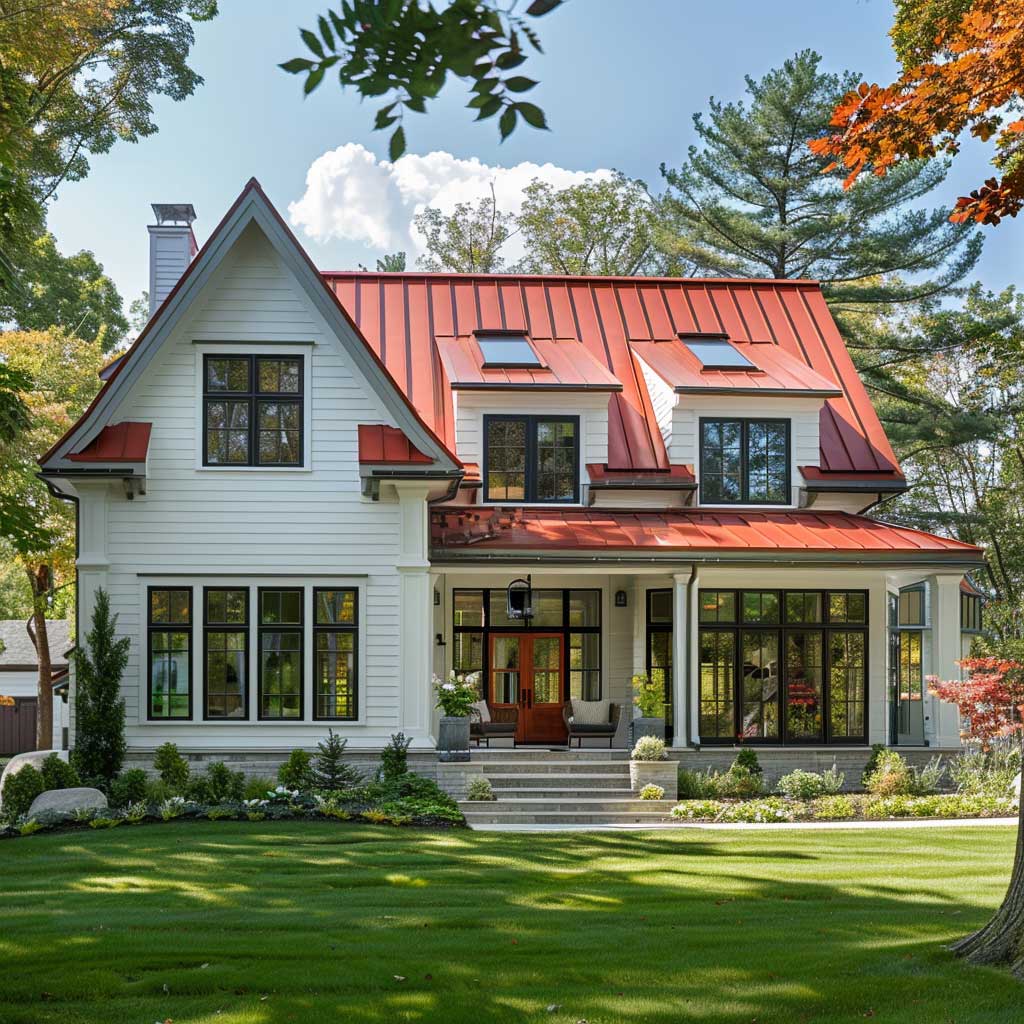
A red roof paired with white siding is the most permanent version of the red and white house exterior — the color decision that costs the most to reverse and carries the longest investment horizon. Red clay tile roofs properly installed last 50 years or more, according to the Tile Roofing Institute; red asphalt architectural shingles have a shorter 20–30 year lifespan but a significantly lower installation cost. That durability gap matters when you’re committing to a color that reads from three blocks away. The combination is historically associated with Mediterranean villas and Spanish colonial architecture, which means it lands most naturally on homes with stucco or low-pitched siding profiles. On a flat-roofed contemporary, the same red roof reads as incongruous rather than classic.
White siding costs $4–$12 per square foot installed for vinyl — the most common substrate for this configuration — based on contractor data from Angi and Hover (2026). Fiber cement in white runs higher at $5–$14 per square foot, but holds its color more cleanly against the red roof over time because it doesn’t yellow the way vinyl can after a decade of UV exposure. A yellowed white siding against a bright red roof is worse than no scheme at all — the yellow undertone makes the red read orange rather than true red, and the whole combination shifts from classic to tired. For homeowners considering how the red roof integrates with broader wall color options, the red roof house color schemes guide on ArtFasad covers the full palette logic from earthy neutrals to charcoal and white.
Large windows are an underutilized design move in this configuration. They break up the white siding expanse horizontally, preventing the wall from reading as a blank field against the dominant red roof. The proportional question to ask is whether the roof or the siding commands more visual attention from the street — on most residential lots, the roof plane seen at a 45-degree approach angle covers roughly 60% of the perceived facade. What doesn’t work: a warm tan or beige siding as a substitute for white. The warmth in tan fights the warmth in red rather than contrasting it, and the home loses the clean graphic clarity that makes this scheme worth executing. White is not negotiable in this pairing.
Most Homeowners Ignore the Garage — Red Trim on White Changes That Immediately
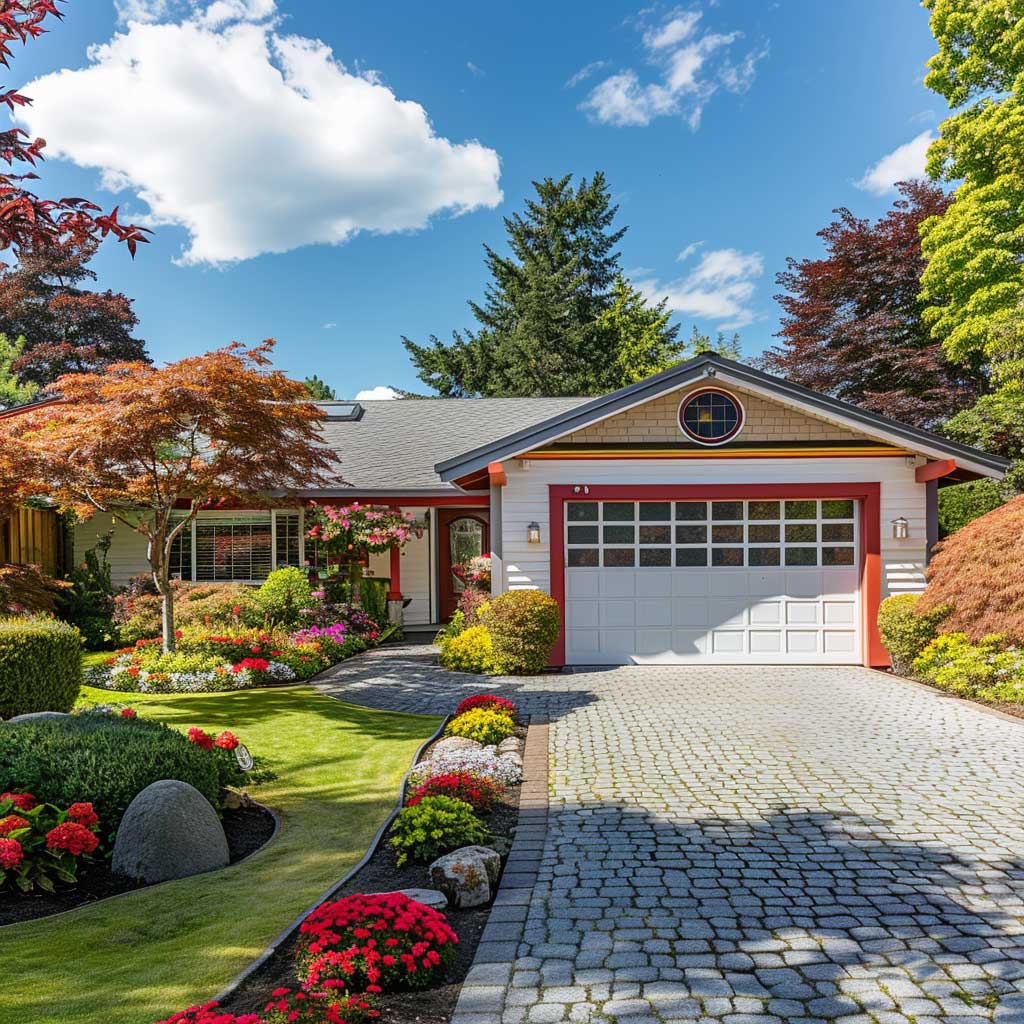
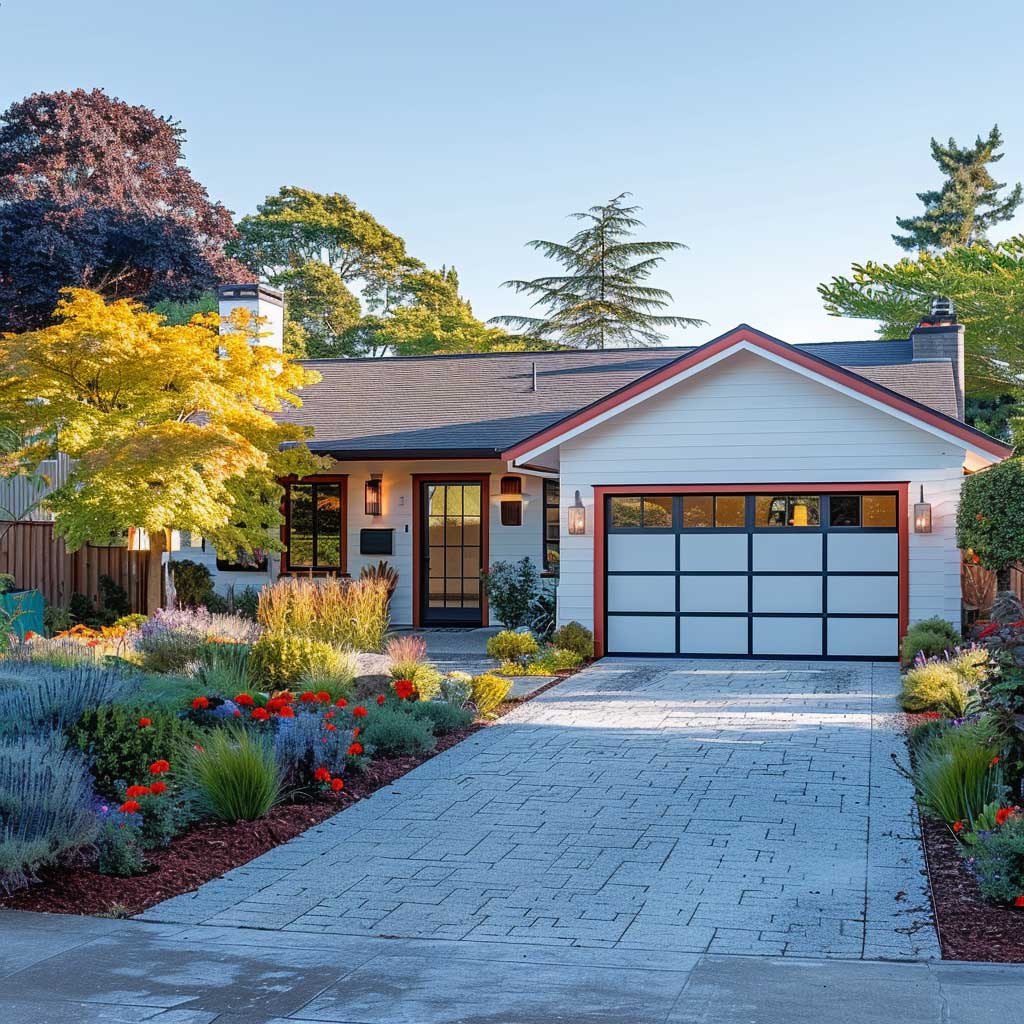
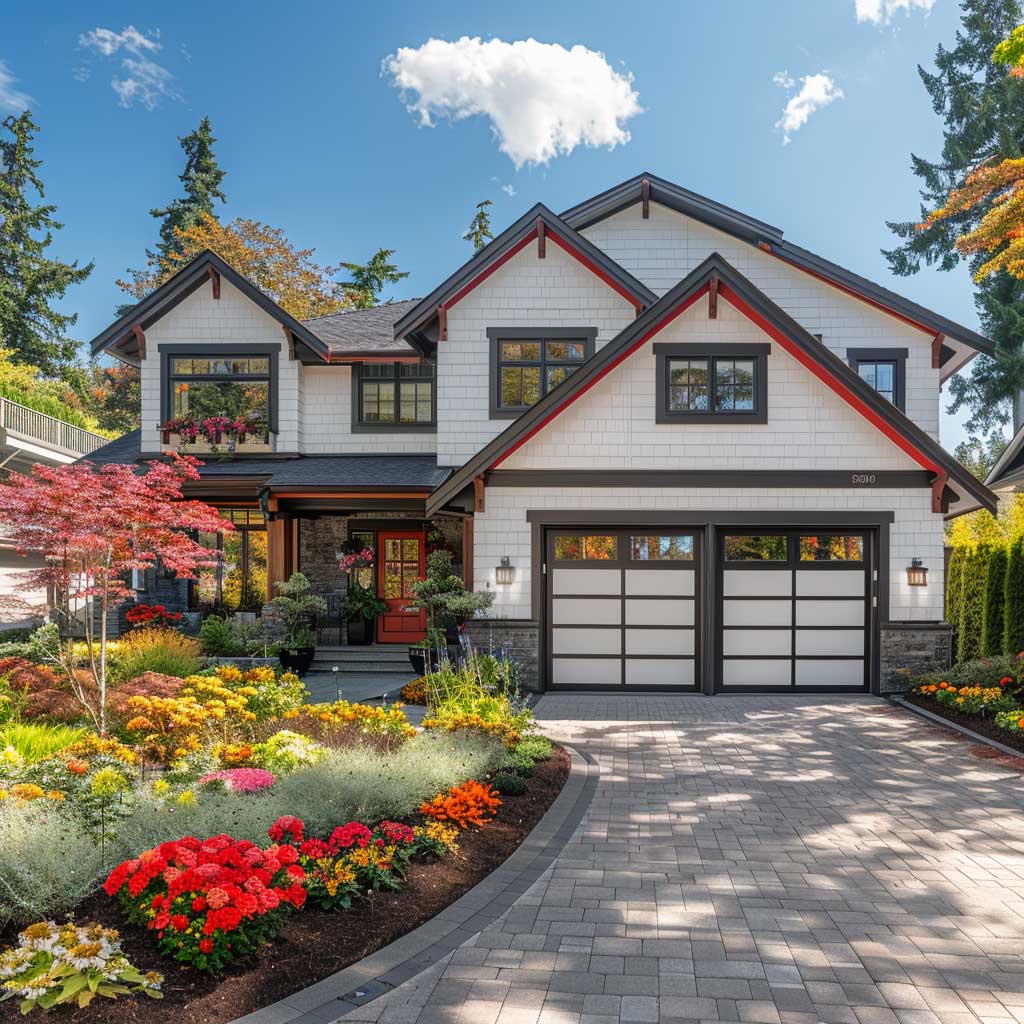
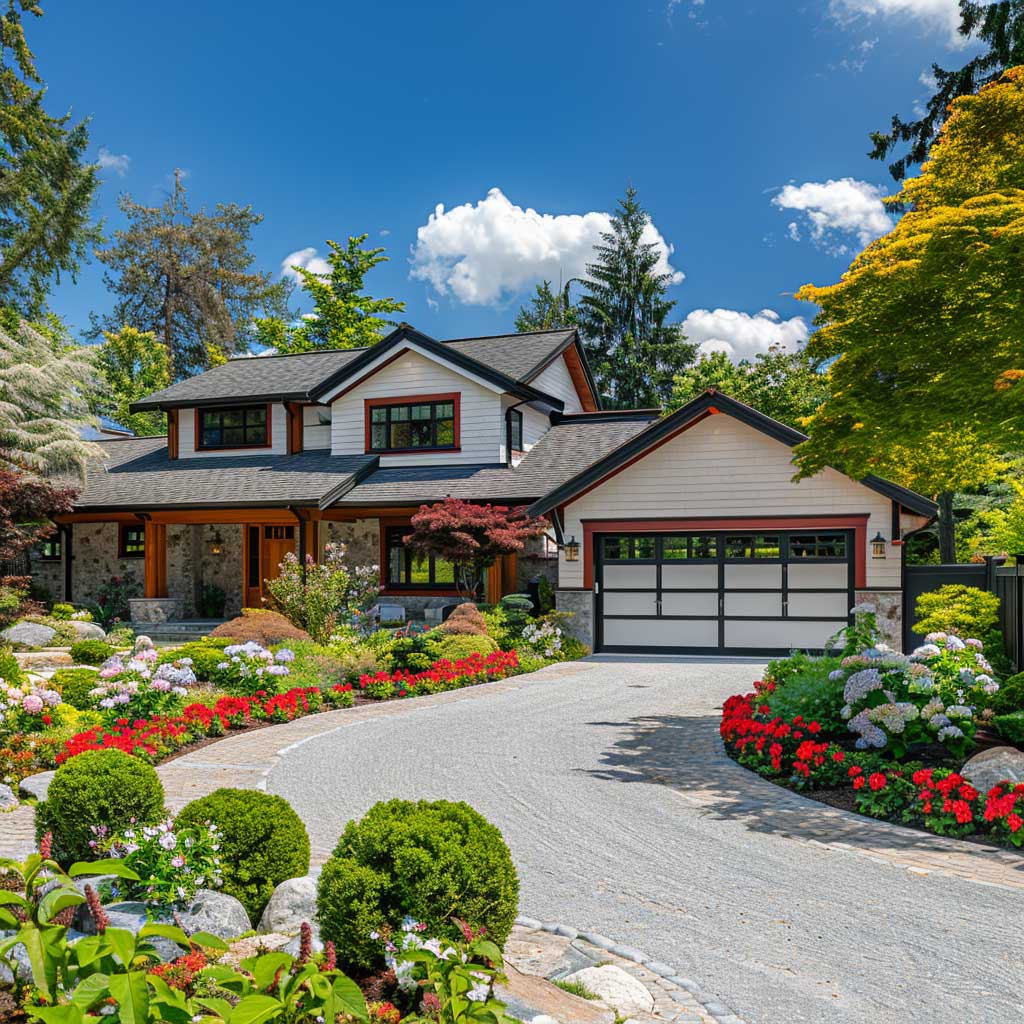
On most suburban homes, the garage door covers between 8 and 16 feet of the front facade — often the single largest continuous surface visible from the street. Leaving it white with no detail treatment makes the garage the visual anchor of the whole house by default. Adding red trim to a white garage redirects that attention deliberately, turning the garage from a void into an architectural element. Professional garage door painting averages $350, with a range of $150–$1,200 depending on door size and materials, according to Angi. For less than half the cost of a sofa, it’s one of the highest-return exterior updates available by dollar per square foot of visual impact.
Red trim applied to a white garage works across three zones: the door panel edges and rails, the window surrounds on doors that include glass inserts, and the fascia board directly above the opening. Applying red to all three creates a framed effect — the garage reads as a composed architectural bay rather than a garage door with some paint on it. The proportion rule for this configuration is the reverse of the accent-wall approach elsewhere: the red trim should be thinner and more linear rather than broad or blocky. A 3-inch red band on panel edges reads as intentional; a 6-inch band looks like someone ran out of white paint mid-door. For homeowners looking at how red pairs with different siding materials beyond white, the red and charcoal house siding material guide covers fade resistance and proportion logic that applies to any bold exterior combination.
What does the red trim look like in ten years? Red pigments on exterior trim fade faster than almost any other color category. On a south- or west-facing garage in a sunny climate, expect noticeable color shift within 5–7 years with standard exterior paint. Applying a quality alkyd or 100% acrylic exterior paint in semi-gloss, with a primer coat specifically designed for the door material, extends that to 8–10 years before repainting is needed. Using darker metal — black or dark bronze — for hardware against the red trim locks the palette without introducing a fourth color. White hardware against red trim creates a competing focal point that makes the trim feel accidental rather than designed.
| Configuration | Red Coverage | Best Material Choice | Repaint Interval |
|---|---|---|---|
| Red front door / white trim | Under 5% of facade | Premium exterior semi-gloss, alkyd or 100% acrylic | 5–8 years on door |
| White walls / red accents (shutters + door) | 10–20% of facade | White vinyl or fiber cement siding; red in semi-gloss | 8–10 years |
| Red roof / white siding | Roof dominates — 50%+ visual plane | Red clay tile (50+ yr) or architectural shingles (20–30 yr) | Tile: minimal; shingles: replace at 20–30 yrs |
| White garage / red trim | Under 10% of garage surface | Alkyd or 100% acrylic exterior semi-gloss on metal/composite door | 5–10 years |
Benjamin Moore’s red front door paint page at benjaminmoore.com offers side-by-side swatches of every red in their exterior line against white siding — a useful reference for narrowing down specific shade before ordering samples. Benjamin Moore red front door colors shows Caliente AF-290, Heritage Red HC-181, and Vermilion 2002-10 in real facade contexts, which is more useful than a chip alone.
Final Take
Red and White Works Precisely Because It Refuses to Be Neutral
The version you choose — door, accents, roof, or garage — determines how far that statement travels. A red front door reaches the neighbors; a red tile roof reaches the neighborhood.
Proportion and material selection matter more than the specific shade. Red pigments are UV-unstable; the finish and substrate you choose determines whether the color holds for 5 years or 25.
White needs to be a true white. Any warm undertone in the white base works against the contrast and makes the red read orange rather than red. Test both colors on the actual facade surface for 48 hours before committing. Save this post before consulting a paint supplier or contractor — the proportion rules and material notes here are the ones worth having in your pocket.