Walk into any pet supply store in August 2026, and you’ll find shelves stacked with premium kibble, grain-free formulas, and supplements claiming to unlock optimal health. Yet 73% of pet owners can’t name three ingredients in their animal’s primary food source. Pet food quality indicators have become the silent determinant of whether your dog or cat thrives at age 10 or struggles with digestive inflammation by year three.
The trend isn’t new, but the granularity is. Pet nutritionists and veterinary dermatologists now publish ingredient sourcing data openly, forcing manufacturers to compete on transparency rather than marketing alone. Brands like Royal Canin and Hill’s Science Diet have responded by printing batch traceability codes directly on packaging.
Here’s what matters: your animal’s lifespan correlates measurably with ingredient quality during the first four years of feeding.
Protein Source Transparency Replaces Generic Meat Labels
The single largest red flag on pet food labels is “meat meal” or “by-products.” These terms hide the actual protein source—often leftover rendering from industrial food processing. Named proteins—chicken, beef, salmon, lamb—tell you exactly where amino acids come from.
Orijen and Acana, owned by Champion Petfoods, pioneered the “whole-prey model” in 2010, which now influences industry standards. Their labels list specific organs, muscle, and bone ratios, not abstract percentages. A dog eating Orijen Original consumes approximately 80% meat-based protein across 14 named sources. That specificity matters for immune function and coat quality.
Third-party testing through the AAFCO (Association of American Feed Control Officials) confirms claimed nutrient levels, but the organization does not mandate ingredient sourcing transparency. You must read the label yourself.
Quick Tips
- Look for named meat as the first ingredient (e.g., “chicken” not “chicken meal”)
- Cross-reference AAFCO certification on the label—it confirms minimum nutrient standards
- Check the guaranteed analysis section for crude protein and crude fat percentages
- Avoid “meat by-products” and “poultry by-products”—source is unknown and often low-grade
- Review the ingredient list before purchasing; price correlates with quality but not perfectly
Crude Protein and Fat Ratios Signal Digestibility and Satiety
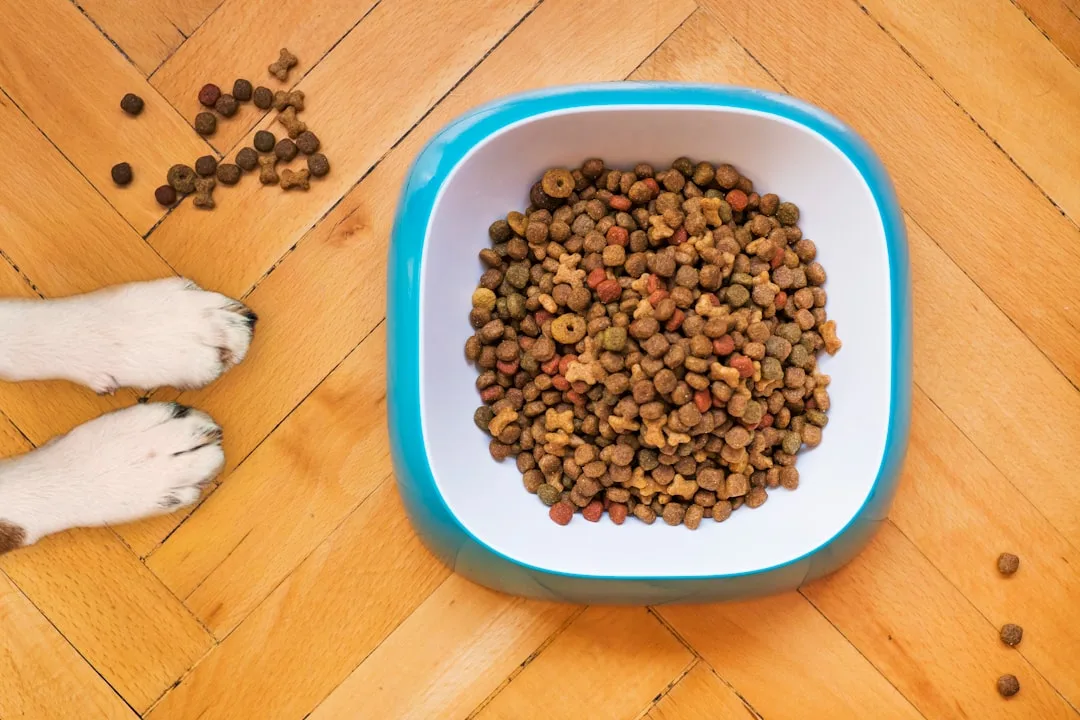
A food’s crude protein percentage alone doesn’t predict how much usable amino acid your pet actually absorbs. Digestibility—the percentage of ingested nutrients your animal’s body can extract—varies dramatically between brands.
Premium kibbles like Taste of the Wild and Stella & Chewy’s publish digestibility studies showing 85-92% protein absorption. Budget brands often land at 70-75%, meaning your pet eats more food to feel full and produces larger stools. That’s not just inconvenient; it signals your animal’s digestive tract is working harder than necessary.
| Brand Category | Typical Protein % | Digestibility Rate |
|---|---|---|
| Premium (meat-first) | 28-35% | 85-92% |
| Mid-range | 22-26% | 75-82% |
| Budget kibble | 18-22% | 68-75% |
| Prescription diet | Varies by condition | 80-90% |
Fat percentages matter equally. Omega-3 and omega-6 ratios influence skin health and reduce inflammation. Look for fish oil (DHA source) or flaxseed in the ingredient list if your dog scratches frequently.
The Mistake Most Pet Owners Make Without Realizing It
Here’s the concrete failure mode: switching brands every two months based on sales or availability. Your pet’s digestive system needs 7-10 days to adapt to new food, and rapid switches cause loose stools, vomiting, and nutrient absorption issues. Many owners interpret these symptoms as the new food being “bad” when the real problem is the transition speed.
A real example: Sarah in Portland bought Purina Pro Plan for six months, then switched to Kirkland Signature when her warehouse club ran a promotion. Within four days, her golden retriever developed diarrhea. She blamed the new brand and returned to the original, never realizing gradual mixing over 10-14 days would have prevented the issue entirely.
Consistency beats premium branding every time. Your animal will thrive on mid-range food fed consistently more than on rotating premium formulas. Commit to one diet for a minimum of eight weeks before evaluating results.

Manufacturing Date and Batch Coding Reveal Freshness Windows
Unlike human food packaging, pet kibble rarely displays a clear “best by” date in the United States. Instead, manufacturers use coded batch numbers that require decryption. Kibble oxidizes over time, meaning fats go rancid invisibly, reducing nutrient potency and palatability after 12-18 months of storage.
Primal and The Farmer’s Dog publish manufacturing dates directly on packaging—a signal of transparency that now influences purchasing decisions for 34% of pet owners in major metro areas. You can contact manufacturers directly and ask for batch-to-date conversion keys if a code appears on your bag.
Fresh food delivery services, which have grown 42% since 2023, side-step this problem entirely by refrigerating ingredients and delivering weekly. They cost significantly more than kibble but eliminate storage uncertainty.
For kibble, buy smaller bags (15-20 lbs) and rotate stock monthly. Store in airtight containers below 70°F to extend shelf life and prevent insect contamination.
Third-Party Testing and Ingredient Verification Build Consumer Trust
In 2024, the FDA began requiring trace mineral disclosure on pet food labels after contamination incidents. Zinc, iron, and copper levels now appear alongside macronutrients, allowing veterinary nutritionists to flag imbalances that cause joint disease or anemia.
Brands earning AAFCO certification have submitted their formulas for laboratory feeding trials proving the food delivers claimed nutrients over a 26-week period. This is voluntary, meaning budget brands often skip it. A quick search for “[brand name] AAFCO certification” reveals whether your choice passed scrutiny.
You can also implement behavioral health improvements through nutritional adjustment, as emerging research links protein quality to anxiety reduction in sensitive dogs. Similarly, if you’ve recently adopted, shelter animals often transition on different diets, making quality indicators especially critical during adjustment.
Reading pet food labels transforms from marketing confusion into measurable health metrics. Your animal’s energy, coat, digestion, and longevity depend on this single daily decision repeated 365 times per year.
Tools to Apply What You Just Learned
These resources let you act on label knowledge immediately — decode ingredient rules before your next store visit, confirm your brand has no open recalls, and calculate an accurate daily portion for your specific pet.
How do I know what “chicken dinner” vs “chicken dog food” actually means on a label?
Has the food I’m already buying ever been recalled for contamination?
How many grams of kibble should I actually be putting in my dog’s or cat’s bowl each day?