Tranquil living spaces rarely come from expensive finishes, and this house proves it with two humble materials: plywood on the walls and joinery, timber on the floors. The pairing works because both surfaces share one warm, low-contrast palette, so the eye stops jumping between textures. Interior-grade plywood costs roughly $12–$40 per 4×8 sheet, while Baltic birch runs about $45–$110, which keeps a fully wood-lined room within a modest renovation budget. If you want calm on a tight spend, start with the walls rather than the furniture.
Does plywood actually look calm, or just unfinished? It reads as calm when sheets are cut to a consistent grid, sanded smooth and sealed with a matte or clear coat. Timber flooring then carries the long-term load: solid hardwood typically lasts 50–100 years and can be sanded back 4–6 times. Treat the floor as the investment and the plywood as the mood-setter.
Below you will find real price ranges, side-by-side tables of plywood grades and floor types, and the mistakes that make wood-lined rooms feel like a site shed instead of a retreat. Each figure reflects typical market averages and manufacturer data, so use the numbers as planning ranges rather than quotes. Local pricing shifts with freight and season, so ask suppliers for a per-sheet breakdown before you order.
Quick Scan
- Interior softwood plywood costs about $12–$40 per 4×8 sheet; Baltic birch sits at $45–$110.
- Installing plywood on walls typically adds $1.50–$6.50 per sq ft in labor.
- Perforated birch plywood reaches NRC 0.4–0.6, while plain sheets absorb very little sound.
- Solid hardwood floors last 50–100 years vs 25–50 years for most engineered boards.
- Wear layer decides engineered floor life: 2 mm allows 1–2 refinishes, 4 mm allows 3–4.
- Refinishing costs $3–$8 per sq ft, roughly half the price of a new floor.
- One wall material plus one floor species calms a room faster than three competing woods.
Why Plywood Interiors Feel Calm Instead of Cheap
Plywood interiors earn their calm from repetition: the same grain, the same pale tone and the same sheet module repeated across walls, ceilings and storage. In this home the panels run through the living areas as one continuous skin, so no single surface fights for attention. A standard sheet measures 4×8 feet, giving 32 sq ft of coverage and a natural grid for joints. Plan your layout around that module before buying a single sheet.

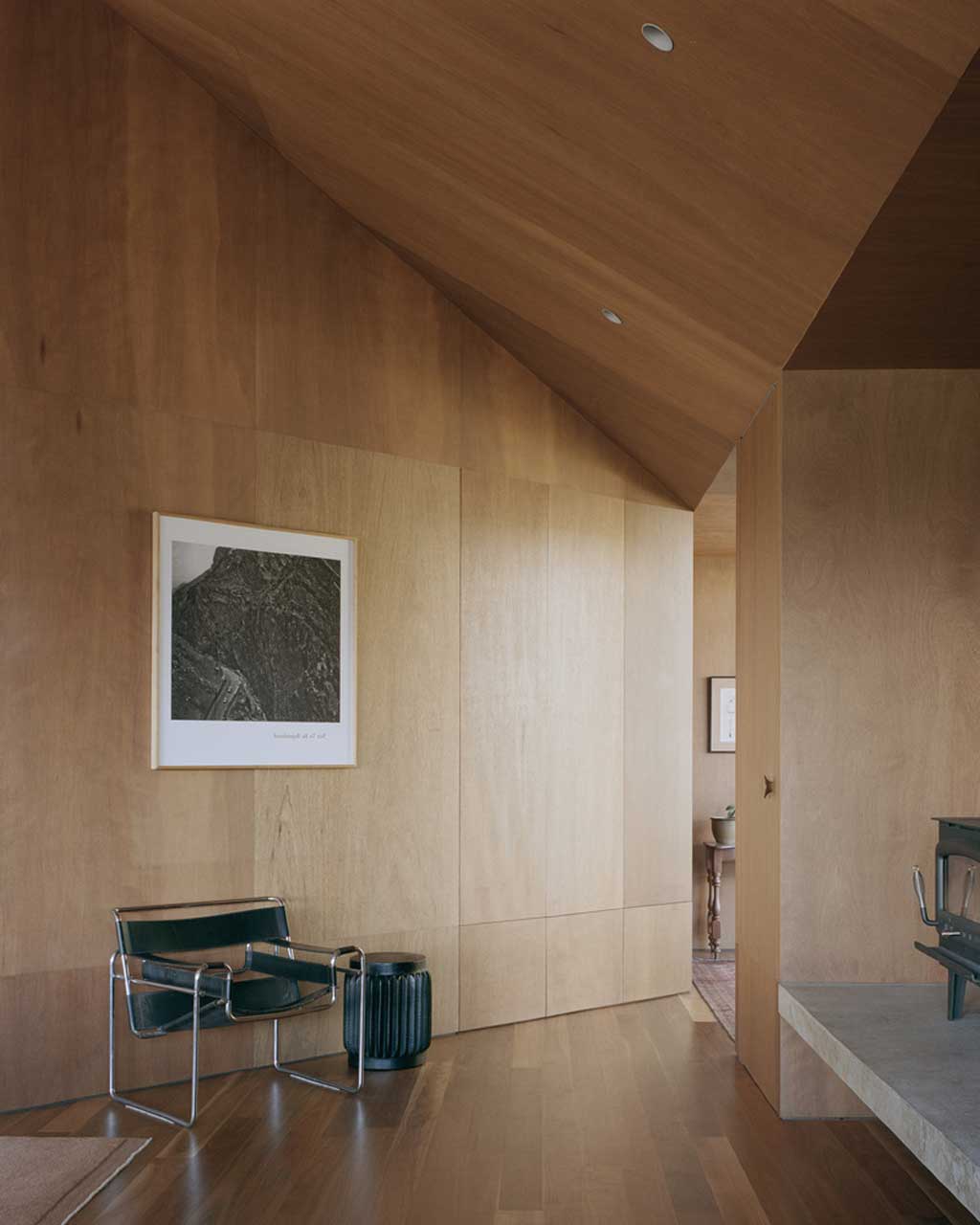
Think of a plywood wall like a well-cut suit: the fabric can be ordinary, but clean seams make it look tailored. Cheap-looking plywood rooms usually fail at the joints, not the material, with random offcuts and uneven gaps. Budget interior sheets at $12–$40 look sharp when joints line up, while $100 Baltic birch still looks messy when cut carelessly. Spend on precise cutting before you spend on a premium grade.
Can a whole house carry this look without feeling like a sauna? It can, as long as the floor or ceiling breaks the tone by a shade or two. The Swedish rock-side house lined with pastel birch plywood shows how tinted sheets keep a 120 sq m interior airy rather than boxy. Avoid lining every surface in identical raw ply, because the room loses its edges and starts to feel smaller.


| Architecture | http://edition-office.com |
| Photography | https://www.lorenads.com/ |
Plywood Interior Design Goes Well Past Wall Cladding
Plywood interior design covers far more than flat walls: cabinetry, shelving, bench seats, sliding doors and ceiling linings can all come from the same stock. Using one material for 3 or 4 jobs keeps the palette tight and the visual noise low. Baltic birch with its void-free multi-ply core typically costs 25–50% more than standard panels, but its striped edges can stay exposed as a design detail. Choose birch where edges show and cheaper ply where they hide.
Plywood also helps a room sound quieter, though plain sheets do less than most people expect. Flat wood surfaces typically reach a noise reduction coefficient of only 0.15–0.35, so most sound still bounces back into the room. Slotted panels with acoustic felt behind them play in a different league, with some designs reaching NRC values up to 0.80. If echo is the problem, specify perforations instead of adding more plain panels.


A peer-reviewed study of perforated birch plywood measured NRC values of 0.4–0.6 once holes were added, against very little absorption from unperforated sheets. The strongest result came at a perforation level of about 5.77%, tested with 300 mm of air space behind the panel. That cavity works like the body of a guitar, giving sound somewhere to go. Leave a gap behind acoustic panels rather than fixing them flat to the wall.
Where does plywood pull its weight in a ply interior design scheme? These five uses deliver the most effect per sheet:
- Wall linings laid out on the 4×8 sheet grid, so joints read as intentional lines.
- Built-in joinery in Baltic birch, with exposed edges as the only ornament.
- Ceilings in perforated panels to cut echo in rooms with hard floors.
- Sliding doors and partitions that stay light and easy to cut on site.
- Bench seats and shelving matched to the wall tone for one continuous surface.

Timber Flooring as the Anchor of Tranquil Living Spaces
Timber flooring is the anchor that makes tranquil living spaces feel settled rather than staged. Under a plywood-lined room it adds weight, warmth underfoot and a slightly darker base tone that keeps pale walls from floating. Solid hardwood floors commonly last 50–100 years, compared with roughly 15–25 years for laminate. That gap is the reason the floor deserves the larger share of the budget.
Is timber really the sustainable pick? It can be, when boards come from certified sources and the floor gets refinished instead of ripped out. Bona estimates that solid hardwood can be refinished 4–6 times, with a typical interval of 7–10 years, which keeps one installation working for at least 28 years before replacement comes up. Ask for FSC or equivalent certification on the invoice, not just in the brochure.


A timber floor behaves like a well-worn leather chair: small marks add character instead of ruining it. That forgiving quality matters in a home where walls are pale and smooth, because the floor absorbs the daily wear. Never seal a wood floor with a high-gloss coat in a plywood room, since the shine fights the matte walls and shows every scratch. A satin or matte finish keeps both surfaces in the same visual register.

Solid Boards or Engineered Planks Underfoot
The timber flooring choice comes down to one trade-off: solid boards last longer, engineered planks cope better with heat and humidity swings. New solid wood typically costs $8–$18 per sq ft and engineered wood $8–$14, based on average retailer pricing. Entry-level engineered planks with thin wear layers start lower, at roughly $3–$6 per sq ft. Pick engineered when the floor sits over underfloor heating or a concrete slab.
What decides how long an engineered floor survives? The wear layer, meaning the real hardwood veneer on top, which works like the tread on a tyre. A 1 mm layer usually gives 15–25 years and cannot be fully sanded, a 2 mm layer reaches about 30–40 years with 1–2 refinishes, and a 4 mm layer can serve 50–80 years with 3–4 refinishes. Check the wear layer figure on the spec sheet before you compare price per box.


Refinishing versus replacing is the other number to watch. A professional refinish costs roughly $3–$8 per sq ft, while full replacement usually runs $6–$12, about 2–3 times more. Plan for 3–5 days per room when sanding, because the finish needs time to cure. Do not refinish on a fixed calendar if the surface still looks fine, since every sanding removes wood you cannot get back.
Plywood Grades and Floor Types Side by Side
The two tables below put the main options next to each other, with typical market prices and service life. Sheet prices assume a 4×8 sheet covering 32 sq ft, so per-foot costs are easy to compare. Use the per-foot column when you weigh wall budgets against flooring quotes.
| Plywood option | Price per 4×8 sheet | Approx. price per sq ft | Face look | Best use |
|---|---|---|---|---|
| Interior softwood ply | $12–$40 | $0.38–$1.25 | Visible knots, yellow tone | Hidden carcasses, painted walls |
| Laminate-faced ply | From about $20 | From about $0.63 | Uniform printed surface | Rentals, temporary fit-outs |
| Birch or pine veneer panels | $60–$100 | $1.90–$3.10 | Fine, even grain | Feature walls, ceilings |
| Baltic birch, void-free core | $45–$110 | $1.40–$3.45 | Pale face, striped edges | Exposed joinery, shelving |
| Walnut or teak-faced birch | $120+ | $3.75+ | Dark, rich grain | Accent panels, doors |
| Floor type | Typical cost per sq ft | Expected lifespan | Possible refinishes | Best for |
|---|---|---|---|---|
| Solid hardwood | $8–$18 | 50–100 years | 4–6 | Living rooms on timber subfloors |
| Engineered, 1 mm wear layer | $3–$6 | 15–25 years | Recoat only | Budget or short-term rooms |
| Engineered, 2 mm wear layer | $8–$14 | 30–40 years | 1–2 | Family homes on slabs |
| Engineered, 3 mm wear layer | $8–$14 | 40–50 years | 2–3 | Underfloor heating |
| Engineered, 4 mm wear layer | $8–$14 and up | 50–80 years | 3–4 | Long-term homes needing stability |

How Plywood and Timber Shape Tranquil Living Spaces Together
Combining the two materials into tranquil living spaces depends on contrast held in a narrow band. Pale plywood walls over a mid-tone timber floor create a soft step of one or two shades, enough to define the room without visual noise. A smooth plywood face against a grained floor works like linen against wool: two natural textures, one quiet mood. Keep the floor slightly darker than the walls so the room feels grounded.
How much does a fully wood-lined living area cost? Plywood on walls typically lands around $2–$6 per sq ft installed, and a 1,000 sq ft wall area needs roughly 30–35 sheets. The minimalist home with timber accents and garden views shows the same approach at house scale, with wood carried from floor to furniture. Order a few spare sheets from the same batch so grain and colour match on repairs.
Don’t do this
Mixing three or more wood species in one room is the fastest way to lose the calm. An oak floor, yellow pine ply walls and a walnut cabinet compete instead of resting together. Stick to one floor species and one sheet type, and skip thin 1 mm engineered boards in main rooms: they cannot be sanded, while a 4 mm wear layer survives 3–4 refinishes.


Plywood and timber act here as working parts of the design, not background filler. One sets the mood across walls and joinery, the other carries decades of wear underfoot, and together they turn an ordinary floor plan into a calm home that faces outward to nature.
The Verdict on Wood-Lined Calm
Plywood walls over timber floors remain one of the most cost-effective routes to a calm interior, with interior sheets from about $12 and solid floors that can outlast 50 years.
Spend on the floor first. Solid boards or a 4 mm engineered wear layer give 3–6 refinishes, while a thin 1 mm layer gives none.
Spend second on precise cutting. Aligned joints on the 4×8 grid do more for the look than upgrading from $30 sheets to $100 sheets.
Fix echo with perforations, not more panels. Perforated birch reaches NRC 0.4–0.6, while plain sheets barely absorb sound at all.