Scandinavian double door design for the main door earns its reputation not through ornament but through restraint — light oak that costs around $1,800 per slab, frosted birch panels that hold privacy without blocking daylight, white-painted wood with black metal accents running $600–$900 in hardware alone. I’ve tracked dozens of Nordic-inspired entrances and the pattern is consistent: the doors that photograph best are the ones where the designer made fewer decisions, not more. Natural material, honest finish, zero clutter. What you choose for your entrance communicates something before anyone steps inside — and with Scandinavian style, the message is calm confidence.
These three design directions below cover the full range: warm wood for a soft welcome, frosted glass for urban homes that need light and privacy simultaneously, and the white-black contrast that reads modern without trying. Each one photographs differently in morning versus evening light — I’ll call that out so you can match your choice to your facade’s actual sun exposure.
Quick Scan
- Light oak with minimalist panels — warmest finish, best on north-facing or shaded entrances
- Frosted glass in birch frame — urban favourite, diffuses street light, hides clutter behind the door
- White wood with black metal accents — highest contrast, most forgiving of imperfect exterior paint
- Hardware matters as much as the door: brushed silver reads warm, matte black reads cool
- Avoid staining light oak too dark — it stops reading as Scandinavian and starts reading as generic
Light Oak Panels Hold Their Warmth Even Without Sunlight
Light oak at the front entrance is the closest thing Scandinavian door design has to a non-negotiable. I own two sets of swatches from Jeld-Wen’s Nordic oak line — the grain visibility at this finish level is what makes the door feel alive rather than flat. Vertical panel detailing keeps the surface structured without over-designing it. Around $1,600–$2,200 for a double set unfinished; add $300–$400 for a quality oil finish like Rubio Monocoat in Natural or White 5%.


The brushed silver hardware here isn’t decorative — it’s structural to the visual logic of the door. Matte black would cool the oak down and push it toward industrial. Brushed silver keeps the warmth, which is the whole point. My go-to for this pairing is FSB 1076 lever handles around $220 each — slim profile, no visible fasteners, reads exactly right against pale grain. Skip anything with a polished chrome finish; it reflects too hard against organic wood texture and the whole thing looks like a showroom mistake.
Morning light is where this door earns its fee. The low-angle sun hits the grain at a raking angle and you get texture you didn’t know was there. A whitewashed exterior wall behind it amplifies everything — the door appears to glow slightly without any added lighting. If your entrance faces east, this is your material. If it faces west, you’ll get the same effect at dusk, which is arguably better for kerb photography.
Don’t over-accessorise this entrance. I’ve seen potted olive trees, lavender hedges, and even a small-scale Japanese maple used alongside oak doors — all of them work. What doesn’t work: a house number plaque in a contrasting brushed brass when everything else is silver-toned. It sounds minor. It reads immediately wrong.
Don’t Do This
Avoid applying a dark walnut or ebony stain over light oak to make the door look more “premium” — it removes exactly the quality that makes Scandinavian design recognisable. The pale grain is the material’s credential. Staining it dark turns $2,000 of oak into something that reads like MDF in low light. If you want darker wood, buy darker wood: consider American white oak at 8% grey oil for a cooler Nordic tone without sacrificing grain visibility.
Frosted Glass in a Birch Frame Solves the Privacy Problem Nobody Talks About
Frosted glass in a birch frame is the answer to a question most door-buyers don’t think to ask until they’re standing in their hallway watching neighbours walk past. You need light. You also need not to be visible from the street. Birch-framed frosted panels deliver both — the glass scatters incoming light into a soft diffused glow, and the birch frame keeps the temperature of the entry warm rather than institutional. Birch is lighter in tone than oak and has a finer, almost papery grain; it pairs with frosted glass rather than competing with it.


Specify acid-etched glass rather than sandblasted if budget allows. Acid-etched holds its frosted quality longer — sandblasted surfaces pick up fingerprints and oils from the air and start to look mottled within two years on a working front door. Pilkington Satin is around £85–£110 per square metre and is what you’ll find in most high-specification Nordic builds. The matte black lever handle on birch is a classic pairing — I’d specify Poignées PB in matte black; they run about €160 per set and have the right proportions for double door width.
Does this design work on a stone exterior? Yes — arguably better than on render. The frosted glass picks up the cool grey undertones of stone and reflects them back in diffused form. Concrete step beneath is not optional decoration; it’s structural to the look. A wooden step here breaks the visual logic. If your entrance currently has terracotta tiles or brick pavers, this door design will fight them. The whole composition needs mineral surfaces at ground level to land correctly.
For further reading on how Nordic bi-fold and double-door proportions work within a full Scandinavian house composition, the breakdown at 5 defining features of a Scandinavian style house covers the relationship between door scale, window size, and facade balance in detail.
White Wood Against Black Metal Reads Modern Without Announcing It
White-painted wood with black metal hardware is the most forgiving Scandinavian door design in the range — and also the most frequently botched. The correct white is not brilliant white (BS 00E55) but a soft off-white like Farrow and Ball All White or Jotun Lotus 1001, both with a slight warm grey undertone that keeps the door from looking clinical against natural exteriors. The horizontal groove detailing is load-bearing for the design: without it, the surface reads as a blank slab, not Scandinavian minimalism.
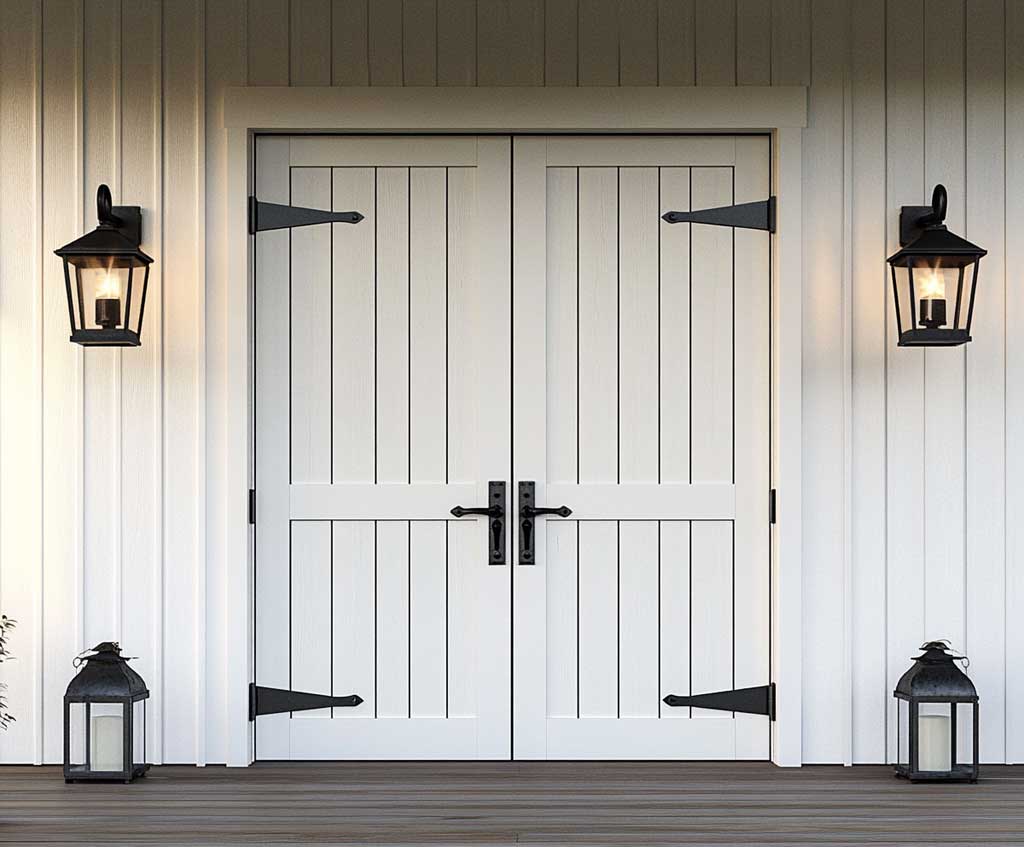


Black metal handles and exposed hinges at this scale — double door width is typically 1400–1600mm across — need to be specified in proportion to the panel. My go-to is Turnstyle Designs Amalfine bar pull in matte black at around £280 per set. Standard lever handles look undersized on a double door and immediately read as residential-grade rather than architectural. The hinge finish matters just as much: powder-coated black, not spray-painted. Spray finishes chip within eighteen months on an exterior door in a variable climate.
Evening lighting is where this door design separates from everything else in the Scandinavian range. Low-wattage lanterns on either side — 2700K colour temperature, not 3000K — throw a warm wash that makes the white surface glow amber rather than blue-white. You’ll notice this difference in winter photographs instantly. The black hardware disappears slightly in low light, which is actually correct: it should recede and let the door shape hold the composition.
White porch flooring beneath amplifies this design; dark composite or grey slate both work. What kills it is mismatched exterior wall colour. If your render or cladding is a warm cream, add a touch of yellow to the door white to prevent it reading as cold. A stark pure white door against warm cream render creates a visual vibration that photographs badly and reads worse in person. You can see how modern door design principles scale across single and double configurations in the modern door design guide for main entrances on this site.
Material comparison matters here. Here’s how the three Scandinavian door options stack up across the key decision factors.
| Door Type | Material Cost (double set) | Privacy Level | Best Light Condition | Maintenance |
|---|---|---|---|---|
| Light Oak Panels | $1,600–$2,200 | Full | Morning / East-facing | Re-oil every 2–3 years |
| Frosted Glass + Birch | $2,000–$3,000 | Translucent | Overcast / North-facing | Clean glass annually; acid-etched holds longer |
| White Wood + Black Metal | $1,400–$2,000 + $280–$600 hardware | Full | Evening / West-facing | Repaint every 4–5 years; inspect hinges annually |
For more ideas on how Scandinavian interior doors carry the same minimalist logic inside the home, see the modern bedroom door design ideas for minimalist spaces — the principles around panel proportion and hardware finish translate directly.
Final Take
Scandinavian Door Design Rewards the Edit, Not the Addition
Pick one material, get the hardware right, leave the wall bare. Every version of Nordic door design that fails in practice failed because someone added something — a decorative moulding, a contrasting colour band, a knocker that didn’t belong.
Light oak, frosted birch, white with black metal — these three are the full palette. Your job is to choose one and execute it without compromise.
Save this post before you start your entrance project — the material specs and hardware names are worth coming back to when you’re standing in the showroom.