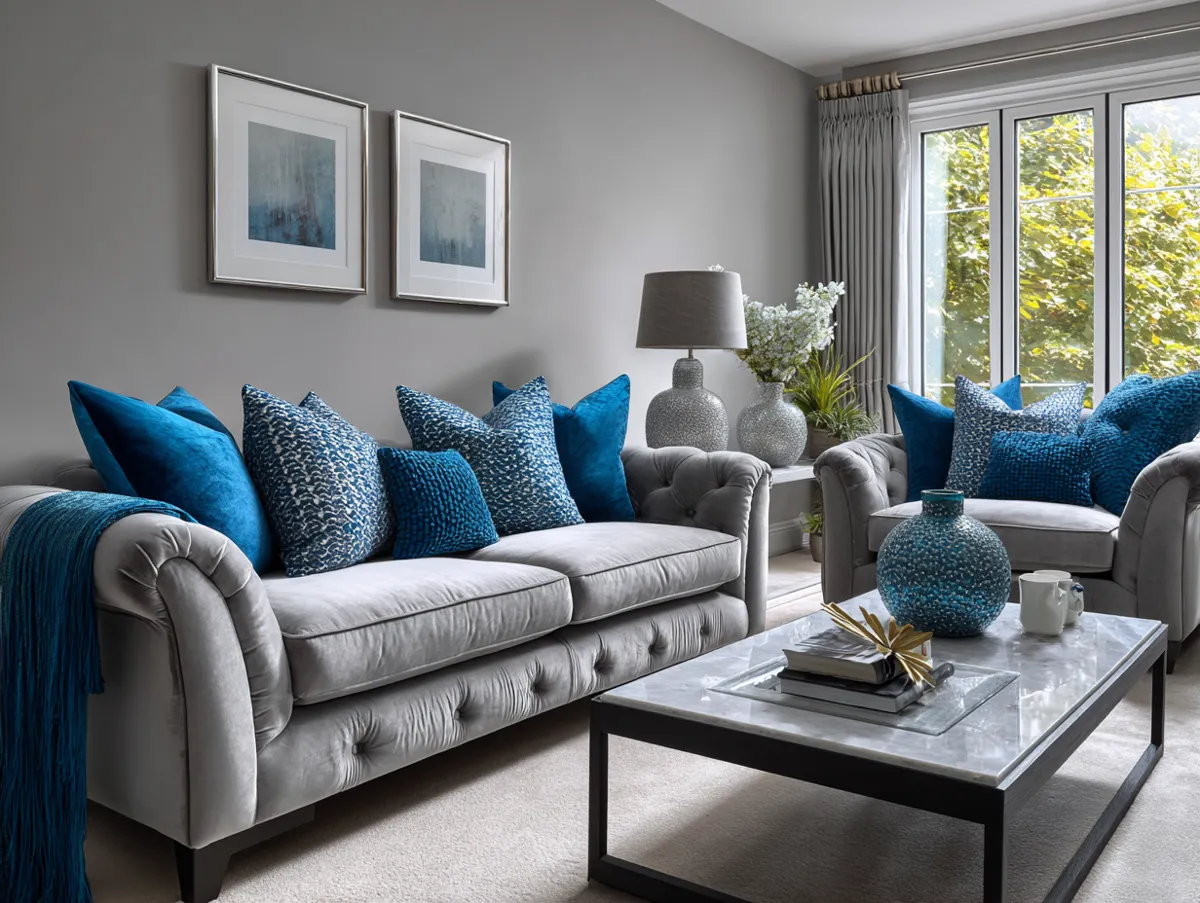
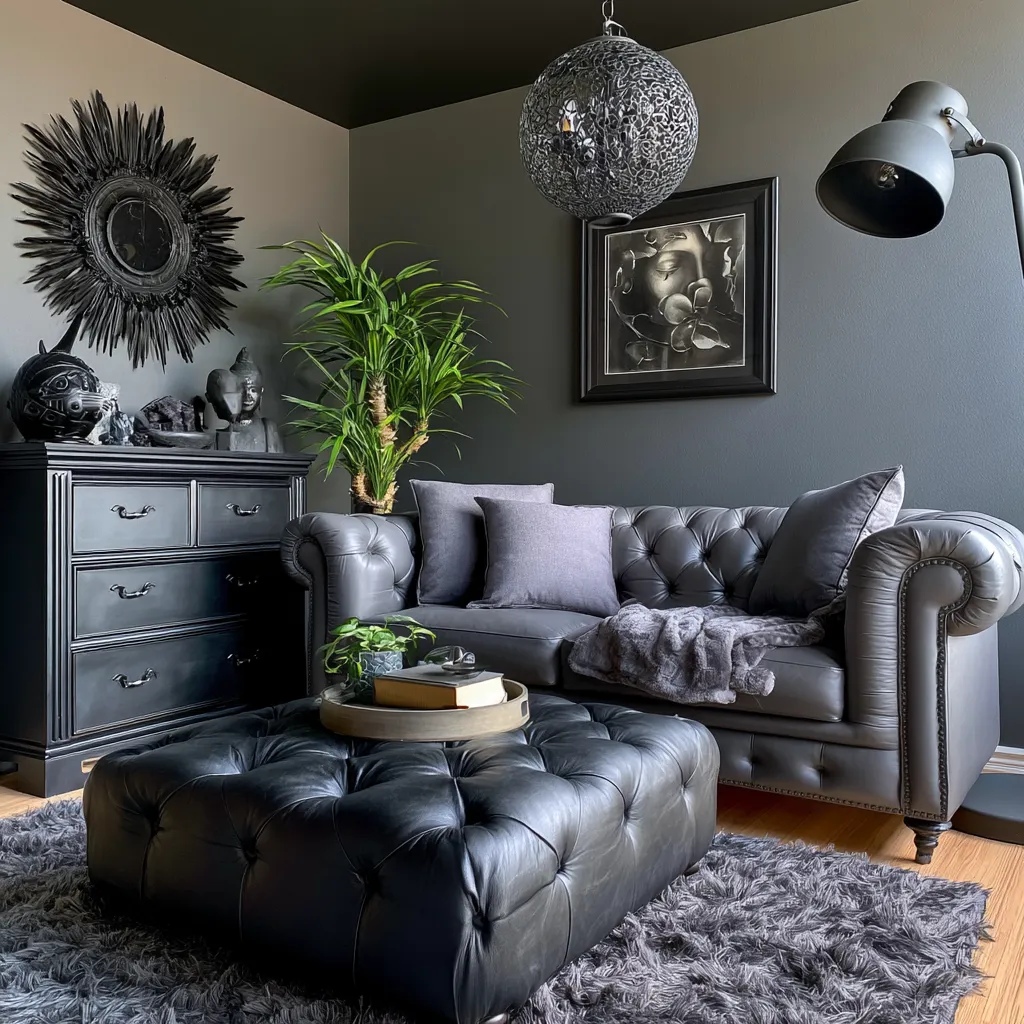
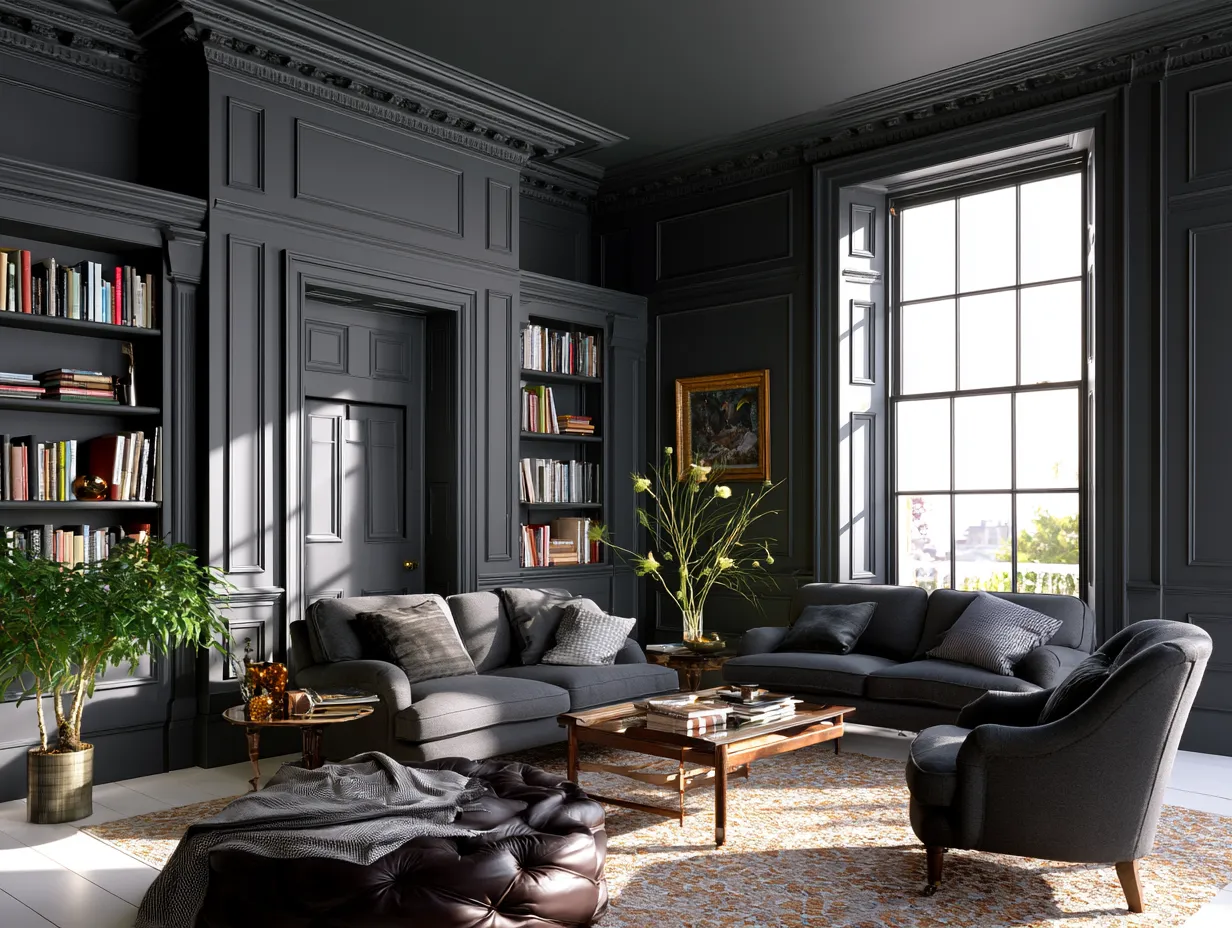
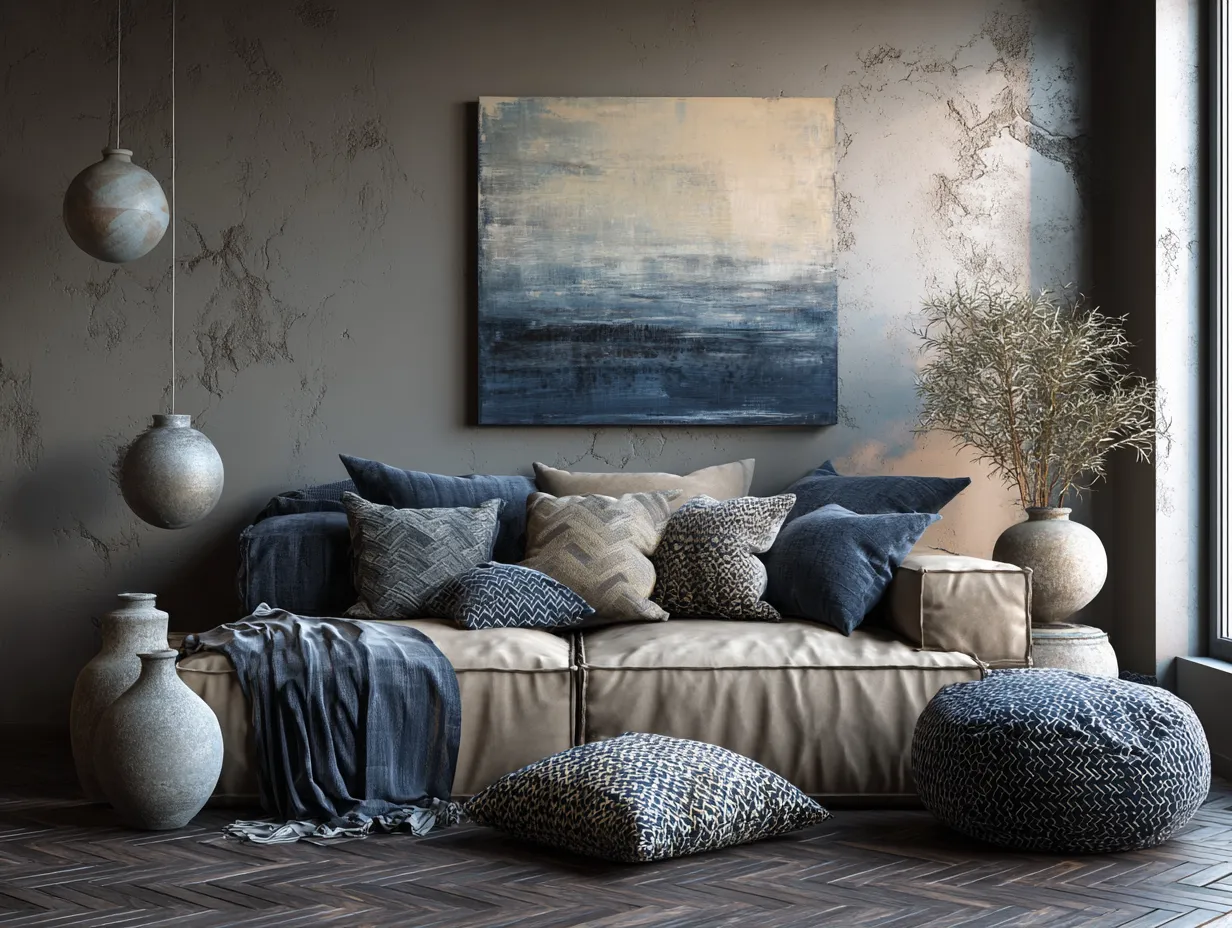
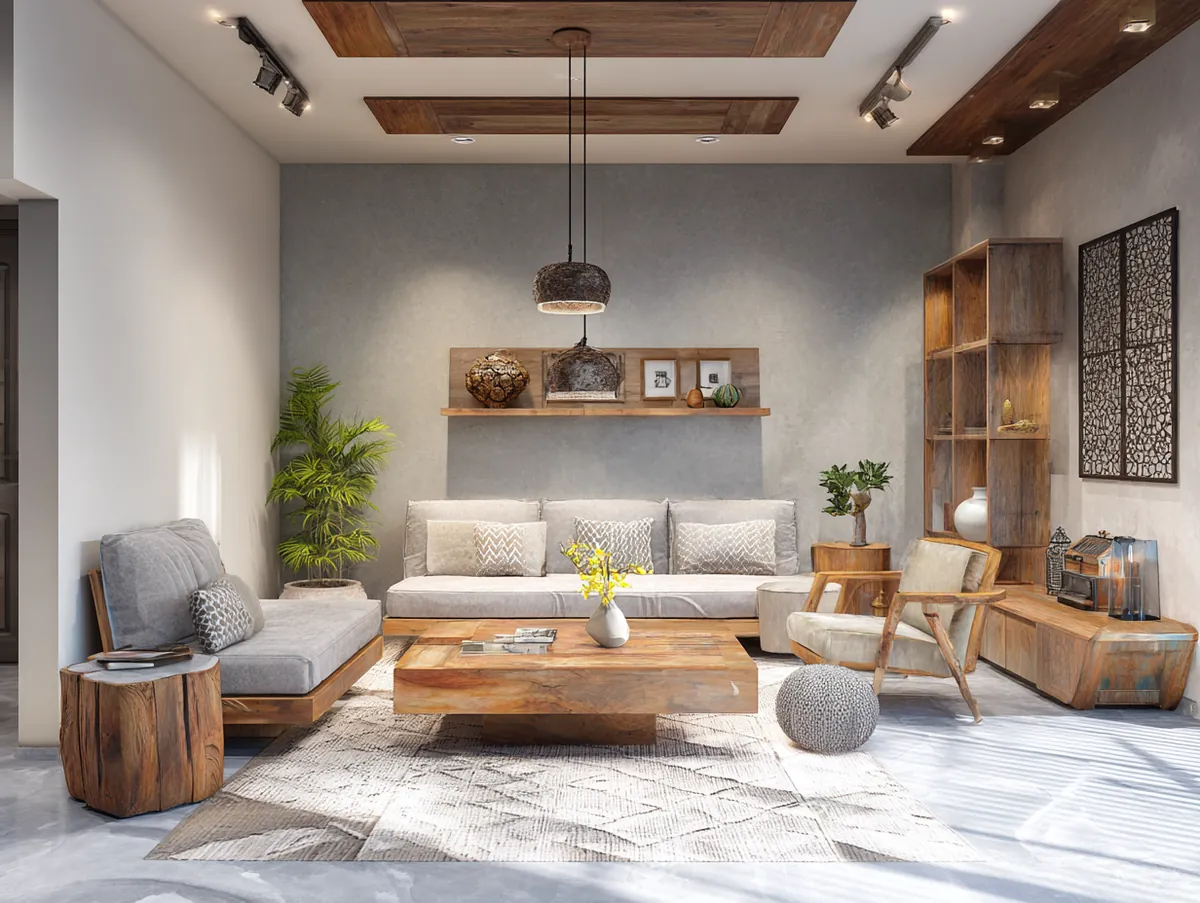
A modern grey and blue living room works when grey takes the large surfaces and blue arrives in measured doses. Designers often use the 60-30-10 split: about 60% grey on walls and big furniture, 30% a supporting tone, and 10% blue in pillows, art or a rug. Does the pairing still look current? Yes, because grey and blue sit side by side on the cool half of the color wheel, so the room reads calm rather than loud. Decide which surface carries the 60% before buying a single cushion.
Light decides the rest. A mid grey such as Repose Gray has a light reflectance value (LRV) of about 58, while a deep navy such as Naval sits at LRV 4, so the two read as clearly separate values even in a dim room. Paint for a typical 16 × 14 ft living room with 9 ft ceilings comes to roughly 2 gallons and 3 quarts for two coats. Test a 2 ft square swatch on two walls for a full day before ordering gallons.
The sections below cover the four moves that shape most grey and blue rooms: the sofa, the walls, the art and the accent shade, from deep navy to royal blue. Each one comes with sizes, LRV figures or typical prices, so the look can be planned on paper first. Pick the move that matches your next big purchase and start there.
Quick Scan
- Split the color roughly 60% grey, 30% supporting tone, 10% blue.
- Repose Gray at LRV 58 vs Naval at LRV 4 gives a 54-point gap that keeps navy crisp against grey.
- Art above the sofa should span about two-thirds of its width: roughly 56 in over an 84 in sofa.
- Hang art 6–10 in above the sofa back, centered near 57 in from the floor.
- An 8 × 10 ft rug (96 × 120 in) holds the front legs of sofas up to about 90 in wide; leave about 18 in of floor at the walls.
- One gallon of paint covers about 350–400 sq ft per coat; plan for two coats.
- Blue cotton-velvet pillow covers start under $10 vs about $52 for a ready-made velvet pillow.
Grey Sofas and Blue Accents Anchor a Modern Grey and Blue Living Room
A grey sofa with blue accents is the fastest route to a grey and blue living room, because the sofa is usually the largest single block of color in the space. A standard three-seat sofa measures about 84 inches across, so in grey it quietly covers a big slice of the 60% share. Think of it as a stage floor: it stays neutral so the blue actors stand out. Choose the sofa in grey first and let every blue piece follow it.
Which grey works best, light or charcoal? Light dove grey makes blue pillows read brighter, while charcoal pushes navy toward black and needs paler blues to show. Blue cotton-velvet covers in a 20 × 20 in size cost about $8–$10 at budget retailers, against roughly $52 for a ready-made velvet pillow. Buy covers rather than full pillows, since they let you swap blues each season for a fraction of the price.


Blue accents on a grey sofa work best at three heights: pillows at seat level, a throw over the arm and a rug underfoot. An 8 × 10 ft rug, which measures 96 × 120 inches, holds the front legs of a sofa up to roughly 90 inches wide. Front legs on vs all legs on is the key choice here: front legs on suits most standard rooms, while all legs on usually calls for a 9 × 12 ft rug. Keep about 18 inches of bare floor between the rug and the walls.
A sofa buried under blue pillows defeats the point, since the grey disappears and the room loses its calm base. Two shades of blue are plenty for one seating group, one deep and one lighter. Blue that repeats in the rug and in one vase ties the zone together like a thread running through a seam. Repeat each blue at least twice in the room so no accent looks stray.


Paint Grey and Blue Living Room Walls by LRV, Not by Color Name
Grey and blue living room walls succeed or fail on light reflectance value, the 0–100 scale that measures how much light a paint bounces back. Typical trade guides put brilliant white near 85, a mid grey around 40 and a deep navy around 10. LRV works like the brightness slider on a phone: two paints both sold as dark grey can land at LRV 12 and LRV 28 and produce very different rooms. Check the LRV on the back of the swatch before falling for a name.
Repose Gray makes a useful benchmark, with an LRV of 58.22 listed on the official Sherwin-Williams Repose Gray color page. Agreeable Gray sits at 60 and reads warmer, while Mindful Gray at 48 looks noticeably deeper. Is a 10-point difference visible on a wall? Yes, especially in north-facing rooms, where every point of reflectance counts. Pick a grey above LRV 55 for a dim room and below 50 only for a bright one.
A grey and dark blue living room needs an even bigger gap between the two paints. Naval sits at LRV 4 and Hale Navy at LRV 8, so Hale Navy returns about twice as much light, a contrast also broken down in this look at navy shades at LRV 4 vs LRV 8 in a modern bathroom. Against a grey at LRV 58, either navy gives a gap of 50 points or more, enough for a crisp two-tone wall. Avoid painting all four walls navy in a room with a single window, and keep the deep shade to the lower half or one accent wall.
- Measure the wall area and divide it by 350 sq ft, the typical coverage per gallon per coat.
- Multiply by two for two coats and add 10–15% for touch-ups.
- Paint a 2 ft square of the grey and the navy on two different walls.
- Check both at noon and after dark before ordering full gallons.
- Use eggshell on walls; flat covers up to 400 sq ft per gallon but marks more easily.
Paint is the cheapest part of the room and the hardest to live with if the shade is wrong. A 16 × 14 ft room has about 489 sq ft of wall once a door and two windows are subtracted, which works out to under 3 gallons for two coats. Hiring a painter typically adds $2–$5 per square foot of floor area, or roughly $448–$1,120 for the same room. Spend on two sample pots before spending on labor.
Blue Wall Art Gives Grey and Blue Living Room Designs a Focal Point
Blue wall art is the quickest way to give blue and grey living room designs a focal point without repainting. On a grey wall, a single blue canvas works like a window cut into stone, and the eye goes straight to it. The standard rule sizes art at about two-thirds of the sofa width, which means roughly 56 inches of art over an 84-inch sofa. Measure the sofa, multiply by 0.67 and shop to that width.


Height matters as much as width. Galleries center art near 57 inches from the floor, and over a sofa the bottom edge typically sits 6 to 10 inches above the backrest. Hung much higher, a blue canvas drifts away from the sofa like a balloon that slipped its string. Mark the 6-inch line with painter’s tape before drilling.
Is one big piece better than a gallery wall? A single large canvas reads calmer in a modern room, while a grouping adds rhythm but must still total about two-thirds of the sofa width as one unit. Shoppers often underestimate the needed size by roughly 20–30%, so a piece that looks big in the store can look lost at home. Skip the lone 24-inch print over a full-size sofa and choose one large blue abstract or a matching pair instead.
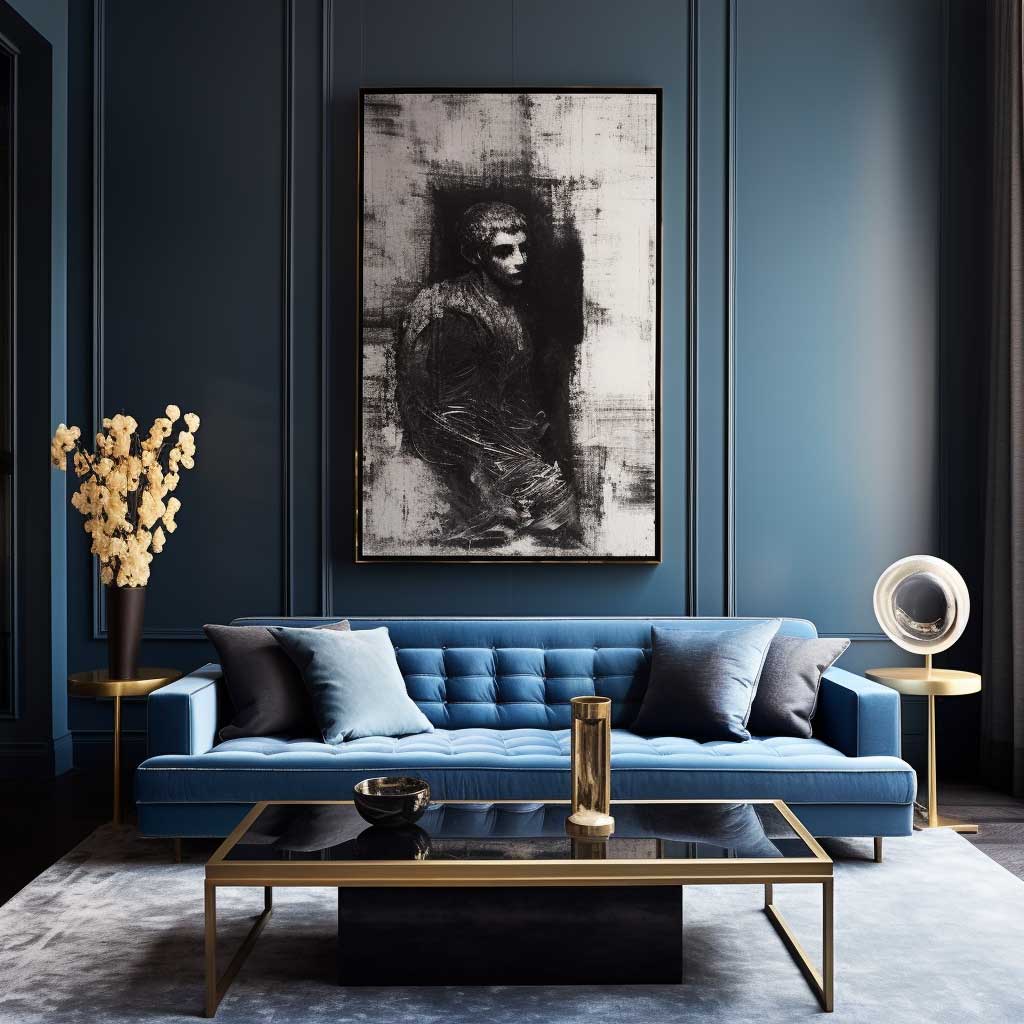

Which blue reads best on grey? Navy and deep indigo give the strongest contrast against a light grey wall near LRV 58, while pale azure shows better on charcoal. Three or more unrelated blues across the art, pillows and rug make the scheme look accidental. Pull one blue from the art into at least one textile on the sofa.
Royal Blue Turns a Modern Grey Room From Quiet to Bold
A modern grey and royal blue living room trades the hush of navy for energy, so it needs tighter rules. Royal blue is far more saturated than navy, which means it grabs the eye at a much smaller dose. Keeping it inside the 10% accent share, rather than the 30% secondary role, stops it from shouting. Treat royal blue like chili in a recipe: a pinch lifts the dish, a spoonful takes it over.
Where should royal blue go first? Pillows, a throw or a single vase are low-risk starts, since a 20 × 20 in cotton-velvet cover costs under $10 and swaps out in seconds. A royal blue sofa, by contrast, spends the whole accent budget on one piece that stays for years. Royal blue vs navy is a choice between lively and restful, and royal blue looks cleanest against a lighter grey near LRV 58–60. Start with two pillows and one object before committing to upholstery.
- Pillow covers or a throw: lowest cost, under $10 per cover at budget stores.
- A rug with a royal blue pattern: anchors the 10% share at floor level.
- One accent chair: the boldest step short of a blue sofa.
- Royal blue art: works best on grey walls at LRV 55 and above.
Royal blue looks harsh under cool 4000K bulbs and richer under warm 2700K light, the same shift seen with navy. Brass or gold accents soften it further, the way a warm frame calms a bright painting. Chrome plus pure white plus royal blue reads cold and clinical, so avoid that trio. Fit 2700K bulbs in the lamps closest to the blue pieces.
Don’t Do This
- Don’t paint all four walls Naval (LRV 4) in a room with one window; Hale Navy at LRV 8 returns about twice the light.
- Don’t hang a 24 in print over an 84 in sofa; aim for about 56 in of art.
- Don’t let royal blue climb past the 10% accent share.
- Don’t buy an 8 × 10 ft rug if it leaves less than 18 in of floor at the walls.
- Don’t order gallons before checking a 2 ft swatch at noon and after dark.
The Modern Blue and Gray Living Room Combination Works in Layers
The modern blue and gray living room combination works best in three layers: grey on walls and big furniture, a supporting tone such as white or wood, and blue as the accent. That is the 60-30-10 rule in practice, the same split used for many neutral-plus-color schemes. A 50-50 split, by comparison, makes grey and blue fight for attention, and the room feels like two halves stitched together. Assign each color a percentage on paper before shopping.


Can grey stay warm next to cool blue? Yes, if the grey leans slightly warm, like Repose Gray with its green and taupe undertones, or if wood takes the 30% role. A grey that sits between two families, such as grey-green or grey-brown, keeps the room from looking drained. Blush can carry the supporting layer too, as these pink living room ideas built on blush walls and grey show. Add one warm material for every two cool ones.
Texture does the job a third bold color would otherwise do. A linen or bouclé grey sofa, a wool blue rug and a matte grey wall give three different surfaces in nearly the same palette. Glossy grey on every surface, by contrast, turns the room into a furniture showroom. Mix at least one rough, one soft and one smooth surface in every grey and blue zone.
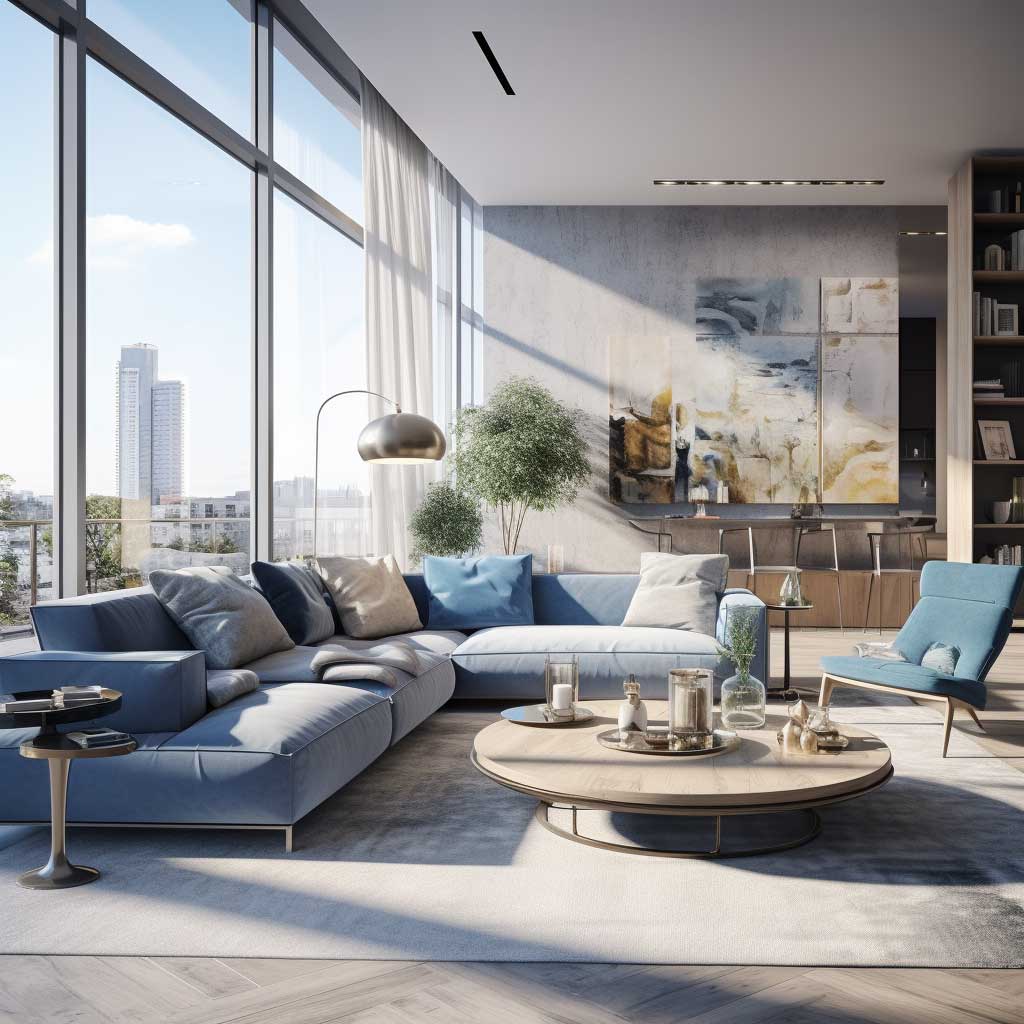
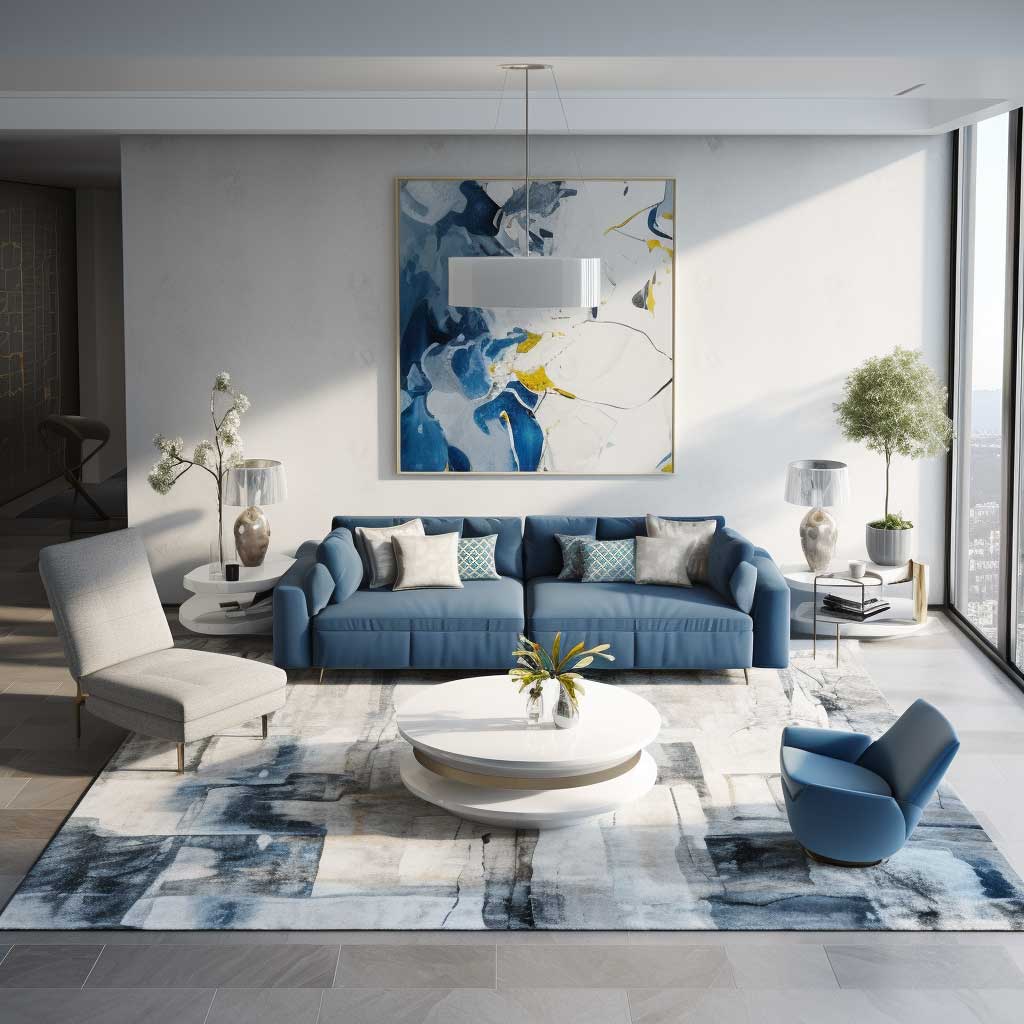
A living room of 250 to 350 sq ft, a typical range for an American home, can hold this layered scheme without feeling busy. Larger open plans can repeat the blue in a second zone, such as a dining corner, so the accent travels across the whole space. A blue that appears only once looks like an afterthought rather than a plan. Echo the main blue at least twice in each zone.
Compare Grey and Blue Pairings Side by Side
Comparing grey and blue paint pairings by their numbers shows why some combos look crisp and others muddy. The table below lines up four common pairings by LRV, contrast gap and the light each one suits. A gap above 40 points reads as a clear two-tone scheme, while a gap under 40 starts to blur after dark. Read the light column before the mood column.
| Pairing | Grey LRV | Blue LRV | Contrast gap | Best light | Mood |
|---|---|---|---|---|---|
| Repose Gray + Naval | 58 | 4 | 54 points | Bright, south-facing | Crisp, formal |
| Agreeable Gray + Hale Navy | 60 | 8 | 52 points | Mixed daylight | Warm, classic |
| Repose Gray + Still Water | 58 | 10 | 48 points | Medium light | Deep, blue-green |
| Mindful Gray + Needlepoint Navy | 48 | 13 | 35 points | Bright rooms only | Soft, low contrast |
Sizing follows the sofa rather than the room. The second table turns the two-thirds art rule and standard rug guidelines into ready numbers for three common sofa widths. Find your row, then shop to it.
| Sofa width | Art width (about 2/3) | Art bottom above sofa | Rug size | Floor gap to wall |
|---|---|---|---|---|
| 72 in | 48–54 in | 6–10 in | 8 × 10 ft | About 18 in |
| 84 in | About 56 in | 6–10 in | 8 × 10 ft | About 18 in |
| 90 in | About 60 in | 6–10 in | 8 × 10 ft (front legs) or 9 × 12 ft | 18–24 in |
Does a pairing have to come from one brand? No, mixing brands is fine as long as the LRV values are known, the same way a recipe works with any brand of flour. Matching by name alone is risky, since two greys with similar names can sit 10 or more points apart. Write both LRVs on the sample card before choosing.
Grey First, Blue Second
A modern grey and blue living room comes down to proportion and light rather than any single product. Roughly 60% grey, 30% support and 10% blue keeps the scheme calm, and a gap of about 50 LRV points keeps navy crisp against grey. Get those two numbers right and almost any sofa or rug will fit.
For walls, start with a grey near LRV 58–60 and test navy at LRV 4 vs LRV 8 on a 2 ft swatch. Plan on about 350 sq ft per gallon per coat and two full coats. Buy sample pots before booking labor.
For the sofa wall, size blue art at two-thirds of the sofa width, about 56 inches over an 84-inch sofa, and hang it 6–10 inches above the back. An 8 × 10 ft rug with the front legs on finishes the seating zone. Leave about 18 inches of floor at the walls.
For bold accents, keep royal blue inside the 10% share and under warm 2700K bulbs. Start with pillow covers under $10 before committing to blue upholstery. Upgrade only the pieces you still like after a full season.