Your home’s air is more polluted than you realize. Carbon dioxide builds silently in bedrooms during sleep, volatile organic compounds off-gas from furniture and paint, and fine particulates accumulate from cooking, pets, and outdoor infiltration. Ambient air quality monitoring has shifted from niche health obsession to mainstream home integration—not because we’re paranoid, but because the data proves invisible air degradation directly impairs cognitive function, sleep architecture, and respiratory recovery. September 2026 marks the moment this technology stops being optional.
How CO₂ and VOCs Silent Degrade Sleep and Focus
Stanford research (widely cited in 2025-2026 home health discussions) documented that elevated CO₂ concentrations above 800 ppm impair decision-making speed and reduce sleep depth. Your bedroom right now is likely reaching 1,200+ ppm after eight hours with the door closed.
Volatile organic compounds—off-gassing from synthetic mattresses, particle board cabinets, carpet adhesives, and cleaning products—accumulate without smell or visible warning. Ambient air quality monitoring devices like the Awair Element detect these in parts per billion, revealing what your nose has normalized into invisibility. Total VOC loads above 500 ppb correlate with waking frequency and next-day fatigue.
This is why the category exploded in 2025-2026. Consumers stopped asking “Do I need this?” and started asking “Why don’t I already have this?”
Quick Tips
- Place primary sensor in the bedroom—sleep quality impact is measurable within three nights
- Mount 3-5 feet above floor; CO₂ and VOCs stratify differently by elevation
- Cross-reference readings with humidity; above 55% RH amplifies mold spore activity and particle persistence
- Open windows when total VOC exceeds 400 ppb, even if outdoor AQI appears acceptable
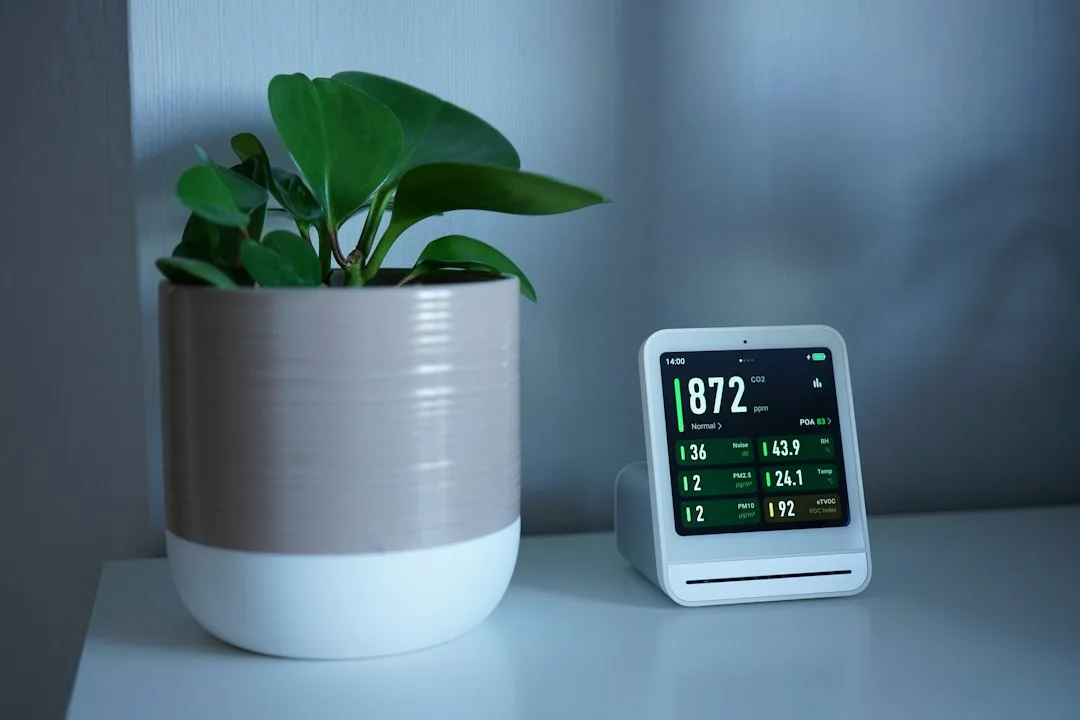
Real-Time Detection Changes How Families Manage Respiratory Wellness
Awair Element, Airthings View Plus, and Eve Room represent the 2026 standard: simultaneous monitoring of CO₂, VOCs, PM2.5, humidity, and temperature, with app integration and automation triggers.
Airthings View Plus ($200-250 range) added Radon detection—a carcinogenic gas families had no way to monitor without professional testing ($150-300 per test). Now seasonal radon infiltration is visible in real time, allowing vent adjustments before exposure accumulates.
Eve Room (mid-tier, priced in the $120-150 range) integrates directly into Apple HomeKit, triggering smart fans and window-opening alerts when CO₂ exceeds your preset threshold. Families with allergic children use this to automate recovery protocols without manual intervention.
| Sensor Model | Primary Metrics | Home Automation Integration |
|---|---|---|
| Awair Element | CO₂, VOCs, PM2.5, humidity, temp | IFTTT, Nest, most ecosystems |
| Airthings View Plus | CO₂, Radon, VOCs, PM2.5, humidity | HomeKit, Alexa, Google Home |
| Eve Room | CO₂, VOCs, PM2.5, humidity, temp | Apple HomeKit native |
| Wynd Halo | PM2.5, humidity, temp only | Basic app, limited automation |
The Biggest Mistake: Ignoring Stratification and Sensor Placement
Most households buy one sensor and mount it in the living room, assuming uniform air quality across zones. This is backwards. CO₂ settles—bedrooms during sleep can be 400+ ppm higher than downstairs living areas.
One family reported “zero VOC issues” based on a kitchen-mounted sensor, yet their teenager’s bedroom registered 600+ ppb from new carpet and off-gassing laminate flooring. Sleep quality improved only after moving the sensor (and then addressing ventilation) in the actual sleeping space.
Professional installers now recommend three-sensor minimum setups: bedroom, main living area, and basement or office. The cost compounds, but the diagnostic value—identifying which room is the actual problem—justifies it immediately.
How Ambient Monitoring Integrates Into Preventive Wellness Data
By September 2026, Shaping the Future of Safe Digital Interaction demands that home health data stays private and user-controlled. Ambient air quality sensors feed into personal wellness vaults—separate from commercial cloud ecosystems—creating longitudinal records of your respiratory environment.
Families with asthma or COPD now correlate flare-up dates with air quality logs, identifying triggers (pet shedding season, outdoor wildfire smoke infiltration, new furniture off-gassing) that doctors previously labeled “environmental” but couldn’t quantify.
Insurance and workplace wellness programs have begun incentivizing home air quality documentation—not as surveillance, but as proof that you’re reducing controllable risk factors. A three-month log of CO₂ consistently below 700 ppm and VOCs under 300 ppb demonstrates respiratory discipline.
Ecosystem Integration Determines Real-World Adoption in 2026
Standalone air quality sensors have a 60-day novelty window before gathering dust. The difference between abandoned gadgets and daily-use tools is automation—automatic fan triggering, window-open alerts, HVAC system communication.
HomeKit-native sensors (Eve Room, certain Airthings models) integrate into existing Apple ecosystems without middleware. Wynd Halo, priced lower but limited in connectivity, reaches customers who value low entry cost over system flexibility—a strategic tradeoff.
By late 2026, expect HVAC manufacturers to embed air quality monitoring directly into smart thermostats, eliminating the need for separate devices. Lennox and Carrier already offer ductless mini-split systems with VOC detection; central-system integration follows this winter.
The real competitive advantage isn’t the sensor itself. It’s the API ecosystem that lets you chain conditions: “If CO₂ exceeds 800 ppm AND humidity drops below 30%, activate humidifier AND open bedroom window via smart blind actuator AND log data timestamp.”
Why September 2026 Is the Adoption Inflection Point
School districts in California, Colorado, and Massachusetts have mandated CO₂ monitoring in classrooms since 2024—creating parental awareness that homes need the same oversight. Home air quality monitoring stopped feeling like luxury tech the moment public institutions made it standard.
Supply chains stabilized in mid-2026 after chip shortages that plagued 2024-2025. Sensor costs dropped roughly 20-30% as manufacturing scaled, pushing premium devices into mid-market accessibility.
Respiratory Long COVID cases and persistent post-viral symptoms shifted consumer psychology. Families recognized that bedroom air quality during recovery mattered as much as medication—driving purchase urgency beyond traditional wellness audiences.
Ambient air quality monitoring is now the foundation. Everything else—smart ventilation, HVAC optimization, material selection for low VOC off-gassing—builds on the data this technology reveals. If you’re not measuring it in 2026, you’re ignoring one of the most actionable home health variables available.
Related Topics