Modern kitchen sink design has split into three clear directions, and picking the wrong one costs you both money and daily frustration. I’ve watched renovations stall because homeowners fell for a look in a showroom without thinking about how a sink actually gets used at 7am on a Tuesday. The gap between a sink that photographs well and one that holds up after two years of Dutch ovens and dog bowl washing is wider than most people expect. Pull up a stool — this breakdown covers materials, configurations, and the one integrated option I’d actually spend money on.
Skip ahead if you’re already decided on material. The farmhouse section has the price reality check most contractors won’t give you upfront. The integrated sink section covers why quartz composite outperforms solid stone in this application, which is the opposite of what most interior designers will tell you.
Quick Scan
- Contemporary kitchen sink styles worth knowing: undermount stainless, apron-front farmhouse, integrated quartz composite
- Undermount stainless — $300–$900 installed, the safest bet for resale, noise-dampening pads matter more than gauge thickness
- Modern farmhouse sink — $600–$1,800+ for fireclay; requires cabinet reinforcement in most homes
- Integrated countertop sink — $1,500–$4,000 custom; zero crevices, easiest daily cleaning, unbeatable visual coherence
- Biggest mistake: choosing a drop-in mount when you’re already replacing the countertop — you’ve already paid for the cut
Undermount Stainless Steel Earns Its Reputation for a Reason
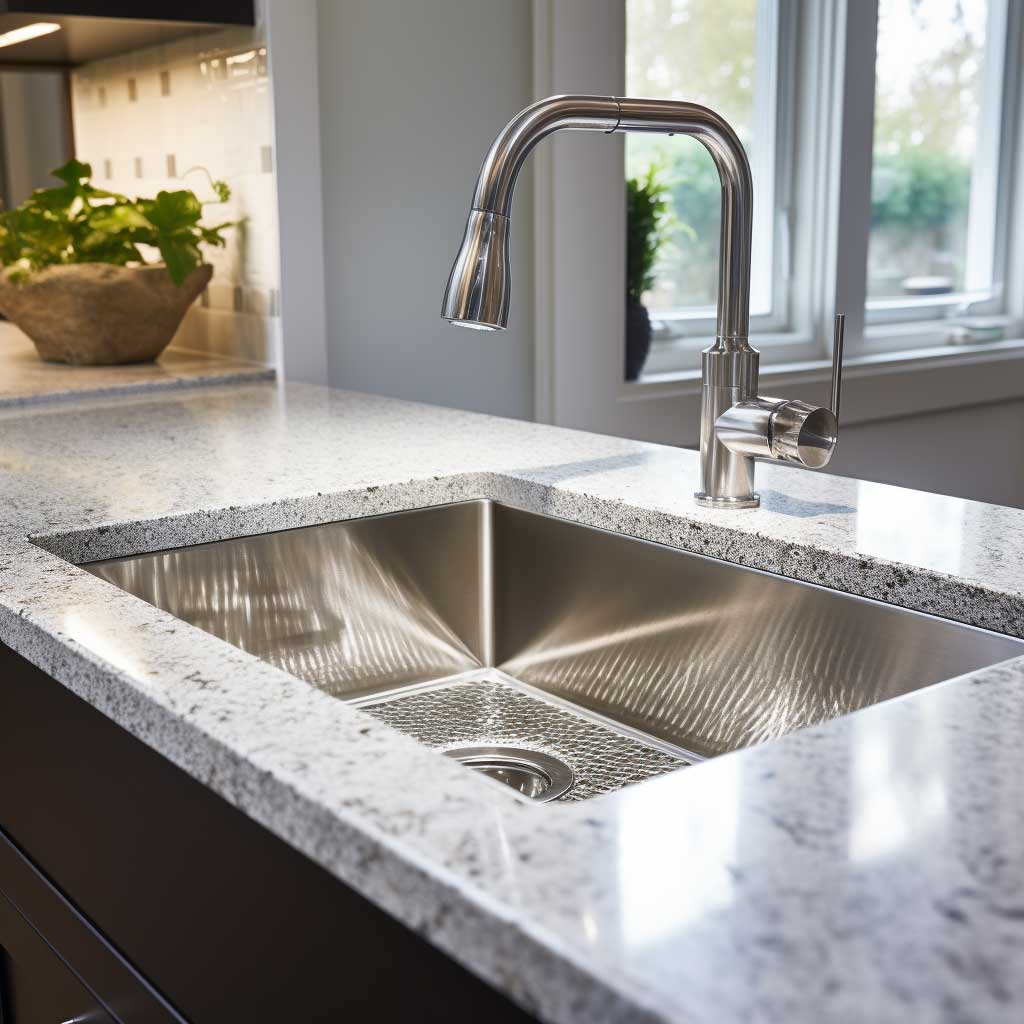
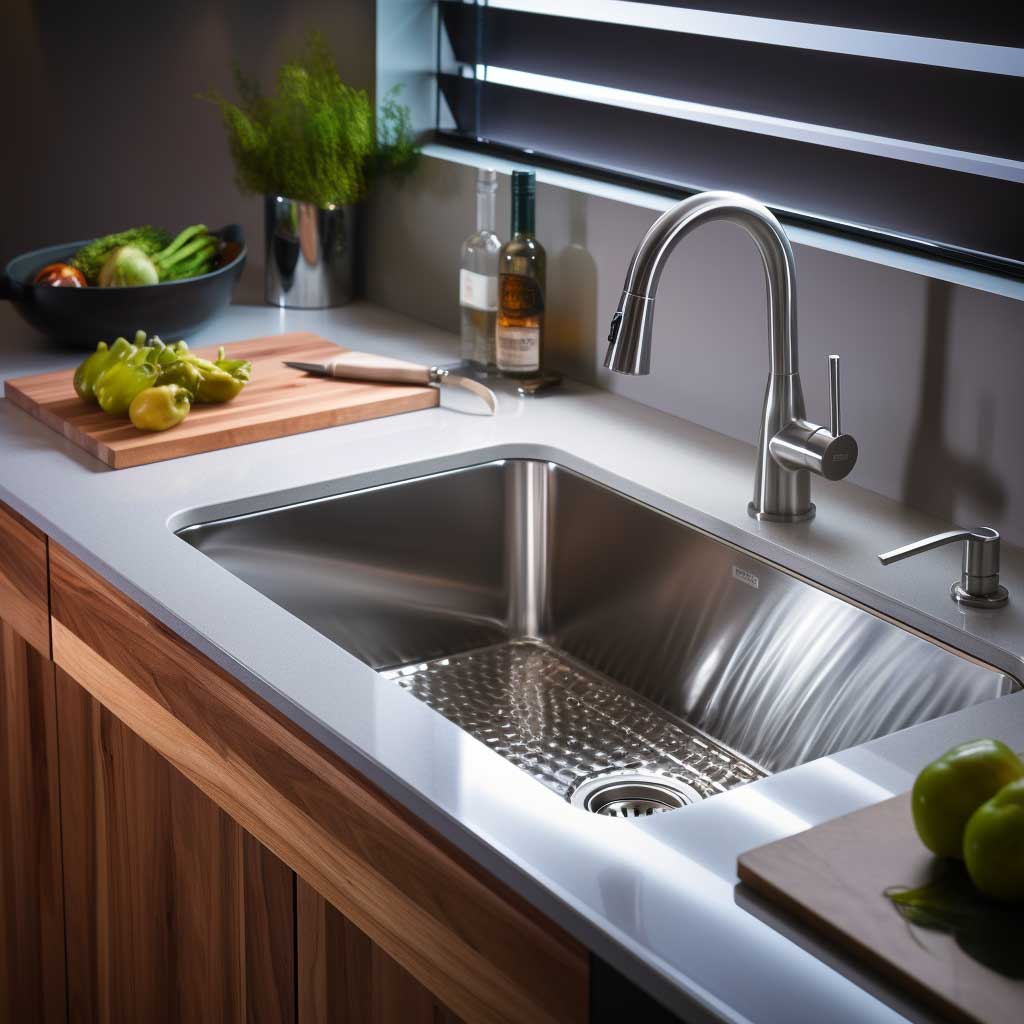


Stainless steel holds the top spot in contemporary kitchen sink design because it solves four problems at once — corrosion, heat, impact, and resale value — without asking you to make any real trade-offs. My go-to recommendation for anyone doing a full kitchen renovation is an undermount single basin in 16-gauge steel, not the 18-gauge version that most big-box stores push. You’ll feel the difference when you drop a cast iron skillet in there. Kohler’s Vault series runs about $480–$620, and the rolled-rim edge on the undermount cut genuinely looks cleaner than anything in that price range.
The undermount installation removes the rim completely. No ledge means no grout line catching food debris, which is the one hygiene win that actually changes your cleaning routine rather than just sounding good in a catalog description. You’ll notice the wipedown goes from 90 seconds to about 20. Noise matters too — homes with open-plan layouts amplify sink noise badly, and the pad coating on a Kraus or Ruvati model ($350–$500 range) kills that echo without adding bulk under the cabinet.
What doesn’t work: ultra-thin 20-gauge stainless. Flexes under weight, sounds like a drum, and shows dents within a year. I’ve also seen people spec a mirror-polish finish because it photographs beautifully — it scratches in a week of normal use. Satin or brushed is the only finish that ages honestly. If your kitchen has warm-toned cabinetry, a fingerprint-resistant PVD coating in champagne or brushed gold looks genuinely sharp and stays cleaner than raw steel. See how undermount sinks pair with different white cabinet finishes here.
Farmhouse Sinks Look Effortless in Photos and Weigh 80 Pounds in Real Life


The modern farmhouse sink is the kitchen equivalent of raw denim — beautiful, high-maintenance, and worth it only if you actually use it the way it was designed to be used. That apron front, the exposed face of the sink that replaces the cabinet door below, is a structural statement as much as a visual one. BOCCHI’s Contempo 36-inch fireclay model at around $898 from Home Depot is the most-referenced benchmark I’ve seen in kitchen design circles right now. It’s finished on all four sides, takes the undermount cut cleanly, and the fireclay glaze resists staining better than porcelain at a similar price.
What nobody tells you at the showroom: fireclay farmhouse sinks weigh between 75 and 120 pounds depending on size, and most residential base cabinets aren’t built for that load without reinforcement. Budget $150–$300 for a contractor to sister the cabinet floor joists before installation. Skip that step and you’ll have a hairline crack in your sink within 18 months from flex stress. The basin depth — typically 9 to 10 inches — is legitimately useful for washing stockpots and cooling sheet pans, not just for the Pinterest aesthetic. I’ve given my dog a bath in one. Not once did I regret the size.
The pairing that fails consistently is a white fireclay farmhouse sink against an all-white shaker kitchen. It disappears. The whole reason to install an apron front sink is the visual weight it adds to the room — it reads as a piece of furniture, not just a fixture. Put it against warm oak, dark walnut veneer, or matte black cabinetry and the contrast does the work. White on white just looks like a medical facility. Also avoid farmhouse sinks in anything smaller than a 30-inch base cabinet; the proportions go wrong fast, and a cramped apron front looks more awkward than a standard drop-in.
Don’t Do This
- Don’t install a farmhouse sink without reinforcing the cabinet base first — 80+ lbs of fireclay will crack if the floor flexes.
- Don’t pick a mirror-polish stainless finish — it shows every scratch within the first week of normal cooking use.
- Don’t spec a drop-in mount if you’re already replacing the countertop — you’ve already paid for the professional cut; go undermount.
- Don’t place a white apron front against white cabinetry — the visual impact of the farmhouse style evaporates entirely.
- Don’t skip reading material weight specs on integrated quartz sinks — some brands quote composite, then deliver pressed particleboard cores at the same price.
Integrated Sink and Countertop Combinations Solve the One Thing Other Sinks Can’t


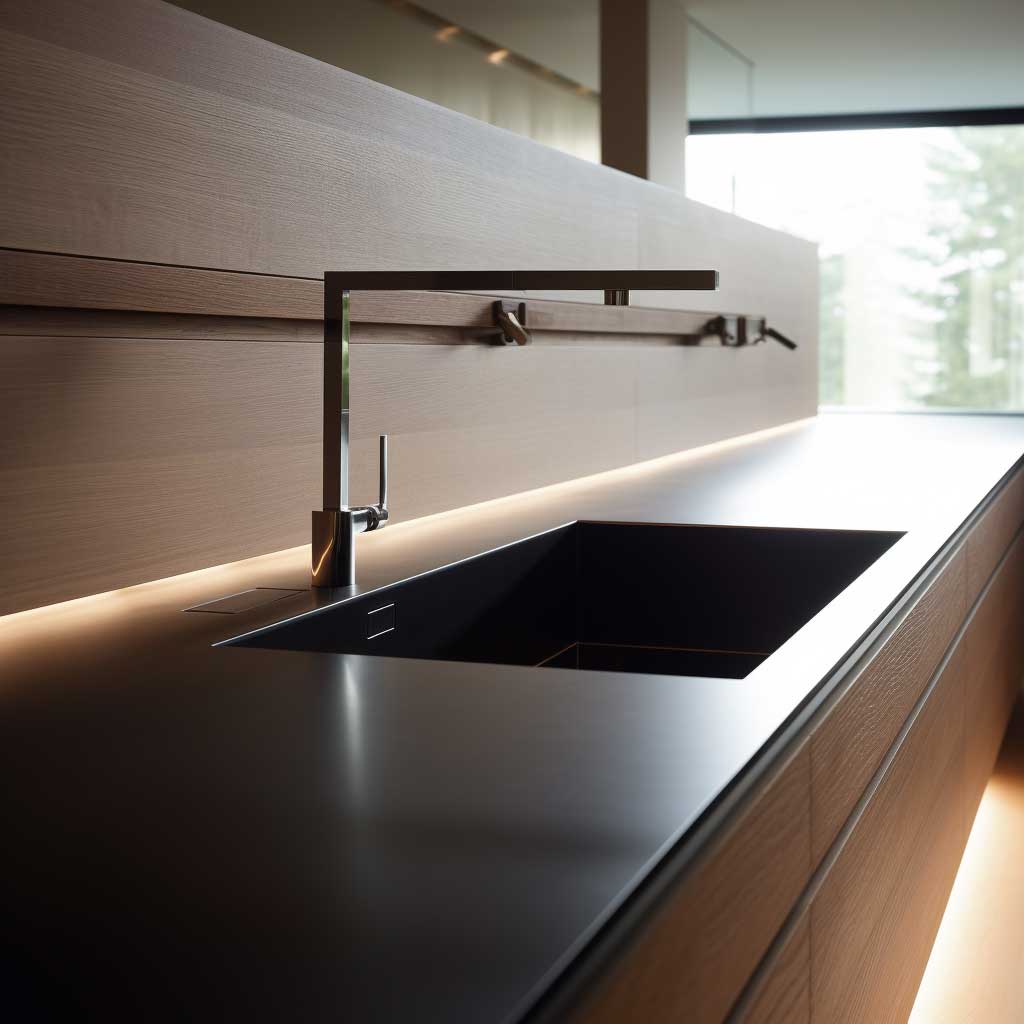

An integrated sink is cast from the same slab as the countertop, so the transition from work surface to basin is a curve, not a joint. No seam means no grime trap, which sounds minor until you’ve tried to clean a silicone bead between a porcelain sink rim and a stone countertop at 11pm after a dinner party. The entire surface wipes in one pass — think of it like the difference between mopping a continuous concrete floor versus mopping around tiles. Quartz composite is the material I’d spend money on here, not solid stone: engineered density holds up to thermal cycling better than marble or granite in a kitchen environment, and the color consistency means a chip repair actually matches.
Custom integrated sinks from fabricators like Elkay or Blanco (through their commercial lines) run $1,500–$4,000 depending on basin dimensions and countertop square footage. That’s a real number. It’s also the only sink type where the shape is genuinely yours — depth, width, drain placement, and basin count are all variables a good fabricator will spec to your workflow rather than a showroom floor plan. I stole this trick from a kitchen designer in Berlin: spec the drain slightly off-center toward the back of the basin. The extra front-to-back bowl length becomes usable prep space when the basin’s empty.
Where integrated sinks fail is in rental units and anything under a 10-year ownership horizon. If you damage the countertop, you’re replacing the whole unit — fabrication, removal, and reinstallation. That’s $2,000–$6,000 for a repair that costs $80 on a standard undermount. They also require a solid stone or composite countertop substrate; you cannot pair an integrated sink with laminate. If your kitchen has mismatched cabinetry styles or heavy decorative hardware, the seamless monolithic surface of an integrated sink will read as incongruous rather than minimal. It needs a clean, restrained backdrop to land the way it’s supposed to. See how integrated sinks fit into full minimalist kitchen layouts here.
For anyone deciding between these three sink types, the deciding variable isn’t usually budget — it’s countertop continuity. Current kitchen sink trend reports consistently rank undermount as the safest choice for resale, integrated as the highest-end specification, and farmhouse as the strongest visual statement when the rest of the kitchen can support it.
Material Comparison at a Glance
| Sink Type | Price Installed | Best Countertop Match | Cleaning Effort | Resale Impact |
|---|---|---|---|---|
| Undermount Stainless | $300–$900 | Quartz, granite, marble | Low | Positive |
| Farmhouse Fireclay | $800–$2,200 | Wood, butcher block, stone | Medium | Strong with right kitchen style |
| Integrated Quartz | $1,500–$4,000+ | Same material, custom fab | Very low | High in luxury segment |
Final Take
Your sink choice locks in a decade of daily decisions. Get the material wrong and no amount of hardware or faucet upgrades will fix it.
If you’re mid-renovation and still undecided: undermount stainless in 16-gauge with a satin finish is the version you’ll never regret. It’s not the most interesting choice. It’s the most correct one for 80% of kitchens.
Spend the saved budget on the faucet — a Kohler Sensate touchless in matte black costs about $420 and adds more daily value than moving up to an integrated sink you’re not ready to commit to maintaining.
Save this post before your next showroom visit — the prices in the comparison table are what you should be quoting back to your contractor.