A white and blue office chair is the quickest route to a navy and crisp white office, because one seat carries both colors and sits exactly where the eye lands first. The pairing works in a corporate suite and a spare-room workspace alike, as long as white covers the large surfaces and navy handles the accents. A classic navy paint reflects only about 8% of incoming light, while a crisp white bounces back roughly 90%, so the contrast reads sharp from across the room. Start with the chair, then build the desk and storage around its two colors.
Does the scheme actually look professional, or just nautical? It reads executive when the proportions are right: a 60 to 72 inch white desk, one navy storage piece and upholstery rated for at least 15,000 double rubs. Skip anchors, stripes and rope details, which pull the room toward a beach house instead of a boardroom. Think of the result as a navy blazer over a white shirt, where the dark layer frames and the light layer does the talking.
The sections below cover color balance, the white executive desk, the navy bookshelf with white bins and the chair itself, each with real sizes and ratings. A comparison table near the end lines up every piece so you can plan floor space before buying anything. Measure the room first, since an executive desk plus 42 to 48 inches of chair clearance takes roughly 6 to 6.5 feet of depth.
Quick Scan
- Navy paint at an LRV near 8 vs crisp white near 90: white for big surfaces, navy for accents.
- A standard executive desk runs 60–72 in wide and 30 in deep; leave 42–48 in behind the seat.
- Bookshelves 10–12 in deep fit most books; 3/4 in particleboard sags past 26 in, pine holds to 36 in.
- A 13 in white bin needs a 13.25 in opening; an 11 in bin tilts and gaps inside a 13 in cube.
- Chair fabric for daily office use should reach about 30,000 double rubs vs 15,000 for home duty.
- Budget chairs fade in 1–3 years; ergonomic models last 7–12, often backed by 12-year warranties.
- Dark denim can stain white faux leather for good, so keep white on trim and navy on the seat.
The Blue and White Office Starts With Light, Not Furniture
A blue and white office looks deliberate when white covers the big planes and navy works as the frame. Light reflectance value, or LRV, explains why: on a 0 to 100 scale, Benjamin Moore lists Hale Navy at an LRV of 8.36 and Chantilly Lace at 90.04. One color returns almost all the light and the other absorbs almost all of it, so the balance between them decides how bright the room feels. Keep walls and the largest desktop white, and let navy arrive through the chair, the shelving and the rug.
Can navy go on the walls too? It can in a room with strong daylight, but in a north-facing office navy walls plus navy furniture read close to charcoal by late afternoon. A private office of roughly 12 by 12 feet is the usual planning size for an executive desk with two guest chairs, and that footprint rarely needs more than one navy wall. Treat navy walls like a dark suit, sharp for one occasion and heavy as a daily uniform.
Which white suits navy best? A near-neutral white such as Chantilly Lace keeps the contrast crisp, while White Dove at an LRV of about 85 softens it with a warmer cast. The sharper option fits a modern, minimal office; the softer one fits wood floors and traditional molding. Test both as large painted samples next to a navy swatch, because a small chip held in hand misreads undertones.
For navy blue office ideas that read polished rather than themed, distribute the two colors like this:
- White walls and ceiling, with navy limited to one storage wall or accent wall
- White desktop, navy drawer fronts or pedestals underneath
- Navy rug sized so the chair casters stay on it when rolled back
- White bins, frames and lamp shades as repeating bright accents
- One warm material, such as brass pulls or light oak, to keep the blue theme office decoration from feeling cold
A White Executive Desk With Navy Drawer Fronts
A white executive desk with navy drawer fronts gives blue executive furniture its lightest, most modern form. Standard executive desks run 60 to 72 inches wide with a 30 inch deep work surface and a 29 to 30 inch height, so the white top becomes the largest bright plane in the room. Navy confined to the pedestals keeps that plane clean while anchoring the base visually. Choose a double-pedestal model if you want navy on both sides, since that layout is the executive standard.


How much room does the desk need? Plan 42 to 48 inches of clearance behind the seat so the chair can roll back without hitting a wall or credenza. A 60 inch desk fits a compact study, while a 72 inch top suits a 12 by 12 foot private office with guest seating. Like a dining table, the desk should leave a clear walkway on every side you actually use. Tape the footprint on the floor before ordering.

White shows coffee rings and pen marks faster than navy, so the top finish matters as much as the color. Matte lacquer hides fingerprints better than high gloss, which turns every smudge into a spotlight under a desk lamp. A navy rug under the desk frames the white top and hides scuffs where shoes land most often. Skip a glass top here, because it doubles glare and fights the calm white surface.

The same proportions scale down to a studio or spare room, where a 48 inch white desk and one navy accent do the same job; these blue and white small space furniture ideas show how compact pieces keep the palette airy. Standard desks start at 48 inches wide, so the look never requires a corner office. Keep navy below the desktop line in tight rooms so the eye travels over one continuous white surface.
Navy Blue Office Furniture That Stores and Displays
Navy blue office furniture earns its place on the storage wall, where a tall navy bookshelf filled with white bins turns clutter into a grid. A general-purpose bookshelf is 10 to 12 inches deep with 8 to 12 inches between shelves, enough for hardcovers and binders without wasted depth. White bins against navy shelves read like piano keys, a clear rhythm that looks organized even when the contents are not. Pick a unit whose interior openings clear your bins by at least a quarter inch.


Do bin sizes really matter? The two standard cube sizes are 11 inches and 13 inches, and a 13 inch bin needs about 13.25 inches of clear opening to slide in. An 11 inch bin in a 13 inch cube leaves a visible gap and tilts, which breaks the crisp white grid instead of completing it. Fabric bins typically carry around 11 to 20 pounds, so heavy files belong in a drawer rather than a bin. Measure the opening, not the outside of the shelf.

Shelf material decides whether the navy unit stays straight for years. A fully loaded bookshelf carries 20 to 40 pounds per running foot, and a 3/4 inch particleboard shelf starts to sag past about 26 inches of span, while yellow pine holds out to 36 inches. Matte navy also hides small dents better than gloss, which catches light along every flaw. Avoid wide flat-pack shelves for books and binders, and choose spans under 26 inches or add a center support.

Already own a plain bookcase? Repainting is the cheaper route, and this guide to painting a bookshelf navy blue with a durable topcoat covers finishes that survive daily handling. Leave one shelf with only two or three objects so the unit looks styled rather than stuffed. A navy shelf behind a white desk also works as a video-call backdrop, because a dark ground pushes faces and objects forward.
Choosing a White and Blue Office Chair That Survives Daily Use
A white and blue office chair works best when navy covers the seat and back while white handles the trim, base or stitching. That split is practical, not just decorative: navy fabric hides wear, and white on the frame stays away from jeans, sleeves and coffee. Upholstery for an office used every day should reach around 30,000 double rubs, against 15,000 for residential heavy duty. Ask for the Wyzenbeek rating before ordering any fabric chair.
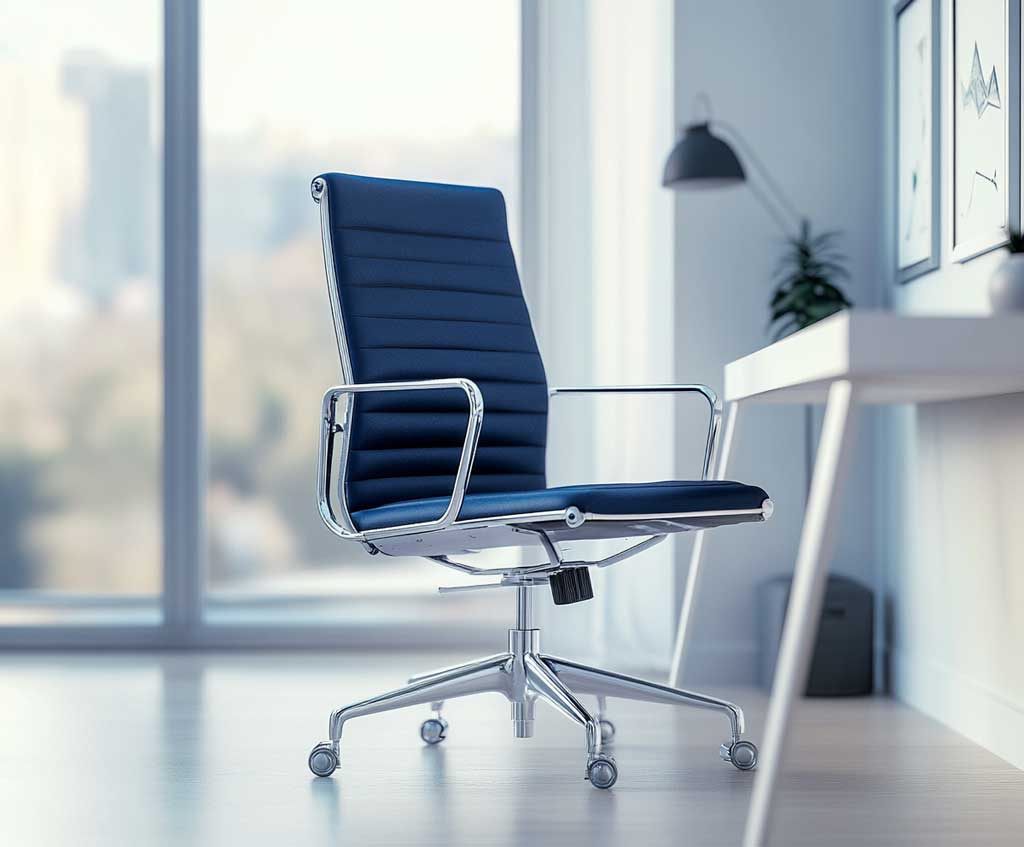

How long should the chair last? Budget chairs often lose comfort and stability within 1 to 3 years, while well-built ergonomic models hold up for roughly 7 to 12 years. Premium makers such as Herman Miller and Steelcase back their chairs with 12 year warranties, a useful signal of expected lifespan. A desk chair is closer to a mattress than a lamp, because hours of daily use, not looks, decide its value. Divide the price by expected years before comparing two models.

Fit counts as much as finish. Standard office chairs top out around 21 to 22 inches of seat height, which suits a desk near 29 to 30 inches but not a standing desk at full height. One common ergonomic model adjusts from about 15.7 to 19.7 inches, a range that lets most users rest their feet flat. White casters and a white five-star base show floor dust quickly, so polished aluminum is the lower-maintenance alternative.

Don’t Do This
Don’t pick an all-white faux leather seat for daily wear with dark jeans. Indigo dye from denim migrates into light vinyl and faux leather, and upholstery care guides warn that once it sinks in, it may never fully come out. A navy seat with white piping shows nothing after a year, while a white seat can carry blue shadows within weeks. If you love white, keep it on the back panel, the arms or the base.
Desk, Shelf and White and Blue Office Chair Side by Side
Lining up the chair with the desk and storage shows where each piece needs floor space and where it needs care. Use the sizes below as planning numbers, then confirm the exact spec sheet of the model you buy. Navy pieces forgive wear while white pieces forgive almost nothing, so the table flags upkeep as well as size.
| Piece | Typical size | Key spec to check | Navy vs white upkeep | Limit or lifespan |
|---|---|---|---|---|
| White executive desk, navy drawers | 60–72 in W × 30 in D × 29–30 in H | 42–48 in clearance behind the seat | White top shows marks; navy pedestals hide scuffs | Matte top stays cleaner-looking than gloss |
| Navy bookshelf | 10–12 in deep, 8–12 in shelf spacing | Particleboard span max ~26 in vs pine 36 in | Matte navy hides dents and dust | 20–40 lb per running foot when loaded |
| White storage bins | 11 in or 13 in cubes | 13 in bin needs a 13.25 in opening | White shows dust but wipes clean | About 11–20 lb per fabric bin |
| Chair, navy fabric seat, white trim | Seat height up to 21–22 in | About 30,000 double rubs for daily office use | Navy seat hides wear and dye transfer | 7–12 years ergonomic vs 1–3 years budget |
| Chair, white faux leather seat | Seat height up to 21–22 in | Stain-resistant coating, cleaning guidance | Denim dye can stain permanently | Looks worn first at the seat front |
Navy Frames, White Carries the Light
A navy and crisp white office works because the two colors sit at opposite ends of the light scale, roughly 8 against 90 on the LRV chart. That gap makes every piece read clearly, from the desk to the bins. Put white on the largest surfaces and navy on the pieces that take wear.
Size the desk before anything else: 60 inches for a compact study, 72 inches for a full private office, plus 42 to 48 inches of clearance behind it. Navy pedestals under a white top give the executive look without darkening the room. Tape the outline on the floor first.
For storage, a 10 to 12 inch deep navy bookshelf with 13 inch white bins beats open shelves crowded with loose files. Keep particleboard spans under about 26 inches so the shelves stay straight. Match bins to the opening, not the label.
Finish with a white and blue office chair that puts navy on the seat and white on the trim, rated near 30,000 double rubs. An ergonomic model lasting 7 to 12 years costs less per year than replacing a budget chair every 2. Check the warranty length as your quickest quality signal.