Grandmillennial style is the design movement that nobody saw coming and almost everyone under forty is now quietly embracing. Named by House Beautiful in 2019 and accelerated by pandemic-era reassessments of comfort, tradition, and the emotional weight of domestic space, grandmillennial decor takes the aesthetic language of a generation two steps back — the chintz, the fringe, the floral wallpaper, the embroidered cushion, the picture-crowded wall — and applies it with the self-awareness, irony, and genuine affection of someone who grew up visiting a grandmother’s sitting room and never entirely stopped missing it.
By 2022, Pinterest reported that searches for “grandmillennial style” had grown by 481% year on year. By 2023, the aesthetic had moved from trend report to mainstream retail, with major UK and US homeware brands releasing collections explicitly referencing it. The living room is where grandmillennial decor finds its fullest expression — it is a style built for sitting, conversation, and the pleasure of a room that has been genuinely inhabited rather than minimally curated.
This guide covers every aspect of the grandmillennial living room: the palette, the pattern logic, the furniture choices, the objects and details that make the difference between a room that feels lived-in and one that feels like a set dressing for a period drama.
What Grandmillennial Living Room Decor Actually Means
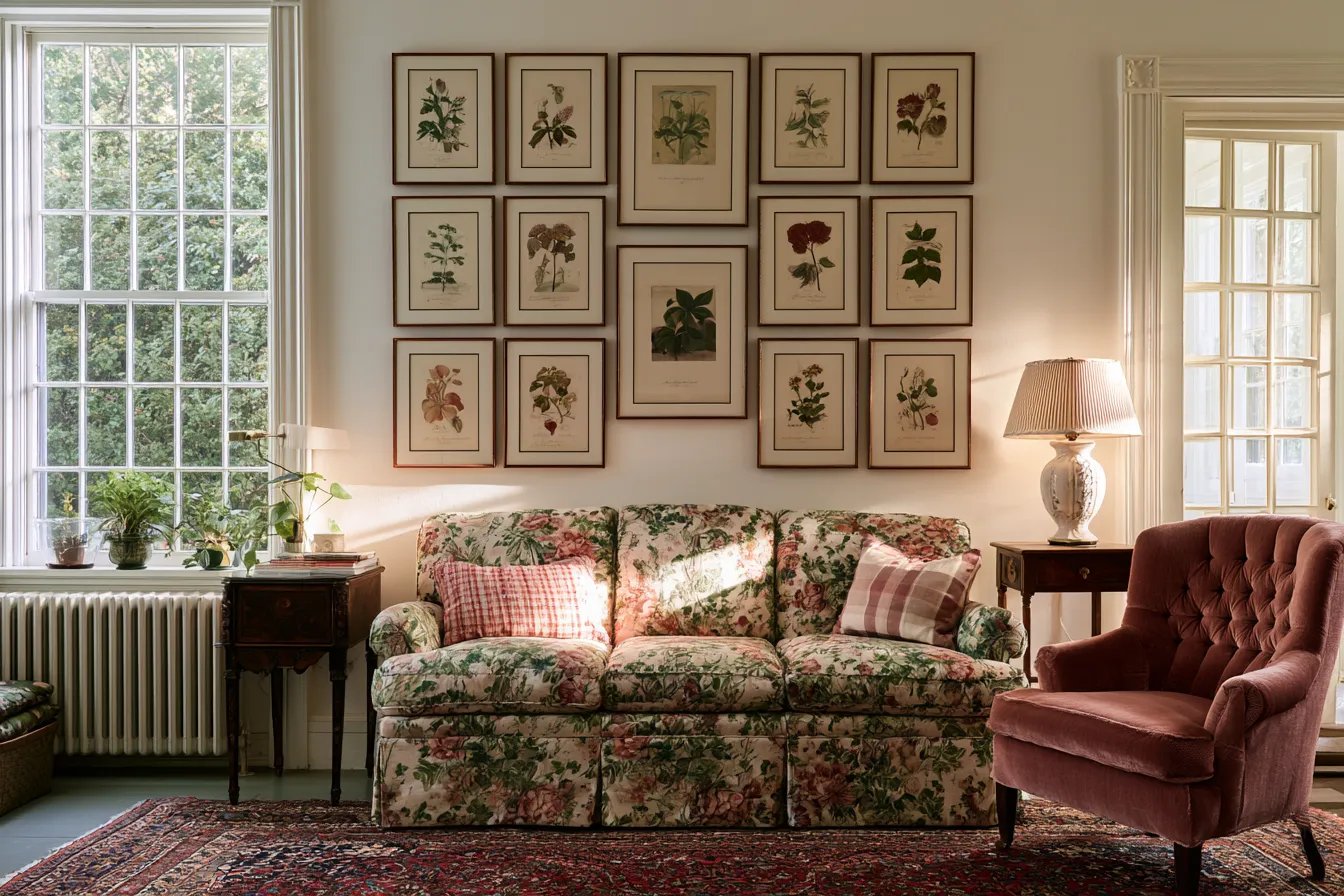
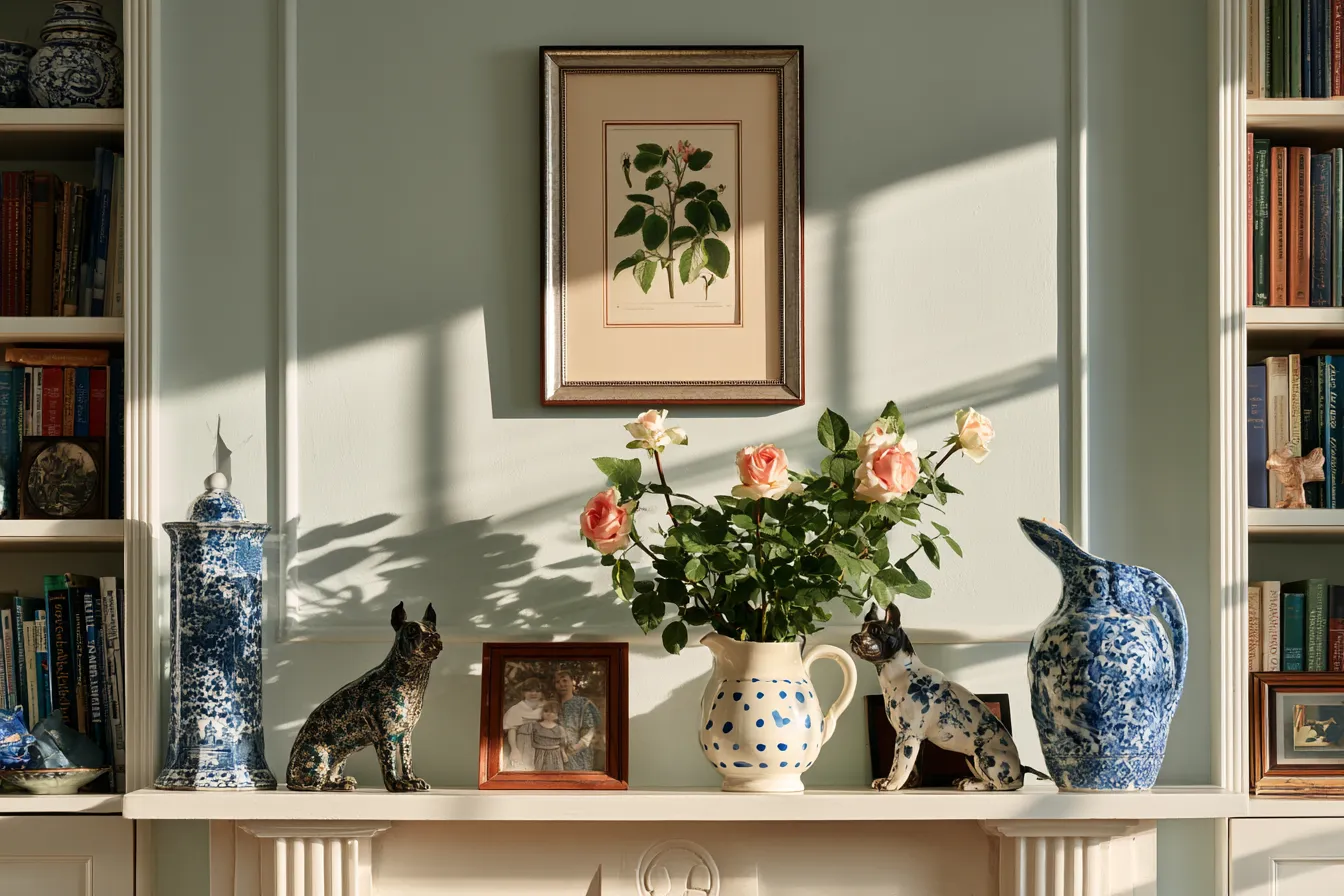
The term grandmillennial describes a person — typically a millennial or younger — who has genuinely traditional, even old-fashioned aesthetic tastes that run directly counter to the minimalist, Scandinavian, or industrial styles that dominated their formative years. The living room decor that expresses this sensibility draws from the domestic interiors of the 1940s through 1980s in Britain and North America: floral and botanical prints, ornate picture frames, needlepoint and embroidered textiles, fringe and tassel trim on curtains and cushions, collections of ceramics and porcelain, crowded bookcases, china dogs on mantlepieces, and a general abundance that minimalism regards as clutter and grandmillennial design regards as personality.
What separates grandmillennial living room decor from simply recreating an elderly relative’s sitting room is the modern inhabitant’s curatorial approach. The grandmillennial room is abundant but not random — each element has been chosen rather than inherited by default, and the overall composition reflects genuine taste rather than accumulated circumstance. The chintz sofa was bought, not kept because nobody knew what else to do with it. The gallery wall was assembled over time and with intention. The difference is invisible from the outside and defines everything about how the room reads.
The Grandmillennial Living Room Palette
The grandmillennial palette is warm, saturated, and unapologetically chromatic — a direct rejection of the grey-and-white neutrality that dominated residential interiors from approximately 2010 to 2020. It draws from the colour language of English country house interiors, Chinoiserie, botanical illustration, and 18th-century decorative arts, filtered through the warmer, more domestic register of mid-20th century British and American living rooms.
Primary Palette Notes
The most characteristic grandmillennial living room colours share three qualities: they are warm in undertone, medium to deep in value (avoiding both very pale pastels and very dark saturated tones), and associated with natural sources — botanical greens, bloom pinks, aged reds, sky blues, warm cream and ivory. Specific colours that recur consistently in grandmillennial living rooms include dusty rose and blush, sage and moss green, powder blue and cornflower, aged terracotta and brick red, soft mustard and ochre, and warm cream and aged ivory. These colours appear both as wall colours and as dominant fabric tones, often in floral prints where multiple palette notes appear within a single textile.
Wall Colour in the Grandmillennial Living Room
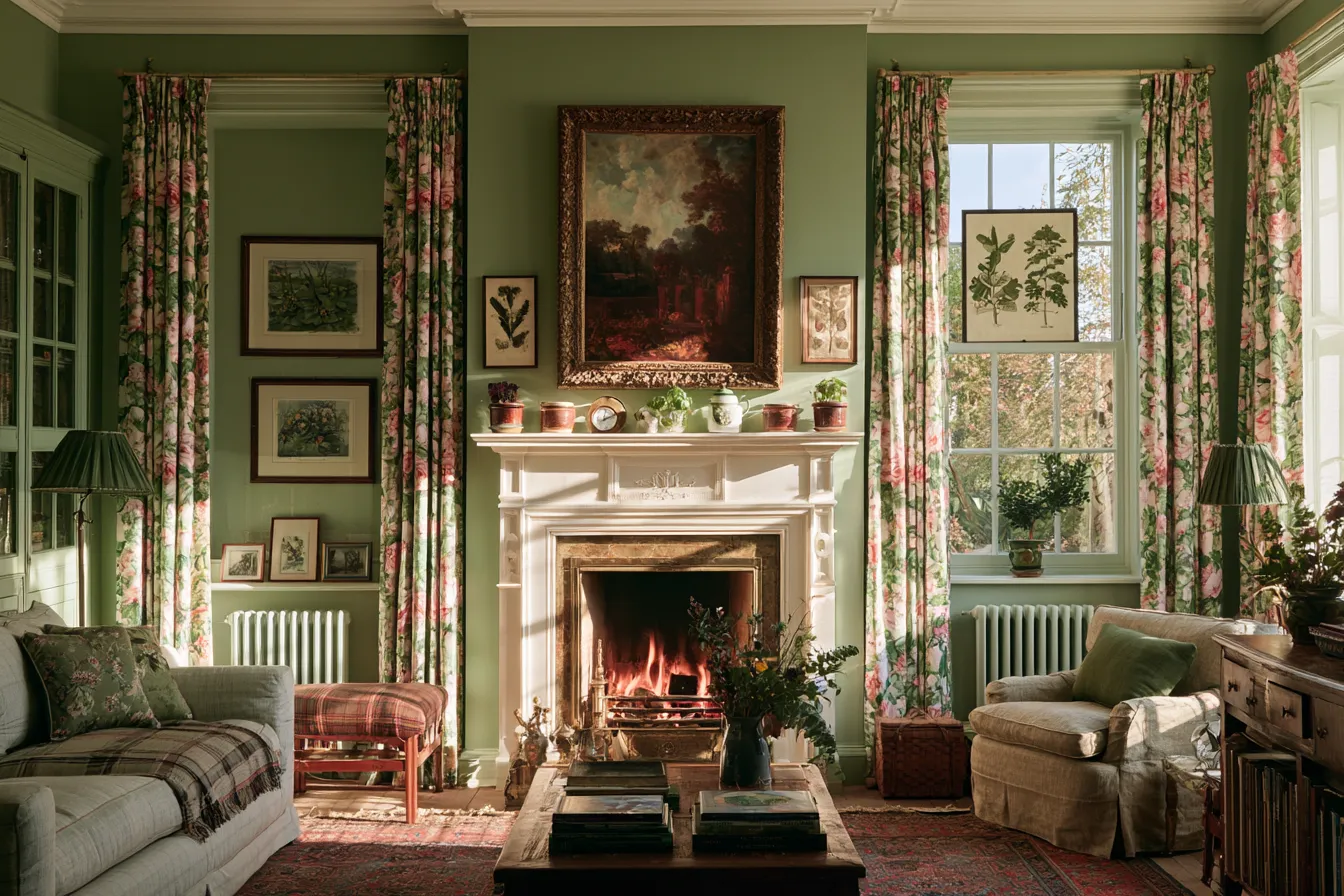
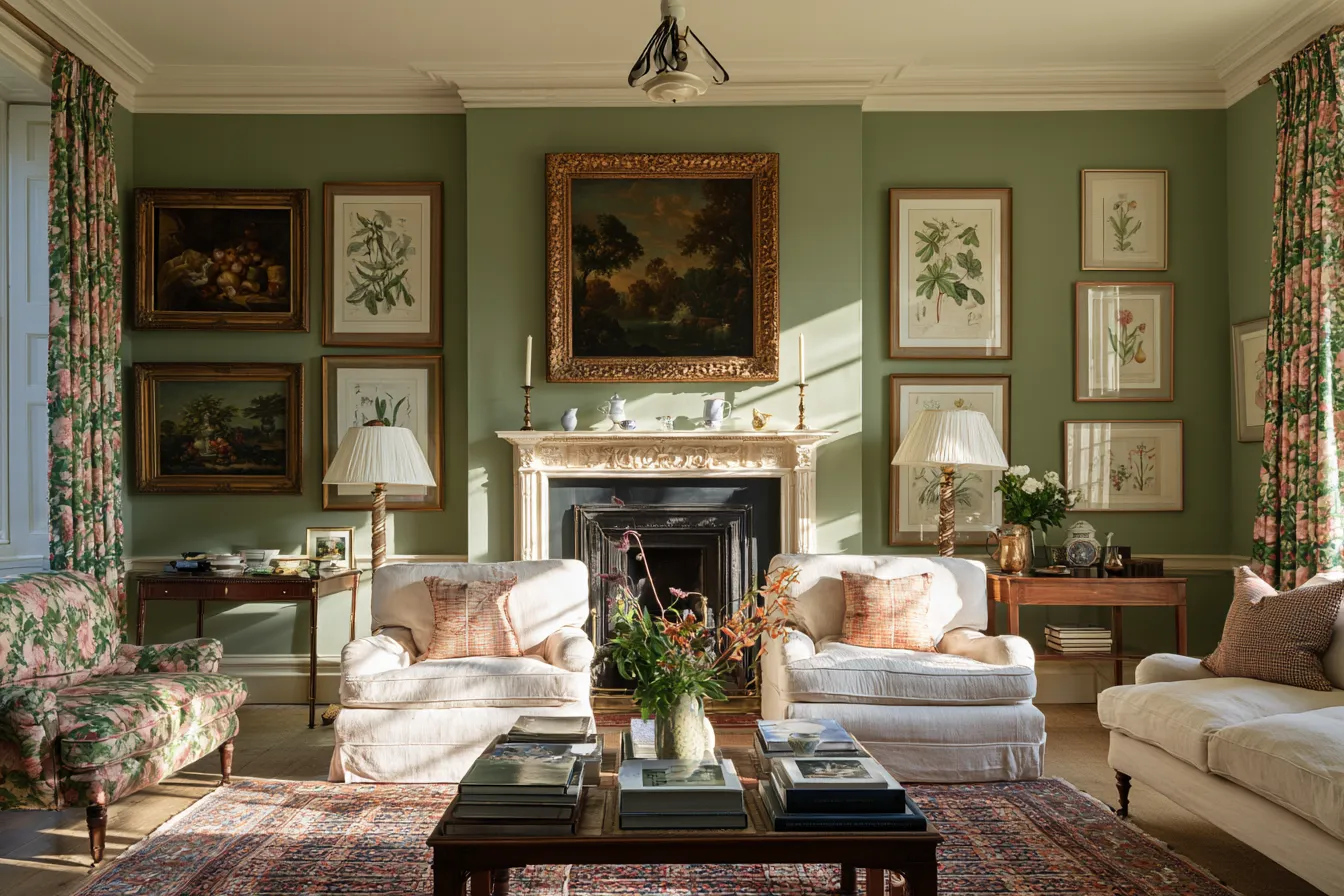
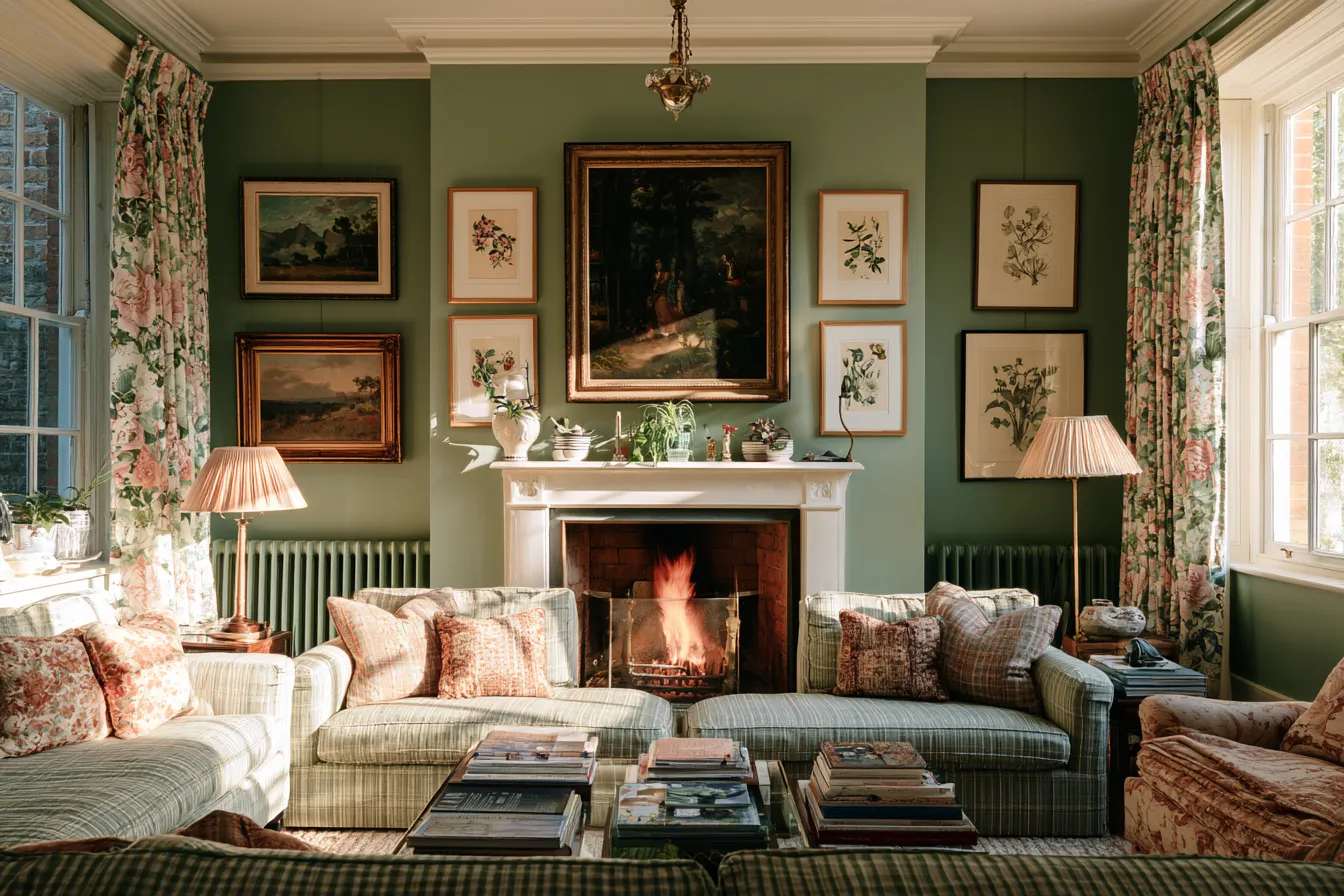
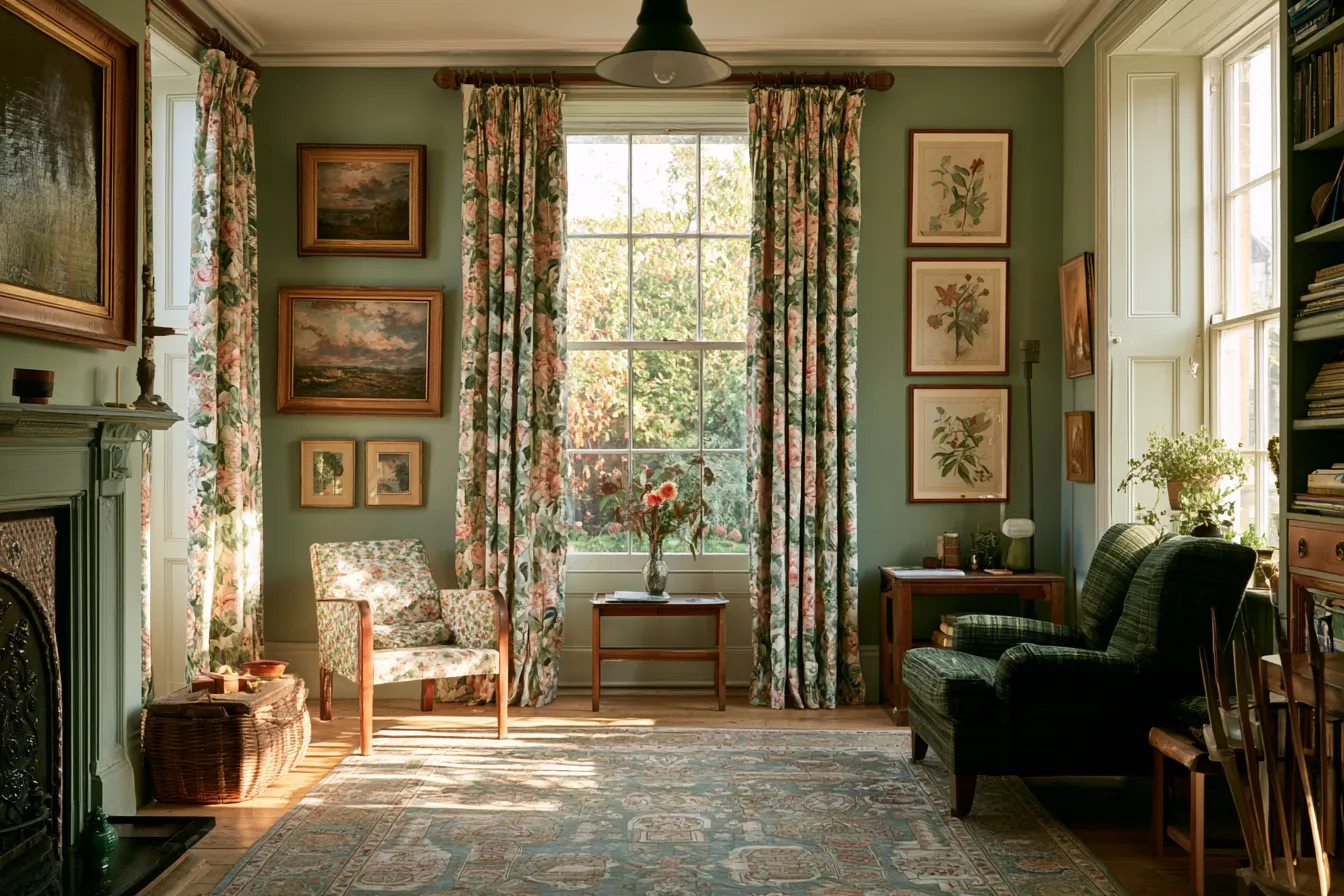
Grandmillennial living rooms rarely have white walls. The wall is understood as an active participant in the room’s colour story rather than a neutral ground. Sage green — particularly Farrow and Ball’s Mizzle, Cooking Apple Green, or Little Greene’s Sage — is perhaps the most commonly encountered wall colour in grandmillennial interiors, providing the botanical reference that links the wall to the floral and botanical patterns in the textiles. Dusty blue (Farrow and Ball’s Oval Room Blue, Hague Blue, or Parma Gray) is the second most characteristic wall family, referencing Georgian interior colour traditions. Deep terracotta, warm cream, and aged yellow ochre also appear frequently.
The wall is also where grandmillennial living room decor most dramatically diverges from its modern counterparts. Wallpaper — particularly floral, botanical, and toile patterns — is not merely acceptable in the grandmillennial living room; it is one of its most powerful tools. A full-room floral wallpaper in a traditional botanical illustration style is among the most committed grandmillennial design statements available and one of the highest-impact single changes that can be made to a living room that is transitioning toward this aesthetic. Our article on botanical wallpaper murals bringing full-room nature indoors covers the specific wallpaper approaches — from full-room applications to feature walls — that translate most naturally into the grandmillennial living room context.
Pattern Mixing in Grandmillennial Living Room Decor
Pattern mixing is the defining skill of the grandmillennial living room and the area that most intimidates those approaching the aesthetic for the first time. The grandmillennial room is not afraid of using four or five different patterns within the same space — floral, stripe, plaid, toile, and geometric can all coexist — but this abundance is not random. It follows a set of principles, largely inherited from traditional English country house decorating, that allow multiple patterns to work together rather than fighting each other.
The Scale Rule
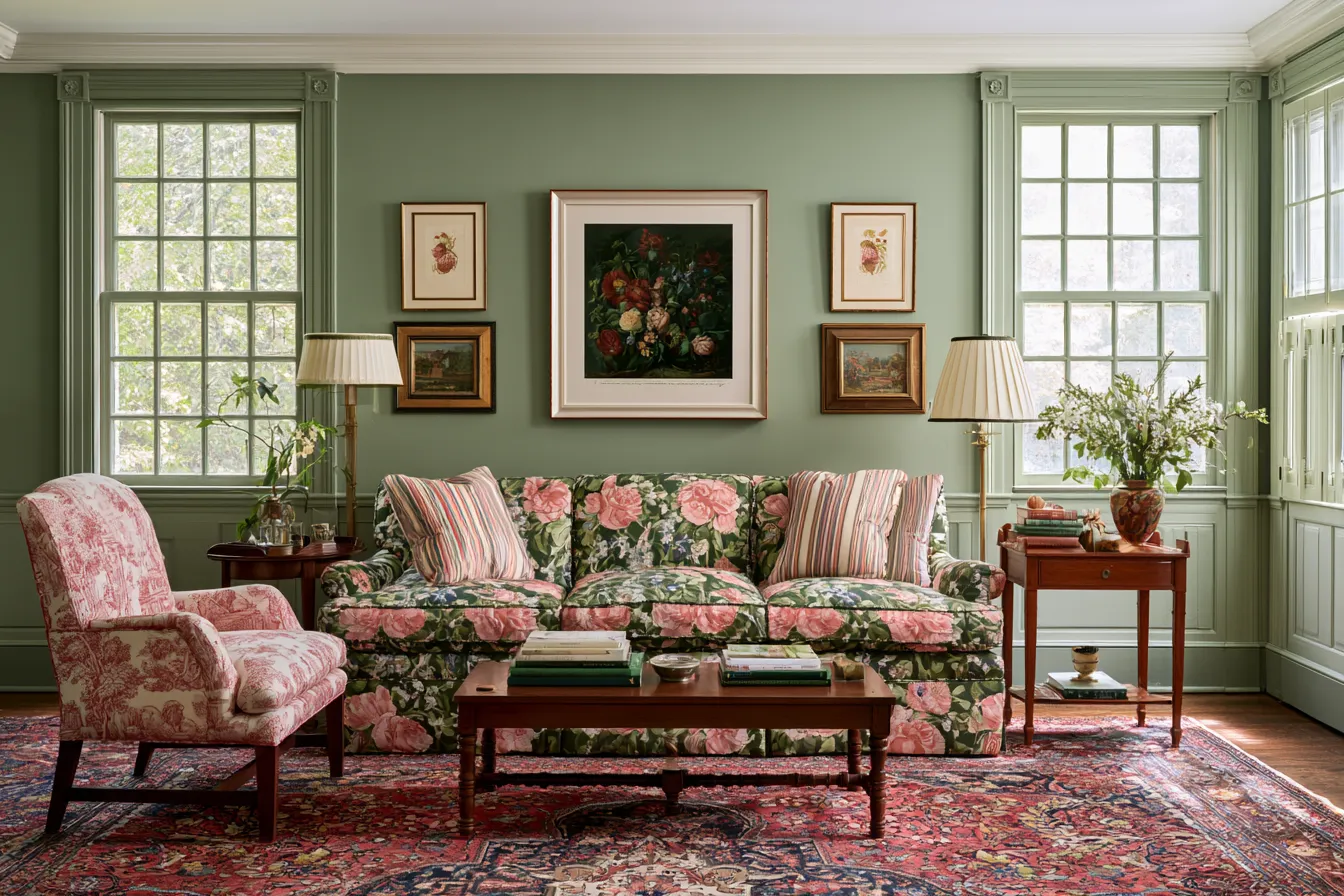
The foundational rule of grandmillennial pattern mixing: vary the scale of every pattern. A large-scale floral on the sofa or curtains, a medium-scale stripe or geometric on a cushion or armchair, and a small-scale print or texture on another cushion or throw — this hierarchy of scale allows multiple patterns to be read simultaneously without visual competition. When two patterns of the same scale appear together (a large floral cushion on a large floral sofa, for instance), the eye cannot resolve them as separate elements and the result reads as confusion rather than richness.
The Colour Connection Rule
The second rule: every pattern in the room should share at least one colour with at least one other pattern. A pink and green floral sofa works with a blue and green striped cushion because both share green; that blue and green stripe works with a pale blue geometric armchair because both share blue. The colour connections create a chain that ties the room’s different patterns together into a coherent composition, even when the patterns themselves are very different in character and origin. This is the logic behind the grandmillennial room’s apparent effortlessness — the patterns look right together because they have been chosen to be right together, not because they match.
Pattern Intensity by Zone
In a grandmillennial living room where multiple patterns are used, the most pattern-intensive elements should occupy the room’s primary visual positions — the sofa, the curtains, the wallpaper — while secondary and accessory pieces carry lighter or simpler patterns. A very busy floral sofa is better balanced by a simpler stripe or solid armchair than by an equally complex second pattern; two equally busy patterns of similar scale competing in the same visual field is the specific error that makes pattern-heavy rooms read as chaotic rather than abundant.
Key Furniture Pieces in the Grandmillennial Living Room
The furniture in a grandmillennial living room sits at the intersection of comfort and tradition. Pieces with visible craftsmanship, period-referencing silhouettes, and upholstery that would not look out of place in a 1950s British sitting room are the consistent choices. Contemporary minimalist profiles — low-profile platform sofas, hairpin-leg side tables in bare metal, Scandinavian-influenced pieces with very sparse decoration — are the specific aesthetic opposite of grandmillennial and should be avoided or at minimum balanced by more traditional pieces if they are already present in the room.
The Sofa
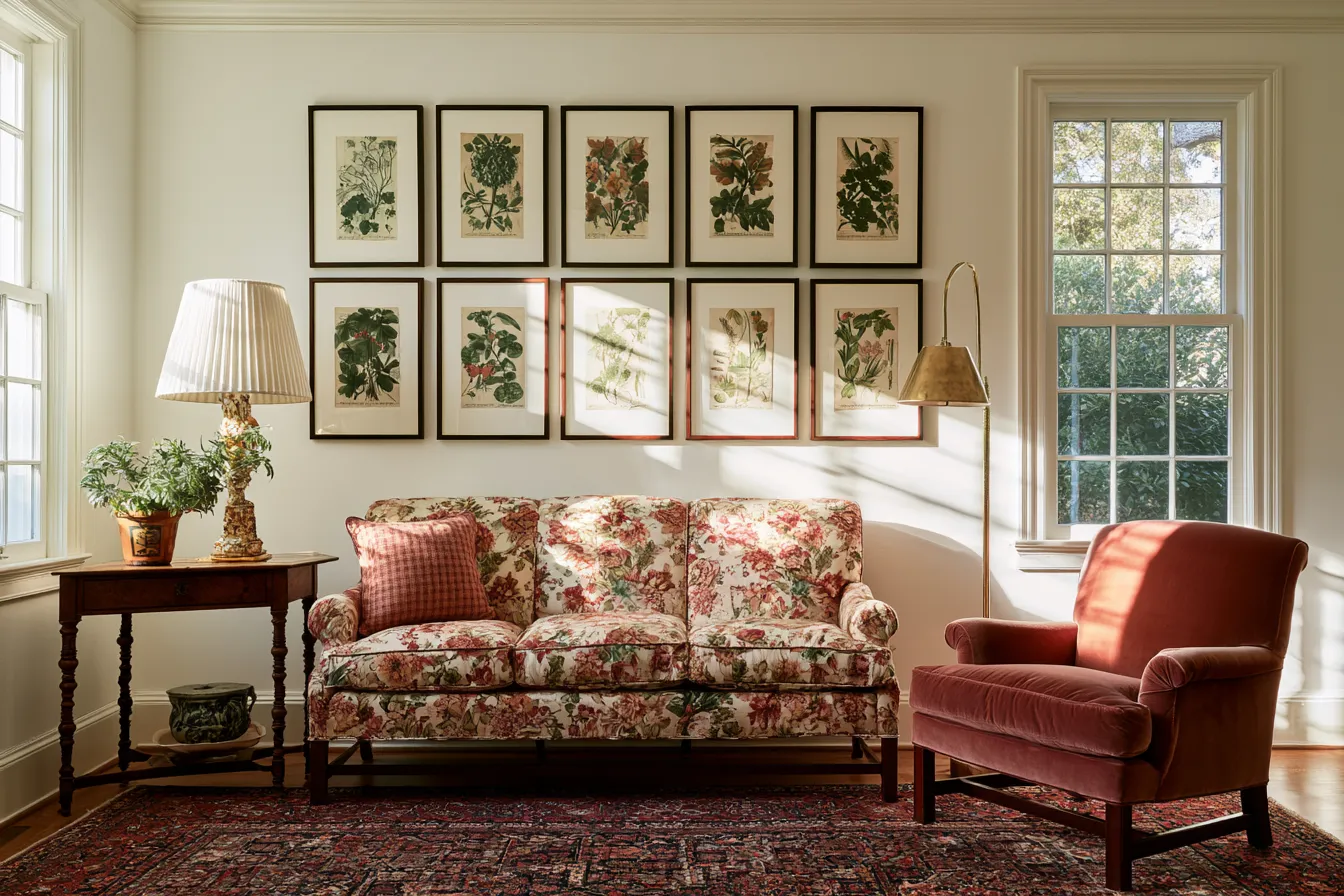
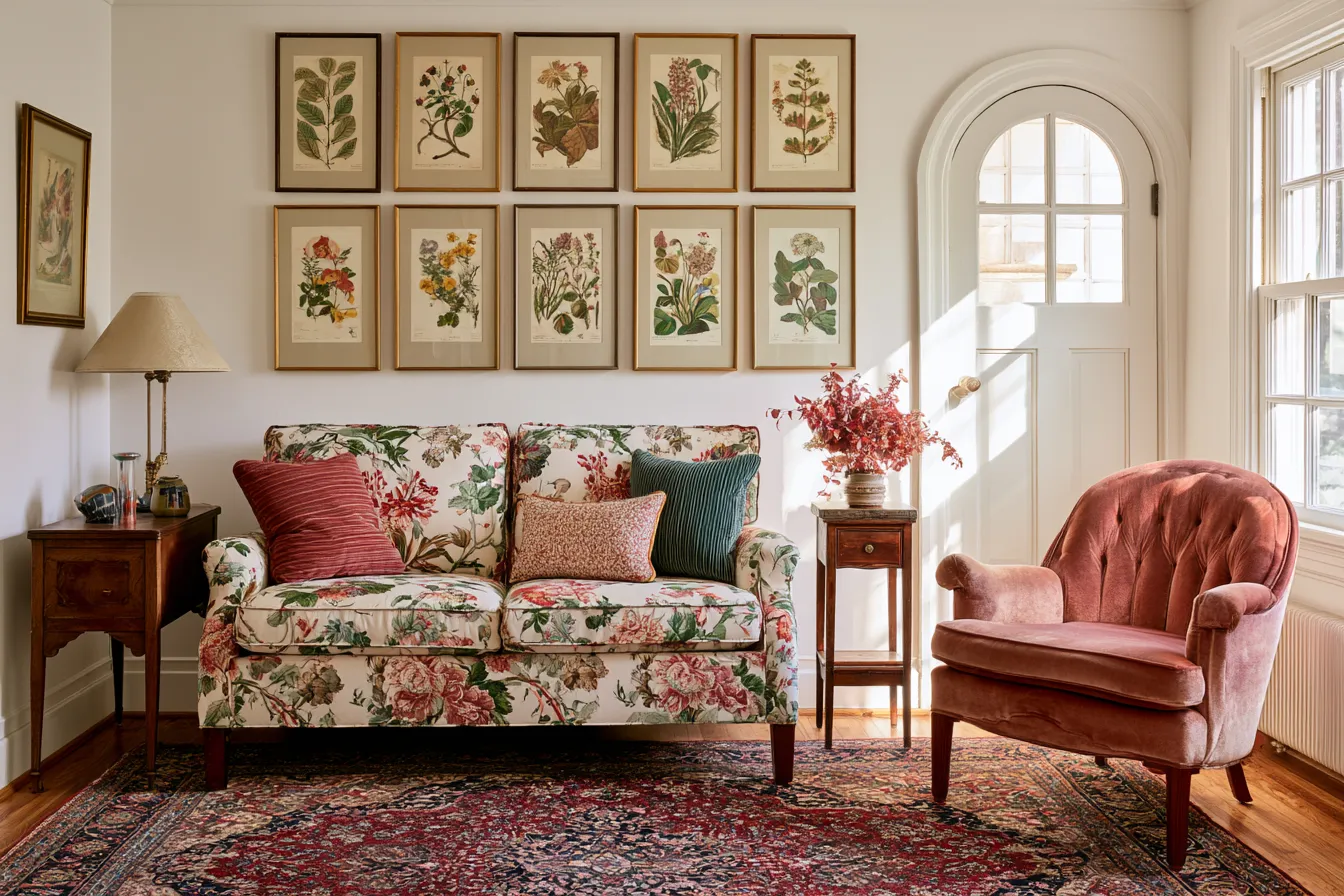
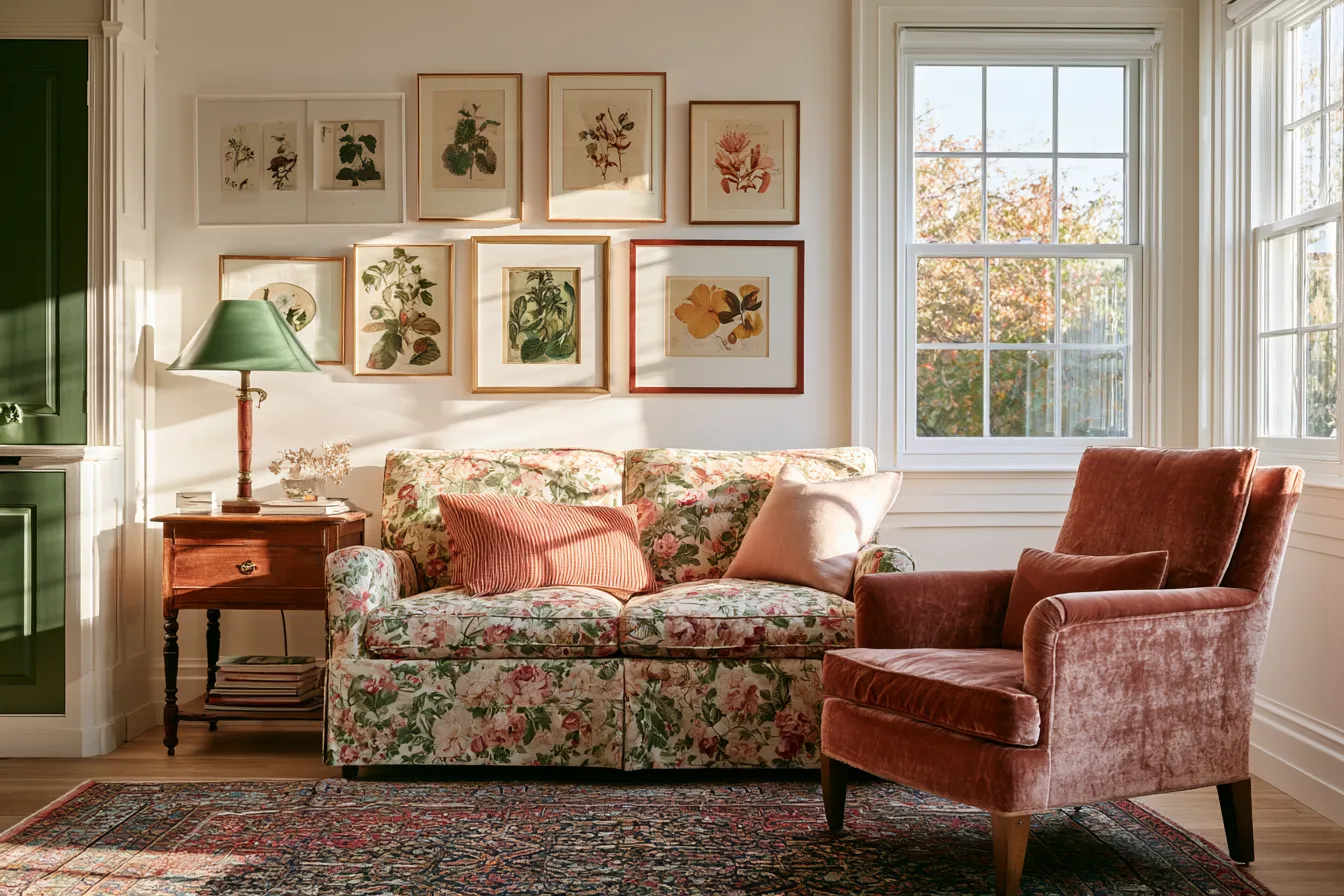
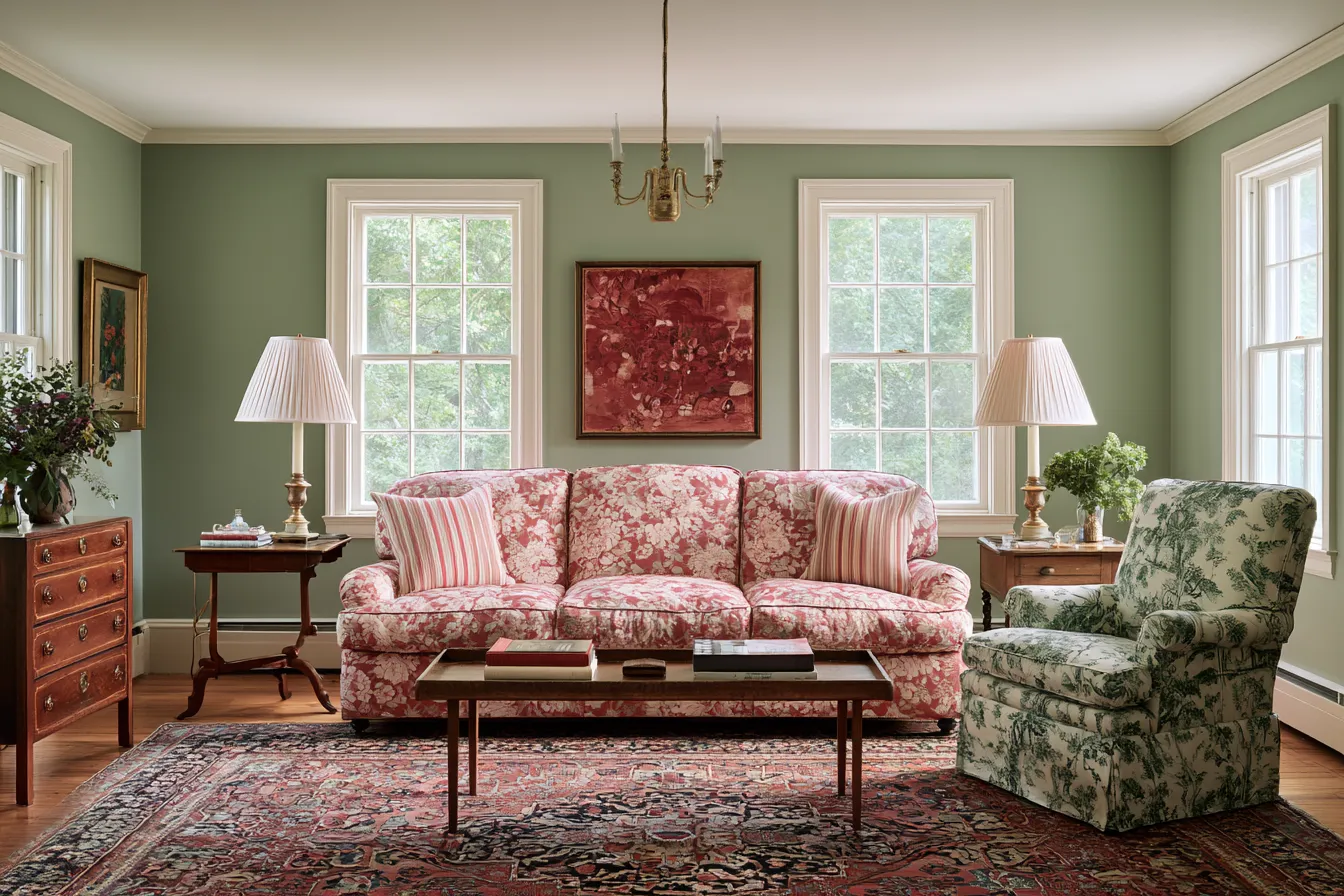
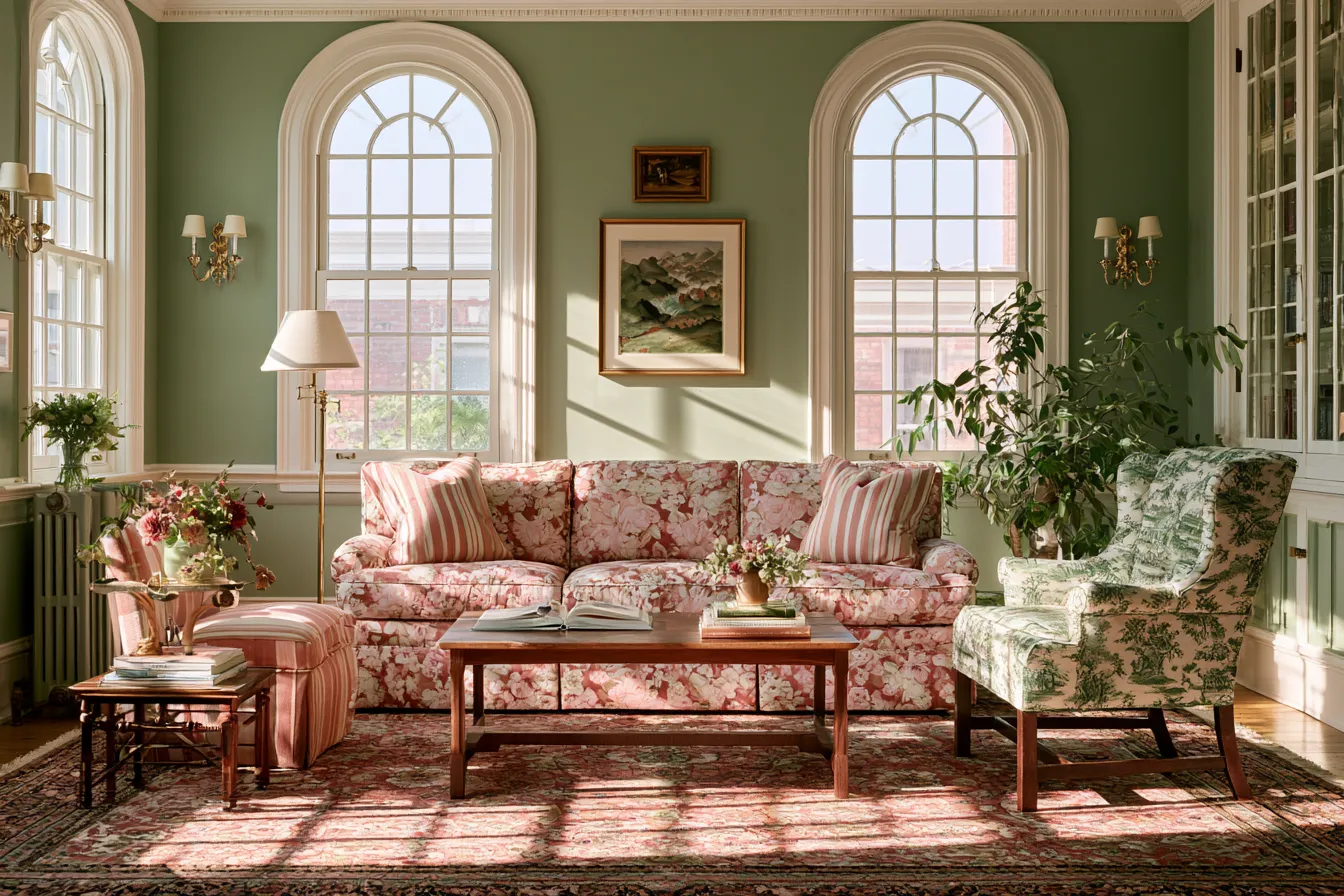
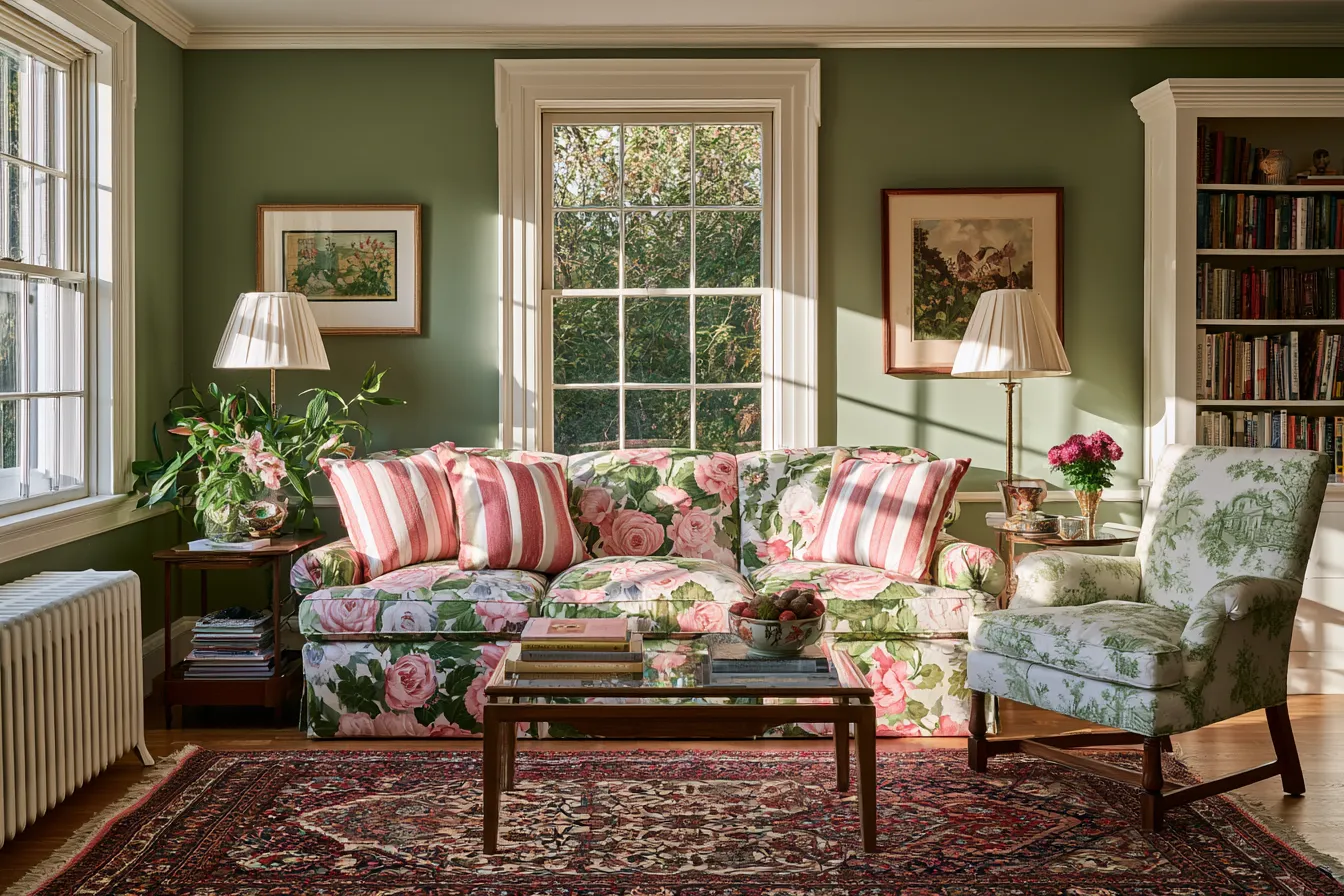
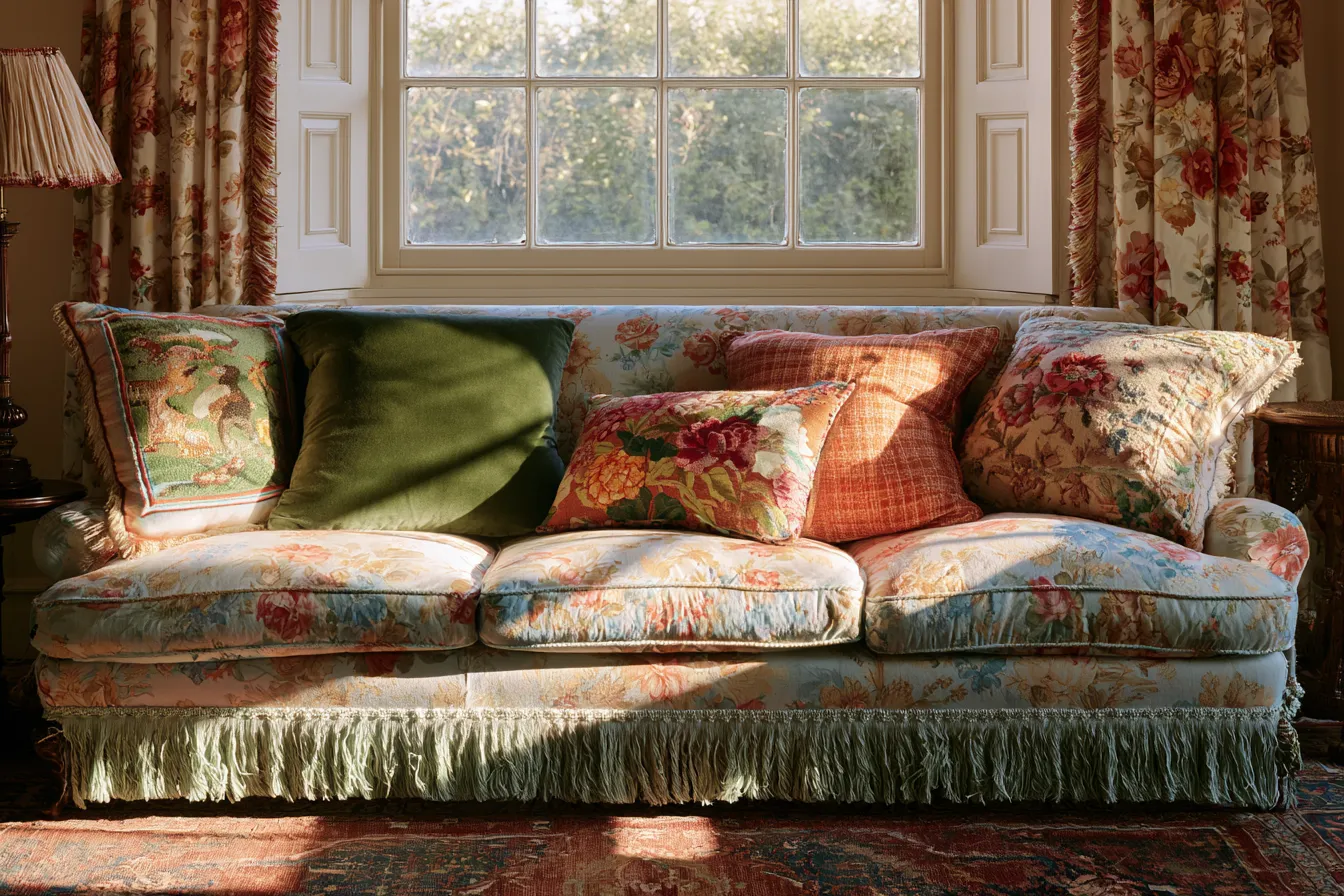
The grandmillennial living room sofa is typically a high-backed, rolled-arm or Chesterfield-profile piece with visible comfort — generous seat depth, plump cushions, and upholstery that reads as soft and inviting rather than structured and architectural. Chintz is the most iconic grandmillennial sofa fabric — the glazed cotton floral print that became synonymous with English country house interiors in the late 20th century — but any floral, botanical, or heritage print in a cotton or linen-cotton blend delivers the same aesthetic logic. A plain sofa in a saturated traditional colour — deep rose, sage green, dusty blue — is the more restrained grandmillennial sofa choice and one that allows the room’s other pattern elements to carry more of the visual work.
Armchairs
The grandmillennial living room typically contains at least two armchairs alongside the sofa — a quantity that would be excessive in a minimalist room but is genuinely necessary in an aesthetic built around the idea of multiple people sitting together in a room designed for exactly that purpose. The wingback chair is the grandmillennial armchair par excellence: its high back, flanking wings, and defined silhouette reference the fireside chairs of 18th-century English interiors and bring a formal, almost theatrical quality to the sitting arrangement. Upholstered in a toile, a needlepoint fabric, a faded velvet, or a bold solid colour that references the sofa’s palette, the wingback chair can carry an enormous amount of the grandmillennial room’s visual weight in a single piece.
Coffee Tables and Side Tables
The grandmillennial coffee table is typically wooden, with turned legs and traditional detail — a Victorian or Edwardian country-house form rather than a contemporary profile. Dark mahogany, walnut, or a painted finish in a colour that references the room’s palette are all appropriate. Nesting tables — a set of two or three tables of descending size that slide beneath each other when not in use — are a classic grandmillennial living room choice that references directly the mid-20th century British sitting room tradition. The glass-topped coffee table on gold or brass legs is a more contemporary-leaning grandmillennial option that introduces glamour alongside the traditional upholstery choices.
| Furniture Piece | Grandmillennial Choice | Profile to Avoid | Key Material |
|---|---|---|---|
| Sofa | Rolled arm, high back, Chesterfield; chintz, floral print, or saturated solid | Low-profile platform, track arm, minimalist silhouette | Cotton chintz, linen blend, velvet |
| Armchair | Wingback, button-back, or barrel chair with traditional upholstery | Tulip, Egg, or clean-line contemporary profile | Toile, needlepoint, velvet, faded floral |
| Coffee table | Turned leg, traditional wooden form, nesting tables, or glass on brass | Solid concrete, raw steel, very minimal Scandi form | Dark wood, mahogany, walnut, brass and glass |
| Bookcase | Tall, solid wood, full-height with glass doors or open shelving crowded with books and objects | Floating minimal shelves, very sparse arrangement | Dark or painted wood, glass-fronted doors |
| Side table | Small, round or square with lower shelf; nesting tables; drum table | Very minimal, bare metal, no lower shelf or detail | Dark wood, painted, marble top with wood base |
Textiles and Soft Furnishings in the Grandmillennial Living Room
Textiles are the grandmillennial living room’s primary medium. The softness, warmth, and visual richness of a grandmillennial room come almost entirely from its fabric choices — the curtains, cushions, throws, and rugs that cover, frame, and layer the room’s surfaces. Understanding which textiles are grandmillennial and which are not is the fastest shortcut to understanding the aesthetic’s material logic.
Curtains
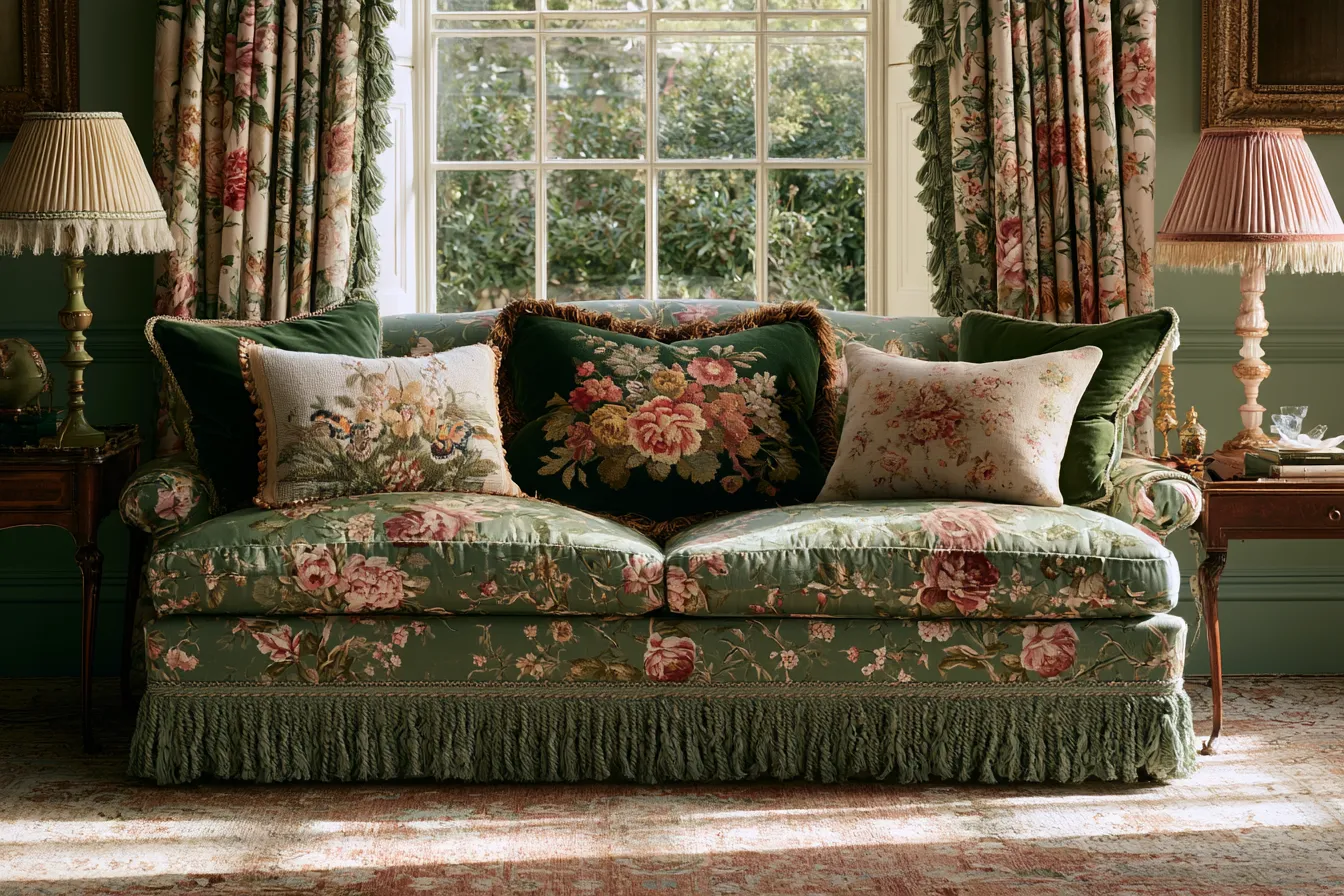
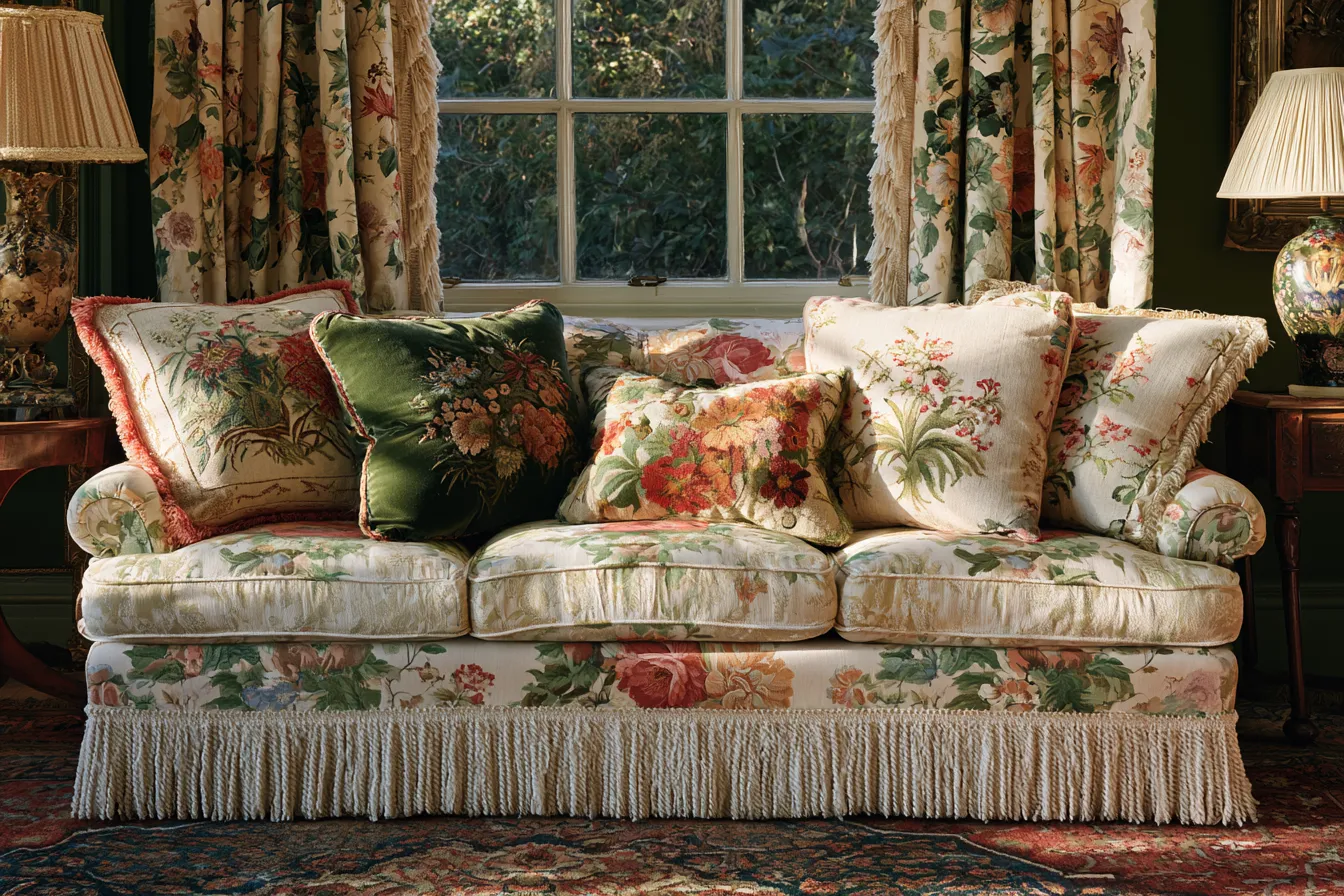
Grandmillennial curtains are floor-length, generously pleated or gathered, and made from fabric with visual complexity — a large-scale floral or botanical print, a toile de Jouy, a damask or brocade, or a heavyweight linen in a deep solid colour. Fringe and tassel trim on the leading edge and base of curtains is one of the most specific grandmillennial signals — the decorative trim that was considered fussy and old-fashioned for twenty years is now understood as the precise expression of the craft-and-tradition values that grandmillennial design celebrates. Curtains should be hung from as high as possible (ceiling height or within 2–3 inches of it) and extend to the floor; the generous hang of well-made curtains is part of what makes a grandmillennial living room feel as though it has been considered at the level of a professional interior designer working in 1975.
Cushions
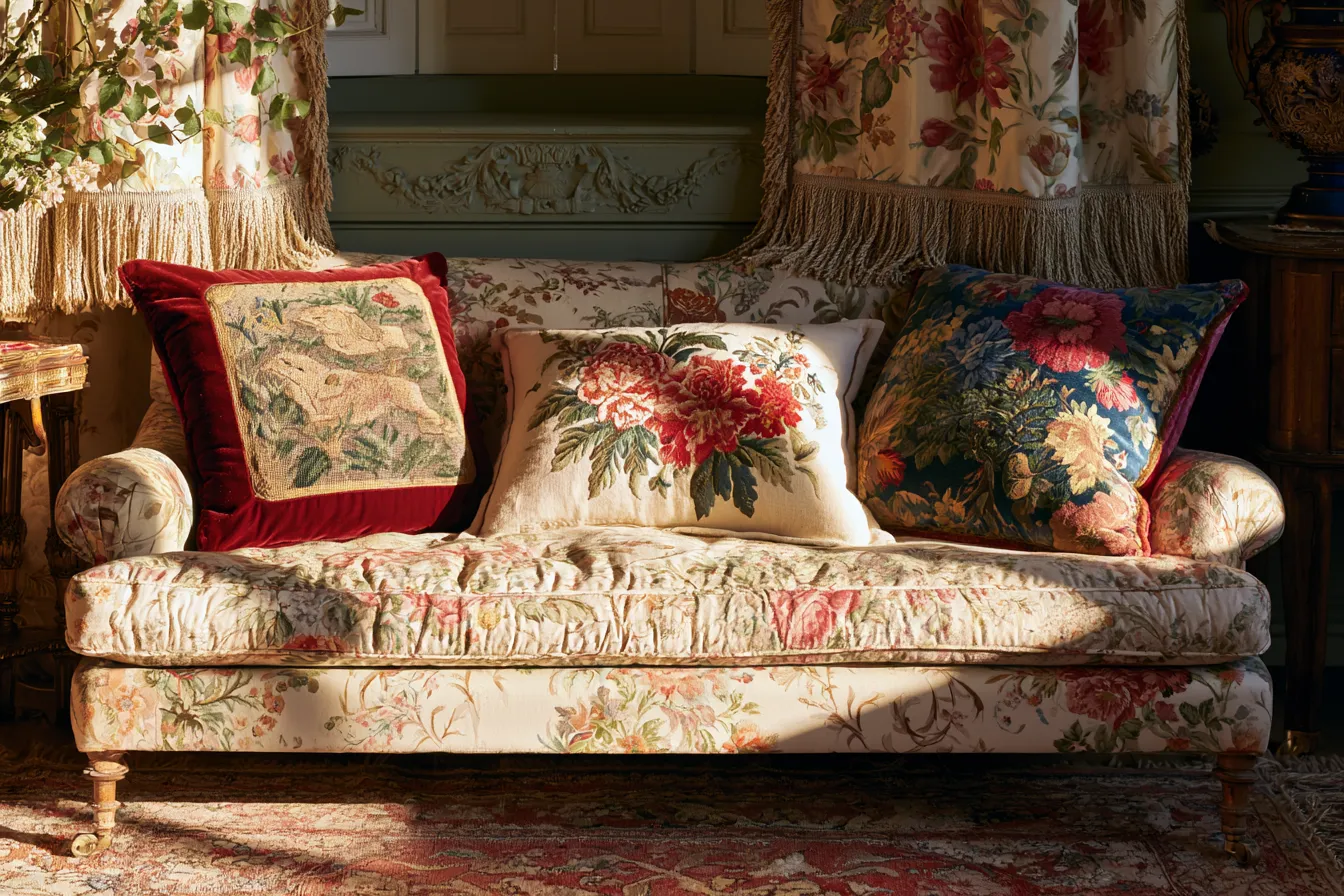
The grandmillennial living room does not have three matching cushions. It has more cushions than is strictly necessary — typically seven to ten on a three-seater sofa plus two chairs — in a range of sizes, fabrics, and patterns that follow the scale and colour connection rules described above. Needlepoint cushions (canvas embroidery in florals, animals, or geometric designs) are among the most characteristically grandmillennial textile choices, evoking the handcrafted domestic tradition that is central to the aesthetic’s emotional appeal. Embroidered cotton, crewelwork, velvet, and faded floral linen complete the typical grandmillennial cushion portfolio. The key is that each cushion should look as though it has a history — whether genuinely vintage, found at a market, or new but made in a traditional craft technique.
Rugs
The grandmillennial living room rug is almost always a Persian, Turkish, or oriental-style carpet — a large-scale patterned rug in deep reds, blues, greens, and golds that provides the floor-level pattern complexity the aesthetic depends on. The rug should be large enough to anchor the entire seating arrangement: front legs of all seating pieces on the rug, with at least 12 inches of rug visible around the perimeter of the sitting group. A faded or antique-washed finish is preferred over a bright, saturated new pile; the sense of history and gentle wear that a faded oriental rug carries is precisely the quality that grandmillennial decor seeks in almost every element it uses.
The specific role of the rug as an anchoring and layering device in pattern-rich rooms — and the layering techniques that add depth without chaos — is covered in our guide to layered rugs and how they create depth without renovation, which provides directly applicable guidance for the grandmillennial living room’s floor-covering strategy.
The Grandmillennial Gallery Wall and Art Choices
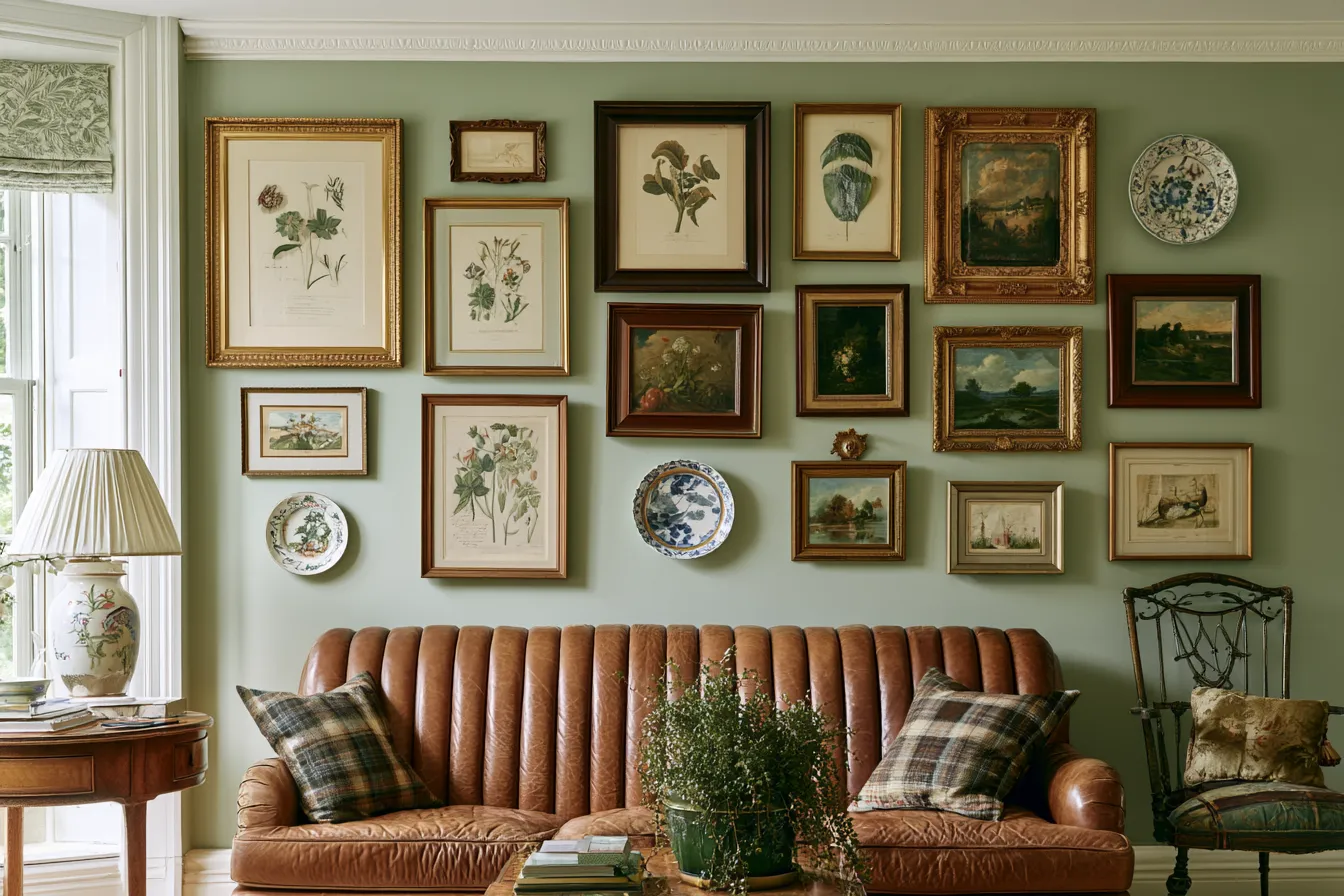
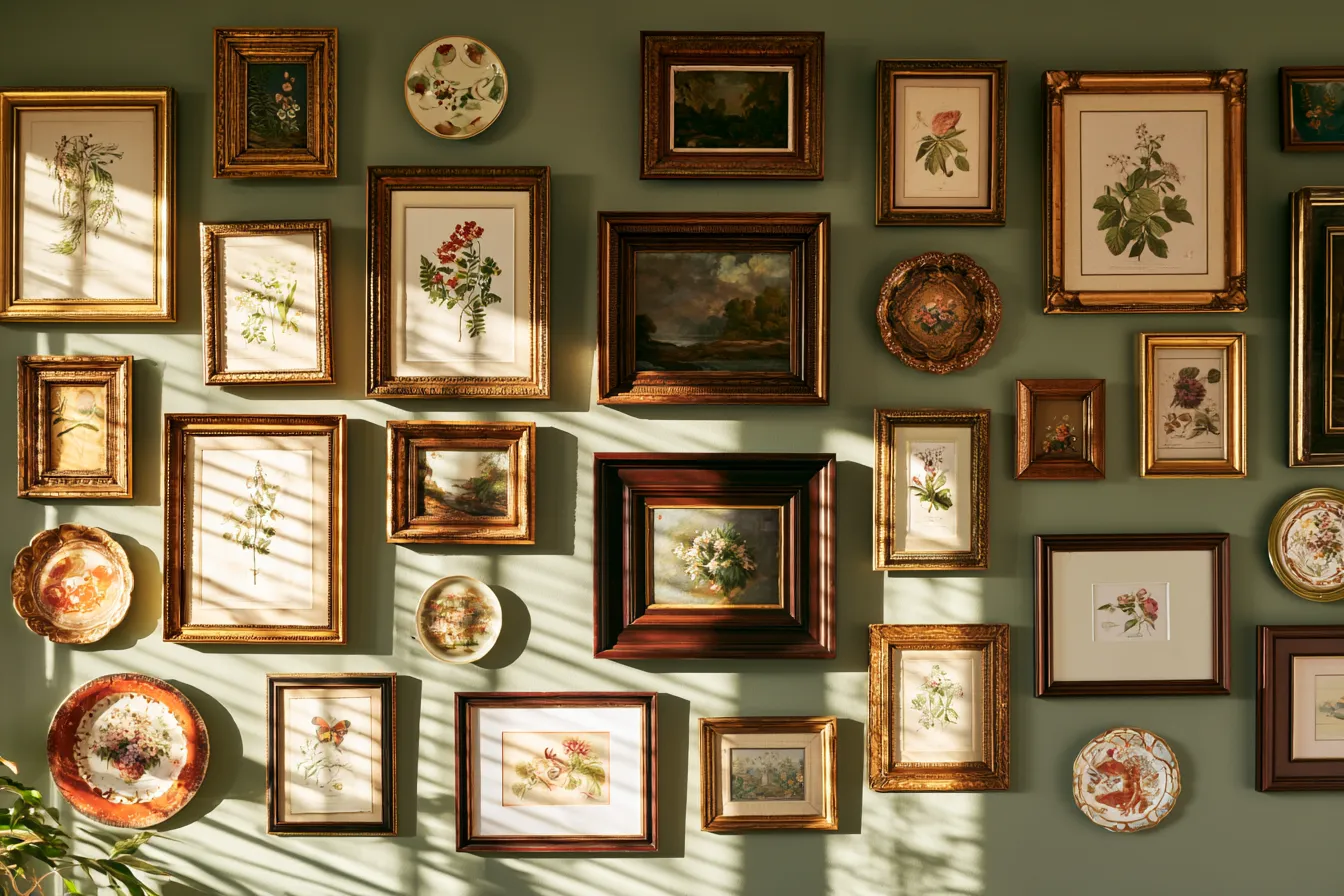
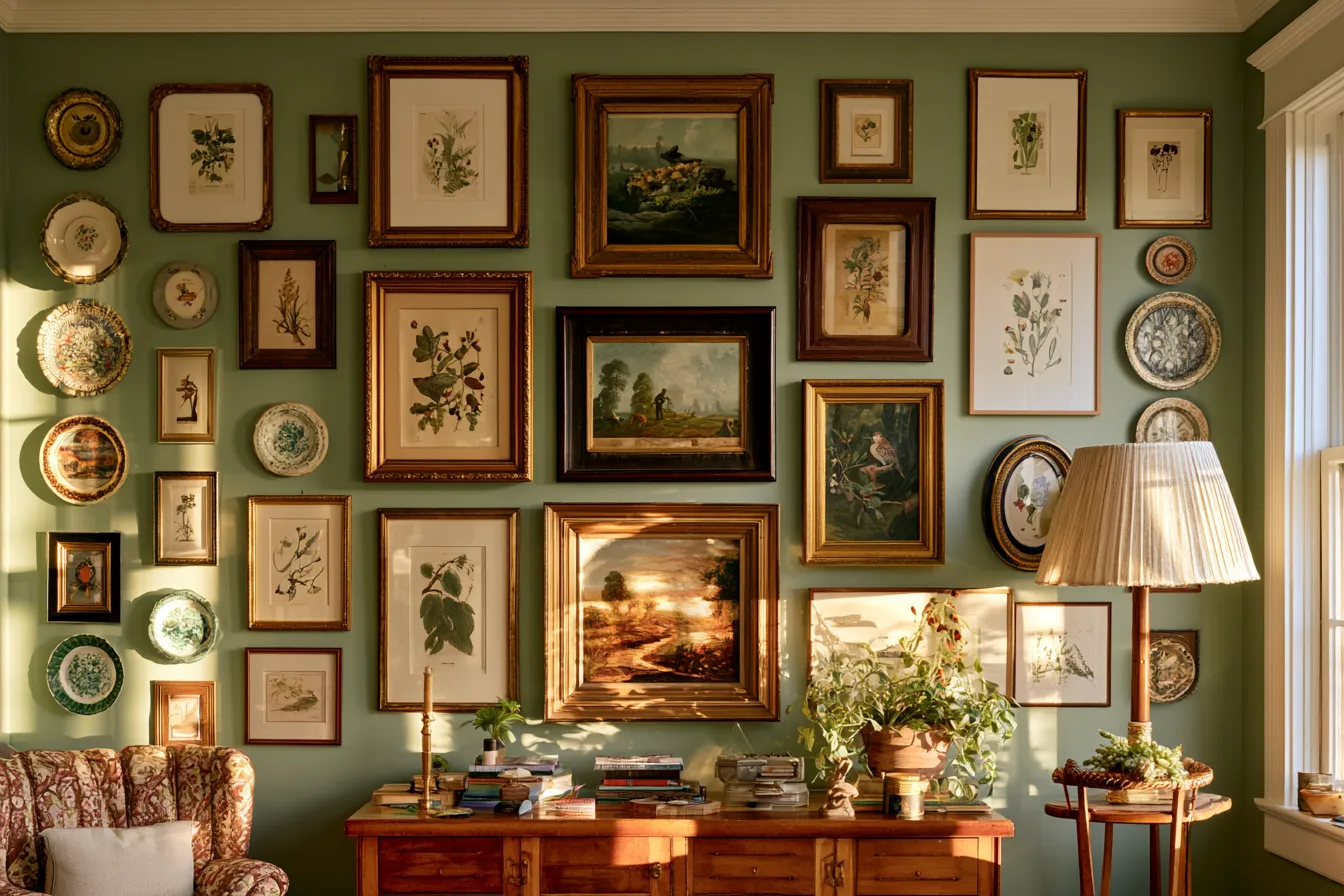
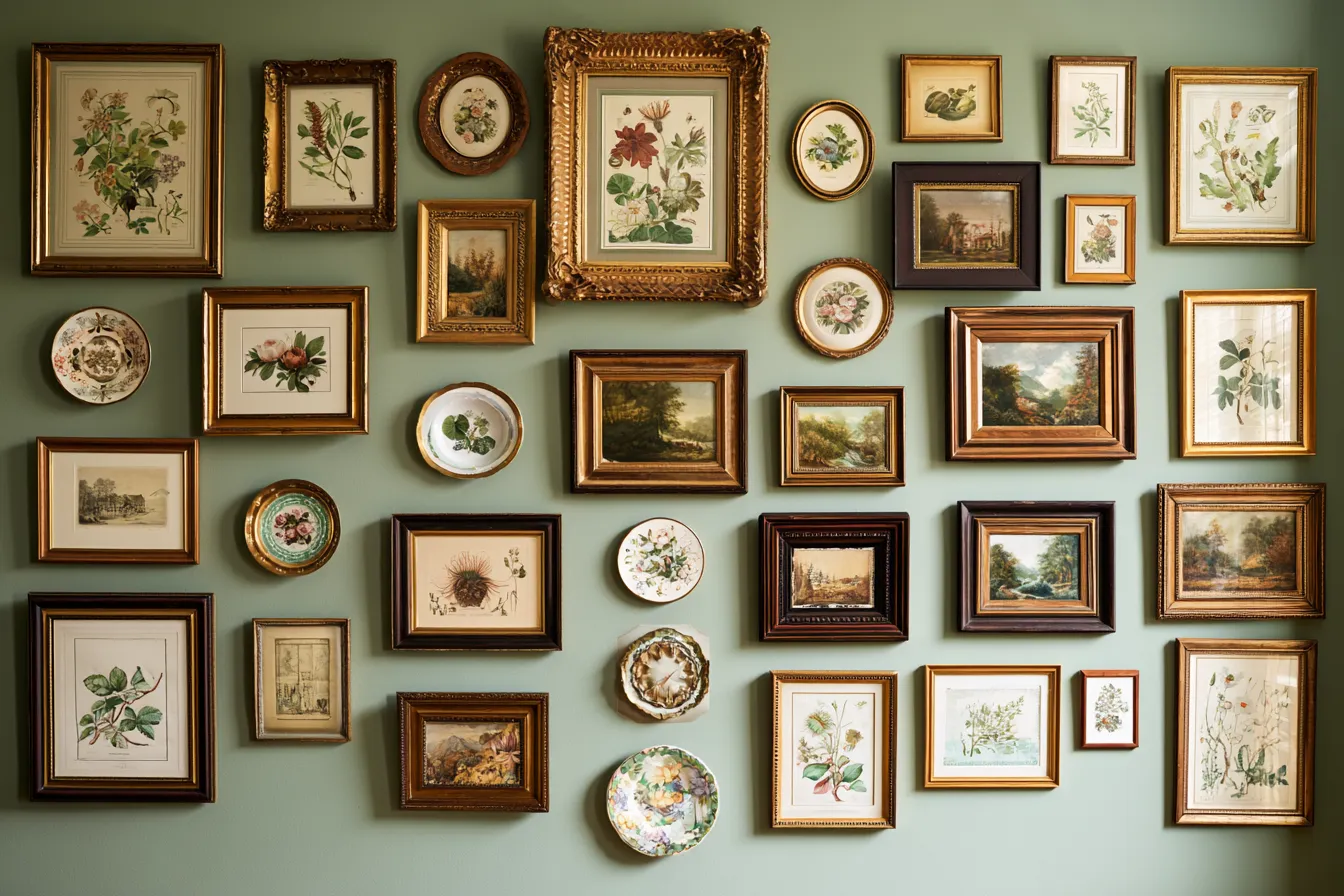
No element is more immediately recognisable in a grandmillennial living room than the gallery wall — a densely hung arrangement of framed pictures that covers a significant portion of one or more walls. The grandmillennial gallery wall is specifically different from the modern, curated gallery wall of the Instagram design account: it is denser, more varied in frame style and picture type, and makes no attempt to impose visual consistency through identical frames or uniform spacing. It looks as though it grew over time, which in a genuine grandmillennial room it often has.
What Hangs on the Grandmillennial Gallery Wall
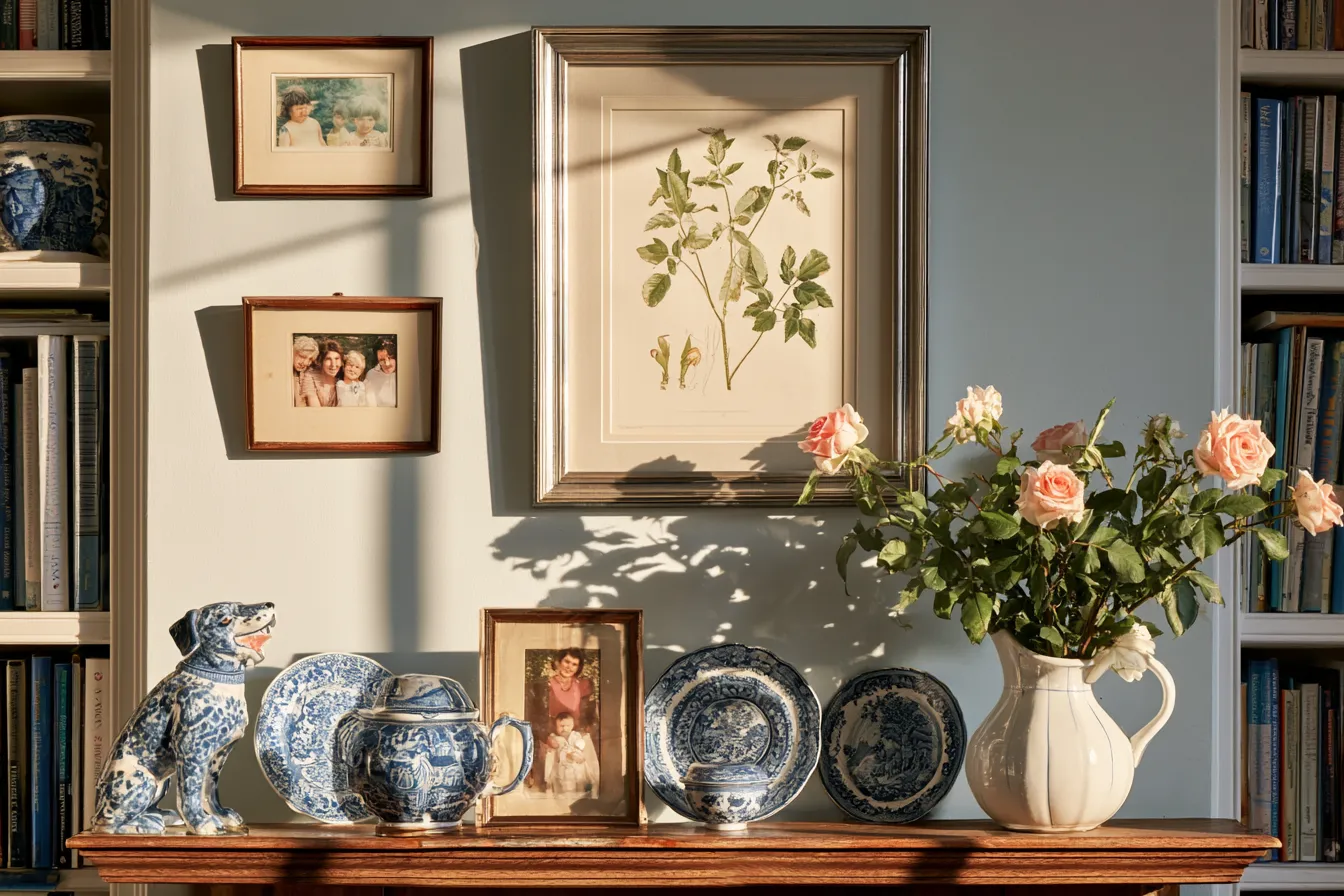
The most characteristic grandmillennial art choices include botanical and zoological prints in the style of 18th and 19th century natural history illustration; oil paintings or oil-effect prints in ornate gilt or dark wood frames; watercolours of landscapes, flowers, or domestic interiors; family portraits (whether genuine ancestral paintings or found portraits from antique shops and estate sales); needlework and embroidered samplers in frames; decorative plates and porcelain medallions hanging alongside framed pictures; and occasional mirrors with elaborate carved or gilded frames interspersed through the arrangement. The variety is deliberate and is what gives the grandmillennial gallery wall its sense of accumulated personal history.
The Frame Mix
Grandmillennial frames are ornate rather than minimal. Gilt or gold leaf frames — particularly carved and gessoed frames in the traditional style — are the most period-specific choice. Dark mahogany or walnut frames, painted frames in colours that reference the room’s palette, and fabric-wrapped frames (a 1970s technique now experiencing grandmillennial revival) all appear. The modern white or black thin-profile frame — the dominant gallery wall frame in contemporary interiors for the past decade — is the specific frame style that grandmillennial design rejects. One or two thin-profile frames can be mixed in as a modern note, but the overall gallery wall should read as traditional and varied in framing rather than contemporary and consistent.
The grandmillennial approach to mixing antique and contemporary art — and the specific techniques that make art from different periods and styles coexist in a single wall arrangement — connects directly to the principles in our article on mixing ultra-modern art with antique wood furniture, which covers the compositional logic of combining objects from different aesthetic periods in a single room.
Objects and Collections in the Grandmillennial Living Room
The grandmillennial living room is a collecting room. Where minimalist interiors are defined by the objects they remove, grandmillennial interiors are defined by the objects they accumulate — arranged with care on mantlepieces, bookshelves, side tables, and windowsills. The specific objects that most characterise the grandmillennial aesthetic are those associated with the traditional British and American domestic interior from the mid-19th to mid-20th century.
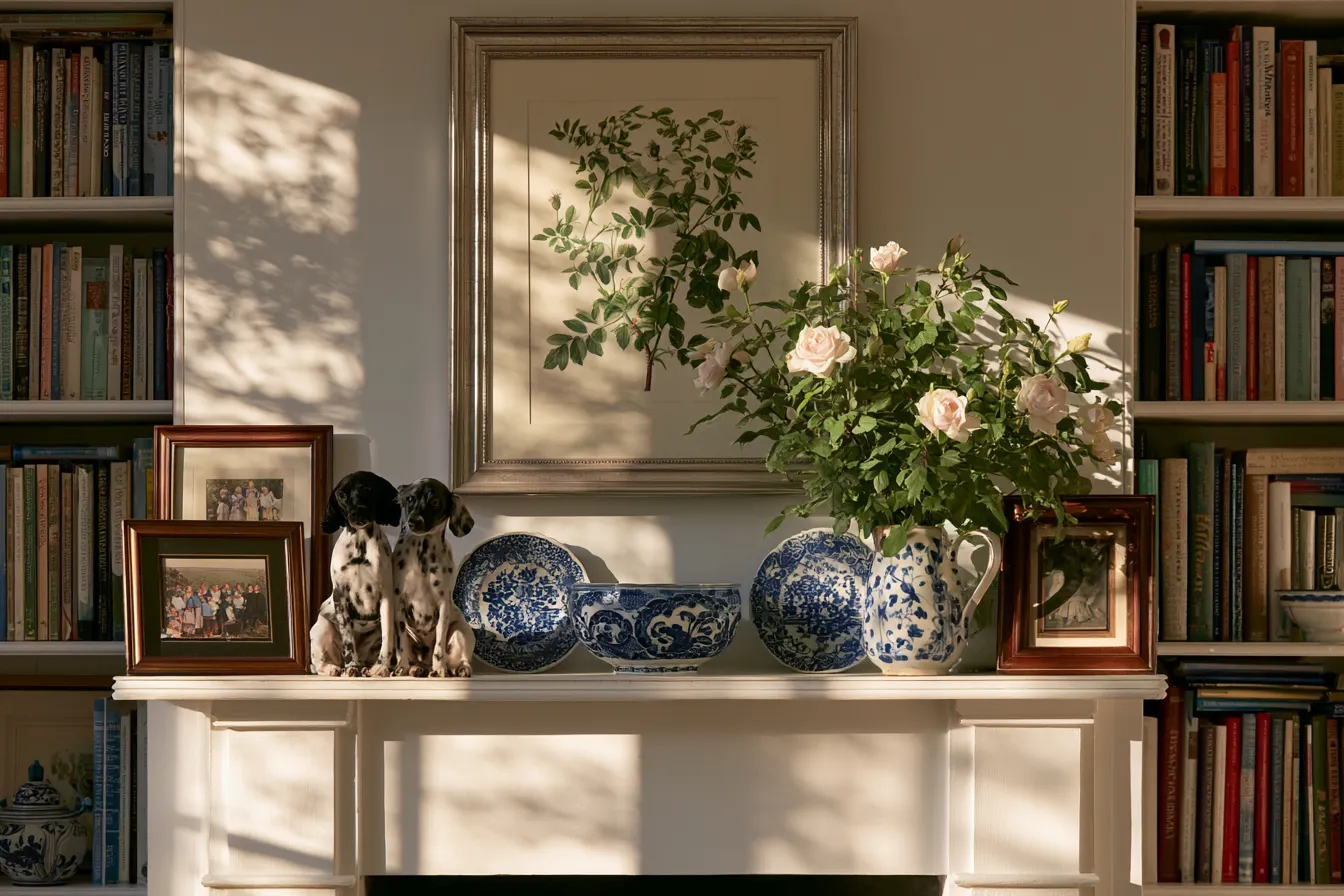
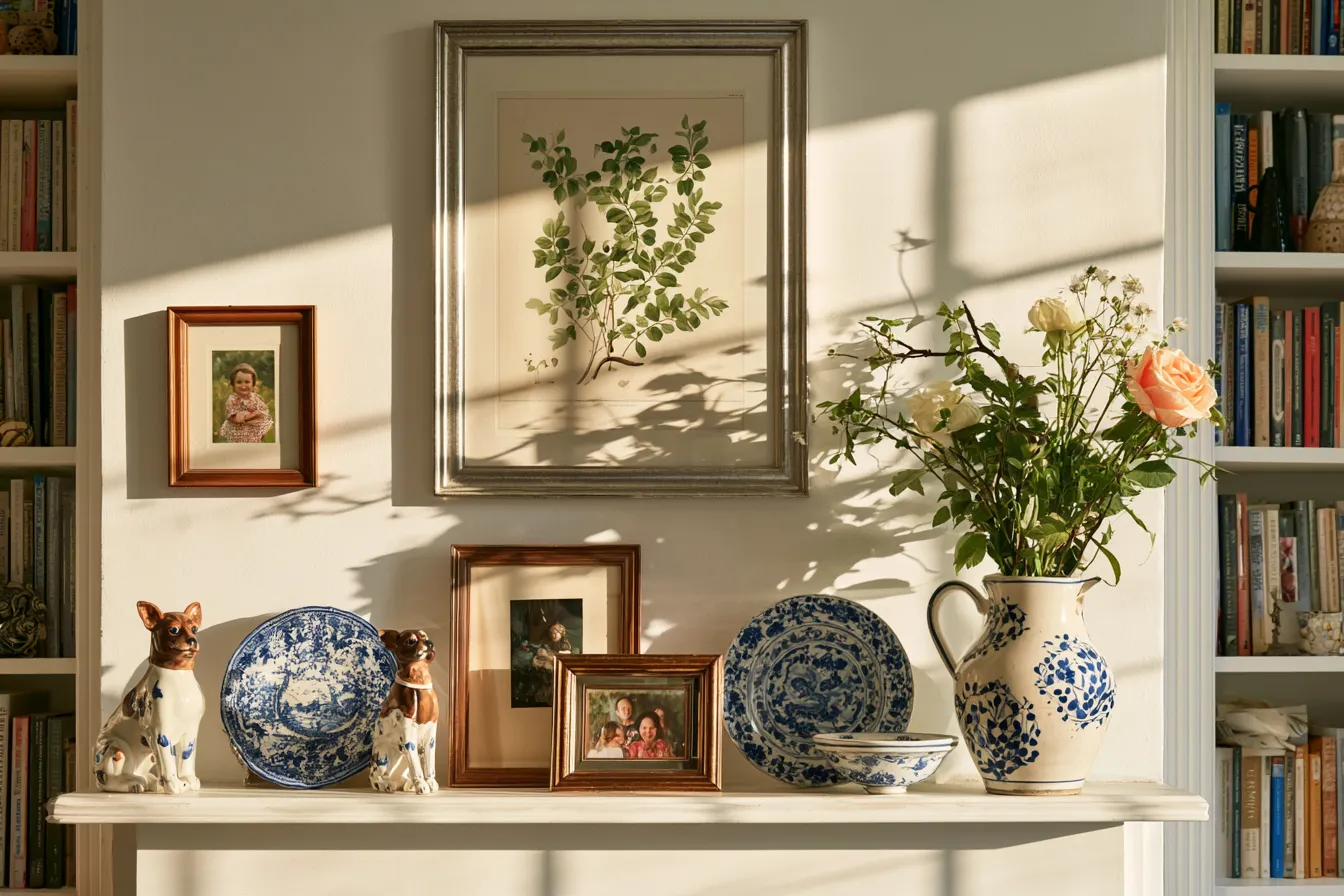
- China and ceramics: Transferware, blue-and-white Delft, English bone china, Staffordshire pottery dogs, Toby jugs, and decorative plates — displayed on mantlepieces, plate rails, shelves, and in glass-fronted cabinets. The china collection is the grandmillennial room’s most characteristically British touch and one of the most specific signals of the aesthetic.
- Books: Prominently displayed on full-height bookshelves with the kind of density that suggests they are read rather than curated. Matching leather-bound sets, paperbacks mixed with hardcovers, and books stacked horizontally between upright ones all signal genuine reading rather than decorative arrangement. An open book on an armchair or a side table reinforces the room’s inhabited quality.
- Fresh flowers: The grandmillennial living room almost always contains cut flowers — in a china vase, a ceramic jug, or a glass vessel — in the same botanical idiom as the room’s floral patterns. Roses, sweet peas, peonies, and garden flowers in loose, unfussy arrangements are more appropriate to the aesthetic than very formal or architecturally arranged florals.
- Framed family photographs: Displayed on side tables, mantelpieces, and piano tops (if the room is large enough to have one), in a mixture of silver frames, leather frames, and ornate traditional frames. The family photograph is one of the grandmillennial room’s most personal elements and one of the most important for communicating that the room is genuinely lived in rather than styled for display.
- Lamps with decorative shades: Table lamps with ceramic, porcelain, or ginger-jar bases in patterns that reference the room’s colour story, topped with pleated silk or linen shades. The lamp base-and-shade combination is one of the most specific grandmillennial object choices and one of the hardest to replicate in a non-grandmillennial context.
- Clocks: A mantel clock, a carriage clock, or a longcase clock in a room large enough to contain one. The presence of a working, ticking clock in a living room is one of the most evocative sensory details of the grandmillennial interior — the sound is as much a part of the aesthetic as the visual.
Grandmillennial Living Room Decor vs Related Aesthetics
Grandmillennial is frequently confused with or conflated with adjacent aesthetics that share some of its visual elements. Understanding where grandmillennial sits relative to these related styles clarifies the specific design decisions that define it and helps identify where the overlaps are productive and where they are misleading.
| Aesthetic | Shared with Grandmillennial | Key Differences | The Occupant |
|---|---|---|---|
| Grandmillennial | — | Self-aware, affectionate adoption of traditional elements by a younger person | A millennial who genuinely loves their grandmother’s aesthetic |
| Traditional / Classic | Period furniture, floral fabrics, rich palette | Less self-aware; executed without irony or modern counterpoint; often heavier and more formal | A person for whom traditional decor is simply correct, not nostalgic |
| Maximalist | Abundance of objects, pattern mixing, rich colour | Maximalism is not period-specific; may include very contemporary or global elements alongside traditional | Someone who believes more is more, regardless of period or style |
| English Country House | Chintz, faded florals, antique furniture, crowded walls | Larger scale, more formal, less accessible — the reference point rather than the interpretation | A landed British family who has lived in the same house for three generations |
| Cottagecore | Florals, natural materials, traditional craft, warm palette | Cottagecore is rural and pre-industrial in reference; grandmillennial is suburban and domestic. Cottagecore avoids the porcelain and the formal upholstery | Someone romanticising rural life; may never have left a city |
| Eclectic | Mixed patterns, mixed periods, personal objects | Eclectic makes no specific period reference; grandmillennial is specifically mid-century domestic traditional | Someone who follows their own taste wherever it leads |
How to Start a Grandmillennial Living Room From a Neutral Base
Most living rooms that want to move toward a grandmillennial aesthetic are starting from a relatively neutral, contemporary base — white or grey walls, a simple upholstered sofa, minimal accessories, perhaps a jute rug and a pair of identical cushions. The transformation toward grandmillennial does not need to happen all at once; it is, in fact, better accomplished incrementally, because the grandmillennial room’s greatest strength is that it looks as though it developed over time.
A practical sequence for introducing grandmillennial living room decor into an existing space:
- Start with the wall colour: Moving from white or grey walls to a sage green, dusty blue, or warm terracotta is the single highest-impact change available in the grandmillennial direction. A room with the right wall colour immediately provides the ground against which all the subsequent grandmillennial elements will read correctly. Paint is also the lowest-cost and most reversible first step.
- Add a patterned rug: Replace a jute or plain rug with a Persian, oriental, or floral flat-weave rug. This introduces the floor-level pattern complexity that grandmillennial rooms depend on and immediately changes the room’s visual character even before any furniture changes.
- Introduce a patterned cushion or throw: A needlepoint cushion, a floral linen cushion, or a fringed throw in a traditional pattern is a low-cost and immediate grandmillennial signal on an otherwise plain sofa. This is the cheapest entry point to the aesthetic.
- Add framed art in ornate frames: Begin a gallery wall with two or three pieces in gilt or dark wood frames — botanical prints, watercolours, or oil-effect paintings sourced from markets, charity shops, or specialist print retailers. The arrangement can grow over time.
- Find one good china piece: A single blue-and-white vase, a Staffordshire figure, or a decorative plate on a stand introduces the ceramics element that is central to grandmillennial decor without requiring a full collection immediately.
- Source a decorative lamp: A table lamp with a patterned ceramic base and a pleated shade does more grandmillennial work per pound spent than almost any other single purchase. Estate sales, antique shops, and charity shops are the best sources at accessible price points.
Grandmillennial Living Room Decor on a Budget
One of the grandmillennial aesthetic’s most practical advantages is that its most important elements are available second-hand at prices that new retail cannot approach. The charity shop, the antique market, the estate sale, and the online vintage platform (eBay, Vinted, Etsy’s vintage section) are the grandmillennial decorator’s primary sources — not because the aesthetic is about economy, but because the aged, personal, and slightly worn quality of second-hand objects is precisely what the grandmillennial room is trying to achieve. A new reproduction chintz cushion signals trend-following; a genuine vintage needlepoint from a market stall signals the real thing.
The highest-value second-hand hunting grounds for grandmillennial living room elements in the UK include Oxfam’s furniture and specialist charity shops (particularly in wealthier areas where donations include better-quality objects), regional auction houses (which regularly include Victorian and Edwardian furniture, ceramics, and pictures at accessible price points), and the weekly antique and vintage markets found in most UK towns of meaningful size. In the US, estate sales accessed through platforms like EstateSales.net and antique malls in suburban areas outside major cities are the equivalent hunting grounds.
For the specific skill of mixing vintage pieces — sourced second-hand over time — with contemporary elements in a way that reads as intentional rather than mismatched, our article on mixing vintage and modern styles for a curated calm space covers the compositional principles that apply directly to the grandmillennial living room’s curatorial challenge.
Lighting the Grandmillennial Living Room
Grandmillennial living room lighting follows the same logic as its object selection: warm, layered, and sourced from pieces with visible craft or decorative character rather than from purely functional fixtures. The central ceiling pendant — if present — should have a decorative shade in a fabric or material that connects to the room’s palette. Pleated silk or linen pendant shades, paper drum shades in a pattern, and traditional lantern-style pendants in brass or bronze are appropriate; exposed-bulb industrial pendants, minimalist cone shades, and modern LED panel lights are the specific opposite of grandmillennial lighting.
Table lamps are as important as — if not more important than — the overhead fitting. The grandmillennial living room typically has three to five table lamps in addition to any overhead lighting: on the mantelpiece, on side tables flanking the sofa, on a bookcase, and on any console or occasional table. This density of warm, low-level light sources is what produces the amber, intimate atmosphere that grandmillennial interiors photograph so characteristically and that makes them so comfortable to spend time in. All lamps should operate at 2,200–2,700K (warm white) and never at the cool or daylight temperatures that the aesthetic’s opposite, the clean contemporary interior, favours.
The library wall — bookshelves covering an entire wall from floor to ceiling — is one of the grandmillennial room’s most impressive and appropriate architectural features. When lit with internal shelf lighting or a series of picture lights across the book spines, it becomes the room’s primary visual event and provides the warmth, density, and sense of intellectual accumulation that defines the grandmillennial ideal at its most ambitious. Our article on library wall living room built-ins covers the structural and styling decisions involved in creating this feature, which is as at home in a grandmillennial setting as in any other interior context where books and their presence are considered important.
The Grandmillennial Living Room Is About Permission
The deepest appeal of the grandmillennial living room is not aesthetic. It is permissive. It gives people who genuinely love floral patterns, framed pictures, china collections, and rooms that smell of old books permission to have exactly the home they want without apologising for finding contemporary minimalism cold, or describing their taste as unfashionable, or waiting for the trend cycle to come back around to what they already knew they liked.
The grandmillennial living room is not trying to look like anything other than what it is: a room designed to be comfortable, visually rich, and full of things that its inhabitant genuinely cares about. That combination — comfort, richness, and personal meaning — is the rarest quality in residential design, and the one most likely to make a room feel like home rather than a showroom for a style. The chintz sofa helps. But the rest of it is just permission.
For the broader context of how eclectic approaches — mixing periods, styles, and sources in a single living room — can be made to cohere visually and emotionally, our article on eclectic living room design where tradition meets modernity covers the compositional principles that underlie the grandmillennial approach and apply to every room that values personality over perfection.