Boucle fabric has become one of the defining material stories of contemporary residential interiors. The looped, nubby weave that gives the fabric its name — from the French word for curl or buckle — has appeared on sofas, armchairs, ottomans, and headboards across every design platform and retail category since around 2019. By 2023, searches for boucle furniture had grown by over 400% on major UK and US retail platforms compared with 2019 figures, and the material now appears in collections from entry-level high-street retailers through to bespoke furniture makers.
The challenge with a boucle sofa is not finding one. It is knowing what to do with it once it arrives. The texture that makes boucle so visually compelling — the tactile loop structure that catches light differently at every angle — also makes it one of the more demanding fabrics to style correctly. Get the surrounding decisions right and the boucle sofa becomes the room’s defining element. Get them wrong and it sits in the room looking like an expensive mistake that the rest of the space cannot support.
This guide works through every styling decision that surrounds a boucle sofa: cushion selection, rug pairing, coffee table choice, wall colour, accent furniture, and the specific combinations that work across different interior styles.
Why Boucle Sofa Styling Requires a Different Approach Than Other Upholstery
Most upholstery fabrics — velvet, linen, cotton weaves, performance textiles — function as a surface that provides colour and a degree of texture. A navy velvet sofa is primarily navy; its velvet quality is secondary. A boucle sofa inverts this hierarchy: the texture is the primary event, and the colour is secondary to the material’s looped, dimensional character. This inversion has significant consequences for how everything around the boucle sofa should be chosen.
Because boucle is inherently busy at close range — the loops create a micro-pattern of light and shadow that reads as visual complexity even in off-white or cream — the materials around it should, as a general rule, be calmer. Flat weaves, smooth surfaces, and matte finishes all provide contrast that allows the boucle’s texture to register without competing. The mistake most commonly made when styling a boucle sofa is adding additional high-texture elements — a heavily tufted cushion, a very thick shag rug, a deeply embossed wallpaper — that compete with the boucle rather than supporting it.
The second consequence of boucle’s texture-first character: it reads as warm regardless of its colour. An off-white boucle sofa in a cool grey room will warm the space; the same colour in a flat woven linen would not. This warmth is an asset in most styling contexts — it is one of the reasons boucle has been so enthusiastically adopted — but it means that rooms styled around a boucle sofa should lean into warmth rather than trying to counteract it with cool or stark surrounding choices.
Boucle Sofa Colour Variations and What Each Demands in Styling
Boucle sofas are available across a range of colours, but the vast majority of those sold commercially fall into four families: off-white and cream, warm greige and oat, soft sage and muted green, and warm camel and stone. Each colour family creates different styling requirements and sits differently within the palette families most commonly used in contemporary interiors.
| Boucle Sofa Colour | Wall Colour Pairings | Rug Direction | Cushion Palette | Coffee Table Material |
|---|---|---|---|---|
| Off-white / Cream | Warm white, soft sage, clay, dusty terracotta | Jute, sisal, or low-pile wool in natural tones | Linen in warm stone, leather in cognac, velvet in sage or terracotta | Travertine, oak, raw oak with black metal frame |
| Warm greige / Oat | Warm off-white, aged plaster, deep forest green | Wool flatweave in cream, brown or sage pattern | Baked clay, dusty pink, camel, dark olive | Walnut, dark oak, travertine with brass detail |
| Soft sage / Muted green | Warm white, cream, deep green (colour drench), warm taupe | Persian or oriental in muted tones, jute | Cream linen, warm white, terracotta, cognac leather | Marble, oak, aged brass and glass |
| Camel / Warm stone | Warm cream, aged white, deep charcoal, moody navy | Wool in dark geometric, Persian, dark jute | Cream, ivory, deep chocolate brown, off-black | Dark walnut, black powder-coated steel, slate |
The off-white and cream boucle sofa is the most popular by a significant margin — UK retailer data from 2023 suggests it accounts for approximately 55–60% of boucle sofa sales — and it is also the most forgiving in styling terms. Its neutral ground allows almost any colour story to be built around it, which is both its strength and its styling risk: the room can easily become so neutral that it lacks any point of visual interest beyond the sofa’s texture.
Cushion Styling for a Boucle Sofa: The Rules That Actually Work
Cushions are the most immediate and revisable styling decision surrounding a boucle sofa, and the choices made here determine whether the sofa reads as a design-forward piece or a plain fabric couch with cushions on it. The principles that consistently produce the best results:
Fabric Contrast Is Essential
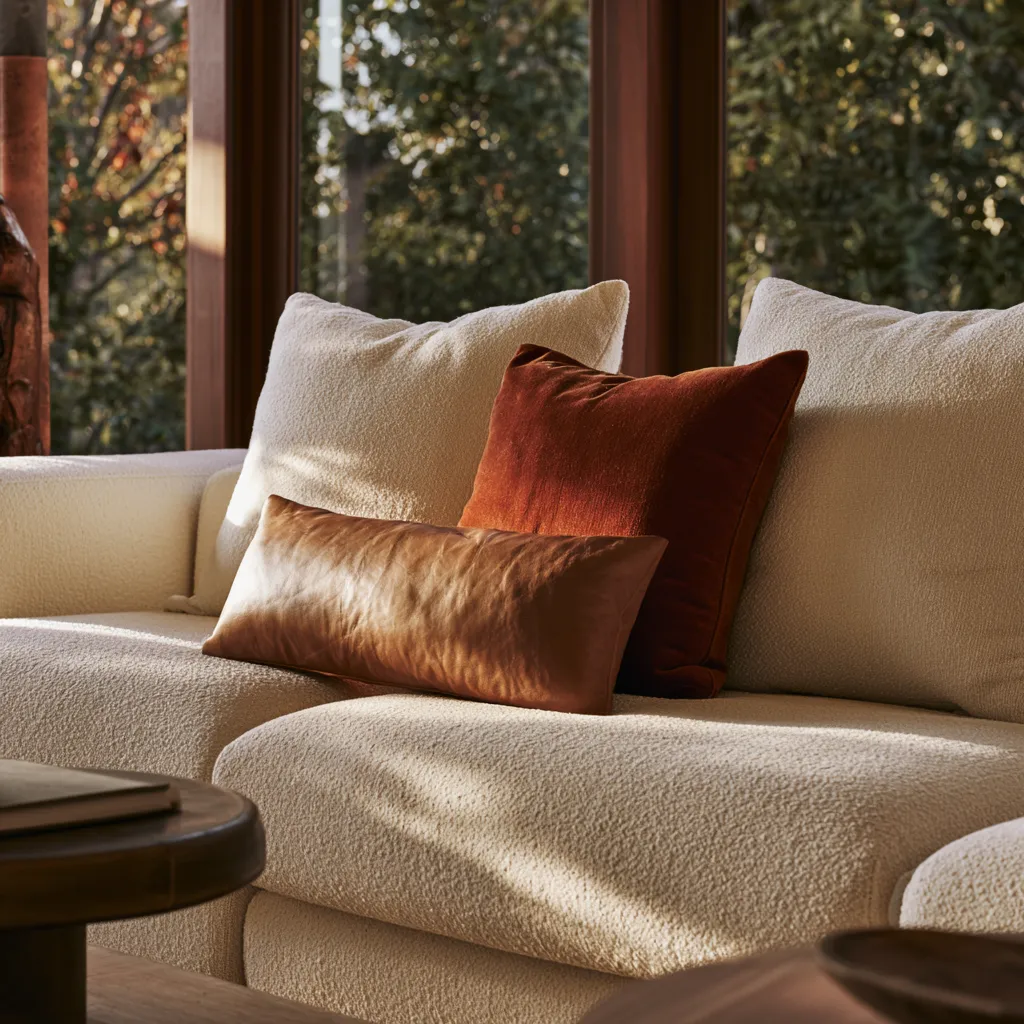
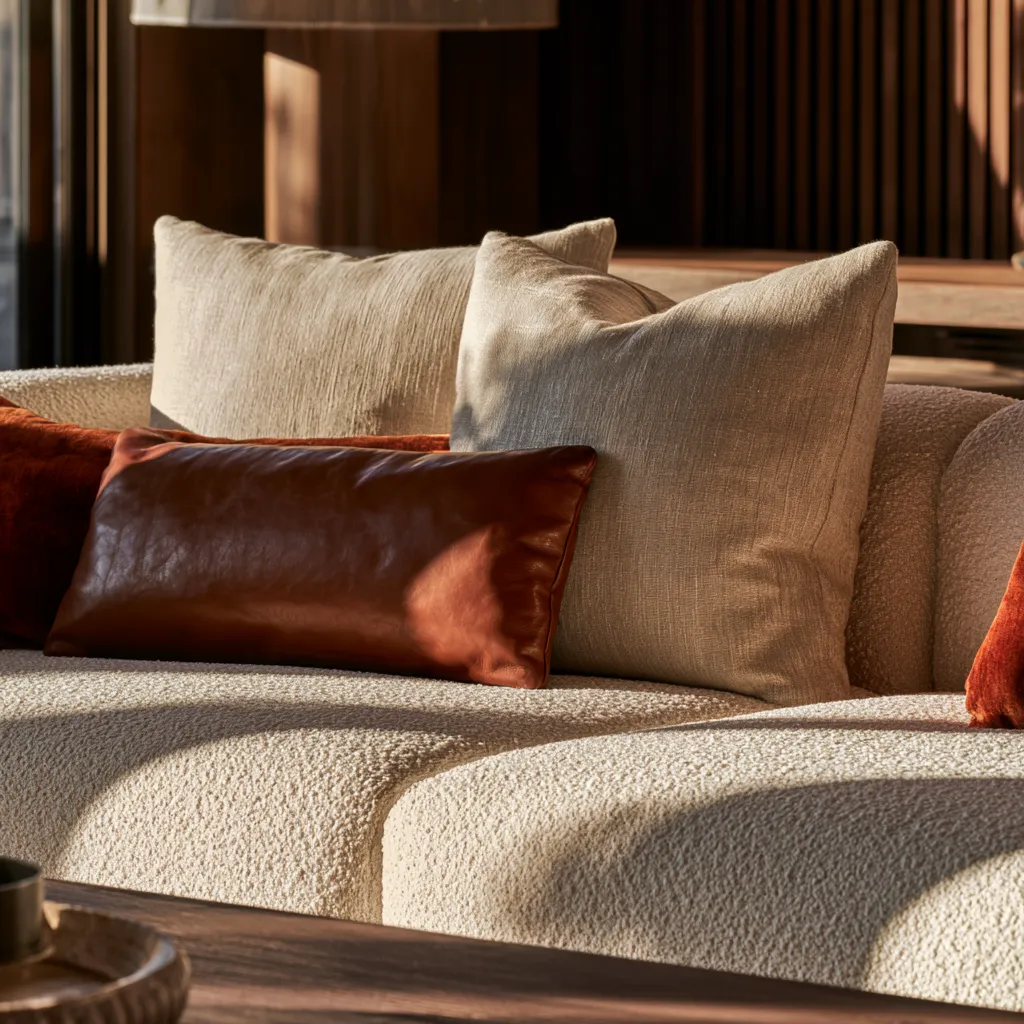
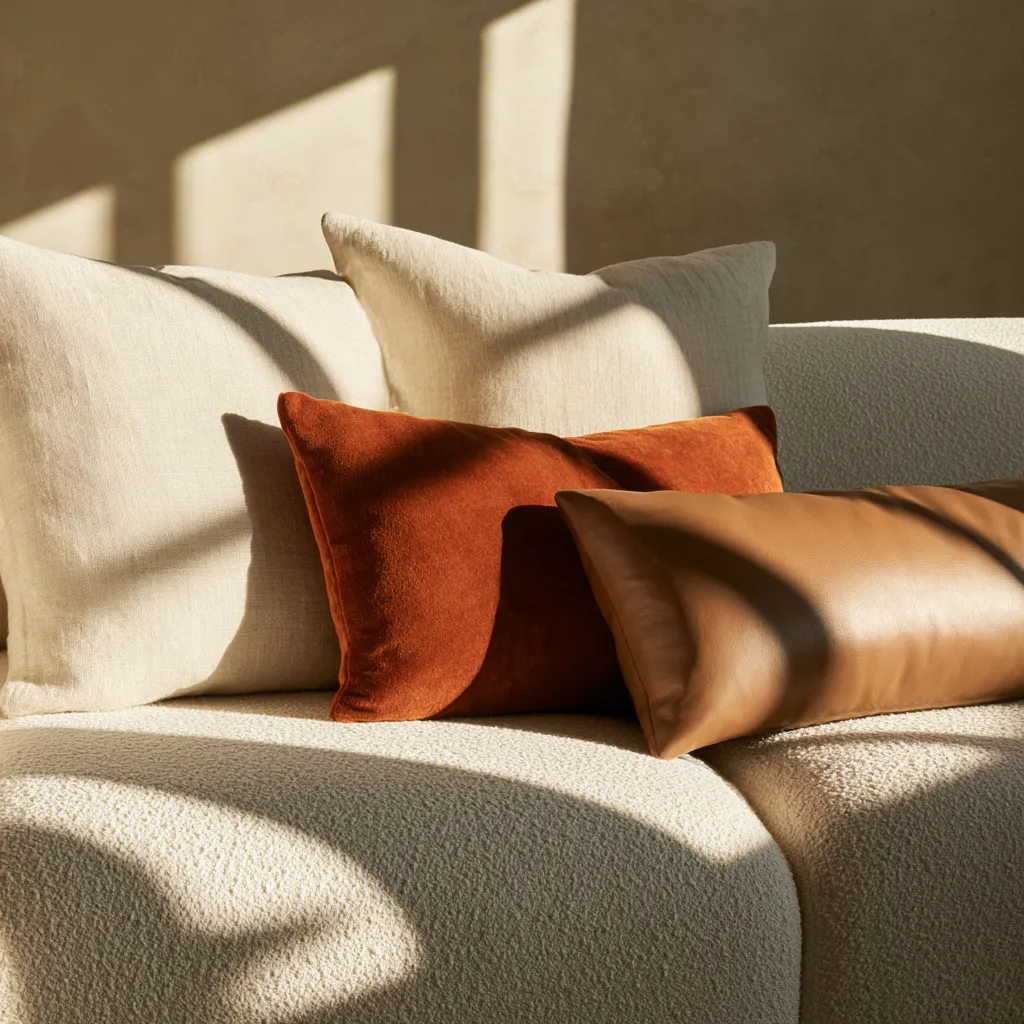
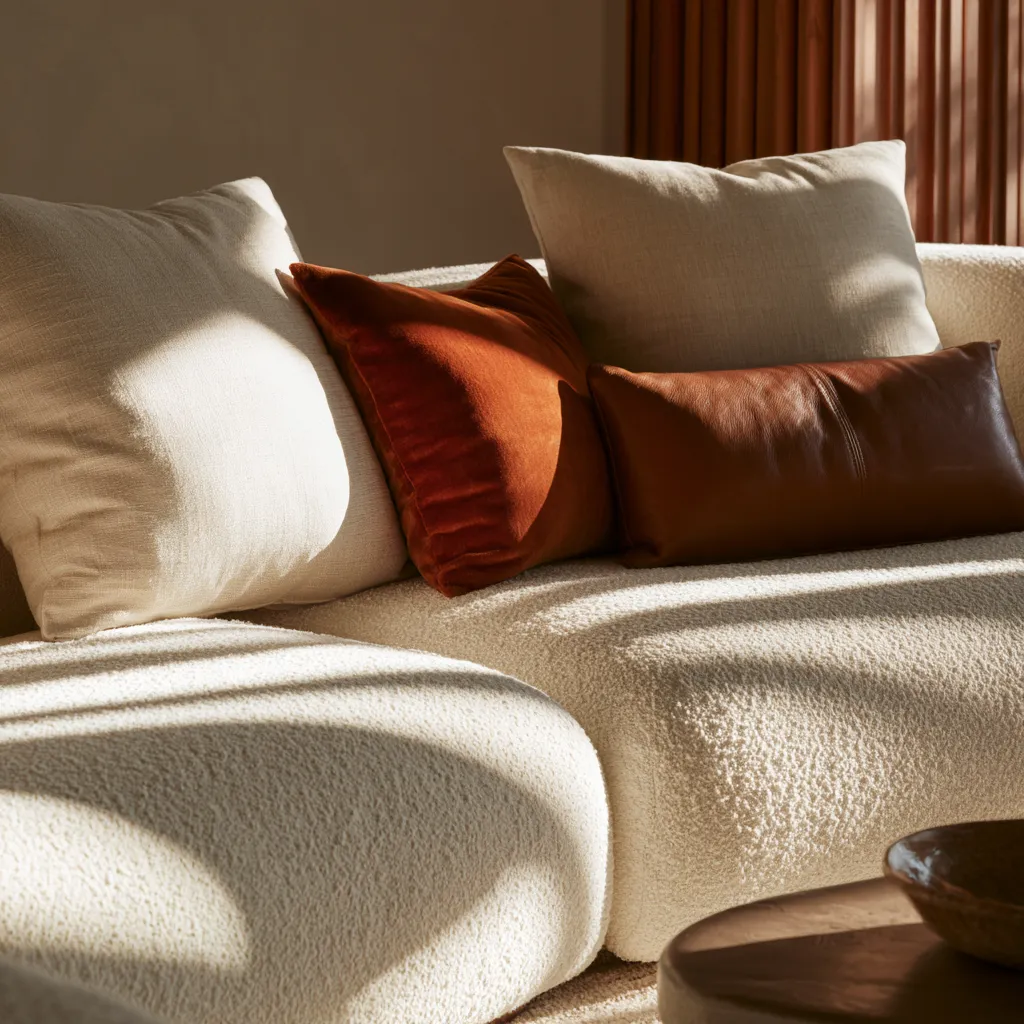
The most important rule in boucle sofa cushion styling: avoid other boucle cushions. Two boucle textures at the same scale reading side by side produce a visual confusion rather than a layered composition. The cushions on a boucle sofa should introduce contrast — a smooth linen in a solid colour, a woven cotton in a geometric or simple stripe, a velvet in a jewel tone, a leather or suede in a natural warm colour. Each of these materials contrasts with the boucle’s looped texture and provides a visual resting point that the eye needs after encountering the sofa’s own surface.
Odd Numbers and Varied Sizes
The standard cushion formula for a three-seater boucle sofa that consistently photographs well and reads as intentional in person: two large square cushions (60 × 60 cm) in a solid colour at the back, two medium cushions (50 × 50 cm) in a contrasting fabric or mild pattern in front of these, and one lumbar cushion (30 × 60 cm) placed across the front of the arrangement. This five-cushion configuration gives the sofa visual depth — the different sizes create a sense of layering rather than a flat row of matching squares — while maintaining the restraint that the boucle’s own texture demands. For a two-seater boucle sofa, reduce to three cushions: two medium squares and one lumbar.
Colour Strategy for Cushions on a Boucle Sofa
The cushion palette should either closely match the room’s accent colour (picking up a tone from the rug, wall, or a key piece of furniture) or introduce the room’s single strongest accent colour. On a cream boucle sofa in a neutral room, the cushions are often the room’s primary colour moment — a terracotta velvet cushion or a sage linen can carry the entire room’s colour story if the rest of the palette is restrained. On a sage boucle sofa, the cushions should introduce warmth: cream, cognac, or a baked terracotta that prevents the sofa and its cushions from reading as a single green mass.
Rug Pairings for Boucle Sofa Styling Ideas That Hold Together
The rug beneath a boucle sofa does more styling work than perhaps any other single element in the room. Because the boucle sofa operates as a texture-forward piece, the rug must be chosen to complement rather than compete — and the specific choices that work depend heavily on the boucle sofa’s colour and the room’s overall material palette.
Jute and Sisal Under Cream and Off-White Boucle
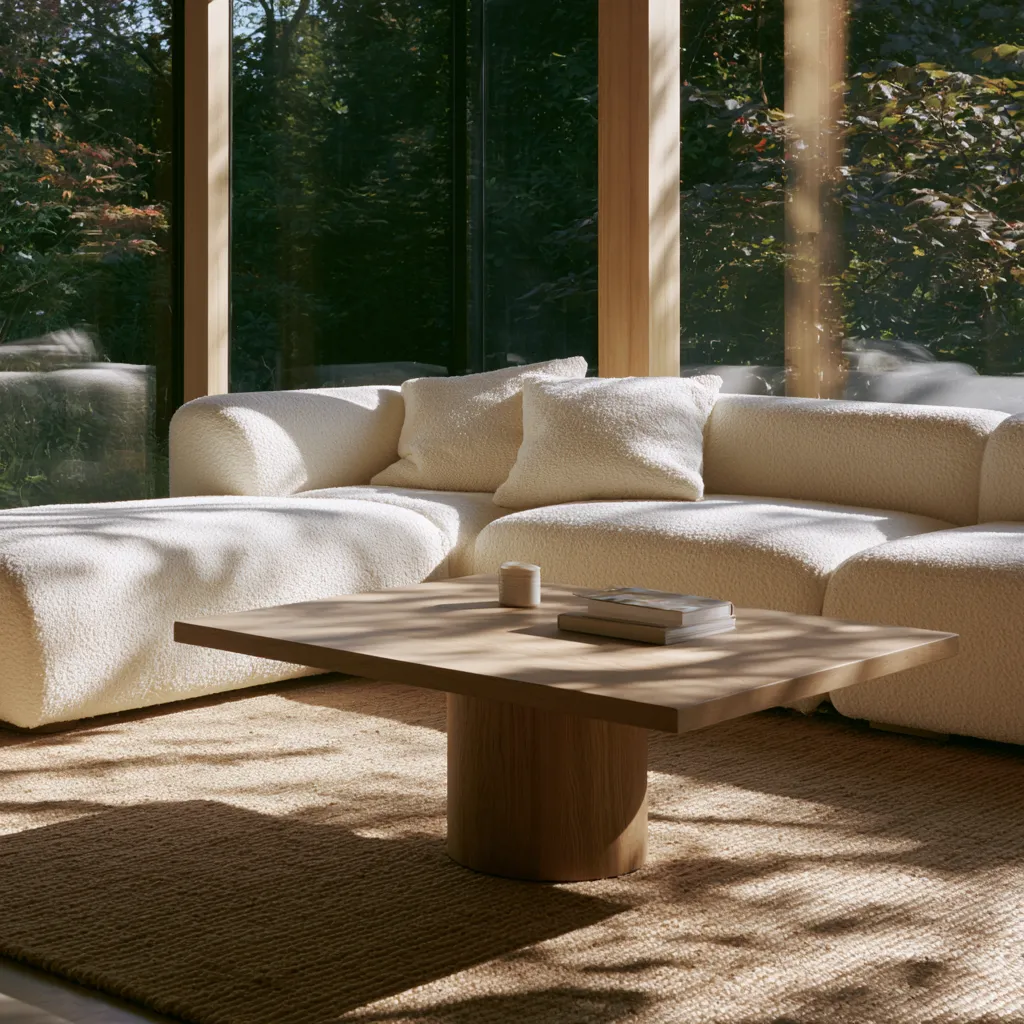
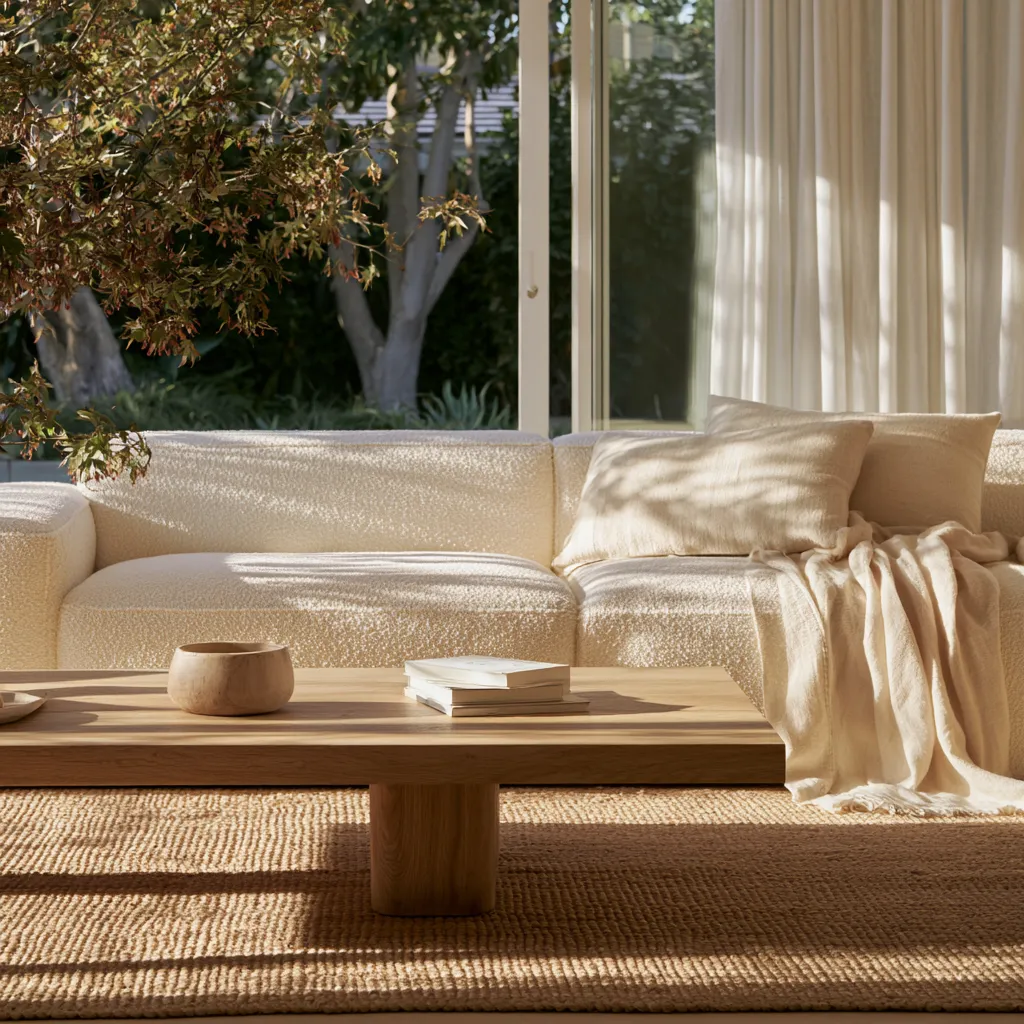
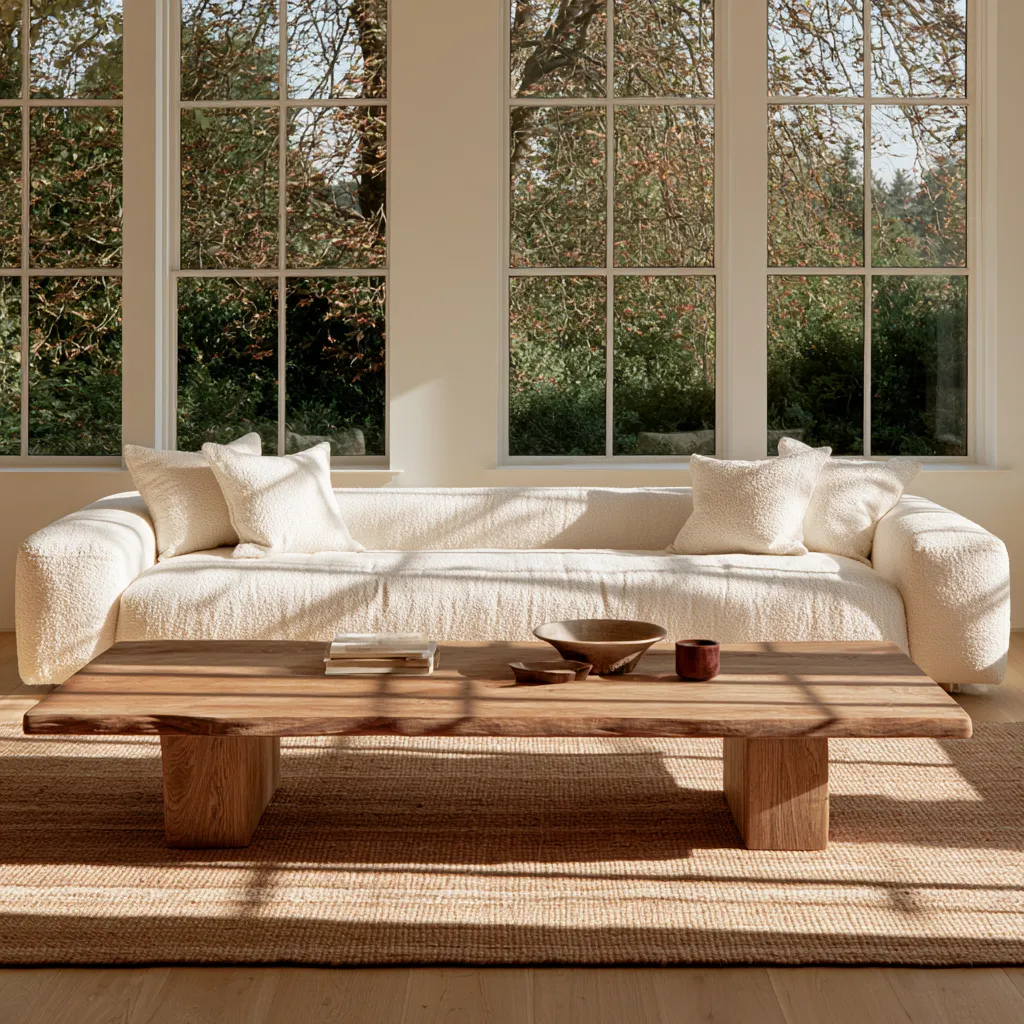
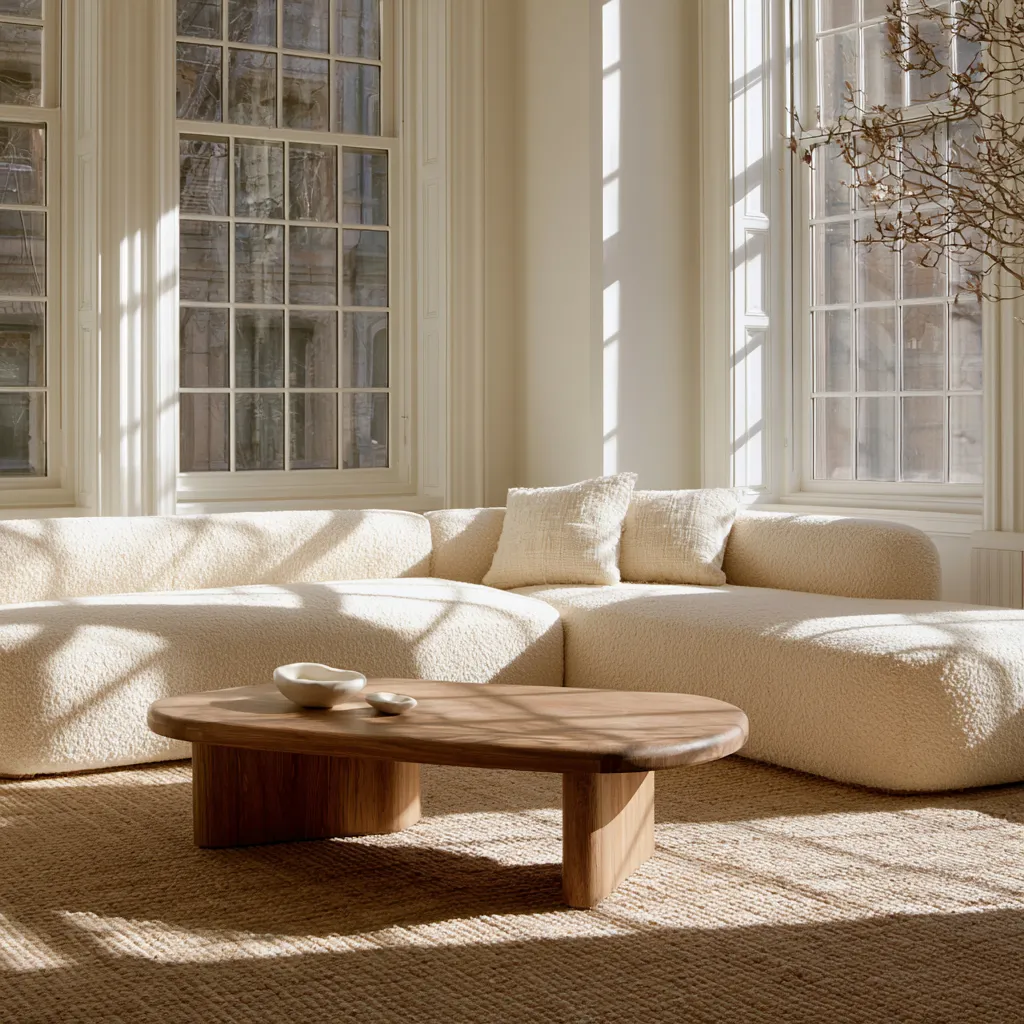
The combination of a cream or off-white boucle sofa over a jute or sisal rug is one of the most reliably successful in contemporary residential interiors. The rough, flat weave of jute contrasts with the boucle’s loops without competing, the natural warm brown of the jute grounds the cream sofa without darkening it, and the combination reads as both casual and intentional — the two poles that organic modern styling inhabits most comfortably. Jute rugs are also among the most durable for this application: at 160 × 230 cm or larger, they hold up to foot traffic in a way that softer pile rugs do not, and they are significantly more affordable than wool alternatives of comparable size.
Wool Flatweave Under Greige and Oat Boucle
A wool flatweave rug — particularly one in a subtle geometric, a faded stripe, or a tonal kilim pattern — sits below a greige or oat boucle sofa with the kind of understated confidence that pile rugs cannot achieve in this context. The flatness of the weave provides the same contrast-to-boucle logic as jute, but delivers more pattern and more colour range. A flatweave in warm cream and soft brown geometric works well below a greige boucle; a faded kilim in dusty terracotta, ochre, and cream introduces the warm colour accents that an oat boucle sofa’s neutral base calls for.
Persian and Oriental Rugs Under Sage Boucle
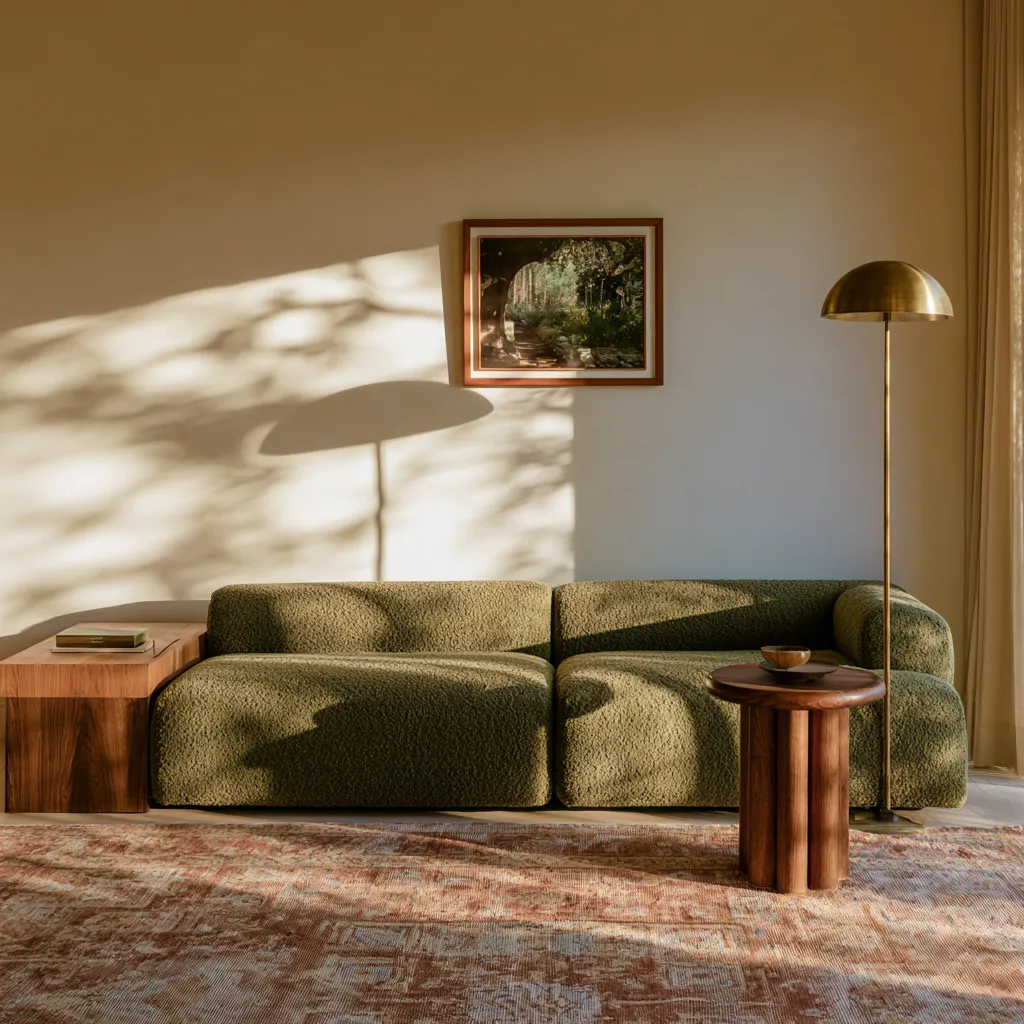
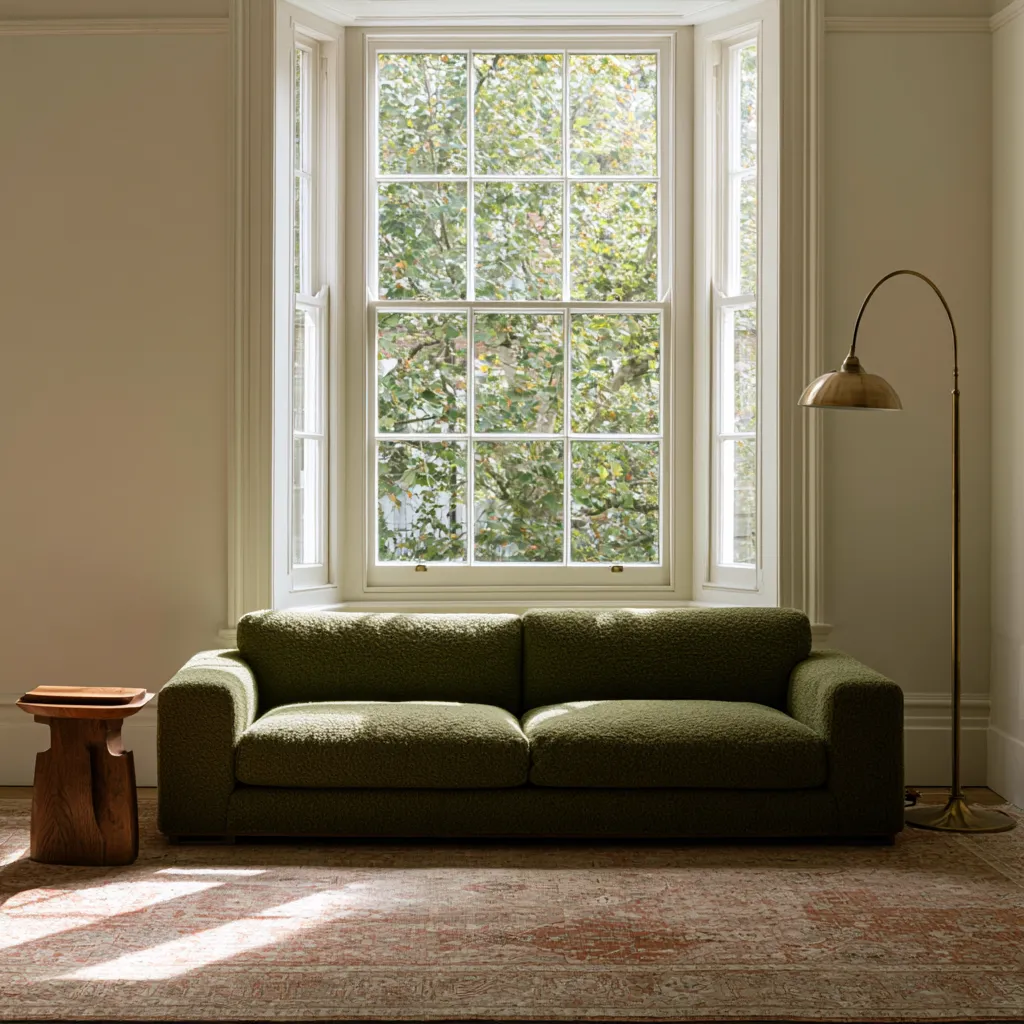
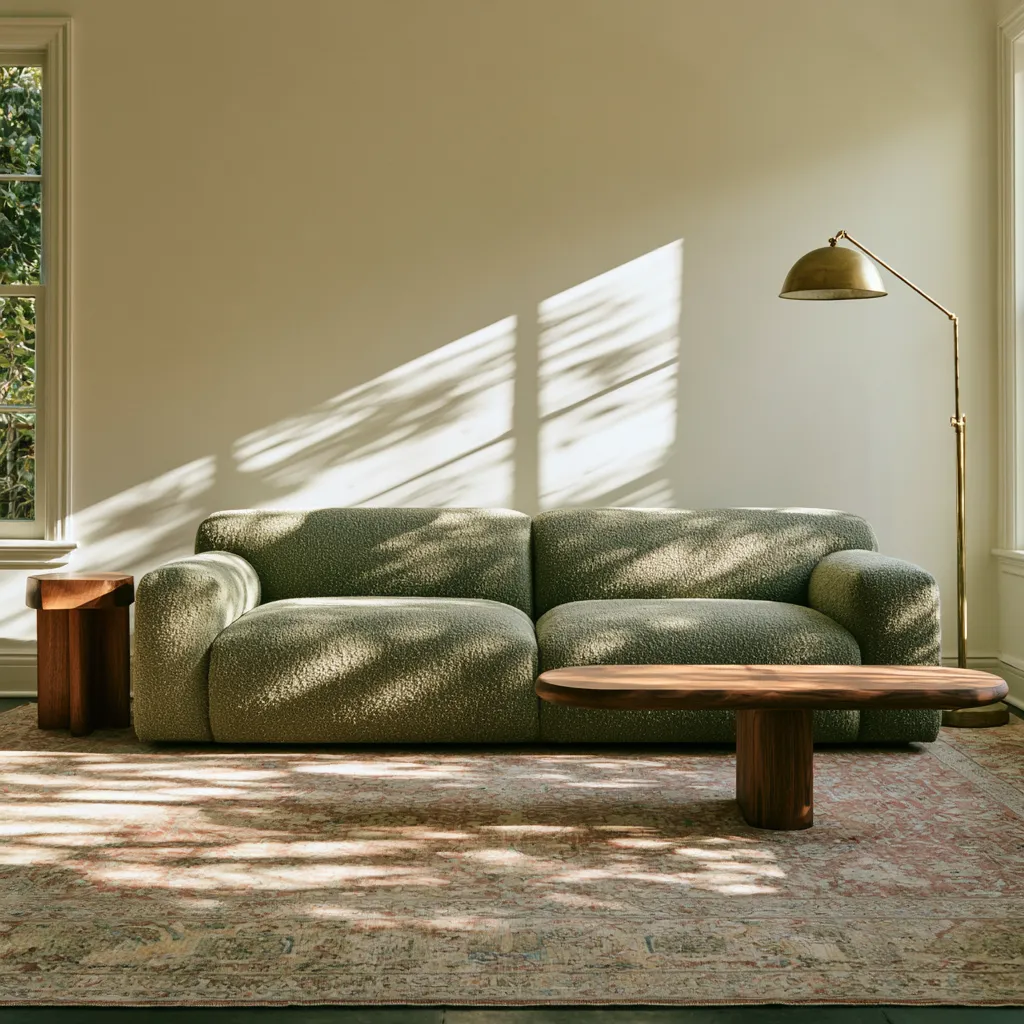
A sage green boucle sofa pairs unexpectedly well with a muted Persian or oriental rug in faded terracotta, dusty rose, and warm ivory. The green of the sofa references the rug’s botanical palette, the warmth of the rug’s reds and pinks counterbalances the coolness of the sage, and the rug’s pattern introduces a richness and complexity that a plain sage sofa in an otherwise neutral room would need from somewhere. This pairing is one of the most design-confident boucle sofa styling ideas available and photographs particularly well in warm natural light.
For a deeper exploration of how rugs function as compositional tools across different living room styles, our guide to layered rugs and creating depth without renovation covers the underlying principles that apply directly to boucle sofa rug selection.
What to Avoid
Two rug types consistently underperform under a boucle sofa. High-pile shag rugs compete with the boucle’s texture at the same scale and create a visual busyness that neither element can resolve. Very dark or strongly patterned rugs — black, very deep navy, bold graphic prints — create a contrast that overwhelms rather than frames the sofa, pulling the eye downward and away from the piece the room is built around. The rug under a boucle sofa should support rather than challenge.
Coffee Table Choices for Boucle Sofa Living Rooms
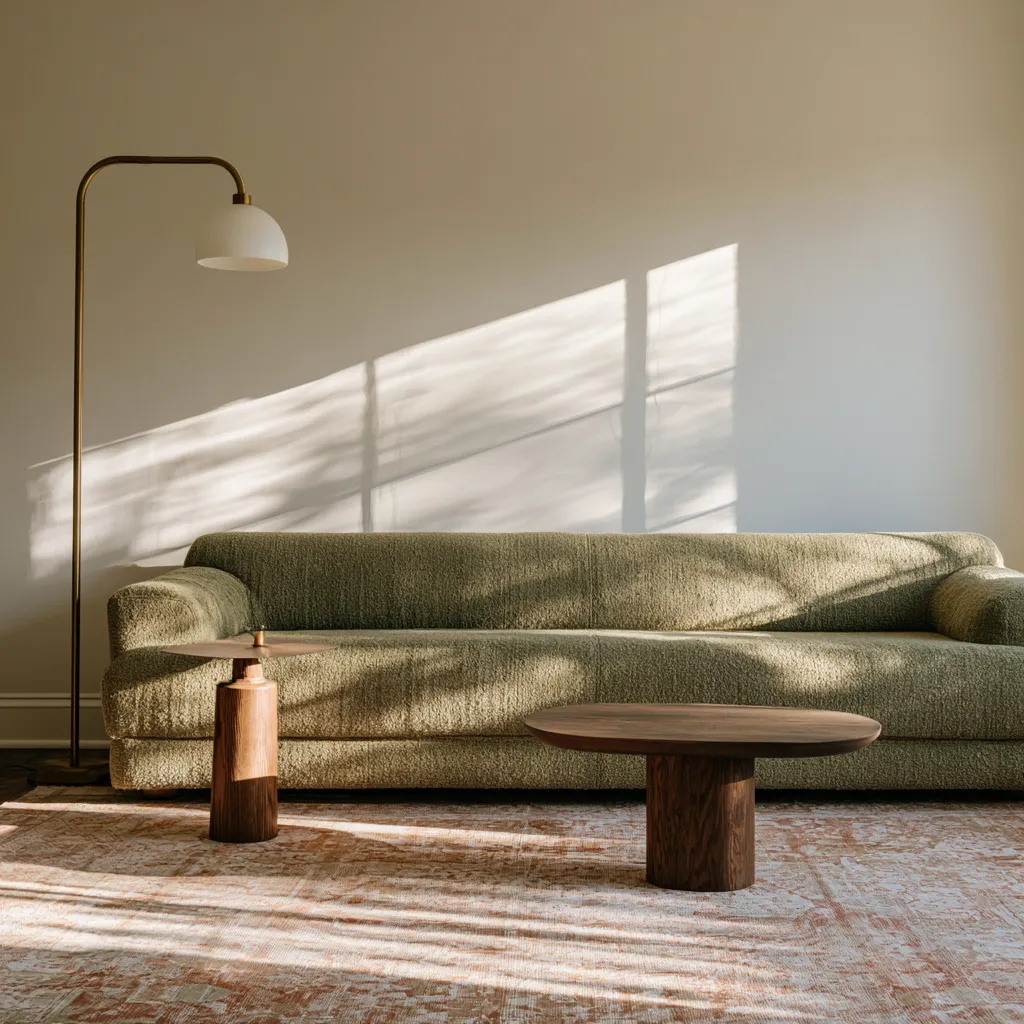
The coffee table positioned in front of a boucle sofa is the room’s second most visible piece and the one that does most of the tonal and material work alongside the sofa. The choices that consistently succeed share a common logic: they introduce a material that is harder, smoother, and more visually resolved than the boucle’s looped softness, providing the contrast the room needs without introducing colour that competes with the sofa’s palette.
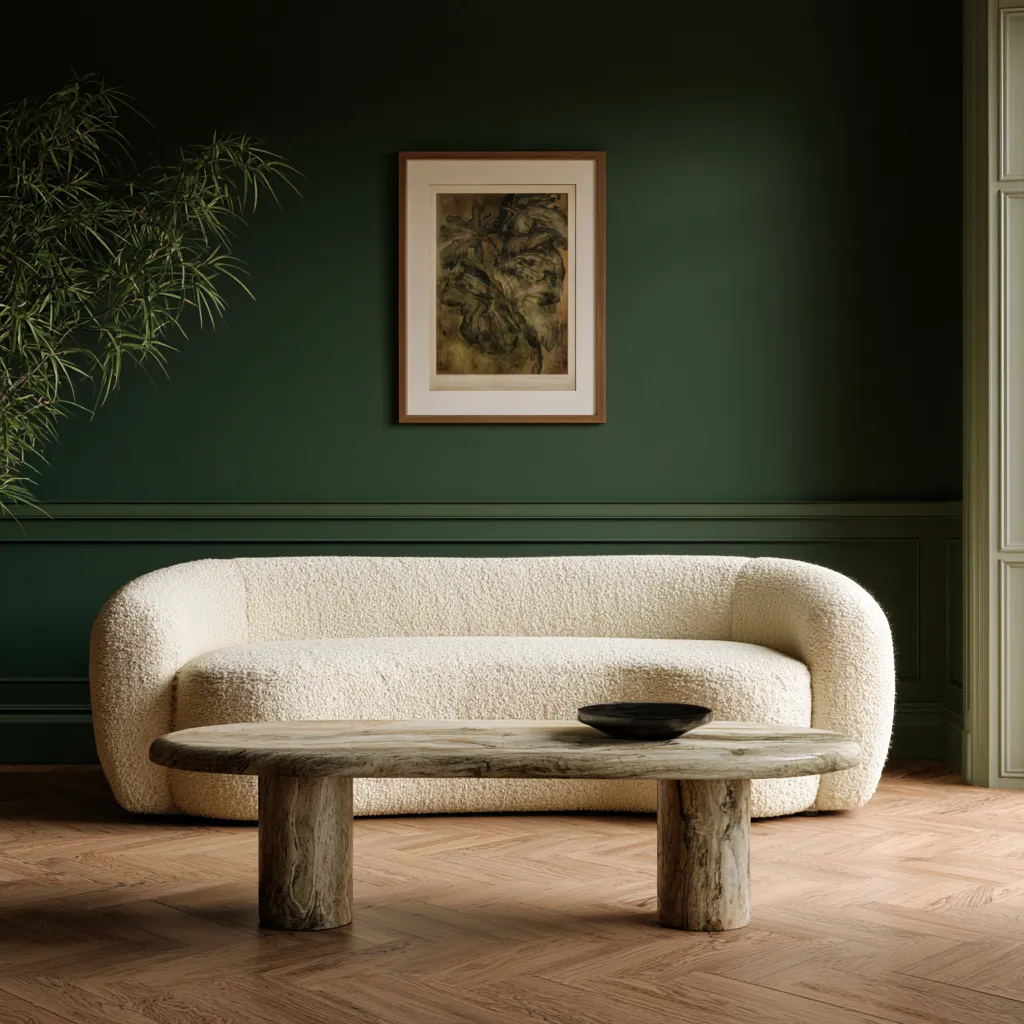
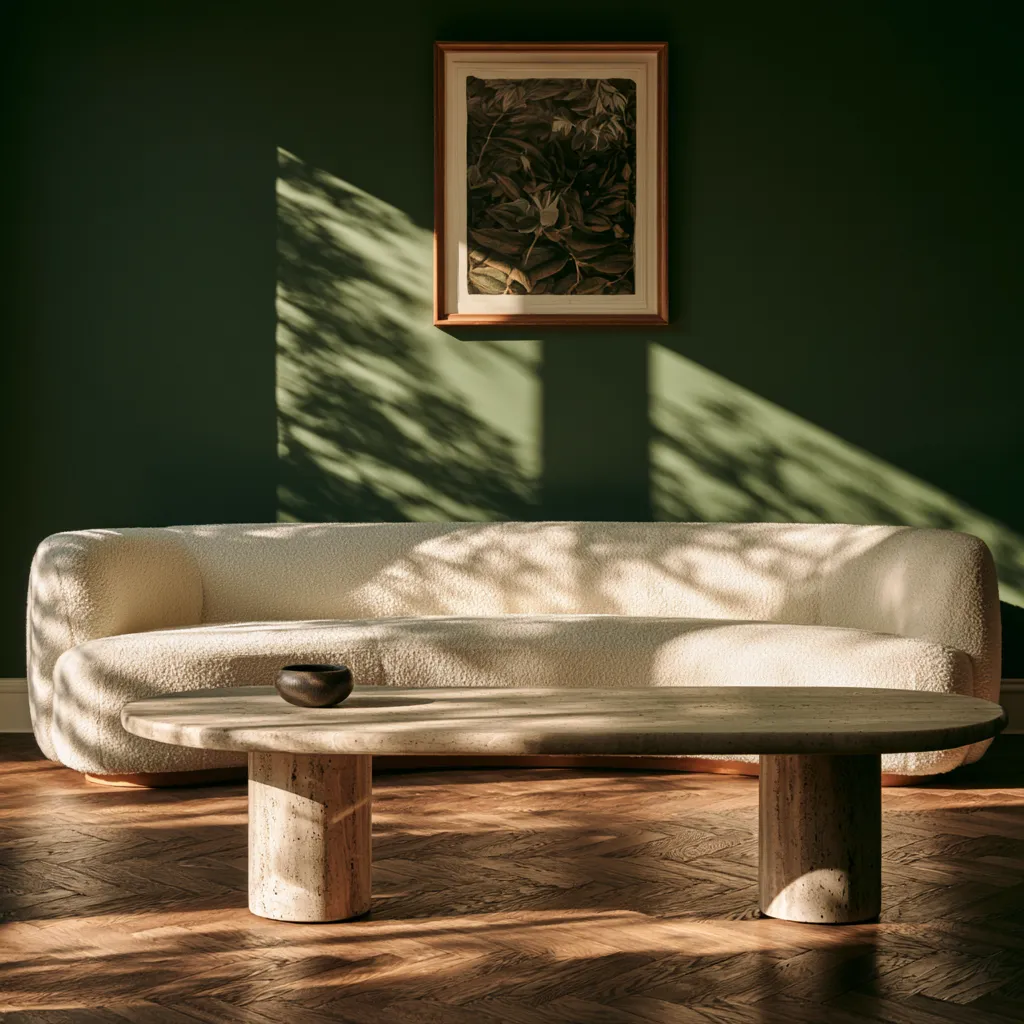
- Travertine top with brass or raw steel base: Travertine’s warm, slightly porous surface pairs naturally with cream and oat boucle — the two materials share the same warm ivory territory while reading as completely different in touch and visual weight. A travertine-top coffee table at 40–45 cm height (the standard range for seated use) with a simple oval or rectangular profile is one of the most-used pairings in contemporary boucle sofa styling.
- Solid oak with rounded edges: The warm grain and rounded-edge profile of a solid oak coffee table sits comfortably below a boucle sofa in almost any colourway. Light oak pairs best with cream and oat boucle; dark or smoked oak with camel and greige boucle. The rounded edge is important — sharp-cornered coffee tables in close proximity to a very soft-looking sofa create a visual tension that rounded forms resolve.
- Walnut with tapered or hairpin legs: In a boucle sofa styled in a mid-century influenced or Japandi direction, a walnut coffee table on tapered or hairpin legs introduces the period reference and the visual lightness that both aesthetics depend on. The dark warmth of walnut provides contrast to a cream or sage boucle without darkening the room.
- Marble with dark metal base: White or Calacatta marble on a matte black or very dark metal frame provides the clean, resolved contrast that works particularly well with camel or warm stone boucle. The marble’s cool smooth surface reads against the sofa’s warm loops, and the dark metal base anchors the combination without adding bulk.
- Organic ceramic or plaster-finish piece: In rooms where the organic modern aesthetic is the goal, a coffee table with a plaster, concrete, or ceramic finish in an irregular or hand-formed shape picks up the boucle’s handmade quality at a completely different material and scale. These pieces are less common at retail level but increasingly available from independent makers.
Boucle Sofa Styling Ideas by Interior Style
The boucle sofa has become associated primarily with organic modern and Japandi interiors, but it sits comfortably within a broader range of styles when the surrounding choices are made with the aesthetic’s specific logic in mind. The following section covers the styling approaches that work within each major interior style where boucle is commonly encountered.
Organic Modern Boucle Sofa Styling
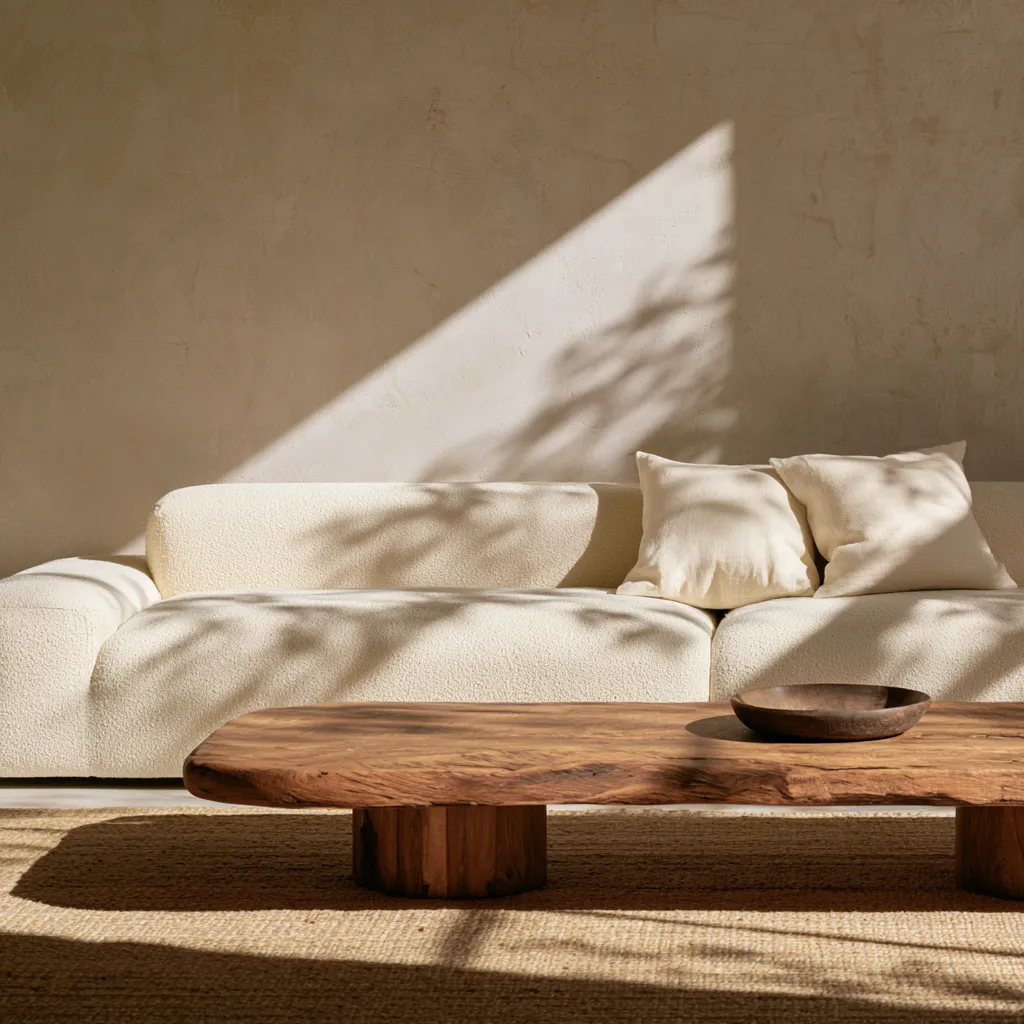
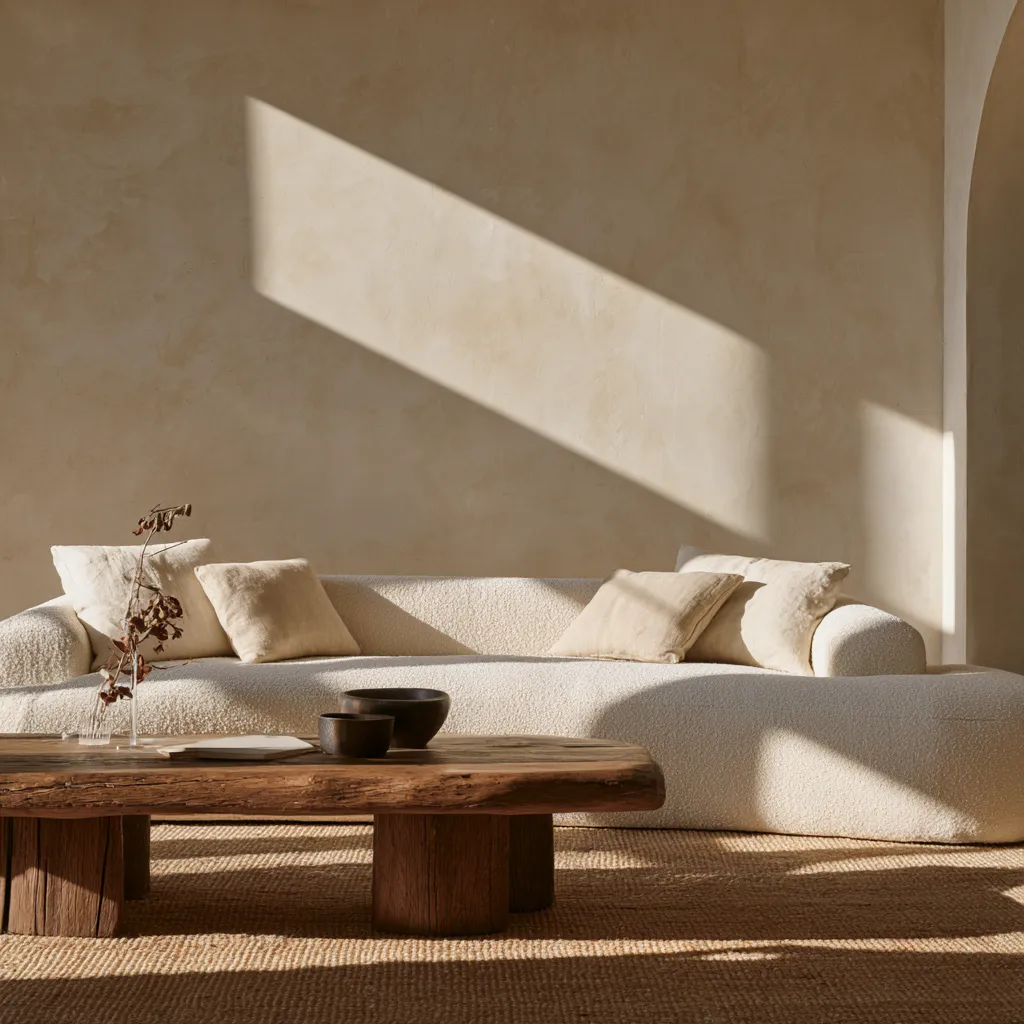
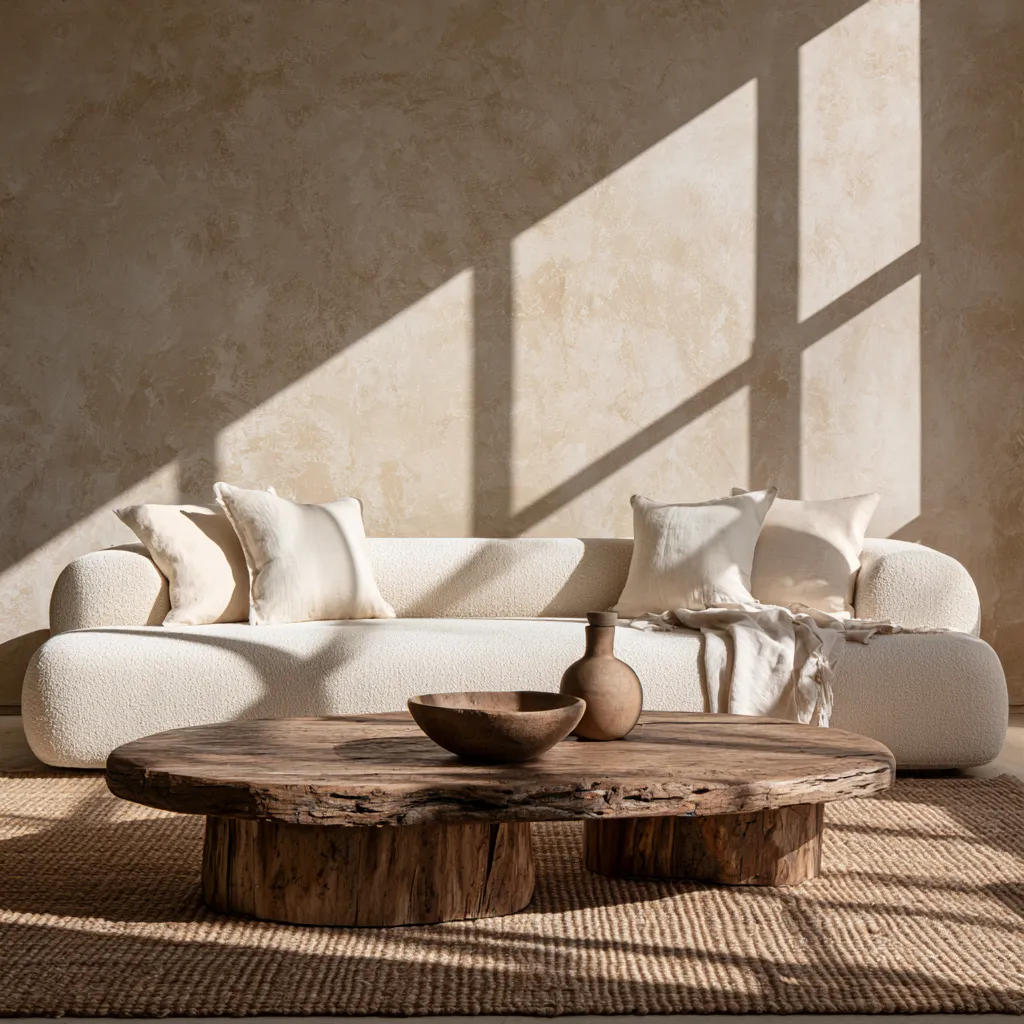
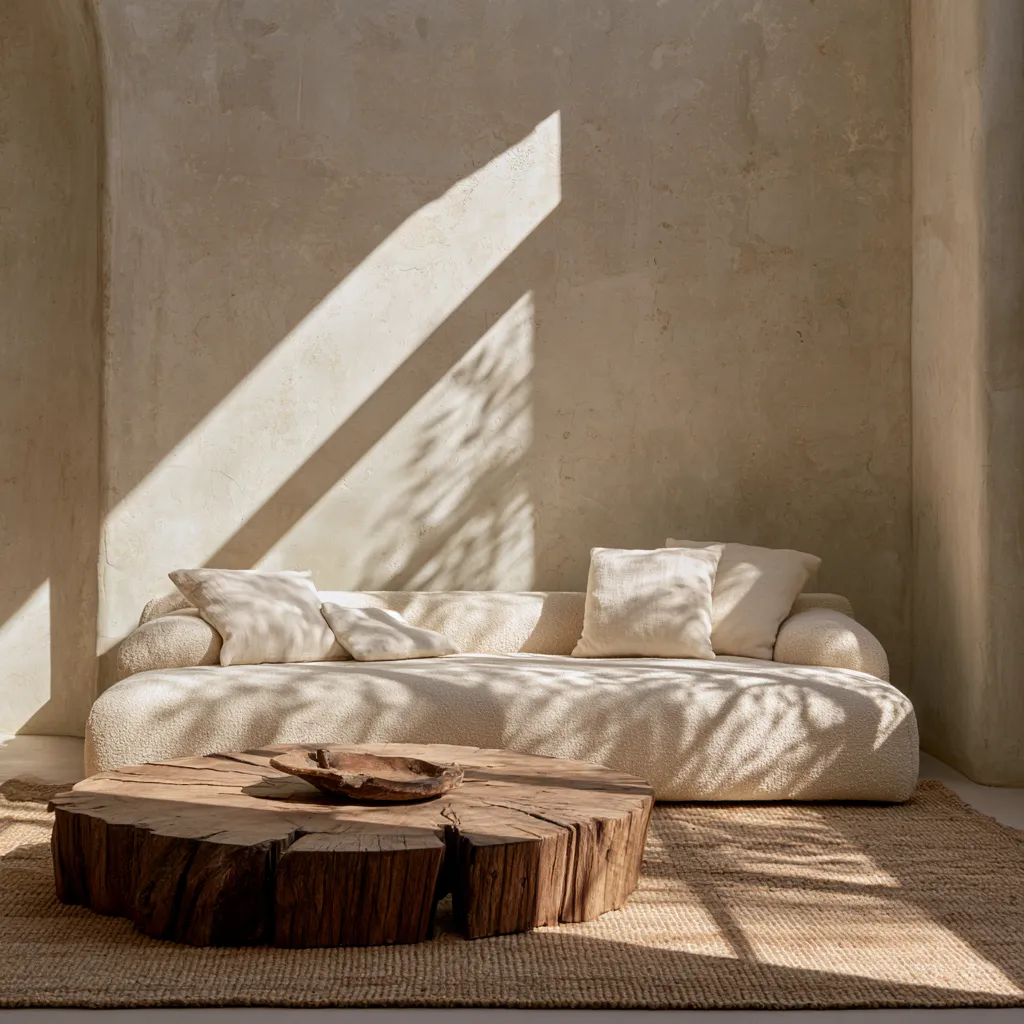
Organic modern is where the boucle sofa is most at home. The aesthetic’s palette — warm off-whites, aged creams, dusty olives, warm taupes, and natural material accents in rattan, jute, linen, and unfinished wood — is the precise environment the boucle sofa was designed to inhabit. Styling the boucle in an organic modern direction means restraint: a jute rug, a travertine or natural wood coffee table, cushions in linen and leather rather than patterned fabrics, and a wall colour in the warm off-white or aged plaster family. Limit decorative objects on the coffee table to three: a low ceramic vessel, a single art book, and a small textured object (a raw stone, a small sculptural piece in clay or stoneware). More than three tips the organic modern vignette into clutter.
For more on the warm neutral palette logic that organic modern interiors depend on, our guide to how organic modern style works with warm neutrals and muted olive covers the colour and material principles that directly inform boucle sofa styling in this aesthetic.
Japandi Boucle Sofa Styling
In a Japandi-influenced room, the boucle sofa should be a restrained choice: an oat or warm grey colourway over a light ash or natural birch frame, with as little decorative cushion arrangement as possible — two cushions in the same linen as the sofa, or one cushion in a contrasting natural material, is sufficient. The Japandi palette (cool off-whites, warm greys, natural wood tones, black or charcoal accents, occasional sage or muted terracotta) sits well with a boucle sofa provided the boucle’s warmth is not compounded by adding additional warm textures in too many places. A flat wool rug in light grey or cream and a low walnut or ash coffee table with tapered legs complete the composition without competing.
Maximalist and Eclectic Boucle Sofa Styling
The boucle sofa can anchor a maximalist room provided it functions as the room’s textural constant rather than one pattern among many. In a room with a bold Persian rug, art-covered walls, and mixed furniture styles, a cream or oat boucle sofa provides a visual resting point — the surface the eye returns to between encounters with the room’s more demanding elements. The cushion arrangement in this context can be more abundant and more varied: velvet, embroidered cotton, and patterned linen cushions in the room’s key colours. The sofa itself should remain the most textural — but least chromatic — element in the room.
Warm Neutral and Tonal Boucle Sofa Styling
The tonal approach — building the entire room within a very narrow warm neutral palette and relying on material contrast for interest — is one of the most sophisticated and demanding boucle sofa styling directions. The room is cream, oat, warm linen, aged plaster, raw oak, and the sofa’s boucle texture is the primary material event within this almost monochromatic composition. This approach requires confidence in the materials being selected — every piece needs to be genuinely interesting in isolation, because there is no colour or pattern contrast to fall back on. When it succeeds, it is among the most compelling results that boucle sofa styling can produce.
Wall Colour Behind a Boucle Sofa: What Works and What Fights It
The wall behind and around a boucle sofa has more visual contact with the sofa than any other surface in the room. The wall colour sets the tonal key against which the sofa’s texture is read, and the wrong choice can make even a beautiful boucle sofa look ordinary, yellow, or visually lost.
- Warm off-white and aged whites: The most reliable wall colour choice behind a cream or oat boucle sofa. The key is choosing a white with warm — not cool — undertones: Farrow and Ball’s Pointing, Little Greene’s Slaked Lime, or Dulux’s Warm Pebble. Cool whites (those with grey or blue undertones) make cream boucle look yellow in comparison; warm whites allow both the wall and the sofa to read as intentionally warm and related.
- Aged plaster and limewash tones: Matte, slightly textured wall finishes in dusty clay, warm mushroom, or aged stucco colours are particularly successful behind cream and oat boucle because they introduce a secondary texture at a completely different scale. The wall reads as a surface rather than a flat painted plane, which is the same visual logic that makes boucle itself so interesting.
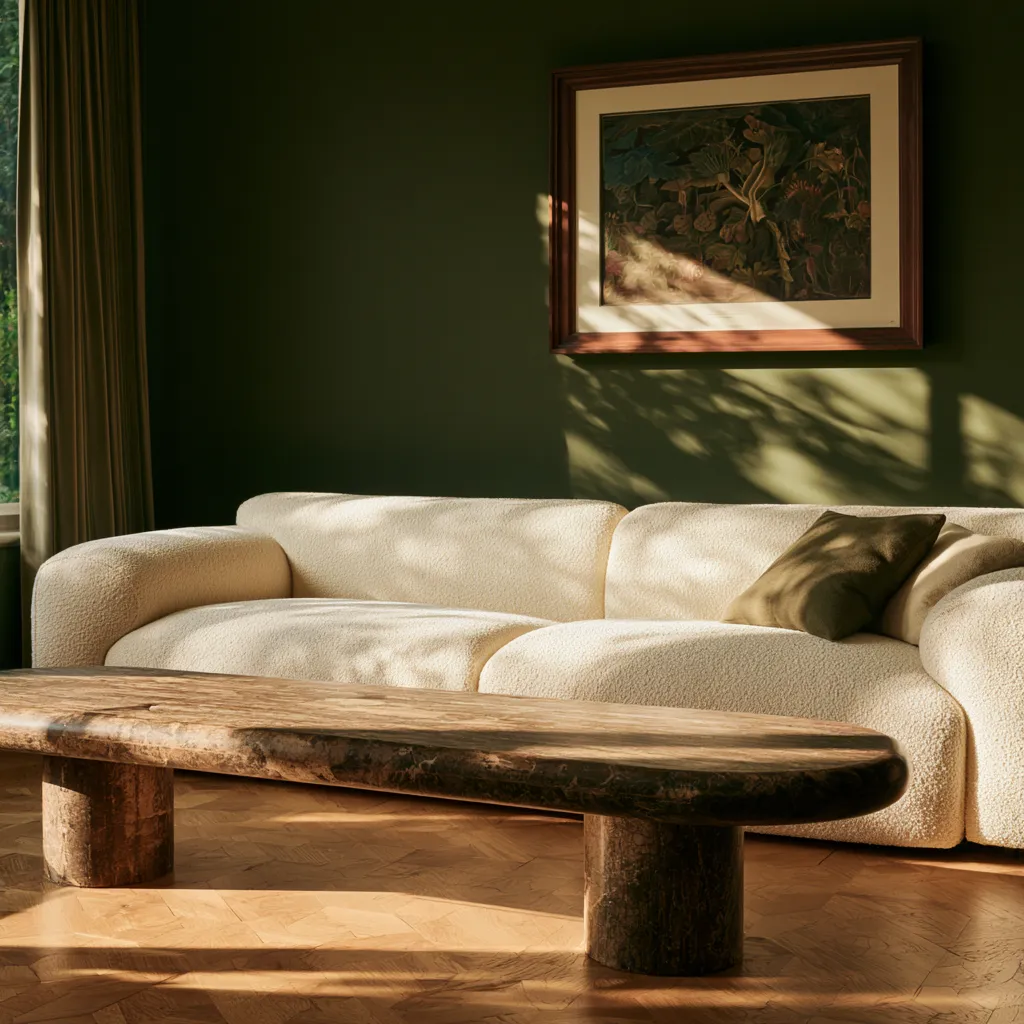
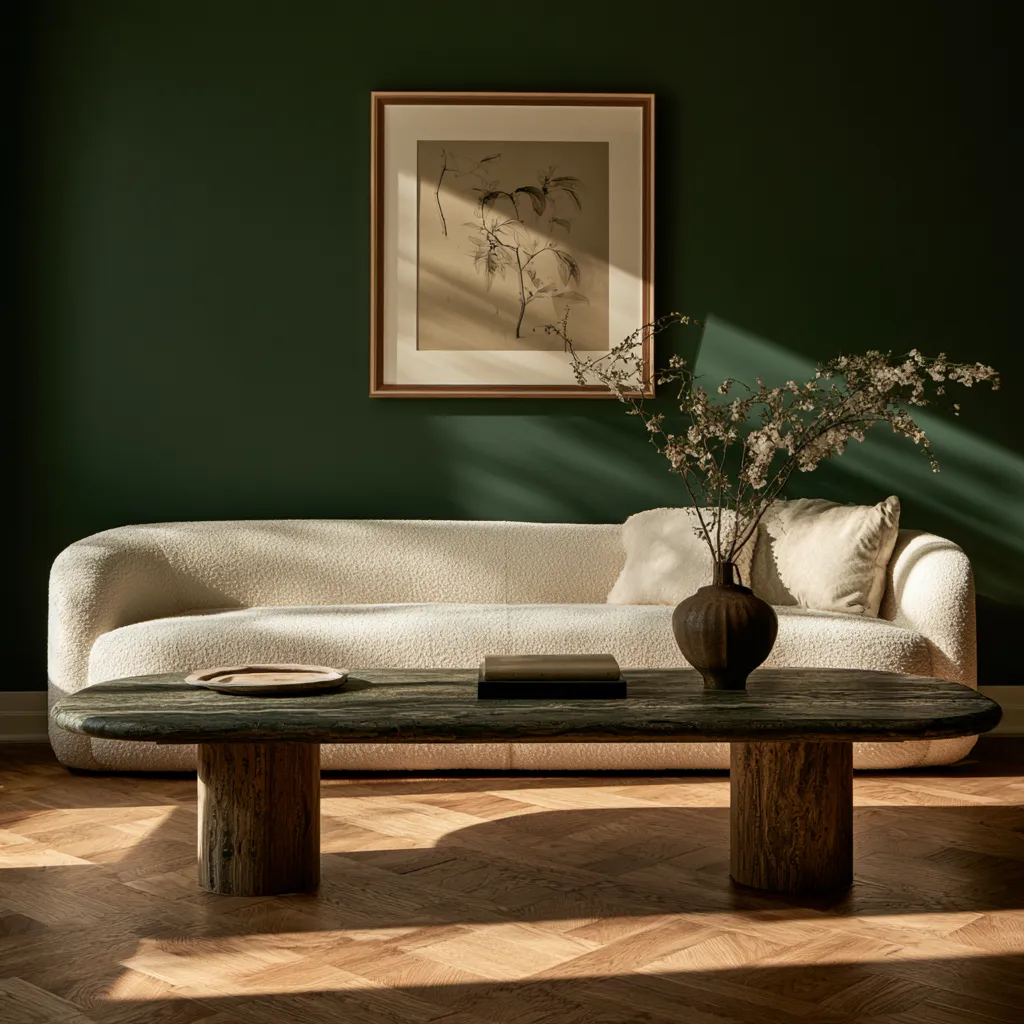
- Deep forest green: One of the most dramatic and successful boucle sofa styling choices: a cream or ivory boucle sofa against a deep forest green wall. The green’s depth makes the sofa’s cream tone luminous, the warmth of the green’s earthy base prevents the combination from reading as too formal or cold, and the material contrast between the looped sofa and the flat painted wall is as strong as any styling combination available. This pairing works best in rooms with good natural light — in a darker room the green can absorb too much light and the sofa reads as insufficiently bright.
- Warm terracotta and clay: Behind a sage or muted green boucle sofa, a warm terracotta or fired-clay wall delivers the complementary warmth that balances the sofa’s cool green. The pairing references Mediterranean and Moroccan domestic interiors — where the combination of green and terracotta is a centuries-old visual language — and sits naturally with rattan accents, natural wood tones, and a Persian or kelim rug.
- What to avoid: Cool grey walls behind a cream boucle sofa make the sofa look dingy and the room feel disconnected. Brilliant white behind any boucle colourway makes the sofa look off-colour by comparison. Very dark charcoal or black walls can work, but require very specific lighting conditions to prevent the sofa from disappearing into the background.
Accent Furniture Alongside the Boucle Sofa
The furniture that surrounds a boucle sofa — side tables, accent chairs, ottomans, console tables — should maintain the same contrast logic that governs cushion and rug selection: introduce materials that are different in character from the boucle while remaining within the same tonal family.
Side Tables
A side table beside or at the end of a boucle sofa should be in a harder material: stone, wood, or metal. Marble-topped side tables with brass or raw steel bases are the most popular choice in contemporary boucle sofa rooms, combining warmth (the marble’s veining, the brass detail) with visual hardness that contrasts the sofa. A simple solid wood side table on tapered legs — oak, walnut, or ash — is the lower-cost alternative that delivers the same material logic. Avoid rattan or wicker side tables beside a boucle sofa: both materials are texturally similar to boucle at the same scale, and the combination produces visual confusion rather than material contrast.
Accent Chairs
The accent chair beside a boucle sofa should be in a contrasting material. A leather or faux-leather accent chair in cognac, tan, or a dark cognac introduces the smooth, hard material that boucle’s texture demands as a counterpoint. A velvet armchair in sage green, terracotta, or warm burgundy introduces colour contrast alongside material contrast. What to avoid: another boucle piece alongside a boucle sofa. Two boucle pieces in close proximity — a boucle sofa and a boucle armchair, particularly in similar colourways — produce a room that has one textural note and no visual variety beyond it.
Ottomans
An ottoman in front of or beside a boucle sofa follows the same rules as the accent chair: choose a contrasting material rather than adding more boucle. A leather ottoman, a wood-framed upholstered piece in a flat woven fabric, or a travertine-topped ottoman are all appropriate. The exception is a deliberately tonal living room where the goal is a layered warm-neutral composition — in this context a matching boucle ottoman can work if the sofa and ottoman are in subtly different shades and the other materials in the room (wood, stone, metal) provide sufficient material contrast.
For specific arrangement strategies for sofas, accent chairs, and ottomans in living rooms of different sizes, our article on unique sofa arrangements for petite living rooms covers the layout principles that apply directly to boucle sofa setups in smaller spaces.
Boucle Sofa Maintenance and Practicality: The Reality Behind the Aesthetic
Boucle’s styling appeal is high; its practical demands require honest assessment before purchase. The loop structure that makes boucle so visually interesting is also what makes it less suitable for certain household contexts.
| Practical Consideration | Boucle Performance | What This Means in Practice |
|---|---|---|
| Durability (Martindale) | 15,000–25,000 rubs typical; lower than velvet or performance fabric | Suitable for moderate use; not ideal as the sole sofa in a high-traffic family room |
| Pet hair | Poor — loops trap hair and it is difficult to remove completely | Cat and dog owners should treat this as a significant deterrent or choose a performance boucle alternative |
| Pilling | Moderate risk, particularly in friction zones (seat corners, armrests) | Rotate cushions; use a fabric shaver for pill removal; some pilling is normal in the first year |
| Stain resistance | Low — the loop structure absorbs liquid rather than allowing it to bead | Blot immediately; avoid rubbing; professional cleaning recommended for significant stains |
| Fading | Low to moderate; natural wool boucle is more susceptible to UV than synthetic | Avoid positioning directly in strong sunlight; use window treatments in south or west-facing rooms |
| Cleaning | Dry cleaning recommended for most natural fibre boucle; vacuum with upholstery brush weekly | Check the sofa’s care label before purchase; some boucle sofas cannot be spot-cleaned safely |
The practical limitations of natural boucle have driven the development of performance boucle alternatives — fabrics that replicate the looped appearance of boucle using solution-dyed synthetic fibres with Martindale ratings of 50,000 or higher. These alternatives are increasingly indistinguishable from natural boucle at a visual and tactile level and represent the sensible choice for households with children, pets, or high seating traffic. The styling approach is identical whether the sofa is natural or performance boucle; the practical outcomes differ significantly.
Lighting a Boucle Sofa Room to Show the Texture at Its Best
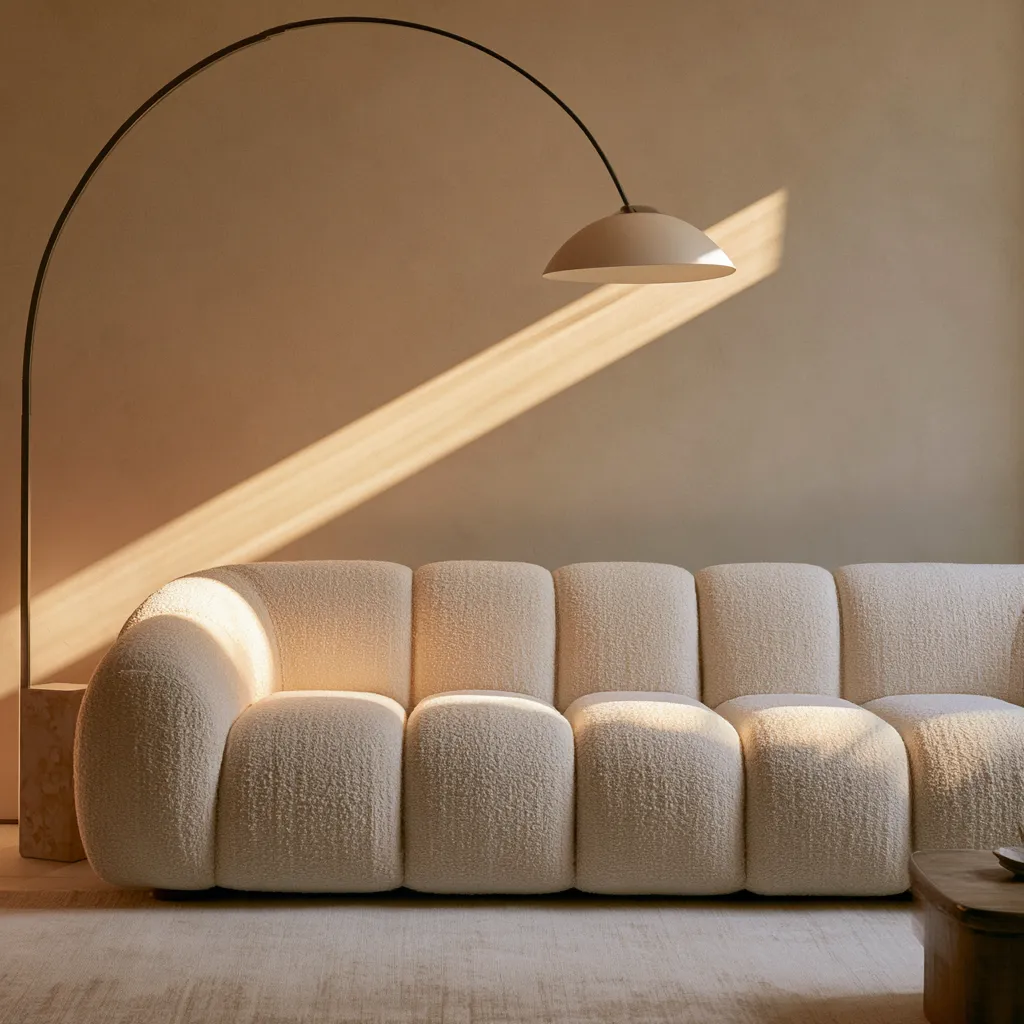
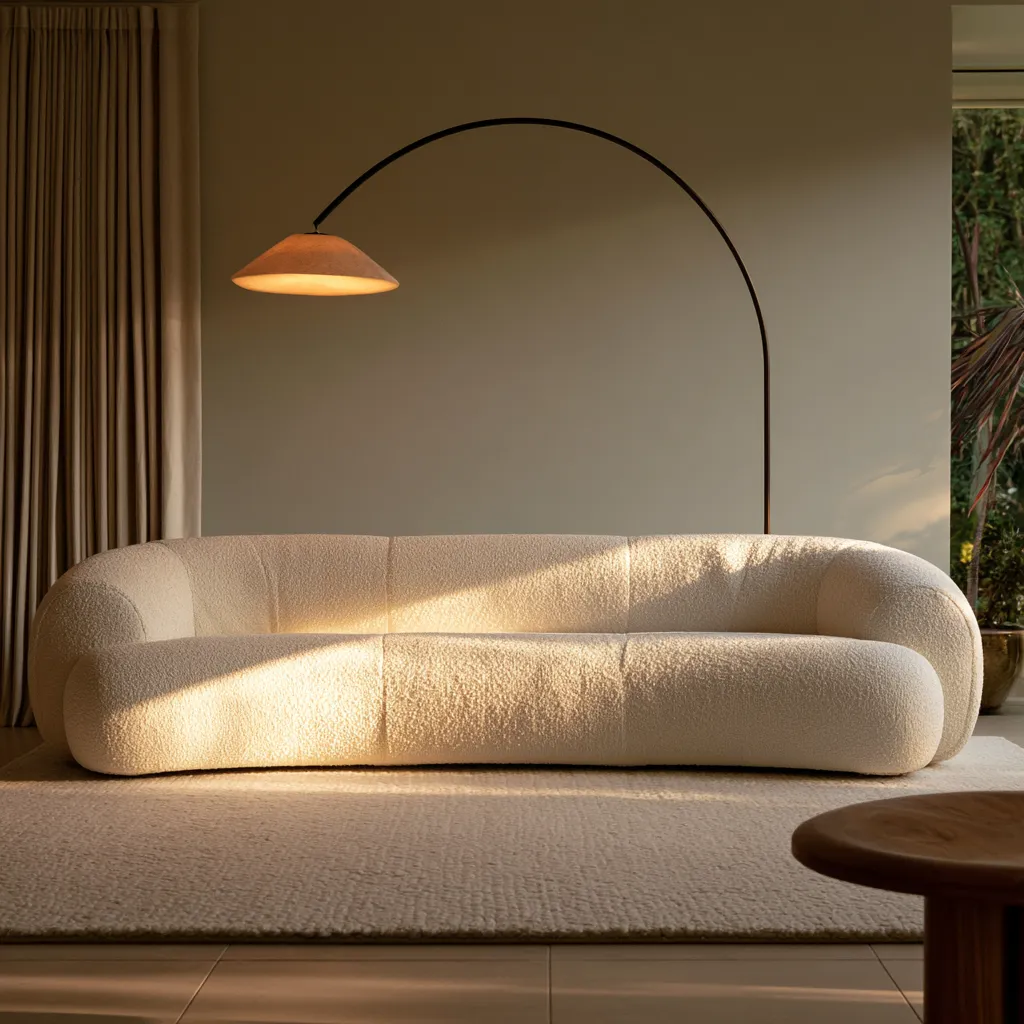
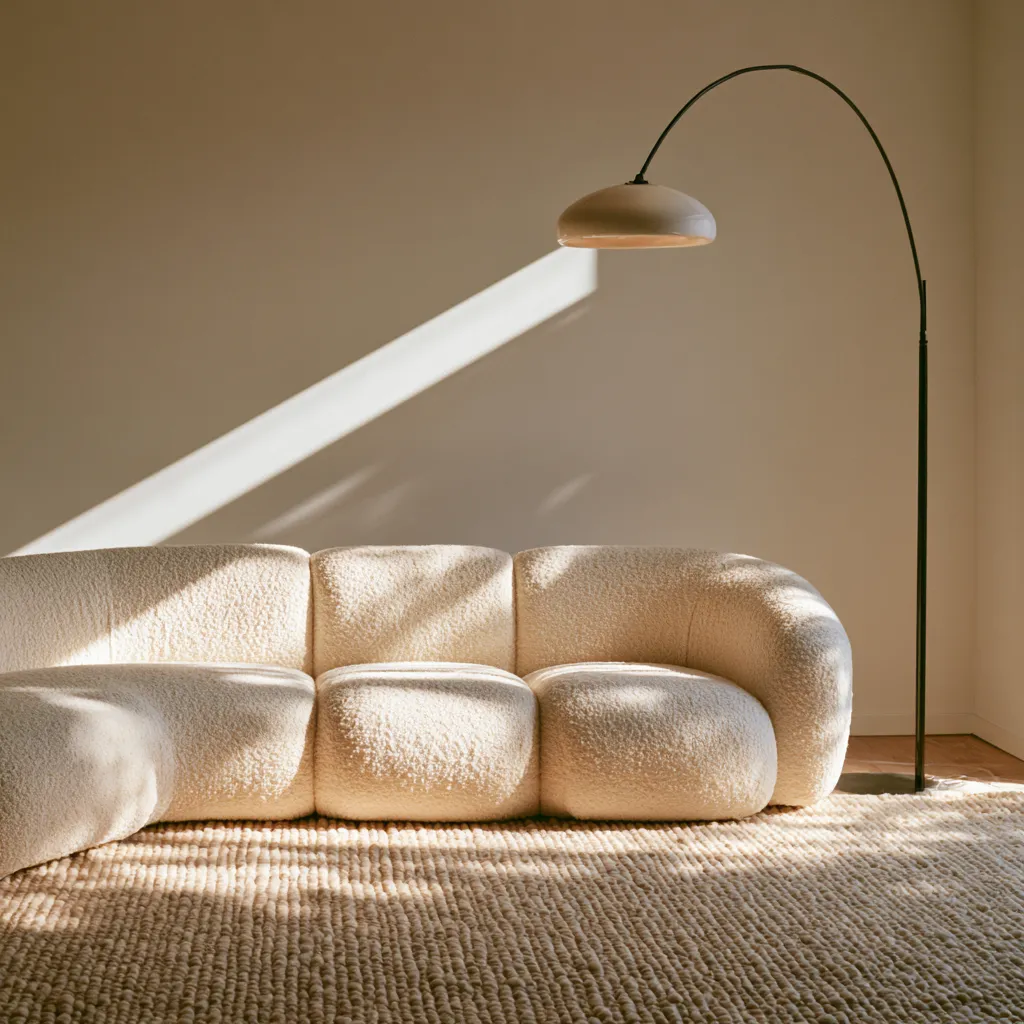
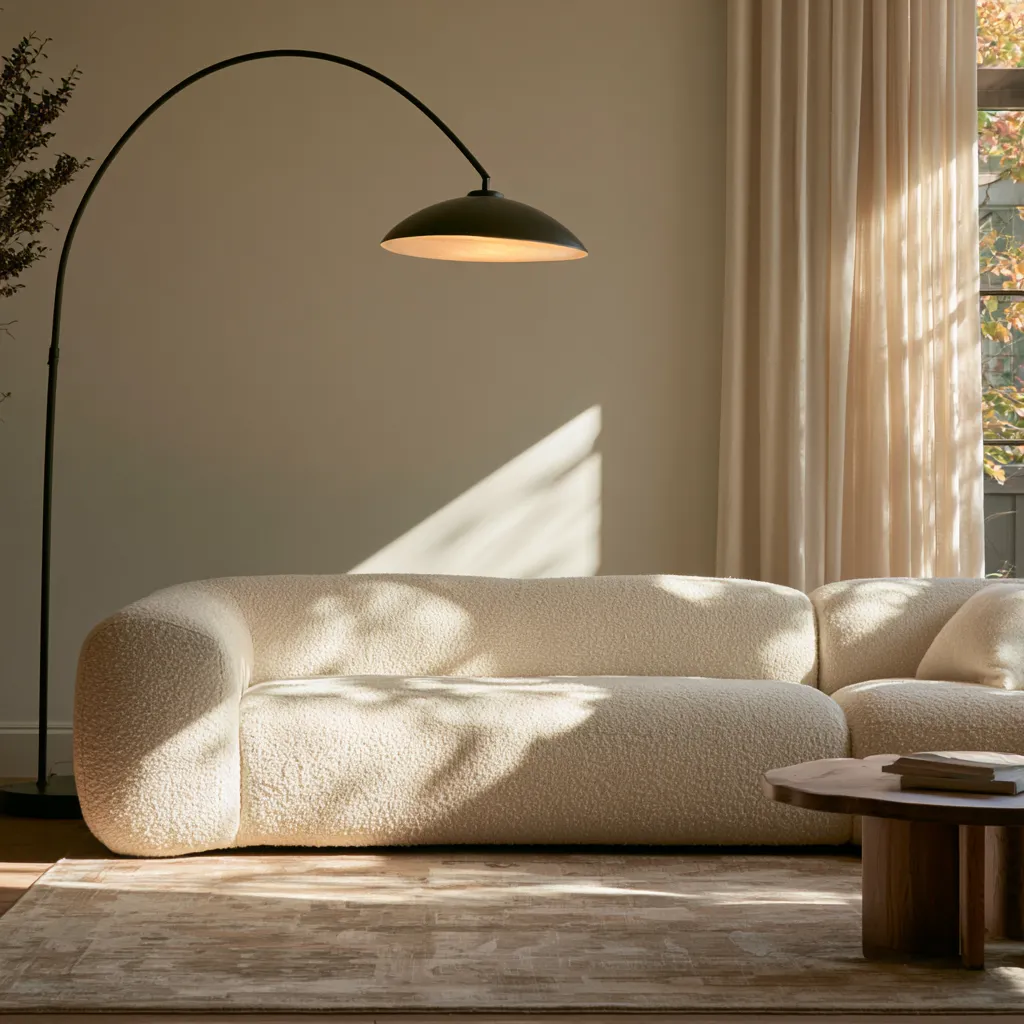
Boucle fabric changes dramatically under different light conditions. The loop structure catches and scatters light in ways that flat fabrics do not, and the quality of the room’s lighting determines whether the boucle’s texture reads as rich and dimensional or flat and undifferentiated. The general principle: warm, directional light sources that cast a slight angle across the sofa surface will reveal the boucle’s loops most dramatically. Overhead, diffused, or very cool-toned light sources flatten the texture and reduce the fabric’s visual appeal.
A floor lamp positioned beside or just behind the sofa, at an angle that casts light across the seat back, is the single most effective lighting addition for a boucle sofa room. At 2,200–2,700K (warm white), it will produce the amber-pooled, tactile-looking result that boucle sofa styling photographs so strongly in editorial contexts. A table lamp on a side table at the sofa’s end delivers the same effect at a smaller scale. The combination of both — a floor lamp behind and slightly to the side, a table lamp at the end — creates the layered warm light that makes a boucle sofa room look the way it does in the design accounts and interior journalism that has made boucle so popular.
For the broader context of how layered living room lighting strategies are constructed — and how warm-toned, multi-source lighting transforms the appearance of every element in the room including textile pieces like a boucle sofa — our article on Nate Berkus living room ideas and the principles behind them covers the light and layer approach that is foundational to living rooms where textured pieces are the primary design statement.
The Most Common Boucle Sofa Styling Mistakes
The popularity of boucle sofas has made their styling mistakes correspondingly common. The errors that appear most repeatedly:
- Too many boucle pieces in one room: A boucle sofa, boucle accent chair, and boucle cushions in the same space is too much of one texture. The boucle becomes wallpaper — present everywhere, reading nowhere. One boucle statement piece per room; contrast everything else.
- A cool-grey or stark-white room around a cream boucle sofa: The boucle’s warmth and the room’s cool quality fight each other and neither wins. The sofa looks yellow; the room looks cold. Boucle needs warmth around it — in the walls, the rug, the wood tones.
- High-shine or very glossy materials in close proximity: A high-gloss lacquer coffee table, polished chrome legs, or a very shiny pendant light placed near a boucle sofa creates a dissonance between the sofa’s matte, tactile surface and the hard reflective elements around it. The contrast is too great — it reads as a collision rather than a composition. Matte, brushed, or lightly polished finishes sit better with boucle.
- Matching the sofa colour exactly in the cushions: Cream cushions on a cream boucle sofa — particularly in the same or similar fabric weight — reduce the sofa to a flat mass of one tone and one texture. The cushions disappear into the sofa rather than sitting on it. Even a very subtle tonal shift — an oat or warm stone cushion on a cream sofa — reads better than an exact match.
- Neglecting scale in the rug: A rug that does not extend under the front legs of the boucle sofa makes the sofa float visually without ground — the room reads as unanchored. The rug under a boucle sofa should extend at least 20 cm under the sofa’s front legs and at least 60 cm beyond the sofa’s sides. In a standard living room, this typically requires a rug of at least 200 × 290 cm.
Putting the Boucle Sofa Styling Sequence Together
The sequence in which the decisions surrounding a boucle sofa are made matters. Work outward from the sofa in the following order: first the rug (the largest surface in contact with the sofa, and the one that sets the room’s floor-level material and pattern story); then the wall colour (the largest surface behind and around the sofa, setting the tonal key); then the coffee table (the room’s second most prominent piece after the sofa); then the accent chair or side chairs (which introduce the material contrast that the boucle texture demands); and finally the cushions (which personalise the sofa and introduce the room’s accent colours at the most intimate scale).
The through-line connecting every decision in this sequence is the same: contrast the boucle’s warm, looped softness with harder, smoother, and more resolved materials. Let the boucle be the room’s most tactile element. Give it a wall colour warm enough to support it, a rug flat enough to ground it, a coffee table hard enough to contrast it, and cushions varied enough in material and colour to animate it. When these decisions are made in relation to each other rather than in isolation, the boucle sofa does what it promises from the first moment you see it in a showroom — it makes the room feel like somewhere you want to sit.
For inspiration on how warm neutral palettes — the natural home of most boucle sofa styling ideas — can be built with depth and specificity rather than becoming simply beige, our guide to why creamy off-whites and warm neutrals outperform stark white provides the colour principles that make boucle sofa rooms feel genuinely considered rather than defaulted into.