Exterior window shutter ideas get far more interesting when the shutter stops being a narrow plank beside the glass and becomes the wall itself. Casey Brown Architecture did exactly that on a 3 m × 3 m copper cabin in Berry, New South Wales, where three hinged panels rise on manual winches to shade the deck and drop back down to seal the room. Do outdoor shutters like these actually work? Yes, because one moving panel handles privacy, sun control and weather protection in a single motion. Treat the shutter as a working part of the facade, not as trim.
For a conventional house, the same logic applies at a smaller scale and a far smaller price. A pair of medium exterior shutters typically costs $50–$1,000 in materials, depending on style and material, and ten installed plantation-style shutters average about $2,400. Operable shutters cost more than fixed panels screwed flat to the siding, but they repay that gap every hot afternoon and every storm. Pick working hardware first, then choose the look.
The sections below start with the copper retreat and then translate its moves into window shutter ideas for an ordinary home: styles, materials, prices and upkeep. If you are planning a retreat rather than updating a house, compare footprints and budgets in this roundup of unique cabin designs with real build costs. Two comparison tables put seven styles and six materials side by side. Begin with the job you need most, whether shade, privacy or storm defense.
Quick Scan
- Permanent Camping 2 sits on a 3 m × 3 m footprint, about 100 sq ft, yet its open shutters roughly double the usable floor area.
- Three copper panels run on three manual winches, with no motor and no wiring.
- Exterior shutters cost about $50–$1,000 per pair in materials; vinyl starts near $100, exterior MDF reaches $700.
- Manual shutters run about $300–$700 per pair installed vs $500–$1,000 for motorized sets.
- Top-hinged Bahama shutters ($300–$600) copy the cabin’s awning trick; side-hinged louvered pairs cost $150–$500.
- Most shutters last 10–20 years, depending on material, climate and care.
- Rated hurricane shutters handle winds up to 150 mph, a job decorative panels cannot do.
How a Copper Hut Reinvents Cool Shutters
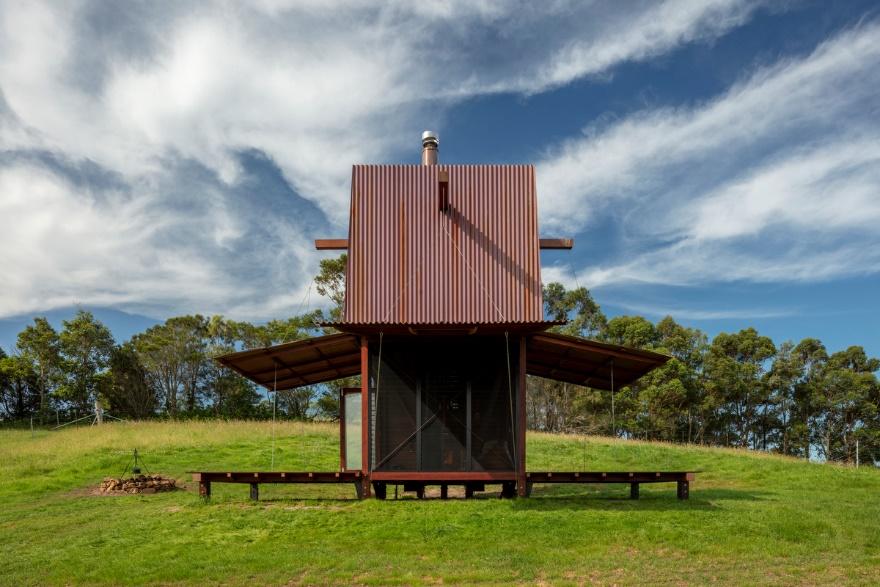
Cool shutters rarely start as a house plan, and this one began as a camping trip that never ended. Permanent Camping 2 stands in green paddocks about 500 m from the main homestead, overlooking the Pacific Ocean, and the only way in is on foot. It refines a 2007 original in Mudgee, built about 13 years earlier by the same studio. Its copper skin wraps the whole tower when nobody is there, like the lid on a jewelry box. Close every panel before leaving, and the cabin needs no other lock-up routine.

What makes these unique window shutters work is scale, since each one is an entire wall rather than a slim leaf beside a window. Three copper panels hinge at the top and rise on three manual winches, so one person can open the ground floor without power. Why not motorize them? A winch has fewer parts to fail on a remote hill, and powered shutters cost roughly $500–$1,000 per pair installed against $300–$700 for manual ones on an ordinary house. Don’t add a motor just for convenience on a building used a few weekends a year.
Lift-Up Walls Show What Exterior Window Shutter Ideas Can Do
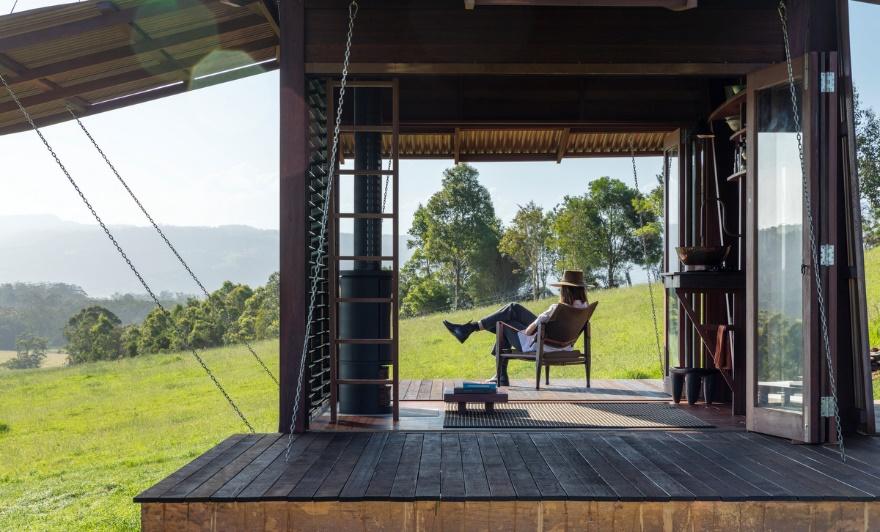
Outdoor window shutter ideas usually promise privacy, and this cabin delivers it on a sliding scale. With all three panels down, the 3 m × 3 m room becomes a sealed copper box; with one panel up, it frames a single view; with all three raised, glass doors on two sides fold away to open the room. Compare that with a fixed decorative pair, which changes nothing about light or view. Decide how many positions your windows need before you choose hinges.
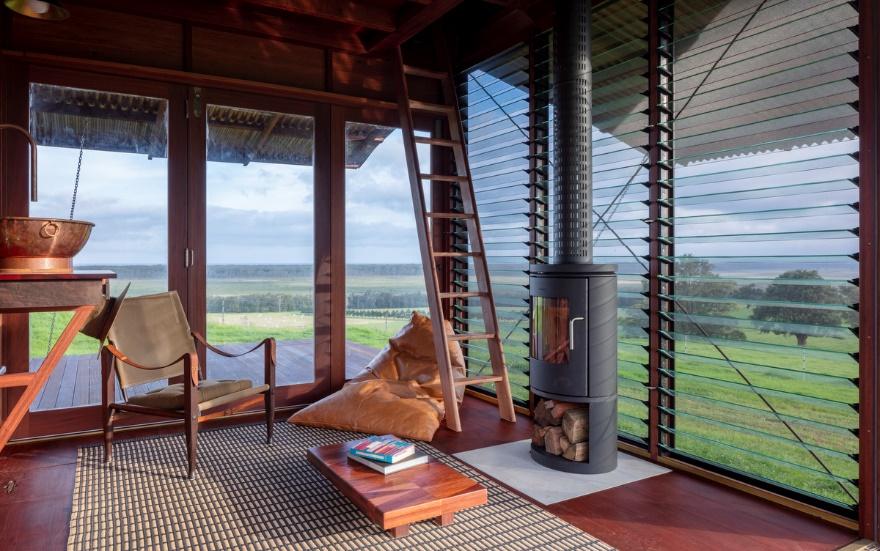
In the open position each panel turns into a canopy above the deck, and the deck roughly doubles the usable floor space. A room of about 100 sq ft behaves like one twice that size on a fine day. Is that a fair trade for a little extra hardware? For a retreat with no spare square footage, it is the cheapest extension available. Pair any lift-up shutter with a deck set level with the floor, so the room spills outward without a step.

Raised panels also work as deep eaves, letting in low morning light while blocking the harsh midday sun, much like the brim of a hat. Bahama shutters bring the same top-hinged logic to a standard house at about $300–$600 per pair, compared with $150–$500 for side-hinged louvered pairs. Don’t leave a lift-up panel open in high wind; the cabin’s owners winch the copper shut before a thunderstorm for that reason. Choose top-hinged shutters for the windows that take the hardest afternoon sun.
Two Copper Towers Built Around Shutter Ideas for a House
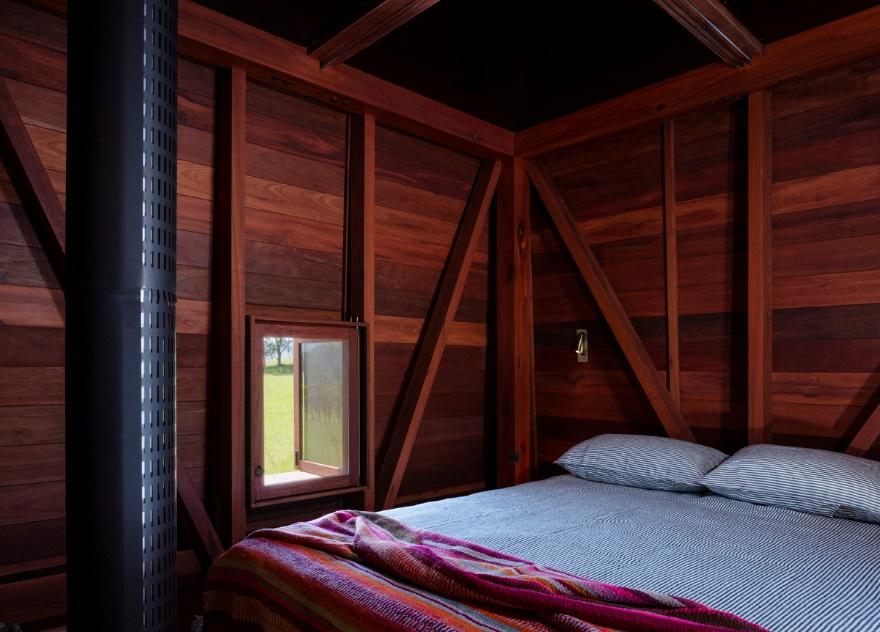
Shutter ideas for a house read best when the plan stays simple, and this one splits into two copper towers. The larger tower holds a ground-floor living space with a sink, a wood fireplace and two chairs, plus a sleeping mezzanine reached by a ladder. The smaller tower holds the bathroom, with a composting toilet and a tank that stores rainwater from the roof. Don’t squeeze a shower into the main room of a footprint this small. Keep wet rooms in their own volume when a site has no sewer connection.
A deck links the two towers, so the walk to the shower happens outdoors under open sky, more campsite than hotel. Rooftop solar panels power the lighting, and the roof doubles as a lightning conductor. The project earned a 2022 International Architecture Award from The Chicago Athenaeum, a rare result for a building of roughly 100 sq ft. Does a tiny cabin need that much engineering? On an exposed hill it does, so budget for weather protection before interior finishes.
Exterior Window Shutter Ideas by Style and Price
Exterior shutter design ideas for an ordinary home fall into a handful of styles, and each borrows something different from the copper cabin. Board and batten shutters cost about $50–$600 per pair and give a plank-built rustic look, while colonial pairs run $250–$550 and suit symmetrical traditional fronts. Bahama shutters are the closest relative of the cabin’s awnings, since they hinge at the top and prop open at an angle. Don’t mix three different styles on one facade. Match the style to the roofline first and the color second.
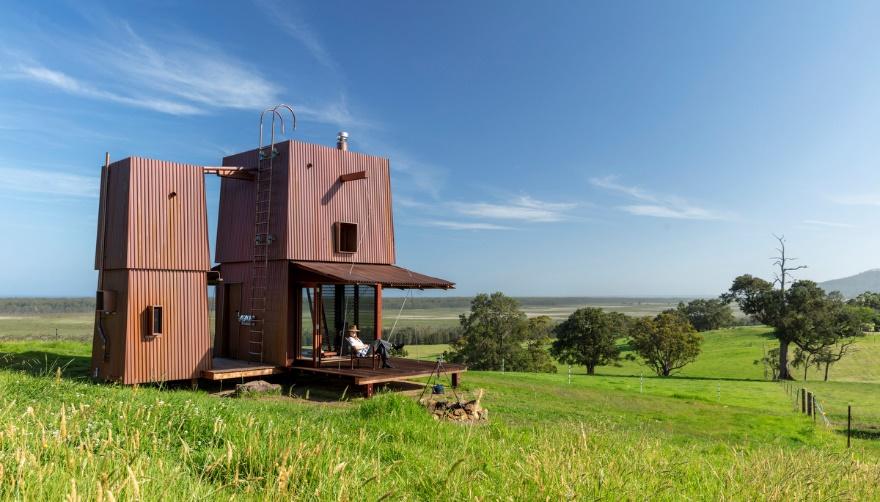
Shutters that fold up into awnings let a 100 sq ft cabin borrow the whole hillside as its living room.
Price spreads follow function more than fashion. A flat panel pair starts near $50, roller shutters cost $350–$600, and accordion storm shutters reach $1,000 per pair because they must stop flying debris. Do decorative pairs add anything beyond looks? Very little, so think of them as earrings and storm shutters as a helmet: both sit on the face of the house, but only one protects it. Buy storm-rated hardware only where the climate demands it and keep the rest simple.
Materials That Decide How Long Outdoor Shutters Last
Shutter ideas for windows often stall at the material question, and the copper cabin shows one extreme answer. Its outer skin is copper that weathers over time, wrapped around recycled ironbark salvaged from an unused wharf float. On a house, everyday choices run from vinyl at about $100–$300 per pair to wood at $200–$400 and MDF at $300–$700 for exterior use. Choose the material by exposure, not by the catalog photo.

Aluminum costs $200–$500 per pair and is the usual pick for hurricane shutters, while vinyl wins on price and color range with little upkeep. Wood looks warmer but behaves like a wooden boat: it lasts only as long as its finish stays sound. How long should any of them last? Most shutters survive 10–20 years, depending on material, maintenance and how many storms they face. Don’t hang unsealed wood on a wall that takes salt spray every day.
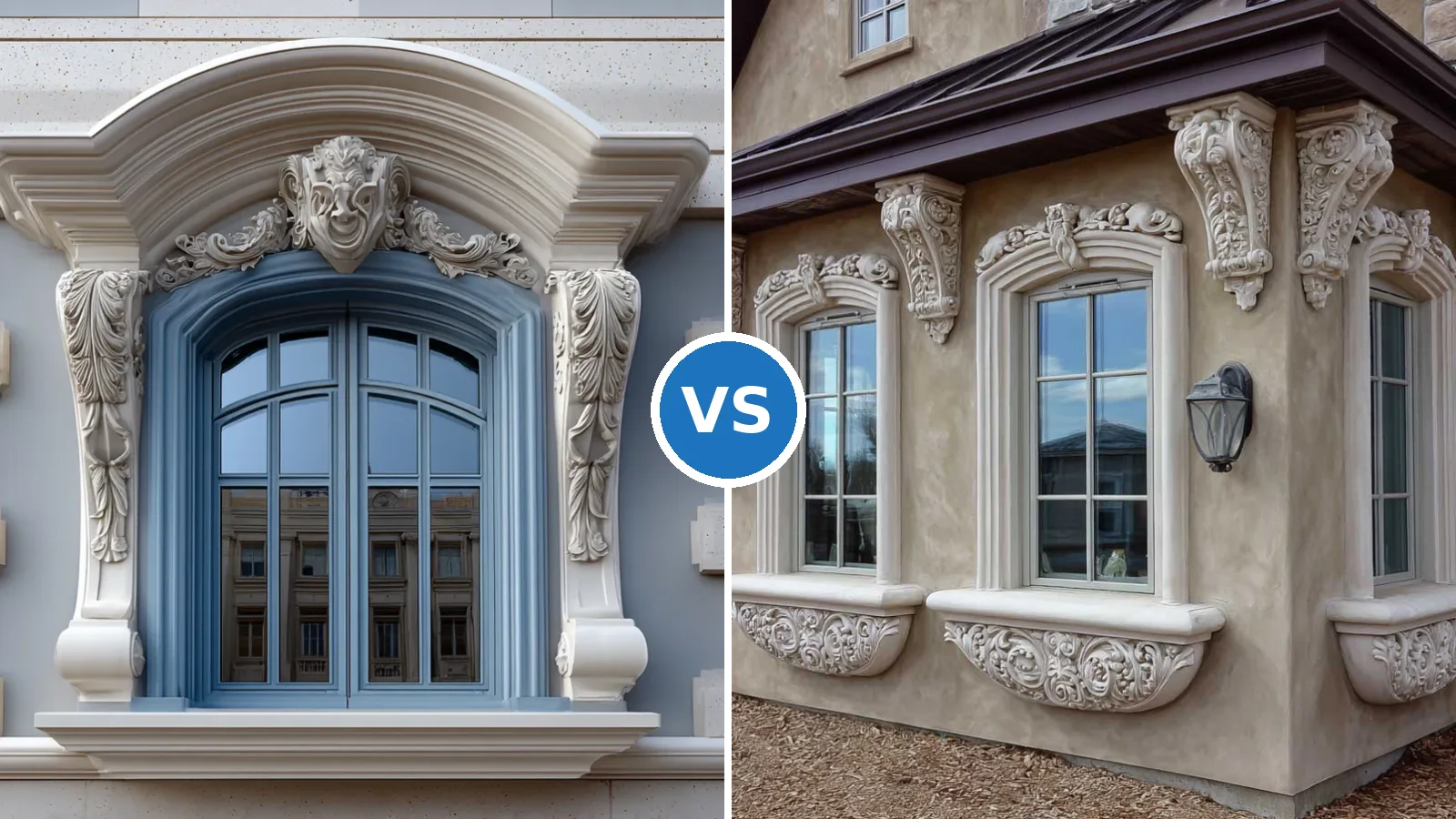
The frame around the window matters as much as the panel beside it, because a heavy surround can clash with a light shutter. Stucco houses need lighter trim in particular, as this comparison of window casing vs foam trim on stucco facades explains. Painting existing shutters costs roughly $45–$85, a cheap way to test a new color against replacing the set. Refresh the color first and replace only the panels that have warped.
Labor follows a predictable pattern. Installers typically charge $60–$100 per hour, and each shutter takes one to two hours to hang, according to Fixr’s shutter installation cost guide. Ten installed plantation shutters average about $2,400, compared with $1,200 for five basic vinyl flat panels. Request quotes in fall or early winter, when off-season pricing tends to be more competitive.
Unique Window Shutters Without the Classic Mistakes
Unique window shutters fail for the same few reasons on almost every house, and most come down to sizing and hardware. A shutter that could never cover its window reads like a costume prop, while one that actually closes earns its place on the facade. Replacing a failed shutter costs about $250–$400, plus a removal fee of $25–$100. Size every pair to the opening the first time and skip both bills.
Don’t Do This
- Don’t rely on decorative panels in storm country: rated hurricane shutters handle winds up to 150 mph, fixed decorative ones handle none.
- Don’t order a pair narrower than the window it flanks; closed, the two leaves should cover the glass.
- Don’t ignore hinges: a little household lubricant once a month keeps operable hardware quiet and free.
- Don’t motorize a remote cabin: a $500–$1,000 powered pair needs electricity and service, a manual winch needs neither.
- Don’t install storm shutters without checking permits; many hurricane-prone states require them.
Fire is the other threat a closed shutter can answer. Steel fire shutters cost about $450–$750 per pair, compared with $150–$500 for a standard louvered set, and the closed copper skin of the Casey Brown cabins was designed with bushfire in mind. Is that upgrade worth it in wildfire country? For walls facing dry bush, yes. Check the local fire rating before choosing shutter material on an exposed site.
Exterior Shutter Styles Compared Side by Side
Side by side, the styles split into two camps: decorative pairs that mostly stay under $300 and functional storm types that start near $350. Window size moves the bill too, since materials for a large 72 × 96 inch opening run $600–$1,200 versus $140–$250 for a 24 × 36 inch window. Use the first table to pick a style and the second to pick the material.
| Style | Price per pair (materials) | Hinge / operation | Storm role | Best for |
|---|---|---|---|---|
| Flat panel | $50–$300 | Side-hinged or fixed | Low | Craftsman and modern fronts |
| Board and batten | $50–$600 | Side-hinged | Low to medium | Farmhouse and rustic cabins |
| Louvered | $150–$500 | Side-hinged, airflow through slats | Low | Light and privacy control |
| Colonial | $250–$550 | Side-hinged | Low to medium | Symmetrical traditional homes |
| Bahama | $300–$600 | Top-hinged, props open | Medium | Hot climates, shade over glass |
| Roller | $350–$600 | Rolls down from a box | High | Security and storm protection |
| Accordion | $350–$1,000 | Folds to the side | High | Hurricane-prone coasts |
| Material | Exterior price per pair | Upkeep | Main strength | Typical use |
|---|---|---|---|---|
| Vinyl | $100–$300 | Low, occasional washing | Lowest cost, wide color range | Decorative pairs on budget projects |
| Faux wood | $100–$300 | Low | Wood look without rot | Traditional facades |
| Thermalite | $150–$400 | Low | Wood-like and stable | Plantation-style shutters |
| Wood | $200–$400 | High, regular repainting | Warmth, custom profiles | Historic and colonial homes |
| Aluminum | $200–$500 | Low | Strength in wind | Hurricane shutters |
| MDF | $300–$700 | Medium | Smooth painted finish | Premium painted pairs |
The Verdict on Shutters That Open Walls
The strongest exterior window shutter ideas treat the panel as a working wall, and the copper cabin proves it on about 100 sq ft, doubling its living area each time three winches turn.
For a standard house, start with function: Bahama shutters at $300–$600 per pair for shade, louvered pairs at $150–$500 for airflow, and roller or accordion types at $350–$1,000 where storms hit hard.
Choose the material by exposure. Vinyl at $100–$300 per pair suits low-maintenance facades, aluminum at $200–$500 suits windy coasts, and wood at $200–$400 rewards owners willing to repaint.
Plan for 10–20 years of service and labor at $60–$100 per hour. Manual hardware at $300–$700 per pair installed beats motorized sets at $500–$1,000 anywhere a repair crew is hours away.
| Architecture | Casey Brown Architecture |
| Photography | Andrew Loiterton |