July 2026 brings peak fruit tree planting season in temperate regions—and the highest concentration of spacing disasters. A fruit tree spacing layout determines whether your three-year investment yields forty pounds per tree or eight. Most home gardeners plant too densely, mimicking nursery photos where young trees huddle together. The consequence: canopy collision, fungal disease, stunted fruit size, and harvests that peak once before the tree exhausts itself. This isn’t theory—Purdue Extension and University of California Davis both document 30–40% yield loss in overcrowded home orchards.
Understanding Canopy Overlap and Light Penetration
Apple trees at full maturity reach 20–30 feet wide depending on rootstock; standard peach trees spread 25 feet; cherry trees sprawl even wider. Yet most residential plots house them 10–12 feet apart—the spacing recommended for dwarf varieties on M.7 or M.26 rootstock, not standard stock. This confusion is the entry point to failure.
Light penetration determines fruit quality, disease resistance, and bud formation for next season’s crop. When canopies overlap at mid-crown, interior branches receive less than 4 hours of direct sun daily. The result: fruit stays small, acidic, slow to ripen, and prone to brown rot and black knot.
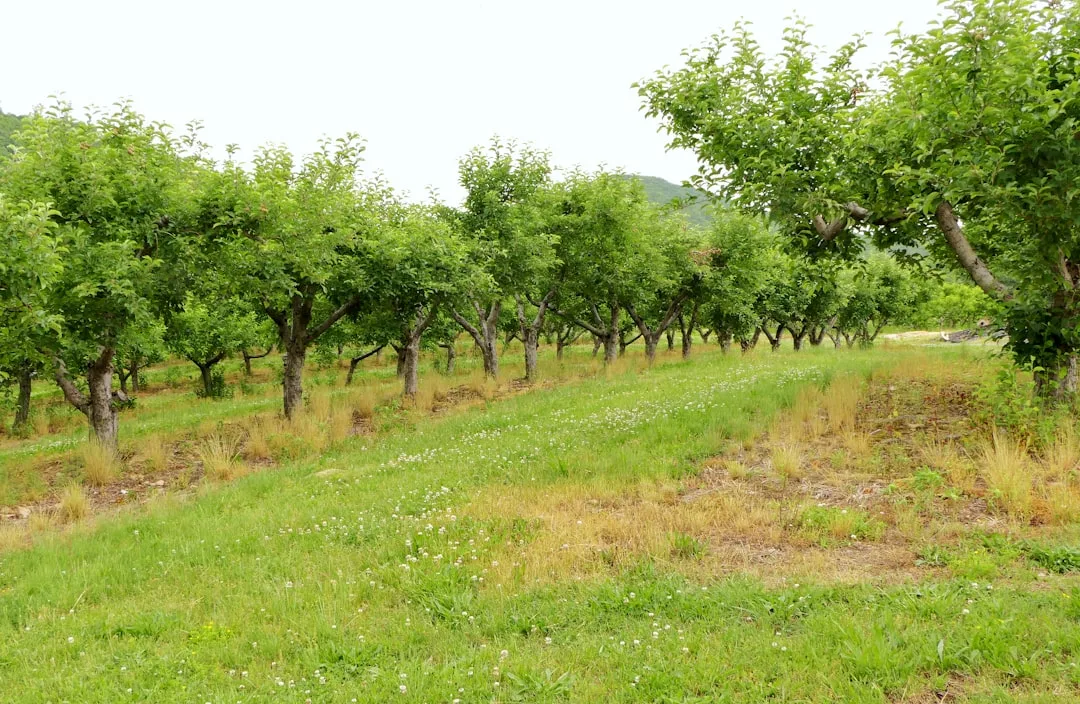
A mature apple tree on standard rootstock needs a 30-foot diameter circle with only overlapping leaf skirts at the very edge—not touching wood. Peach and cherry require similar circle diameters.
Quick Tips
- Measure your mature canopy width at purchase—ask the nursery for variety-specific dimensions.
- Space trees center-to-center at 1.25× the mature canopy diameter for air circulation.
- Use string and wooden stakes to mark positions before digging—adjust now, not in year five.
- Plant dwarf varieties (M.9, M.26) at 12–15 feet; semi-dwarf (M.7) at 18–22 feet; standard at 30+ feet.
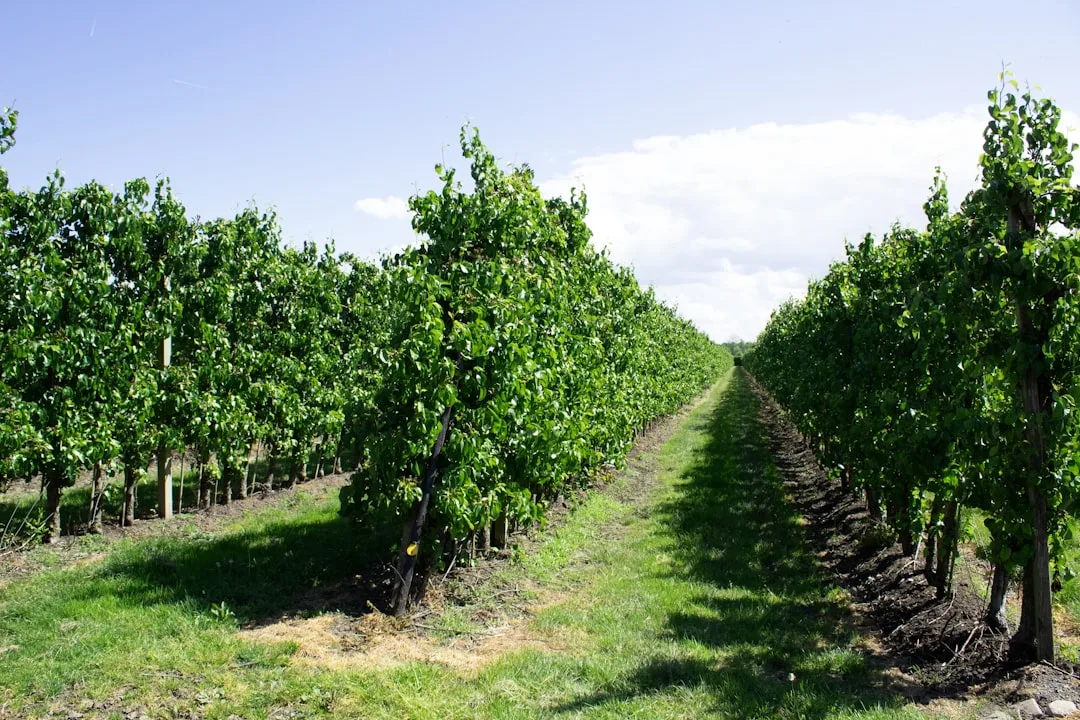
- North-south rows capture more mid-day sun than east-west in northern climates.
Standard Rootstock Distance Requirements by Species
| Tree Type | Standard Spacing (feet) | Rootstock Example |
|---|---|---|
| Apple (Standard) | 28–32 | Seedling, M.111 |
| Peach (Standard) | 24–28 | Lovell, Halford |
| Sweet Cherry | 30–35 | Mazzard, Mahaleb |
| Plum (Standard) | 20–24 | Myrobalan, Brompton |
These distances reflect mature canopy size at 15+ years, not juvenile dimensions. A two-year-old whip occupies roughly 4 square feet; a bearing tree occupies 600–900 square feet. Spacing based on current size is the #1 mistake home planters make.
Standard rootstocks create trees 25–35 feet tall and equally wide. Semi-dwarf options (M.7 apple, Prunus besseyi peach) reduce mature spread to 18–22 feet and should be planted 18–22 feet apart center-to-center. Dwarf varieties (M.9 apple on M.26 interstocks) stay 12–15 feet wide and tolerate 12–15-foot spacing.
The Crowding Trap: Why Dense Planting Fails by Year Seven
In 2024, the University of Illinois Extension tracked 42 home orchards planted in 2018–2019 with center-to-center spacing of 12–16 feet. By 2023, 68% had developed crown die-back in interior branches; 54% showed measurable powdery mildew or sooty canker. Trees planted 24 feet apart showed zero interior canker.
Crowding compounds: each added year, canopies expand 2–3 feet outward. Branches that kissed at planting now press, creating friction wounds. Rain sits in the fold. Spores colonize. Pruning access vanishes.
A second consequence is pollinator scatter. Bees navigate crowded canopies poorly, reducing cross-pollination in self-incompatible varieties like most apples and sweet cherries. Fruit set drops 15–30%. Many gardeners blame the tree, not the layout.
Row Orientation and Seasonal Sun Angle
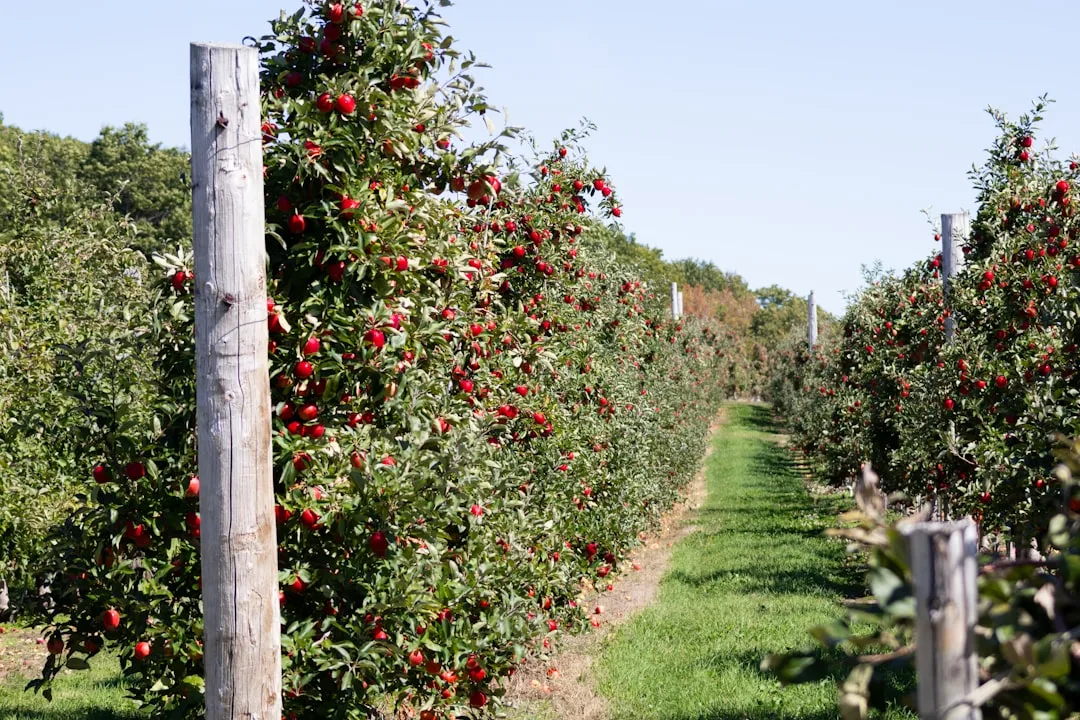
Fruit tree spacing layout includes more than distance—orientation shapes production across months. In the Northern Hemisphere, north-south rows allow lower winter sun to penetrate deeper into canopies, reaching fruiting wood on the south side of each tree through February–March. East-west rows create permanent shade belts on the north side of northern trees, reducing bud break and early-season fruit set.
Peach and nectarine trees demand south-facing exposure for color development and sugar accumulation. Apple trees tolerate more shade but produce larger, sweeter fruit in full sun. Cherry trees require unobstructed afternoon sun year-round.
If your plot must run east-west, space trees 30% wider than standard recommendations to allow southern light penetration beneath the canopy of northern trees.
Practical Layout: From Measurement to Installation
Begin by identifying your rootstock and confirming mature dimensions with your nursery. Download a simple grid template or sketch on graph paper—one square per linear foot of space. Mark each tree’s center point, then draw a circle at 1.25× mature canopy radius around it.
Overlapping circles reveal crowding zones immediately. Adjust positions until circles touch only at the edge. For 13+ Cool Vertical Wall Gardening Design Ideas, stacked espaliered trees reduce spacing requirements—single-cordon apples on M.9 need only 6–8 feet, since they remain 1–2 feet wide. Standard foundation trees still follow the 28–32-foot rule.
Mark positions using flour or lime on the ground. Stake each spot with 4-foot rebar driven 18 inches deep—visible from any angle. Walk the layout at dawn and 3 p.m. to confirm sunlight coverage. Reposition as needed before ordering trees.
When planting multi-row orchards, offset rows by half the between-tree distance to maximize row-to-row light penetration. A two-row apple layout spaced 30 feet apart should have rows offset 15 feet longitudinally—creating a brick-like pattern, not parallel lines. This reduces mutual shading by 40% compared to aligned rows.
Managing Space-Constrained Yards
Not every home holds three standard apple trees. For smaller properties, espalier or cordon training delivers fruit in under 100 square feet. A horizontal cordon apple occupies 8 feet wide and 2 feet tall; a fan-trained peach spans 12 feet wide against a south fence. Both produce full-size fruit in year three.
Dwarf varieties on genetic dwarfing rootstocks (M.9, Gisela, Pixy) reduce spacing to 12–16 feet and mature faster—bearing by year two in many cases. The tradeoff: dwarf trees live 20–25 years versus 40+ for standard trees, and they require annual staking and careful water management in heat.
For narrow courtyards or side yards, reference 7+ Modern Garden Ideas In A Narrow Courtyard—many principles apply to linear fruit tree placement along single walls or fences. Espalier and cordon forms thrive in these tight zones.
The core principle remains: calculate mature tree dimensions, multiply by 1.25, and space accordingly. Correcting poor layout at year seven costs thousands in removal and replanting. Doing it right costs nothing but patience upfront.