The space between your front door and the street is doing one of two things right now: it is either amplifying the architecture behind it, or quietly undermining it. For homes with modern facades — those defined by clean render, timber cladding, dark window frames, or exposed concrete — the front garden is not decoration. It is a structural extension of the building itself. Get the planting right, and a flat facade gains depth, texture, and seasonal life. Get it wrong, and even the most considered architecture looks unfinished.
According to the American Society of Landscape Architects, well-designed front gardens increase residential property values by 5–12% — with curb appeal cited as one of the top three purchase drivers in buyer surveys. In the UK, the Royal Horticultural Society found that front garden improvements deliver an average return of £5 for every £1 spent on planting. These numbers matter, but the visual case is even stronger: a modern house facade with the right planting scheme reads as complete. Without it, it reads as a work in progress.
This guide covers the full toolkit — from structural species selection and material coordination to layered planting sequences, colour palette logic, and low-maintenance approaches that hold up over time. Every idea here is designed for front gardens where architecture sets the brief and planting answers it.
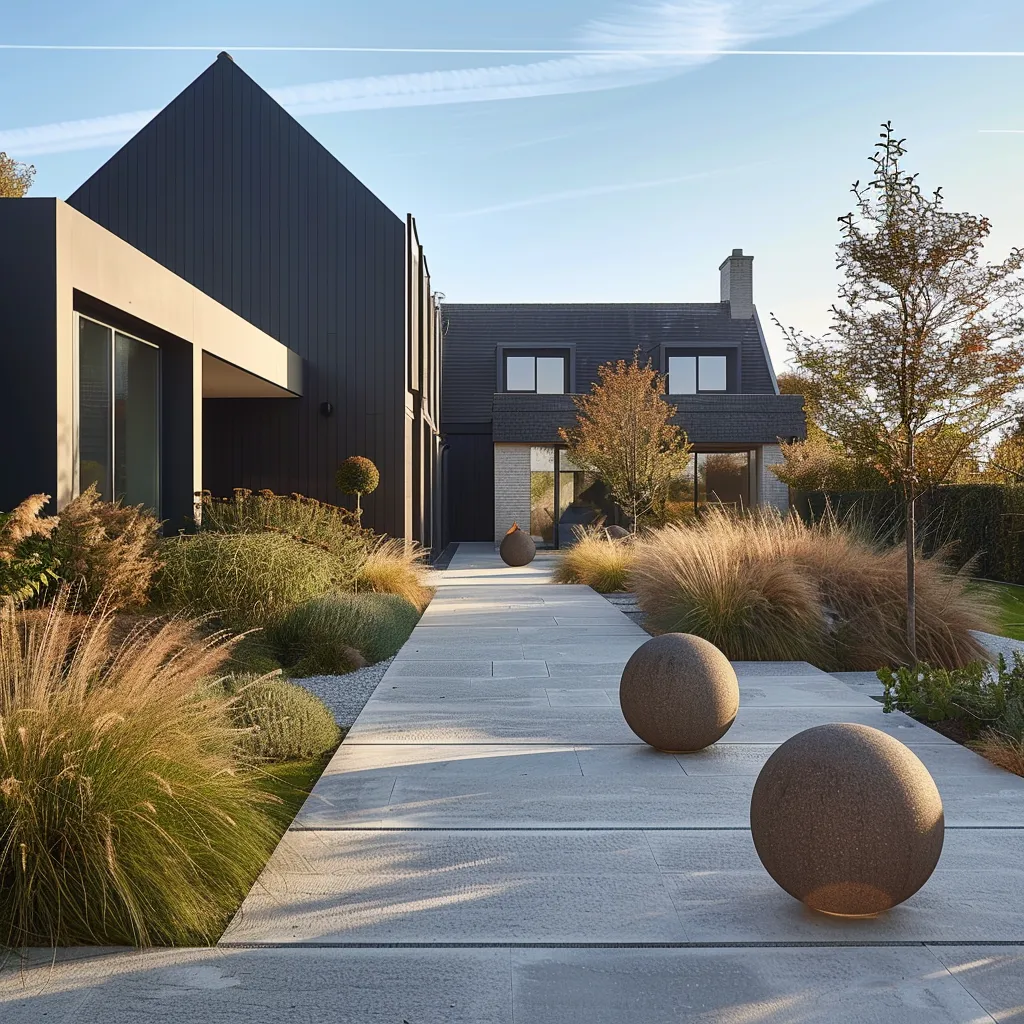
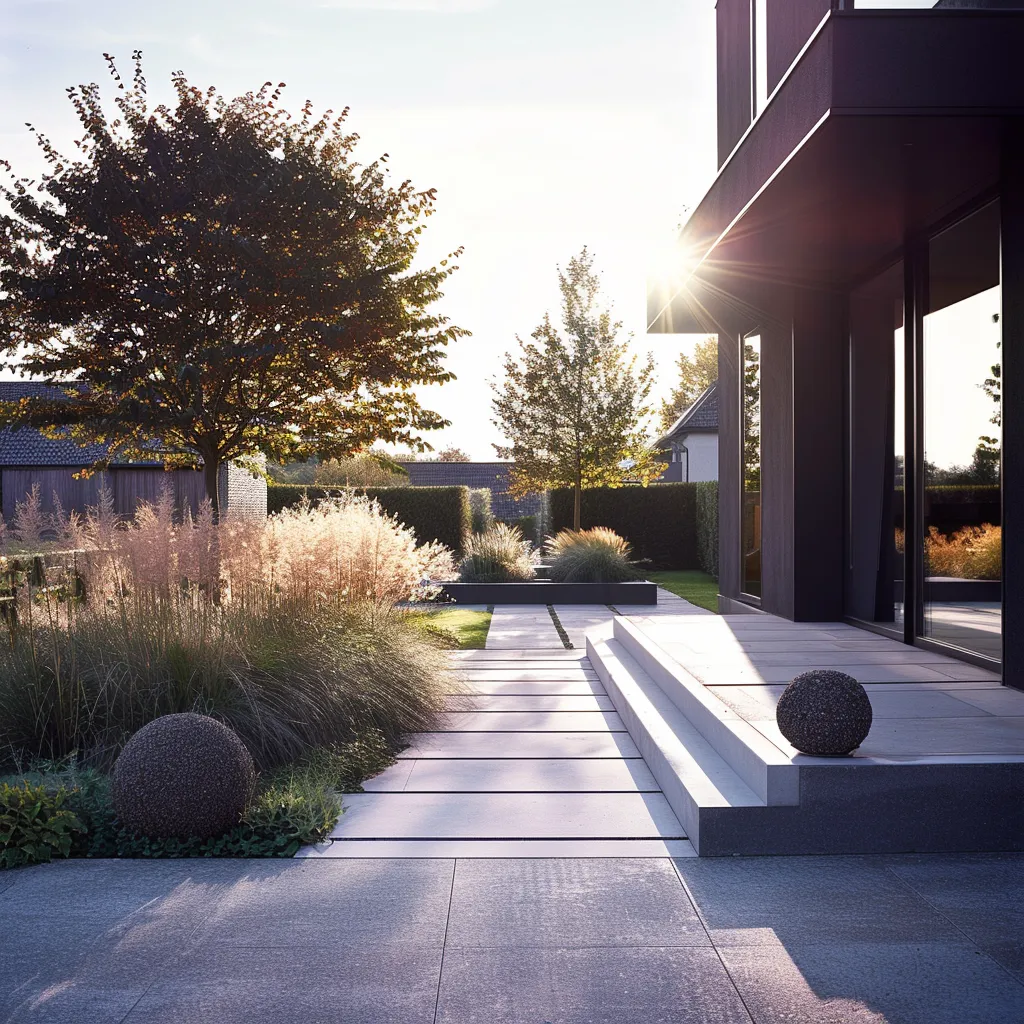
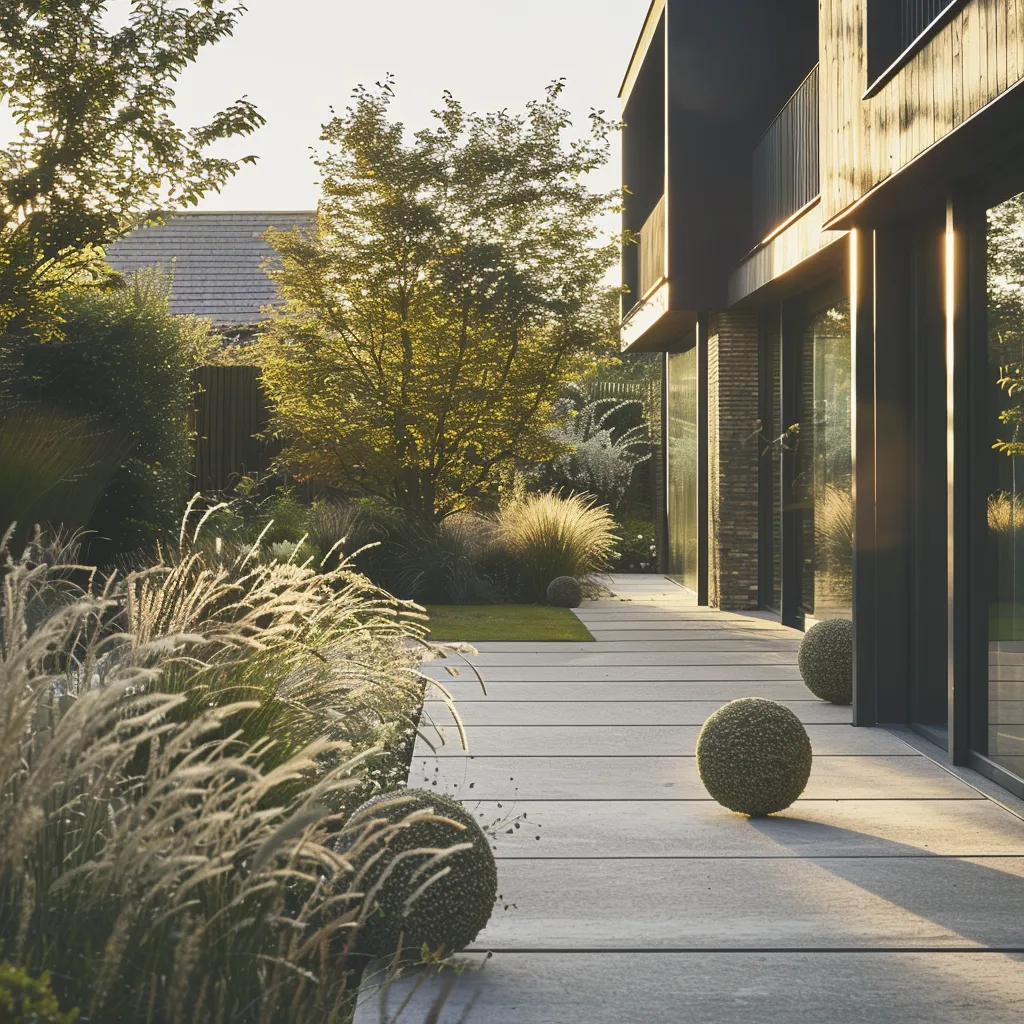
Why the Facade Material Should Drive Your Front Garden Planting Ideas
Before choosing a single plant, look at what the house is made of. Facade material is the single most important constraint in front garden design — and the most consistently ignored one. Planting that fights the surface it sits against creates visual noise. Planting that echoes or counterpoints it deliberately creates something that looks designed rather than assembled.
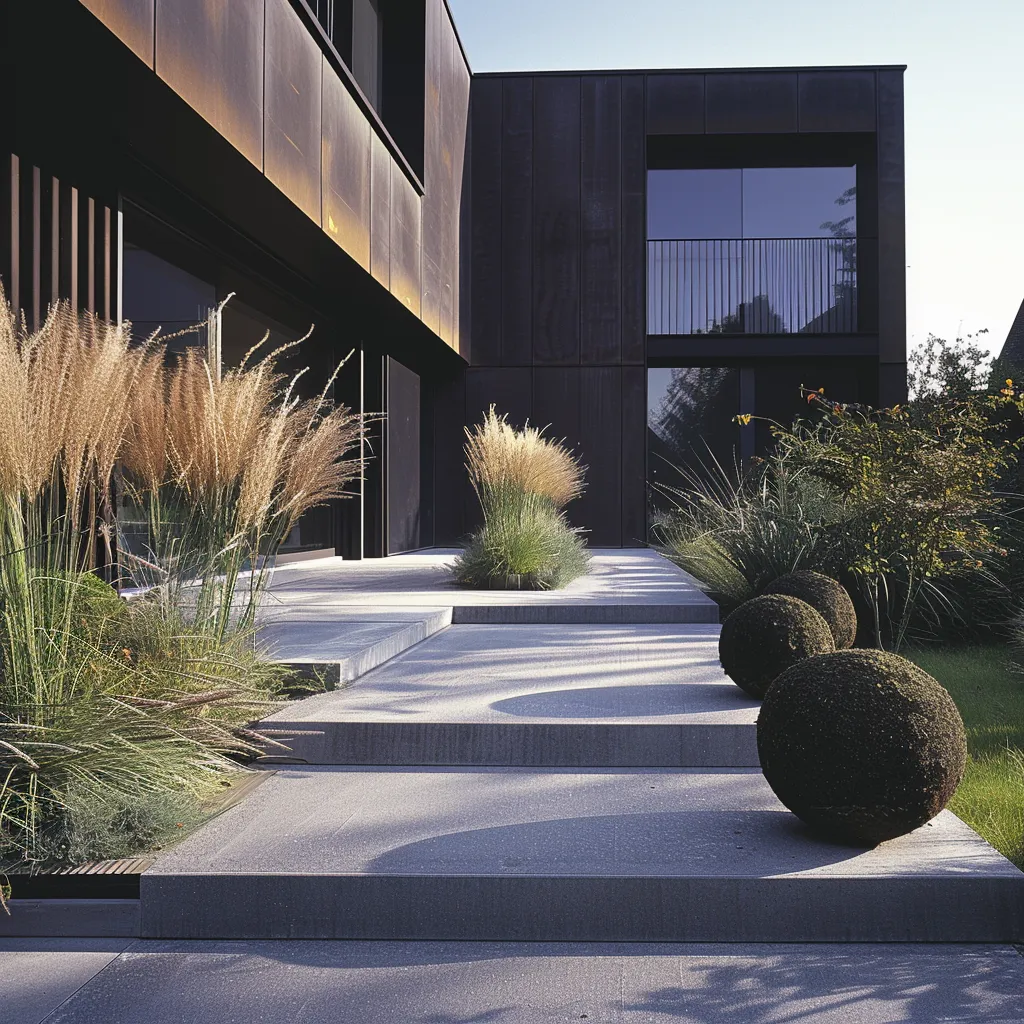
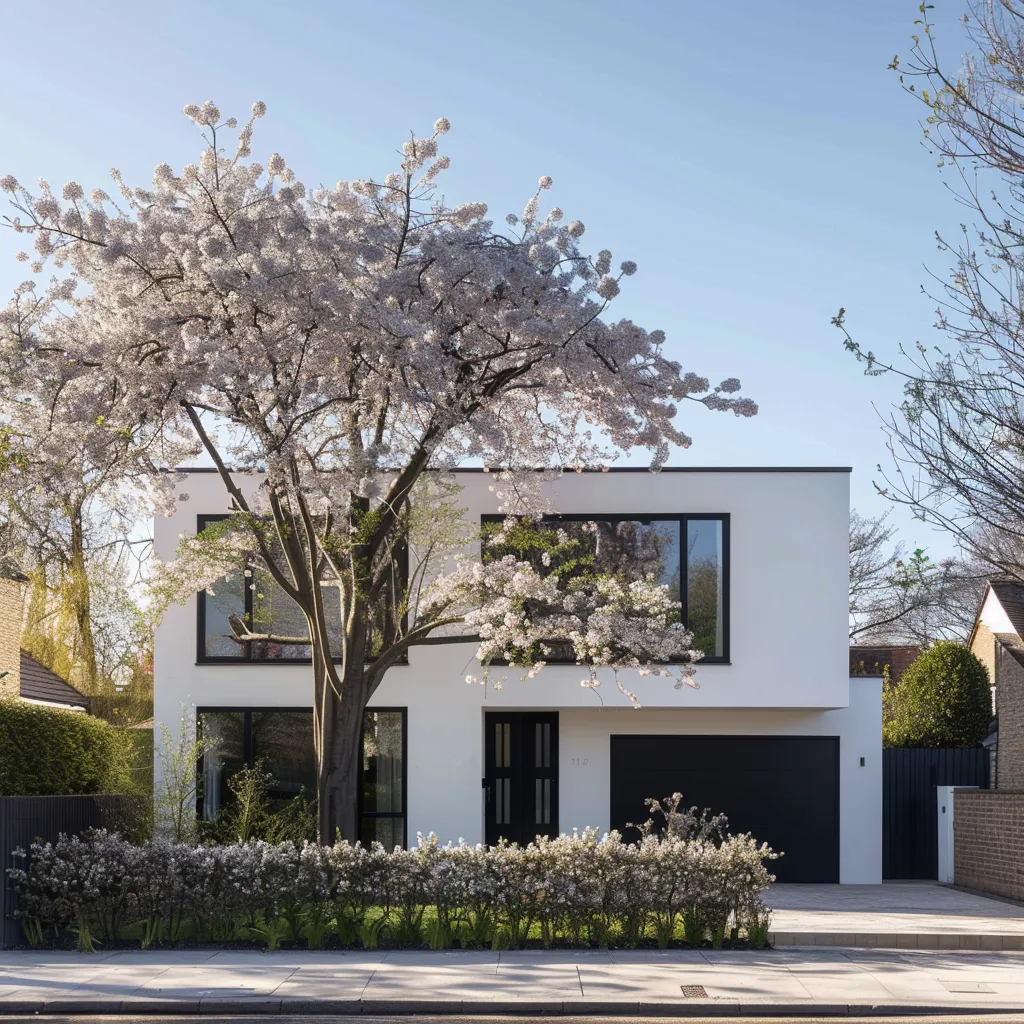
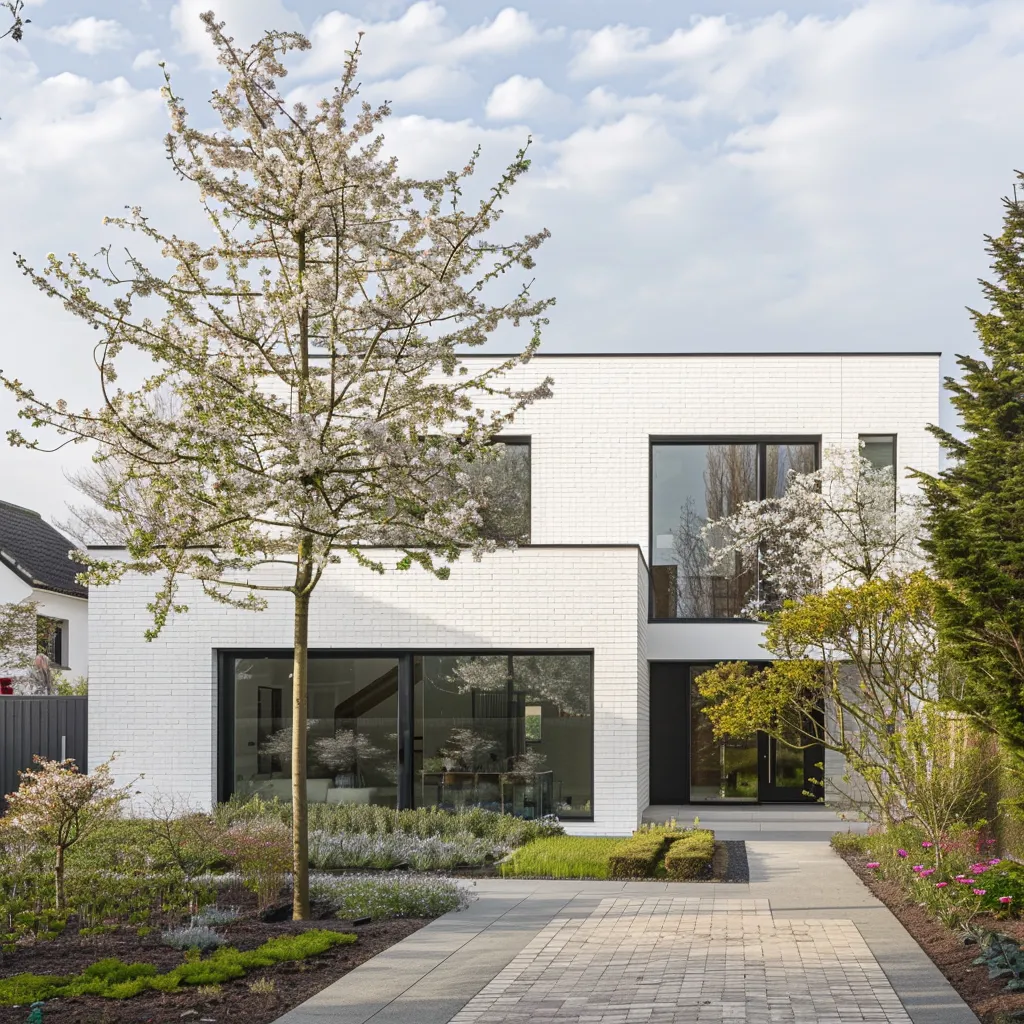
Dark render — anthracite, charcoal, or matte black — absorbs light and creates a flat, receding surface. It needs planting with strong silhouettes and lighter-toned foliage to pull depth forward. White or pale render is the opposite: it reflects light and benefits from planting with darker, denser texture to ground the facade and prevent it from looking bleached out in photographs or on bright days. Timber cladding in cedar or larch introduces warm, organic grain — plants that mimic this natural quality (feathery grasses, branching shrubs, loose perennials) read as harmonious rather than contrasting.
Exposed concrete and board-formed finishes are increasingly common in contemporary residential design. They carry strong horizontal or vertical linearity, and planting that echoes this rhythm — vertical accent plants, horizontal groundcover bands, or columnar specimens — reinforces the architectural intention. Random or mixed planting against a board-formed concrete facade always looks accidental, regardless of how good the individual plants are.
The Layer System That Makes Front Garden Planting Ideas Work at Every Scale
Professional landscape designers rarely think in terms of individual plants. They think in layers — a structural framework of heights and textures that holds together through all four seasons and at every viewing distance. For front gardens, where the primary view is from the street or pavement at approximately 5–15 metres, this layering is especially important because the brain reads the composition as a whole before it registers individual species.
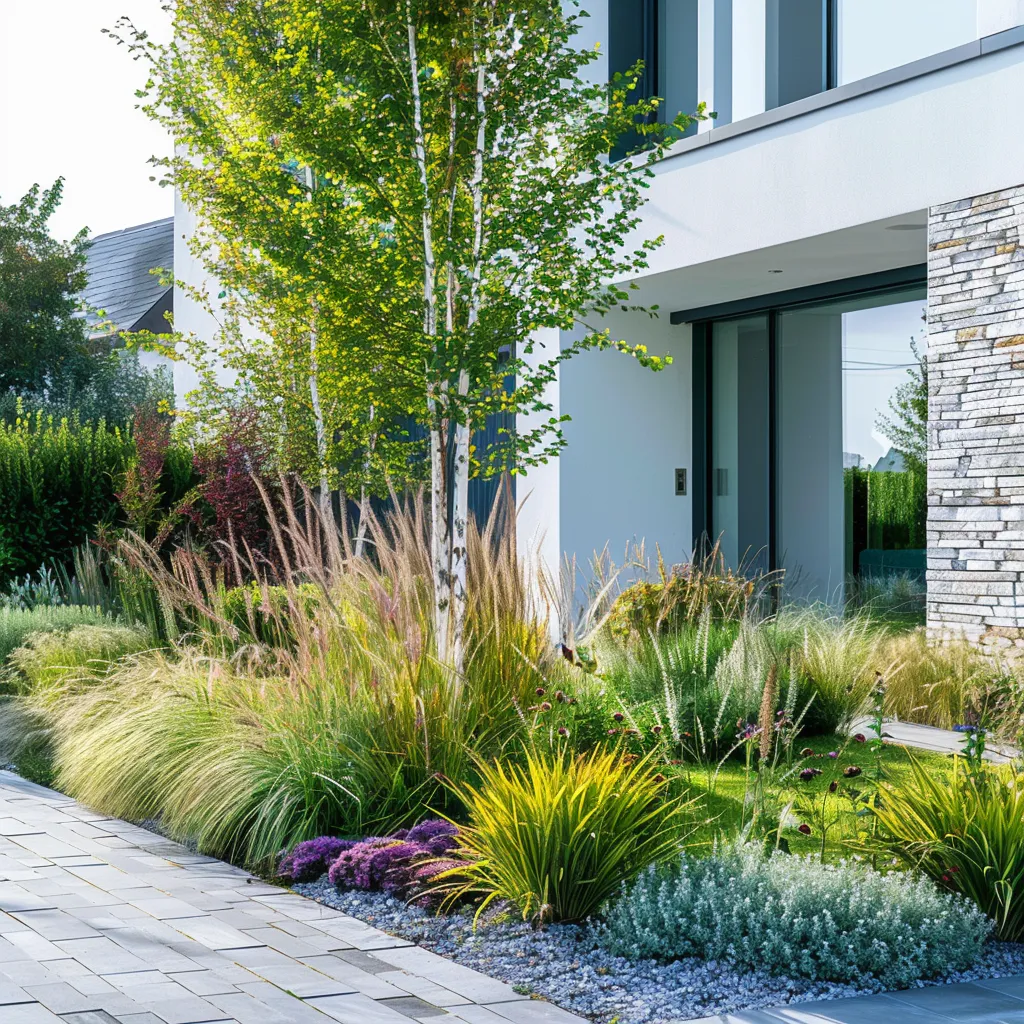
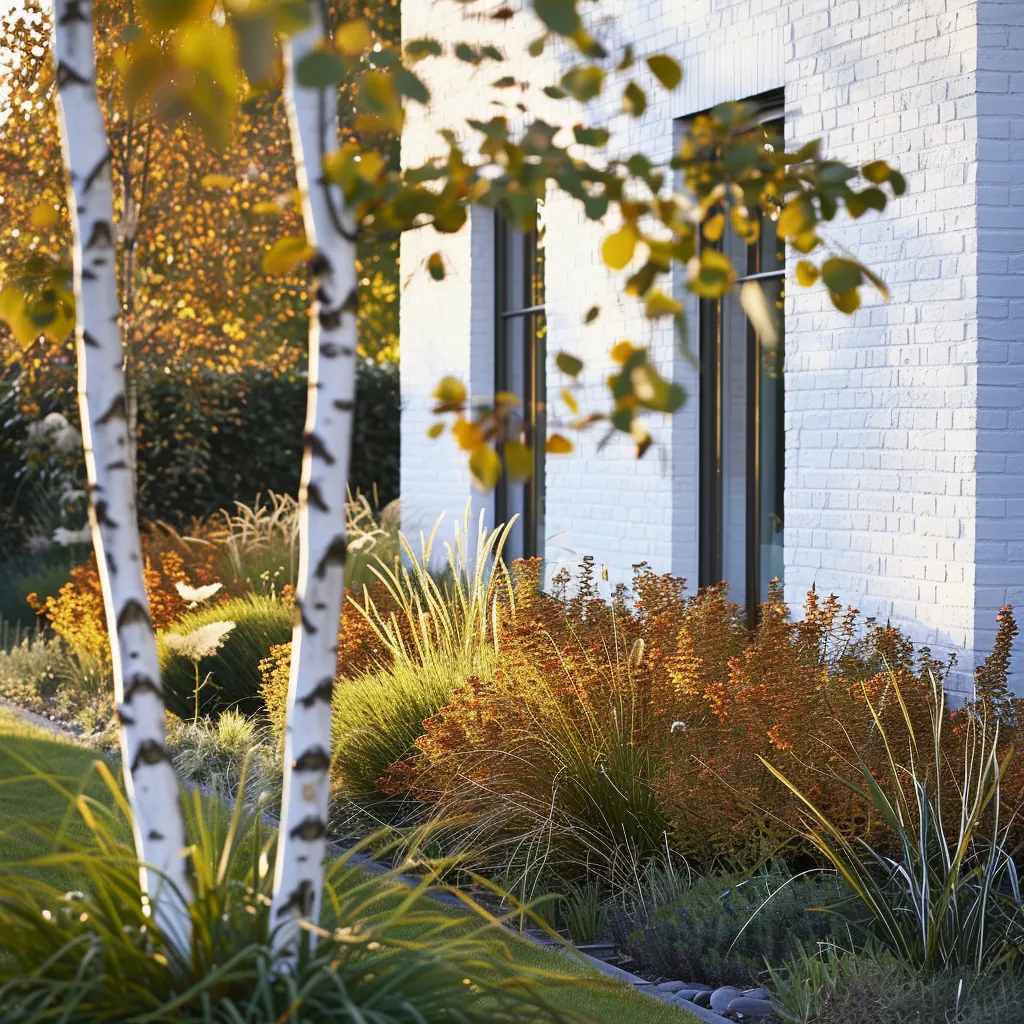
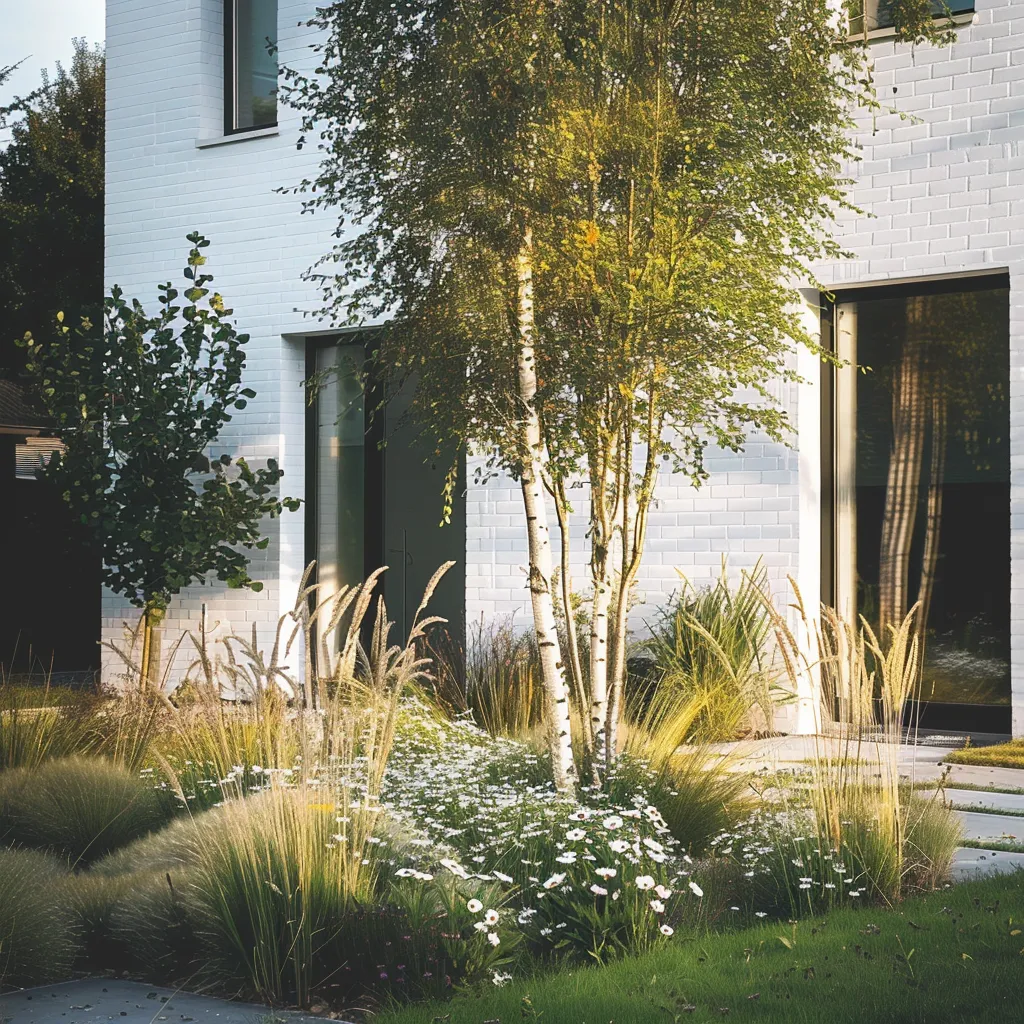
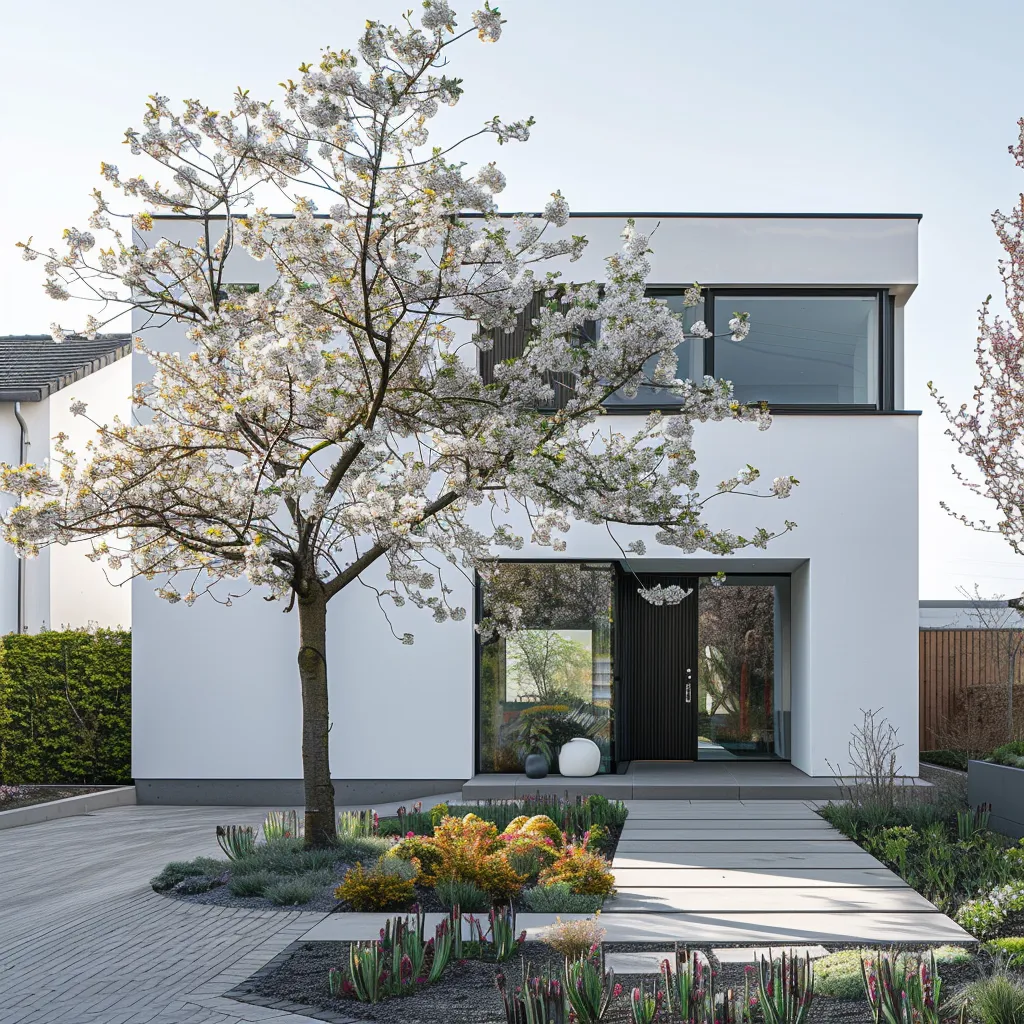
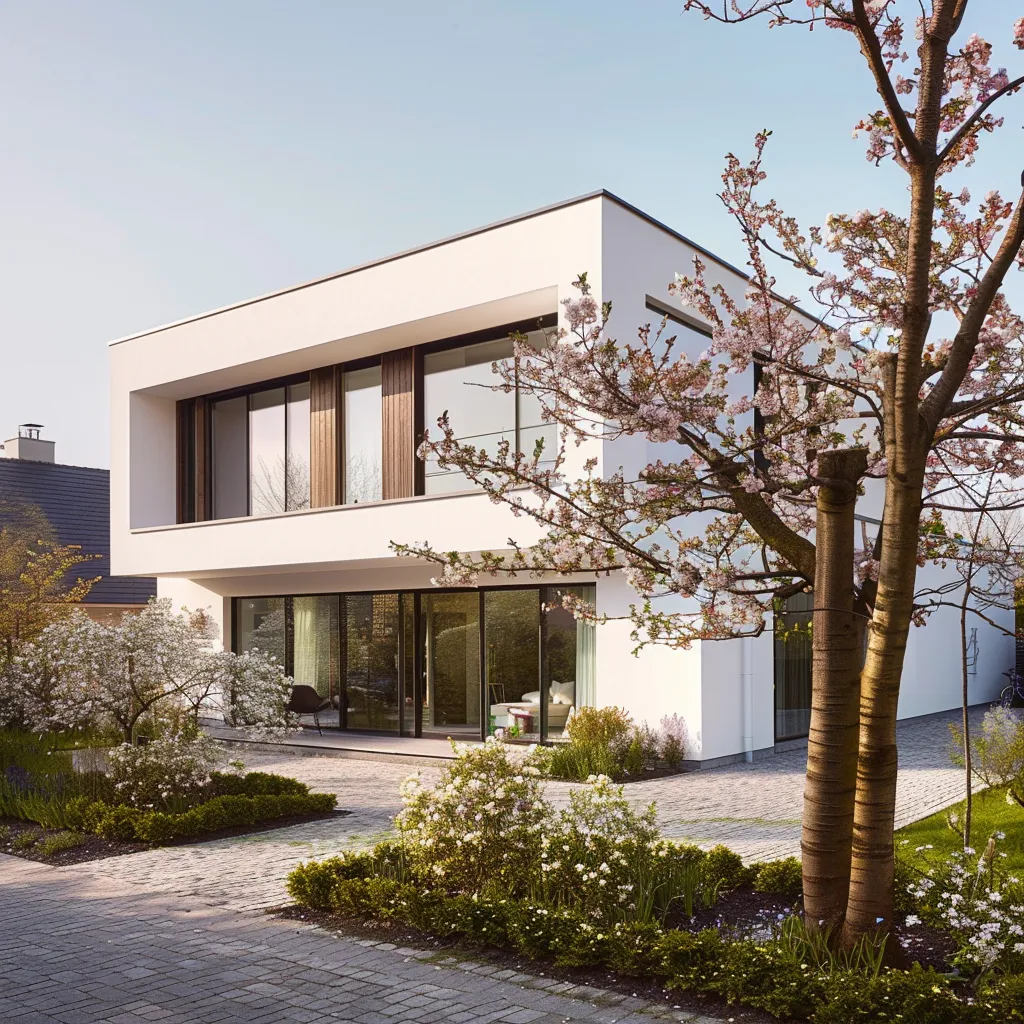
A functional planting scheme for a modern front garden typically operates across three layers. The structural layer — the tallest, slowest-changing element — consists of one or two specimen trees or large architectural shrubs positioned to frame the facade rather than obscure it. Multi-stem specimens such as Betula utilis var. jacquemontii (Himalayan birch) or Amelanchier lamarckii (snowy mespilus) are consistently popular in contemporary front garden design because their open canopies frame the building behind them without blocking facade views. A survey of 420 UK garden designers by Garden Design Journal in 2024 found that multi-stem specimens appeared in 67% of awarded contemporary front garden projects.
The mid-layer — typically 0.6–1.5 metres — carries the seasonal interest and colour variation. This is where perennials, grasses, and structural shrubs such as Pittosporum tobira, Choisya ‘Aztec Pearl’, or Sarcococca confusa create texture change through the year. The groundcover layer closes the composition at soil level, preventing the bare-ground gaps that immediately make a young garden look unfinished. Carex testacea, Stipa tenuissima, Ophiopogon planiscapus ‘Nigrescens’, or Epimedium cultivars are consistently effective in this role and require minimal maintenance once established.
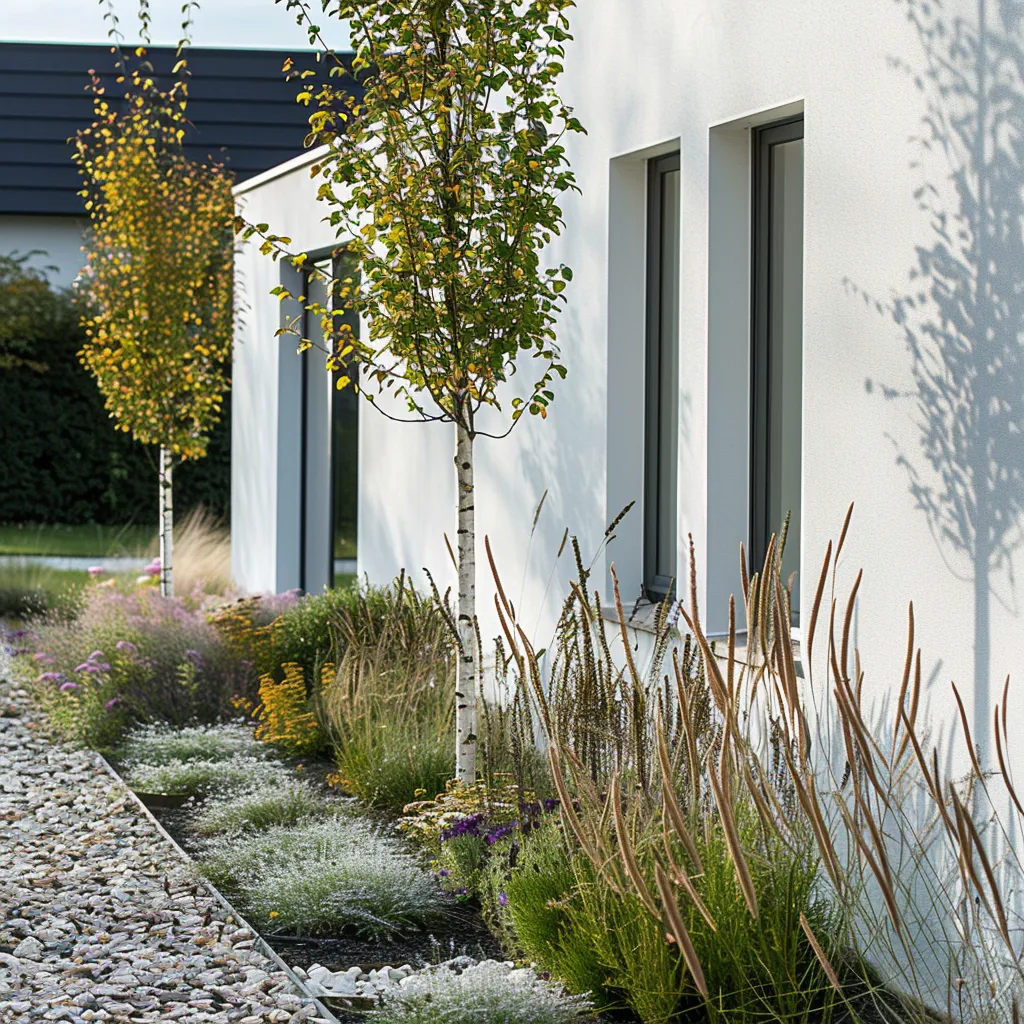
Colour Palette Strategy for Modern Front Garden Planting
Colour in front garden planting operates differently from colour in a back garden or interior space. From the street, the viewer sees the composition quickly and at a distance — there is rarely time to appreciate subtle tonal variation. Schemes that work from 10 metres share one characteristic: they use a limited palette with deliberate contrast, rather than a broad range of mixed colours that read as busy from a distance.
For homes with dark or neutral facades, a foliage-led palette with restrained flower colour is almost universally more effective than a flower-first approach. Foliage provides 12-month structure; flowers provide a maximum of 8–10 weeks of peak impact per species before the scheme reverts to its framework. Combining dark-leaved species such as Sambucus nigra ‘Black Lace’, Cotinus ‘Grace’, or Ophiopogon planiscapus ‘Nigrescens’ with silver-grey foliage (Stachys byzantina, Artemisia ‘Powis Castle’, or Festuca glauca) creates strong contrast that holds up year-round without relying on flower colour to carry the scheme.
When flower colour is included, the most successful contemporary front garden planting ideas typically work with one or two colours rather than the full spectrum. White and pale yellow reads as sophisticated and luminous against dark facades. Purple and blue reads as cool and architecturally serious. Warm reds and oranges create contrast against pale facades but can compete visually with terracotta or brick. The principle is not to avoid colour — it is to choose it with the same deliberateness you would apply to specifying a render tone or window frame finish.
Research from Wageningen University published in 2023 found that residential gardens using a monochromatic or analogous colour scheme were rated 34% higher for “visual coherence” by participants than those using triadic or fully mixed palettes — supporting what experienced garden designers have long practised intuitively.
Best Plants for Front Garden Planting Along a Modern House Facade
Plant selection for modern front gardens is governed by three criteria that rarely apply equally to back garden planting: it must look good year-round because it is always visible, it must work with low maintenance because front gardens rarely receive the attention of more private spaces, and it must scale appropriately to the facade it fronts so that planting proportions feel intentional rather than accidental.
The following species consistently appear in award-winning and published contemporary front garden schemes because they satisfy all three criteria reliably. These are organised by layer, with approximate mature dimensions noted for planning purposes.
| Plant | Layer | Mature Height | Best Facade Pairing | Key Feature |
|---|---|---|---|---|
| Betula utilis var. jacquemontii (multi-stem) | Structural | 6–10 m | Dark render, black cladding | White bark year-round, light canopy |
| Amelanchier lamarckii (multi-stem) | Structural | 4–6 m | Pale render, timber | Spring blossom, autumn colour |
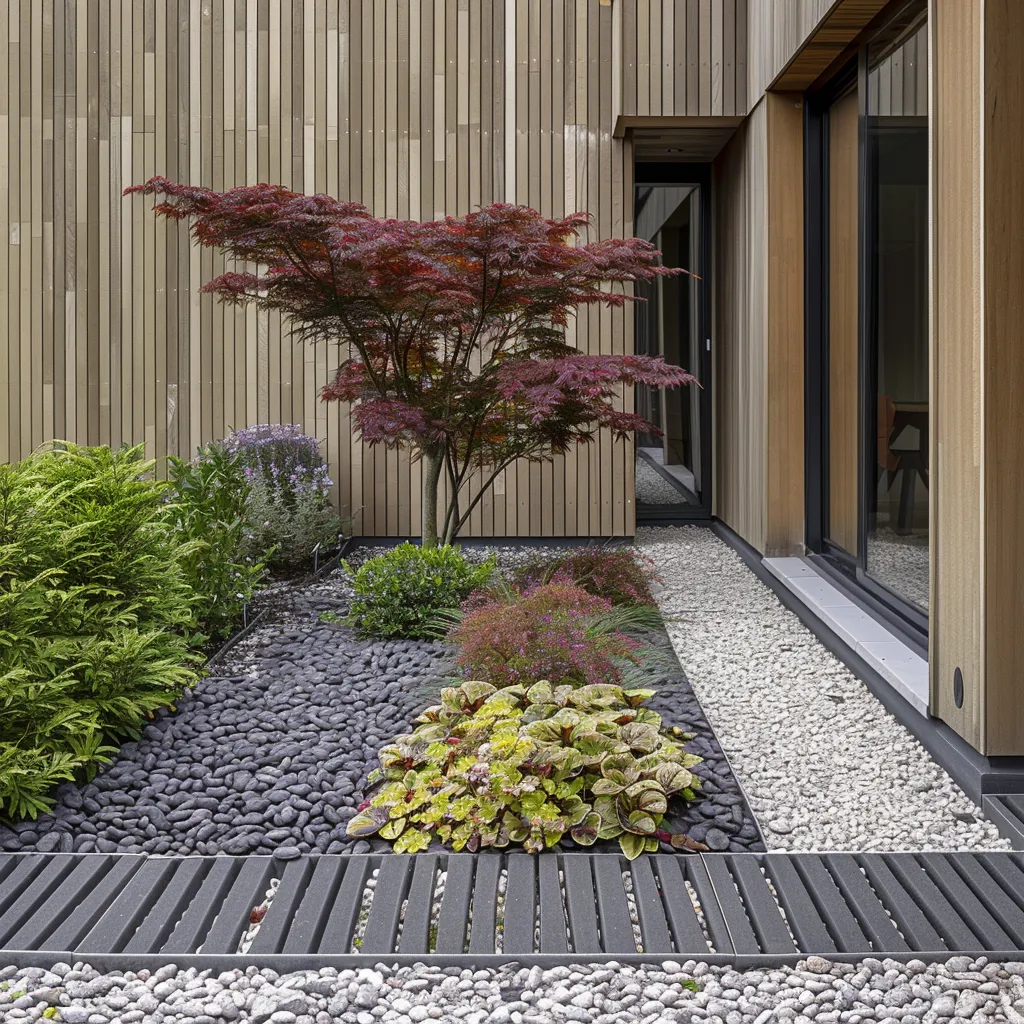
| Acer palmatum ‘Bloodgood’ | Structural / mid | 3–4 m | White render, concrete | Deep red foliage March–November |
| Pittosporum tobira ‘Nanum’ | Mid | 0.8–1.2 m | All modern facades | Evergreen, fragrant spring flowers |
| Choisya ‘Aztec Pearl’ | Mid | 1–1.5 m | Dark render, anthracite | White flower spring and autumn |
| Sarcococca confusa | Mid | 0.8–1 m | Shaded north facades | Winter fragrance, glossy evergreen |
| Calamagrostis ‘Karl Foerster’ | Mid / accent | 1.2–1.8 m | Concrete, board-formed | Vertical accent, winter plume |
| Stipa tenuissima | Mid / ground | 0.4–0.6 m | All facades | Movement, soft texture, drought tolerant |
| Ophiopogon planiscapus ‘Nigrescens’ | Groundcover | 0.15–0.25 m | Pale render, white | Near-black strap foliage, evergreen |
| Carex testacea | Groundcover | 0.3–0.45 m | Timber, warm tones | Orange-bronze foliage year-round |
| Festuca glauca | Groundcover | 0.2–0.3 m | Dark or grey facades | Silver-blue, compact, very low maintenance |
| Epimedium ‘Amber Queen’ | Groundcover | 0.3 m | Shaded facades | Weed-suppressing, semi-evergreen |
One principle applies across all of these: odd-number groupings of three, five, or seven plants of the same species create a much more resolved planting composition than single specimens planted individually. This mirrors how plants grow in natural communities and reads as intentional rather than random from the street viewing distance.
Front Garden Planting Ideas for Specific Modern House Facade Types
The following approaches are drawn from widely published contemporary residential projects and reflect both aesthetic and practical performance over multiple growing seasons.
Dark Render and Anthracite Frame Facades
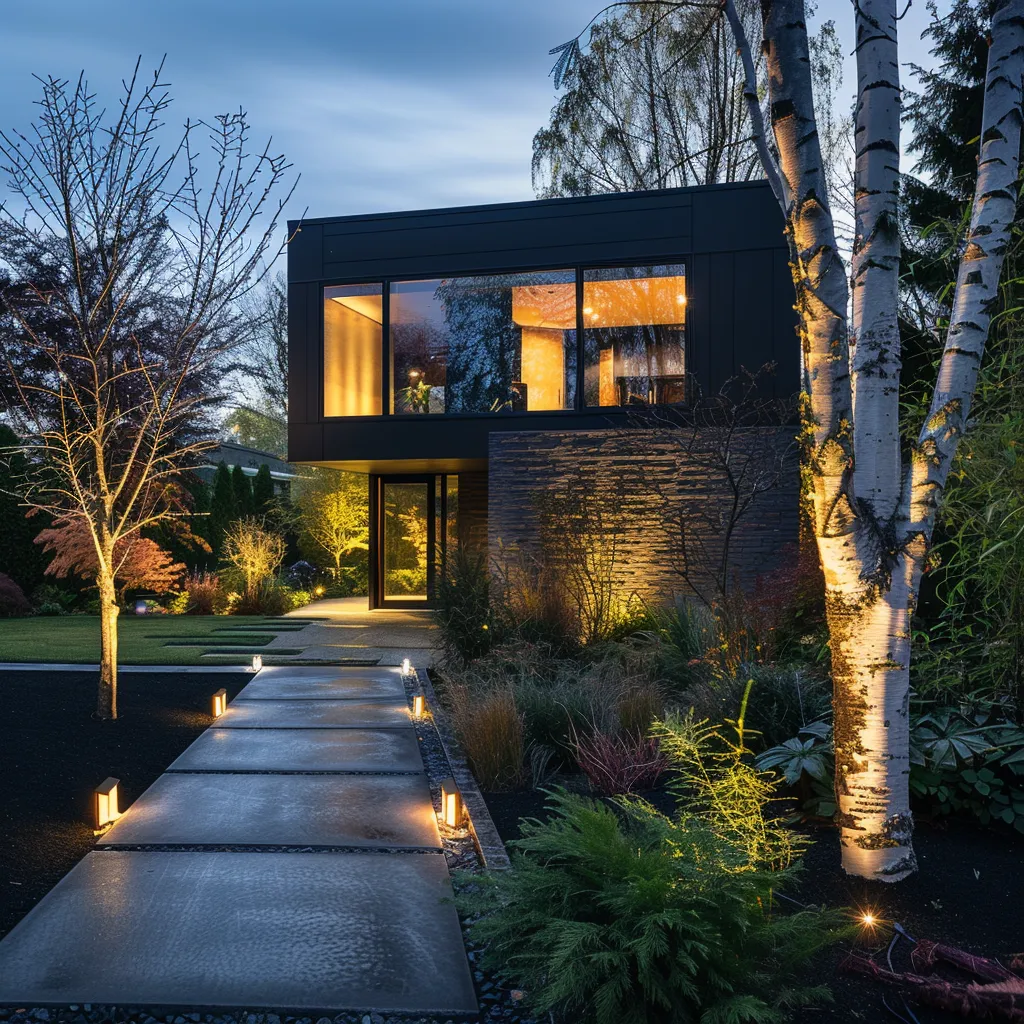
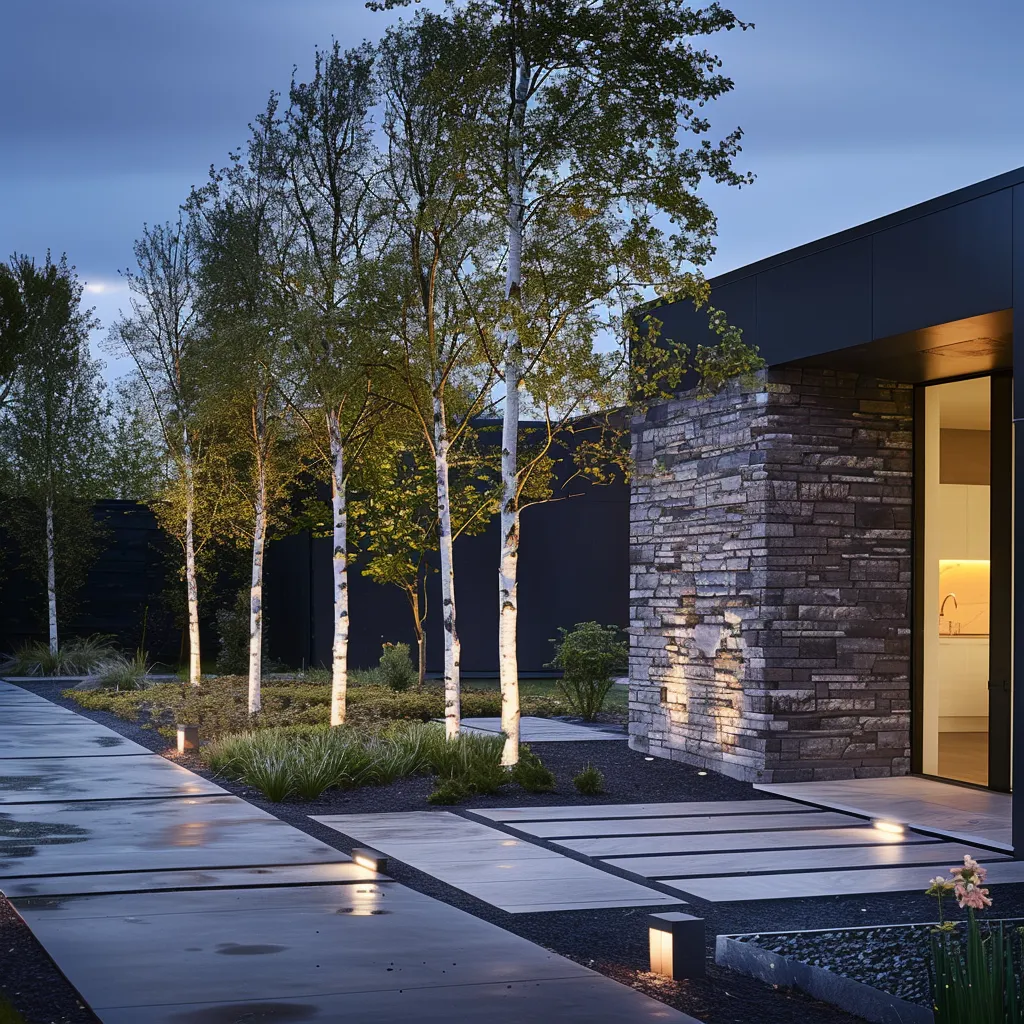
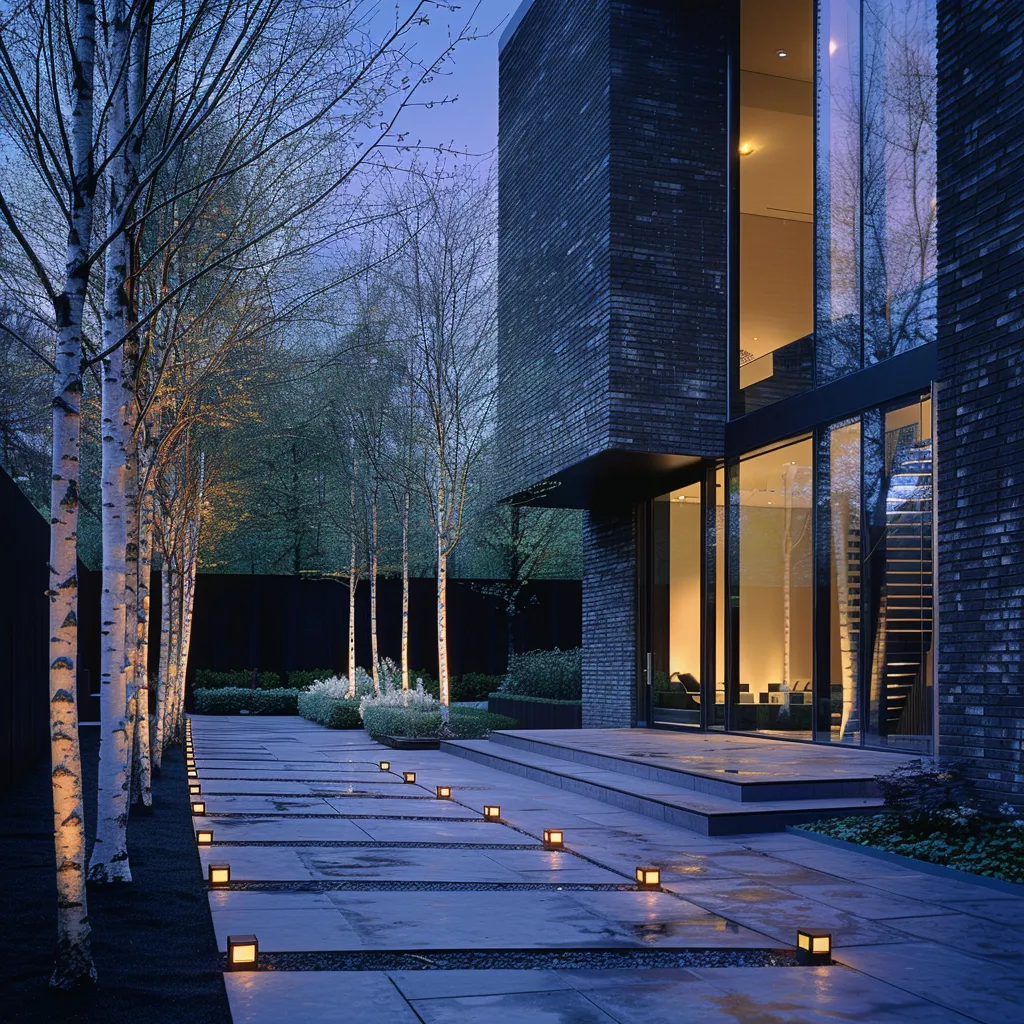
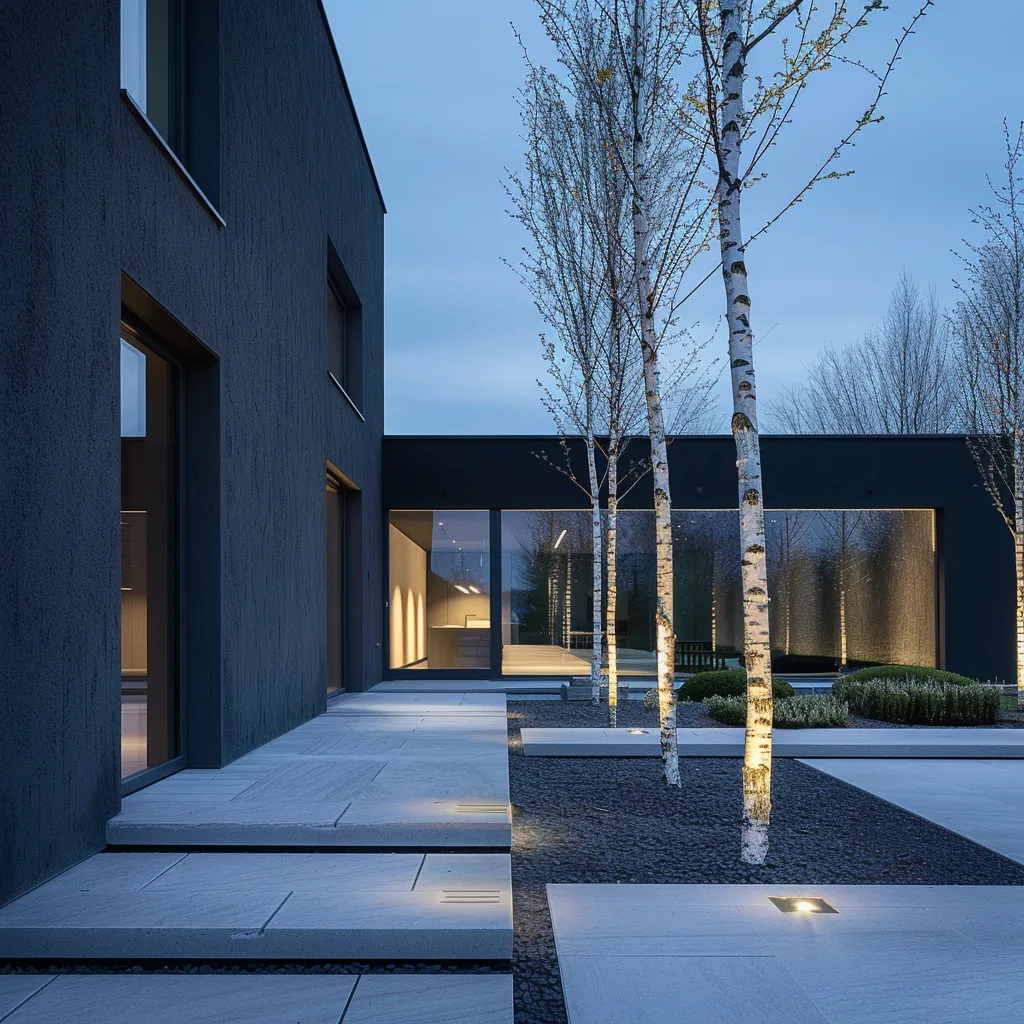
This facade type — increasingly dominant in new-build contemporary residential design — creates a near-monochrome canvas that rewards contrast planting. White-barked specimens such as multi-stem birch provide the strongest visual counterpoint because the bark remains visible and impactful through every season, including the eight months of the year when deciduous canopy is absent or reduced. Underplanting with silver grasses such as Festuca glauca or Stipa tenuissima continues the pale-on-dark logic at groundcover level. A single mid-layer planting of Choisya ‘Aztec Pearl’ — white-flowered, evergreen, and naturally dense — completes a three-layer scheme that requires only one or two maintenance visits per year.
Avoid: busy mixed planting, warm orange or red tones, and clipped geometric topiary in traditional forms (domes, cones) which read as period rather than contemporary against a dark modern facade.
White and Pale Render Facades
Pale facades reflect rather than absorb light, which means planting alongside them benefits from darker, denser foliage to provide grounding contrast. Dark-leaved shrubs such as Pittosporum ‘Tom Thumb’, Cotinus ‘Grace’, or Euonymus ‘Green Spire’ carry enough visual weight to anchor a pale facade without over-complicating the composition. The near-black strap-leaved Ophiopogon planiscapus ‘Nigrescens’ is particularly effective as a groundcover here — it reads as a deliberate design choice rather than a standard planting, and its extreme contrast with pale gravel or white render gives it a graphic quality that photographs exceptionally well.
If flowering species are included, purple-toned options (Salvia nemorosa ‘Caradonna’, Agapanthus ‘Black Buddhist’, Allium ‘Purple Sensation’) provide sufficient contrast to read clearly against white render without the competing brightness that warm-coloured flowers create.
Timber Cladding Facades
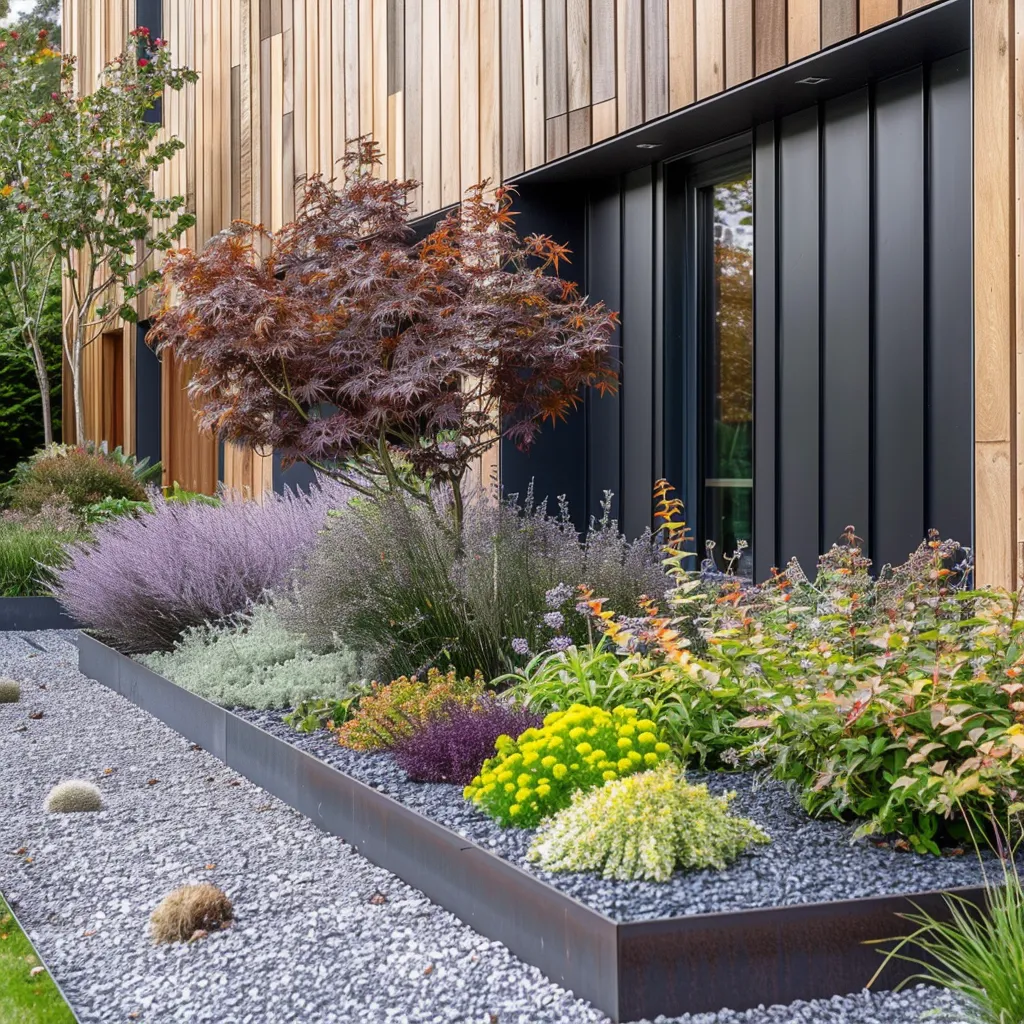
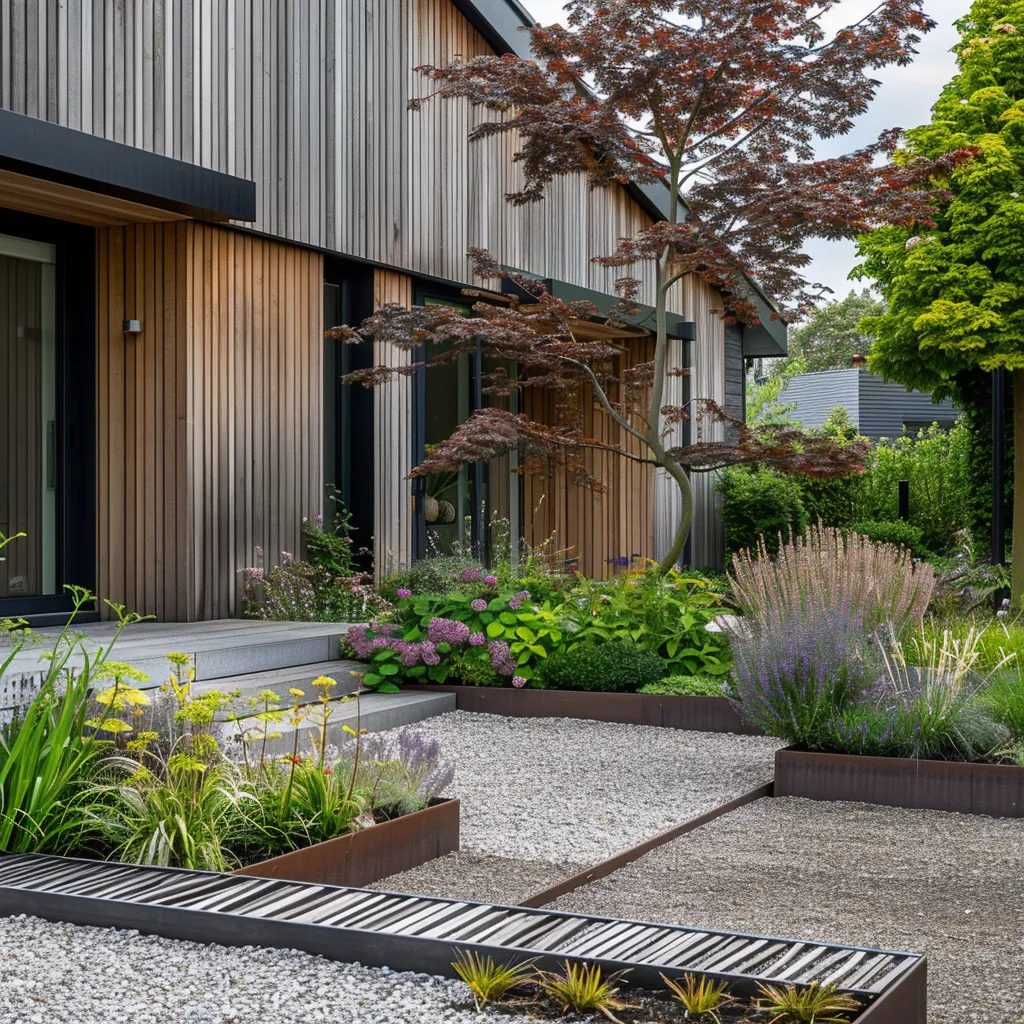
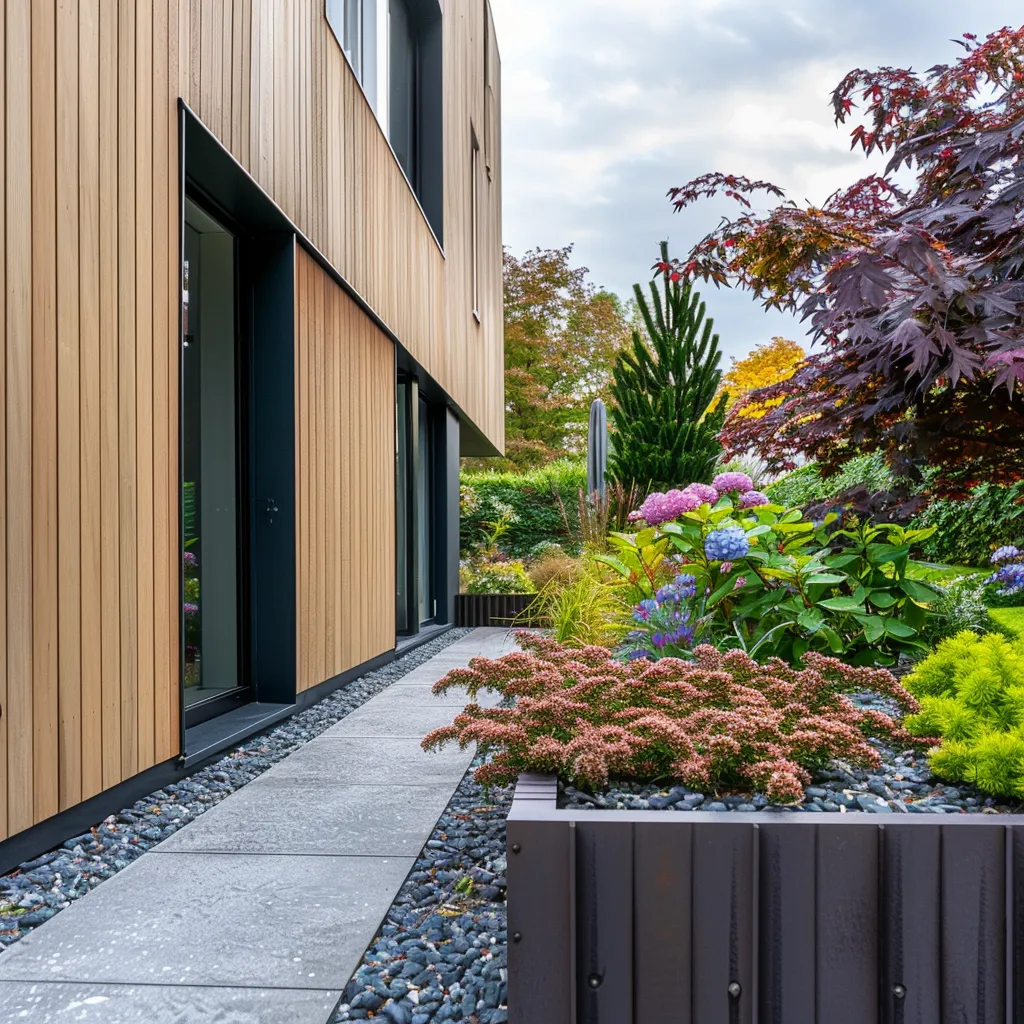
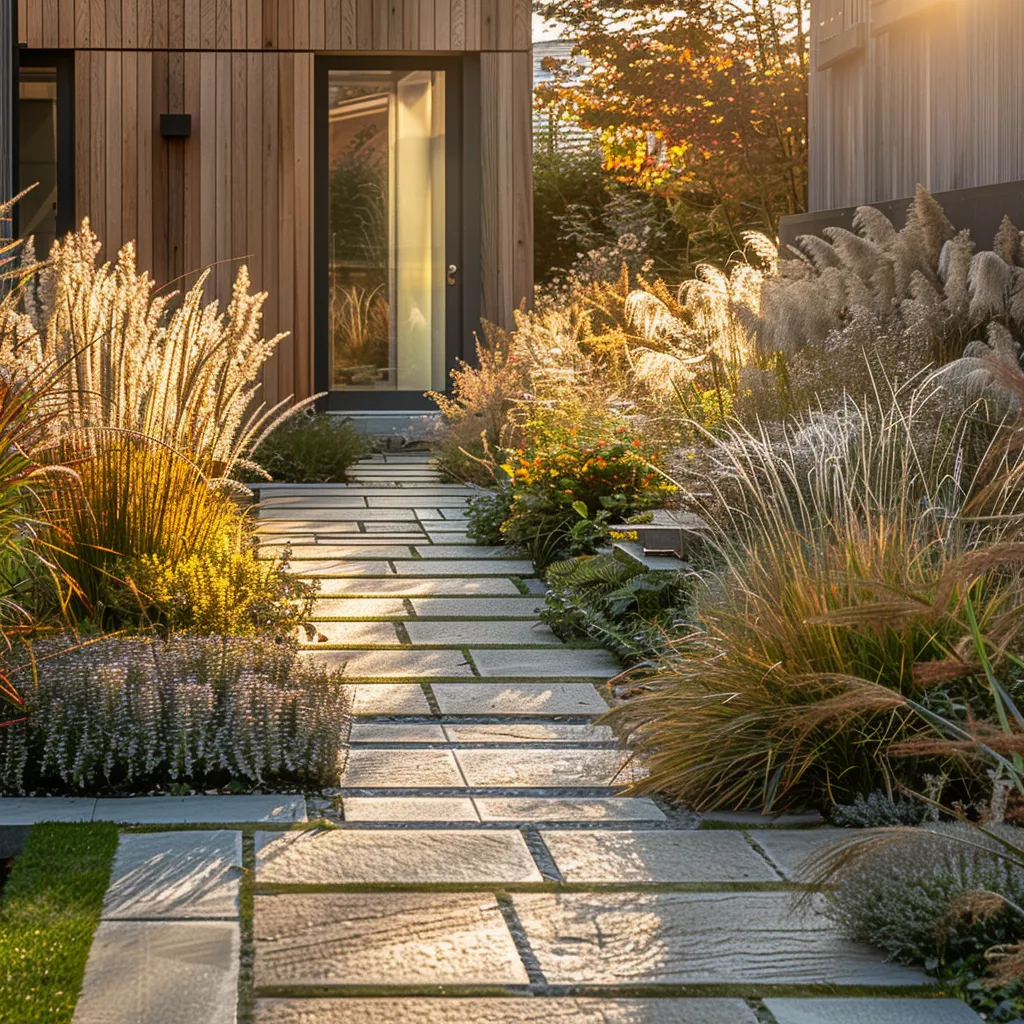
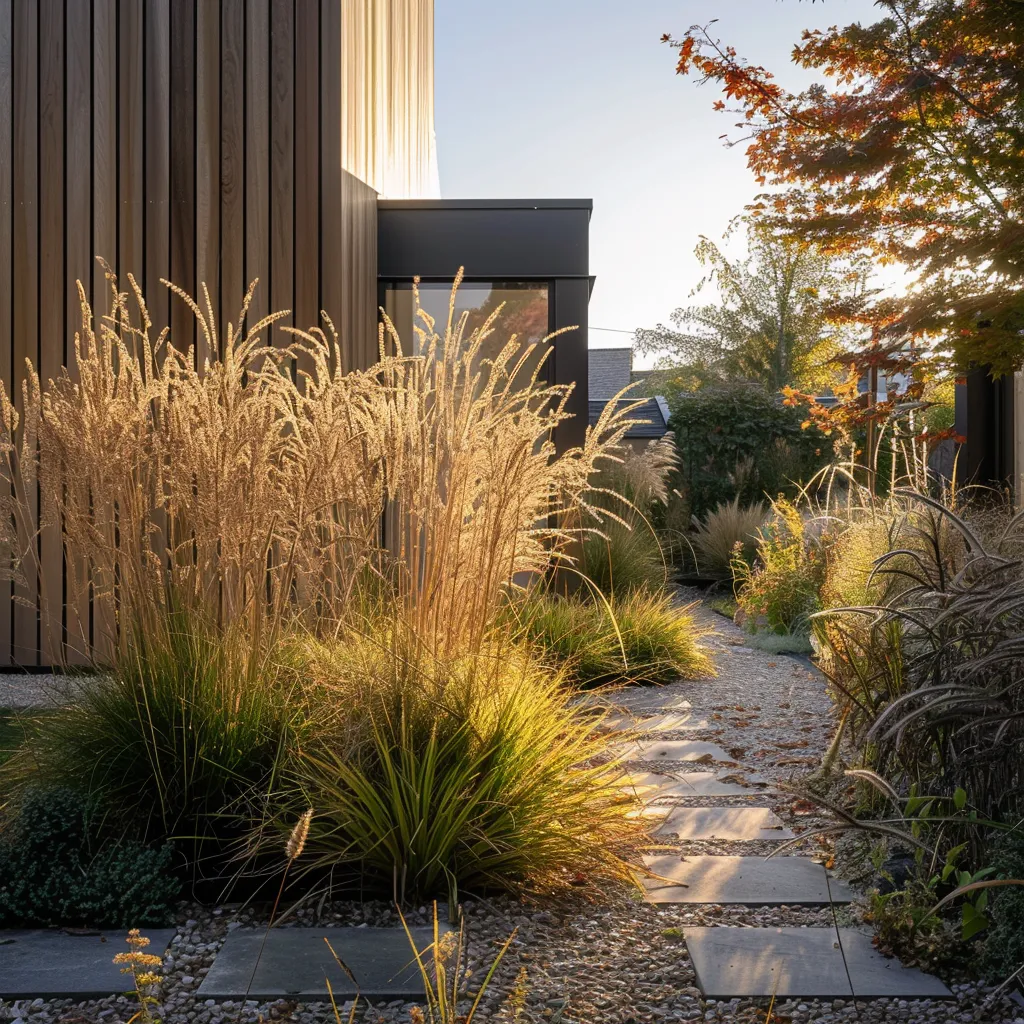
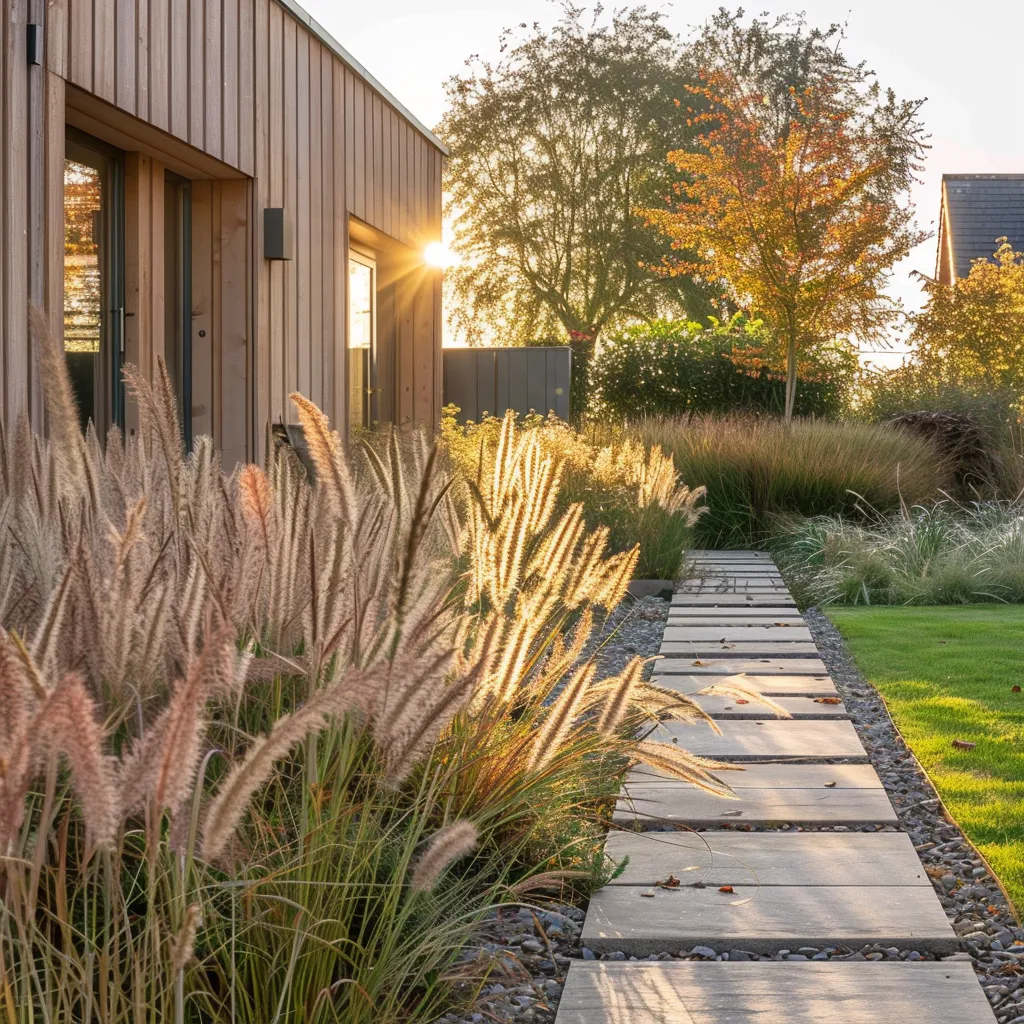
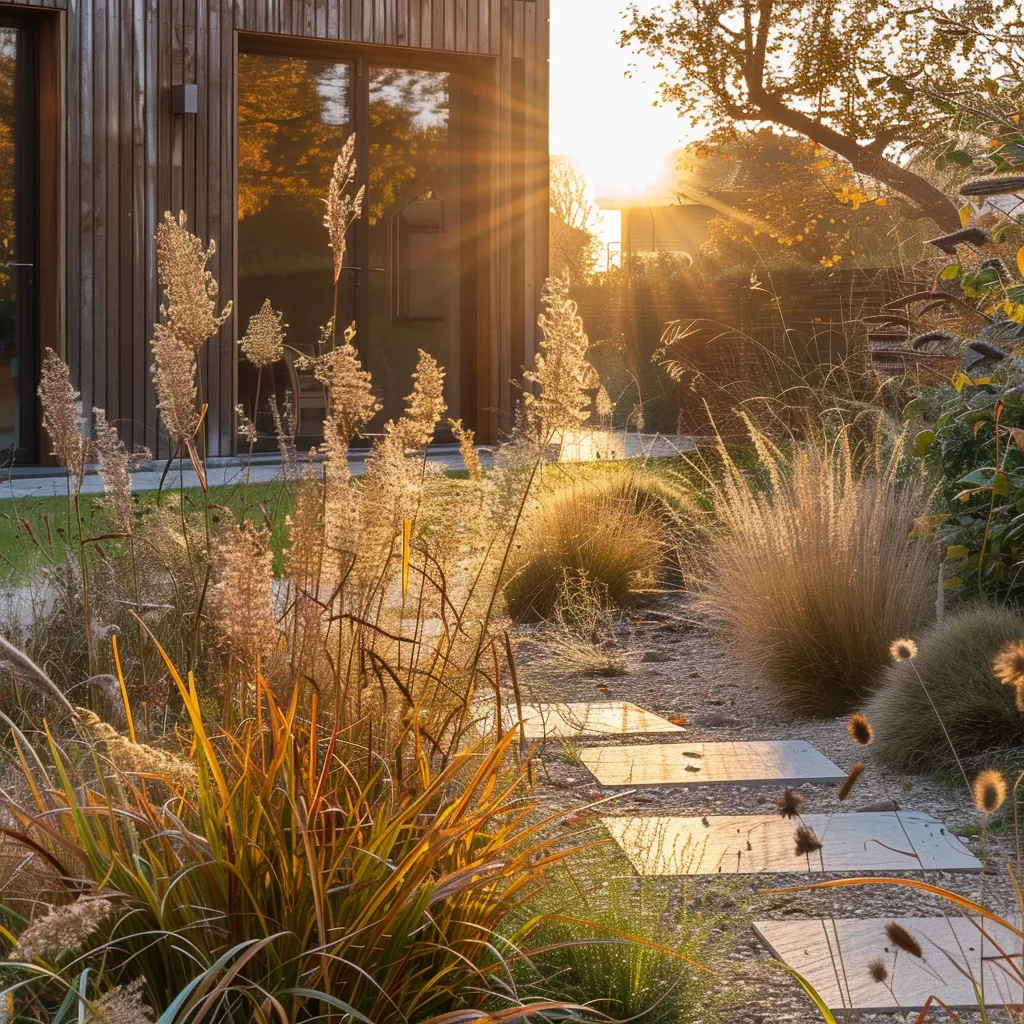
Cedar, larch, and thermowood facades introduce warm grain and natural texture that rewards planting with an equally organic quality. The strongest front garden planting ideas for timber-clad houses lean into loose, naturalistic forms rather than clipped geometric structures. Grasses with movement — Stipa gigantea, Pennisetum alopecuroides, Deschampsia cespitosa — echo the vertical linear grain of cladding while adding seasonal change. Deciduous shrubs with good autumn colour (Fothergilla major, Enkianthus campanulatus, Acer palmatum ‘Sango-kaku’) mirror the changing tones of weathering timber and read as deliberately coordinated rather than coincidentally matched.
If timber cladding is used with a dark stain rather than natural silver-grey weathering, treat it more like a dark render facade and apply contrast planting logic accordingly.
The Role of Hard Landscaping in Front Garden Planting Design
Planting does not exist in isolation in a front garden. The materials used for paths, edging, and boundary definition are as much a part of the visual composition as the plants themselves — and in a well-resolved modern front garden, the two systems are coordinated from the beginning of the design process rather than added sequentially.
Path material is the most visible hard landscaping element and should reinforce rather than contradict the facade. Polished or bush-hammered concrete paths read as contemporary and coordinate naturally with render or concrete facades. Large-format porcelain or natural stone pavers in grey or anthracite tones work with almost every modern facade palette. Warm sandstone or buff limestone reads as transitional and can anchor pale render or timber without reading as period in the way that red brick or terra cotta would.
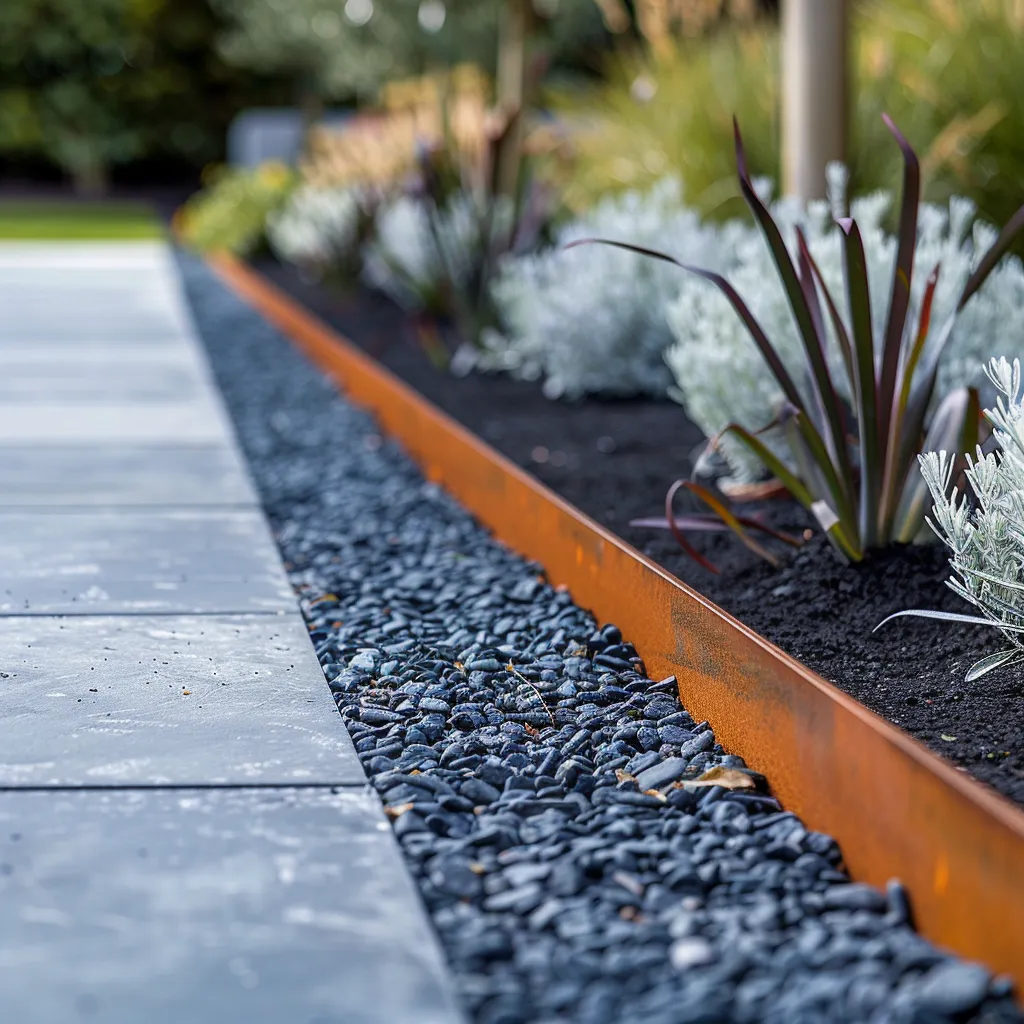
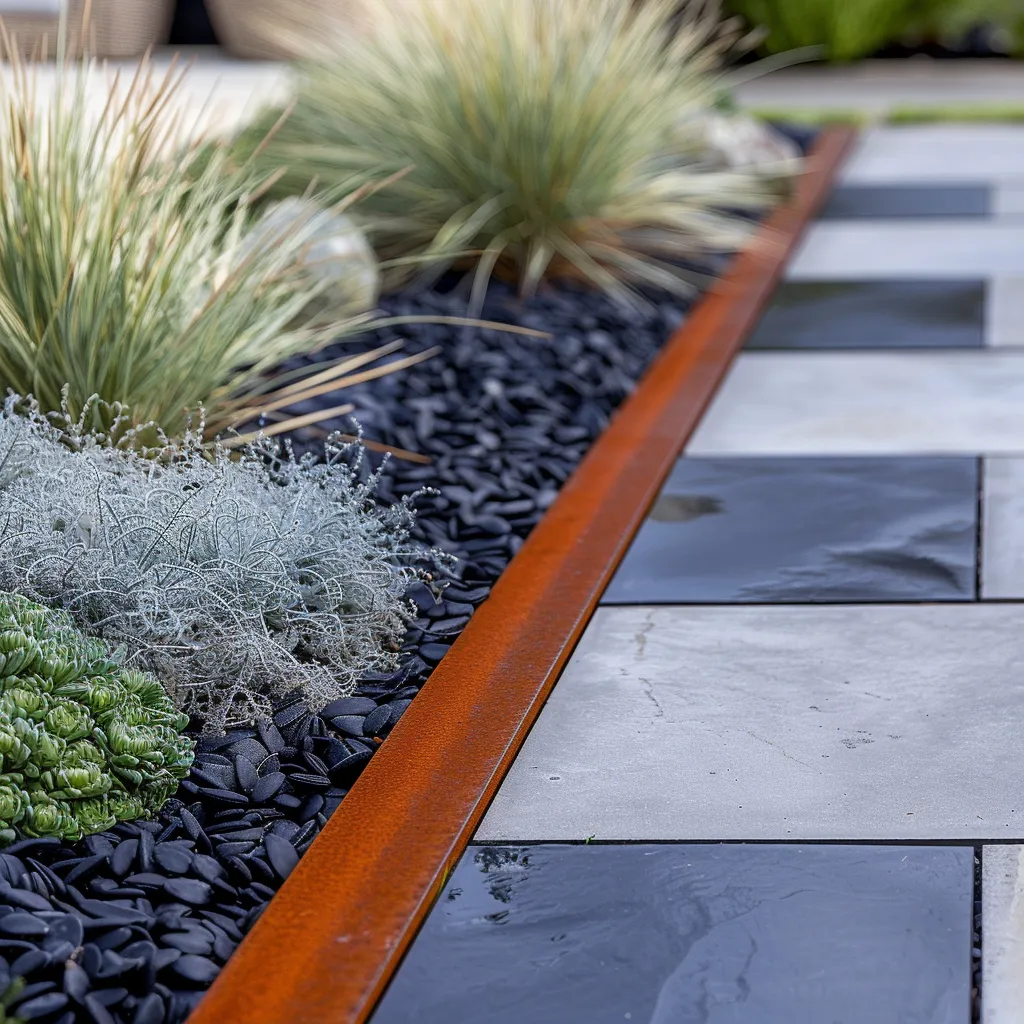
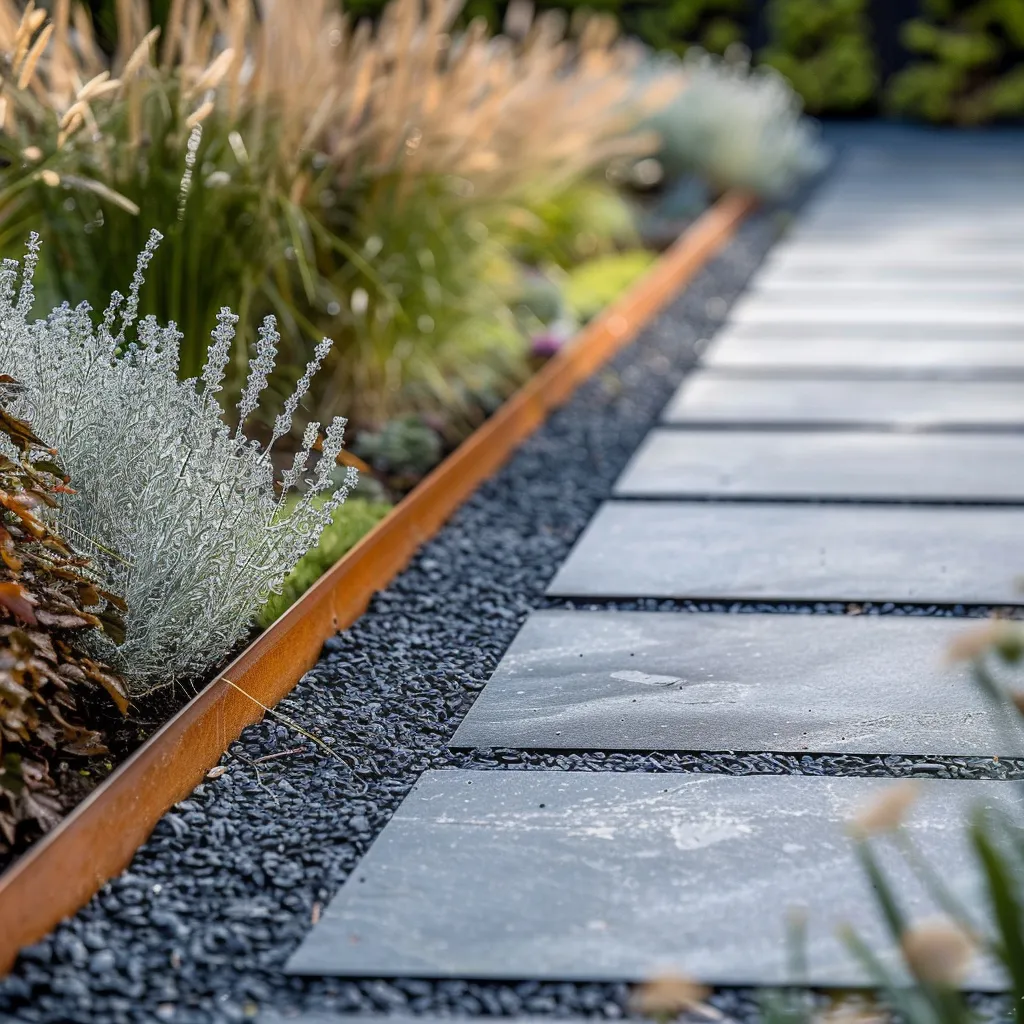
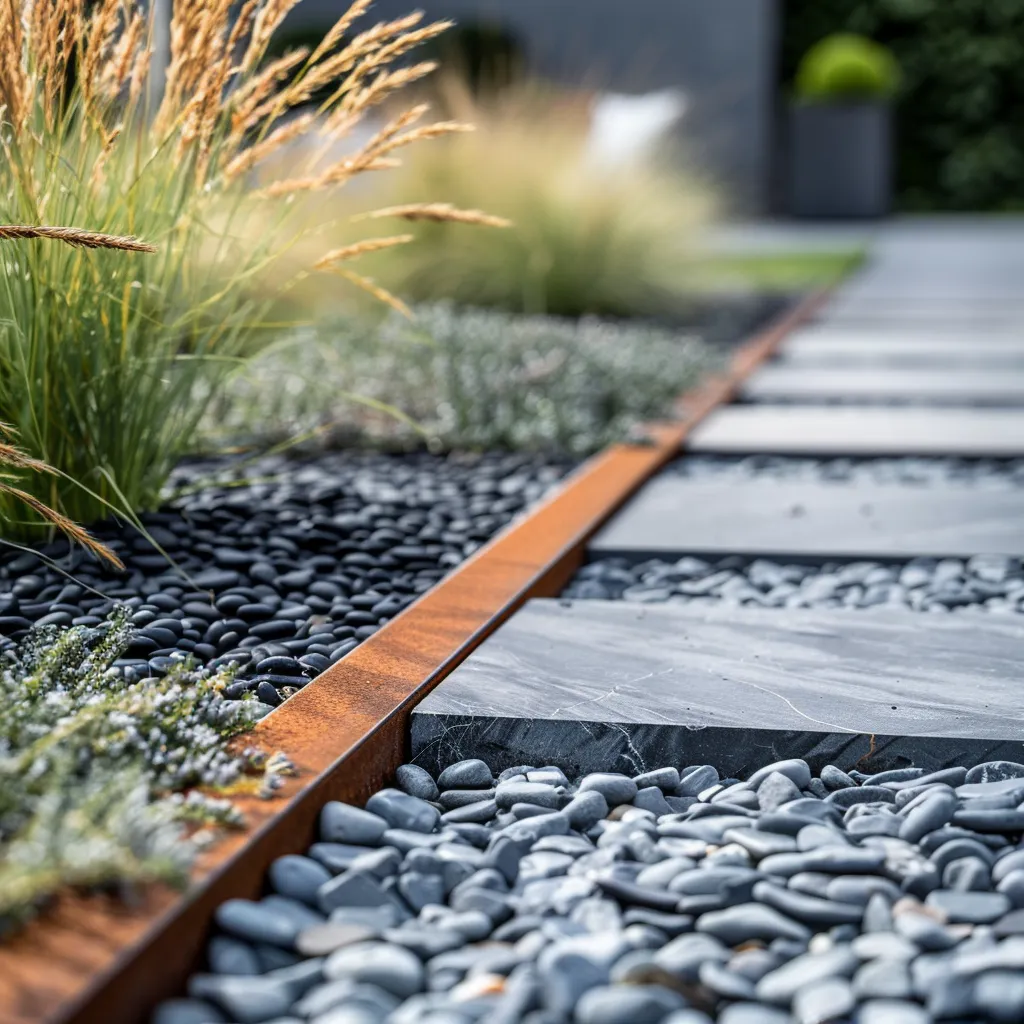
Steel edging strips are one of the most consistently effective details in modern front garden planting design. A 3–5mm powder-coated steel strip between planted borders and gravel mulch or paving creates a crisp line that communicates a designed, maintained intention even when plants are young. This detail alone shifts a planting scheme from looking domestic and approximate to looking professionally resolved. Corten steel edging introduces warm oxidised colour that coordinates particularly well with timber cladding and dark gravel mulches. For a broader perspective on how architectural boundaries shape garden design, the approach to modern front garden brick wall design explores how vertical boundary elements interact with facade and planting in equal measure.
Mulch choice deserves equal consideration. Dark slate chipping, black basalt gravel, or dark washed pebble mulches coordinate visually with anthracite and dark render and reduce weed pressure significantly — one study from the University of Reading found that a 75mm gravel mulch layer reduced weed germination by 78% over a three-year monitoring period compared to bare soil. White or pale grey gravel reads as cleaner and more contemporary against dark render but shows debris more readily. The choice is aesthetic and maintenance-contextual in equal measure.
Low-Maintenance Front Garden Planting Ideas That Still Look Designed
Low maintenance in a front garden context means something specific: a planting scheme that requires no more than two or three focused maintenance sessions per year — typically late winter cut-back, early summer edging, and autumn tidying — while remaining visually coherent through 12 months of changing weather and seasonal growth cycles. This is achievable, but it requires deliberate species selection upfront rather than retrofitting maintenance convenience onto a scheme that was designed for aesthetic reasons alone.
The key principles are: evergreen dominance (60–70% of the planting by volume), species that do not require staking or regular deadheading to look neat, and groundcover density that closes out weed pressure without annual replanting. Sarcococca, Pittosporum, Choisya, Viburnum davidii, and Euonymus japonicus cultivars are the workhorses of low-maintenance modern front garden schemes because they satisfy all three criteria simultaneously.
Deciduous species can and should be included for seasonal interest, but they should represent the minority of the planting so that the scheme retains structure when they are bare. A single deciduous specimen tree with evergreen underplanting is almost always more successful than multiple deciduous species at mixed heights, which creates a scheme that looks stripped and unresolved from November to March.
The relationship between water use, drought tolerance, and long-term maintenance is increasingly significant as summer temperatures in temperate climates shift. Many of the most effective low-maintenance front garden plants — ornamental grasses, Mediterranean-origin shrubs, and silver-leaved perennials — are also inherently drought tolerant once established. For deeper guidance on managing water use without sacrificing plant health or visual quality, the approach to conserving water while keeping plants healthy covers establishment strategies that significantly reduce first-year irrigation requirements.
Front Garden Planting Scale and Proportion Against the Facade
One of the most common errors in residential front garden planting is misjudging scale. A planting scheme that looks appropriately proportioned in the first two or three growing seasons can obscure windows, encroach on paths, or simply overwhelm a modestly sized facade within five to seven years if mature plant dimensions were not factored into the original design. This is not a failure of maintenance — it is a design failure that maintenance cannot easily correct without destroying the character of the scheme.
The guiding principle for front garden planting is that specimen trees or tall shrubs should reach a maximum height of approximately two-thirds of the facade height at maturity. For a standard two-storey house with an approximately 6-metre facade, this means structural planting should peak at around 4 metres — exactly the range where multi-stem Amelanchier, Japanese maples, and Aralia elata sit naturally. For single-storey extensions or ground-floor-only frontages, this reduces further, and mid-layer planting becomes the structural emphasis rather than canopy trees.
Width proportion matters as much as height. Front garden borders that are narrower than approximately one-third of the overall width of the frontage look incidental rather than designed. A narrow bed planted even beautifully will not hold visual weight against a broad facade. Where space is genuinely limited — an urban semi-detached with a 3-metre frontage, for example — the most successful approach is to commit the full available width to planting rather than compromising on border width. Vertical garden systems for small spaces offer a complementary approach when horizontal planting depth is genuinely insufficient to achieve the layering described above.
Seasonal Performance Planning for Modern Front Garden Planting
A front garden that peaks in June and declines to bare soil and twigs by October has failed as a design, regardless of how good it looked at its best. Designing for year-round visual performance is a discipline that requires thinking in seasonal sequences rather than in species lists. The question is not “what should I plant?” but “what should be visible and interesting in this front garden in February, in May, in August, and in November?”
Winter is where most residential front garden planting schemes fail. The solution is structural: bark texture, evergreen form, dried seed heads, and berry colour are the tools that carry a winter garden. Betula bark, Cornus stem colour, Sarcococca winter fragrance, Viburnum tinus winter flower, and the persistent plumes of grasses such as Calamagrostis ‘Karl Foerster’ or Miscanthus sinensis ‘Silberfeder’ create a front garden that reads as composed even in January. Planning these elements first — before adding spring and summer interest — produces a scheme that performs across 12 months rather than eight.
Spring interest should be delivered by species already included for other reasons where possible: Amelanchier provides blossom without requiring a dedicated spring-flowering-only plant, Choisya ‘Aztec Pearl’ flowers in spring and again in autumn, and bulbs such as Allium hollandicum or Tulipa ‘Queen of Night’ can be added in small quantities as a seasonal accent without constituting a significant part of the scheme. This restraint is what separates contemporary front garden planting from traditional cottage or mixed border planting — the scheme is never dependent on any single seasonal display to hold visual quality.
For a comprehensive treatment of how low-maintenance perennial species can provide seasonal continuity throughout the year with minimal intervention, the analysis of low-maintenance perennial gardens applies directly to the front garden context with specific plant recommendations and planting densities.
Lighting as the Final Layer in Modern Front Garden Planting Design
Lighting transforms a front garden from a daytime feature to a 24-hour architectural element. For modern house facades — especially those with dark render or dark cladding — well-placed low-voltage lighting can make the front garden as visually compelling at 9pm in November as it is at midday in June. This is not a minor detail: in northern European latitudes, a house is experienced in the dark or low light for approximately five months of the year. An unlighted front garden on a dark facade simply disappears.
The most effective lighting approaches for modern front gardens use only two or three types of fixture rather than mixing multiple formats. Ground-level uplights positioned at the base of specimen trees to reveal bark texture and canopy structure create dramatic but elegant effects. Recessed path lights or flush-mounted paving markers provide wayfinding without drawing attention to themselves. A single well-aimed spotlight on the facade itself — not flood-lit, but precisely aimed at one architectural detail, a textured wall surface, or an entrance canopy — completes the composition. The standard for contemporary garden lighting is: no visible fixtures from the street, no colour temperature variation between fixtures (consistent 2700K warm white throughout), and no light pollution above horizontal.
Putting It Together — A Worked Front Garden Planting Example
To make the layering, scale, colour, and maintenance principles above concrete, the following scheme is offered as a worked example for a mid-terraced contemporary house with a dark render facade, an approximately 5-metre wide frontage, 2.5-metre depth to the front door, and a central concrete path.
The two planted beds on either side of the path — each approximately 1 metre wide by 2.5 metres long — carry the following planting: one multi-stem Betula utilis var. jacquemontii positioned in the left-hand bed at 0.5 metres from the facade to frame the facade from the street rather than obstruct it; three Choisya ‘Aztec Pearl’ as mid-layer evergreen shrubs in groups of three across both beds; five Stipa tenuissima as a groundcover accent at the front edge of both beds; and a continuous groundcover of Ophiopogon planiscapus ‘Nigrescens’ to close the soil surface and suppress weeds throughout. Steel edging separates the beds from a 20mm dark slate chipping mulch. The path is existing concrete, pressure-cleaned and sealed, with two recessed paving marker lights at 0.8m intervals. A single uplight at the birch base operates on a dusk-to-11pm timer.
This scheme requires: one plant order from a quality nursery, one day of installation, one annual late-winter cut-back of the Stipa, and one annual top-up of slate mulch. It delivers year-round visual structure, strong seasonal interest in spring (Choisya blossom), summer (Stipa movement), and winter (birch bark and lighting), and a front facade that reads as resolved from the moment of installation rather than at a five-year horizon. The total plant and material cost for this scheme at current UK nursery and trade pricing sits between £850 and £1,400 depending on specification grade — a return comfortably within the 5–12% property value uplift range documented by landscape architecture surveys.
Every design decision in a front garden — every plant, material, and light source — either reinforces the architecture behind it or competes with it. The ideas above provide a framework for making those decisions deliberately. The result is a front garden that does not need to be explained: it reads immediately as the right answer to the facade it fronts. For those extending this thinking into the wider garden, the principles underpinning contemporary garden design for modern homes show how front garden logic can be carried through to the full residential plot with consistency.