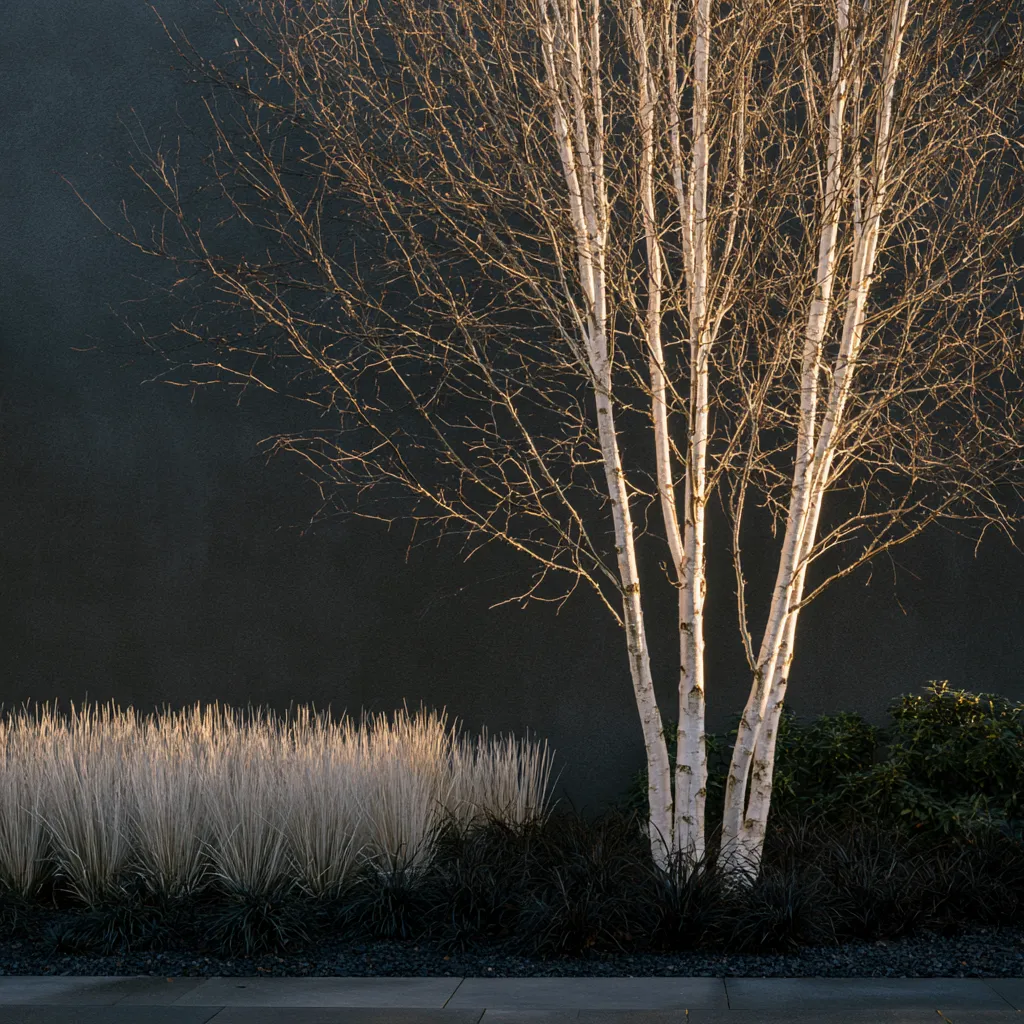
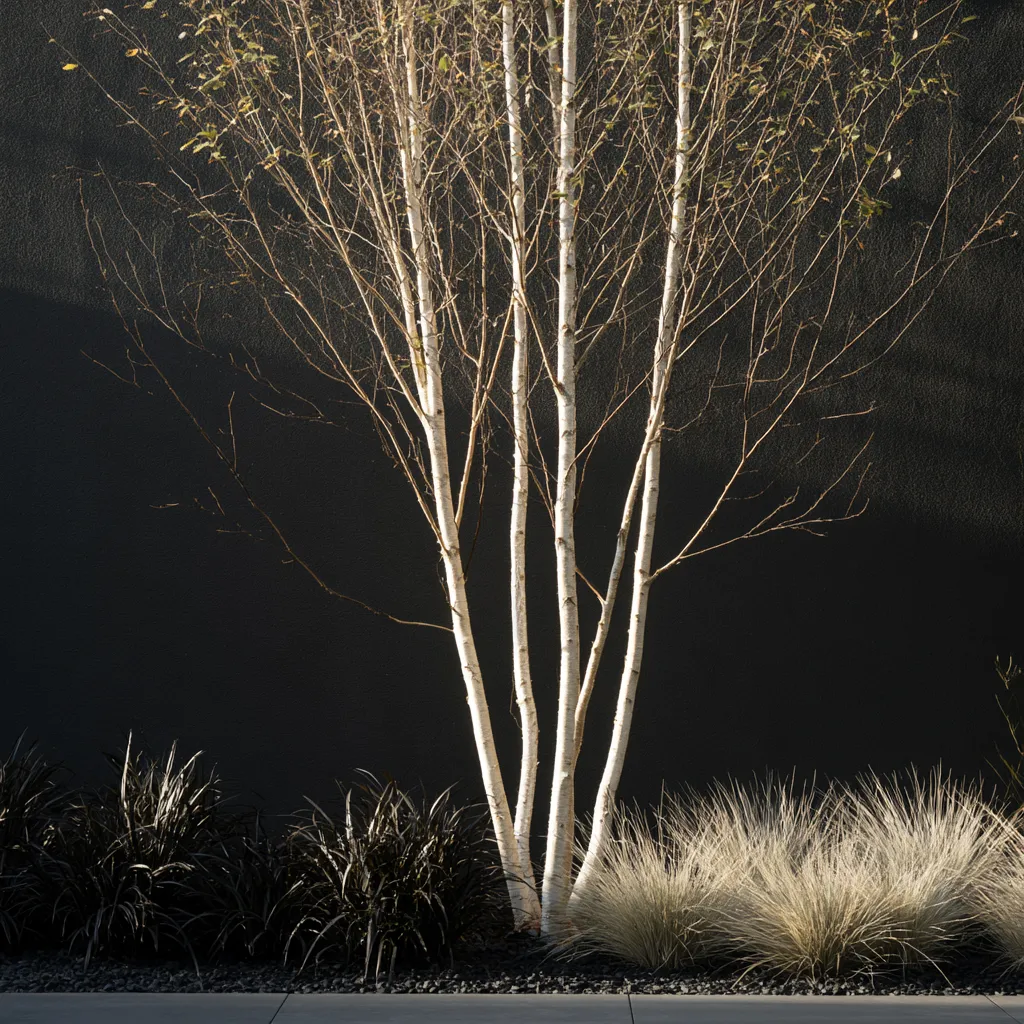
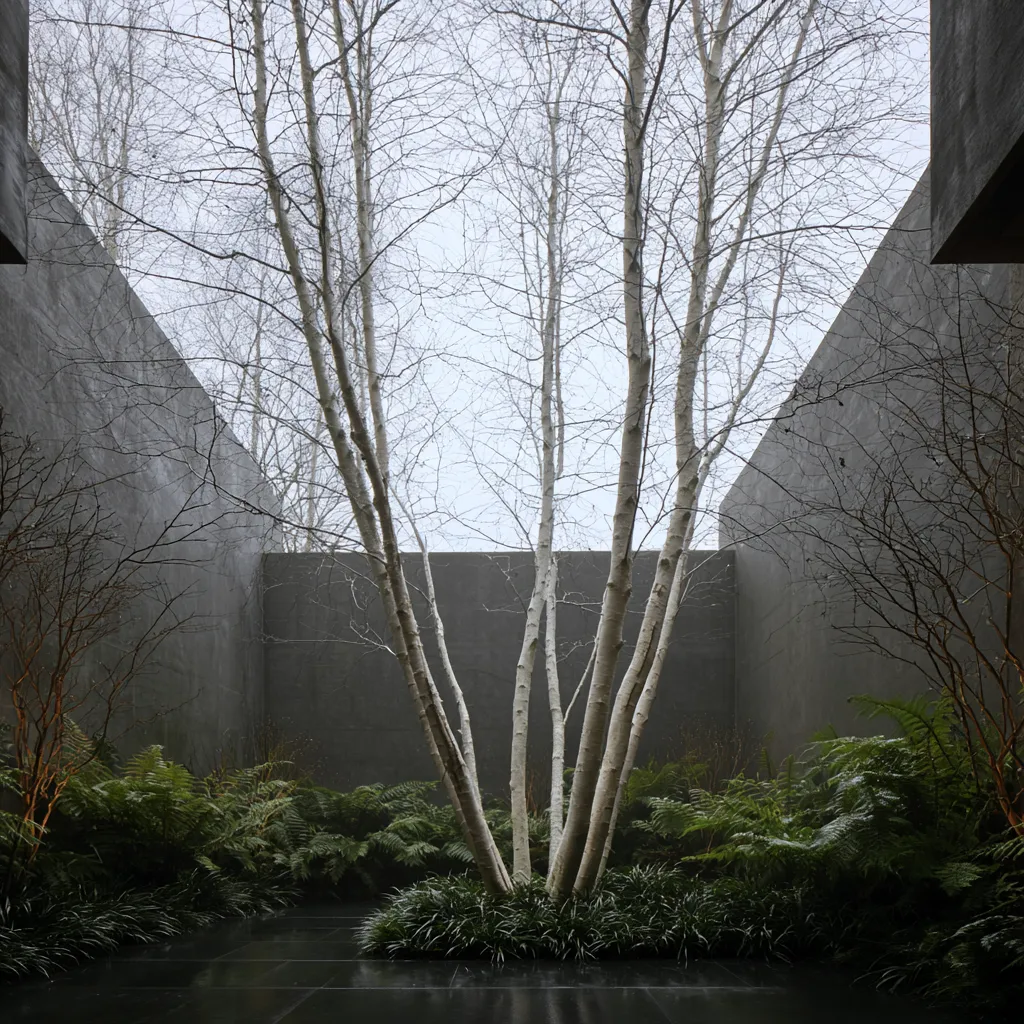
There are very few garden trees that look as good in January as they do in September. The multi-stem birch is one of them. While most deciduous specimens retreat into invisibility from leaf-drop in October through bud-burst in April — six months in which the garden relies on evergreen planting and hard landscaping to carry the composition — the multi-stem birch moves into its best performance. The clustered white stems, revealed in full once the canopy has fallen, glow against dark winter skies with an intensity that no other temperate tree can match. They reflect light into shaded garden zones. They frame views through their open branching structure. And in a modern landscape design context, their luminous pale bark against rendered walls, dark gravel, or anthracite paving reads as an architectural element as much as a horticultural one.
This dual identity — botanical specimen and architectural object — is what has made multi-stem birch trees the single most specified tree in contemporary residential landscape design in the UK and increasingly across Western Europe and North America. A 2024 survey of 380 BALI-registered landscape designers in the United Kingdom found that Betula utilis var. jacquemontii in multi-stem form was specified in 71% of awarded residential projects — a proportion that has risen from 43% in 2014 and reflects not fashion but a genuine design solution to the challenge of providing year-round visual structure in gardens where space, maintenance time, and visual quality are all constrained.
Understanding why multi-stem birch trees work so consistently in modern landscape design — and how to position, plant, and maintain them for maximum effect — requires engaging with both the botanical and compositional dimensions of the species. This guide addresses both, with specific variety comparisons, underplanting plant plans, scale and placement guidance, and the practical knowledge needed to establish a multi-stem birch successfully in the range of garden conditions where it is most commonly used.
Why Multi-Stem Birch Trees Dominate Modern Landscape Garden Design
The design case for multi-stem birch trees in modern landscape contexts rests on four qualities that no other commonly available garden tree combines simultaneously: exceptional winter bark presence, a light and open canopy that does not overwhelm small or medium gardens, a slender multi-stem form that reads as sculptural rather than merely arboricultural, and near-universal compatibility with the material palette of contemporary landscape design — dark render, pale concrete, anthracite steel, black gravel, and porcelain paving.
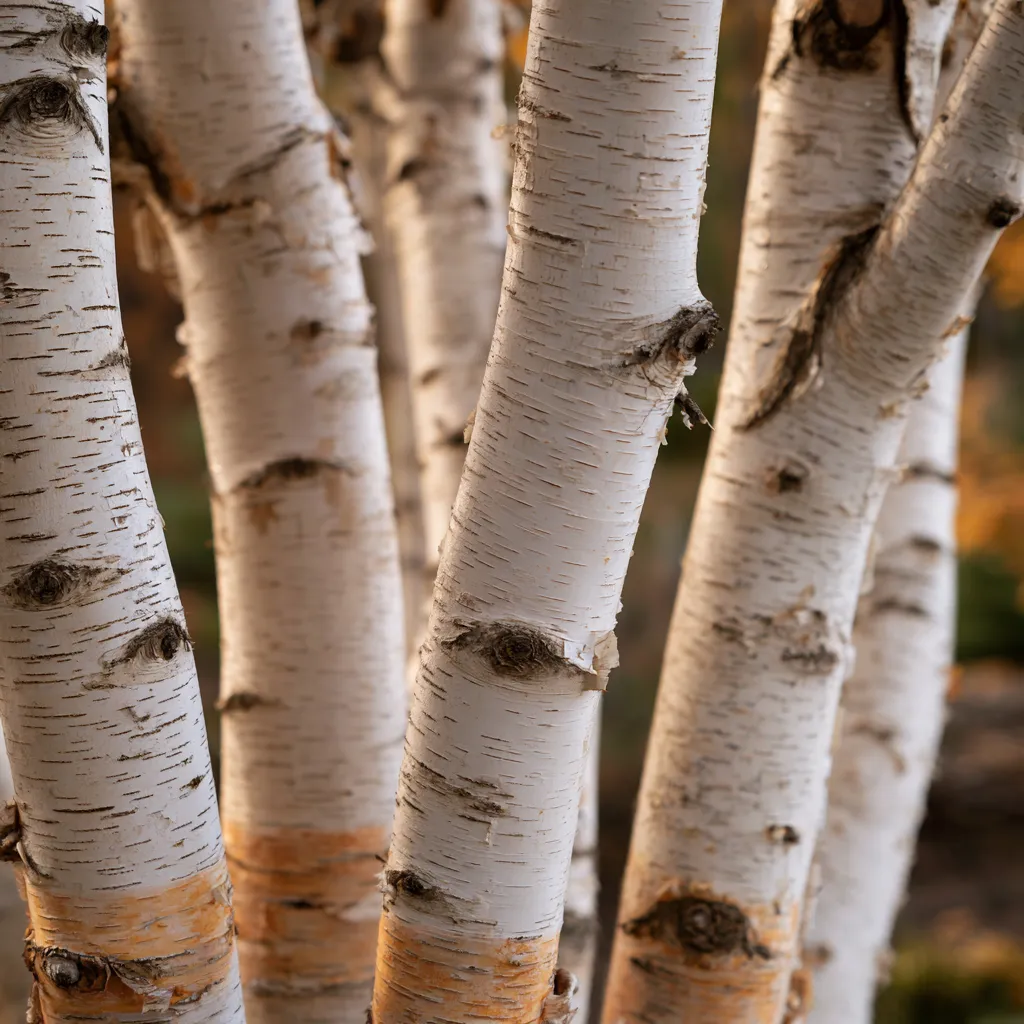
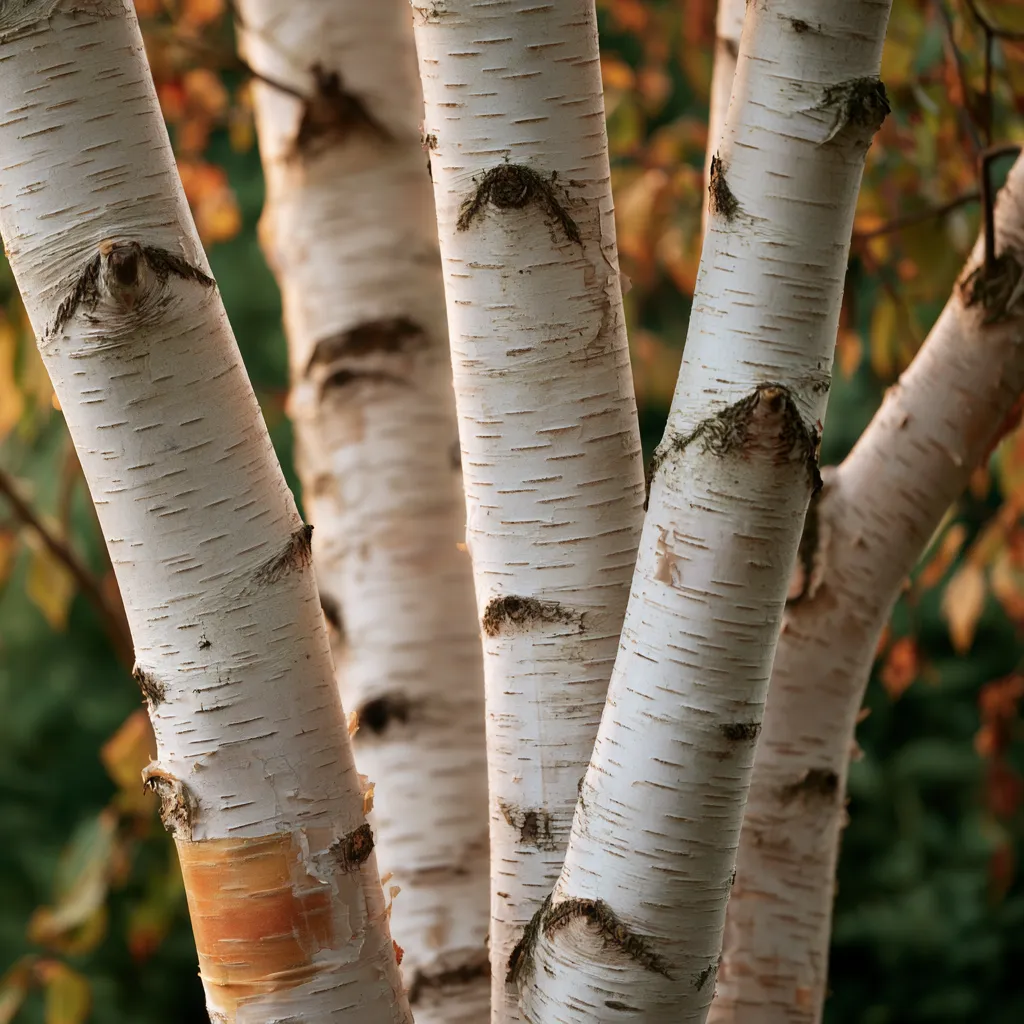
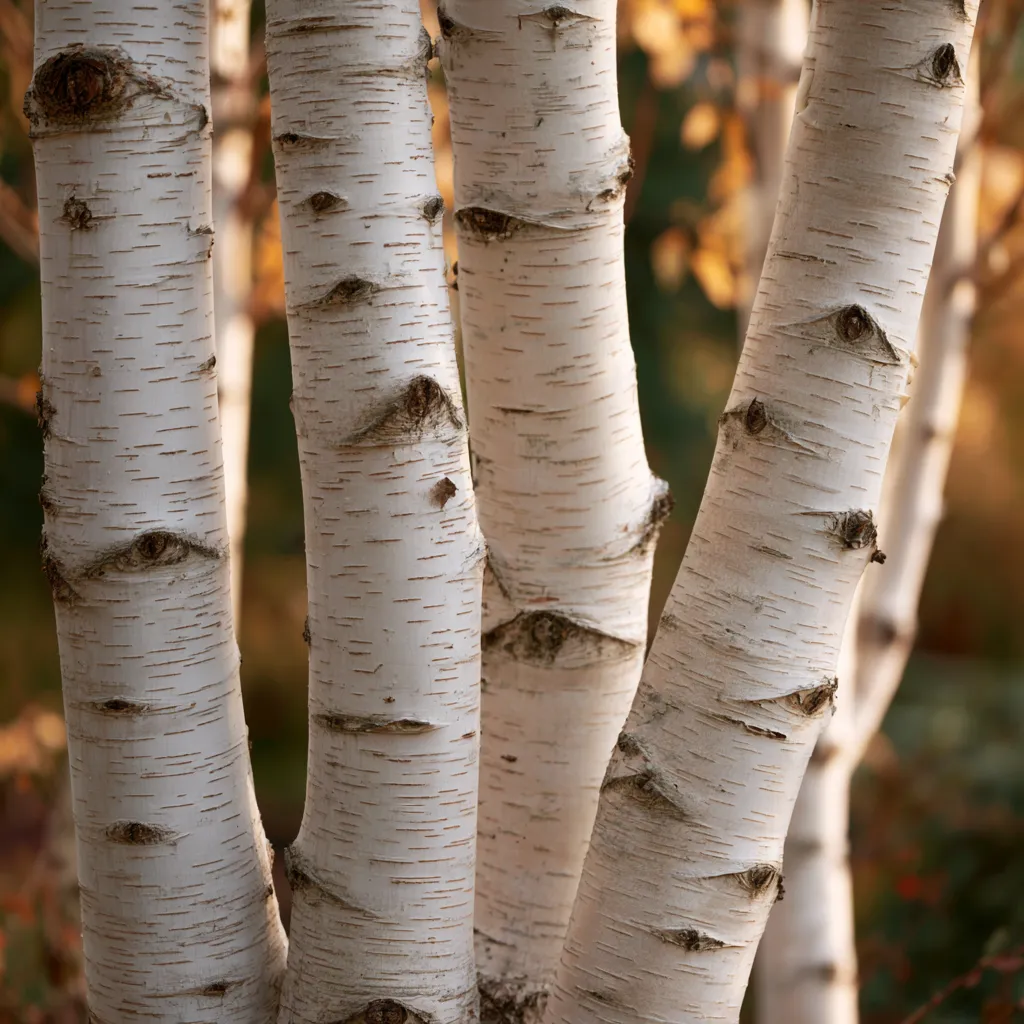
The white bark is the most immediately recognised quality, but it is the most misunderstood in terms of how it actually functions in a garden composition. Birch bark does not simply read as white — it reads differently at different times of day, different seasons, and different viewing distances. In morning light it appears cool and slightly silver. In late afternoon low sun it shifts to warm cream with orange undertones visible in the older, lower sections of bark where the papery layers have aged. At night under focused uplight, it becomes intensely luminous — an effect used deliberately in high-specification modern landscape lighting schemes where birch stems are treated as vertical light-reflecting columns. In fog and grey winter light, the stems glow with a quality that appears almost self-illuminating. This tonal range across a single tree across a single day is one of the reasons that landscape designers with experience of the species return to it repeatedly.
The multi-stem form — typically three, five, or seven stems emerging from a single root ball, depending on how the tree was trained in nursery — provides scale and visual weight without the crown density of a single-stem tree of equivalent height. A multi-stem birch of 4 metres height casts roughly 35–45% less shade than a single-stem tree of the same species at the same height, because the stems are spaced rather than unified into a single crown. This reduced shade is critical in small modern gardens where overstorey planting competes directly with understorey planting for light — and it is the property that allows birch to be used in front gardens, narrow side passages, and small courtyards where most other trees of equivalent visual impact would be impractical.
From a compositional standpoint, the multi-stem birch in modern landscape design functions as a vertical anchor — the tallest element in a layered planting composition that provides the eye with a fixed point from which to read the surrounding planting, hardscape, and architecture. In gardens where the architecture provides strong horizontal emphasis (low-slung contemporary extensions, long runs of flat-roofed garden buildings, horizontal timber cladding), the vertical lines of birch stems provide essential counterpoint. In gardens where the architecture is vertical (tall terraced house facades, narrow urban plots), birch stems reinforce rather than contradict the dominant geometry while softening it with organic form.
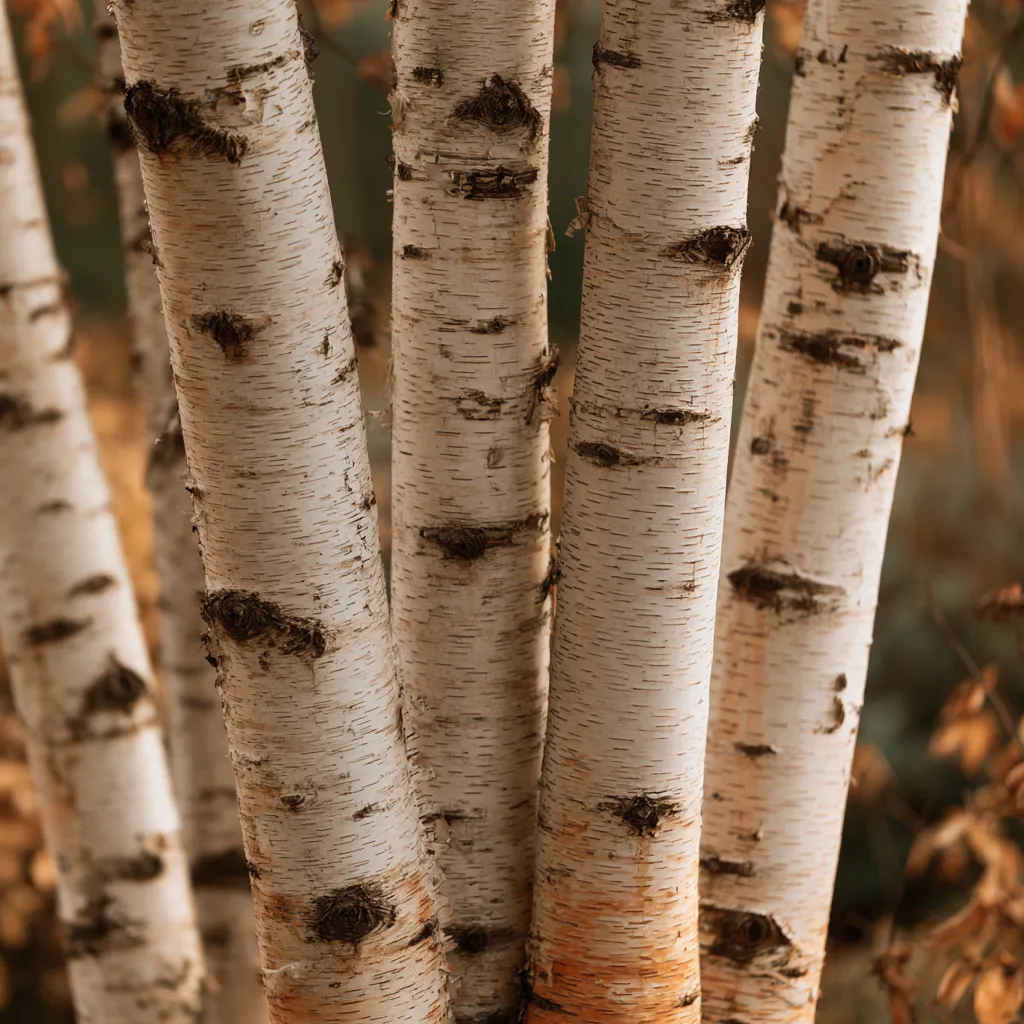
Multi-Stem Birch Tree Varieties for Modern Landscape Garden Design
Not all birch trees produce the same bark whiteness, and the difference between a correctly specified and an incorrectly specified variety is the difference between a luminous white-stemmed specimen and a grey or brownish tree that reads as undistinguished in the garden. For modern landscape design purposes, bark whiteness and stem quality are the primary selection criteria — not ultimate tree size, growth rate, or leaf shape, which are secondary considerations in most residential garden contexts.
| Variety | Bark Whiteness | Mature Height (multi-stem) | Spread | Growth Rate | Best Modern Landscape Use | USDA Hardiness |
|---|---|---|---|---|---|---|
| Betula utilis var. jacquemontii | Brilliant white, brightest available | 6–10 m | 4–6 m | Medium-fast (40–60 cm/yr) | Feature tree, front garden, courtyard | Zone 5–8 |
| Betula utilis var. jacquemontii ‘Doorenbos’ | Very white, consistent across stems | 7–10 m | 4–5 m | Medium (30–50 cm/yr) | Group planting, formal settings | Zone 5–8 |
| Betula utilis var. jacquemontii ‘Grayswood Ghost’ | Near-white with grey sheen, very consistent | 8–12 m | 5–7 m | Medium (30–45 cm/yr) | Large gardens, park-scale planting | Zone 5–8 |
| Betula utilis var. jacquemontii ‘Silver Shadow’ | Very white, large pendulous leaves | 7–10 m | 4–6 m | Medium-fast (40–55 cm/yr) | Single specimen, garden focal point | Zone 5–8 |
| Betula pendula (silver birch) | White-grey, darkens with age | 10–20 m (single stem typical) | 6–10 m | Fast (50–80 cm/yr) | Natural woodland, wilder gardens | Zone 2–7 |
| Betula nigra (river birch) | Cream to pinkish-tan, peeling | 8–12 m multi-stem | 5–8 m | Fast (50–70 cm/yr) | Wet sites, North American gardens | Zone 4–9 |
| Betula albosinensis ‘Fascination’ | Orange-pink to copper, dramatic | 6–9 m | 3–5 m | Medium (30–45 cm/yr) | Warm colour scheme, autumn interest | Zone 5–7 |
| Betula utilis ‘Wakehurst Place Chocolate’ | Dark chocolate-brown, non-white | 5–8 m | 3–5 m | Slow-medium (25–40 cm/yr) | Dark accent tree, contrast planting | Zone 5–8 |
For the vast majority of modern landscape garden design applications, Betula utilis var. jacquemontii is the correct choice — either the straight species or one of its named cultivars such as ‘Doorenbos’ (particularly consistent bark whiteness across all stems) or ‘Silver Shadow’ (larger leaves providing stronger summer canopy). The species is distinguished from other white-barked birches by the consistency of its bark whiteness: the white extends to ground level on all stems without the dark, rough basal bark that develops on Betula pendula with age, and it maintains near-white colouration on young stems even in the first years after planting. For gardens where dark render, black gravel, or deep charcoal paving forms the backdrop, this consistent brightness is the quality that makes the species irreplaceable.
Betula nigra (river birch) deserves mention as the superior choice for gardens with heavy clay or waterlogged soils, and for North American gardens in USDA Zones 4–9 where Betula utilis var. jacquemontii may be borderline hardy. River birch in multi-stem form develops exfoliating cream-to-cinnamon bark with strongly textured peeling layers that provides comparable visual interest to jacquemontii bark, though with warm rather than cool tones. It is substantially more tolerant of wet soils, urban air pollution, and summer heat — qualities that make it the preferred multi-stem tree for landscape designers working in challenging site conditions across the eastern and midwestern United States.
Placement and Scale — Multi-Stem Birch Tree Design Logic for Modern Gardens
Correct placement of a multi-stem birch in a modern landscape design is the decision that most determines whether the tree becomes the garden’s defining compositional element or a plant that happens to be present. The birch’s specific visual properties — vertical luminous stems, light open canopy, fine-textured branching — create predictable design relationships with their surroundings that, understood in advance, allow the designer to position the tree to maximum effect.
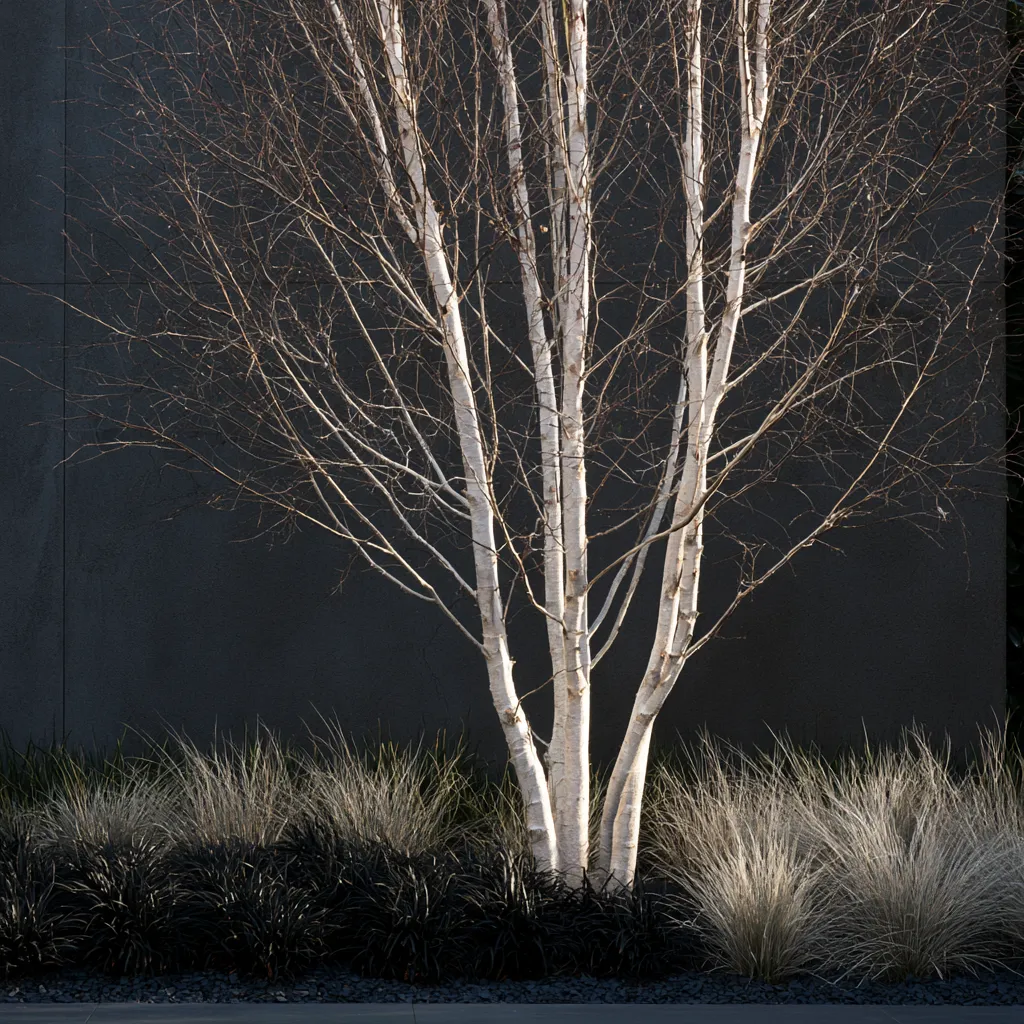
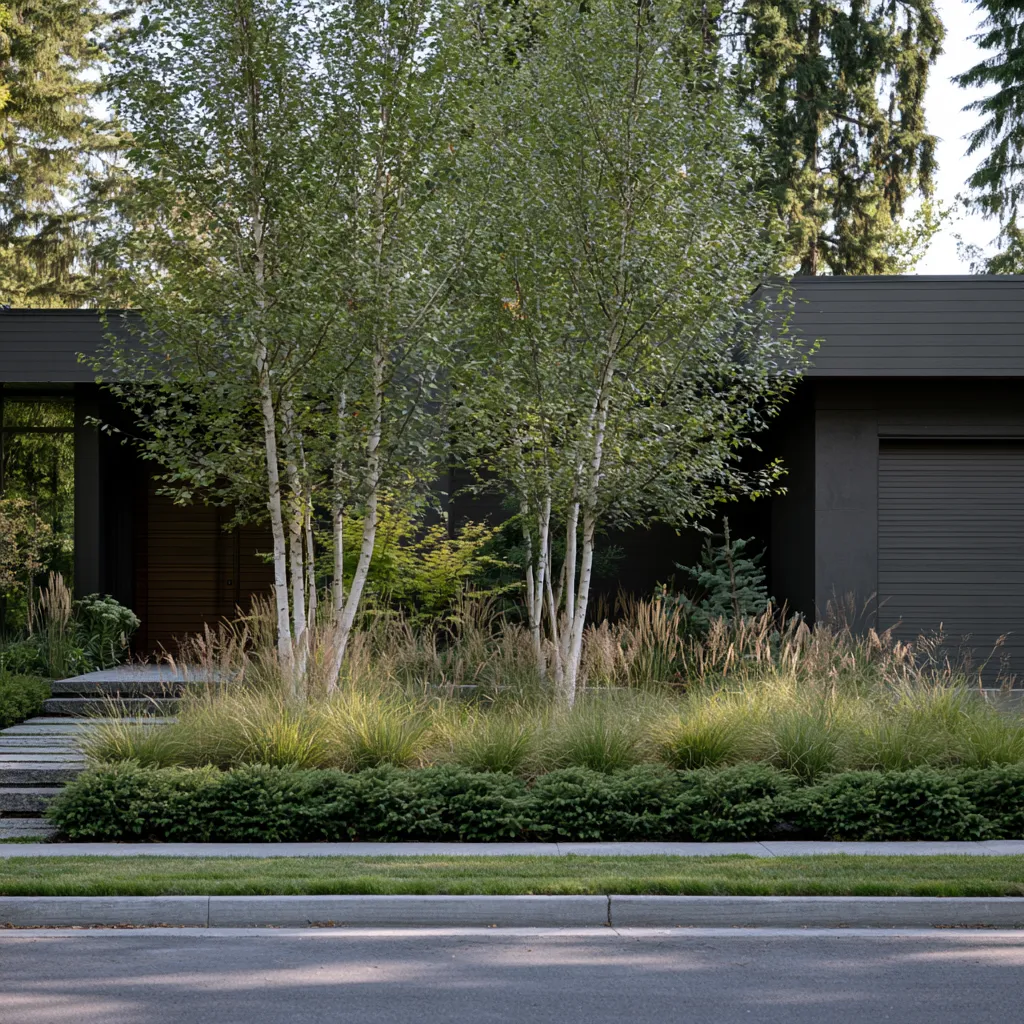
The most powerful placement for a multi-stem birch in a modern landscape is against a backdrop that contrasts with its stem colour. Dark rendered walls, dark timber board fencing, dark stone or brick boundary features, and dense dark evergreen hedging — all provide the tonal contrast that allows white stems to read with maximum intensity. A multi-stem birch positioned in open ground with a light sky backdrop or a pale stone wall behind it loses most of its visual impact because the contrast that defines the stems against their background is insufficient. This backdrop principle is the single most consistently overlooked placement consideration in residential multi-stem birch planting, and its neglect accounts for a significant proportion of birch plantings that fail to achieve the visual impact the client expected.
Scale relative to the surrounding architecture is the second placement determinant. The guiding principle for multi-stem birch in modern residential landscape design is that the tree should reach approximately half to two-thirds of the adjacent facade height at maturity. For a standard two-storey house of approximately 7–8 metres facade height, this positions the ideal mature birch crown at 4–5 metres — exactly the natural mature height of a well-grown Betula utilis var. jacquemontii multi-stem specimen in a typical garden soil. For single-storey extensions, outbuildings, or low-rise contemporary architecture, smaller specimens or slower-growing cultivars such as ‘Wakehurst Place Chocolate’ are more appropriate to maintain proportional balance.
Horizontal distance from the house is constrained by root system spread. Multi-stem birch trees in garden conditions develop a relatively shallow but laterally extensive root system — typically extending 1–1.5 times the crown radius from the trunk base. For a specimen with a 4-metre crown spread, this places the root zone edge at approximately 2–3 metres from the trunk. As a practical rule, multi-stem birch should not be planted closer than 3 metres to any building foundation, and not closer than 2 metres to any below-ground service (drainage, water supply, power cables), to avoid root interference with infrastructure over the long term.
In the front garden specifically, the multi-stem birch has become the dominant tree of contemporary landscape design — partly for the visual reasons described above, and partly because it satisfies the practical constraints of the front garden context better than most alternatives. Its light canopy does not obscure facade visibility from the street. Its relatively moderate root system (compared to lime, horse chestnut, or plane) makes it safer near building foundations and pavement surfaces. And its year-round interest — white stems visible in winter, fresh lime-green leaf emergence in April, dappled summer canopy, golden autumn colour — makes it one of the highest-value trees per square metre of garden space available.
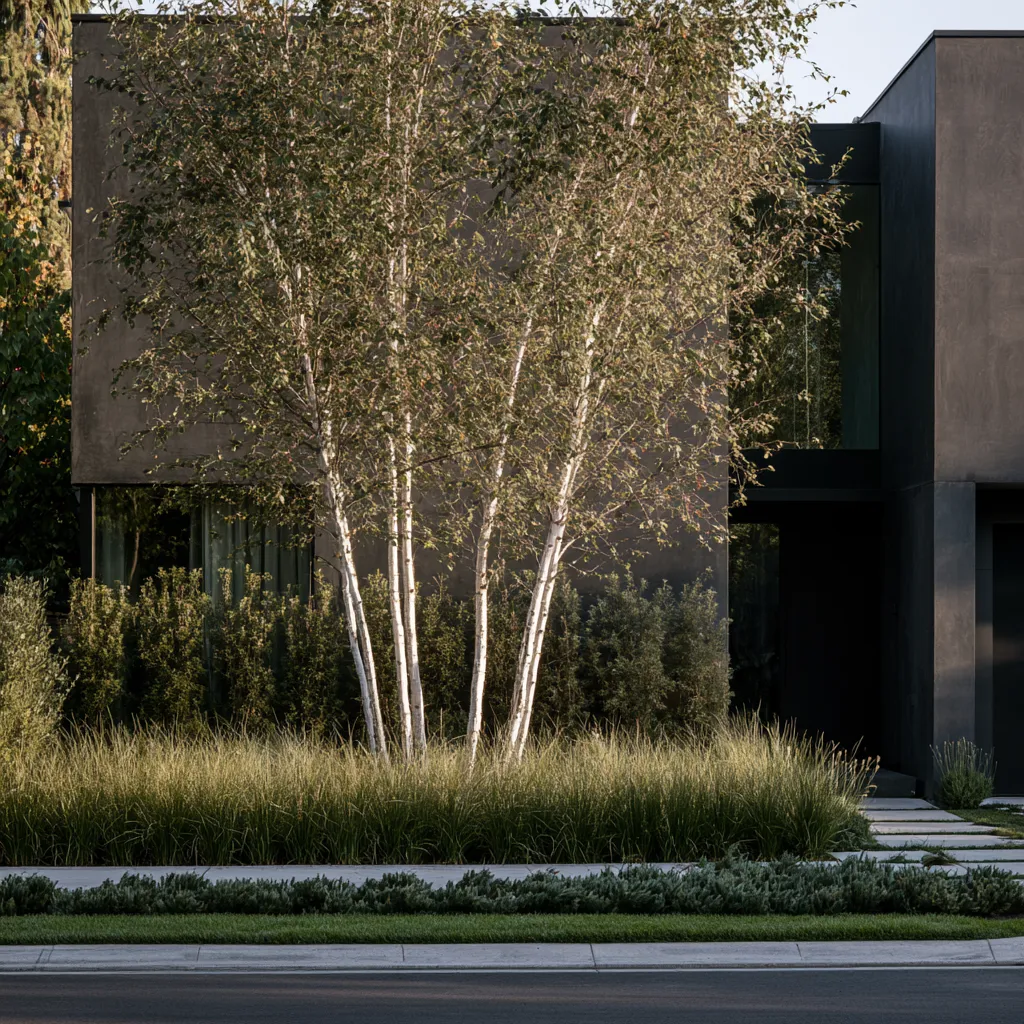
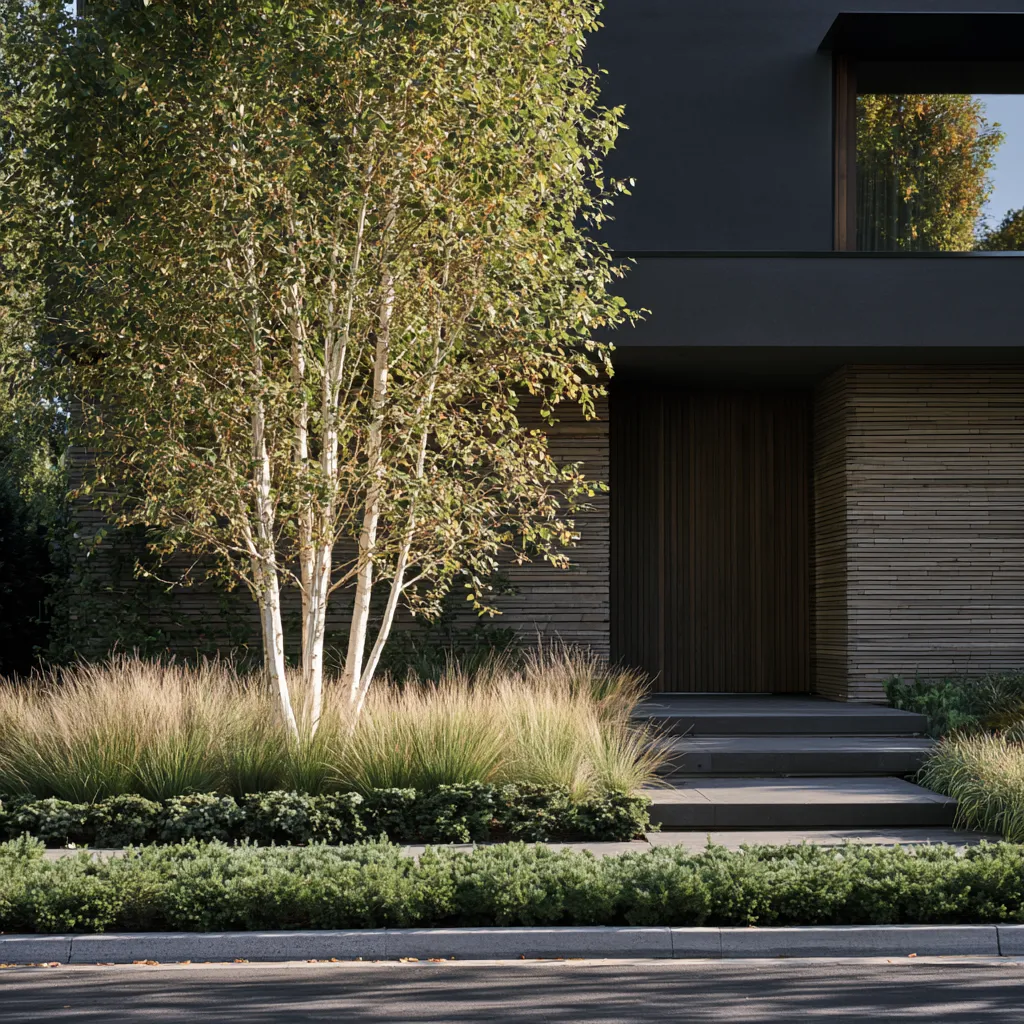
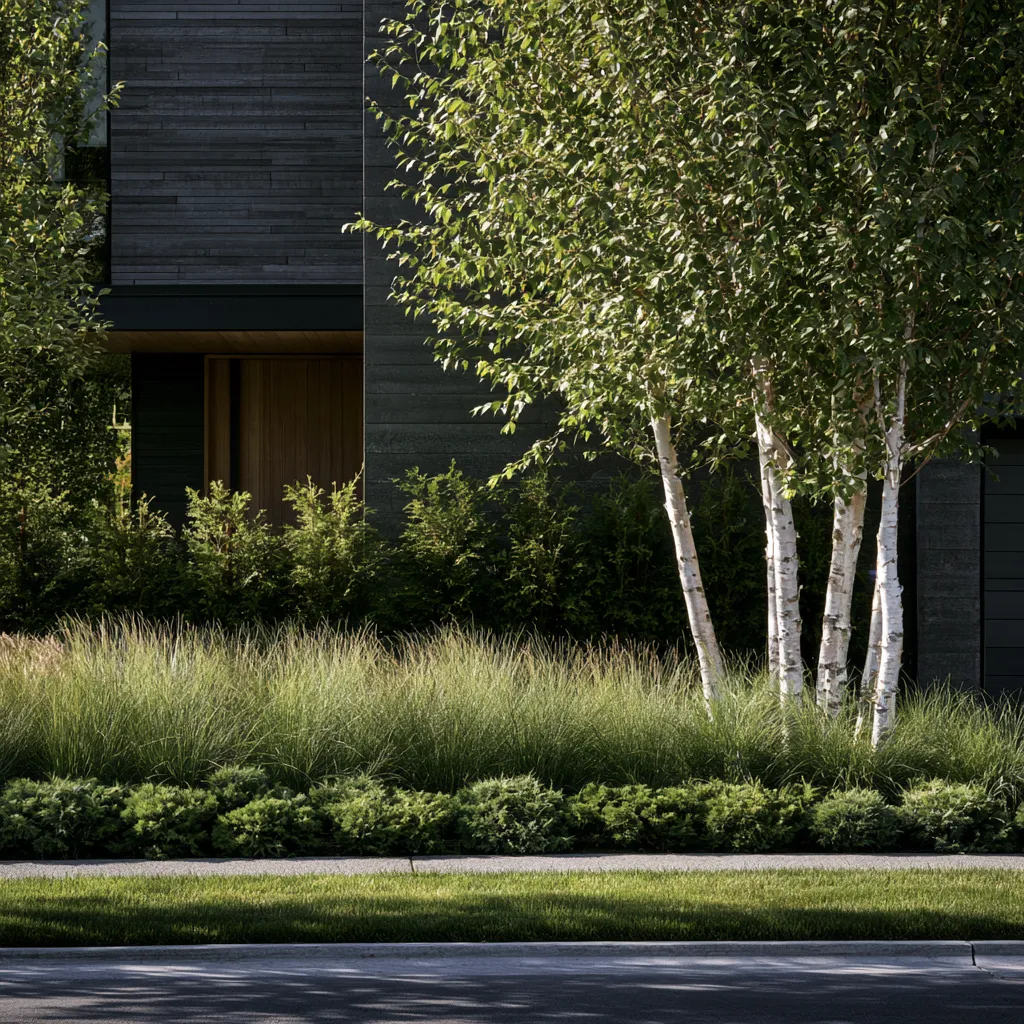
Underplanting Plans for Multi-Stem Birch in Modern Landscape Design
The ground plane beneath a multi-stem birch tree is one of the most compositionally significant spaces in a modern landscape garden design — and one of the most frequently under-resolved. The birch’s light canopy creates a zone of partial shade and reduced rainfall (the canopy intercepts approximately 20–30% of precipitation in leaf, creating a drier microclimate at soil level immediately below the crown), with generally fertile loam soil if the tree is well established and the root zone is not compacted. This specific microclimate suits a defined range of planting that, chosen correctly, creates a year-round underplanting composition as visually impactful as the tree itself.
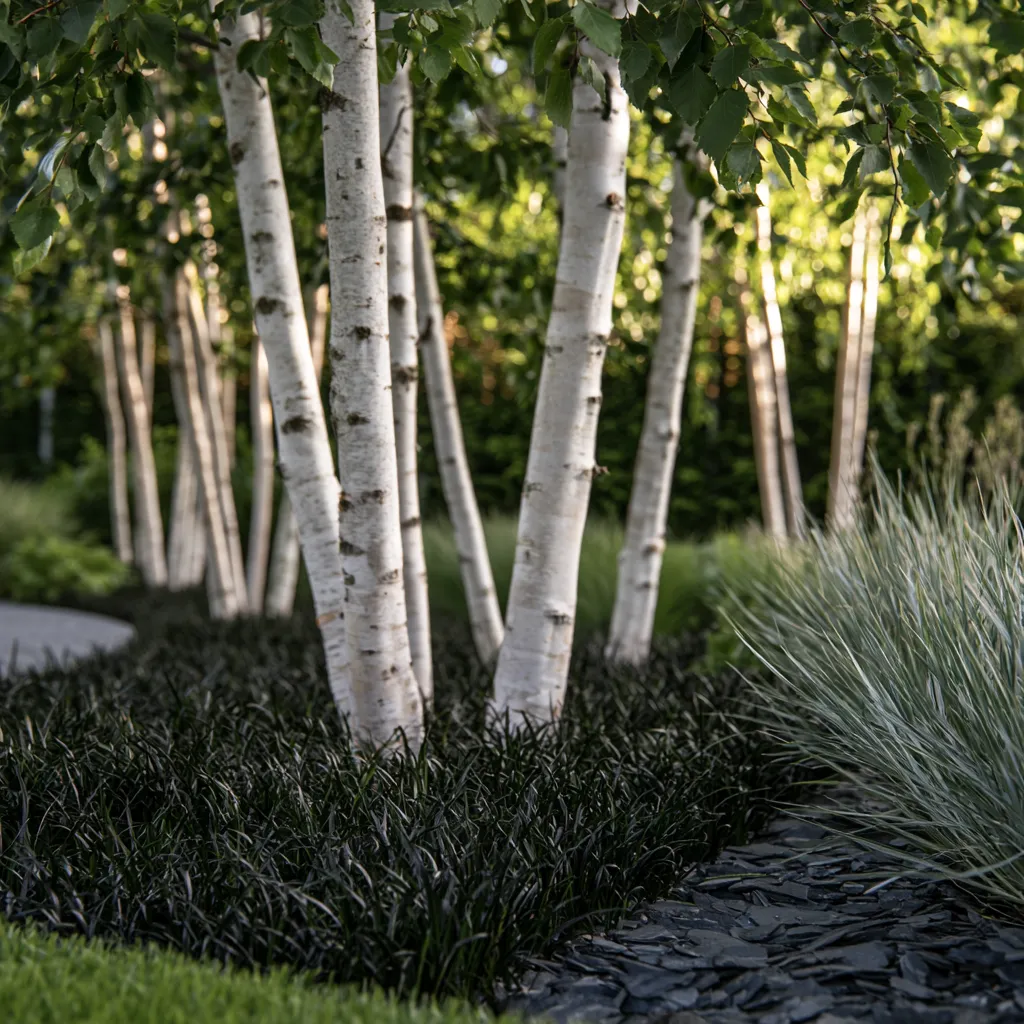
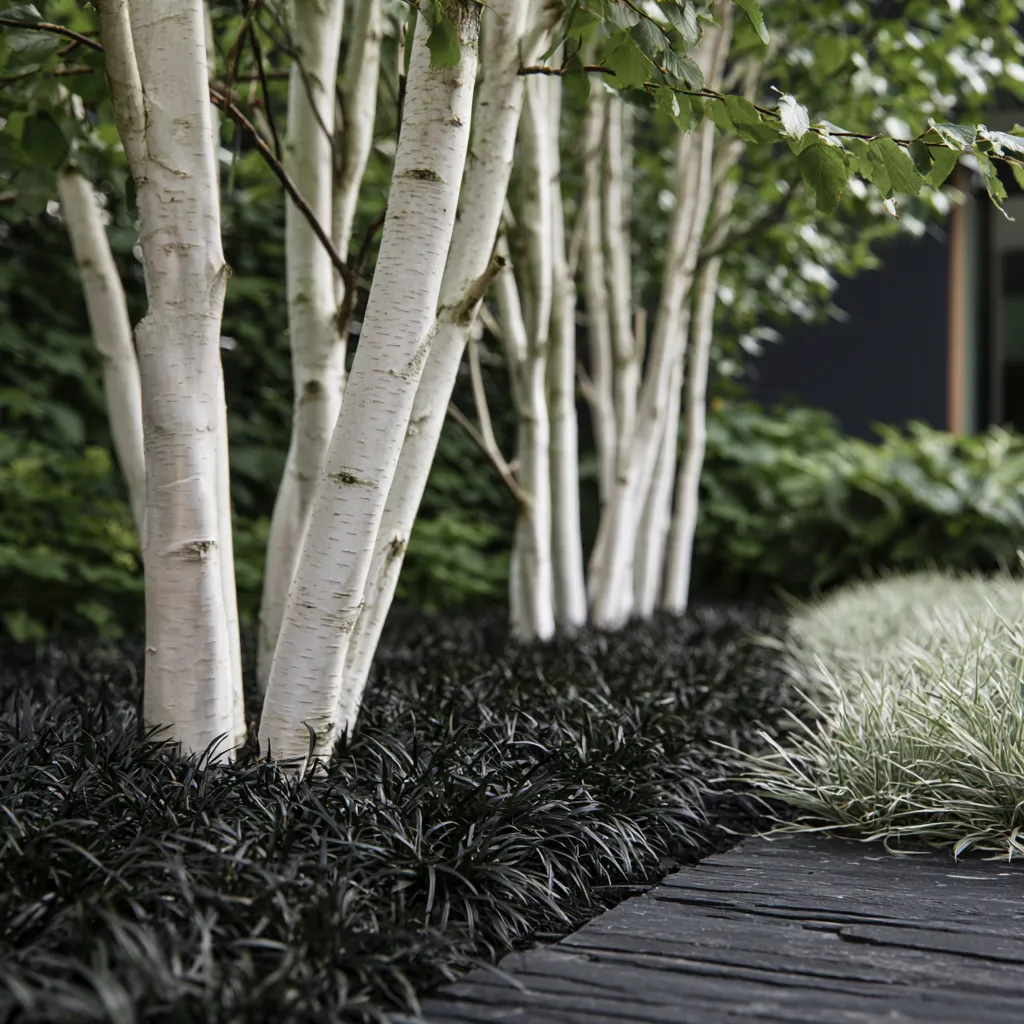
The most consistently effective underplanting approach for multi-stem birch in modern landscape contexts operates on a contrast principle: the underplanting should provide the darkest possible ground-level tone to maximise the contrast with the white stems above. Three species achieve this most reliably and with the lowest maintenance requirement over time.
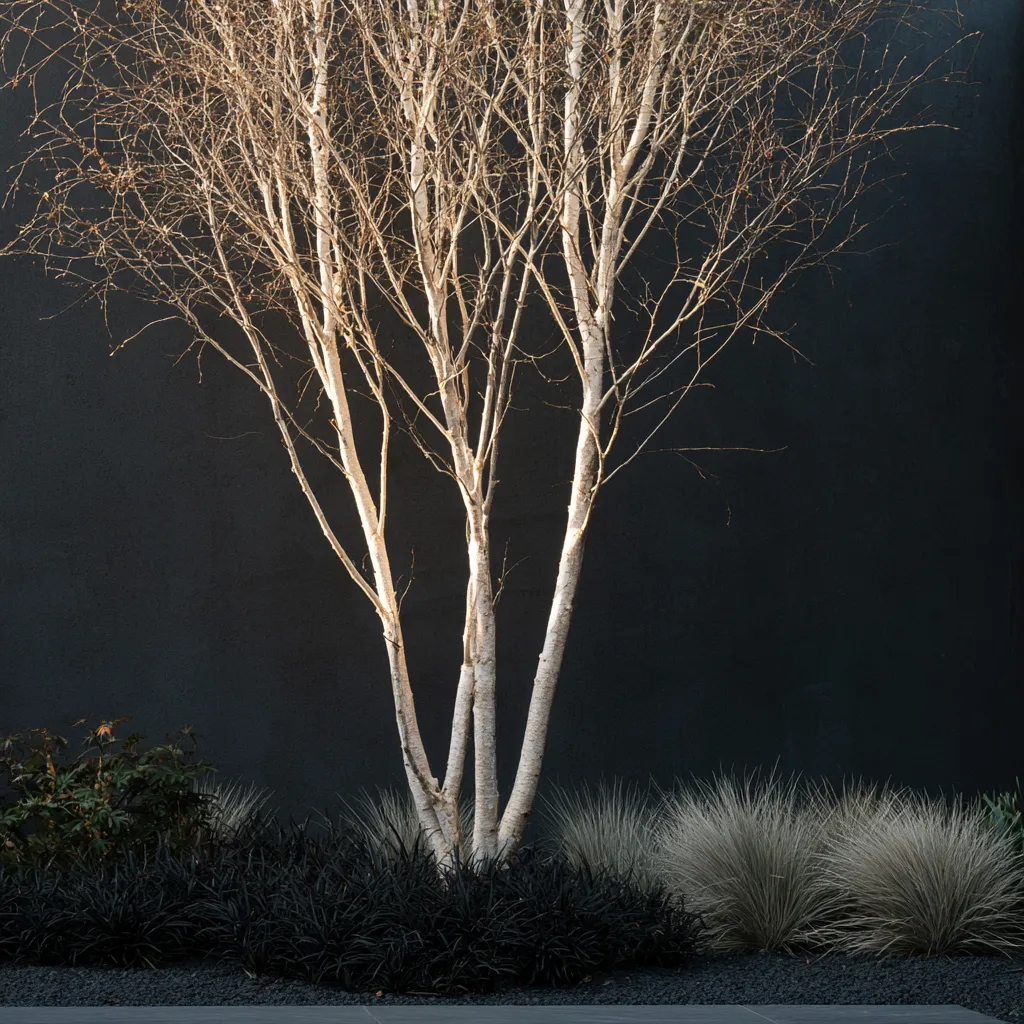
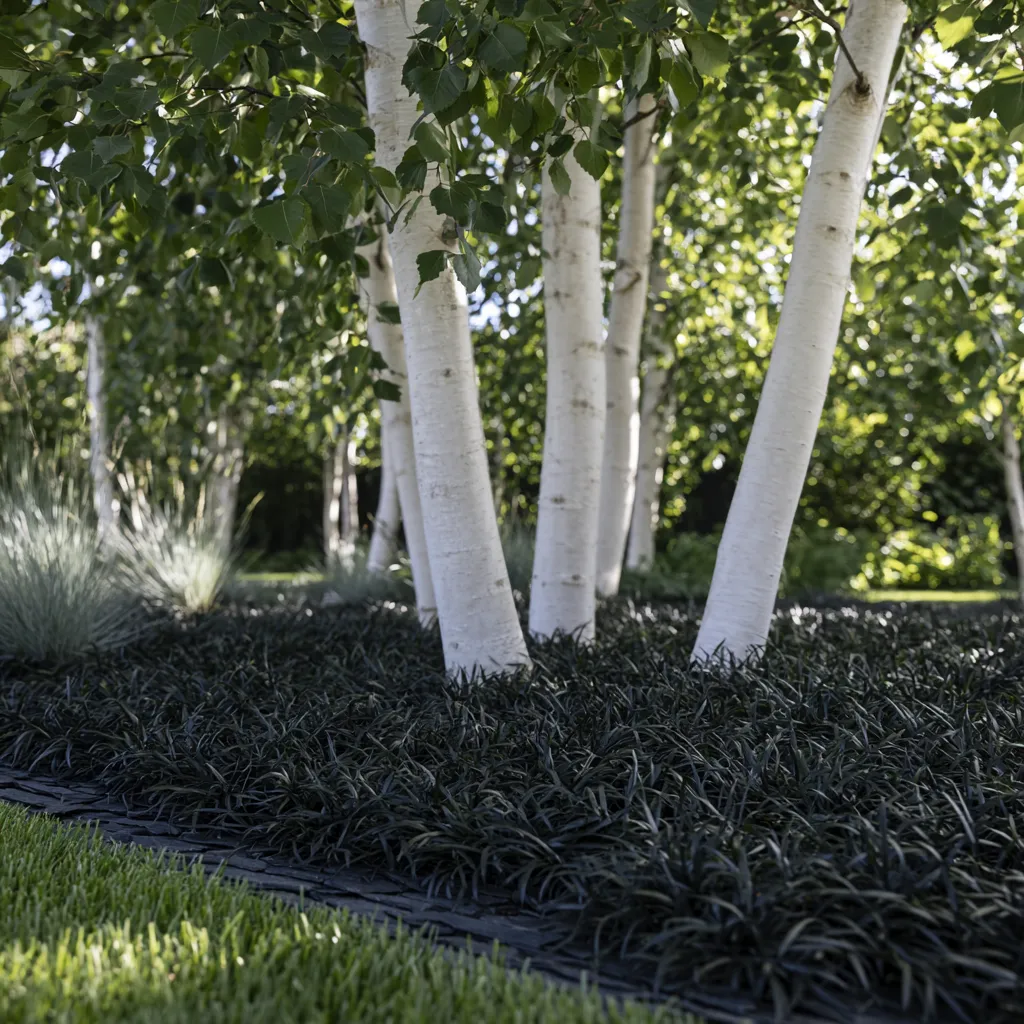
Ophiopogon planiscapus ‘Nigrescens’ — the near-black mondo grass — is the most architecturally refined underplanting for multi-stem birch in contemporary gardens. Its strap-like, near-black leaves create a groundcover of extreme tonal contrast at soil level that frames the white stems as dramatically as any manufactured backdrop. It is evergreen, slow-spreading, drought-tolerant once established, and requires no maintenance beyond occasional division when clumps become overcrowded after five or more years. A typical multi-stem birch underplanting of Ophiopogon ‘Nigrescens’ uses 15–25 individual plants spaced at 20 cm centres across a 1.5–2 metre radius planting zone, at a planting cost of approximately £75–£150 in the UK or $90–$180 in the US at standard retail pricing for 9 cm pot plants.
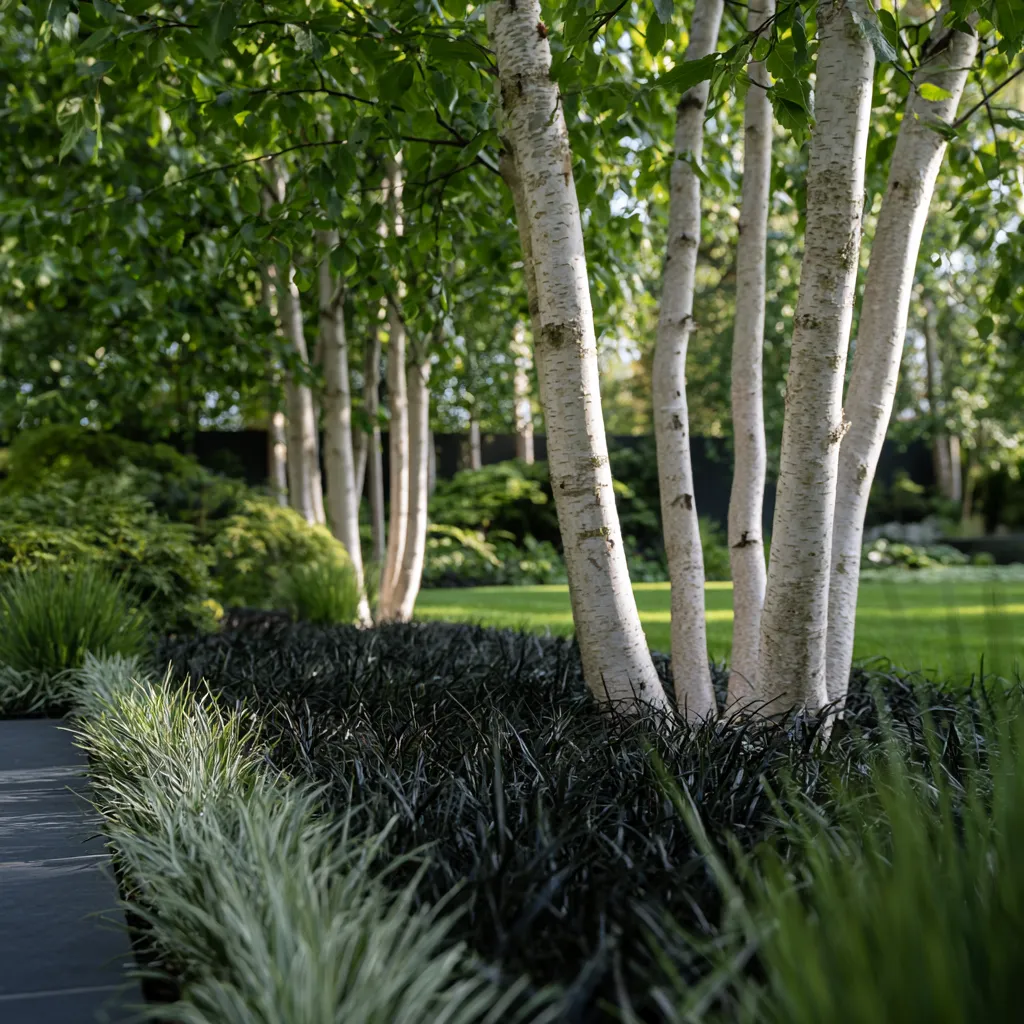
Carex morrowii ‘Ice Dance’ — a creamy-white margined evergreen sedge — provides a different kind of contrast: the white and green variegation of its foliage echoes the white-on-dark pattern of the birch bark at ground level, creating a vertical-to-horizontal visual rhyme within the composition. It tolerates partial shade more effectively than many variegated grasses and maintains its variegation throughout the year, providing winter interest that matches the winter bark interest of the tree above it.
Epimedium cultivars — the barrenworts — provide the most ecologically resilient underplanting option and are particularly valuable in dry shade conditions directly below the canopy. Epimedium ‘Amber Queen’, ‘Lilafee’, and ‘Sulphureum’ are all highly effective beneath birch, producing spring flowers at the moment of birch leaf emergence and maintaining semi-evergreen or evergreen ground cover through winter. Epimedium’s ability to suppress weed growth through dense root competition is a practical advantage in a planting zone that would otherwise require frequent maintenance intervention. The full range of plants well-suited to the partially shaded, relatively dry conditions under a birch canopy is explored in detail in the comprehensive guide to shade garden plants, which includes species recommendations, establishment advice, and maintenance strategies for the specific microclimate that a tree canopy creates at ground level.
Beyond the immediate underplanting zone, multi-stem birch trees work most powerfully in modern landscape design when they are accompanied by a mid-layer of ornamental grasses that extends the visual logic of the composition outward from the tree base. Calamagrostis ‘Karl Foerster’, Miscanthus sinensis ‘Malepartus’, Panicum virgatum ‘Shenandoah’, and Pennisetum alopecuroides ‘Hameln’ all provide the fine textural quality and autumn and winter persistence that complements birch bark tonality without competing with it. The specific design properties and management requirements of ornamental grasses that make them the default companion planting for multi-stem birch in modern landscape design are covered in depth in the article on drought-resistant ornamental grasses, which includes performance data across climate zones and specific grass-to-backdrop coordination guidance.
Using Multi-Stem Birch Trees in Groups — Modern Landscape Grove Planting
A single multi-stem birch is a design statement. Three or more multi-stem birch trees planted as a group — at spacings that allow canopies to begin to overlap at maturity — create something qualitatively different: a grove that transforms a section of garden into an inhabited landscape rather than a planted space. Grove planting of multi-stem birch is one of the most powerful moves available in modern residential landscape design and one of the most underused, largely because it requires planting three trees where one might seem sufficient, and trusting the long-term result over the immediate appearance.
The standard grove configuration for multi-stem birch in modern landscape design uses an odd number of specimens — three, five, or seven — positioned in an informal irregular cluster rather than a regular grid. The spacing between individual trees should be 1.5–2.5 metres at planting, allowing the canopies to reach each other within 5–8 years and create the overhead enclosure and dappled light that distinguishes a grove from a row. Within the grove, the ground plane is typically treated as a single unified planting zone: a continuous carpet of moss, Ophiopogon, Epimedium, or native woodland ground cover species such as Geranium macrorrhizum or Pulmonaria that flows beneath and between the tree bases as though the grove had always been there.
Grove planting of birch produces a microclimate at ground level that is measurably cooler and more humid than surrounding open garden areas. In urban heat island conditions — increasingly significant in temperate cities where summer peak temperatures have risen by 2–3°C over the past three decades — this cooling effect has measurable benefits for both plant and human comfort. Research from the University of Manchester’s urban climate group found that small urban tree groves of three to five specimens reduced ambient air temperature at ground level by 1.8–2.4°C on peak summer days compared to open paved surfaces, and by 0.8–1.2°C compared to open lawn areas. In a city garden where summer heat stress is a genuine constraint on outdoor use, a birch grove represents a significant functional investment as well as a design one.
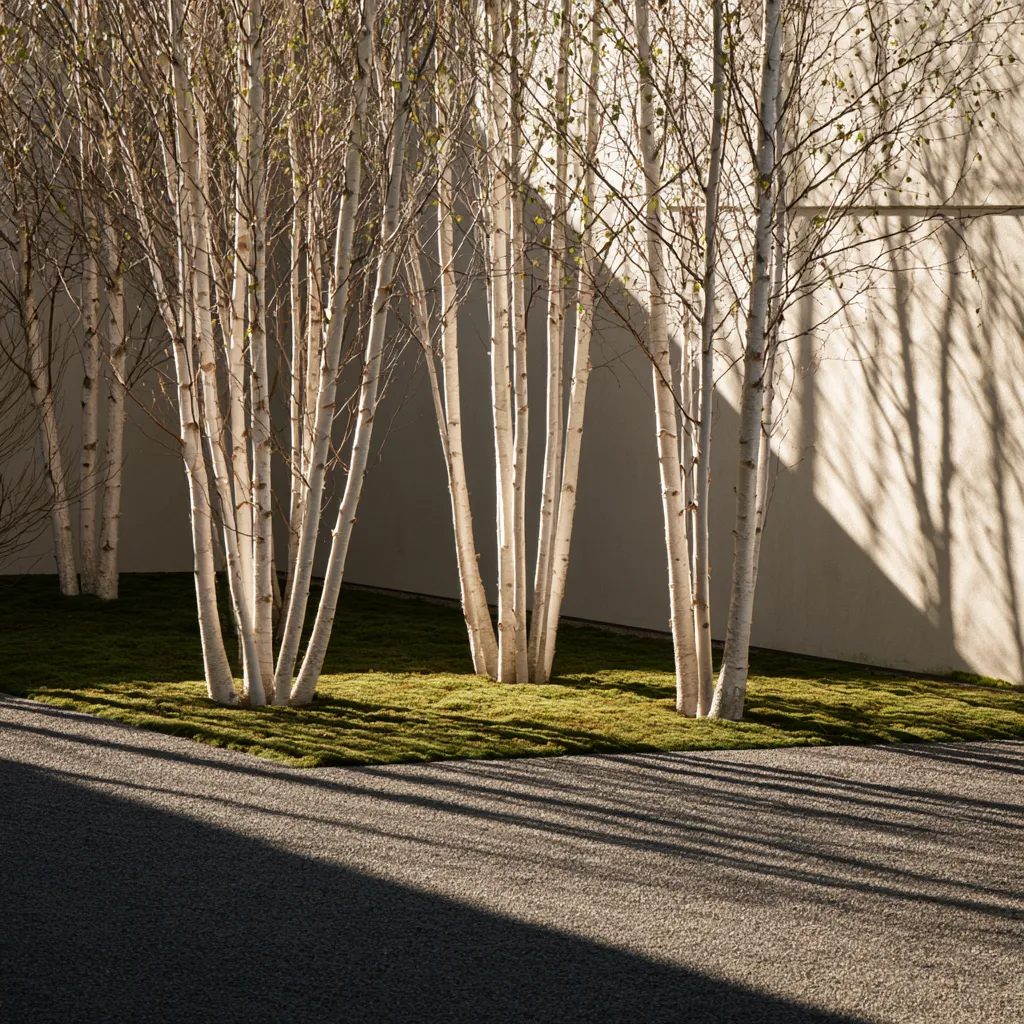
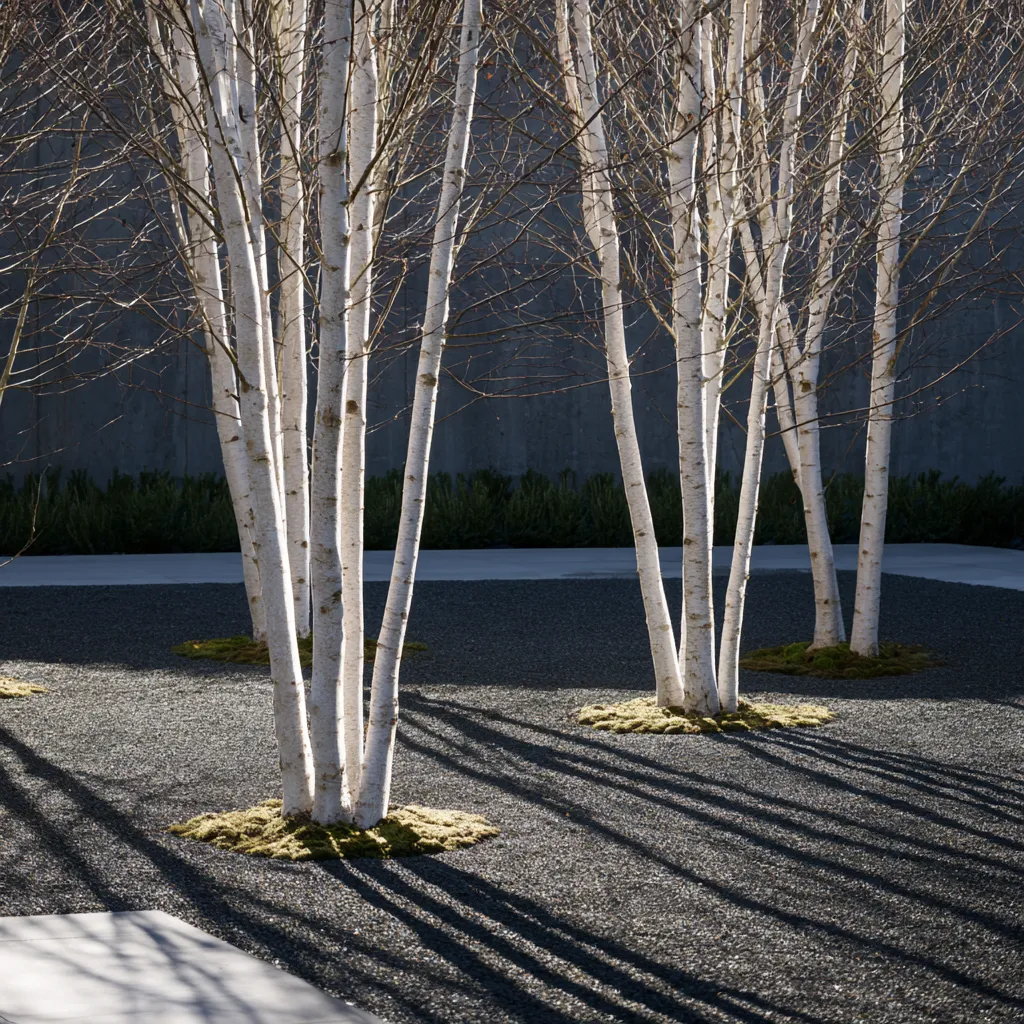
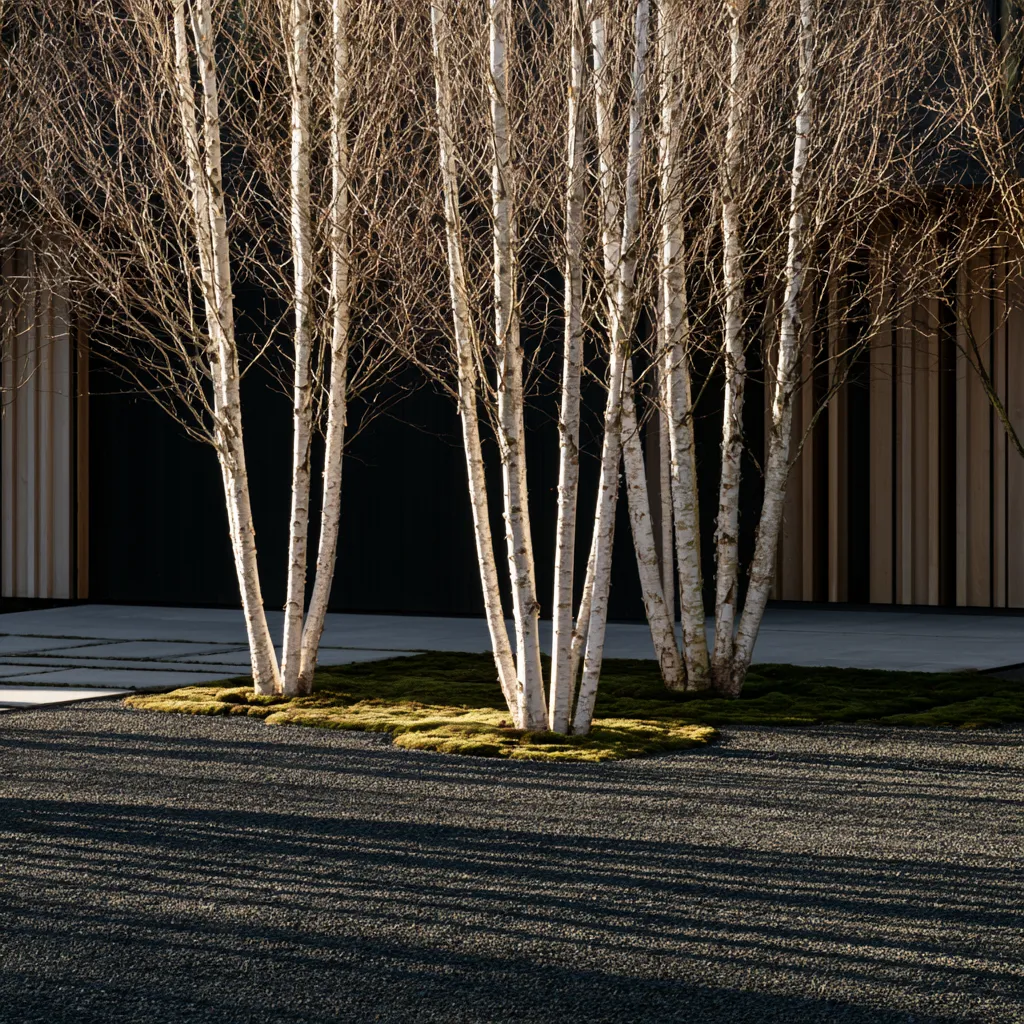
From a purely visual standpoint, the grove planting of multi-stem birch in a modern landscape creates the one quality that individual specimen trees cannot: the sense of immersion in a landscape rather than the appreciation of an object within one. Walking through a grove of multi-stem birch on a winter morning — stems catching low sun from multiple angles, shadows crossing the ground plane in overlapping patterns — is an experience that distinguishes a great garden from a well-designed one. It is the experience that the best residential landscape design projects consistently aim for, regardless of the garden’s size or the client’s budget.
Multi-Stem Birch in Courtyard and Urban Garden Landscape Design
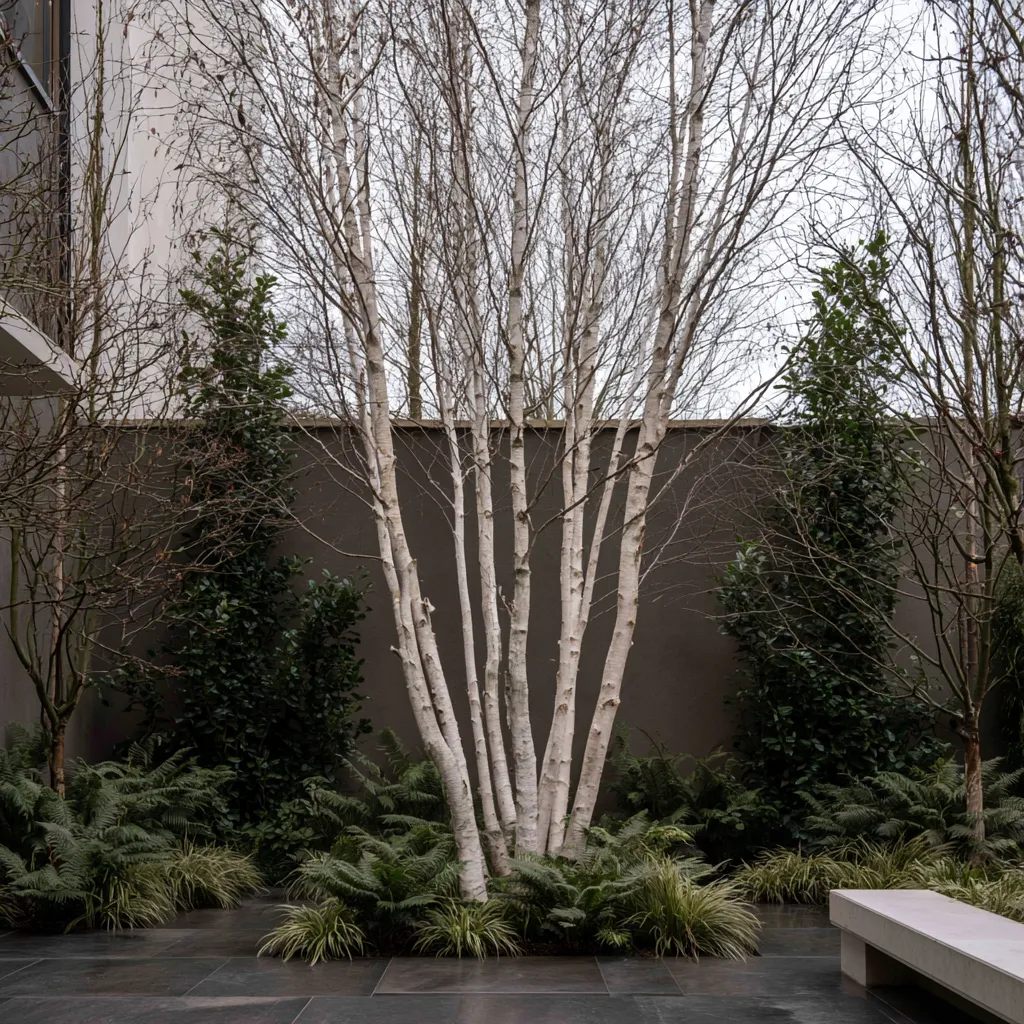
The urban courtyard and small walled garden represent the most demanding context for tree planting in modern landscape design — restricted planting volume, limited light, reflected heat from surrounding hard surfaces, and the need for a tree that provides maximum visual impact within a rigidly bounded space without outgrowing its setting within a decade. Multi-stem birch satisfies these conditions more consistently than any other tree regularly used in residential urban landscape design.
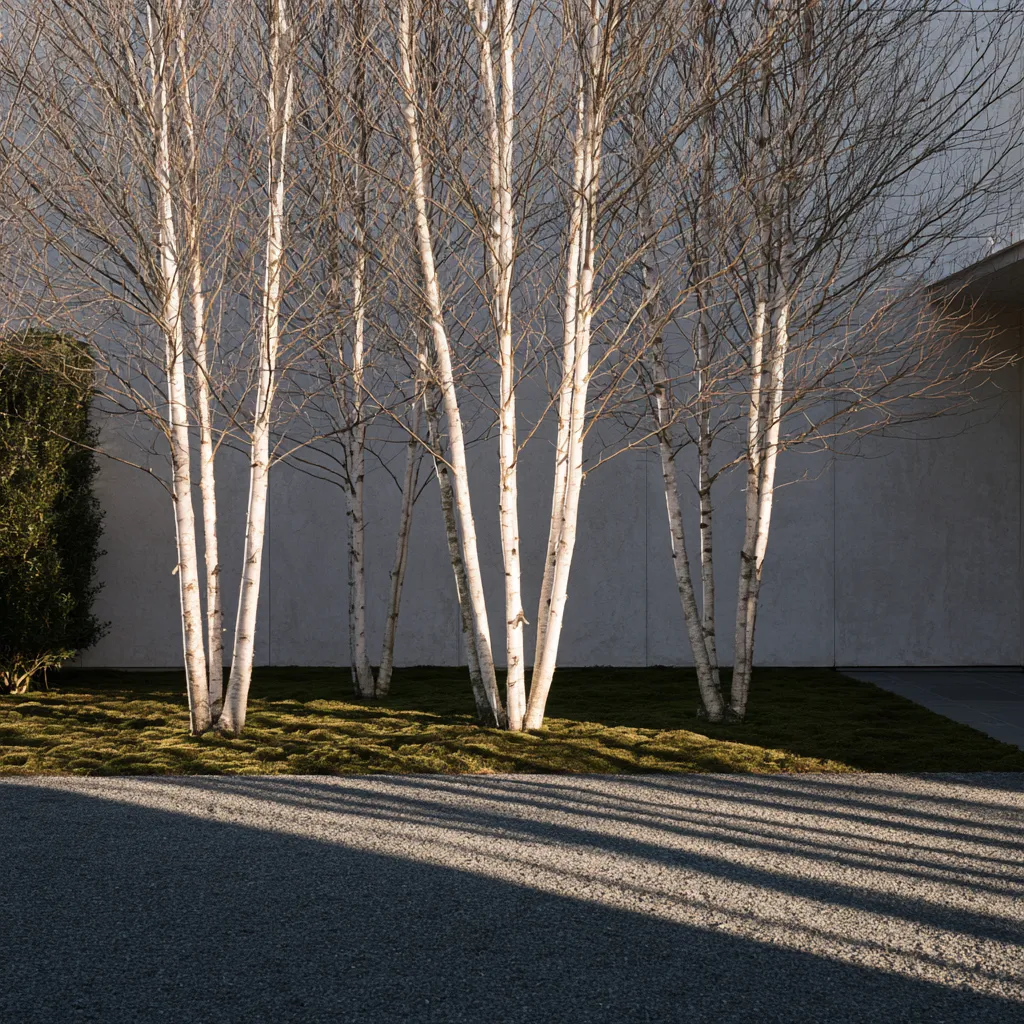
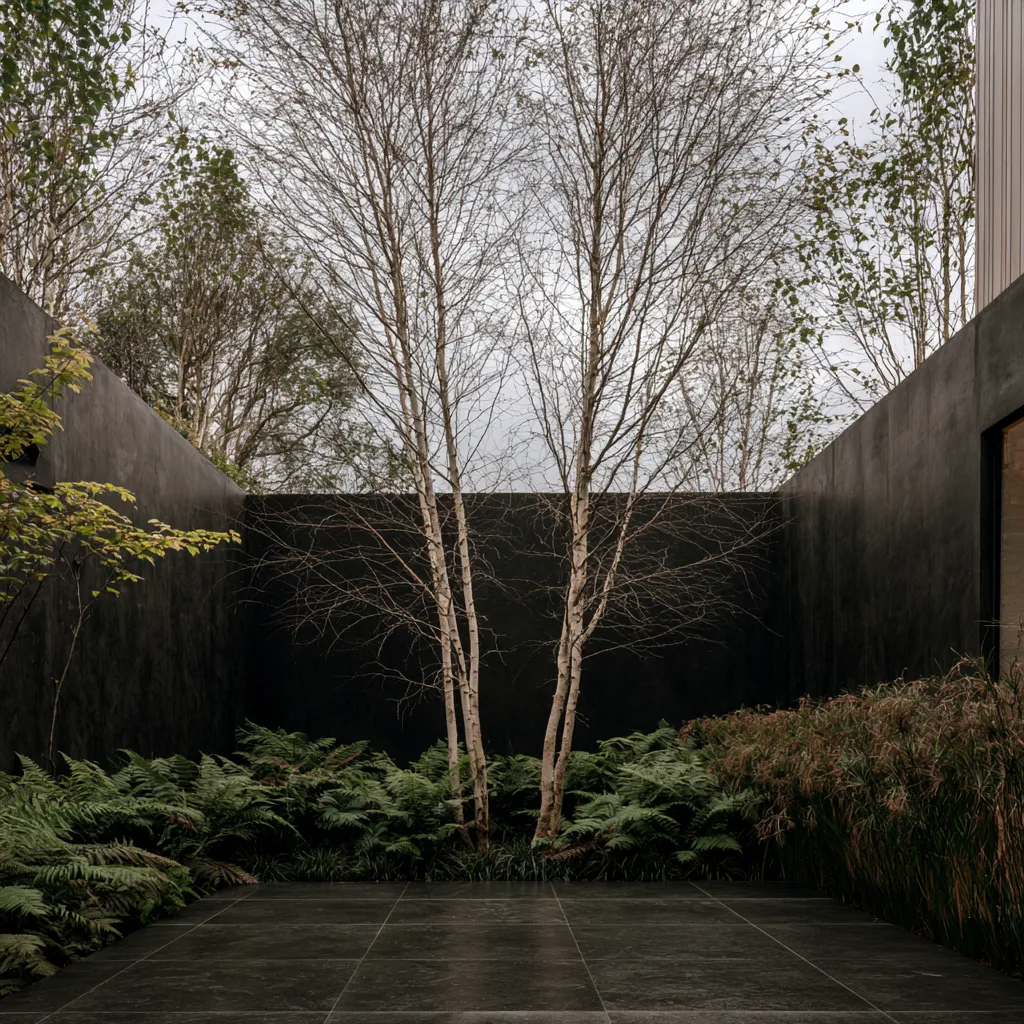
In courtyard settings, the multi-stem birch performs an additional function beyond its visual qualities: it humanises the vertical enclosure. A courtyard garden surrounded by 2–3 metre walls creates a confined space that can feel pressurised and inward-looking without a vertical element that mediates between the human scale of the ground plane and the abrupt vertical termination of the wall tops. A multi-stem birch whose canopy rises above the wall line — visible from inside the courtyard as a living element that connects the enclosed space to the sky above — relieves this pressure and gives the space a sense of orientation. This effect is heightened in winter when the leafless canopy traces a complex branching pattern against the sky that changes with every shift in light and wind.
For courtyard planting, a raised or contained planting zone — either an in-ground pit of minimum 2 cubic metres volume or a large raised planter of equivalent capacity — provides the root space needed for long-term tree establishment without the extensive lateral root spread that becomes a problem when a tree is planted directly into the ground of a small paved courtyard. Courtyard birch specimens are often specified at a smaller initial size than garden specimens — 2–3 metres at planting rather than the 3–4.5 metres that is standard for garden feature trees — to allow a longer establishment period in the restricted planting zone before the crown reaches the proportions that create the desired visual effect.
Irrigation is not optional for birch in enclosed courtyard conditions. The combination of limited soil volume, reflected heat from surrounding hard surfaces, and reduced natural rainfall from overhead obstruction creates a deficit that self-sufficient rainfall in an open garden would never produce. A drip irrigation system delivering 10–15 litres per tree per week through the summer months — operated automatically on a timer and supplied from a water storage tank or mains connection — is the practical solution and should be specified as part of the courtyard planting installation rather than retrospectively added when tree stress symptoms appear. For detailed guidance on how water management strategies interact with planting health in garden design contexts, the principles covered in the discussion of garden design ideas for modern narrow courtyard gardens address water, light, and space constraints in the context most directly relevant to urban birch tree planting.
Seasonal Interest of Multi-Stem Birch in Modern Landscape Design
One of the most important qualities of any tree specified for modern landscape garden design is its contribution to the garden across all twelve months, not merely during the period of peak summer foliage. The multi-stem birch delivers genuine year-round interest in a way that few other garden trees achieve without the need for supplementary seasonal planting — and understanding this seasonal sequence in detail helps designers and homeowners appreciate why the tree justifies its position as the defining specimen in so many contemporary garden compositions.
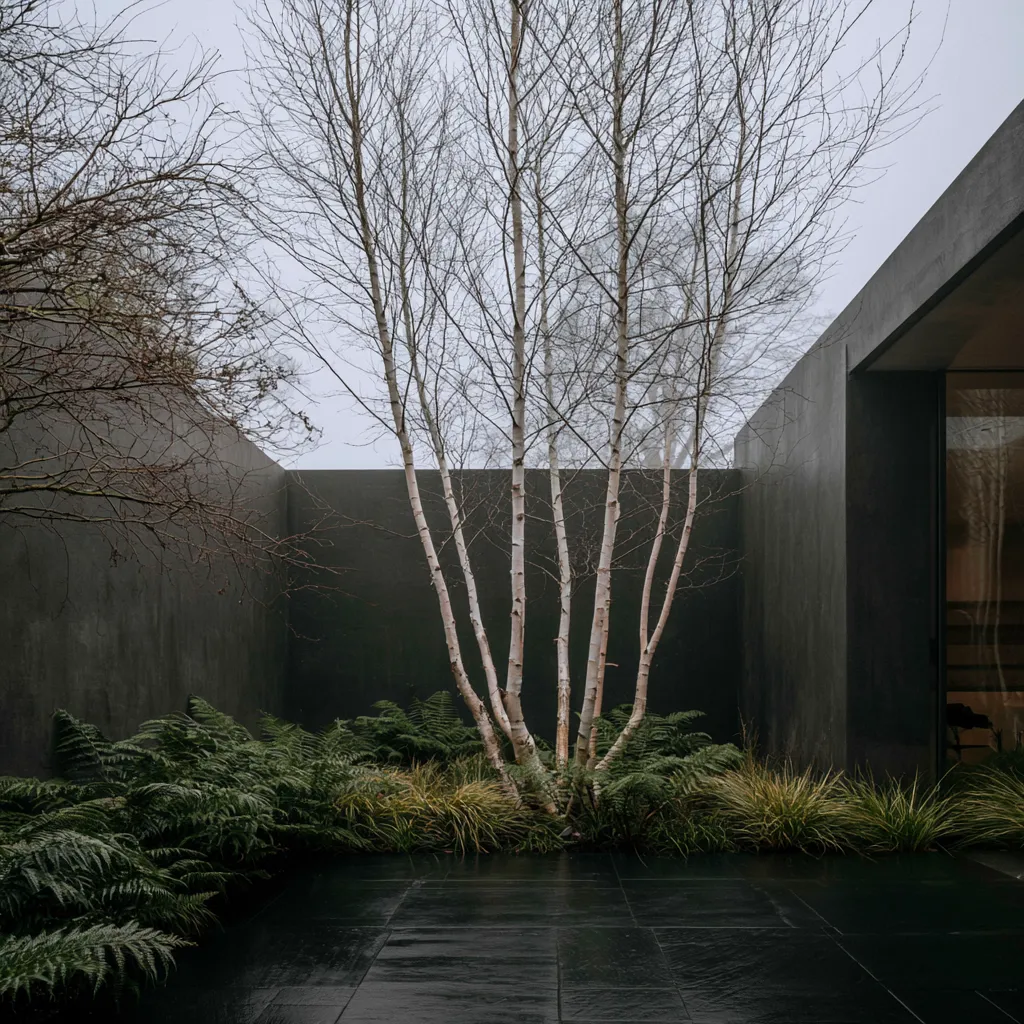
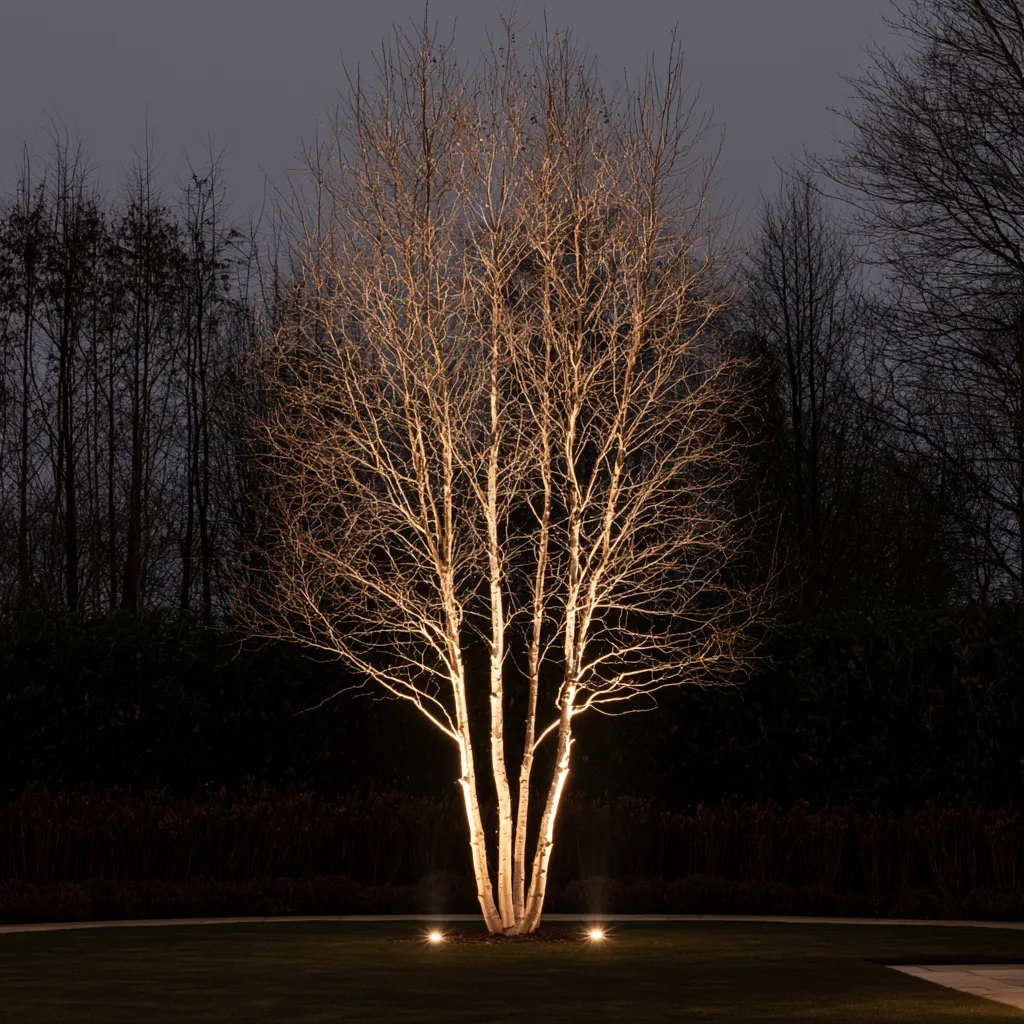
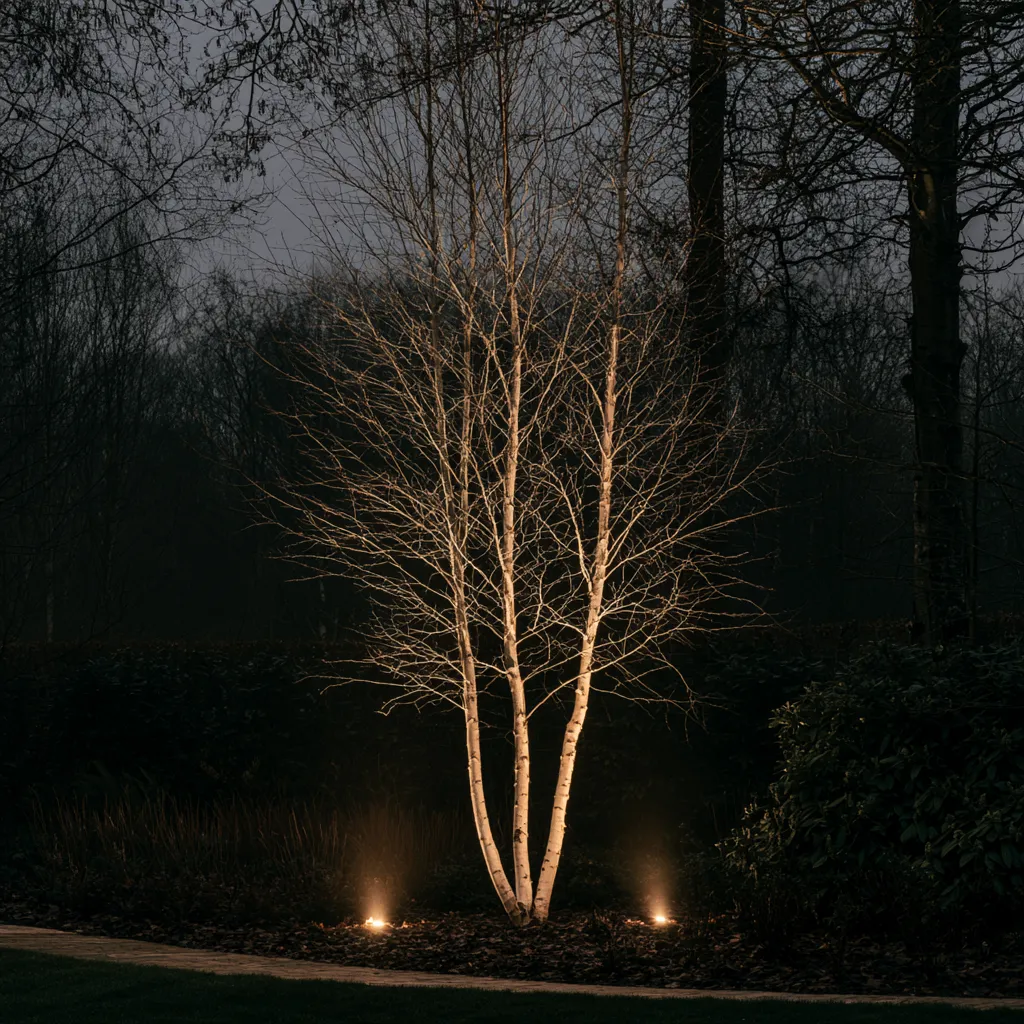
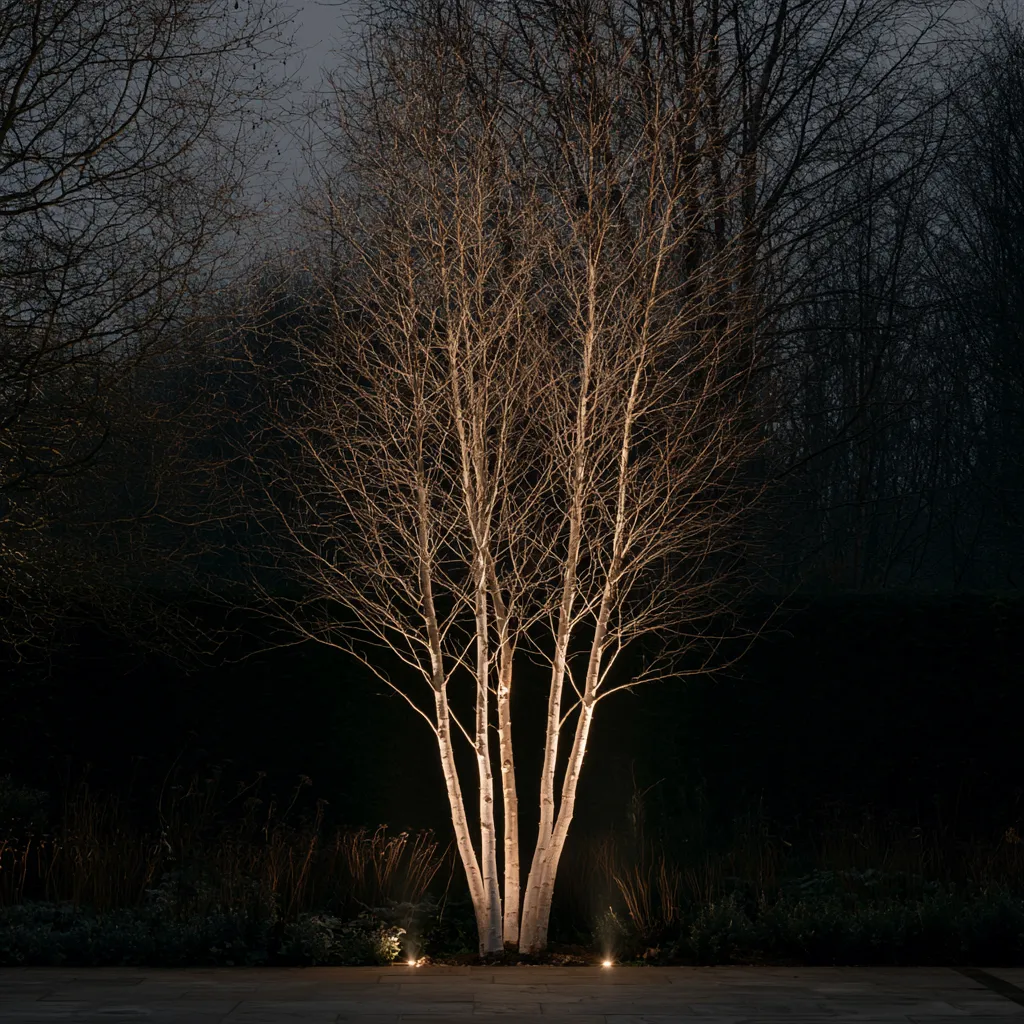
Winter — December through February — is the birch’s finest season in modern landscape terms. Leafless stems are fully revealed, providing maximum visual presence and maximum contrast against dark backdrops, overcast skies, and snow if it falls. The catkin buds that develop through winter add fine texture to the stem silhouette and extend the visual information available in the tree’s branching structure. If the garden is lit — and for any modern landscape design project where the garden is experienced at night — focused uplights at the base of multi-stem birch stems in winter produce one of the most architecturally resolved garden night-scenes available without elaborate installation.
Spring — March through May — begins with the elongation and opening of catkins in late February to March, which adds movement and a slight flush of colour to the still-white stems before leaf emergence. Fresh leaf growth in April is one of the year’s most satisfying garden moments: the young leaves of Betula utilis var. jacquemontii emerge in a clear, clean lime-green that reads as vivid against white bark and dark backdrop simultaneously. By May the canopy is fully expanded, casting dappled shade that transforms the planting conditions beneath the tree and creating the combination of light, movement, and sound (birch leaves move in the gentlest breeze) that makes the tree so compelling at this season.
Summer — June through August — is the season in which multi-stem birch is most taken for granted. The full canopy is in place, the bark is largely obscured by leaf cover, and the tree functions primarily as a shade and movement provider. But the quality of light filtered through a birch canopy — flickering, shifting, green-gold — is one of the distinctive sensory signatures of the garden at this season, and the tree’s contribution to the thermal comfort of the garden beneath it is at its highest. In gardens where sitting out in summer heat is a primary use, a multi-stem birch positioned to cast shade over a seating area from midday onwards provides cooling that static shade sails or pergolas cannot replicate with the same aesthetic result.
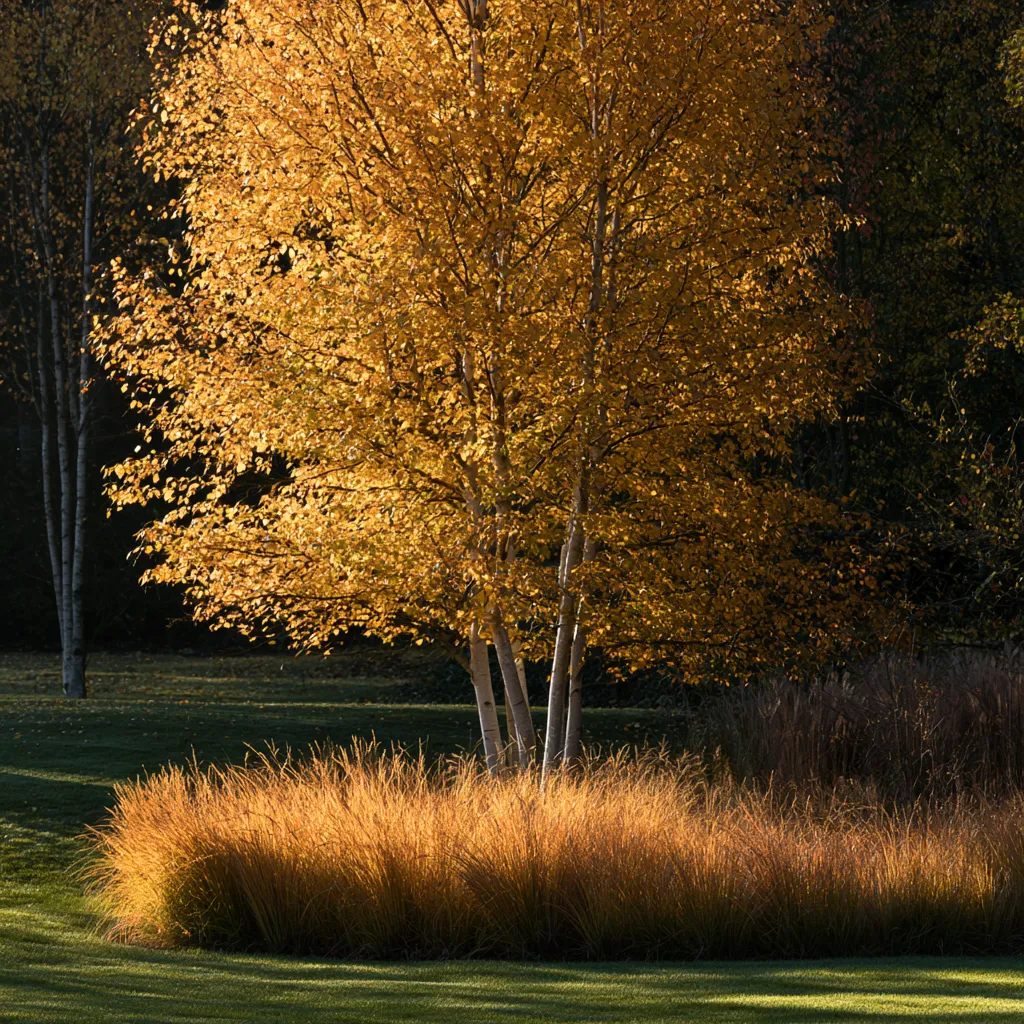
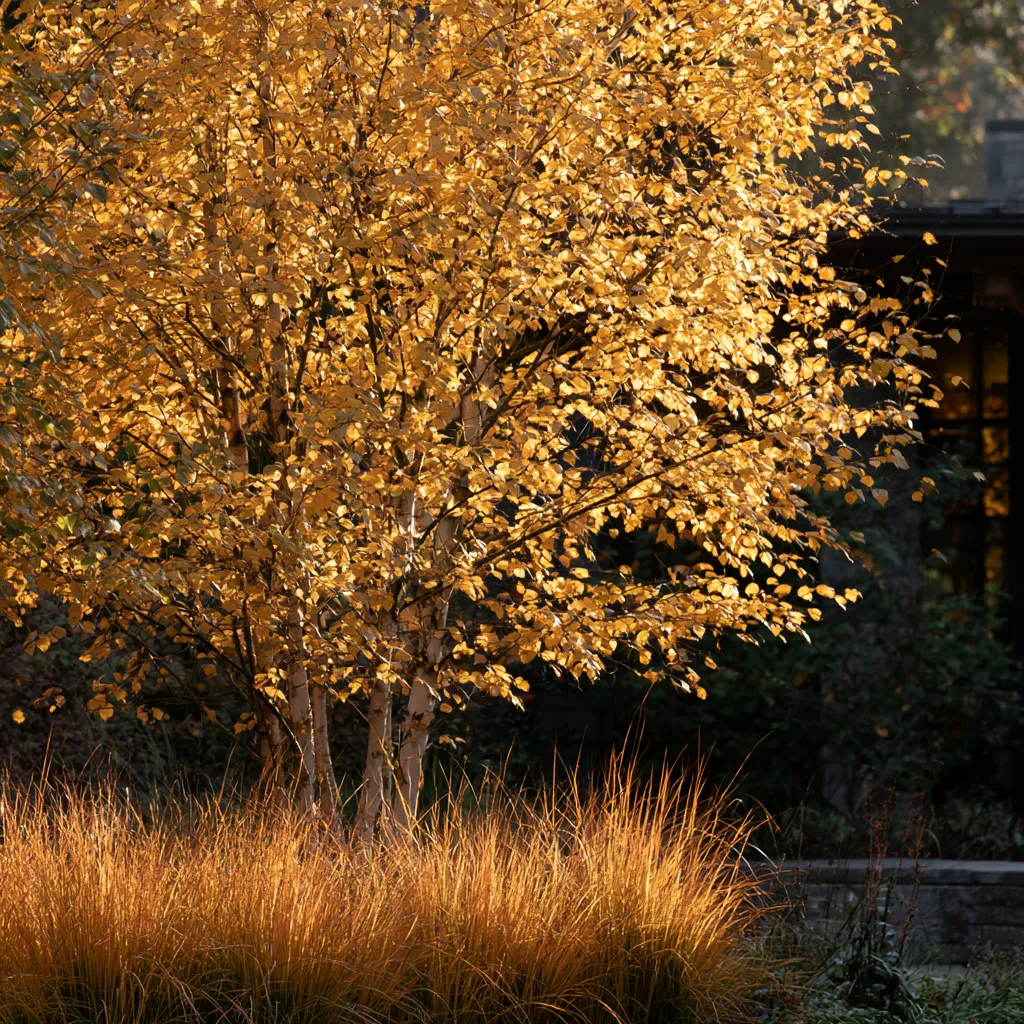
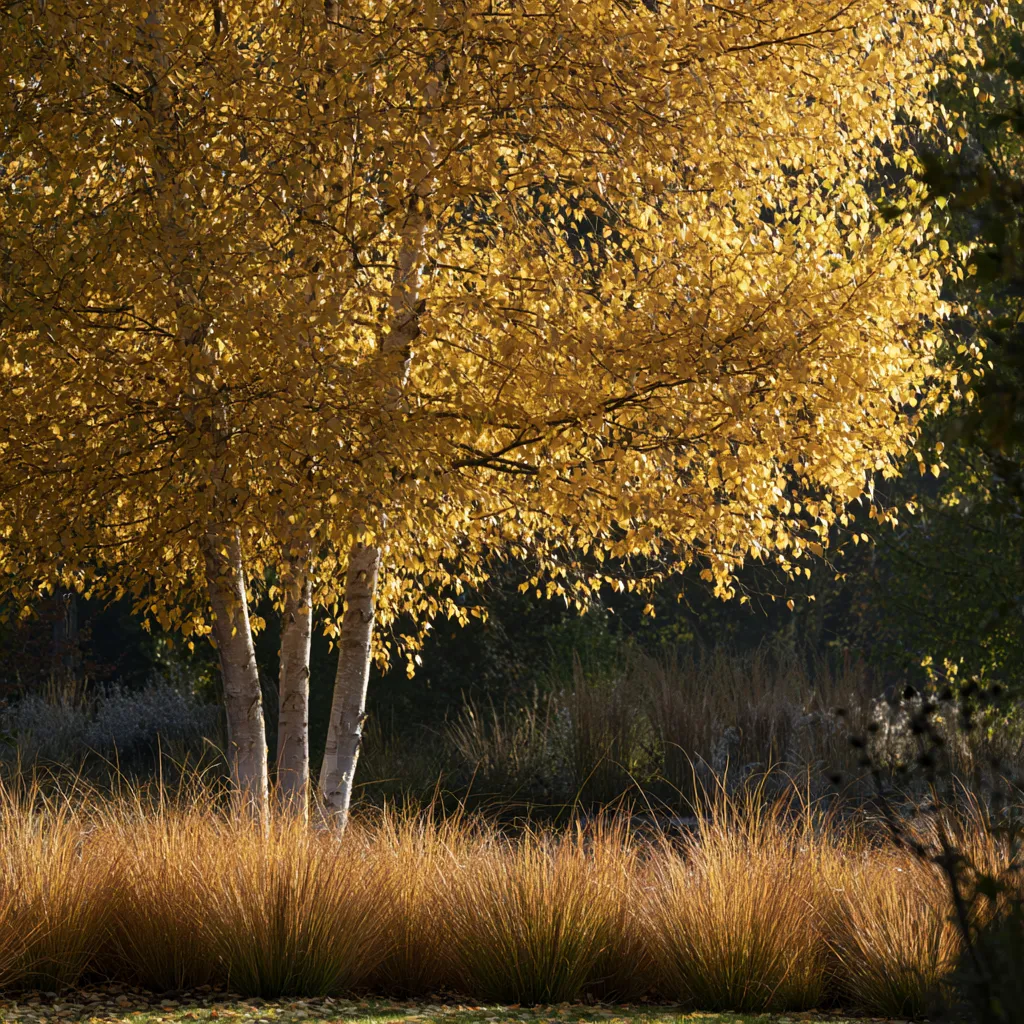
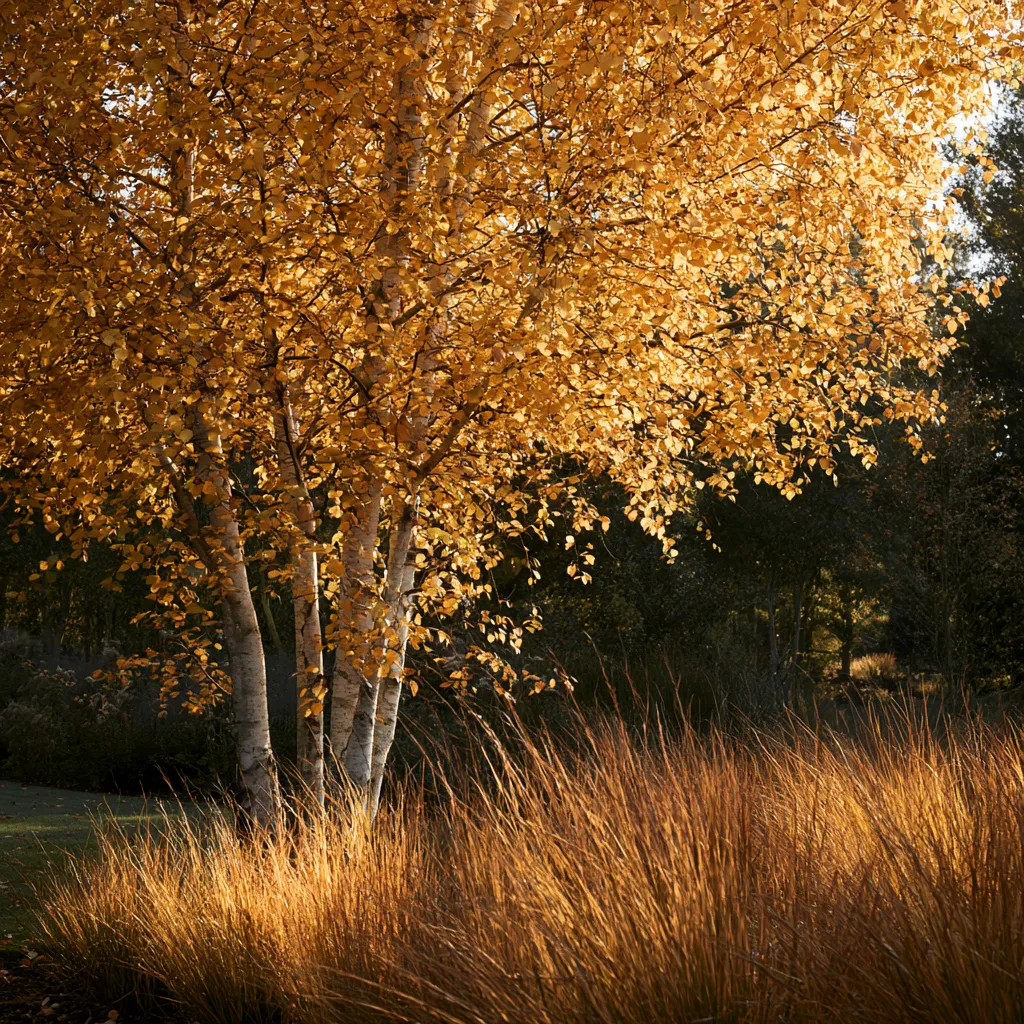
Autumn — September through November — brings the birch’s second peak visual moment: leaf colouring in clear yellow-gold, often developing first at the outer canopy edges and moving inward over two to three weeks before leaf drop. The yellow against white bark in October morning light is a combination that photographs better than almost any other autumn garden moment. The leaf drop itself is clean and rapid — birch leaves decompose quickly and require less management than the persistent or leathery leaves of many other garden trees.
Planting and Establishment — Multi-Stem Birch Tree Garden Design Practice
Successful establishment of a multi-stem birch in modern landscape garden design depends on five practical factors: planting season, root ball preparation, soil condition, staking, and watering in the first two growing seasons. Each of these factors is straightforward in principle but frequently executed incorrectly, leading to establishment failure or slow establishment that delays the tree’s impact by two to three years beyond what correctly planted specimens achieve.
Planting season for multi-stem birch is more significant than for most garden trees. Birch is one of the earliest trees to begin root activity in spring and one of the most sensitive to disturbance during active growth. Bare-root and root-balled specimens should be planted between late October and late February — the dormant season — for maximum establishment success. Container-grown specimens can be planted at any time of year but will establish most reliably if planted before June or after mid-September, avoiding the peak summer water demand period before the root system is established in the new soil. Nursery surveys consistently find that autumn-planted birch specimens achieve 15–25% faster trunk caliper growth in years two and three than spring-planted equivalents of the same initial specification.
Root ball preparation is critical for specimens purchased as large semi-mature trees — the 3–4.5 metre specimens that are standard for feature tree planting in modern landscape design. These trees are typically supplied as heavy root-balled specimens wrapped in burlap, weighing 150–400 kg depending on size. The planting pit should be prepared to a depth 20 cm greater than the root ball depth and a width 50–60 cm greater than the root ball diameter, with the base of the pit broken up but not backfilled with loose material — a common error that causes the root ball to sink as the disturbed base material compacts, burying the trunk base below the original soil grade. The trunk base of a birch should sit at or marginally above the surrounding soil grade after planting, never below it.
Staking of large birch specimens requires two or three stakes driven outside the root ball perimeter with flexible ties that allow the trunk to move in the wind — this movement stimulates the development of reaction wood that creates trunk taper and structural stability over time. A rigidly staked birch that cannot move develops a caliper-to-height ratio that is structurally inadequate, and when the stake is removed — which should occur after 18–24 months — the tree may fail structurally in the first significant storm. The broader principles of correct tree care, including staking, post-planting pruning, and long-term structural assessment, are covered comprehensively in the detailed guide to the art and science of caring for trees, which provides practical guidance applicable to multi-stem birch and all other garden tree species across their full life cycle.
Watering in the first two growing seasons is the single most important establishment intervention. A multi-stem birch of 3–4 metres height requires approximately 25–40 litres of water per week during dry summer periods in the first year, and 15–25 litres per week in the second year. This volume is impractical to deliver effectively through hand watering alone and should be provided through a slow-release drip system positioned at the root ball perimeter — either a permanent drip line or a temporary leaky-pipe ring removed after year two. Trees that receive inadequate water in their first summer typically survive but develop leaf scorch, premature leaf drop, and reduced root development that sets establishment back by a full growing season.
Multi-Stem Birch Tree Lighting in Modern Landscape Design
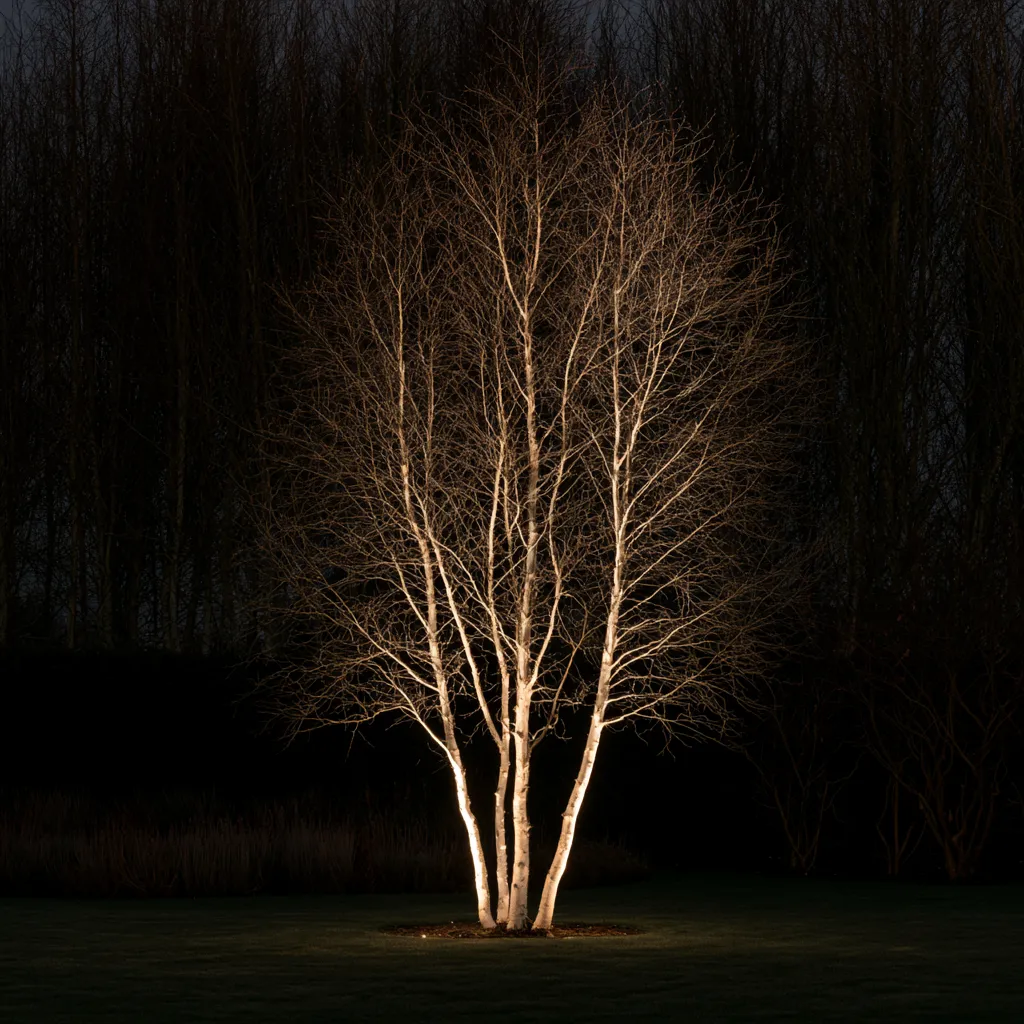
Garden lighting transforms multi-stem birch from a daytime feature to a 24-hour architectural element — and the specific visual properties of the species make it arguably the most rewarding tree in residential landscape design for artificial lighting. The white bark acts as a natural reflector: a single focused uplight positioned at the base of a multi-stem specimen can illuminate the full height of the stem cluster with a fraction of the power required to achieve comparable effect on a grey or brown-barked tree.
The standard lighting specification for multi-stem birch in modern landscape design uses one or two 3–6 watt LED uplights (depending on tree size and stem spacing) positioned at the outer edge of the root ball perimeter — not immediately at the trunk base, which creates an unflattering upward wash that flattens the three-dimensional quality of the multi-stem form. Positioning the uplight 40–60 cm from the nearest stem, angled at 15–20 degrees from vertical, creates a raking effect that emphasises the three-dimensional quality of the bark texture and casts shadows through the stem cluster that reveal the depth and complexity of the multi-stem form. A colour temperature of 2700–3000 Kelvin (warm white) coordinates with the amber and cream undertones in birch bark and reads as more natural than cooler white sources, which can make the bark appear blue-tinged in conditions of high colour rendering.
In winter, when the canopy is absent, uplighting a multi-stem birch creates one of the most striking and frequently reproduced images in modern residential landscape design: a cluster of glowing white stems against a dark sky, the branching silhouette extending above the light zone into darkness. This is the image that makes the multi-stem birch in a modern landscape look complete in December — and it is the image that no other commonly available garden tree produces with equivalent ease. For gardens where the tree is the primary architectural feature and the overall landscape design is organised around it as a year-round focal point, lighting the birch is as important a design decision as selecting the tree itself.
Multi-Stem Birch Tree Garden Design as a Long-Term Landscape Investment
A multi-stem birch specimen of 3–4 metres height at planting, correctly sited and established, will reach 5–6 metres and full visual maturity within 7–10 years of planting. At 15–20 years, it will be a garden presence of genuine significance — the kind of tree that becomes an inseparable part of the property’s identity and, crucially, a material contributor to its value. Research from Savills and Knight Frank, the UK residential property consultancies, has consistently found that gardens with established specimen trees command a 5–15% premium over equivalent properties without tree presence, with multi-stem specimens in front gardens identified specifically as positive valuation indicators in buyer preference surveys.
The initial investment for a quality multi-stem Betula utilis var. jacquemontii specimen at 3–4 metres height — the standard specification for modern landscape feature tree planting — runs from approximately £350–£850 at UK specialist nursery pricing (Barcham Trees, Hillier Nurseries, Chevithorne Barton), or $420–$1,020 at comparable US specialist nursery pricing. At 4–4.5 metres height, the range rises to £750–£1,800 depending on stem number, caliper, and root ball size. These figures represent the plant cost only; installation, including planting pit preparation, staking, tie materials, initial irrigation, and mulching, typically adds 30–50% to the total installation cost for professional landscape contractor supply-and-plant projects.
For homeowners who specify their own garden trees, the lower cost of purchasing a smaller 1.5–2 metre multi-stem specimen and allowing it to establish over a longer period is a genuine alternative — a well-grown small specimen planted correctly will overtake a larger but less-well-established specimen within three to four years. The discipline of specifying correctly, planting correctly, and then waiting patiently is the quality that distinguishes the best long-term garden design outcomes from those that look impressive immediately but disappoint over time. The principles that govern good long-term residential garden design — including the role of specimen trees as structural anchors for the wider planting scheme — are explored in the context of contemporary garden design for modern homes, where the relationship between architecture, long-term planting, and the evolving character of a garden over time is developed as a design philosophy as much as a set of practical recommendations.
The multi-stem birch tree in modern landscape garden design is, ultimately, one of the most reliable answers available to the question that every garden design must answer: what, in this space, will still look right in twenty years? The answer is almost always something alive — something that improves with age, that earns its position through accumulated presence rather than immediate impact, and that connects the designed garden to the natural world it draws from. The white-stemmed birch, leafless in January, catching the low winter light against a dark wall, is that answer expressed with particular clarity.